Grandstream HT818 v2 8-Port FXS VoIP Gateway
The Grandstream HT818 v2 is an eight-port FXS VoIP gateway designed to connect conventional analog telephones, fax devices and other compatible two-wire analog endpoints to a SIP-based communications environment. It combines eight RJ11 FXS interfaces with two Gigabit Ethernet ports and an integrated NAT router, making it useful where an organisation wants to preserve working analog devices while moving call control to an IP PBX, hosted SIP platform or managed VoIP service. Grandstream specifies support for two SIP profiles, wideband voice codecs, T.38 fax, secure provisioning, TLS and SRTP, three-way conferencing per port and automated deployment tools.
For Dubai and UAE buyers, the main purchasing question is not simply whether the unit has eight analog ports. The more important questions are how many analog devices must be retained, whether those devices are phones or fax machines, which SIP platform will register the gateway, whether the network needs VLAN and QoS controls, how the ports will be mapped to extensions or service profiles, and how the gateway will be managed after installation. Fourteck can help scope those details before a quotation so the selected gateway matches the PBX, SIP provider, cabling and operational plan. Product availability, commercial terms, warranty conditions and regional compliance requirements should be confirmed at the time of order.
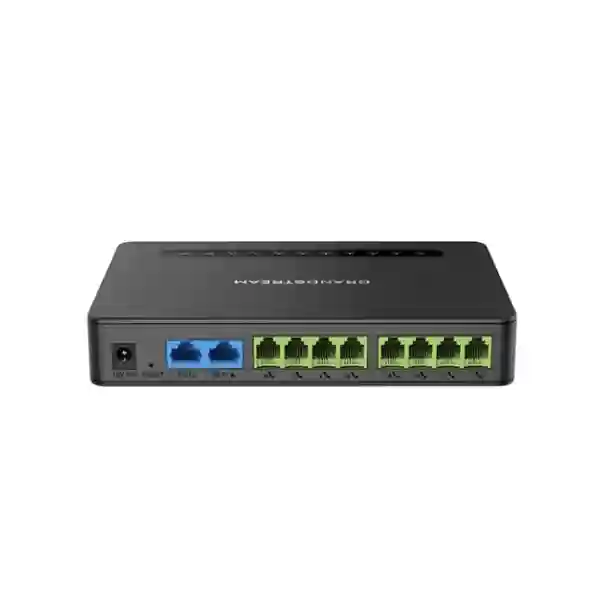
Eight RJ11 interfaces for compatible analog phones or fax devices.
Profile assignment and extension mapping should be planned against the PBX or provider.
Two 10/100/1000 Mbps RJ45 ports with integrated NAT routing capability.
T.38 Group 3 fax relay with automatic G.711 pass-through fallback where appropriate.
Start with the deployment requirement, not the port count
An eight-port gateway is often considered when a business already has a cluster of analog extensions that still perform useful functions. These may include reception phones, basic desk handsets, workshop extensions, wall phones, fax machines, lift or service-room phones, gatehouse handsets, paging interfaces or legacy analog endpoints connected through existing copper cabling. A migration to SIP does not always require replacing every endpoint on day one. A gateway can provide a controlled transition by converting analog line interfaces into SIP-connected services while allowing the organisation to modernise the PBX and network separately.
The HT818 v2 is especially relevant when five to eight analog ports are genuinely required at one physical location. If only one or two analog devices must remain, a smaller ATA may be more economical and operationally simpler. If three or four ports are needed, a four-port model can be a better fit. When the requirement is much larger, a higher-density FXS gateway can reduce the number of individual appliances that must be powered, configured and monitored. Port count should therefore be selected from the actual migration map rather than from an assumption that more ports are always better.
The second design question is what each analog port will represent in the call-control system. A port may correspond to a PBX extension, a fax identity, a shared service profile or a specific dial-plan role. The HT818 v2 supports two SIP profiles, so the relationship between the eight FXS ports and the SIP registration architecture needs to be understood before commissioning. The PBX administrator should document extension numbers, authentication requirements, codec policy, DTMF method, caller ID behaviour, emergency calling rules, outbound route permissions and any restrictions required for each analog endpoint.
A third question is whether the existing analog device itself is still appropriate. Retaining a dependable fax machine or a simple warehouse handset can be sensible. Retaining a failing phone simply because an analog gateway is available may create more support work than replacing that endpoint with a native SIP device. Fourteck therefore treats the HT818 v2 as a migration and integration component rather than a universal substitute for modern IP phones. The best design can be a mixed environment in which suitable analog devices remain on FXS ports while users who need richer call control, BLF keys, directories, headset integration or application features move to native SIP endpoints.
Verified interface and voice capabilities
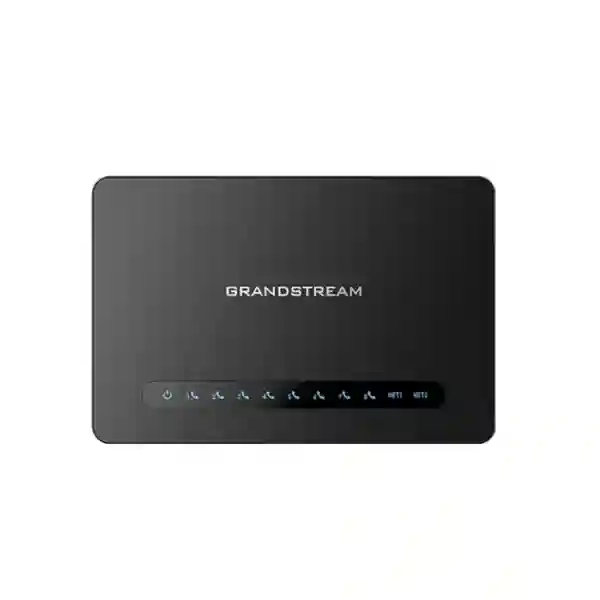
Grandstream positions the HT818 v2 as a powerful eight-port FXS gateway with a Gigabit NAT router. The current product information lists eight RJ11 FXS ports, two 10/100/1000 Mbps Ethernet ports, a reset control and front-panel indicators for power, the two network interfaces and all eight phone ports. The physical design is intended to consolidate multiple analog connections into one managed gateway rather than requiring a separate single-port adapter for every device.
| Area | Verified HT818 v2 capability | Why it matters in a project |
|---|---|---|
| Analog interfaces | Eight RJ11 FXS ports | Supports a concentrated group of compatible analog endpoints at one site. |
| Network interfaces | Two Gigabit Ethernet ports | Useful for routed or switched network designs and for preserving Gigabit connectivity around the gateway. |
| SIP profiles | Two SIP profiles across the gateway | Requires deliberate profile, extension and dial-plan mapping during PBX integration. |
| Conferencing | Three-way voice conferencing per port | Provides common business call handling without requiring an IP phone at the analog endpoint. |
| Fax | T.38 fax relay up to 14.4 kbps with G.711 pass-through fallback | Gives administrators more than one method to integrate compatible fax workflows over IP. |
| Security | TLS, SRTP and AES-secured provisioning capabilities | Supports a stronger deployment baseline when the PBX, provisioning platform and policy are configured to use them. |
| Management | Web management, syslog, SSH, TR-069, configuration-file provisioning and Grandstream management options | Helps service providers and IT teams standardise configuration, monitoring and maintenance. |
The voice codec list in Grandstream documentation includes G.711, G.722, G.723.1, G.729A/B, G.726-32, iLBC and Opus, together with jitter-buffer and echo-cancellation functions. Codec availability is useful, but a deployment should normally use a deliberate codec policy rather than enabling every option without reason. The selected codec must be supported by the PBX or SIP service and should reflect available bandwidth, interoperability requirements and voice-quality objectives. Wideband codecs can improve perceived clarity when the full call path supports wideband audio, while interoperability with older trunks or devices may require a more conservative selection.
Grandstream also lists caller-ID support for multiple formats, DTMF and pulse dial methods, several disconnection methods, and common telephony functions such as call waiting, hold, blind or attended transfer, forwarding, do-not-disturb and caller-ID display or blocking. These capabilities make the gateway more than a basic electrical converter, but the user experience still depends on the connected analog phone and on what the PBX allows. An analog handset without feature keys cannot suddenly behave like an executive IP phone, so the project should distinguish between gateway functionality and endpoint ergonomics.
How the eight FXS ports fit into a SIP architecture
FXS is the analog subscriber-side interface that provides the line connection used by a conventional analog telephone or compatible fax machine. In practical terms, the analog device plugs into an HT818 v2 phone port with an RJ11 cable, while the gateway uses Ethernet to communicate with the IP network and SIP call-control platform. The gateway handles the transition between analog signalling at the endpoint side and SIP/RTP communication on the IP side.
This architecture is useful when the physical location already has analog endpoint wiring but the organisation wants the central PBX to be IP-based. A small hotel back office may have analog utility phones distributed to non-guest areas. A school can have basic phones in service rooms. A warehouse may have rugged analog handsets positioned where advanced displays are unnecessary. An industrial or commercial site may also retain fax devices or other approved analog telephony equipment. In each case, the gateway sits at the boundary between the analog endpoint layer and the SIP network.
The PBX remains responsible for the broader communications policy. Extension numbering, trunk selection, time conditions, call queues, business-hours routing, outbound restrictions, voicemail, call recording and enterprise directory functions are typically controlled centrally rather than by the FXS gateway alone. The HT818 v2 should therefore be documented as part of the overall voice architecture. A commissioning sheet should show the gateway network address, the network port role, VLAN details if used, each FXS port, the extension or service mapped to that port, the SIP profile assignment, the intended caller ID behaviour and the analog device type connected.
Grandstream states that the HT81x v2 family can be used with Grandstream UCM IP PBXs for zero-configuration provisioning. This can simplify deployments built around the same vendor ecosystem, but organisations using other SIP platforms can still integrate the gateway through standards-based SIP configuration when supported by both sides. Compatibility should be confirmed for the exact PBX version, SIP service, feature set and security policy. A successful registration test is not the same as complete interoperability validation; the commissioning process should also verify inbound calls, outbound calls, caller ID, DTMF, transfers, hold, fax behaviour where used, failover logic and any business-specific dial-plan rules.
For hosted SIP deployments, the network edge deserves additional attention. NAT behaviour, SIP ALG, firewall policy, DNS, time synchronisation, TLS certificate handling and RTP reachability can affect call reliability. Because the HT818 v2 includes a NAT router, the administrator should decide whether that routing function is actually required or whether the gateway should simply operate within an established managed LAN design. Adding a second routing layer without planning can create avoidable troubleshooting complexity. In structured business networks, the simpler topology is often the one that makes addressing, QoS and fault isolation easiest to understand.
Dual Gigabit Ethernet and routing: useful capability, but plan the topology
The HT818 v2 provides two 10/100/1000 Mbps Ethernet interfaces. Grandstream documentation for the HT81x v2 family identifies the default roles as NET1 operating as the WAN-side DHCP client and NET2 operating as the LAN-side DHCP server, with role changes available in the web interface. The integrated router can be valuable in compact deployments, but it should not automatically replace a business firewall or managed edge design. Its presence gives the installer options; it does not remove the need for network architecture.
In a straightforward office deployment, the gateway can be connected to an existing managed switch on a voice or communications VLAN and receive addressing according to the site standard. This usually provides the clearest operational model because switching, DHCP, routing, access policy and monitoring remain under the existing network team. In a smaller branch, lab or service-provider arrangement, the integrated NAT function may be part of the intended topology. The correct choice depends on who owns the network, what failure domains are acceptable and whether the gateway must provide downstream connectivity to another Ethernet device.
The platform supports Layer 2 and Layer 3 quality-of-service mechanisms listed by Grandstream, including 802.1Q VLAN functions, 802.1p tagging and IP-layer traffic prioritisation methods. Voice quality is still an end-to-end property. Marking packets at the gateway does not guarantee low latency if the switch, firewall, WAN or service-provider path ignores those markings or is congested. A production rollout should therefore confirm VLAN membership, switch-port configuration, uplink capacity, WAN contention, RTP path and firewall behaviour. Where voice is business critical, monitoring should focus on latency, jitter, packet loss and registration stability rather than only link speed.
DNS and NTP also matter more than they appear. SIP environments often depend on names rather than fixed IP addresses, while security and event logs rely on accurate time. A gateway with incorrect DNS settings may fail to reach a provider even when basic IP connectivity works. A device with incorrect time may create confusing log sequences or certificate-related problems. The commissioning checklist should therefore include successful DNS resolution, time synchronisation and reachability of any provisioning or management services.
For remote branches, the WAN design should also consider failover. Grandstream documentation notes support for a failover SIP server so the gateway can switch to a secondary server if the primary server connection is lost. That feature is valuable only when the wider design supports it. A secondary SIP server cannot help if the branch has a single failed Internet circuit and no alternate path. Conversely, a dual-WAN firewall is of limited value if the voice platform itself has no resilient registration or routing architecture. Treat gateway failover, WAN failover and PBX resilience as separate layers that need to work together.
Fax over IP: what the HT818 v2 supports and what still needs testing
Fax remains one of the strongest reasons organisations keep analog interfaces during a voice migration. Grandstream specifies T.38 Group 3 fax relay up to 14.4 kbps for the HT818 v2 and an automatic switch to G.711 fax pass-through when required. That gives the gateway two recognised approaches for carrying fax traffic over an IP environment, but successful faxing is dependent on the full call path rather than the ATA alone.
The PBX, SIP trunk or hosted provider, codec policy, network quality and remote fax endpoint all influence results. If the upstream provider does not support T.38 in the required path, enabling it on the gateway cannot guarantee a T.38 session. If G.711 pass-through is used, packet loss and jitter may have a greater impact because the original modem tones are carried through the audio path. The deployment should therefore be tested with the actual provider and destination patterns that the business uses, not only with a single local test number.
A practical fax test plan should include outbound and inbound documents, different page counts, repeated attempts and the destinations that matter to the organisation. It should also record whether the call negotiated T.38 or remained in an audio pass-through mode. Where compliance or business process depends on reliable document delivery, the organisation should compare analog-over-VoIP fax with alternatives such as a managed digital fax service. The presence of T.38 support makes the HT818 v2 a credible component for fax integration, but it should not be treated as a promise that every public-network fax route will behave identically.
For mixed use, document the fax-designated FXS ports separately from voice ports. Their codec, echo, jitter and call-routing requirements may differ from ordinary phone extensions. Avoid changing fax settings globally simply to resolve one destination without understanding the effect on the other ports. A controlled configuration backup before changes, followed by repeatable test results, makes later troubleshooting much easier for the support team.
Security and provisioning for multi-device operations
Grandstream lists TLS and SRTP support for protecting signalling and media when the SIP environment is configured to use them, along with AES-secured provisioning and a security certificate per unit. The HT818 v2 also supports provisioning and management mechanisms that include HTTPS, TFTP, SSH, TR-069, configuration files, syslog and browser-based administration. These capabilities are particularly important for managed service providers and organisations that may deploy multiple gateways across branches.
A secure installation should begin with administrative access, not just SIP registration. The administrator should use the device-specific management credentials supplied with the unit, restrict management exposure to trusted networks, prefer encrypted management methods where supported, disable services that are not required by the operational model, and keep a controlled record of configuration ownership. The gateway should not be exposed directly to the public Internet simply because it has a web interface. Management access should follow the organisation’s network-security policy.
Provisioning is another area where scale changes the design. Manually entering settings into one gateway may be manageable. Repeating the same task across dozens of locations increases the risk of inconsistent codecs, passwords, server addresses, dial plans and firmware settings. Automated provisioning allows a standard baseline to be defined and applied more consistently. The baseline can include network parameters, SIP profile settings, security preferences, syslog targets and approved feature options, while location-specific variables are applied separately.
Grandstream Device Management System is presented by the manufacturer as a central platform for provisioning, management, monitoring and troubleshooting of supported Grandstream products. For an organisation already using GDMS, adding HT-series devices to that operational model can reduce the number of standalone configuration processes. Enterprises with their own provisioning systems may instead use supported configuration-file or TR-069 workflows. The right choice depends on organisational ownership, security requirements, number of devices and whether the voice platform is managed internally or by a service provider.
Firmware governance should also be deliberate. Grandstream publishes firmware and release information for the HT8xx v2 family and warns that certain upgrades introduce downgrade restrictions. That makes change control important. Before a production firmware change, review the applicable release notes, confirm the model, back up the configuration, understand the rollback limitations and test critical functions in a representative environment. A gateway servicing multiple analog lines can affect several users simultaneously, so upgrading without a maintenance plan is not ideal.
Logging completes the operational picture. Syslog and device status information can help identify registration failures, network changes and configuration events. Logs are most useful when the device clock is correct and when the support team knows the expected normal state. A simple support sheet should record the gateway model, serial number, hardware and firmware state, IP address, PBX or provider, SIP server addresses, port-to-extension mapping and the location of the approved configuration backup. This turns troubleshooting from guesswork into a repeatable process.
Where the HT818 v2 makes practical sense in Dubai and the UAE
Dubai organisations often operate a mixture of new IP infrastructure and older analog endpoints. Office refurbishments, warehouse expansions, hospitality upgrades and PBX migrations do not always happen at the same time. In these environments, an eight-port FXS gateway can provide a practical bridge that lets the core communications platform move forward while selected analog devices remain in service. The strongest use cases are those where the analog endpoints have a clear operational purpose and are physically concentrated enough for an eight-port gateway to simplify the design.
Office migration and phased PBX replacement
An established office may have several analog phones used in reception support areas, utility rooms, records rooms or secondary desks. During a move from a legacy PBX to a SIP system, replacing every handset can increase the project scope without adding meaningful user value. The HT818 v2 can keep appropriate analog endpoints connected while primary users move to native IP phones. This approach is most effective when the migration map identifies which devices are temporary, which are intended to remain long term and which should be replaced in a later phase.
Warehouse, workshop and back-of-house communications
Warehouses and workshops can contain simple wall-mounted or desk analog phones that need only reliable extension calling and transfer capability. Where the devices are still serviceable, an FXS gateway may be more appropriate than installing feature-rich IP phones in locations that do not need screens, directories or programmable keys. The installer should check cable quality, distance and electromagnetic conditions, and should make sure the gateway is positioned in a protected location with stable power and network access.
Hospitality, serviced apartments and institutional facilities
Hotels, serviced apartments, schools, clinics and institutional buildings can have dispersed telephony functions that are not all suited to the same endpoint type. Some rooms or service areas may retain analog phones while administrative users require modern SIP handsets. A gateway can support a hybrid design, but the project must consider whether eight ports at one physical distribution point align with the actual cabling layout. If analog extensions are spread across distant risers or buildings, a different distribution strategy may be easier to maintain.
Fax and legacy workflow retention
Some UAE businesses continue to receive or send fax documents for specific external workflows. The HT818 v2 provides T.38 capability and G.711 pass-through support for compatible fax integration. The deployment should still be validated end to end and should not assume that a fax machine that worked on a direct PSTN line will behave identically through every SIP provider. For organisations where fax is occasional rather than operationally critical, a digital fax service may be worth comparing before preserving dedicated analog hardware.
Branch standardisation
A multi-site organisation may use the HT818 v2 as a standard gateway type for branches that have a similar number of analog requirements. Standardisation can simplify spares, configuration templates, monitoring and staff training. It should not force the same model into every site, however. A branch with only one analog line should not receive an eight-port gateway merely to match another location. Standardise the configuration approach and documentation first, then choose the port density that fits each site.
HT818 v2 or a smaller ATA? Use a port-density decision
Within the Grandstream HT81x v2 family, the port count is one of the clearest selection differences. The HT812 v2 provides two FXS ports, the HT814 v2 provides four, and the HT818 v2 provides eight. All three are positioned as analog-to-VoIP devices with dual Gigabit networking in the v2 family, while the eight-port model is intended for sites that need the highest FXS density among these three devices. Selecting the right model is usually a matter of counting real analog requirements and allowing sensible but not excessive room for expansion.
| Requirement | Likely direction | Reasoning |
|---|---|---|
| One or two analog devices | Evaluate a lower-port ATA | Reduces unused capacity, footprint and configuration surface when growth is unlikely. |
| Three or four analog devices | Evaluate a four-port design | Keeps the appliance aligned to the actual number of analog endpoints. |
| Five to eight analog devices at one location | HT818 v2 becomes a strong fit | Consolidates the analog interfaces into one gateway and simplifies power and management compared with several small ATAs. |
| More than eight analog devices | Compare higher-density FXS gateways | A larger gateway family may be easier to manage than multiple eight-port units. |
| Most users need display, BLF, directories or headsets | Consider native SIP phones | An ATA preserves analog endpoints; it does not provide the richer user interface of a business IP phone. |
Spare capacity should be intentional. Buying eight ports for six required devices can be sensible when the site is expected to add one or two analog endpoints. Buying eight ports for a single fax machine without a growth plan is usually less compelling. At the other extreme, deploying several HT818 v2 units for a very high-density analog estate may work technically, but a dedicated high-density FXS gateway can simplify rack space, configuration and port management. Fourteck can compare the port-density options after receiving an endpoint inventory.
The decision should also consider network design and support ownership. If the organisation already standardises on Grandstream management and UCM systems, an HT81x v2 gateway may fit naturally into the operating model. If the environment uses a different PBX or provider, standards-based SIP compatibility should be tested against the required functions. Model selection is therefore a combination of analog port count, SIP integration, management method and lifecycle strategy rather than a specification comparison alone.
Installation and commissioning workflow
A reliable HT818 v2 deployment is easier when the configuration is treated as a small infrastructure project rather than a plug-and-forget task. The following sequence gives the installer a practical framework. Exact values depend on the PBX, SIP service, network policy and connected analog equipment.
- Inventory the analog endpoints. Record each phone, fax machine or compatible analog device, its physical location, current extension or public identity, cable path and whether it must remain after the migration. Remove obsolete ports from the design rather than automatically recreating every legacy line.
- Confirm the call-control platform. Identify the IP PBX, hosted SIP service or provider that will register the gateway. Document server addresses, transport requirements, authentication method, codec policy, DTMF method and any provider-specific NAT guidance.
- Choose the network topology. Decide whether the gateway will sit on an existing LAN or voice VLAN, whether its integrated routing capability is required, how it will obtain an IP address and which management networks are allowed to reach it.
- Update and baseline the device carefully. Check the current Grandstream firmware guidance, review release notes and downgrade restrictions, create a configuration backup and apply only an approved release according to the organisation’s change process.
- Configure SIP profiles and FXS mapping. Map the required ports to the correct extension or service logic. Apply dial-plan rules, caller-ID behaviour, call features and security settings in a documented and repeatable way.
- Validate network services. Test IP connectivity, DNS, time synchronisation, access to the SIP servers, management reachability and any VLAN or QoS policy. Confirm that firewall and NAT handling match the voice platform design.
- Test every analog port. Make inbound and outbound calls from each connected phone. Verify ring behaviour, caller ID, DTMF, hold, transfer and any features that users actually need. A single successful test port does not prove that the whole mapping is correct.
- Run fax-specific tests where applicable. Test actual fax destinations and note whether T.38 or G.711 pass-through is being used. Repeat tests rather than relying on a single successful page.
- Verify resilience. Where the architecture includes a secondary SIP server or alternate WAN path, test the failover behaviour under controlled conditions and confirm how the gateway recovers when the primary service returns.
- Document and hand over. Store the approved configuration backup, network address, firmware state, port-to-extension map, administrator ownership and support procedure. Label the physical FXS ports so onsite troubleshooting does not depend on trial and error.
Analog cabling, ringing load and physical planning
The IP side of the gateway receives much of the attention, but the analog side also deserves engineering discipline. Grandstream’s datasheet specifies a short/long-haul ring load of 2 REN and support for up to 1 km on 24 AWG line for the HT818 v2. These figures are useful design references, not a substitute for testing the installed cable. Cable gauge, joints, patching, environmental noise, connected devices and local wiring practices can affect results.
Where existing building cabling is being reused, identify the pair assigned to each endpoint and confirm that it is electrically isolated from any live legacy PBX or PSTN feed before connecting it to the FXS gateway. An FXS port supplies analog line conditions and should not be connected blindly to another powered line source. Migration work should be performed by personnel who understand both the old telephone wiring and the new SIP design.
Physical placement should balance network access, analog cable reach, cooling, protection and serviceability. A gateway hidden above a ceiling may shorten analog cable runs but make maintenance difficult. A gateway in a communications cabinet can be easier to manage, provided the analog pairs are correctly presented and labelled. Stable power is also important because all eight analog ports depend on the same appliance. If the voice service needs to remain available during short utility interruptions, consider the gateway, network switch, firewall, PBX and access circuit together when designing UPS coverage.
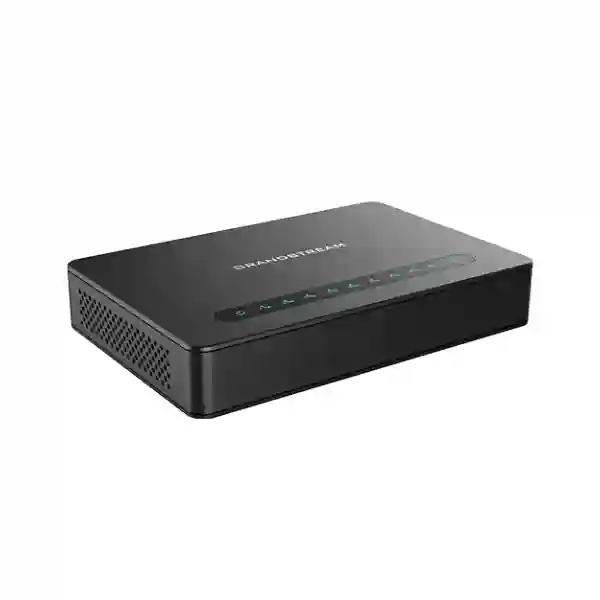
The HT818 v2 has a compact desktop-style form factor, but dense analog cabling can become untidy quickly. Use a clear numbering system that matches the configuration sheet. Label each RJ11 connection and the corresponding building cable. Avoid routing analog and power cables in ways that create unnecessary interference or make future tracing difficult. Good labelling is a low-cost improvement that can save significant time when one of eight lines later needs investigation.
Procurement checklist before requesting a quotation
A useful quotation request gives enough technical context to avoid supplying the wrong gateway or creating unexpected installation work. Buyers do not need to provide a complete engineering design, but the following information helps Fourteck evaluate fit and identify questions early.
- Number and type of analog endpoints to be retained, including how many are phones and how many are fax devices.
- Existing PBX or new SIP platform, including vendor and version when known.
- Hosted SIP provider or trunk provider, if the gateway will register or route through an external service.
- Site location and whether the project is in Dubai, Abu Dhabi, Sharjah, Ajman or another UAE emirate.
- Network information such as available switch ports, VLAN policy, PoE expectations and whether the gateway’s integrated routing function is intended to be used.
- Extension plan and whether individual FXS ports need separate internal numbers, direct-dial numbers or special outbound restrictions.
- Fax requirements, typical destinations and whether the current SIP provider supports T.38.
- Required services such as installation, configuration, onsite commissioning, remote setup assistance, PBX integration or post-installation support.
- Project quantity, rollout schedule and whether several UAE or regional sites require a standard configuration template.
- Any mandatory security, compliance, logging or change-control requirements that must be reflected in the deployment.
Commercial availability can change, so Fourteck should confirm stock status, lead time, warranty terms and the exact supply scope at quotation stage. The page intentionally does not publish a fabricated price or availability claim. For project purchasing, quantity, accessories, engineering services and delivery location can all influence the final commercial proposal.
When retaining analog endpoints is the right choice — and when it is not
An ATA is valuable when it protects a useful investment. If an analog phone is reliable, easy for the user, located in a low-feature environment and already wired correctly, converting it to SIP through an FXS gateway can be a sensible migration choice. The same is true for selected fax machines or specialised analog telephony endpoints that are difficult or unnecessary to replace immediately. The gateway lets the organisation modernise the call-control layer while scheduling endpoint replacement according to business priorities.
However, the case changes when users need features that depend on a modern SIP endpoint. Receptionists may need many BLF keys, managers may require a richer directory, service teams may need headsets and soft keys, and remote workers may benefit from Wi-Fi or cordless devices. In those roles, preserving a basic analog phone can limit usability even if the gateway functions perfectly. A native IP phone can provide better access to PBX features and may reduce the amount of analog wiring that must be maintained.
Fourteck therefore recommends an endpoint-role review during migration. Separate devices into three groups: analog devices worth retaining, analog devices that should be replaced now, and devices that can remain temporarily but have a planned replacement date. This prevents the gateway from becoming a permanent repository for obsolete equipment simply because the original project aimed to minimise change.
If the decision is to move selected users to native SIP phones, related Fourteck product pages can help with endpoint research. Examples already available on this site include the Grandstream GXP2130 v2, Grandstream GXP2160, Grandstream GXP1628, Grandstream GXP1625, Grandstream DP750 for DECT deployments, and the Grandstream GHP631 for hospitality-oriented use cases. These are not direct substitutes for the HT818 v2; they illustrate the different endpoint paths available when analog retention is no longer the best operational choice.
Multi-site and regional deployment considerations
A gateway project can begin in Dubai and later expand to other UAE or regional locations. The best way to scale is to standardise design rules rather than blindly duplicate one configuration. Each branch should have a consistent naming convention, management method, firmware policy, configuration backup process, logging destination and port-mapping format. Site-specific values such as extension numbers, network addresses and SIP credentials can then be applied within that framework.
For Abu Dhabi and larger enterprise sites, voice services may sit within tightly controlled VLAN, firewall and change-management policies. For Sharjah, Ajman or distributed commercial branches, the challenge may be maintaining consistent settings across smaller locations with limited onsite IT staff. In both cases, remote provisioning and management can be valuable, but secure access and clear configuration ownership remain essential. A service provider should be able to explain which settings it controls and which remain the customer’s responsibility.
For organisations with operations outside the UAE, telecom regulation, electrical requirements, service-provider compatibility and product availability can differ by country. Fourteck’s regional network can support broader project discussions through Fourteck UAE, Fourteck global services, Fourteck Africa, Fourteck Uganda, Fourteck Kenya, Fourteck Tanzania, Fourteck Kuwait, Fourteck Ghana and Fourteck Nigeria. Availability and local suitability should be confirmed separately for each destination rather than inferred from a UAE deployment.
Where the gateway will be integrated with an IP PBX, the wider voice architecture may also include SIP trunks, call routing, extensions and failover design. Fourteck’s IP PBX Dubai resource can support those broader discussions. The HT818 v2 is one component in that architecture; the quality of the final solution depends on correct design across the PBX, network, SIP service, analog cabling and endpoint layer.
Technical details worth checking during design
Grandstream’s published technical information lists the protocols and management functions expected of an enterprise ATA, including SIP, RTP/RTCP, HTTP and HTTPS, DHCP, DNS, NTP, TFTP, SSH, STUN, SNMP, TR-069 and related networking functions. The device supports SIP over TCP/TLS and SRTP for secure call environments. These specifications are valuable because they show the tools available to the administrator, but not every protocol needs to be enabled in every installation. A hardened deployment should use the minimum set required by the operational model.
DTMF can be transported in audio, by RFC2833-style RTP events or through SIP INFO according to the documented feature set. The correct method is the one compatible with the PBX, trunk and applications that receive digits, such as auto attendants, voicemail systems and access services. Incorrect DTMF configuration is a common reason calls connect successfully while menu navigation fails. Include an IVR test in commissioning whenever users depend on external menus.
Caller ID compatibility should be treated in a similar way. The gateway supports several analog caller-ID formats, but the connected phone must also understand the configured format. When an older analog handset does not display the expected caller information, verify the gateway format and device compatibility before assuming the SIP provider has failed to send caller ID. Tests should cover both internal extension calls and external calls because number presentation can differ between the two paths.
The HT818 v2 also supports GR-909 line-testing functions according to Grandstream’s HT81x v2 documentation. Line testing can assist diagnosis, but physical wiring faults still require practical cable inspection and testing. A software result should be combined with knowledge of the building distribution, patching and endpoint. This is especially important where legacy copper has passed through multiple moves, cross-connects or undocumented junctions.
Grandstream’s datasheet lists a 12 V, 1.5 A output power supply requirement for the HT818 v2 and a compact enclosure approximately 180 mm by 120 mm by 36 mm with a listed weight around 356 g. These values help with cabinet planning, but the project should use the power adapter supplied or approved for the unit and verify the delivered regional power accessory. Compliance markings listed by Grandstream include FCC, CE and RCM. Regulatory suitability for the actual deployment country should still be confirmed at procurement because regional requirements can change.
For source verification and the latest manufacturer material, buyers and engineers can consult the official Grandstream HT818 v2 product page and the current Grandstream documentation for the HT81x v2 family. Product documentation and firmware guidance should take priority over copied third-party specifications if a difference is found.
Support and lifecycle planning after installation
Once the HT818 v2 is installed, day-two operations determine whether the gateway remains easy to support. The first requirement is configuration ownership. Someone should know where the current backup is stored, which PBX or provider settings are authoritative, who can approve firmware changes and which team is responsible for the analog cabling. Without that ownership, a simple handset issue can be passed repeatedly between network, telephony and facilities teams.
The second requirement is a known-good baseline. After successful commissioning, save the approved configuration and record the expected registration state of each port. If a later change causes a problem, support staff can compare the current state with the baseline rather than reconstructing the original design from memory. Where automatic provisioning is used, the provisioning template should be version controlled so that a manual local change is not silently overwritten at the next resynchronisation.
The third requirement is a maintenance strategy. Firmware updates can contain security, stability or interoperability changes, but production gateways should not be updated casually simply because a new file exists. Review the release notes, determine whether the update addresses a relevant issue, understand any downgrade restriction, test if the service is critical and schedule a maintenance period appropriate to the number of users affected. Eight FXS ports can represent eight separate business functions, so the impact of one gateway restart can be wider than it appears.
The fourth requirement is lifecycle review. During annual telephony reviews, ask whether each retained analog endpoint is still needed. A gateway deployed during a PBX migration may begin with eight active lines but later serve only two. At that stage, the organisation can decide whether to keep the spare capacity, consolidate services differently or migrate the remaining devices. Lifecycle planning prevents a transitional architecture from becoming permanent without a business reason.
Fourteck can support customers who need supply, configuration guidance, PBX integration planning, commissioning or troubleshooting for a broader SIP migration. The exact service scope should be defined in the quotation because onsite cabling work, network changes, PBX configuration and provider coordination are different tasks. A clearly defined scope gives the customer a more predictable handover and makes responsibility boundaries easier to manage.
Frequently asked questions about the Grandstream HT818 v2
How many analog devices can the HT818 v2 connect?
The HT818 v2 provides eight RJ11 FXS ports, so it can connect up to eight compatible analog line devices at the gateway. The exact application depends on the device type, analog wiring, ringing load and SIP design. Each required port should be mapped and tested individually during commissioning.
Does the HT818 v2 support Gigabit Ethernet?
Yes. Grandstream specifies two 10/100/1000 Mbps RJ45 Ethernet ports for the HT818 v2. The HT81x v2 documentation describes NET1 and NET2 roles that can be used in routed or LAN-oriented designs. The installer should choose a topology that fits the existing managed network rather than adding routing layers without a clear requirement.
Can the HT818 v2 be used with a fax machine?
Yes, the manufacturer lists T.38 Group 3 fax relay and automatic G.711 pass-through fallback. Reliable faxing still depends on the PBX, SIP provider, network quality and remote destination. A production fax workflow should be validated with the actual provider and representative destinations before the old line is retired.
How many SIP profiles does the HT818 v2 support?
Grandstream lists support for two SIP profiles with the eight FXS ports. Because profile assignment affects how the ports register and route calls, the PBX or service-provider design should be confirmed before configuration. Do not assume that the number of FXS ports is the same as the number of independent SIP profiles.
Does the HT818 v2 support secure SIP communication?
The documented feature set includes SIP over TLS and SRTP, as well as secure provisioning capabilities. Those technologies provide value only when they are configured consistently across the gateway, PBX or provider and network policy. Fourteck can review the required security method as part of an integration scope.
Can the HT818 v2 work with a Grandstream UCM IP PBX?
Yes. Grandstream’s HT81x v2 documentation states that the family can be used with Grandstream UCM series IP PBXs and supports zero-configuration provisioning in that ecosystem. The extension map, call routes, security policy and any fax requirements should still be tested as part of the complete system commissioning.
Is the HT818 v2 only for Grandstream PBXs?
No. The gateway uses standards-based SIP and can be evaluated with compatible third-party IP PBXs or hosted SIP platforms. Compatibility is not just a matter of registration, so test call handling, DTMF, caller ID, codecs, fax, security and failover functions required by the organisation before a large rollout.
Should I choose the HT818 v2 instead of an HT814 v2?
Choose by actual analog port demand. The HT814 v2 provides four FXS ports, while the HT818 v2 provides eight. A site with five to eight required analog devices may benefit from the HT818 v2, whereas a site with three or four devices can often use the smaller model. Capacity, growth and management simplicity should be considered together.
Does the HT818 v2 replace a business IP phone?
No. The HT818 v2 lets compatible analog endpoints participate in a SIP environment. It does not give a basic analog phone a colour screen, BLF keys, advanced directory interface or other physical features of a native business IP phone. Use it when retaining analog endpoints is intentional, not merely because replacement decisions have not been reviewed.
Can Fourteck supply and help configure the HT818 v2 in Dubai?
Fourteck can prepare a project quotation and discuss supply, configuration, PBX integration and commissioning requirements for Dubai and UAE deployments. Availability, lead time, warranty terms, exact service scope and regional compliance should be confirmed in the quotation rather than assumed from a web page.
Request an HT818 v2 project quotation from Fourteck
If you are planning to retain several analog phones or fax devices while moving to SIP, send Fourteck the number of analog endpoints, the PBX or hosted SIP platform, site location and any fax or installation requirements. We can use that information to confirm whether the eight-port HT818 v2 is the right density or whether a smaller or higher-density gateway would be more appropriate.
Discuss your UAE requirement with Fourteck Explore IP Phone Fourteck
Reviews
There are no reviews yet.