Grandstream GRP2604P Dubai: PoE Business IP Phone for Structured Office Deployments
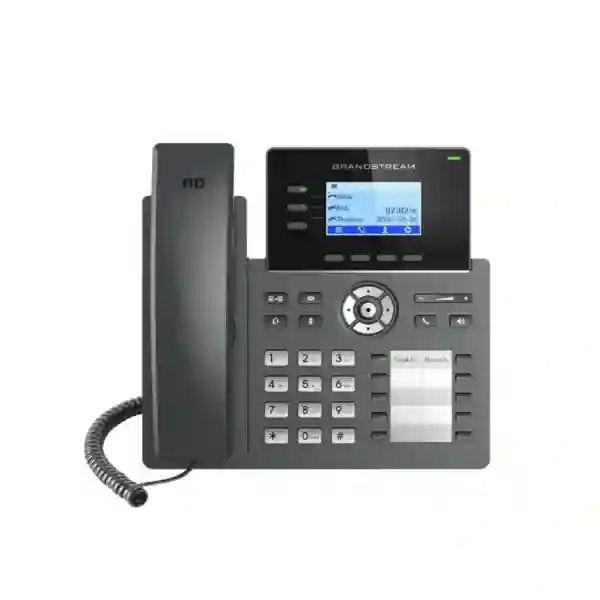
The Grandstream GRP2604P is a 3-line essential business IP phone designed for organizations that want straightforward desk calling, centralized provisioning, Gigabit Ethernet and integrated Power over Ethernet without moving into a more complex premium endpoint class. It supports six SIP accounts, up to three call appearances, ten BLF keys, five-way audio conferencing, HD audio on the handset and speakerphone, and Grandstream Device Management System (GDMS) provisioning. In a Dubai or wider UAE office where PoE switching is already part of the network design, the GRP2604P can reduce desk-side power cabling while keeping the endpoint and a connected workstation on Gigabit Ethernet.
For buyers, the key question is not simply whether this phone has PoE. The real decision is whether the combination of six SIP registrations, physical BLF/speed-dial keys, wired Gigabit connectivity, enterprise-oriented security and centralized management matches the user’s role. The GRP2604P is especially relevant for administrative staff, reception support, branch users, supervisors and general office workers who handle more than one line or need quick access to colleagues. This page approaches the model as a deployment decision rather than a feature list, so procurement teams can judge network fit, call-flow fit, PBX compatibility and rollout requirements before requesting a quotation from Fourteck.
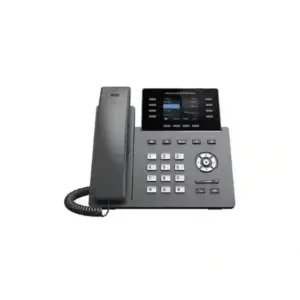
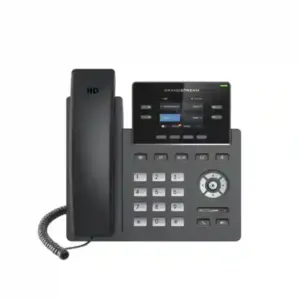
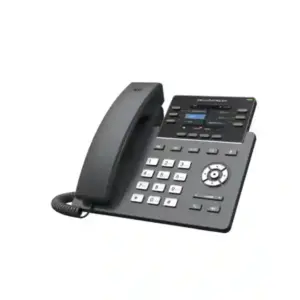
Three line keys with support for six SIP accounts and up to three call appearances.
Two auto-negotiating 10/100/1000 Mbps Ethernet ports with integrated PoE on the GRP2604P.
Physical BLF keys can support presence monitoring, speed dial and call-handling workflows depending on PBX configuration.
Centralized provisioning and management options help standardize multi-phone and multi-site deployments.
The buying decision in one minute
Choose the GRP2604P when the desk needs a wired SIP phone with PoE, Gigabit passthrough, several SIP registrations and a visible bank of BLF keys. It is a practical fit when an organization wants predictable mass deployment, centralized endpoint management and traditional physical keys instead of a touch-centric user experience. The model is not positioned as a video phone, Wi-Fi-first endpoint or executive color-screen device; its strength is efficient voice operation in a managed Ethernet environment.
| Customer requirement | GRP2604P capability | Practical value | Check before ordering |
|---|---|---|---|
| One cable for network and power | IEEE 802.3af PoE | Cleaner desk and easier centralized power planning | Confirm PoE switch budget and port availability |
| Multiple identities or extensions | Six SIP accounts | Useful for shared roles, multi-tenant or multi-line call flows | Confirm PBX licensing and account design |
| Quick colleague status / speed access | Ten BLF keys | Less menu navigation for frequent transfers or monitoring | BLF behavior depends on SIP/PBX configuration |
| Centralized rollout | GDMS, TR-069 and encrypted XML provisioning | More consistent configuration across many endpoints | Define firmware and template governance before mass rollout |
| Wired workstation behind phone | Dual Gigabit Ethernet | Can preserve Gigabit access for a connected PC in suitable designs | Validate VLAN, QoS and switching architecture |
Why the “P” variant matters: GRP2604P versus GRP2604
The essential difference is power delivery. Grandstream lists integrated PoE on the GRP2604P, while the GRP2604 is the non-PoE variant. The current Grandstream datasheet identifies dual Gigabit Ethernet on the family and specifies PoE for the P model. It also lists the universal power supply in the package for the GRP2604 rather than the GRP2604P. That distinction is important during procurement because a project based on PoE switches can standardize on network-delivered power, while a location without suitable PoE must plan its power method and accessories carefully before ordering.
Functionally, buyers should treat the two models as the same user-experience family rather than as two different capability tiers. The core call handling, display, SIP account count, BLF key count, HD audio, security approach and centralized management positioning are shared. Therefore, choosing the P version is primarily an infrastructure decision. In a new office fit-out in Dubai, Abu Dhabi or Sharjah, it often makes sense to decide the switching architecture first and then select the phone variant that matches it. In an existing office with non-PoE switching, the non-PoE model may be operationally simpler unless the network is being upgraded at the same time.
PoE also affects resilience planning. If voice endpoints are powered from a managed PoE switch connected to a suitable UPS, the organization can design backup power centrally instead of relying on many individual desk adapters. That does not automatically make the phone service resilient—PBX availability, WAN connectivity, SIP trunks, switching and routing must also remain available—but it can simplify the electrical side of a continuity design. Fourteck can review the phone requirement together with the switch, VLAN, QoS and PBX environment so the endpoint choice supports the full communications architecture rather than being treated as an isolated purchase.
Call handling: where six SIP accounts and ten BLF keys become useful
Six SIP accounts do not mean that every user needs six telephone numbers. They provide configuration flexibility. A receptionist may register a personal extension plus departmental identities; a shared desk may need separate accounts for different teams; a branch phone may register to more than one SIP service according to the customer’s design; or an organization may use multiple accounts for failover, hot-desking or service separation. Grandstream lists up to three call appearances and provides three physical line keys, so the way those accounts present to the user should be designed around the actual PBX behavior rather than around the maximum account count alone.
The ten BLF keys are one of the strongest reasons to select the GRP2604P instead of a simpler endpoint. BLF can show monitored extension status when the PBX supports the required SIP subscription behavior, and the keys can also be assigned for speed dial or other functions depending on the platform and template. In a small front desk, that can provide one-touch access to sales, accounts, warehouse and management contacts. In a support team, it can help staff see whether key colleagues are engaged before transferring a caller. In a branch office, it can place frequently used internal destinations directly on the phone.
This capability should be planned rather than simply enabled. Ten BLF labels are most useful when naming, key order and transfer conventions are standardized. If each handset is configured differently, users lose the benefit of muscle memory. For a multi-site rollout, a baseline key map can be combined with role-specific variations: reception, administration, supervisor, general user and shared desk. Central provisioning can then push consistent settings, while only the identity-specific details change per device. The result is a phone that feels simple to the user even when the underlying SIP environment is sophisticated.
Audio designed for everyday business calls
Grandstream specifies HD audio on the handset and full-duplex speakerphone, with wideband codec support that includes G.722 and Opus among the listed codecs. The GRP2604P also includes Noise Shield technology and AI noise reduction in the current datasheet. These features are useful in open offices, shared work areas and hybrid collaboration spaces where keyboard noise, nearby conversations or air-conditioning can otherwise reduce clarity.
Audio quality remains end-to-end. The SIP platform, codec negotiation, LAN congestion, WAN path, headset, microphone position and acoustic environment all influence the call. For deployments where voice quality is business-critical, configure VLANs and QoS consistently, test representative calls and validate the actual headset or speakerphone workflow used by staff.
Five-way conferencing without changing devices
The current Grandstream GRP2604/GRP2604P datasheet specifies support for five-way audio conferencing. This can be useful for quick internal discussions, escalation calls and small customer conversations without requiring users to launch a separate meeting application. It is a convenience feature rather than a replacement for a managed conferencing platform when organizations need recording, large participant counts, screen sharing, meeting control or formal collaboration workflows.
Because Grandstream documentation can be revised over time, organizations standardizing a large fleet should align on a tested firmware release and confirm the desired behavior during deployment acceptance. This is particularly important when a phone rollout includes PBX upgrades, security policy changes or new provisioning templates at the same time.
Display and physical workflow: simple, visible and key-driven
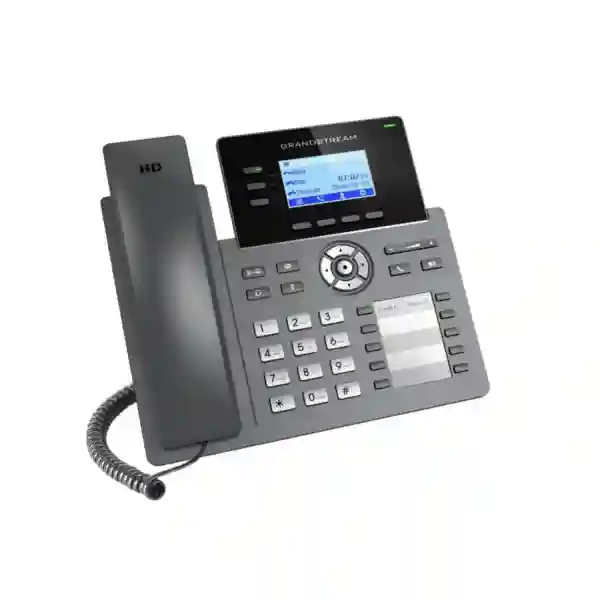
The GRP2604P uses a 2.7-inch 132 × 64 backlit graphical LCD. It is deliberately a traditional business-phone interface rather than a large color touchscreen. For many operational users, that can be an advantage: the handset, line keys, soft keys, navigation controls, dedicated function keys and physical BLF area are visible and tactile. Users who spend much of the day answering, transferring and placing calls often value predictable buttons more than application-rich screens.
Grandstream lists four XML programmable context-sensitive soft keys, five navigation/menu keys, ten BLF keys and eight dedicated function keys covering message, transfer, headset, mute, send/redial, speakerphone and volume control. This layout supports common desk-phone actions without forcing users through deeply nested menus. The phone also supports downloadable XML or LDAP phonebooks with up to 2,000 entries and a call log of up to 800 records, useful for offices that want centralized directory access and local call history.
The stand supports two angles, listed as 39° and 45°, and the phone can be wall mounted with a separately sold wall-mount bracket. Those details matter for reception counters, security desks, compact workstations and hospitality back-office locations where desk depth is limited. If wall mounting is part of the project, include the bracket and cable-routing method in the bill of materials rather than treating mounting as an afterthought.
Gigabit Ethernet and PoE: design the network before the desk
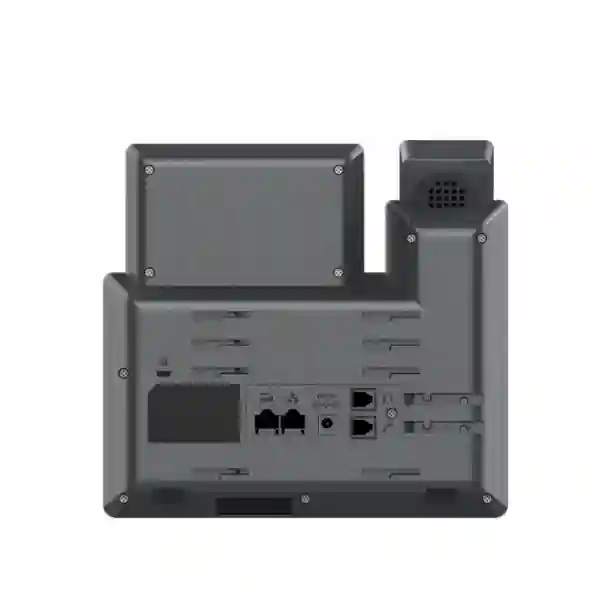
The GRP2604P has two switched auto-negotiating 10/100/1000 Mbps Ethernet ports. In a typical desk topology, one port connects to the access switch and the second can connect onward to a workstation. Gigabit capability helps avoid making the phone an unnecessary 100 Mbps bottleneck in modern offices. Whether this pass-through design is appropriate depends on the user’s data traffic, switch port strategy, VLAN design, security policies and network segmentation requirements.
Power over Ethernet is specified as IEEE 802.3af for the P model. Procurement teams should verify that the selected switch has enough PoE-enabled ports and adequate total power budget for the number of phones, alongside access points, cameras or other PoE devices sharing the same switch. Port count and PoE budget are separate constraints: a 48-port switch may have enough physical ports but insufficient power budget for all connected devices, or may reserve some ports for uplinks and infrastructure. Although a single GRP2604P has modest consumption, a large deployment should still be calculated as a system.
Voice VLANs can separate phone traffic logically from ordinary workstation data. Grandstream lists 802.1Q and 802.1P Layer 2 QoS along with Layer 3 QoS mechanisms such as ToS and DiffServ. The phone also supports LLDP-MED, which can be helpful in compatible network environments for voice endpoint discovery and policy assignment. The exact design should match the organization’s switches, DHCP, PBX and security architecture rather than relying on phone defaults.
For branch connectivity, QoS on the LAN is only part of the path. The router, firewall, SD-WAN or WAN link must preserve a sensible voice policy where needed. If traffic crosses an internet connection, organizations should also assess latency, jitter and packet loss. A high-quality endpoint cannot correct a poorly designed network, but the GRP2604P provides the networking and QoS features needed to participate in a well-designed voice environment.
PBX and SIP compatibility: evaluate the complete call platform
The GRP2604P is a SIP endpoint. Grandstream lists SIP RFC3261 alongside standard IP and voice protocols, so it is designed to register to compatible SIP services and PBX platforms. Compatibility, however, is more than successful registration. Organizations should verify the features they actually depend on: BLF subscriptions, shared call appearance, call pickup, call park, transfer behavior, voicemail indication, LDAP directory access, hot-desking, redundancy, secure signaling and media, and any platform-specific provisioning method.
For a new IP PBX deployment, the phone choice and PBX configuration should be designed together. Extension numbering, outbound caller ID, hunt groups, queues, ring groups, time conditions, emergency routing, branch dialing and failover all affect what the user experiences. For migration from an older analog or proprietary system, the project also needs to address SIP trunks, gateway requirements, number porting, switch capacity, cabling, and whether legacy devices such as fax, door phones or analog lines remain in scope.
Fourteck can use the GRP2604P as part of a larger IP telephony design rather than treating the handset as the entire solution. This is particularly relevant where a customer is choosing between on-premises IP PBX, hosted SIP, multi-site telephony or a hybrid architecture. For related system planning, buyers can also review Fourteck IP PBX resources for Dubai and the broader business IP phone portfolio.
Provisioning at scale: GDMS, TR-069 and encrypted configuration
One of the strongest reasons to use the GRP series for multi-phone deployment is centralized management. Grandstream supports the GRP2604P through GDMS, its device management system for configuration, provisioning, management and monitoring. The datasheet also lists TR-069 and AES-encrypted XML configuration as mass-provisioning options. A business with five phones may configure devices manually, but once a project grows to dozens or hundreds of endpoints, template-driven provisioning becomes significantly more valuable.
A practical rollout starts with a baseline template containing network, time, language, security, codec, dial-plan and feature settings. Role-specific templates can then define key layouts or account behavior for reception, administration, supervisor and standard users. Device-specific values such as extension credentials should be handled separately and securely. The aim is to make device replacement and expansion routine: when a handset is changed, the administrator should not have to remember dozens of manual settings from an earlier installation.
Firmware governance is equally important. Grandstream’s current documentation continues to evolve, and the October 2026 GRP260x user guide includes hardware-revision-specific firmware downgrade restrictions for certain GRP2604(P) units after particular upgrades. That is a reminder that mass firmware changes should be tested on representative hardware before broad deployment. A staged policy—lab or pilot group, departmental group, then full rollout—reduces the risk of discovering a compatibility issue across every handset at once.
For organizations with multiple branches, central management can also support consistent security and troubleshooting. Administrators can standardize approved settings, identify devices that diverge from the baseline and reduce the time spent visiting desks for routine configuration. The management platform does not replace documentation; an asset register should still track location, MAC address, user, extension, hardware revision, firmware baseline and switch port where appropriate.
Reception and administrative desks
The ten BLF keys can map the most frequently transferred departments or colleagues, while six SIP accounts provide flexibility for shared identities and departmental lines. The phone is best for a light-to-moderate reception workflow that benefits from physical keys. A very high-volume attendant may need a model or console arrangement with a larger key field, so call volume and monitored-extension count should be measured before final selection.
Branch-office users
PoE and centralized provisioning make the GRP2604P attractive where many branches need the same endpoint standard. A common template can simplify support, while Gigabit Ethernet allows a workstation to share the desk network path where policy permits. WAN resilience, SIP failover and remote management should be considered as part of the branch design.
Sales and customer service
The model fits users who make and receive frequent voice calls but do not need a touchscreen. BLF and speed-dial keys can reduce dialing friction, while HD audio and headset support help with longer conversations. Contact-center environments should additionally confirm queue integration, wallboard needs, reporting and headset ergonomics.
Hotels, schools and clinics
Back-office, administration and service desks can benefit from a standardized SIP endpoint with central provisioning. The phone may also be useful in staff areas where quick internal transfers matter. Public-facing, patient-facing or guest-room requirements can be different, so those roles should be assessed separately instead of deploying one model everywhere.
Headset workflows and EHS support
The GRP2604P provides an RJ9 headset interface and Grandstream specifies Electronic Hook Switch compatibility for Plantronics, Jabra, Sennheiser and additional compatible headsets. EHS can allow supported headset users to handle calls more conveniently without returning to the handset for every answer or disconnect action. This is valuable for reception staff, sales users, service desks and employees who type while speaking.
Headset compatibility should be validated by exact headset model, cable or EHS adapter requirements, firmware and desired functions. Brand-level compatibility does not guarantee that every headset from a vendor exposes the same controls on every phone. For a larger project, test one representative headset-phone combination before buying the full quantity. Check comfort, microphone level, ring behavior, answer/end function, mute control and any required adapter.
Organizations standardizing on Jabra or another professional headset ecosystem can use the phone as part of a consistent desk package. The deciding factor should be the user’s work pattern: an occasional caller may prefer the handset, while a receptionist or service agent can gain significant ergonomic benefit from a properly selected headset. Fourteck can include endpoint and headset compatibility review in the quotation discussion when the exact headset model is supplied.
Security: endpoint controls need to fit the network policy
Grandstream positions the GRP series with enterprise-level protection and lists secure boot, dual firmware images and encrypted data storage for the GRP2604P. The current datasheet also specifies TLS 1.3 support, HTTPS web access, SIP over TLS capabilities, SRTP options and 802.1X media access control. These features provide building blocks for a more controlled voice environment, but they must be configured consistently with the PBX, certificate strategy, switch authentication and organizational security policy.
A secure deployment should change default administrative behavior, restrict management access, use supported encrypted signaling and media where the telephony platform supports them, and avoid exposing phone administration interfaces directly to untrusted networks. VLAN segmentation can reduce unnecessary access between user devices and voice endpoints. 802.1X may be appropriate in organizations with network access control, while smaller businesses may use a simpler trusted LAN design. The correct approach depends on the existing infrastructure and operational maturity.
Provisioning credentials deserve the same care as PBX credentials. If configuration files contain account secrets, they should be delivered using protected mechanisms and access-controlled repositories. Firmware should come from approved sources, and changes should be staged. Device decommissioning should include credential removal and asset-record updates so retired handsets cannot retain active registrations or management access.
Security is therefore not a checkbox attached to the phone. It is a lifecycle process covering procurement, configuration, network onboarding, firmware maintenance, monitoring, replacement and retirement. The GRP2604P provides appropriate controls for that process, while the organization determines how rigorously those controls are implemented.
A practical network and PBX checklist before installing GRP2604P phones
- Confirm extension design. Decide how many SIP registrations each role truly needs, which account is primary, how outbound caller ID is handled and whether shared identities are required.
- Confirm PBX feature behavior. Test BLF, transfer, call pickup, park, voicemail indication, directory access, conferencing, hot-desking and failover if those functions are part of the user workflow.
- Validate PoE capacity. Count PoE ports and total switch power budget. Include other powered devices on the same access switch, not only phones.
- Define VLAN and QoS policy. Plan DHCP, LLDP-MED, 802.1Q, 802.1P and Layer 3 QoS behavior according to the switching and routing environment.
- Plan management. Choose GDMS, TR-069, encrypted XML or another approved provisioning method and document the ownership of templates and credentials.
- Standardize firmware. Review current Grandstream release notes and hardware-revision considerations, then test upgrades on representative units before mass deployment.
- Map physical keys. Define BLF and speed-dial labels by role. Avoid different layouts for every desk unless there is a real business reason.
- Check headset details. Validate the exact headset, EHS method and cable or adapter requirements before ordering a large quantity.
- Assess resilience. Consider UPS-backed PoE switching, PBX availability, WAN backup, SIP trunk redundancy and emergency calling requirements as one system.
- Document handover. Record phone location, user, extension, MAC address, firmware, switch port, template and support contact so future changes are controlled.
Dubai and UAE deployment context
A Grandstream GRP2604P Dubai deployment is often part of a broader office fit-out or telephony refresh rather than a one-for-one handset purchase. New offices in business towers and free-zone environments commonly centralize switching in structured cabinets, making PoE a natural way to power desk phones. In such projects, the phone quantity should be planned with patch panels, switch ports, VLANs, IP addressing, UPS capacity and PBX licensing from the start. This avoids a common problem where handsets arrive before the network has enough powered ports or before the extension plan is finalized.
For existing Dubai offices, the question is usually different: can the GRP2604P be introduced without disrupting established cabling and call flows? A pilot desk should test current Ethernet cabling, switch negotiation, PoE, SIP registration, transfers, BLF, caller ID and any remote branch links. If the current access switches are only Fast Ethernet or lack PoE, the project may include network upgrades. If the organization is also moving PBX platforms, schedule phone and PBX migration carefully so troubleshooting is not complicated by too many simultaneous changes.
Abu Dhabi enterprises and multi-site organizations may place greater emphasis on standardized configuration, centralized management and predictable change control. Sharjah industrial and commercial facilities may value robust wired deployment and clear separation of office, warehouse and reception roles. Ajman small and mid-sized offices may prioritize a simple PoE desk standard that can expand as staff are added. Deira and Bur Dubai retail, trading and service businesses often have compact desks and frequent customer calls, where physical BLF and speed-dial keys can be more practical than a complex touchscreen interface.
Fourteck can scope the endpoint alongside switching, IP PBX, SIP trunk, headset and support requirements. Availability, lead time and exact commercial pricing should be confirmed at quotation time rather than assumed from online listings, because project quantity, accessories and supply conditions can change. For wider Grandstream-related UAE planning, see Grandstream UAE resources from Fourteck.
Regional project planning beyond the UAE
The same GRP2604P can be used in GCC and African deployments, but the decision criteria change with the project. A regional rollout should standardize what can be standardized—phone model, firmware policy, SIP template, security baseline, key mapping and asset records—while allowing local network, carrier and support conditions to vary. That is more reliable than copying a Dubai configuration unchanged into every country.
Kuwait
For Kuwait office and branch deployments, verify local SIP service design, PoE switching, WAN policy and centralized management before standardizing the handset. Multi-site organizations can benefit from common templates while keeping carrier-specific settings separate.
Uganda
For Kampala and wider Uganda projects, plan the phone together with switching, UPS coverage and branch connectivity. A PoE design can simplify endpoint power, while configuration templates can make support easier across multiple offices. See Fourteck Uganda for regional solutions.
Kenya
Kenya projects should define SIP/PBX ownership, Internet or WAN quality, VLAN policy and support process. The physical BLF keys are useful where branch users frequently call or transfer to known internal destinations. See Fourteck Kenya.
Tanzania
Tanzania deployments can use the same centralized template strategy for offices in Dar es Salaam and distributed branches, while WAN resilience and local carrier arrangements are validated independently. See Fourteck Tanzania.
Nigeria
Nigeria enterprise rollouts can benefit from consistent endpoint provisioning, especially where several offices need the same user experience. Network resiliency, switch power design and voice traffic policy should be validated by site. See Fourteck Nigeria.
Ghana
For Ghana branch and office projects, standardize the endpoint baseline but keep local WAN, PBX and support dependencies documented. This makes it easier to replace phones without rebuilding settings manually. See Fourteck Ghana.
What the GRP2604P does not try to be
Good procurement depends as much on limitations as on capabilities. The GRP2604P is not designed as a touch-screen collaboration terminal, a video endpoint or a Wi-Fi-first mobile desk phone. Grandstream’s current specifications emphasize wired Gigabit Ethernet and do not position this model as a wireless endpoint. If a desk cannot be reached by Ethernet, select the network architecture or phone model around that constraint rather than assuming wireless functionality.
The 2.7-inch monochrome graphical display is appropriate for conventional call control, but users who need rich color directories, application integration or a larger visual interface may be better served by another endpoint class. Similarly, ten BLF keys are valuable for a small set of monitored extensions, but a busy operator responsible for dozens of extensions may need a model with greater expansion capability or a software attendant console.
The phone also does not remove PBX, switching or SIP design work. Features such as BLF, call pickup, shared call appearance, secure SIP, remote extensions and failover depend on the platform and network. A product page can list supported functions, but the deployment must prove them in the customer’s environment. Where interoperability is important, Fourteck recommends a pilot configuration before large-scale procurement.
Finally, do not select the P model only because PoE appears more advanced. If an office has no PoE switching and no plan to add it, the infrastructure trade-off may favor a different power strategy. Conversely, if the organization is building a new managed network with UPS-backed PoE, the GRP2604P can fit neatly into that architecture. The right choice is the variant that reduces complexity across the whole lifecycle.
GRP2604P specification reference for procurement teams
| Model | Grandstream GRP2604P |
|---|---|
| Positioning | 3-line essential carrier-grade IP phone for easy deployment and centralized management |
| SIP / line capacity | 6 SIP accounts, 3 line keys, up to 3 call appearances |
| Display | 2.7-inch 132 × 64 backlit graphical LCD |
| BLF keys | 10 BLF keys |
| Ethernet | Dual switched auto-negotiating 10/100/1000 Mbps Ethernet ports |
| Power | Integrated PoE on GRP2604P; IEEE 802.3af listed by Grandstream |
| Audio | HD handset and full-duplex HD speakerphone; G.722 and Opus are among supported codecs |
| Noise handling | Noise Shield technology and AI noise reduction listed in current datasheet |
| Conference | 5-way audio conferencing |
| Headset | RJ9 headset port with EHS compatibility for supported professional headsets |
| Provisioning | GDMS, TR-069, AES-encrypted XML configuration; firmware via FTP/TFTP/FTPS/HTTP/HTTPS |
| QoS | Layer 2 802.1Q/802.1P and Layer 3 ToS/DiffServ/MPLS QoS support |
| Security | Secure boot, dual firmware images, encrypted data storage, TLS/HTTPS/SRTP capabilities and 802.1X |
| Phonebook / call log | Downloadable XML/LDAP phonebook up to 2,000 items; call log up to 800 records |
| Stand / mounting | Two stand angles; wall mount supported with bracket sold separately |
| Dimensions | 214 × 206 × 68 mm with handset |
| Unit weight | 790 g |
Specifications above are based on current Grandstream documentation reviewed for this page. Firmware, hardware revisions and regional packaging can change; confirm project-critical details before final ordering.
How to build a reliable GRP2604P rollout
1. Start with roles, not quantities
List the people who need phones and group them by call pattern: reception, administration, executive, general office, sales, service desk, warehouse, security, meeting room and shared desk. The GRP2604P may be an excellent standard for several groups but not all of them. Reception may need many BLF targets; executives may prefer a larger display; warehouse users may need cordless mobility; meeting rooms may need conference devices. Role-based design prevents overbuying features for simple users and underbuying for demanding roles.
2. Build one validated reference configuration
Configure a small pilot with the target PBX, switch and network policy. Test account registration, inbound and outbound calls, transfer, hold, mute, conferencing, BLF, voicemail indication, directory access, headset behavior, VLAN, QoS, PoE and failover. Record the exact firmware and configuration template that passed. This reference phone becomes the baseline for the rest of the project.
3. Separate global, role and device settings
Global settings include time, language, security, codecs, management policy and network defaults. Role settings cover BLF layout, soft keys and user experience. Device settings contain extension-specific credentials and identifiers. Keeping those layers separate makes templates easier to maintain. When a policy changes, administrators can update the global template without overwriting user-specific values.
4. Stage deployment and verify after each batch
Deploy a department or branch first, collect user feedback and observe call quality before rolling out the next batch. Check whether labels are clear, BLF mapping is useful, headset users can answer calls, and switches remain within PoE budget. If the pilot reveals a workflow problem, changing twenty phones is much easier than changing two hundred.
5. Hand over documentation and support ownership
A successful project ends with a documented extension plan, device register, configuration baseline, administrator access process, firmware policy and escalation path. The customer should know who controls GDMS or other provisioning systems, who can change PBX settings and how replacement phones are enrolled. This turns a one-time installation into an environment that can be operated safely for years.
Quotation and procurement checklist for Fourteck
To prepare a useful quotation, provide more than the phone model. A short requirements summary helps Fourteck identify accessories, switching, PBX or service items that may otherwise be missed. Exact pricing, stock and delivery timing should be confirmed at the time of quotation rather than inferred from third-party web listings.
- Required quantity of Grandstream GRP2604P phones and expected future expansion.
- City and country for the project, plus whether all phones are for one site or several branches.
- Existing or planned PBX platform and whether new SIP trunks or licensing are required.
- PoE switch model, available PoE ports and whether switching is part of the new scope.
- Need for headsets, exact headset preference and whether EHS remote answer/end is required.
- Number of users who need BLF keys and which extensions or departments should be monitored.
- Requirement for provisioning, on-site installation, remote configuration, PBX integration or user training.
- Security requirements such as TLS/SRTP, voice VLANs, 802.1X or restricted management access.
- Any wall-mount locations, shared desks, reception counters or other non-standard physical placements.
- Target deployment schedule and whether migration must happen in phases to avoid business disruption.
Why buy the GRP2604P as part of a designed solution rather than a standalone handset
A business phone only delivers its intended value when the supporting environment is designed correctly. A six-account phone cannot compensate for a poorly structured extension plan. PoE cannot help if the switch lacks capacity. HD audio cannot eliminate packet loss on a congested WAN. BLF keys cannot show useful status if the PBX is not configured to publish it. Central provisioning cannot improve consistency if no one owns the templates. This is why Fourteck approaches the Grandstream GRP2604P Dubai requirement as part of a communications system.
For a new office, the scope may include structured cabling, PoE switches, firewall policy, voice VLANs, IP PBX, SIP trunks, phones, headsets and configuration. For an existing office, the work may be narrower: replace old handsets, preserve the existing PBX and re-provision extensions. For a multi-country rollout, the priority may be a common endpoint template and centralized management while each country retains its own carrier and routing design. The same phone can sit in all three scenarios, but the services around it are different.
Fourteck’s role is to clarify those dependencies before procurement. That reduces the risk of discovering missing PoE capacity, incompatible headset accessories, insufficient BLF keys or a PBX feature limitation after the phones are delivered. Customers can request a handset-only quote when the infrastructure is already known, or request a broader design review when the GRP2604P is part of a larger migration.
Frequently asked questions about Grandstream GRP2604P
Does the Grandstream GRP2604P support Power over Ethernet?
Yes. The GRP2604P is the PoE variant in the GRP2604 family. Grandstream lists integrated PoE and dual Gigabit Ethernet ports. Confirm that the access switch has an appropriate PoE port and sufficient total PoE budget for the full device count.
How many SIP accounts does the GRP2604P support?
It supports six SIP accounts, three line keys and up to three call appearances. The practical number of accounts a user should receive depends on the PBX design and role rather than on the maximum alone.
How many BLF keys are available?
Grandstream lists ten BLF keys. They can be valuable for frequently monitored extensions, speed-dial destinations and call-handling functions, depending on PBX support and provisioning.
Is the GRP2604P suitable for reception?
It can be a strong fit for a small or moderate reception role because it provides multiple SIP accounts and ten physical BLF keys. A high-volume operator who needs to monitor many more extensions may need a phone with greater key expansion or a software attendant console.
Does it have Gigabit Ethernet?
Yes. The current datasheet lists two switched auto-negotiating 10/100/1000 Mbps Ethernet ports, useful when the phone shares a desk network connection with a workstation in a supported network design.
Does the GRP2604P support HD audio?
Yes. Grandstream specifies HD audio on the handset and full-duplex speakerphone. The phone also lists wideband codecs including G.722 and Opus, along with Noise Shield technology and AI noise reduction in current documentation.
Can it be managed centrally?
Yes. The GRP2604P is supported by Grandstream Device Management System (GDMS). Grandstream also lists TR-069 and AES-encrypted XML configuration for mass provisioning. Organizations should establish template ownership and a controlled firmware policy before large rollouts.
Which headsets can be used?
The phone provides an RJ9 headset jack and Grandstream lists EHS compatibility for supported headsets from Plantronics, Jabra, Sennheiser and others. Exact headset model, cable and EHS functionality should be tested before quantity purchase.
Can the GRP2604P be wall mounted?
Yes, the family is wall mountable, but Grandstream notes that the wall-mount bracket is sold separately. Include the bracket in the project bill of materials if wall mounting is required.
Does it support secure SIP and encrypted media?
Grandstream lists TLS, SRTP, HTTPS, secure boot, encrypted data storage and additional security capabilities. Actual encrypted calling depends on compatible PBX or service configuration, certificate policy and network setup.
Is a power adapter included with the GRP2604P?
The current Grandstream datasheet lists the universal power supply in the package content for the GRP2604, not the GRP2604P. The P model is designed for PoE use. If a site will not use PoE, confirm the appropriate power arrangement and accessory requirements before ordering.
Can the phone work with different SIP PBX platforms?
The GRP2604P is a standards-based SIP phone and can register to compatible SIP systems, but feature-level interoperability varies. Confirm the functions you depend on—BLF, pickup, park, directory, secure signaling, provisioning, redundancy and hot-desking—on the target platform.
Is it a good choice for multi-site organizations?
Yes, especially when sites use managed Ethernet, PoE and centralized provisioning. A standard model and common templates can simplify support across branches, while site-specific carrier, WAN and emergency-routing settings remain local to each environment.
What should be tested before a large GRP2604P rollout?
Test the actual PBX, firmware, switch, PoE, VLAN, QoS, headset, BLF map, call transfer behavior, directory, failover and security policy on representative devices. Then deploy in stages and compare each batch with the approved reference configuration.
Request a GRP2604P quotation or deployment review
If your requirement is for the Grandstream GRP2604P in Dubai, Abu Dhabi, Sharjah, Ajman or another UAE location, send Fourteck the required quantity, PBX platform, PoE switch details, headset requirements and deployment locations. For regional projects in Kuwait, Uganda, Kenya, Tanzania, Ghana or Nigeria, include the site count and whether the objective is handset supply only or a standardized multi-site rollout.
Fourteck can help confirm whether the GRP2604P is the right endpoint for the user role, identify infrastructure dependencies and prepare a quotation based on the actual project scope. Pricing, availability, accessories and delivery timing are confirmed during the quotation process rather than assumed in advance.
Reviews
There are no reviews yet.