Grandstream hospitality voice · Dubai & UAE
Grandstream GHP631 Dubai – Black PoE Hotel IP Phone for Guest Rooms
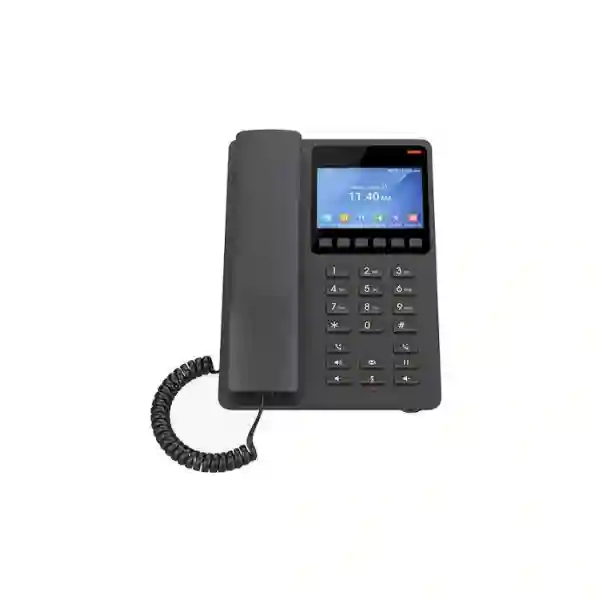
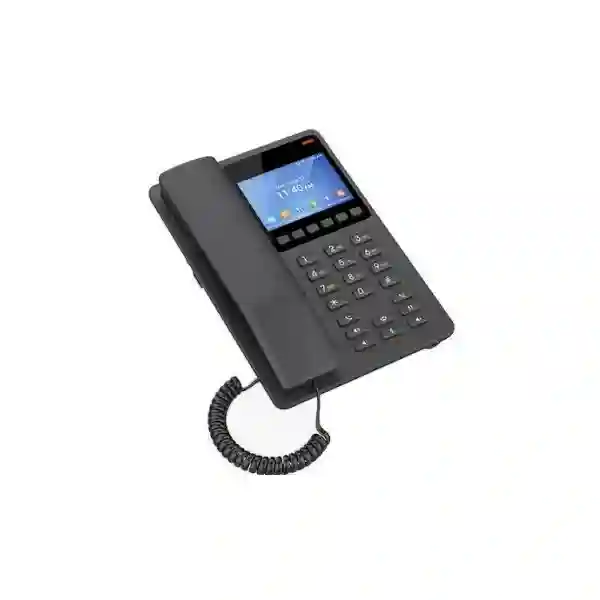
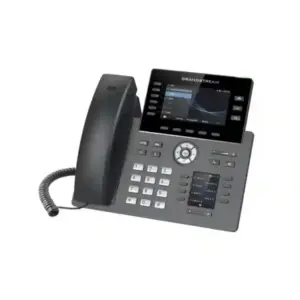
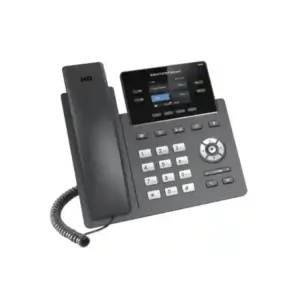
The Grandstream GHP631 is a compact black hotel IP phone designed for properties that want a familiar guest-room telephone experience with a colour display, wired Ethernet and Power over Ethernet. For hotels, serviced apartments, healthcare rooms, dormitories and similar environments in Dubai and across the UAE, its appeal is straightforward: two SIP accounts and lines, a 3.5-inch 480×320 colour LCD, programmable guest-service access, HD audio, 3-way conferencing, GDMS-based device management and a single 10/100 Mbps Ethernet interface with integrated PoE Class 2. The wired GHP631 should not be confused with the GHP631W, which is the Wi-Fi 6 variant. A Fourteck proposal should therefore start with the room network design, PoE availability, PBX or SIP platform, required guest-service keys, provisioning method and the number of endpoints rather than treating every GHP63x model as interchangeable.
2 SIP accounts / 2 lines
3.5-inch colour LCD
Integrated PoE Class 2
GDMS management
Quick decision: when the GHP631 is the right room phone
Choose the GHP631 when the property has structured Ethernet to the room, wants PoE to simplify endpoint power, prefers a black handset and needs a visible colour interface for hotel or institutional calling. It is especially relevant when IT teams want to standardise provisioning across many rooms through Grandstream Device Management System, or when the property needs programmable access to services such as reception, housekeeping, room service, security or other internal extensions. Because the GHP631 is a SIP endpoint, the final behaviour still depends on the PBX, dial plan, VLAN, QoS, provisioning profile and any hotel-system integration around it.
Best fit
Hotels, resorts, serviced apartments, hospitals, dormitories and managed accommodation with wired room connectivity and a SIP-based voice platform.
Key design advantage
A single Ethernet run can provide network access and PoE, reducing the need for a separate local power adapter at every room endpoint.
Important distinction
The GHP631 itself is not the Wi-Fi model. For integrated dual-band Wi-Fi 6, compare the GHP631W and confirm the desired power and wireless design before ordering.
Before quotation
Confirm room count, PBX/SIP platform, PoE switch capacity, VLAN plan, service-key mapping, wall or desk mounting, deployment schedule and commissioning scope.
Verified GHP631 technical profile
The following points are based on Grandstream’s current GHP630/GHP631 documentation. They are useful for design and comparison, but a project should still verify firmware, hardware revision, PBX compatibility and regional requirements before deployment.
| Model | Grandstream GHP631, black finish |
|---|---|
| Display | 3.5-inch high-resolution 480×320 colour LCD |
| SIP capacity | 2 SIP accounts and 2 lines |
| Network | One auto-negotiation 10/100 Mbps Ethernet port with integrated PoE Class 2 |
| Wi-Fi | No integrated Wi-Fi on GHP631; Wi-Fi 6 is provided on GHP630W/GHP631W variants |
| Guest/service controls | 6 context-sensitive soft keys plus standard dial and phone function keys; speed-dial functions can be configured for room-service workflows |
| Audio | HD handset support for wideband audio; codecs include G.729A/B, G.711 µ/a-law, G.726, G.722, G.723, iLBC and full-band Opus |
| Conference | Up to 3-way voice conferencing |
| USB | USB Type-C port for charging external devices, 500 mA maximum |
| Mounting | Desktop or wall mounting with wall-mountable base |
| Management | GDMS, TR-069 and encrypted XML provisioning options; firmware can be delivered over FTP, TFTP, HTTP or HTTPS |
| Security | Secure boot, unique device certificate, administrator-level passwords, 256-bit AES encrypted configuration, SRTP, TLS and 802.1X support |
| QoS | Layer 2 802.1Q/802.1p and Layer 3 ToS, DiffServ and MPLS QoS support |
| Dimensions | 210 mm × 147 mm × 89.8 mm with handset and base stand |
| Unit weight | 601 g for GHP630/GHP631 |
| Operating environment | 0°C to 40°C operation; 10% to 90% non-condensing humidity |
The real buying question is wired PoE versus wireless room deployment
For many UAE hospitality projects, the most important decision is not whether the telephone has a colour screen; it is how the endpoint will connect and be powered. The GHP631 is designed for a wired Ethernet environment with PoE. That can be a strong fit in new hotels, refurbished properties with structured cabling, hospitals with managed bedside networks, staff accommodation and apartment projects where the IT team wants predictable endpoint connectivity and central power control from managed switches.
A PoE design can simplify room installation because the phone does not need a separate local power supply in the same way as a wireless variant. It also lets IT teams place the voice endpoint on a dedicated VLAN, apply QoS policies, monitor switch-port state and troubleshoot the physical path from the telecommunications room to the guest room. When the property already has spare PoE capacity, this can produce a clean operational model. When the existing cabling is incomplete or room renovations make new cabling difficult, the Wi-Fi 6 GHP631W may deserve comparison instead.
The decision should therefore be made from the infrastructure outward. Fourteck can use a room schedule, floor count, IDF/MDF topology, switch inventory, PBX details and target service-key layout to determine whether the GHP631 belongs in the design, whether a wireless variant is more practical, or whether a mixed deployment is appropriate for different areas of the property.
Customer requirement → GHP631 capability → deployment consideration
| Customer requirement | Relevant GHP631 capability | Practical benefit | Check before deployment |
|---|---|---|---|
| Power and network over one room cable | 10/100 Mbps Ethernet with PoE Class 2 | Simplifies endpoint power and centralises network control | PoE budget, switch port availability and cabling quality |
| Clear guest-facing screen | 3.5-inch 480×320 colour LCD | Provides a more informative interface than screenless room phones | Desired labels, language and property workflow |
| Fast access to hotel departments | Context-sensitive keys and speed-dial configuration | Guests can reach frequently used services with less dialling | Dial plan, key mapping, PBX routing and naming standards |
| Central management across many rooms | GDMS, TR-069 and XML provisioning | Reduces room-by-room manual configuration | Provisioning ownership, firmware policy and network reachability |
| Secure SIP communication | TLS, SRTP, secure boot, certificates and encrypted configuration | Supports a stronger endpoint-security design | PBX support, certificate management and security policy |
| Voice quality on managed networks | Opus, G.722 and QoS support | Allows modern wideband calling and traffic prioritisation | WAN/LAN latency, packet loss, SIP trunk design and codec policy |
| Accessible guest-room handset | Hearing Aid Compatibility and handset volume support | Supports more inclusive room communication planning | Property accessibility requirements and regional standards |
What guests and hotel operations teams actually need from a room phone
A hotel room phone has a different job from an executive desk phone. Guests do not usually need dozens of line appearances, expansion modules or complex collaboration features. They need a device that is easy to understand immediately, calls the front desk reliably, exposes a small number of useful hotel services and behaves consistently across every room. Hotel operations teams, meanwhile, need a fleet that can be provisioned, monitored, replaced and reconfigured without excessive room visits.
The GHP631 is suited to that balance because it keeps the physical format familiar while adding a colour display and centrally manageable SIP functionality. A property can map commonly used numbers such as reception, concierge, housekeeping, reservations, restaurant or security through its PBX and endpoint configuration. The exact service names and dial destinations should follow the hotel’s own operating model. A luxury resort with multiple restaurants may use a different key strategy from a compact business hotel, hospital or student residence.
The phone also supports standard functions such as redial, voicemail access when provided by the server, transfer, conference, hold, mute and a flexible dial plan. These functions are valuable not because every guest will use them, but because the same endpoint can accommodate different room types and institutional use cases. A hospital ward, for example, may value straightforward extension calling and nurse-station access, whereas a serviced apartment property may prioritise reception, maintenance and emergency contact workflows.
For project design, the useful question is therefore: which guest or occupant actions should be possible in one or two presses, and which functions should remain hidden or simplified? That answer should drive PBX programming, key labels, restrictions, call permissions and provisioning templates.
Network and PBX planning for a GHP631 rollout
The GHP631 should be treated as part of the property’s voice architecture rather than as an isolated handset. The phone supports SIP and standard IP networking, but successful deployment depends on how the LAN, PoE switching, PBX, SIP trunks, DNS, DHCP, VLANs and security controls work together. In a new hotel build, that usually means coordinating endpoint quantities with floor-by-floor switch capacity before room commissioning begins. In an existing property, it may mean validating old cabling, patch panels and switch power budgets before replacing legacy analogue phones.
1. Room Ethernet and PoE capacity
Each wired GHP631 needs an Ethernet path to the voice network and receives power through its PoE-capable network interface. The design team should confirm the total number of active rooms, spare-room devices, public-area phones and any staff-area endpoints. Switch capacity should be checked not only for port count but also for PoE budget, uplink capacity, resilience and future expansion. A floor with forty rooms should not be planned as forty isolated phones; it should be planned as a managed access layer with clear fault domains, labelling and power assumptions.
2. Voice VLAN and QoS
The GHP631 supports 802.1Q, 802.1p and Layer 3 QoS mechanisms. On a properly designed network, that allows voice traffic to be separated and prioritised according to the organisation’s standards. The endpoint alone cannot solve congestion or poor WAN design, so VLAN tagging, DHCP options, switch configuration, uplink capacity and router/firewall policies should be considered together. In larger hotels, consistent templates across access switches help reduce room-by-room troubleshooting.
3. SIP accounts and dial plan
With two SIP accounts and two lines, the phone can support a straightforward room extension while leaving room for a second account or application where the PBX design requires it. The actual use should be driven by the telephony platform. Room numbering, external dial permissions, emergency-dial behaviour, voicemail, front-desk routing, wake-up workflows and department short codes should be defined centrally. Properties migrating from analogue hospitality systems should pay special attention to whether old room numbers, PMS interfaces or class-of-service restrictions must be preserved.
4. Provisioning and lifecycle management
Grandstream supports GDMS as a central management platform and also documents TR-069 and XML-based provisioning. This matters once the project moves beyond a handful of rooms. A repeatable provisioning profile can standardise SIP settings, keys, firmware, security options and operational behaviour. The project team should decide who owns the template, how firmware changes are tested, how replacement phones inherit the room configuration and how credentials are protected during staging.
GHP631 security and management: useful controls, not automatic security
Grandstream lists secure boot, a unique security certificate per device, administrator-level passwords, 256-bit AES encrypted configuration files, SRTP, TLS and 802.1X among the GHP63x security capabilities. These features give the endpoint a useful security foundation, but the final security posture depends on deployment choices. TLS must be supported and correctly configured at the PBX or SIP service. SRTP depends on the media path. 802.1X requires network-side identity and policy. Encrypted provisioning is useful only when credential handling, access permissions and management accounts are controlled.
For hotel networks, segmentation is particularly important because guest Wi-Fi, staff devices, building systems, CCTV, access control and voice often coexist on the same physical infrastructure. The room telephone should normally live within a controlled voice design rather than on an unrestricted guest network. Firewall policies, switch access rules, management reachability, DNS and NTP should be documented so that the phone can perform its job without unnecessary exposure.
Operational security also matters. A property with hundreds of rooms should know how default credentials are handled, how decommissioned phones are reset, how spare units are staged, how firmware is tested and how configuration changes are audited. Central management can make the fleet easier to administer, but it should be governed with the same care as any other infrastructure-management platform.
GHP631 vs GHP631W vs GHP630: which model fits the room standard?
The closely named models can create procurement mistakes if colour and connectivity are not written clearly in the bill of materials. The simplest way to distinguish them is by finish and wireless capability. The GHP631 is the black wired model with PoE; the GHP631W is the black Wi-Fi 6 model. The GHP630 is the corresponding white wired model. A project specification should state the exact model code rather than only “GHP63 series.”
| Model | Finish | Integrated Wi-Fi | Typical reason to choose |
|---|---|---|---|
| GHP631 | Black | No | Wired Ethernet/PoE room standard with dark interior finish |
| GHP631W | Black | Dual-band Wi-Fi 6 | Wireless room deployment where the project prefers Wi-Fi connectivity |
| GHP630 | White | No | Same wired family concept where a white handset better matches the room design |
Core family features such as the colour display, SIP capacity, GDMS support, conferencing, audio capabilities and hotel-oriented operation are shared across the GHP630/GHP631 family. The choice should therefore focus on connectivity, power, finish and the property’s operational standard rather than assuming that a higher-looking suffix means a more capable wired phone.
Where the GHP631 can fit beyond a conventional hotel room
Serviced apartments
Use the phone as a simple resident-to-reception endpoint where a managed property wants a consistent internal calling experience without placing a full enterprise desk phone in every unit.
Hospitals and clinics
A compact wired endpoint can suit patient rooms and controlled areas when the telephony, accessibility and infection-control requirements of the healthcare organisation have been evaluated separately.
Dormitories and staff housing
Central provisioning and a simple extension model can support residence management, reception and security calling across many rooms or units.
Retail or service counters
The device can serve locations that need a simple fixed SIP phone for internal communication, although an enterprise desk-phone family may be more suitable where staff need richer call handling.
Dubai deployment planning: what to confirm before ordering room phones
A Grandstream GHP631 Dubai project usually becomes easier when the property supplies a structured room schedule rather than only a handset quantity. The room schedule should identify room numbers, suites, accessible rooms, public areas, back-of-house locations, reception points and any spare-unit requirement. That creates a clean basis for endpoint count, switch capacity, extension numbering, provisioning templates and installation planning.
For new hotels and fit-outs, Fourteck can align the phone requirement with the PBX, switches, PoE design and structured cabling. For operating hotels, the project may need a staged migration that preserves existing room-service numbers and minimises disruption. In either case, the project should confirm whether the existing voice service is SIP-based, whether analogue gateways remain in the architecture, whether the property management system interfaces with the PBX, and whether guest calls are billed or controlled through hotel software.
A quotation should also distinguish hardware supply from optional staging, configuration, installation, PBX programming, network changes, on-site testing and post-installation support. Stock, commercial terms and delivery timing should be confirmed for the actual quantity and project schedule rather than assumed from a generic product page.
Abu Dhabi, Sharjah and wider UAE considerations
In Abu Dhabi, hospitality projects may range from city hotels and serviced residences to healthcare and institutional accommodation. The same GHP631 hardware can be relevant, but the surrounding design may be more complex where the property has multiple buildings, centralised voice services or strict change-management procedures. A floor and building breakdown helps determine whether endpoints are managed from one PBX and GDMS structure or from separate operational domains.
In Sharjah and Ajman, existing hotels and residential properties may place more emphasis on migration from older telephone infrastructure. A network-readiness survey becomes valuable before committing to a PoE room phone at scale. Testing a representative room path, switch port, VLAN and SIP registration can expose cabling or configuration problems early. Where structured Ethernet is not available at every location, the GHP631W or another deployment method may be evaluated instead of forcing a wired design into unsuitable rooms.
For multi-emirate operators, standardisation can simplify support. The same extension policy, endpoint template, firmware baseline and naming convention can be applied across properties while still allowing each hotel to map local departments and services. The objective is not to make every property identical; it is to keep the technical operating model consistent enough that replacements, troubleshooting and onboarding remain manageable.
How to stage and commission a multi-room GHP631 deployment
The best time to solve configuration problems is before technicians begin entering occupied rooms. A practical deployment uses a controlled staging process: define the PBX and network standards, build the provisioning template, test a small group of phones, confirm the guest-service keys and only then expand to the full room count. This reduces repeated manual work and makes acceptance testing measurable.
- Confirm the bill of materials. Separate GHP631 wired black units from GHP631W wireless units and any white GHP630 family endpoints. Include spare units according to the property’s own operational policy.
- Validate the network. Test room cabling, PoE switch capacity, VLAN assignment, DHCP, DNS, NTP and access to the SIP/PBX environment. Document switch ports and room labels.
- Build the PBX plan. Define extension numbers, class of service, external call restrictions, department short codes, voicemail behaviour and emergency-call handling based on the property’s rules.
- Create the provisioning profile. Standardise SIP parameters, programmable keys, time settings, security controls, firmware and any approved user-interface settings through GDMS or the chosen provisioning method.
- Pilot representative rooms. Include a standard room, suite, accessible room and any non-room location with a different workflow. Verify registration, inbound and outbound calling, key mapping, display behaviour and audio.
- Roll out by floor or zone. Use a checklist for endpoint serial/model, room number, extension, switch port and test result. A staged approach simplifies rollback and fault isolation.
- Hand over support information. Keep the provisioning ownership, firmware baseline, replacement procedure, spare-unit process and escalation contacts documented for the hotel IT or facilities team.
Common design mistakes to avoid
Ordering GHP631 when Wi-Fi was expected
The model name is close to GHP631W, but the connectivity design is different. The purchase order should carry the exact suffix and deployment assumption.
Ignoring PoE budget
Port count alone is not enough. The switch must provide the required power across all active endpoints and still fit the wider network design.
Treating a room phone like a generic office phone
Guest-service key mapping, room numbering, call permissions and ease of use should drive the configuration rather than copying a standard office-user template.
Skipping a pilot floor
A small pilot can reveal VLAN, dial-plan, provisioning and cabling issues before they affect dozens or hundreds of rooms.
Assuming PMS integration
The phone is a SIP endpoint; hotel-software integration normally depends on the PBX and middleware. Compatibility should be confirmed against the actual hospitality system.
Publishing untested firmware to every room
Central management makes change easy, so changes should be controlled. Test representative endpoints and maintain a documented baseline before broad rollout.
What to include in a GHP631 UAE request for quotation
A useful RFQ does more than name the model. Providing the technical context lets Fourteck distinguish the endpoint supply from the surrounding implementation work and helps prevent mismatches between room design, network power and PBX expectations.
- Required quantity of GHP631 units and any spare-unit requirement.
- Property type, city, number of rooms, floors and buildings.
- Existing or planned IP PBX, hosted SIP or unified communications platform.
- Whether room Ethernet and PoE switching already exist.
- Current extension numbering and guest-service dial plan.
- Desired room-service keys or department shortcuts.
- Desk mounting, wall mounting or a mix of both.
- Requirement for staging, provisioning, installation, PBX configuration or testing.
- Any PMS, call-accounting, emergency-calling or special hospitality workflow that must be retained.
- Target project schedule and whether deployment must be phased around occupied rooms.
Related Grandstream hospitality planning resources
A single handset page cannot answer every PBX, network and guest-communication question. These Fourteck resources provide broader planning context for room-phone selection, hospitality PBX design and multi-model comparison.
Compare the wider GHP family and choose the room-phone style and connectivity that fit the property.
Grandstream Hotel Guest Room Phone Systems
Plan guest-room calling, wired and wireless variants, network requirements and migration considerations.
Grandstream Hotel Phone and PBX Solutions
Understand the relationship between GHP endpoints, PBX sizing, room workflows and hotel-system integration.
Grandstream Hospitality Communication Systems
Extend planning beyond room phones to reception, staff communication, networking and multi-site operations.
Frequently asked questions about the Grandstream GHP631
Is the Grandstream GHP631 a Wi-Fi hotel phone?
No. The GHP631 is the wired black model. Grandstream identifies the GHP631W as the version with integrated dual-band Wi-Fi 6. For a GHP631 project, plan on wired Ethernet and PoE unless the design is changed to the W variant.
Does the GHP631 support Power over Ethernet?
Yes. Grandstream specifies one 10/100 Mbps Ethernet port with integrated PoE Class 2 for the wired GHP631. The project still needs a compatible PoE network and sufficient switch power budget.
How many SIP accounts does the GHP631 support?
The GHP631 supports two SIP accounts and two lines. The way those accounts are used depends on the PBX, room-numbering plan and property requirements.
What display does the GHP631 use?
It uses a 3.5-inch high-resolution 480×320 colour LCD, giving the GHP63x family a more visual guest interface than Grandstream hotel phones that do not use a colour display.
Can the GHP631 be wall mounted?
Yes. Grandstream documents desktop and wall installation, with a wall-mountable base. The room layout, cable exit location and guest accessibility should be checked before deciding the mounting method.
Can a hotel centrally manage many GHP631 phones?
Yes. The GHP series supports Grandstream Device Management System for central configuration, provisioning, management and monitoring. Grandstream also documents TR-069 and encrypted XML provisioning methods.
Does the GHP631 support secure SIP and media?
The phone supports TLS and SRTP along with secure boot, device certificates and encrypted configuration capabilities. End-to-end use depends on compatible PBX, network and certificate settings.
Can the USB Type-C port charge a guest device?
Grandstream specifies the USB Type-C port for charging external devices with a 500 mA maximum. It should be treated as a convenience charging port rather than assumed to provide high-power fast charging.
What is the difference between GHP631 and GHP630?
Within this family, the practical visible difference is colour: GHP631 is black and GHP630 is white. Both are wired models in the GHP63x family. The W suffix identifies the integrated Wi-Fi variants.
Is the GHP631 only for hotels?
No. Grandstream also positions the family for apartments, dormitories, hospitals, retail stores and similar environments that need a compact, centrally managed SIP phone.
Can the GHP631 work with any PBX?
It is a standards-based SIP phone, but a project should not assume universal compatibility with every PBX feature or hospitality workflow. SIP registration, codec policy, provisioning, key behaviour, PMS-related functions and security settings should be confirmed against the actual platform.
Does the phone support 3-way conferencing?
Yes. Grandstream specifies up to 3-way voice conferencing. In a guest-room environment this may be used less often than simple service calling, but it can be useful in institutional or staff-use scenarios.
Can Fourteck provide a Grandstream GHP631 Dubai quotation?
Fourteck can prepare a project-specific quotation after confirming quantity, location, room and floor count, PBX platform, PoE/network readiness, installation scope and any provisioning or configuration requirement. Pricing, availability, delivery and service terms should be confirmed for the actual project rather than assumed from generic market listings.
Plan the GHP631 as part of the room communication system
For a Grandstream GHP631 Dubai or wider UAE deployment, send Fourteck the model quantity, property location, room schedule, PBX details, PoE switch information and the guest-service functions you want on the phone. We can use that information to compare the wired GHP631 with related GHP options, identify network and provisioning requirements and prepare a configuration-specific proposal. Exact stock, price, lead time, warranty terms and implementation scope should be confirmed at quotation stage.
Reviews
There are no reviews yet.