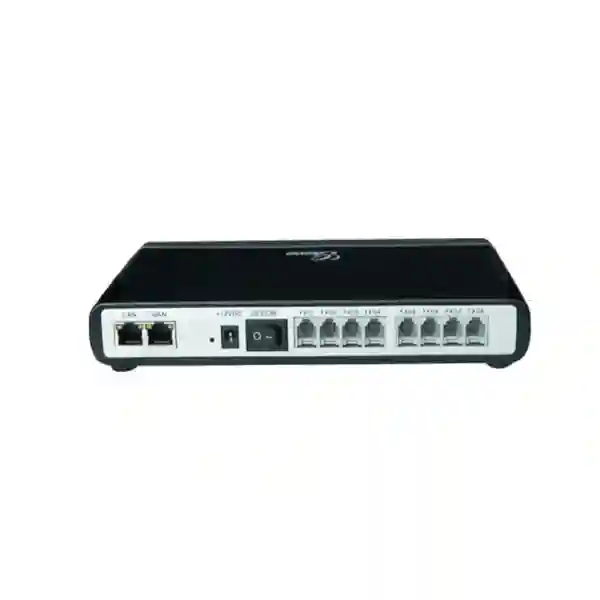
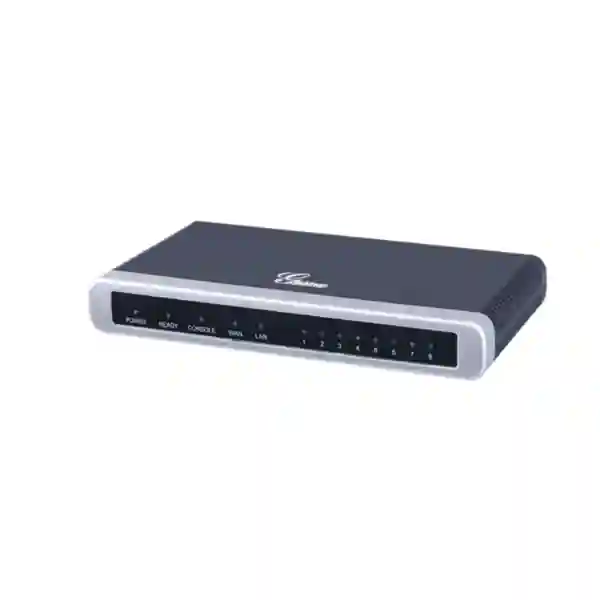
Grandstream GXW4108 8-Port FXO Gateway for Business PSTN-to-SIP Integration
The Grandstream GXW4108 is an eight-port FXO analog VoIP gateway designed to connect traditional public switched telephone network lines to SIP-based communications systems. It is relevant when a business still receives or originates calls on analog PSTN lines but wants those lines presented to an IP PBX, SIP server, softswitch, branch VoIP platform, or hybrid communications environment. Rather than replacing every analog carrier circuit at once, the gateway provides a practical bridge between legacy line infrastructure and an IP telephony core.
For organizations evaluating the GXW4108 today, the most important question is not simply “does it have eight FXO ports?” The real decision is whether the gateway is being used to support an existing deployment, integrate retained analog trunks, provide migration continuity, or serve as part of a new design. Grandstream currently highlights the newer HT881 as an eight-FXO gateway in its active analog gateway portfolio, so buyers planning a new installation should compare both platforms and confirm product availability, firmware support, interoperability requirements, and lifecycle expectations before ordering.
Fast decision guide: when the GXW4108 makes sense
Retaining analog PSTN lines
Use an FXO gateway when carrier-delivered analog lines must remain in service while the call-control platform moves to SIP or IP PBX technology.
Existing GXW4108 estates
The model remains highly relevant for support, reconfiguration, expansion planning, migration audits, dial-plan work, fault isolation, and replacement decisions.
Branch and hybrid telephony
A branch can present local analog trunks to a centralized or on-premise SIP platform while preserving familiar PSTN routing patterns.
New procurement
Compare the GXW4108 with Grandstream’s current HT881 before a new purchase. The better choice depends on lifecycle, compatibility, network design, features, and support requirements.
What the Grandstream GXW4108 actually does
The GXW4108 sits between analog telephone lines and an IP voice network. Its eight RJ11 FXO interfaces connect toward PSTN lines or suitable analog trunk interfaces, while its Ethernet interfaces connect the gateway to the data network that carries SIP signaling and RTP media. When an inbound analog call arrives, the gateway can translate that event into SIP signaling toward the configured IP telephony environment. For outbound calls, the SIP system can route a call toward a GXW4108 channel, which then seizes an analog line and places the call over the PSTN.
This distinction is important because an FXO gateway is not the same as an FXS gateway. FXO ports are designed to connect to analog lines supplied by a telephone service or PBX trunk interface. FXS ports, by contrast, provide analog station service for devices such as legacy telephones, fax machines, or analog extensions. Businesses occasionally order the wrong gateway type because both are described as “analog VoIP gateways.” The design should therefore begin with the direction of the analog interface, not just the number of ports.
Verified GXW4108 capability snapshot
| Area | GXW4108 capability | Why it matters |
|---|---|---|
| Analog interfaces | 8 RJ11 FXO ports | Connects up to eight analog PSTN lines or suitable analog trunk circuits to the IP voice environment. |
| Network | Dual 10/100 Mbps RJ45 Ethernet ports | Provides connectivity between the gateway and the IP network carrying SIP signaling and media. |
| Signaling | SIP / RFC 3261 | Supports integration with compatible SIP IP PBXs, SIP servers, softswitches, and related environments. |
| Media security | SRTP support | Provides media-protection capability where the connected design and compatible endpoints support it. |
| Voice codecs | Includes G.711, G.723, G.726, G.729 variants, G.728 and iLBC | Gives flexibility when matching codec policy, bandwidth constraints, and legacy SIP environments. |
| Fax | T.38 Group 3 fax relay with G.711 pass-through fallback | Useful where retained analog fax workflows must cross an IP network, subject to end-to-end network and SIP-platform compatibility. |
| QoS / VLAN | DiffServ, ToS and 802.1P/Q tagging | Helps place voice traffic into an engineered network policy instead of treating it like ordinary best-effort data. |
| Resilience | PSTN failover capability on power failure | Supports continuity planning for suitable analog line arrangements; actual failover behavior should be validated during deployment. |
Technical capabilities above are based on Grandstream GXW410x product documentation. Firmware, regional PSTN signaling, PBX behavior, carrier line conditions, and configuration can affect real-world operation, so deployment settings should be validated on the target network.
Customer requirement → gateway role → practical outcome
An effective GXW4108 deployment starts with the business requirement rather than with a port count. Eight FXO channels are valuable only when they align with how the organization actually receives calls, distributes inbound traffic, presents caller identity, handles outbound access, uses fax, and maintains continuity. The examples below show how the gateway can fit common scenarios.
Keep existing PSTN numbers while moving to an IP PBX
A company may have long-established public numbers delivered on analog lines, yet wish to modernize internal telephony with SIP phones, softphones, call queues, IVR, centralized management, and branch connectivity. An FXO gateway can act as the boundary between the legacy carrier handoff and the new call-control platform. Inbound PSTN calls can be translated into SIP and routed to the appropriate destination, while outbound calls from IP users can be sent through available analog lines. The practical benefit is migration flexibility, although the final design should still assess whether keeping analog trunks is operationally and commercially preferable to migrating directly to SIP trunks.
Integrate a branch office with centralized SIP call control
A branch may retain local analog lines for local-number identity, fallback, regulatory, building, or service-provider reasons while using an IP PBX located elsewhere. The GXW4108 can make those lines accessible to a compatible SIP environment over the branch network. The design must account for WAN reliability, codec selection, latency, packet loss, QoS, NAT policy, firewall rules, dial plans, and what should happen if connectivity to the central PBX is interrupted.
Support a phased telephony migration
Large changes are often staged. A business might first replace the PBX, then migrate trunks, then modernize endpoints or applications. During that transition, the GXW4108 can preserve access to analog lines while the SIP environment is commissioned. The limitation is that transitional equipment can become permanent by accident. Fourteck therefore recommends documenting the target-state architecture, the retained analog dependencies, the criteria for eventual migration, and whether a newer gateway such as the HT881 is more appropriate for any fresh procurement.
Call-flow design: inbound and outbound PSTN routing
In an inbound scenario, an analog call reaches one of the GXW4108 FXO ports. The gateway detects the incoming condition according to the configured PSTN parameters, processes caller ID where supported by the line and signaling standard, and generates a SIP call toward the configured destination. That destination might be an IP PBX trunk, an extension, an auto-attendant, a hunt group, a queue, or another routing object. The IP PBX then determines how the organization should answer the call.
For outbound traffic, the IP PBX or SIP server sends the call to the gateway based on its routing rules. The GXW4108 selects or uses the applicable FXO channel, seizes the analog line, and dials the destination. A deployment should define whether specific lines are tied to specific departments, whether channels are pooled, how busy conditions are handled, and whether alternative routes exist when analog capacity is exhausted.
Inbound PSTN
Carrier analog line → GXW4108 FXO port → SIP signaling/media → IP PBX → IVR, queue, ring group, extension, or other configured destination.
Outbound PSTN
IP phone or application → IP PBX route → GXW4108 SIP side → selected FXO port → analog carrier line → called party.
PSTN line behavior matters more than many buyers expect
Analog lines are not universally identical. Call progress tones, caller ID delivery methods, disconnect supervision, polarity behavior, impedance, regional timing, and provider-specific characteristics can influence how reliably an FXO gateway detects and clears calls. This is why a gateway that appears “connected” at the cabling level can still experience operational issues such as calls not disconnecting cleanly, caller ID not appearing, delayed answer behavior, false busy detection, one-way audio, or outbound dial timing problems.
Grandstream documentation lists support for multiple caller ID standards, including Bellcore, ETSI, BT, NTT, and DTMF-based caller ID. That flexibility is useful for international deployments, but the correct setting still needs to match the actual carrier service. Similarly, tone detection and disconnect parameters should be tested against real lines. A configuration copied from another country, provider, or old PBX may not be appropriate even if the hardware model is identical.
For Dubai, Abu Dhabi, Sharjah, Ajman, and other UAE deployments, the commissioning process should include live inbound and outbound call testing on the exact service being connected. For Uganda, Kenya, Tanzania, Nigeria, Ghana, Kuwait, and other regional deployments, the same principle applies: validate provider signaling rather than assuming that a generic “international” template will handle every network correctly.
Codec, jitter, echo, and voice-quality planning
A PSTN-to-SIP gateway converts between analog telephony and packet voice. Voice quality therefore depends on both the analog line and the IP path. The GXW4108 supports common codecs including G.711 and compressed alternatives. Codec choice should be made in the context of available bandwidth, compatibility with the PBX or upstream SIP platform, expected transcoding, latency, and audio-quality priorities.
G.711 is often preferred on controlled LANs because it avoids additional compression and provides a straightforward voice path, but it uses more bandwidth than compressed codecs. Where calls traverse constrained WAN connections, compressed codecs may be considered if the entire call path supports them and the quality trade-off is acceptable. The presence of a codec in the gateway specification does not mean it should automatically be enabled; a smaller, intentional codec list usually makes troubleshooting easier.
Grandstream lists G.168 echo cancellation and dynamic jitter buffering for the GXW410x family. These mechanisms are important because analog-to-digital gateways can expose echo or timing problems that are less noticeable in an all-IP call path. Nevertheless, no gateway can compensate for every network problem. Packet loss, excessive jitter, unstable WAN connectivity, overloaded switches, duplex mismatches, poor analog cabling, and incorrectly engineered QoS can all reduce quality. A professional deployment should therefore test the full call path rather than relying on a single device setting.
VLAN and QoS design for business voice
The GXW4108 includes QoS-related capabilities such as DiffServ/ToS and 802.1P/Q tagging. In a managed network, these functions can help align the gateway with the organization’s voice VLAN and traffic-prioritization policy. However, tagging alone does not create quality of service. Switches, routers, WAN edges, firewalls, and upstream links must recognize and preserve the intended policy. If packets are tagged at the gateway but ignored or remarked elsewhere, there may be no practical benefit.
A sensible deployment process confirms the management subnet, voice VLAN requirement, default gateway, DNS policy if needed, NTP/time configuration, SIP server reachability, firewall rules, NAT behavior, and QoS markings before production cutover. For multi-site organizations, consistent addressing and documentation are especially useful because analog gateways can otherwise become “mystery appliances” that only receive attention when trunks stop working.
Security: protect the SIP side even when the carrier side is analog
The fact that the external trunks are analog does not make the gateway’s IP side low risk. The GXW4108 participates in SIP signaling and IP media, so management access, network segmentation, authentication, dial permissions, firmware, and exposure to untrusted networks should be treated as part of the voice-security design. Grandstream lists SRTP support for the GXW410x family, and secure management practices should be used where supported by the selected firmware and surrounding platform.
Avoid exposing a voice gateway directly to the public internet unless the architecture explicitly requires it and protective controls have been designed for that use. Restrict management access to trusted administration networks, change default credentials, use appropriate firewall policies, disable unused services where possible, monitor call behavior, and limit dial routes to the destinations that users actually require. Toll fraud is a business risk: an incorrectly secured SIP trunk or gateway can create real financial exposure even when the gateway itself is physically inside an office.
Fax over IP: what the T.38 specification does—and does not—guarantee
Grandstream documents T.38 Group 3 fax relay support up to 14.4 kbps for the GXW410x family, with automatic switching to G.711 fax pass-through. This capability can be valuable when analog fax workflows must coexist with an IP telephony network. However, fax reliability is an end-to-end issue. The gateway, PBX, SIP carrier or remote gateway, network path, timing, jitter, and fax endpoint can all affect results.
For a business that depends on fax for healthcare, logistics, administration, legal workflows, hospitality, or legacy supplier communication, the commissioning process should include repeated send and receive tests rather than a single successful page. Confirm whether the connected SIP platform actually negotiates T.38, whether any SBC or firewall modifies SDP, whether packet loss is present, and whether fallback to G.711 is reliable. If fax is mission critical, document a fallback process and assess whether a dedicated fax service is more appropriate than routing everything through the same voice path.
GXW4108 and IP PBX compatibility planning
Grandstream designed the GXW410x family for interoperability with SIP-based environments, but successful interoperability still depends on the exact PBX, firmware, SIP behavior, dial plan, NAT arrangement, codec policy, and call-routing design. The phrase “SIP compatible” should therefore be treated as the start of engineering rather than as a guarantee that every feature will behave identically on every platform.
Before connecting the gateway to Asterisk, FreePBX, 3CX, Grandstream UCM, a hosted SIP platform, another on-premise IP PBX, or a custom softswitch, define the role of each side. Decide whether the gateway registers to the PBX or is addressed by IP, how inbound channels map to destinations, which device controls digit manipulation, which side owns failover logic, and how caller ID should be presented. Also define what should happen when the PBX is unavailable, when all FXO channels are busy, or when the carrier line fails.
For customer environments that already use IP PBX solutions in Dubai or are planning a broader Unified Communications migration, gateway integration should be treated as one part of the overall call architecture. Network switching, firewall policy, extension design, SIP trunking, endpoint provisioning, remote-user access, call recording, emergency routing, and business continuity can all influence the final topology.
GXW4108 versus HT881: how to approach the decision
Grandstream continues to host the GXW4104/GXW4108 product and documentation pages, while its current analog gateway portfolio prominently lists the HT881 as an eight-FXO gateway. For that reason, organizations planning a brand-new eight-line analog gateway deployment should compare the GXW4108 requirement with the HT881 rather than assuming that an older project specification is still the best procurement choice.
| Decision point | GXW4108 | HT881 direction |
|---|---|---|
| Primary role | 8-port FXO PSTN-to-SIP gateway widely used in existing deployments. | Current Grandstream 8-FXO gateway platform for contemporary deployments. |
| Best fit | Support, replacement compatibility, established configs, migration projects, or procurement where specifically validated. | New projects where current platform features, support path, and availability better meet the requirement. |
| Network architecture | Dual 10/100 Ethernet interfaces in the documented GXW410x design. | Two 10/100/1000 Ethernet interfaces in bridge mode capability and PoE-PD support are documented for HT841/HT881. |
| Procurement question | Is this needed for continuity with an installed GXW4108 environment? | Is this a net-new 8-FXO requirement where the current platform should be preferred? |
Fourteck can help map the requirement before a quote is requested. The key inputs are the number of analog lines, PBX make/model, SIP topology, carrier signaling, branch/WAN design, fax requirements, failover expectations, and whether the gateway is replacing an installed unit or supporting a new build.
Existing GXW4108 replacement and migration checklist
Replacing a gateway is more than moving eight RJ11 cables from one chassis to another. Existing configuration often contains business logic that is not obvious from the outside. Before changing hardware, export or document the current configuration where possible and record every dependency that affects call behavior.
- Port-to-line mapping: identify which telephone number or trunk appears on each FXO interface.
- Inbound destinations: document which extension, IVR, queue, ring group, or SIP URI receives calls from each line.
- Outbound routing: record channel-selection rules, access codes, emergency routes, local dialing behavior, and any least-cost or department-specific rules.
- Caller ID behavior: note line standards, presentation format, and any normalization performed by the PBX.
- Disconnect supervision: capture busy-tone, polarity, loop-current, or timing parameters that keep calls from remaining connected after the far end hangs up.
- SIP credentials and profiles: record registration status, authentication, server addresses, transport policy, local ports, and failover details.
- Network settings: capture IP address, VLAN, gateway, DNS, QoS markings, NAT policy, firewall rules, and management restrictions.
- Fax paths: confirm whether T.38, G.711 pass-through, or a separate fax service is in use.
- Business continuity: document what should happen during power failure, WAN outage, PBX outage, and carrier failure.
Deployment process for a controlled cutover
Audit
Count live lines, identify numbers, test line quality, document PBX routes, confirm network details, and capture the current configuration.
Design
Define SIP addressing, channel mapping, codec policy, caller ID, dial plans, VLAN/QoS, security, fax behavior, and failover expectations.
Stage
Configure the gateway off-line or on an isolated segment where possible, then validate registration, reachability, routing, and management access.
Test
Test inbound, outbound, busy, no-answer, caller ID, disconnect, concurrent channels, DTMF, fax if required, and failure scenarios.
Cut over
Move production lines in a controlled window, monitor live calls, and keep a rollback path until critical call flows have been confirmed.
Document
Record port mapping, IP details, credentials ownership, firmware, PBX routes, support contacts, configuration backups, and test results.
Where GXW4108 deployments commonly go wrong
Wrong interface type
The project needs analog extension ports but an FXO gateway is ordered, or the design needs FXO trunks but an FXS gateway is selected. Always identify what exists on the far side of each RJ11 connection.
Assuming every analog line behaves the same
Regional and provider-specific signaling can affect caller ID, ring detection, disconnect supervision, and call progress. Live testing matters.
Treating SIP compatibility as plug-and-play
A SIP-capable PBX and SIP-capable gateway can still disagree on registration, transport, authentication, DTMF, codec order, port usage, dial plans, or NAT handling. A documented interconnection plan avoids long troubleshooting cycles.
Ignoring network quality
When the analog side sounds good but calls degrade after conversion to IP, the cause may be packet loss, jitter, congestion, routing, firewall inspection, or WAN instability rather than the PSTN line itself.
No lifecycle plan
An older gateway can remain operational for years, but a business should know what its replacement path is before a failure occurs. For eight-FXO Grandstream requirements, the HT881 should be part of that assessment for new designs.
Dubai and UAE deployment considerations
Businesses in Dubai, Abu Dhabi, Sharjah, Ajman, and other UAE locations often operate mixed telephony estates: newer SIP phones and IP PBXs may coexist with analog lines retained for main numbers, fax, lift/emergency interfaces, legacy equipment, or phased migration. A GXW4108 can be relevant in such hybrid environments when eight FXO channels match the line requirement, but the design should first confirm whether those analog services are still required or whether a migration to carrier SIP services provides a cleaner long-term architecture.
For offices in Deira, Bur Dubai, Business Bay, JLT, industrial areas, warehouses, schools, clinics, hotels, retail sites, and multi-branch operations, practical installation questions include where the carrier lines terminate, whether the telecom room has reliable UPS power, whether the gateway will sit on the voice VLAN, how the IP PBX is reached, and who owns after-hours support. The analog handoff may be physically local while call control is hosted elsewhere, so both cabling and IP routing must be included in the design.
Fourteck can support requirement analysis through Fourteck UAE, including gateway selection, IP PBX planning, network readiness, and migration strategy. Availability, pricing, warranty, and replacement status should be confirmed at quotation time rather than assumed from older online listings.
Regional planning beyond the UAE
The same GXW4108 architecture can appear in African and GCC business networks, but regional deployment should not be reduced to replacing a country name in a standard design. In Uganda and Tanzania, branch connectivity quality and the availability of skilled on-site support may make remote management, documentation, and rollback planning especially important. In Kenya and Nigeria, multi-site organizations may use local PSTN lines while centralizing SIP call control, making WAN resiliency and route ownership key design factors. In Ghana, analog line retention may be driven by installed equipment or transitional telecom arrangements. In Kuwait, enterprise procurement may place more emphasis on standardized hardware, support continuity, and documented compatibility with an existing PBX estate.
Fourteck’s regional network includes Uganda, Kenya, Tanzania, Ghana, Nigeria, and Kuwait. For each region, procurement and configuration should be based on the actual carrier line behavior and PBX environment rather than on assumptions from another market.
What to provide when requesting a GXW4108 or replacement quote
A useful quote request includes enough technical context to avoid supplying the wrong gateway or proposing a solution that creates extra integration work. The following information allows Fourteck to distinguish a straightforward hardware request from a migration, replacement, or integration project.
- Required number of analog PSTN lines now and expected growth.
- Whether the requirement is for a new deployment, a failed GXW4108 replacement, a spare, or an upgrade project.
- IP PBX, SIP server, or softswitch make/model and software version where known.
- Whether SIP registration is used or the devices communicate by fixed IP.
- Inbound destination requirements such as IVR, queue, receptionist, ring group, or extension.
- Outbound routing requirements, including any line preference or department-specific policy.
- Fax requirements and whether T.38 is supported end to end.
- Network details such as VLAN, subnet, WAN topology, firewall, NAT, and QoS policy.
- Country, carrier, and branch/site location so PSTN behavior can be considered.
- Whether installation, configuration, remote support, testing, documentation, or migration assistance is required.
Technical buyer questions answered
Is GXW4108 an FXO or FXS gateway?
The GXW4108 is an FXO gateway with eight RJ11 FXO ports. It is intended to connect analog PSTN lines or suitable analog trunk interfaces into a SIP/IP telephony environment. If the requirement is to connect analog telephones or fax machines as extensions, an FXS gateway or ATA is the relevant category instead.
Can GXW4108 connect to an IP PBX?
Yes, the GXW410x family is designed for SIP-based environments and can integrate with compatible IP PBXs, SIP servers, and softswitches. Configuration details vary by platform, so registration method, authentication, codec policy, DTMF method, dial plans, NAT, and routing should be validated against the selected PBX.
Does it support eight simultaneous analog lines?
The GXW4108 provides eight FXO ports. Actual concurrent call handling depends on how the ports are connected, configured, and routed, as well as the PBX and network design. Capacity planning should therefore consider both physical channels and the end-to-end call-control architecture.
Does it support fax?
Grandstream documents T.38 Group 3 fax relay up to 14.4 kbps and automatic G.711 pass-through fallback for the GXW410x family. Fax reliability should be tested across the complete network and SIP path.
Does it support VLAN and QoS?
Grandstream documentation lists DiffServ, ToS, and 802.1P/Q VLAN tagging. These capabilities are most effective when they are part of an end-to-end network policy across switches, routers, firewalls, WAN links, and the IP PBX environment.
Should I still buy GXW4108 for a new project?
For a new eight-FXO Grandstream requirement, compare the GXW4108 requirement against the current HT881 platform before ordering. Existing GXW4108 deployments may justify like-for-like support or replacement analysis, but a new project should consider current product capabilities and support direction. Confirm availability and lifecycle status at quotation time.
FAQ: Grandstream GXW4108
What is the Grandstream GXW4108 used for?
It is used to connect up to eight analog PSTN lines to a SIP-based IP telephony environment. The gateway translates between analog line signaling and SIP/RTP so an IP PBX, SIP server, or softswitch can use those PSTN lines.
How many FXO ports does GXW4108 have?
The GXW4108 has eight RJ11 FXO ports. Its sibling GXW4104 has four FXO ports.
Can GXW4108 work with hosted or on-premise IP PBX systems?
It is designed for SIP-based environments and can be used with compatible hosted or on-premise systems where network reachability, SIP parameters, security, and routing are correctly configured.
What Ethernet interfaces are provided?
Grandstream documents two 10/100 Mbps RJ45 network interfaces for the GXW410x family.
Does GXW4108 support caller ID?
Yes. Grandstream documents support for several caller ID standards, including Bellcore, ETSI, BT, NTT, and DTMF-based caller ID. The selected configuration must match the carrier line behavior.
Can GXW4108 be used for fax?
Yes, the documented feature set includes T.38 Group 3 fax relay and G.711 fax pass-through fallback. Reliable faxing still depends on compatible settings across the gateway, PBX, carrier or remote endpoint, and network.
What is a good replacement path for GXW4108?
Grandstream currently lists the HT881 as an eight-FXO analog gateway. The correct replacement should be selected after checking port count, PBX compatibility, configuration requirements, network features, failover needs, and the behavior of the analog lines being retained.
Can Fourteck help configure the gateway?
Fourteck can assist with requirement analysis, gateway selection, SIP/IP PBX integration planning, network readiness, dial-plan design, configuration support, testing, and migration planning. Scope and service availability should be confirmed for the target location and environment.
Plan the gateway around your call flow, not around the box
The Grandstream GXW4108 remains an important reference point for organizations with existing eight-line FXO deployments or hybrid analog/SIP environments. Its core value is straightforward: it bridges analog PSTN lines into SIP-based communications. The engineering around that bridge—carrier signaling, IP PBX routing, codecs, fax, VLANs, QoS, security, failover, documentation, and lifecycle planning—is what determines whether the system is reliable in daily business use.
If you are replacing an installed GXW4108, provide the current line map and PBX details so the migration can preserve business call behavior. If you are planning a new deployment, compare the requirement with Grandstream’s HT881 and choose the platform that best matches current support, network features, and long-term architecture. Fourteck can help evaluate the requirement without assuming stock, price, compatibility, or a one-size-fits-all design.
Technical reference: Grandstream GXW4104/GXW4108 product documentation and GXW410x datasheet. Product availability, firmware support, regional carrier behavior, and current replacement recommendations should be confirmed for each project.



Reviews
There are no reviews yet.