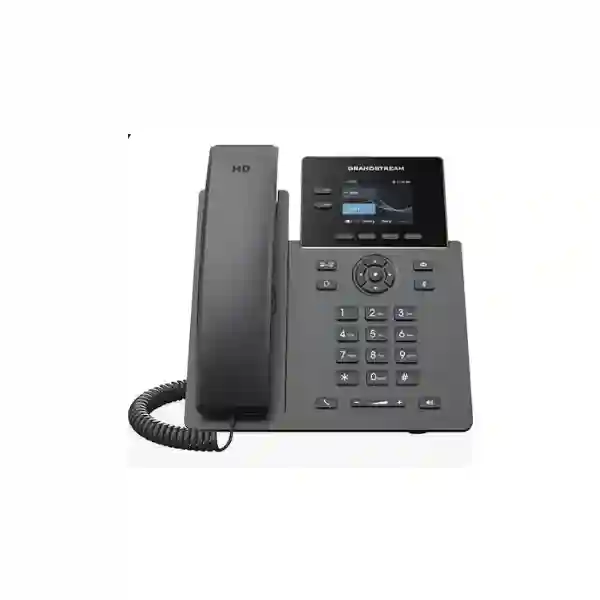
Grandstream GRP2610 Dubai: 2-Line Carrier-Grade IP Phone for Managed Business Deployments
The Grandstream GRP2610 is a two-line SIP desk phone designed for organizations that want a standardized, centrally manageable voice endpoint without paying for built-in Wi-Fi, Bluetooth, Gigabit Ethernet or Power over Ethernet that a particular desk may not need. Grandstream positions the GRP2610 as a carrier-grade model for mass deployment, and its practical strengths are easy provisioning, two SIP accounts, a 2.4-inch color display, HD audio, Noise Shield technology, up to eight virtual multi-purpose keys, five-way audio conferencing and support for Grandstream Device Management System (GDMS). For a Dubai or UAE business using conventional Ethernet and local power at the desk, that combination can be a sensible fit for general staff, branch users, administrative desks, service counters and high-volume standardized rollouts.
The key buying issue is the exact variant. The GRP2610 is the non-PoE version, while the closely related GRP2610P adds integrated PoE. The GRP2610 uses dual switched 10/100 Mbps Ethernet interfaces and is supplied for local power operation. That difference matters when planning switch ports, desk cabling, UPS strategy and installation cost. This page is therefore structured as a deployment and procurement guide, not only a specification list: it explains where the GRP2610 fits, where it does not, how it differs from the PoE version, what to confirm with your PBX or SIP service, and how Fourteck can help scope a suitable business rollout in Dubai, across the UAE and in wider regional projects.
Two line keys with support for two SIP accounts, suitable for straightforward desk calling and dual-identity use cases.
A 320×240 TFT color screen provides a clear visual interface for calls, menus, directory access and status information.
The GRP2610 is intended for conventional Fast Ethernet desk connectivity and does not include integrated PoE.
Centralized provisioning and management can reduce manual configuration work in multi-phone and multi-site deployments.
What business requirement does the GRP2610 actually solve?
A business phone should be selected around the user role, network design and support model rather than around the largest feature list. The GRP2610 is strongest when a company needs a dependable SIP desk phone for users who spend most of their day on ordinary business calls and do not require advanced wireless features, a large touchscreen or many physical line appearances. Two SIP accounts cover many standard employee scenarios: one primary extension plus a secondary identity, a branch line plus a departmental account, or a direct extension plus a shared service identity where the PBX supports the intended call flow.
Its value becomes clearer in larger deployments. A phone purchased one unit at a time can be configured manually, but a fleet of dozens or hundreds of endpoints becomes an operational task. Grandstream supports the GRP2610 through GDMS, while the device also supports TR-069 and encrypted XML provisioning methods. This allows an organization or integrator to standardize account settings, codecs, VLAN parameters, dialing rules, firmware policy and other endpoint options rather than repeating desk-side configuration. The practical benefit is not simply convenience; it is configuration consistency, easier replacement, faster branch rollout and a clearer support baseline.
| Customer requirement | Relevant GRP2610 capability | Practical benefit | Buying consideration |
|---|---|---|---|
| Simple office desk calling | 2 SIP accounts / 2 line keys | Enough account capacity for many general employees | Reception or heavy multi-line users may need a higher model |
| Centralized rollout | GDMS, TR-069 and encrypted XML provisioning | Standardized settings across many endpoints | Provisioning design still needs correct PBX and network data |
| Clear business audio | HD handset and speakerphone, G.722, Opus and Noise Shield | Better voice clarity where the call path supports wideband audio | End-to-end quality also depends on PBX, WAN, codecs and QoS |
| Frequent transfer or colleague access | Up to 8 virtual multi-purpose keys | Can reduce menu navigation for commonly used functions | Exact BLF/MPK behavior depends on provisioning and PBX support |
| Local-power desks | Non-PoE GRP2610 design | Suitable where power adapters are acceptable or PoE switching is not planned | Choose GRP2610P when integrated PoE is a requirement |
Verified Grandstream GRP2610 specifications that matter during design
Specifications are useful only when they are connected to a deployment decision. The matrix below focuses on verified capabilities from Grandstream documentation and explains why each one matters in a business network. It deliberately avoids invented prices, stock claims, warranty periods or compatibility promises that should instead be confirmed for the actual project.
| Product class | 2-line carrier-grade professional IP phone |
|---|---|
| SIP accounts / line keys | Up to 2 SIP accounts with 2 line keys |
| Display | 2.4-inch 320×240 TFT color LCD |
| Programmable controls | 4 programmable context-sensitive soft keys plus up to 8 virtual multi-purpose keys depending on configuration |
| Ethernet | Dual switched auto-sensing 10/100 Mbps Ethernet ports |
| PoE | Not integrated on GRP2610; integrated PoE belongs to GRP2610P |
| Audio | HD handset and speakerphone; wideband support includes G.722 and Opus alongside common narrowband codecs |
| Conferencing | 5-way audio conferencing |
| Headset | RJ9 headset interface with EHS support for compatible headset deployments |
| Management / provisioning | GDMS, TR-069, firmware upgrade methods and AES-encrypted XML configuration options |
| Security | Secure boot, encrypted data storage, dual firmware images, TLS, SRTP, 802.1x and encrypted configuration support |
| Directories / logs | XML/LDAP phonebook support and call-history functions as defined by firmware and provisioning |
| Mounting | Two-position desk stand; wall mounting supported with the appropriate wall-mount accessory |
GRP2610 vs GRP2610P: the decision is about power architecture
The names are almost identical, so procurement teams can easily assume that the two models are interchangeable. Functionally they share the same basic two-account calling concept, but the power design is different. The GRP2610 does not provide integrated PoE; the GRP2610P does. This single letter can change the physical rollout plan across an office because PoE allows the network switch to supply endpoint power over Ethernet, while the GRP2610 relies on local power.
| Decision point | GRP2610 | GRP2610P |
|---|---|---|
| SIP accounts | 2 | 2 |
| Ethernet | Dual 10/100 Mbps | Dual 10/100 Mbps |
| Integrated PoE | No | Yes |
| Desk power planning | Local power adapter and outlet planning | PoE switch or injector planning |
| Best-fit environment | Existing offices where local power is easy and PoE is unnecessary | Structured networks that want centralized endpoint power |
If the organization already uses a PoE switch and wants phones to stay powered through a centralized UPS-backed network stack, the P variant may be operationally preferable. If desks already have suitable outlets, the network is not PoE-enabled, or the project is replacing older locally powered handsets without redesigning the switch layer, the GRP2610 can remain a practical choice. Fourteck can review the endpoint count, switch model, available PoE budget, cabling and resilience requirements before the quotation stage so the model is selected as part of the network design rather than as an isolated purchase.
Who is the GRP2610 best suited for?
The model is a strong fit for users whose daily communication needs are predictable. A general employee who needs one extension, voicemail, transfer, hold, conferencing and a small set of frequently used speed-dial or BLF functions does not necessarily benefit from a much larger endpoint. The GRP2610 concentrates on the essentials while keeping enterprise-oriented management and security features that matter to IT teams.
General office users
Suitable for employees who mainly place and receive business calls, access voicemail, transfer calls and use a limited number of SIP identities. The 2.4-inch screen gives a more modern visual interface than basic monochrome endpoints without adding touchscreen complexity.
Branch and satellite offices
Useful where a company wants the same endpoint profile across multiple locations. Centralized provisioning can support repeatable rollout, while standard SIP interoperability gives flexibility across compatible IP PBX and hosted voice environments.
Education and institutional desks
Administrative offices, staff rooms and service points often need reliable voice, extension dialing and transfer functions rather than premium executive features. Fleet management can be important when endpoints are spread across buildings.
Retail and service counters
A compact SIP endpoint can handle store-to-office calls, supplier communication and internal extensions where only a small number of accounts is required. Noise Shield can be useful where background activity is present, while overall call quality still depends on network conditions.
Managed service deployments
Service providers and IT teams can benefit from centralized provisioning, firmware control and standardized configuration. This is particularly relevant when the business values lower ongoing administration more than advanced user-facing features.
Hot-desking scenarios
The phone includes telephony features that can support shared-desk workflows depending on the PBX and provisioning design. Confirm how the intended PBX handles user login, credentials, directories and feature codes before standardizing the model.
Network planning: what the dual 10/100 ports mean in a modern office
The GRP2610 uses dual switched 10/100 Mbps Ethernet ports. In a voice-only context, Fast Ethernet provides far more bandwidth than a SIP voice stream requires. The more important question is whether a workstation will be connected through the phone’s PC port and what bandwidth that workstation needs. In a modern office where desktop computers routinely move large files, use high-resolution cloud applications or rely on Gigabit LAN throughput, placing the PC behind a 100 Mbps phone can become a bottleneck. In that situation, a Gigabit-capable phone or a separate network drop may be the better design.
This is why endpoint selection should happen together with switch and cabling planning. A voice VLAN can logically separate IP telephony traffic, while QoS can prioritize voice where the network is congested. The GRP2610 supports common Layer 2 and Layer 3 QoS mechanisms, but the phone cannot fix an incorrectly designed network by itself. Switch configuration, VLAN tagging, DHCP options, DNS, NTP, firewall rules, SIP traversal, PBX routing and WAN quality all contribute to the actual user experience.
For Dubai office projects, it is common to see a mixture of new structured cabling and older desk layouts. If one data point is shared between a phone and a PC, confirm the expected workstation speed before selecting a Fast Ethernet endpoint. If the phone has its own dedicated drop, the 100 Mbps limit may have little practical impact. Fourteck can map these details during a requirement review so the handset does not become an unexpected LAN constraint after installation.
PBX and SIP compatibility should be confirmed before mass ordering
The GRP2610 is based on SIP and Grandstream documents broad interoperability with SIP devices and SIP/NGN/IMS platforms. That does not mean every PBX feature behaves identically on every platform. Basic registration, calling, transfer and voicemail are only part of the requirement. A real deployment may also depend on BLF subscriptions, shared call appearance, directory synchronization, provisioning templates, call park, pickup groups, hot desking, TLS certificates, SRTP policies, NAT traversal, custom feature codes or emergency dialing rules.
Before a large purchase, validate the intended PBX or hosted SIP service with a representative configuration. Confirm the number of required SIP registrations per user, authentication method, codec policy, DTMF mode, extension numbering, voicemail behavior, directory source and any platform-specific provisioning method. For an on-premises PBX, also confirm network reachability and VLAN design. For a cloud PBX, confirm firewall and NAT requirements and whether the provider has a supported Grandstream provisioning profile. A short pilot can prevent a larger operational problem.
GDMS changes the support model from phone-by-phone to fleet management
Grandstream Device Management System is one of the most important reasons to consider the GRP family for standardized deployments. Instead of treating each phone as a separate configuration task, an administrator can manage endpoint settings through a centralized workflow. This can be valuable for a Dubai head office with branch locations in Sharjah or Abu Dhabi, a school group with many campuses, a retail chain, a hospitality operator, or a managed service provider supporting multiple customer sites.
Central management is most useful when the organization first defines a configuration standard. That standard can cover account naming, time zones, NTP, firmware policy, VLAN parameters, QoS, screen behavior, programmable keys, directory sources, security options and administrator access. Phones can then be assigned to the correct profile rather than configured ad hoc. The operational gain is consistency: when a user moves desk, a branch opens, or an endpoint is replaced, the support team has a known baseline.
A management platform does not remove the need for good change control. Firmware versions, template changes and new security settings should still be tested against the PBX and a small endpoint sample before a broad rollout. Organizations with regulated or sensitive environments should also review their own security and data-handling requirements before using any cloud management service. Fourteck can help align endpoint provisioning with the network and PBX design rather than treating management as a separate afterthought.
Security features are useful, but configuration determines the real result
Grandstream lists several enterprise-oriented security mechanisms for the GRP2610 family, including secure boot, dual firmware images, encrypted data storage, TLS, SRTP, 802.1x and encrypted configuration support. These features give IT teams a stronger technical foundation than a phone that relies only on basic SIP credentials. However, secure capabilities only deliver value when they are actually enabled and matched to the PBX, network and certificate design.
For example, TLS can protect SIP signaling and SRTP can protect media, but both ends of the call path must support and be configured for the intended security policy. 802.1x can help control network access, but the switching infrastructure, authentication server and endpoint certificate or credential process must be planned. Strong administrator passwords and restricted management access are still necessary. Firmware should be managed deliberately, and unused services should not be left exposed without reason.
Use controlled SIP credentials, separate administrator passwords and role-appropriate access. Avoid reusing weak credentials across a large handset fleet.
Where the PBX supports it, review TLS and SRTP policies so signaling and media protection are designed end to end rather than assumed.
Use controlled provisioning sources, encrypted configuration where appropriate, and change management for templates and firmware.
Segment voice traffic when appropriate, restrict unnecessary management exposure and apply switch-port controls that match the organization’s security policy.
Audio quality, Noise Shield and conferencing: what users should expect
The GRP2610 supports HD audio on the handset and speakerphone and includes wideband codecs such as G.722 and Opus. Wideband voice can sound more natural than traditional narrowband telephony when the PBX, trunk, remote endpoint and network support the same codec path. The phone also supports Grandstream’s Noise Shield technology, intended to reduce background noise. This can be useful for open offices, service counters or active branch environments, although acoustic conditions still vary by room and user position.
Five-way audio conferencing allows the phone to participate in small ad hoc conference calls without a separate meeting platform for every discussion. This can suit supervisors, project coordinators and branch teams who occasionally need several participants on one call. For larger meetings, scheduled collaboration, screen sharing or video, a dedicated conferencing or unified communications platform remains more appropriate.
The headset interface is another practical factor. The phone provides an RJ9 headset connection and supports EHS functionality for compatible deployments. A contact-center-style team should confirm the exact headset model, cable or EHS accessory and expected call-control functions before purchase. Users who require USB headsets, integrated Bluetooth or wireless headset pairing may be better served by another phone model with those interfaces built in.
When the GRP2610 is not the right phone
A good product page should make exclusions clear. The GRP2610 is not the automatic answer for every desk. If the requirement includes PoE, Gigabit passthrough, Wi-Fi, Bluetooth, a large number of line appearances, a bigger display or more advanced expansion capability, another model may fit better. Buying a lower-cost endpoint that does not match the network or user role often creates more support cost than selecting the correct model from the start.
- Choose a PoE model when the design depends on centralized switch power, cleaner desk cabling or UPS-backed endpoint power without local adapters.
- Choose a Gigabit model when a workstation will share the phone’s Ethernet path and the desktop requires more than 100 Mbps throughput.
- Choose Wi-Fi or Bluetooth capability when wireless network connectivity or direct Bluetooth accessory pairing is an actual requirement.
- Choose more line keys or SIP accounts for reception, executive assistants, dispatch, customer-service supervisors or users who actively manage many call identities.
- Choose a collaboration endpoint when video, touchscreen interaction or application integration is more important than conventional SIP desk-phone operation.
Related Grandstream options already available in the Fourteck catalog
The GRP2610 sits inside a much larger Grandstream endpoint portfolio. A buyer comparing models should focus on differences that change the deployment rather than assuming that the next model number is always the right upgrade. Fourteck’s existing Grandstream pages can help with nearby alternatives for specific requirements.
Grandstream GRP2601W
Consider when Wi-Fi is part of the desk connectivity requirement and the deployment does not fit a wired-only GRP2610 approach.
Grandstream GRP2602P
Useful to review when PoE is mandatory and the organization is comparing essential-series business endpoints for general users.
Grandstream GRP2602G
Relevant when Gigabit Ethernet is a deciding factor because a workstation will share the phone’s network connection.
Grandstream GRP2603
Worth comparing for users whose call-handling requirements go beyond a very basic two-line endpoint.
Grandstream GRP2603P
A nearby PoE alternative for organizations evaluating a structured wired rollout with additional call-control capacity.
Grandstream GRP2604P
A stronger fit when the desk needs PoE, Gigabit connectivity and more SIP/BLF capacity than a simple GRP2610 deployment.
Dubai and UAE deployment considerations
A Dubai IP phone project often involves more than selecting the handset. Office moves, branch openings, PBX migrations and structured-cabling upgrades can all change which endpoint variant is appropriate. For a new fit-out where PoE switches are already planned, the non-PoE GRP2610 may not be the first choice because centralized power can simplify desk cabling and resilience. For an existing office with conventional power at every desk and a non-PoE access layer, the GRP2610 can avoid unnecessary switch changes while still providing modern SIP calling and centralized management.
In Deira and Bur Dubai, many businesses operate from established office environments where cabling and power layouts may have evolved over time. The practical first step is to inspect the existing network path: one cable or two per desk, current switch speed, VLAN support, available rack capacity, UPS design and whether the PC is expected to connect through the phone. In JLT, Business Bay and newer commercial spaces, structured networks may already use PoE extensively, making the GRP2610P or another PoE model easier to standardize.
For Sharjah and Ajman branch deployments, centralized provisioning can become more valuable than premium endpoint features. A company that wants the same dial plan, firmware policy, directory source and programmable-key layout across multiple sites can treat the handset fleet as one managed environment. For Abu Dhabi corporate and institutional projects, security policy, network authentication, change control and resilience may carry greater weight, so the endpoint should be assessed alongside PBX architecture and access-switch standards.
Fourteck can support requirement analysis, model comparison, compatibility review, quantity planning, network/PBX coordination and quotation preparation. Current pricing, stock, delivery timing and applicable warranty terms should be confirmed for the specific order rather than assumed from a generic product page.
Regional project planning beyond the UAE
Fourteck also works across regional markets where the same endpoint may be considered under different network, procurement and support conditions. A useful regional strategy does not copy a Dubai paragraph and replace the city name. Instead, it evaluates power reliability, LAN design, PBX location, bandwidth, remote support requirements, lead times and the organization’s ability to standardize configuration across branches.
Uganda
For Kampala and multi-branch organizations, centralized provisioning can reduce travel for routine endpoint setup. Network power strategy should be reviewed carefully: if PoE-backed switching is part of the resilience design, compare the GRP2610P; where reliable local power already exists at the desk, the GRP2610 may remain appropriate. See Fourteck Uganda for regional solution context.
Kenya
Nairobi and distributed business sites may prioritize standardized SIP configuration across branches. Confirm WAN quality, hosted-PBX connectivity, local switching and the need for UPS-backed endpoint power before deciding between non-PoE and PoE variants. Regional information is available through Fourteck Kenya.
Kuwait
Enterprise and multi-site deployments should focus on endpoint standardization, PBX compatibility and network design rather than model price alone. A structured PoE environment may favor a PoE endpoint even where the GRP2610 has the necessary calling features. See Fourteck Kuwait for broader regional coverage.
Nigeria and Ghana
For growing branch networks, define how phones will be powered during outages, how configuration changes will be distributed and how PBX services are reached between sites. Central management can be valuable when support teams are remote. See Fourteck Nigeria and Fourteck Ghana.
Tanzania
Dar es Salaam and regional offices may need a balance of straightforward endpoint operation and centralized support. Validate local LAN speed, power approach and SIP platform requirements before standardizing the GRP2610. Broader solution information is available through Fourteck Tanzania.
A practical rollout method for GRP2610 projects
A successful rollout follows a repeatable process. This matters whether the project is ten phones in one Dubai office or hundreds of endpoints across branches. The goal is to prove the design on a small sample, standardize configuration, then expand with clear support ownership.
- Define user roles. Count ordinary employees, reception users, executives, shared desks and customer-service positions separately. The GRP2610 may fit one group while another needs more line keys, wireless connectivity or Gigabit Ethernet.
- Confirm the PBX or hosted SIP platform. Record SIP account limits, authentication requirements, feature codes, BLF behavior, directory integration, voicemail and provisioning options.
- Audit the desk network. Confirm whether the phone has a dedicated network drop or shares connectivity with a PC, whether 100 Mbps is acceptable, and whether voice VLANs and QoS are required.
- Choose the power architecture. If centralized PoE and UPS-backed switching are required, compare the GRP2610P rather than assuming the GRP2610 is equivalent.
- Create a standard endpoint profile. Define firmware, time settings, security controls, SIP parameters, programmable keys and directory settings before mass provisioning.
- Pilot representative users. Test ordinary calls, transfer, hold, conferencing, voicemail, BLF, directories, headset operation and failover conditions with the actual PBX.
- Document exceptions. Some users will require a different endpoint. Capturing those exceptions early prevents forced standardization that makes daily work harder.
- Roll out in controlled batches. Keep serial/asset records, configuration ownership and support escalation clear so the phone fleet remains manageable after installation.
Procurement checklist before requesting a quotation
Providing the right project data at quotation stage helps avoid mismatched variants and last-minute accessory or network changes. For a GRP2610 requirement, send Fourteck the intended quantity, delivery location, PBX or hosted voice platform, user type, required SIP accounts, network-switch model, whether PoE is needed, workstation connectivity method, headset requirements and any staging or configuration services expected.
| Information to provide | Why it matters |
|---|---|
| Quantity and destination | Supports commercial planning, packing, delivery coordination and project phasing. |
| PBX / SIP platform | Allows compatibility and provisioning expectations to be reviewed before ordering. |
| PoE requirement | Determines whether the GRP2610 or GRP2610P power model better matches the network. |
| PC-through-phone requirement | Helps determine whether 100 Mbps pass-through is acceptable or Gigabit should be specified. |
| User role | Prevents assigning a two-line endpoint to users who need more active call controls or accounts. |
| Headset model | Allows interface and EHS requirements to be checked rather than assumed. |
| Provisioning / staging scope | Clarifies whether phones are required as hardware only or as part of a configured rollout. |
Frequently asked questions about the Grandstream GRP2610
Does the Grandstream GRP2610 support PoE?
No. The GRP2610 is the non-PoE variant. If integrated Power over Ethernet is required, compare the GRP2610P. The two models share the same general two-line calling concept, but their power architecture is different.
How many SIP accounts does the GRP2610 support?
The GRP2610 supports up to two SIP accounts with two line keys. This is suitable for many standard office users but may be limiting for reception or multi-identity roles that actively manage several lines.
Does the GRP2610 have Gigabit Ethernet?
No. It uses dual switched 10/100 Mbps Ethernet ports. If a desktop PC will connect through the phone and needs Gigabit throughput, evaluate a Gigabit-capable IP phone or a separate network connection.
Does the GRP2610 include Wi-Fi or Bluetooth?
No. The GRP2610 is designed as a wired Ethernet desk phone and does not include integrated Wi-Fi or Bluetooth. Choose another model when those wireless capabilities are required.
Can the GRP2610 be centrally managed?
Yes. Grandstream supports the GRP2610 through GDMS and also documents provisioning options including TR-069 and encrypted XML configuration. Central management can be particularly useful for larger or multi-site deployments.
Does the GRP2610 support HD audio?
Yes. The phone supports HD audio on the handset and speakerphone and includes wideband codecs such as G.722 and Opus. Actual end-to-end audio quality depends on the PBX, remote endpoint, codec negotiation and network conditions.
How many participants are supported in an audio conference?
The GRP2610 supports five-way audio conferencing, which can be useful for small ad hoc conference calls without moving to a separate collaboration platform.
Can I use a headset with the GRP2610?
The phone provides an RJ9 headset interface and supports EHS functionality for compatible headset deployments. Confirm the exact headset model and any required EHS accessory before purchase.
Is the GRP2610 suitable for a reception desk?
It can work for a simple reception role, but many reception users need more line appearances, more direct keys or higher account capacity. Review the actual call volume and transfer workflow before standardizing a two-line phone for reception.
What should I confirm before buying the GRP2610 in Dubai?
Confirm quantity, PBX or hosted SIP platform, required SIP accounts, PoE requirements, workstation network speed, headset needs, provisioning method and delivery location. Fourteck can then help determine whether the GRP2610 or another model better fits the project.
Request a Grandstream GRP2610 quotation from Fourteck
For a useful quotation, share the required quantity, deployment city, PBX or SIP platform, user roles, whether the phone will share a data link with a PC, and whether Power over Ethernet is required. Fourteck can review the requirement against the GRP2610, GRP2610P and relevant Grandstream alternatives, then help with model selection, compatibility planning, provisioning scope and deployment coordination.
Current stock, commercial terms, lead time, delivery arrangements and applicable warranty conditions should be confirmed at the time of inquiry. For broader UAE IT procurement and communication requirements, visit Fourteck UAE or explore the IP Phone Fourteck catalog.

Reviews
There are no reviews yet.