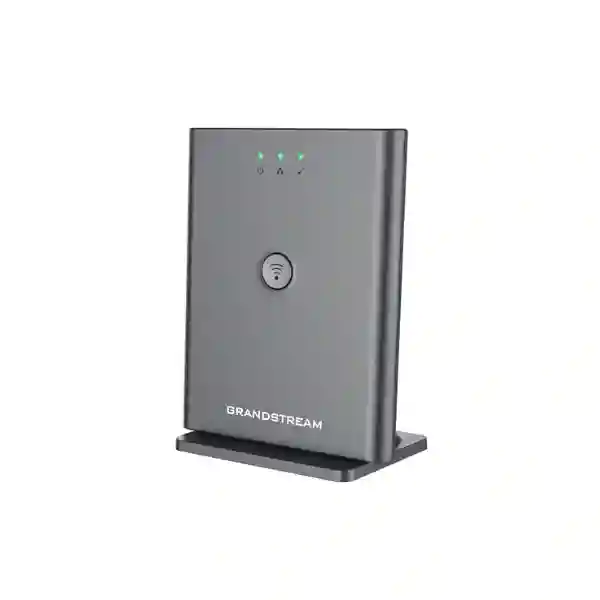
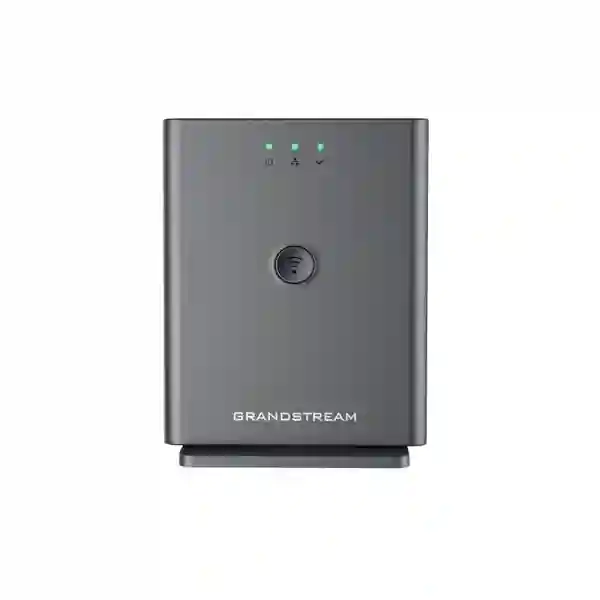
Grandstream DP752 Dubai – Long-Range DECT VoIP Base Station
The Grandstream DP752 is a DECT VoIP base station designed for organizations that need cordless SIP calling without turning every mobile user into a Wi-Fi handset project. It can pair with up to five compatible Grandstream DP-series DECT handsets, supports up to ten SIP accounts, and handles up to five concurrent calls. For Dubai and UAE buyers, its practical value is the combination of cordless mobility, integrated PoE, centralized SIP registration, HD voice support, flexible ring groups, and business-oriented provisioning. Grandstream specifies indoor range up to 50 metres and outdoor range up to 400 metres with supported DP730, DP725, or DP735 handsets; DP722 and DP720 combinations are specified up to 350 metres outdoors. Actual coverage depends on walls, doors, shelving, RF conditions, building materials, handset model, and placement.
Fourteck can help customers evaluate the DP752 as part of a complete business telephony design that may include compatible handsets, SIP extensions, IP PBX integration, PoE switching, VLAN and QoS planning, secure provisioning, branch connectivity, and deployment support. The goal is not simply to select a base station, but to confirm that the cordless design matches user movement, call capacity, site coverage, network readiness, and future growth.
Is the DP752 the right DECT base station for your requirement?
The DP752 is particularly relevant when a business needs staff to move around a defined site while remaining reachable on SIP extensions. Typical examples include retail floors, warehouses, workshops, hospitality back-of-house areas, clinics, schools, villas, small compounds, showrooms, logistics facilities, and offices where employees regularly leave a desk. Instead of placing a fixed desk phone at every point where a user might work, the base station connects to the IP network while the paired DECT handsets provide cordless mobility.
It is important to separate user count, handset count, SIP account count, and concurrent call count. The DP752 supports up to five handsets and up to ten SIP accounts, but it supports up to five simultaneous calls. A site with five mobile employees making occasional calls can be a good fit. A call-centre team requiring ten simultaneous conversations is not. Likewise, a warehouse with many more than five mobile users may need multiple DECT cells, a different base-station architecture, or another mobility design.
Choose the DP752 when your priority is a compact, standards-based DECT system for up to five cordless handsets, with business SIP features and integrated PoE. Consider alternatives when you need substantially more handsets, more simultaneous calls, multi-cell roaming at larger scale, or a design based primarily on Wi-Fi calling.
DP752 verified capabilities at a glance
How the DP752 fits into a business VoIP architecture
The DP752 is not an IP PBX by itself. It is a SIP-connected DECT base station that sits between the wired IP network and cordless DECT handsets. In a typical deployment, the base station connects to an Ethernet switch, receives power through PoE or a local power adapter, registers one or more SIP accounts to a PBX or compatible SIP platform, and then presents those accounts to paired handsets according to the required call-routing design.
For organizations already using a Grandstream UCM IP PBX, the DP752 supports Grandstream Zero Config provisioning. In mixed-vendor SIP environments, standard SIP functionality can also be used, but compatibility and feature behavior should always be validated against the selected PBX, hosted platform, SIP trunk arrangement, firmware level, security policy, and network. Features such as transfer, voicemail indication, caller identification, directory access, call forwarding, conference behavior, codecs, and failover can depend on both the endpoint and server-side implementation.
Connect the DP752 to a suitable switch port, ideally with voice VLAN, QoS, DHCP/DNS and PoE planning already defined.
Configure the required SIP accounts and server parameters for the PBX or SIP service being used.
Pair compatible DP handsets and map accounts, lines and ring behavior according to employee roles.
Test coverage, inbound/outbound calls, transfer, voicemail, handover expectations, security and busy-hour capacity.
Coverage planning in Dubai offices, warehouses and mixed-use sites
Coverage is one of the strongest reasons buyers consider the Grandstream DP752, but published maximum distance should never be treated as a guaranteed radius. Grandstream specifies up to 50 metres indoors, while outdoor figures vary by handset model. In practice, reinforced concrete, metal shelving, fire doors, lift shafts, tinted glazing, machinery, insulated partitions, underground areas, long corridors, mezzanine floors and dense storage can change RF propagation substantially. A base placed at one edge of a building may technically connect but still produce inconsistent voice quality at the far end.
For a Dubai warehouse, a more useful planning question is not “does the base support 400 metres?” but “where do staff actually walk, what materials sit between them and the base, and where must a call remain usable?” For a clinic or hotel, the concern may be several rooms and corridors rather than open distance. For a villa or low-rise office, floor separation can matter more than horizontal distance. In each case, central placement, cable availability, PoE, obstructions and the selected handset should be considered together.
Grandstream also supports the DP760 DECT repeater with the DP752 for range extension in suitable designs. A repeater can be useful when the basic coverage area needs to be enlarged, but it should not be used as a substitute for proper RF planning. If the requirement involves many handsets, complex roaming between multiple zones, or significantly more simultaneous calls, a broader multi-cell or alternative architecture may be more appropriate.
Which handsets can you pair with the DP752?
Current Grandstream documentation identifies the DP752 with compatible DP-series cordless handsets including DP735, DP730, DP725 and DP722, while older DP720 combinations also appear in DP752 documentation. The choice of handset changes the user experience, battery profile, display, physical durability, available controls and specified outdoor range. The base station therefore should not be selected independently from the handset requirement.
| Handset | DP752 pairing context | Typical buying consideration |
|---|---|---|
| DP735 | Supported in current DP752 documentation; outdoor range specified up to 400 m with DP752. | Consider when a rugged handset design and longer battery capability are important. |
| DP730 | Outdoor range specified up to 400 m; 50 m indoors. | Feature-rich color-screen option for mobile business staff. |
| DP725 | Current supported handset; outdoor range specified up to 400 m with DP752. | Useful where long talk/standby capability and a compact cordless format are priorities. |
| DP722 | Outdoor range specified up to 350 m; 50 m indoors. | Cost-conscious general-purpose DECT handset scenario, subject to requirement. |
A procurement decision should consider whether each employee really needs the same handset. Managers, warehouse operators, maintenance staff, reception overflow users and hospitality teams can have different requirements. In some projects, one base can serve a mixed group of compatible handsets, but model support, firmware and desired features should be confirmed before ordering.
SIP accounts, lines and ring groups: what buyers should understand
The DP752 supports up to ten distinct SIP accounts per system, with each handset able to map to selected accounts and each account able to map to selected handsets. This is useful because a cordless system rarely needs a simple one-extension-per-device model. A receptionist may need a main line and personal extension, a warehouse team may share a department number, and a manager may need both a direct extension and a group call appearance.
Grandstream provides several ring-group behaviors for shared SIP accounts. Circular mode can distribute calls sequentially based on the handset that last answered; linear mode follows a pre-defined order; parallel mode can ring multiple handsets at the same time; and DID call group behavior can direct incoming calls to a specific handset while allowing multiple handsets to call out using the same account. The most appropriate method depends on how the organization wants unanswered calls, shared numbers and team responsibility to work.
These endpoint settings do not replace PBX call queues, IVR, hunt groups or contact-centre logic. In many business systems, routing is better handled centrally by the PBX, while the DP752 is configured to present extensions cleanly to cordless users. Fourteck can help separate what should be implemented on the base station from what should be implemented on the PBX so the design remains manageable.
Five concurrent calls: capacity planning without guesswork
Five concurrent calls is a clear system boundary and should be checked before purchase. A small retail shop with three to five mobile staff may never have more than two calls active at once, making the DP752 a comfortable fit. A service desk with five cordless users could approach the limit during busy periods. A larger customer-care team may exceed it even though the number of registered SIP accounts appears sufficient.
Capacity should be estimated from real behavior: how many users may be speaking at once, whether calls are mostly inbound or outbound, whether supervisors join three-way conferences, and whether the system shares a SIP trunk with fixed phones. The DP752 can support ten SIP accounts, but ten SIP accounts do not mean ten simultaneous calls. This distinction is especially important when buyers compare base stations based only on account count.
For multi-department sites, consider whether splitting users across multiple bases provides a cleaner design, or whether a different DECT platform is more appropriate. Adding equipment solely to overcome a capacity limit is not always the best architecture; management, roaming expectations, interference and SIP design also need to be considered.
Voice quality, codecs and network readiness
The DP752 supports a broad set of voice codecs including G.711, G.723.1, G.729A/B, G.726-32, iLBC, G.722 and OPUS. Codec selection affects bandwidth, voice quality and interoperability. HD voice depends on end-to-end support: the handset, base station, PBX, trunk or peer endpoint, and network path all influence the final result. A device that supports a wideband codec cannot force a PSTN call or incompatible remote endpoint to remain wideband.
The wired network should be treated as part of the voice solution. The DP752 supports Layer 2 and Layer 3 quality-of-service mechanisms, including 802.1Q/802.1P and IP-level QoS approaches. In a managed business network, voice VLAN configuration can help isolate and organize telephony traffic, while QoS can prioritize real-time packets when links are congested. Correct switch, firewall, router and PBX settings matter more than enabling random QoS options without an end-to-end policy.
Dubai offices that use cloud PBX services should also check WAN quality, NAT/firewall behavior, DNS reliability and internet failover. Branches connecting to a central PBX may depend on VPN or secure SIP transport. Warehouses and industrial sites may have a reliable local LAN but a constrained WAN. Each environment calls for different tests even when the same DP752 hardware is used.
Security features and configuration choices
Grandstream documents user and administrator access controls, TLS, SRTP, HTTPS, 802.1x, DECT authentication and encryption, and support for encrypted configuration files on the DP752. These capabilities provide building blocks for a stronger deployment, but secure operation depends on how they are implemented. For example, enabling SRTP requires compatible PBX and signaling configuration, certificate handling may be relevant for TLS, and 802.1x depends on network authentication infrastructure.
A practical deployment should include strong administrative credentials, restricted management access, approved firmware, controlled provisioning sources, protected SIP credentials, appropriate firewall rules, and careful review of remote management. Default passwords and unmanaged configuration files create avoidable risk. If remote provisioning is used, HTTPS and encrypted configuration methods should be preferred where the surrounding platform supports them.
Security requirements vary by customer. A small office may focus on preventing unauthorized administration and SIP account abuse. A healthcare or financial environment may have stricter network segmentation and logging requirements. A multi-site enterprise may require certificate-based access, centralized provisioning and formal change control. The DP752 should therefore be evaluated within the organization’s security standard rather than in isolation.
Provisioning and deployment at scale
For one base station, manual configuration through the web interface may be manageable. For several branches or repeat deployments, consistency becomes more important. The DP752 supports automated provisioning mechanisms including TR-069 and XML configuration files, and Grandstream documents firmware upgrade methods over TFTP, HTTP and HTTPS. Organizations using Grandstream UCM PBXs can also take advantage of Zero Config capabilities where supported by the environment.
A scalable rollout should define a standard configuration profile before devices are widely deployed. Typical settings include SIP server addresses, account templates, codecs, dial plan, time and NTP configuration, VLAN, QoS, security settings, provisioning URL, firmware policy, handset mapping, ring behavior and logging. A consistent template can reduce setup time and make troubleshooting easier because branches follow a known standard.
Automation does not remove the need for validation. A configuration pushed successfully can still be wrong for a specific branch. Each rollout should include a test process covering registration, inbound and outbound calls, caller ID, voicemail, transfer, call waiting, directory access, audio quality, range, failover behavior where required, and handset usability. Documentation should record base-station location, switch port, IP address method, SIP account mapping and support ownership.
PoE installation: why placement matters more than the nearest power socket
Integrated IEEE 802.3af Class 1 PoE can make DP752 placement considerably easier because a single Ethernet cable can carry network connectivity and power from a compatible PoE switch. This matters in DECT projects because the best RF location is not always beside a convenient electrical outlet. A centrally positioned wall or elevated area may provide better coverage than a communications cabinet hidden behind multiple walls.
Grandstream recommends placement with the LED side facing the usage area and notes that ceiling mounting can improve coverage in suitable installations. Final placement should also consider serviceability, Ethernet cable routing, physical security and local building conditions. The base should not be hidden behind large metal objects or placed where heat, moisture or unauthorized access can create problems.
Where PoE is not available, the DP752 can use its external power arrangement. The decision should be based on the site, but business deployments generally benefit from centrally managed PoE when a UPS-backed switch is available. In that architecture, the base station can remain powered during short local power interruptions according to the UPS design, while a local wall adapter without backup would stop operating.
DP752 vs DP750: which base station should you choose?
The DP752 and Grandstream DP750 share several familiar characteristics: both are compact DECT VoIP base stations, both support up to five handsets, up to ten SIP accounts and up to five concurrent calls, and both can use PoE. The DP752 is generally the stronger choice when the deployment benefits from its longer specified range with supported newer handsets and when the customer is building or refreshing a current DP-series environment.
| Decision point | DP752 | DP750 |
|---|---|---|
| Handsets | Up to 5 | Up to 5 |
| SIP accounts | Up to 10 | Up to 10 |
| Concurrent calls | Up to 5 | Up to 5 |
| Outdoor coverage context | Up to 400 m with selected DP730/DP725/DP735 handsets; 350 m with DP722/DP720 | Grandstream documentation commonly specifies up to 300 m outdoors with its supported handset combinations |
| Best buying logic | Current long-range compact DP-series deployment | Existing DP750 environment, replacement or requirement that specifically matches its supported ecosystem |
The choice should not be based only on price. If the site already has handsets, confirm exact compatibility before changing the base. If a new project is being designed, compare handset options, range, lifecycle planning and expansion needs. Buyers who need more than five handsets should also look beyond both models rather than assuming multiple independent bases automatically create seamless multi-cell roaming.
Customer requirement matrix
| Requirement | How DP752 may help | What to verify |
|---|---|---|
| Mobile staff inside a warehouse | DECT handsets free users from fixed desks; long specified range can suit open spaces. | Metal racking, dead zones, handset durability, concurrent calls and base placement. |
| Retail floor communication | Shared or direct SIP accounts can keep staff reachable while moving. | Coverage across stock rooms, fitting areas, back office and shop floor. |
| Hotel operations | Cordless SIP extensions can support housekeeping, engineering or back-office teams. | Floor structure, lift cores, PBX integration, group routing and roaming requirement. |
| Small office cordless extensions | One base can support several users and multiple SIP accounts. | Busy-hour call count, PBX compatibility and whether fixed desk phones are still needed. |
| Clinic / healthcare mobility | DECT can provide controlled cordless coverage independent of Wi-Fi client roaming. | Security policy, cleaning requirements, handset selection and coverage through treatment rooms. |
| Villa or residential SIP system | Shared accounts and multiple handsets can extend VoIP calling across a home. | Floor coverage, router/network design and SIP provider interoperability. |
Dubai and UAE deployment considerations
Dubai businesses range from compact offices in business towers to warehouses in logistics zones, retail stores in malls, villas, clinics, hospitality properties and multi-unit commercial facilities. The same DP752 specification can behave very differently in each environment. Office towers may have dense Wi-Fi, multiple VLANs and central PoE switching. Warehouses may have large open spans but significant metal obstruction. Hotels may have thick walls, service corridors and multiple floors. Retail stores may prioritize instant reachability but only require two or three simultaneous calls.
A UAE buyer should also consider where the PBX is located. An on-premise PBX in the same site has a different dependency profile from a hosted PBX across the internet. If voice is cloud-hosted, internet quality and firewall behavior become critical. If the PBX is centralized in another UAE branch or data centre, the WAN/VPN design matters. If the business uses a Grandstream UCM appliance locally, Zero Config may simplify provisioning when the environment is compatible.
For Abu Dhabi offices or industrial sites, large plots and access-controlled areas can create different coverage boundaries from Dubai office layouts. Sharjah warehouses and manufacturing facilities may need RF planning around racks and machinery. Ajman and other emirates may have smaller sites but still benefit from centralized cordless extensions. Fourteck can approach these deployments from the customer requirement first rather than assuming a city name determines the design.
Procurement should also confirm the exact regional variant and compatibility before ordering. DECT radio bands can be region-specific, and the appropriate hardware must match the deployment market and applicable requirements. A product identified only as “DP752” in a marketplace listing should not be assumed to be the correct regional variant without confirmation.
Regional procurement for GCC and African business networks
Organizations that standardize telephony across several countries often prefer a repeatable handset and base-station family because it simplifies user training, spares, provisioning and support. The DP752 can be evaluated as part of that standard, but each country deployment should still confirm the correct DECT variant, local telephony environment, SIP platform, power/network standards and support arrangement. A configuration that works technically in Dubai should not simply be copied into another region without checking local requirements.
Fourteck supports customers and project discussions across regional properties including the UAE, Kuwait, Kenya, Uganda, Tanzania, Ghana and Nigeria. For cross-border rollouts, the better approach is usually to define a common architecture and then document regional deviations. For example, the SIP server and dial plan may be centrally standardized while local WAN, trunking, numbering and compliance requirements vary. Handset quantities may also differ significantly by site.
For multi-country planning, contact Fourteck with a site list, expected handset count, concurrent call estimate, PBX model or hosted platform, LAN/PoE availability, and coverage description. This provides enough context to determine whether the DP752 should be standardized, used only at smaller branches, or replaced by a higher-capacity architecture at selected locations.
Deployment checklist before ordering
Confirm the number of mobile users, whether five handsets are enough, and which DP handset models fit the roles.
Estimate the maximum realistic simultaneous calls, not just total extensions.
Map the actual walk areas and obstacles; avoid using maximum published distance as a guarantee.
Confirm server address, authentication, codec, feature and security compatibility.
Identify switch port, VLAN, DHCP, DNS, QoS, PoE and UPS requirements.
Decide whether the rollout is manual, UCM Zero Config, XML/TR-069 based, or managed through another approved process.
Plan passwords, management access, firmware, TLS/SRTP, configuration protection and network authentication where required.
Consider what happens when the site grows beyond five handsets or five concurrent calls.
Installation and commissioning workflow
1. Requirement review. Document user roles, extension plan, mobile zones, peak calls, PBX or SIP provider, LAN topology and security constraints. This prevents the base station from being treated as a standalone purchase when the real requirement is a working cordless communication system.
2. Placement planning. Select a practical central location based on coverage rather than convenience alone. Confirm Ethernet access, PoE or local power, mounting conditions and physical protection. In difficult buildings, perform practical range tests before finalizing installation.
3. Network preparation. Configure the intended switch port, VLAN, DHCP/DNS, QoS and firewall rules. Verify that the PBX or hosted service is reachable and that SIP/RTP handling follows the platform’s recommended design.
4. SIP and handset provisioning. Register the required SIP accounts, pair the handsets, assign lines and ring behavior, and apply security settings. Where appropriate, use automated provisioning so the configuration is repeatable.
5. Functional testing. Test inbound/outbound calling, transfer, hold, voicemail, caller ID, call waiting, conference behavior, directory access and any PBX-specific features. Validate audio in both directions and under normal network load.
6. Coverage and handover testing. Walk the real user routes while maintaining calls. Check stairwells, stock rooms, service corridors, doors and outdoor areas. Record weak points and decide whether relocation, a repeater or a different architecture is required.
Common mistakes when buying a DECT VoIP base station
Buying by range alone. Maximum outdoor distance is measured under favorable conditions. Real indoor coverage is shaped by the building. A lower-cost site survey or practical test can prevent poor placement and unnecessary hardware changes later.
Confusing accounts with calls. Ten SIP accounts do not provide ten concurrent calls. The DP752 supports up to five simultaneous calls, and that figure should be matched to busy-hour demand.
Ignoring handset choice. Different DP handsets have different durability, battery, display and range characteristics. The base station and handsets form one solution, so they should be selected together.
Assuming any DECT region is interchangeable. DECT frequencies vary by region. Confirm the correct product variant for the deployment country before ordering.
Skipping network preparation. SIP endpoints depend on LAN and WAN quality. Poor VLAN design, bad cabling, overloaded internet links or restrictive firewall policies can create voice problems that are incorrectly blamed on the base station.
No expansion plan. A system that is perfect for four users today may be unsuitable if the branch grows to twelve mobile staff. Buyers should decide whether growth means a second independent zone, a higher-capacity DECT solution, or a different mobility technology.
Troubleshooting questions to ask before blaming the DP752
When a cordless VoIP deployment has problems, troubleshooting should separate DECT radio, Ethernet, SIP signaling, RTP audio, PBX logic and internet connectivity. A handset that shows weak radio coverage points to a different issue from a handset with full DECT signal but one-way audio on external calls. The second case may involve NAT, firewall or SIP/RTP routing rather than RF.
If the base station is not registering, check IP addressing, DNS, gateway, SIP credentials, server reachability, time/NTP, transport and firewall policy. If registration succeeds but calls fail, inspect dial plan, PBX permissions, codec negotiation, trunk routing and SIP responses. If calls work but audio drops while walking, focus on coverage, interference, handset/base firmware and physical placement.
For intermittent problems, document when they occur. Time of day, location, called number, direction of call, specific handset, network interface and server logs can all reveal patterns. Random resets should also lead to checks of power delivery, PoE switch behavior, firmware and hardware health. Structured troubleshooting is faster than changing several settings simultaneously.
When the DP752 is not the best choice
A useful product page should make clear when another architecture may be better. The DP752 is not intended to be a high-density multi-cell enterprise DECT controller for dozens or hundreds of handsets. It does not remove PBX capacity requirements, and it does not increase SIP trunk channels. If the customer needs more than five handsets on one base, significantly more than five concurrent calls, seamless roaming across a large multi-building campus, or centralized management of a very large cordless fleet, a different platform should be evaluated.
It may also be unnecessary when users rarely move and standard desk phones provide a simpler, more ergonomic solution. Conversely, a Wi-Fi handset or mobile softphone may make more sense when the organization has already engineered an enterprise wireless LAN for voice roaming and wants to consolidate mobility on Wi-Fi. DECT remains attractive because voice mobility is separated from normal Wi-Fi client traffic, but that architectural advantage should be weighed against the existing infrastructure.
For mixed requirements, a hybrid design can be practical: desk phones for fixed users, DP752 cordless handsets for mobile staff, softphones for remote workers, and a central PBX for consistent numbering and routing. Fourteck can help map user roles to endpoint types rather than pushing one device type across every employee.
DP752 technical specification reference
| Area | Manufacturer specification |
|---|---|
| Air interface | DECT; regional frequency bands and channel counts vary by market. |
| Range | Up to 50 m indoors; up to 400 m outdoors with DP730/DP725/DP735 or up to 350 m with DP722/DP720. |
| Energy feature | ECO mode. |
| Indicators | Three LEDs for power, network and DECT, plus pairing/paging button. |
| Ethernet | One 10/100 Mbps auto-sensing Ethernet port with integrated PoE. |
| Protocols | SIP RFC3261 plus common IP, RTP/RTCP, HTTP/HTTPS, DHCP, DNS, SSH, TFTP, NTP, STUN, LLDP-MED, LDAP, TR-069, 802.1x, TLS and SRTP support. |
| Voice codecs | G.711 μ/a-law, G.723.1, G.729A/B, G.726-32, iLBC, G.722 and OPUS, with standard DTMF methods and voice processing features. |
| Telephony | Hold, transfer, forward, three-way conference, downloadable phonebook, call waiting, call log, auto answer, flexible dial plan, server redundancy/failover and related SIP functions. |
| QoS | Layer 2 QoS using 802.1Q/802.1P and Layer 3 QoS support. |
| Security | Access controls, authentication options, AES-encrypted configuration, TLS, SRTP, HTTPS, 802.1x and DECT authentication/encryption. |
| Provisioning | TFTP/HTTP/HTTPS firmware upgrade; TR-069 and AES-encrypted XML configuration support. |
| SIP accounts | Up to ten distinct SIP accounts, with flexible account-to-handset mapping. |
| Power | Universal power supply support; IEEE 802.3af Class 1 PoE. |
| Dimensions | 140.31 × 64.98 × 105 mm. |
| Base weight | Approximately 140 g. |
| Operating temperature | -10°C to 50°C. |
| Humidity | 10% to 90% non-condensing. |
Questions Fourteck uses to design the correct DP752 solution
How many mobile users need handsets? The answer determines whether one base is sufficient and whether all users require identical handsets.
How many calls can happen at the same time? This checks the DP752’s five-call limit against actual operational demand.
Where will staff walk while on a call? A floor plan or simple description helps identify coverage challenges and base placement.
Which PBX or SIP service is used? Integration planning depends on the voice platform, transport, security and provisioning method.
Is PoE available? PoE can improve placement flexibility and central power management.
Are there special durability requirements? Warehouse, healthcare and hospitality roles may need a different handset profile from normal office staff.
What growth is expected? The best current solution should not create an avoidable replacement project after a small increase in users.
Frequently asked questions about Grandstream DP752
How many handsets can connect to the Grandstream DP752?
The DP752 supports up to five compatible Grandstream DP-series DECT handsets. The exact handset models and feature behavior should be confirmed against current Grandstream documentation and firmware before purchase.
How many SIP accounts does the DP752 support?
It supports up to ten distinct SIP accounts per system. Accounts can be mapped flexibly to paired handsets according to the required user and ring-group design.
Can the DP752 make ten calls at the same time?
No. The DP752 supports up to five concurrent calls. Ten SIP accounts refers to account capacity, not simultaneous call capacity.
What is the indoor range of DP752?
Grandstream specifies indoor range up to 50 metres. Actual performance depends on building layout, materials, obstructions, RF conditions, placement and handset model, so practical coverage should be validated for the site.
What is the outdoor range of DP752?
Grandstream specifies up to 400 metres outdoors with DP730, DP725 or DP735 handsets and up to 350 metres with DP722 or DP720 under suitable conditions. Real-world range can be lower.
Does the DP752 support PoE?
Yes. The DP752 includes integrated IEEE 802.3af Class 1 PoE, allowing network and power to use the Ethernet connection when connected to a compatible PoE source.
Can I use DP752 with a Grandstream UCM PBX?
Yes. Grandstream documents DP752 support for UCM-series Zero Config provisioning. Exact configuration depends on the UCM model, firmware and deployment design.
Does DP752 work with third-party SIP PBXs?
The DP752 is standards-based and supports SIP, but third-party interoperability should be verified for the selected PBX or hosted platform, especially for advanced features, provisioning, transport security and codec behavior.
Can DP752 be used in a warehouse?
It can be a good fit for warehouse mobility when the handset count, concurrent-call requirement and RF coverage match the site. Metal racking, machinery and long aisles should be considered during placement and testing.
Can the DP760 repeater be used with DP752?
Yes. Grandstream documents the DP760 as compatible with the DP752 for extending DECT coverage in suitable deployments. Repeater design should still be planned around the site and call requirements.
What security features are available?
Grandstream documents TLS, SRTP, HTTPS, 802.1x, DECT authentication/encryption, administrative access controls and encrypted configuration support. The effective security level depends on correct configuration and compatible network/PBX infrastructure.
Does DP752 support automatic provisioning?
Yes. Provisioning options include TR-069 and XML configuration files, while firmware updates can use TFTP, HTTP or HTTPS. Grandstream UCM environments can also use supported Zero Config workflows.
Is DP752 better than DP750?
For many new deployments, DP752 is attractive because of its longer specified range with supported newer handsets while retaining five-handset, ten-account and five-call capacity. Existing handset compatibility, project requirements and expansion plans should drive the final choice.
Can Fourteck help configure DP752 in Dubai?
Fourteck can assist with requirement analysis, PBX/SIP integration planning, network and PoE considerations, handset selection, configuration guidance, coverage planning and deployment support according to the project scope.
Plan your Grandstream DP752 deployment with Fourteck
If you are evaluating the Grandstream DP752 in Dubai or the UAE, share your mobile-user count, number of handsets, PBX or SIP platform, approximate coverage area, PoE availability and expected simultaneous calls. Fourteck can help determine whether one DP752 is sufficient, which compatible handset profile fits the users, whether coverage extension is required, and how the base should integrate with the network and voice platform.
For organizations comparing DP752 with DP750, newer DECT base stations, Wi-Fi handsets or larger multi-cell solutions, the same requirement-led approach can be used. The objective is a cordless communication design that remains understandable, supportable and scalable after installation—not simply a device that looks suitable on a specification sheet.
Specification note: Technical capabilities and compatible handset references on this page are based on current Grandstream documentation reviewed for the DP752. Features can depend on firmware, regional variant, PBX/SIP platform and configuration. Range figures are manufacturer maximum specifications under suitable conditions, not guaranteed site coverage. Confirm compatibility and regional requirements before ordering.
Reviews
There are no reviews yet.