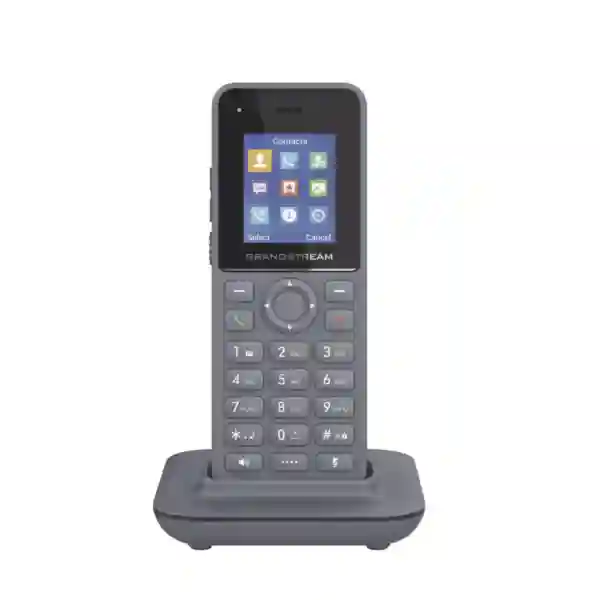
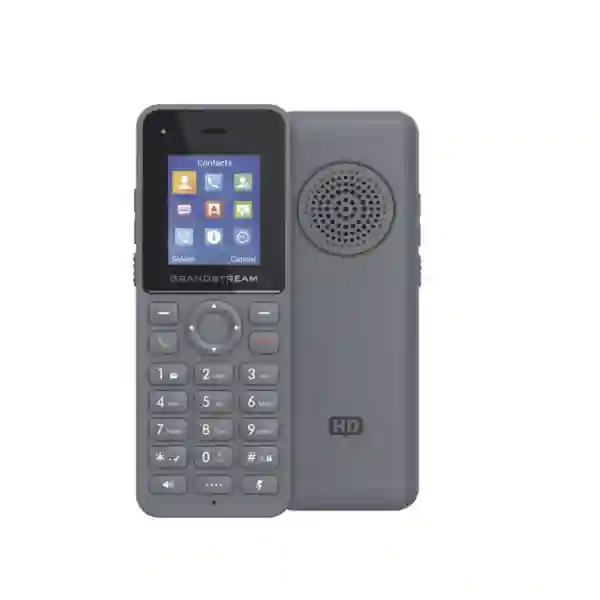
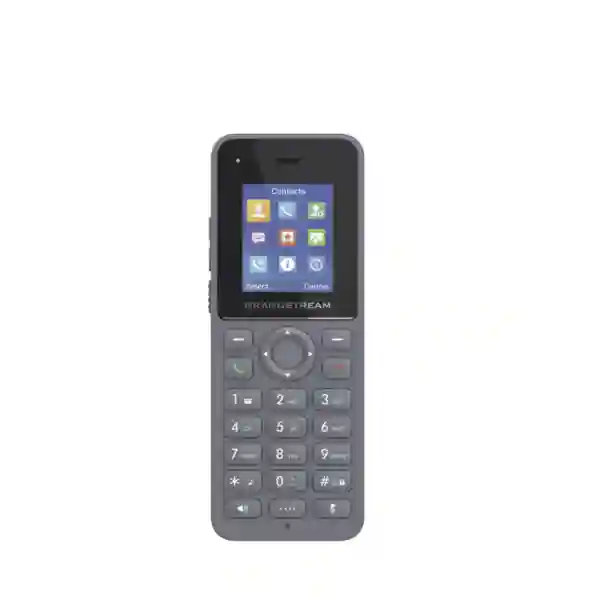
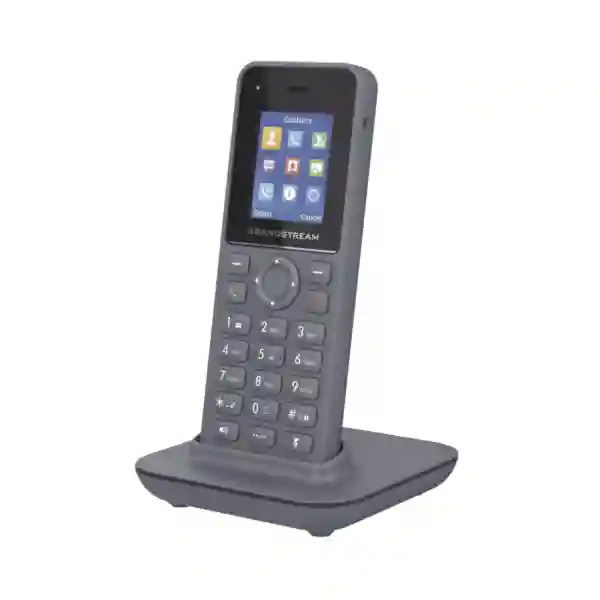
Grandstream DP725 Dubai – DECT Cordless HD Handset for Business Mobility
The Grandstream DP725 Dubai is a cordless DECT HD handset designed for users who need to move around an office, warehouse, retail floor, hospitality property, clinic, school, service area, or home while remaining connected to a SIP-based business phone system. It works with Grandstream DP750, DP752, and DP755 DECT VoIP base stations rather than operating as a standalone Wi-Fi phone. With the right base station, the DP725 can provide up to 400 metres of outdoor range and up to 50 metres indoors, while its 1500mAh rechargeable Li-ion battery is rated for up to 50 hours of talk time and up to 500 hours of standby time under laboratory conditions.
For Dubai buyers, the most important question is not simply whether the handset has a long range. The practical decision is whether the selected base station, SIP account design, expected concurrent-call load, building layout, charging routine, and PBX platform fit the people who will actually use it. Fourteck can help businesses compare the DP725 with other Grandstream DECT handsets, plan handset-to-base ratios, confirm PBX compatibility, and prepare a quotation based on the real deployment rather than treating the handset as an isolated accessory.
128 × 160 colour screen with two programmable soft keys.
Up to 500 hours standby from the 1500mAh Li-ion battery.
Outdoor range with DP752/DP755; indoor range up to 50 m.
Handset line access depends on the capabilities of the companion base.
G.722 HD audio, full-duplex speakerphone, and 3.5 mm headset jack.
The buying decision starts with the DECT base station
A DP725 handset does not connect directly to an Ethernet cable or ordinary office Wi-Fi. It registers over DECT radio to a compatible Grandstream base station, and that base station provides the SIP and network connection. This distinction matters because the base determines system capacity, the number of registered handsets, account mapping, concurrent-call capacity, outdoor coverage, and several provisioning options. A buyer who orders handsets first and considers the base later can easily create an undersized system.
Grandstream lists the DP750, DP752, and DP755 as compatible base stations. The DP750 is an earlier base platform with up to five handsets, up to ten SIP accounts, five concurrent calls, and outdoor coverage of up to 300 metres. The DP752 supports up to five handsets and up to ten SIP accounts, and with the DP725 it can extend outdoor range to up to 400 metres. The DP755 is the higher-capacity choice: it supports up to ten DECT handsets, up to twenty SIP accounts, and up to eight concurrent calls according to Grandstream’s current administration documentation. Those are system ceilings; the right design still depends on how many users may actually talk at the same time.
| Decision point | DP750 | DP752 | DP755 |
|---|---|---|---|
| Registered handsets | Up to 5 | Up to 5 | Up to 10 |
| SIP accounts per system | Up to 10 | Up to 10 | Up to 20 |
| Concurrent calls | Up to 5 | Up to 5 | Up to 8 |
| DP725 outdoor range | Up to 300 m | Up to 400 m | Up to 400 m |
| Typical fit | Existing smaller DP deployments | Small teams needing current long-range support | Larger teams and higher call concurrency |
Maximum range is an environmental test figure, not a promise for every building. Reinforced concrete, metal shelving, lift cores, machinery, glass treatments, radio interference, walls, and base placement can reduce usable coverage.
Who should consider the Grandstream DP725 in Dubai?
The DP725 is most useful when the person carrying the phone cannot stay at a fixed desk. A receptionist who mostly sits at one location may prefer a larger desk phone with more visible line keys. A store supervisor, warehouse coordinator, hotel operations employee, facilities technician, clinic floor coordinator, security supervisor, or service-team member often needs the opposite: the ability to receive and place business calls while walking between work zones. That is the core DP725 use case.
Its 107 g handset weight, belt clip, dedicated Push-to-Talk key, speakerphone, 3.5 mm headset jack, and long battery endurance make it practical for shift-based users. The colour display is compact rather than large; this is a mobility handset, not a touchscreen collaboration terminal. The interface therefore suits people who mainly need reliable call handling, contacts, transfer, forwarding, conferencing, call waiting, intercom, and other standard telephony functions without carrying a larger device.
A sensible way to evaluate the Grandstream DP725 Dubai is to ask five questions: How far does the user move? How many handsets are needed? How many people may talk at the same time? Which SIP PBX or hosted VoIP service will provide the accounts? And how easily can the handset be returned to its charging cradle between shifts? When those answers are clear, the handset and base-station choice becomes much more predictable.
Verified DP725 technical specification snapshot
| Product type | DECT cordless HD handset for compatible Grandstream DECT VoIP base stations |
|---|---|
| Compatible bases | Grandstream DP750, DP752, DP755 |
| Display | 1.8-inch 128 × 160 colour TFT LCD, two programmable soft keys |
| Outdoor range | Up to 400 m with DP752/DP755; up to 300 m with DP750 |
| Indoor range | Up to 50 m |
| Battery | Rechargeable 1500mAh Li-ion; up to 50 hours talk / 500 hours standby under laboratory conditions |
| Charging | Charger cradle plus USB-C port for alternative charging and non-battery operation |
| Audio | HD audio on handset and speakerphone; G.722 and G.726 directly listed, with additional codecs available through the companion base |
| Headset | 3.5 mm headset jack |
| Call features | Hold, transfer, forward, 3-way conference, Push-to-Talk, intercom, call waiting, call log, auto answer, click-to-dial, flexible dial plan |
| Security | DECT authentication and encryption; broader SIP/network security is also influenced by the base station and PBX configuration |
| Provisioning | Software upgrade over the air and handset provisioning over the air; companion base supports centralized provisioning options |
| Dimensions | Handset 135 × 49 × 15.5 mm |
| Handset weight | 107 g |
| Operating temperature | -10 °C to 45 °C; charging range 0 °C to 45 °C |
The important qualifier is that several limits are system dependent. A DP725 paired with a DP752 does not suddenly turn that base into a twenty-account or ten-handset system. Conversely, pairing it with a DP755 allows the deployment to take advantage of the DP755’s higher system capacity. Procurement should therefore treat the handset and base station as one architecture.
Why the 50-hour talk rating changes day-to-day operations
Battery endurance is one of the clearest differences between a mobility handset and a desk phone. Grandstream rates the DP725 for up to 50 hours of active talk time and up to 500 hours of standby time in laboratory conditions. Real results depend on signal strength, call volume, battery age, charging cycles, configuration, and environmental conditions, so buyers should treat those figures as maximum test ratings rather than guaranteed shift duration.
Even with that qualification, the larger battery reserve can simplify charging routines. A warehouse team that carries handsets through long shifts may not want to return them to a cradle every few hours. A hotel engineering or housekeeping coordinator may need the phone available while moving between floors. A retail supervisor may spend much of the day away from a desk. Longer endurance reduces the operational pressure to constantly watch battery percentage, provided the business still establishes a disciplined charging process.
Grandstream also promotes fast charging, stating that a ten-minute charge can provide up to four hours of talk time. This is useful when a handset is picked up at the start of a shift with a low battery, but routine charging should still be designed around the included cradle. For shared devices, label each handset, assign a charging location, check battery condition periodically, and avoid leaving charging responsibility undefined between shifts.
Dubai deployment scenarios: where cordless DECT can solve a real problem
Retail and showrooms
Store supervisors can move between sales floor, stock room, receiving area, and cash-office zones without depending on a fixed desk phone. Incoming supplier, customer, and internal calls can follow the responsible user instead of forcing staff to walk back to a desk. Push-to-Talk can also support quick internal coordination where the feature is enabled and operational policies allow it.
Warehouses and logistics
Warehouse users often work among aisles, loading areas, packing stations, offices, and dispatch zones. A DECT handset can keep voice communication attached to the employee rather than the desk. Coverage should be tested because high metal racks, containers, equipment, and structural barriers can change radio performance even when the open-air range specification looks generous.
Hotels and hospitality
Front-office overflow, engineering, guest-service, housekeeping coordination, and facilities teams may benefit from a handset that remains reachable while staff move. The DP725 is not a rugged waterproof handset, so buyers who need stronger environmental protection should compare it with a ruggedized option rather than assuming every DP-series handset has the same durability.
Clinics and care environments
Administrative and non-clinical teams can use cordless voice to coordinate appointments, reception, facilities, and internal support while moving between rooms. The DP725 is hearing-aid compatible according to the datasheet, but any healthcare deployment should separately assess hygiene policy, device cleaning requirements, emergency calling, coverage, redundancy, and organizational compliance requirements.
Schools and campuses
Administrative staff, operations teams, maintenance, stores, and security desks can use DECT for routine voice communication across defined coverage zones. Large campuses need deliberate base placement and capacity planning. A single impressive outdoor range figure should never replace a site survey when the facility has multiple buildings, dense walls, long corridors, or separate blocks.
SME offices and service teams
Smaller businesses may assign a handset to a manager, support engineer, reception backup, workshop, pantry/service area, or shared duty role. With a DP752 or DP755, the business can combine cordless mobility with existing SIP accounts instead of operating a separate analogue cordless system that sits outside the IP-PBX plan.
A practical architecture: handset, DECT base, LAN, and PBX
The voice path is easier to plan when each layer has a clear job. The DP725 provides the user interface and DECT radio. The DP750, DP752, or DP755 base station connects the cordless system to the IP network and holds the SIP-side configuration. The LAN provides IP reachability to the PBX or service. The PBX, such as a Grandstream UCM platform or another compatible SIP system, provides extensions, trunks, call routing, voicemail, ring groups, permissions, and business dial-plan logic.
This architecture explains why troubleshooting must be systematic. A handset that cannot register may have a DECT subscription problem. A handset that registers but cannot make external calls may have a SIP account, PBX, trunk, dial-plan, network, DNS, or firewall issue. Poor audio could be a coverage problem, LAN quality problem, codec issue, congestion problem, or WAN problem depending on where the impairment occurs. Separating the layers shortens diagnosis.
For new Dubai installations, Fourteck recommends planning the complete voice path before ordering quantities. Confirm extension count, simultaneous calls, base capacity, LAN switch port and PoE strategy where applicable, VLAN/QoS policy, SIP server details, security settings, failover expectations, remote-management policy, and the physical location of the base. Then place handsets according to user roles rather than simply giving every employee the same endpoint.
Range planning in real Dubai buildings
Grandstream specifies indoor range up to 50 metres and outdoor range up to 400 metres with the DP752 or DP755. Buyers should interpret those figures as maximum reference distances in suitable conditions. Indoor radio coverage changes from one property to another. Reinforced concrete, fire doors, lift shafts, metallic partitions, dense storage racks, server-room walls, machinery, tinted or treated glass, and the relative position of the base station all influence the usable footprint.
An open showroom can behave very differently from a warehouse even when both occupy the same floor area. A villa or low-rise office may achieve strong coverage with one centrally placed base, while a long industrial unit can have dead zones despite a shorter straight-line distance. Multi-floor buildings add another variable because vertical propagation is not the same as horizontal open-area coverage. The DP725 itself cannot overcome a poor base location.
The practical method is to identify the farthest and most important user zones, choose a tentative base position, register a handset, and walk the real route while maintaining an active call. Test behind closed doors, in corners, near lifts, in stock areas, across loading bays, and wherever the user must remain reachable. If the deployment uses existing DP750 or DP752 bases, Grandstream also offers DP760 repeaters for certain supported topologies; repeater planning should follow the compatibility and capacity rules of the chosen base platform.
Outdoor range should also be considered with environmental limits. The DP725 is specified for operation from -10 °C to 45 °C and charging from 0 °C to 45 °C. Dubai outdoor temperatures can exceed ordinary electronics operating ranges depending on location, enclosure, direct sunlight, and season. The handset should not be treated as an outdoor-rated device simply because the DECT radio can cover outdoor distance.
HD audio, headset use, and day-to-day call handling
The DP725 supports HD audio on both the handset and speakerphone, with G.722 listed for wideband audio. Grandstream also lists G.726 for narrow-band audio, while codecs such as G.711, G.723.1, G.729A/B, iLBC, and OPUS are supported through the companion DECT base station. The actual codec used on a call depends on the PBX, SIP trunk, peer endpoint, base configuration, and negotiated call path. A handset supporting HD voice does not guarantee that every external PSTN call will remain wideband end to end.
For noisy or hands-busy roles, the 3.5 mm headset jack can be important. It allows a compatible wired headset without relying on Bluetooth. That may suit stock handling, facilities coordination, and office users who prefer a lightweight headset. The handset also includes a full-duplex speakerphone for short conversations or when the user needs hands-free operation in a suitable environment.
Call-control functions cover common business requirements: hold, transfer, forwarding, 3-way conferencing, call waiting, intercom, call logs, auto answer, and flexible dial plans. Push-to-Talk has a dedicated side key, which is more convenient than burying the function in menus. Whether Push-to-Talk is appropriate depends on the team’s workflow and configuration; it should be deployed deliberately rather than treated as a replacement for every two-way-radio scenario.
The 1.8-inch colour screen is intentionally compact. Users who constantly monitor many BLF keys, visual queues, video feeds, calendars, or collaboration apps are better served by a desktop or smart-video endpoint. The DP725’s strength is voice mobility with a familiar keypad and essential call functions.
Security: what the handset protects and what the system still needs
Grandstream lists DECT authentication and encryption for the DP725. This helps protect the radio relationship between handset and base. However, a business voice system has more than one security layer. After the call reaches the base station, the organization still needs to consider administrator credentials, encrypted provisioning, firmware management, SIP signaling protection, media encryption where supported, network segmentation, firewall policy, PBX access control, trunk credentials, logging, and remote-management exposure.
The DP755 documentation, for example, lists features such as TLS, SRTP, HTTPS, 802.1X, and encrypted configuration support at the base level. The security design should be chosen for the whole system and tested against the actual PBX and service provider. Do not assume that enabling one encryption option on one component automatically secures the complete call path.
For managed deployments, change default or factory credentials where applicable, restrict management interfaces to authorized networks, keep supported firmware current, document configuration backups, and control who can register or re-register handsets. If the organization has separate voice and data VLANs, make sure the base station receives the correct IP addressing, DHCP/DNS, QoS, NTP, PBX reachability, and firewall rules. Security settings that are too loose create risk, while settings that are too restrictive can block provisioning or calls; both need structured validation.
Provisioning the DP725 with Grandstream UCM and other SIP systems
Grandstream highlights Zero Config provisioning when its DECT system is used with the UCM series of IP PBXs. This can reduce repetitive manual work in a Grandstream-centered deployment, especially when many extensions and endpoints must be maintained. The DP725 also supports over-the-air software upgrade and handset provisioning, while the base platform provides the network-side configuration and provisioning mechanisms.
A DP725 can also be used with compatible third-party SIP platforms because the base station acts as the SIP endpoint gateway for the DECT handsets. Compatibility should still be confirmed for the required features. Basic registration and calling may work while advanced provisioning, shared-line behavior, directory integration, feature codes, presence, or special PBX functions vary by platform. The correct question is not only “does SIP work?” but “does the complete workflow we need work?”
Before deployment, collect the SIP server or PBX address, extension/account credentials, authentication ID if different, outbound proxy if required, transport and port policy, voicemail access method, dial-plan requirements, emergency dialing policy, time zone, NTP/DNS settings, caller-ID expectations, ring-group design, and codec/security requirements. For larger projects, build and validate one pilot base plus a small number of handsets before replicating the configuration.
That pilot should test incoming and outgoing calls, hold, attended and blind transfer if required, voicemail, DTMF to IVR systems, caller ID, call waiting, conference, roaming within the planned coverage area, battery charging, headset operation, and failover behavior. Document the final settings only after the pilot behaves correctly.
How many DP725 handsets should a business buy?
Quantity planning should start with roles, not headcount. If ten employees work in a branch but only three of them need to move while taking calls, three or four handsets may be more sensible than ten. A shared duty handset can serve a shift role if the organization has a reliable handover and charging process. Conversely, a warehouse or hotel may need more handsets than desks because communication follows people across operational zones.
After identifying users, compare the number of handsets with base capacity. A DP752 supports up to five handsets. A DP755 supports up to ten. If the project has six handsets, the DP755 can be a simpler single-base starting point than designing around a five-handset limit, assuming its radio coverage and call capacity are appropriate. But handset count is only half of the calculation. Concurrent calls can be the real constraint. Six registered handsets do not necessarily mean six simultaneous conversations on every base.
Next, map SIP accounts. Some organizations assign one extension to each handset. Others use shared lines, hunt groups, a common service number, or combinations of personal and shared accounts. The DP755 allows up to twenty SIP accounts at the system level and account-to-handset mapping, giving more flexibility for complex designs. The DP752 is limited to up to ten SIP accounts and five handsets. Match these ceilings to the intended call flow rather than buying on range alone.
Finally, add operational spares only where they solve a real business need. A spare handset can be useful for a 24/7 site, but spare batteries, cradles, belt clips, and replacement devices should be planned according to usage intensity and support policy. Confirm current package contents and accessory compatibility at quotation time.
DP725 vs DP722 vs DP735: choosing by requirement
Businesses often compare DP-series handsets by model number without first defining the work environment. A better comparison starts with endurance, display size, ruggedness, and budget. The DP722 is an earlier 1.8-inch model with up to 20 hours of talk time and up to 250 hours standby according to Grandstream’s current DECT documentation. The DP725 keeps the compact 1.8-inch display but substantially increases the battery rating to up to 50 hours talk and 500 hours standby. That makes it a strong mid-range choice when long shifts matter more than a larger display.
The DP735 moves further toward demanding operational use. Grandstream describes it as a ruggedized DECT handset with a 2.4-inch colour display, IP67 water and dust resistance, antimicrobial casing, drop protection from 2.5 metres, and a larger battery rated for up to 65 hours talk and 650 hours standby. Those features can justify the DP735 for rougher industrial, hospitality, healthcare, or field-style roles. They may be unnecessary for ordinary office, retail, or light warehouse users.
| Requirement | DP722 | DP725 | DP735 |
|---|---|---|---|
| Compact everyday DECT | Good legacy/economy fit | Strong fit | Possible, but may be more than needed |
| Long battery endurance | 20h talk / 250h standby | 50h / 500h | 65h / 650h |
| Larger display | 1.8 inch | 1.8 inch | 2.4 inch |
| Rugged IP-rated use | Not positioned as rugged IP67 | Not positioned as rugged IP67 | IP67 ruggedized |
If the project already uses DP722 handsets, DP725 can be considered where longer endurance is valuable, subject to base-station compatibility and firmware support. If the environment is physically demanding, do not choose DP725 only because it is newer; compare the DP735’s rugged design. Fourteck can help map each role to the most appropriate handset instead of forcing one model across every department.
DP725 versus a normal desk IP phone
A cordless handset is not automatically better than a desktop IP phone. A desk phone usually offers a larger display, easier visual access to multiple line keys, more programmable keys, Ethernet connectivity, and often better ergonomics for users who spend the day seated. It may also act as a two-port Ethernet switch for a nearby PC, depending on model. The DP725 gives up much of that desktop convenience in exchange for mobility.
Choose the DP725 when the user must leave the desk and still answer calls. Choose a desk phone when the user needs high call-control density at a fixed position. Receptionists, contact-centre agents, executives with many monitored extensions, and dispatchers may prefer a feature-rich desktop model. Floor supervisors, technicians, facilities teams, stock coordinators, and roving staff may gain more from DECT.
Many businesses need both. A receptionist can operate a desktop GRP or GXP-series phone while duty managers and floor teams carry DP725 handsets. Ring groups and PBX routing can connect those roles, allowing a call to reach the desk first and then overflow, or ring selected cordless users in parallel. Endpoint selection should follow role design rather than standardizing on one shape of phone for everyone.
Dubai and UAE procurement considerations
When requesting a Grandstream DP725 Dubai quotation, provide more than a handset quantity. Include the number of sites, number of users, existing base-station model if any, PBX or hosted VoIP platform, desired extension plan, expected simultaneous calls, and whether the requirement is a new installation or an expansion. This information allows the quotation to include the right mix of bases, handsets, power accessories, switches, PBX work, and configuration services rather than only the handset line item.
For a Dubai office, a small DP752-based setup may be suitable if five or fewer handsets and five concurrent calls are sufficient. A larger hospitality, warehouse, or multi-department requirement may justify DP755 because it supports more handsets and more simultaneous calls. Existing DP750 users may be able to add DP725 handsets within the base’s capacity and compatibility, but the lower outdoor range and system limits of DP750 should be considered before expanding an older design.
For Abu Dhabi, Sharjah, Ajman, Ras Al Khaimah, Fujairah, and Umm Al Quwain projects, the same technical planning rules apply, but site type often changes the priorities. Industrial properties may focus on range and physical operating conditions. Hotels may focus on staff mobility and shift charging. Clinics may focus on controlled communication and clear handover. Offices may focus on PBX integration, user experience, and support simplicity.
Do not assume a web-listed market price represents the final project cost. DECT deployments can include the base station, handsets, spare or replacement accessories, LAN/PoE work, PBX licensing or subscriptions depending on platform, SIP trunking, installation, configuration, testing, and support. Request a solution quotation based on the intended architecture.
What to check before replacing an older cordless system
A common upgrade project starts with a simple request: replace an old analogue cordless phone or earlier DECT handset. The technical scope can be broader than expected. First identify where the old cordless device is connected. An analogue cordless phone may connect to an FXS port, gateway, or analogue extension. The DP725 belongs to an IP-based SIP architecture through a compatible Grandstream DECT base. Moving to it may therefore change the endpoint, base station, network connection, and PBX configuration at the same time.
Next, list the features users actually rely on. Do they transfer calls to named extensions? Use a shared reception number? Need voicemail indication? Depend on a door phone or paging workflow? Require a common directory? Need to answer the same line from several handsets? Use speed dials or feature codes? A technically successful registration is not enough if the operational call flow changes in a way staff cannot use.
Finally, plan cutover. Register the new base and handset, configure test extensions, validate calls, walk the coverage area, test the production dial plan, train the users, and only then retire the old handset. For critical locations, keep rollback available until the new system has passed real-use checks. This reduces disruption and creates a repeatable method for additional sites.
Installation and registration workflow
Grandstream’s quick-installation guide describes a straightforward subscription process. Power and configure the chosen DP750, DP752, or DP755 base station, then open subscription from the base station’s web interface or by using its Subscribe/Page button. On the DP725, open the menu, navigate to Registration, choose Register, select an available base slot, and start the subscription search. The handset identifies nearby compatible bases so the administrator can select the intended unit.
After the DECT registration succeeds, confirm that the handset is mapped to the intended SIP line or lines on the base. Then test internal dialing, incoming calls, external calls, transfer, hold, voicemail, caller ID, DTMF, conference, and any ring-group behavior. If the deployment uses several handsets, label each one and record the base/handset association so future troubleshooting does not depend on memory.
Charge the battery fully before first use. Grandstream supplies the handset, charger cradle, universal power supply, belt clip, battery, and quick-start material in the standard package described by the datasheet. Package contents and regional power accessories should still be confirmed when ordering. The handset also includes a USB-C port that Grandstream lists for alternative charging and non-battery operation.
Registration is only the first stage. Production readiness includes firmware checks, PBX extension setup, directory and time settings, language, security, call permissions, emergency-calling arrangements, coverage testing, and user handover. Grandstream explicitly notes that emergency-service access requires appropriate SIP service and correct configuration; organizations should define and test emergency dialing according to their local requirements and internal policy.
Network checklist for a stable DECT VoIP deployment
Because the handset uses DECT but the base uses IP networking, voice quality still depends on the LAN and WAN. A reliable deployment begins with correct IP addressing, DNS, NTP, gateway configuration, and access to the PBX or SIP service. If the base receives power through PoE, verify the switch standard and available power budget for the exact base model. If an adapter is used, place it where power is stable and cabling is protected.
Business networks commonly place voice devices in a dedicated VLAN. This can simplify security and QoS, but only when the switch, DHCP, routing, firewall, and PBX path are configured consistently. QoS can prioritize voice packets over less time-sensitive traffic, but it cannot fix a saturated or unstable WAN by itself. Check latency, packet loss, and jitter when diagnosing poor SIP audio.
Avoid placing the DECT base only where an Ethernet socket happens to be convenient. Radio placement and network placement must be solved together. A central elevated position with suitable Ethernet and power can provide better results than a communications cabinet hidden behind dense materials. Where the base must be inside a rack room, test whether the walls and equipment materially reduce coverage before finalizing the design.
For multi-site organizations, standardize naming, extension ranges, firmware policy, backup processes, management access, and documentation. A consistent build makes support easier across Dubai, Abu Dhabi, Sharjah, other UAE branches, and regional locations even when the physical layouts differ.
Limitations buyers should understand before ordering
It is not a standalone Wi-Fi phone. The DP725 requires a compatible Grandstream DECT base. If the requirement is to roam over an enterprise Wi-Fi network, a Wi-Fi handset belongs to a different product category and should be evaluated separately.
The maximum range is not a guaranteed building radius. Real coverage can be lower because of construction, metal, layout, interference, and base location. Test the actual site when mobility is operationally important.
It is not ruggedized to IP67. Grandstream positions the DP735 as its ruggedized IP67 handset. DP725 users in dusty, wet, high-impact, or harsh environments should compare environmental requirements carefully rather than assuming all cordless models have the same enclosure protection.
Line and account capacity depend on the base. Marketing references to up to twenty accounts or lines apply in the supported system configuration, particularly with DP755. A DP752 remains a ten-account, five-handset base platform.
Battery figures are laboratory ratings. Talk and standby time vary with battery age, charge cycles, usage, radio conditions, and configuration. Organizations with long shifts should still build a charging and battery-maintenance routine.
Feature behavior depends on the PBX. Transfer, shared lines, directories, voicemail, caller ID, feature codes, provisioning, and security can behave differently across SIP platforms. Confirm the required workflow before a bulk rollout.
Regional deployment beyond Dubai
The same DECT planning principles apply when Fourteck supports communication projects across the UAE, GCC, and African markets, but the operational requirement changes by site. In Abu Dhabi industrial and institutional locations, a buyer may prioritize defined coverage zones, call concurrency, and documented handover. In Sharjah and Ajman, SMEs may be expanding from one or two cordless users to a small multi-handset SIP environment. In hospitality projects, staff mobility and charging discipline may be more important than advanced desk-phone keys.
For Kuwait, procurement teams often need a clear bill of materials covering bases, handsets, PBX compatibility, and support responsibilities rather than a single product price. For Uganda and Kenya, branch or campus deployments may need additional attention to power stability, network design, local SIP services, and spare strategy. In Tanzania, multi-building environments can make coverage testing more important than theoretical range. Nigeria and Ghana projects may similarly combine voice mobility with wider network modernization.
Regional deployment also affects support planning. A handset is easy to replace; undocumented configuration is not. Keep a record of base model, firmware, handset registration, account mapping, extension numbers, administrator access process, network settings, and PBX dependencies. For distributed sites, use the same logical design where practical while allowing physical radio layouts to differ.
Fourteck’s wider solution resources are available through Grandstream solutions from Fourteck, while broader IP telephony and communication planning can be explored through IP Phone Fourteck. Links are provided for solution context; product availability and project scope should be confirmed at quotation time.
RFQ checklist for Grandstream DP725 Dubai
A useful quotation request gives the technical team enough information to design the DECT system correctly. Sending only “DP725 price” may return a handset price but not answer whether the proposed system will work. Use the following checklist for a project RFQ:
- Number of DP725 handsets required now and expected within the next 12–24 months.
- Existing Grandstream DP750, DP752, or DP755 base stations, including quantity and firmware where known.
- PBX platform, hosted VoIP provider, or Grandstream UCM model.
- Number of SIP extensions/accounts and how they should map to handsets.
- Maximum simultaneous calls expected during the busiest period.
- Building type, approximate floor area, number of floors, and critical coverage zones.
- Whether outdoor yards, loading bays, parking areas, or detached rooms must be covered.
- Need for Push-to-Talk, headset use, shared numbers, ring groups, voicemail, directories, or door/intercom integration.
- LAN VLAN/QoS policy, available switch ports, and PoE availability for the selected base.
- Installation, configuration, testing, user training, and support requirements.
- Delivery location in Dubai/UAE or export destination for regional projects.
With these inputs, the quote can distinguish handset quantity from base-station quantity and highlight any PBX or network prerequisites. This reduces change orders after installation and helps compare alternatives on the same technical basis.
Frequently asked questions about the Grandstream DP725
Does the Grandstream DP725 work without a DECT base station?
No. The DP725 is a DECT handset and must register to a compatible Grandstream DP750, DP752, or DP755 DECT VoIP base station. The base station provides the Ethernet and SIP-side connection to the PBX or hosted VoIP service.
What is the indoor and outdoor range of the DP725?
Grandstream specifies up to 50 metres indoors. Outdoors, it is rated for up to 400 metres with DP752 or DP755 and up to 300 metres with DP750. Real coverage varies with walls, metal, building construction, interference, base placement, and environmental conditions.
How long does the DP725 battery last?
The 1500mAh Li-ion battery is rated for up to 50 hours of talk time and up to 500 hours of standby time under laboratory conditions. Actual battery life varies with use, signal conditions, battery age, charge cycles, and configuration.
How many DP725 handsets can connect to a DP755?
The DP755 supports up to ten compatible Grandstream DECT handsets. It also supports up to twenty SIP accounts and up to eight concurrent calls according to Grandstream’s current administration documentation.
Can I use the DP725 with the DP752?
Yes. Grandstream lists DP752 as a compatible base. DP752 supports up to five handsets, up to ten SIP accounts, and up to five concurrent calls. With DP725, Grandstream specifies outdoor range up to 400 metres and indoor range up to 50 metres.
Does the DP725 support a headset?
Yes. The handset includes a 3.5 mm headset jack. This can suit users who need hands-free calling without relying only on the speakerphone. Confirm headset connector compatibility before ordering accessories.
Does the DP725 support Push-to-Talk?
Yes. Grandstream provides a dedicated Push-to-Talk side button on the DP725. The feature can be useful for quick internal team communication when supported and configured as part of the deployment.
Is the DP725 waterproof or ruggedized?
Grandstream does not position the DP725 as its IP67 rugged handset. Buyers needing stronger water, dust, and drop protection should compare the DP735, which Grandstream describes as ruggedized with IP67 protection and 2.5-metre drop resistance.
Can the DP725 work with a Grandstream UCM IP PBX?
Yes. Grandstream specifically promotes UCM-series Zero Config provisioning with its DECT system. The exact deployment still requires a compatible base station and correct PBX, extension, network, and security configuration.
How do I request a Grandstream DP725 Dubai quotation?
Send Fourteck the handset quantity, base-station model or requirement, PBX platform, number of SIP accounts, simultaneous-call estimate, site layout, and installation/configuration needs. This allows the quotation to cover the complete DECT solution rather than only the handset price.
Plan the DP725 as part of the complete voice system
The strongest reason to choose the DP725 is not a single specification. It is the combination of compact DECT mobility, long battery endurance, HD voice, Push-to-Talk, headset support, and compatibility with Grandstream’s DP base-station family. The strongest reason to plan carefully is that those benefits depend on the base station, SIP/PBX architecture, network, coverage, and user workflow.
For a new Grandstream DP725 Dubai project, Fourteck can help compare DP752 and DP755 base options, estimate handset and concurrent-call capacity, review PBX compatibility, plan site coverage, and prepare a requirement-based quotation. For an existing Grandstream DECT system, provide the current base model and handset count so the expansion can be checked against supported capacity before ordering.
Technical specifications are based on current Grandstream documentation reviewed for this page. Maximum range, battery endurance, account capacity, call capacity, codec use, and feature behavior can vary by base station, firmware, PBX, configuration, environment, and network conditions. Confirm project-specific compatibility and package contents before ordering.

Reviews
There are no reviews yet.