
GRANDSTREAM • ANALOG TO SIP • DUBAI & UAE
Grandstream HT812 v2 Dubai — 2-Port FXS ATA with Dual Gigabit Ethernet
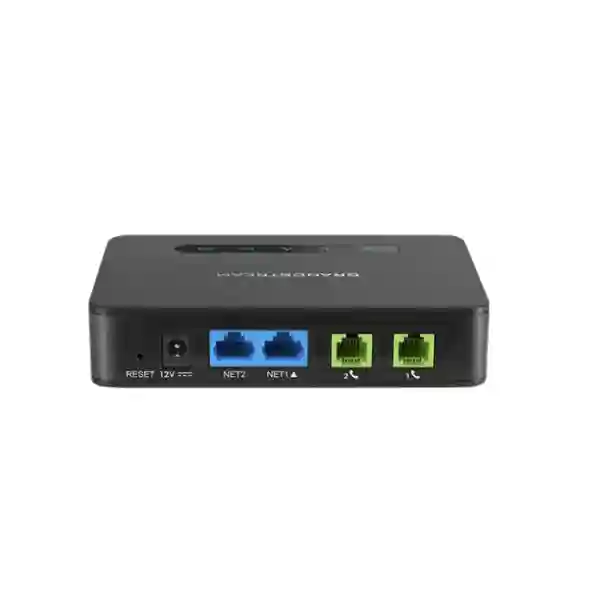
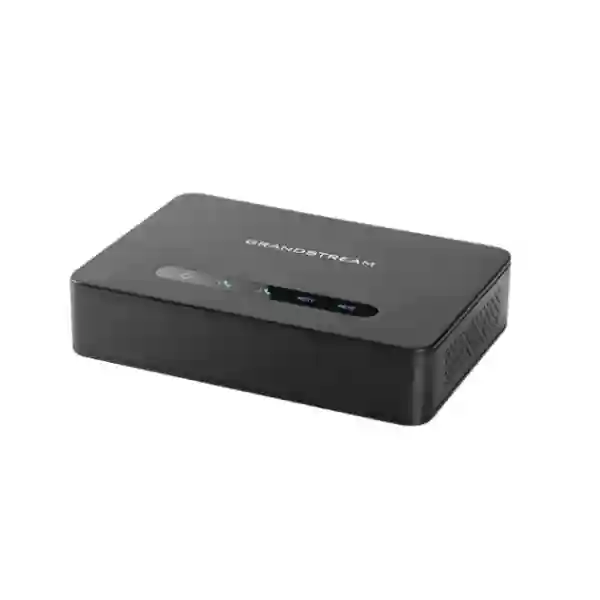
The Grandstream HT812 v2 Dubai page is for businesses that want to keep two compatible analog phones, fax machines or similar approved analog endpoints while moving the surrounding communications platform to SIP. The HT812 v2 combines two RJ11 FXS ports, two SIP profiles and two Gigabit Ethernet ports with an integrated NAT router, giving installers a compact bridge between traditional analog endpoints and an IP-based PBX or hosted SIP service. It also supports T.38 Fax-over-IP, G.722 and Opus wideband codecs, TLS and SRTP, automated provisioning through TR-069 and XML configuration files, SIP-server failover and Grandstream UCM Zero Configuration.
The model is particularly useful when an organization has a valid operational reason to retain analog devices instead of replacing everything with IP phones. Typical projects include a reception desk with legacy handsets, a branch office retaining a fax machine, phased PBX migrations, apartment or hospitality back-office telephony, service-provider deployments and multi-site standardization. The practical buying question is not simply “does it have two ports?” but whether those ports, SIP profiles, routing behavior, security options and provisioning method match the project.
Direct answer: what is the Grandstream HT812 v2 used for?
The Grandstream HT812 v2 is a two-port analog telephone adapter that converts analog telephone interfaces into SIP-based VoIP connectivity. A standard compatible analog telephone or fax machine connects to one of its FXS ports, while the ATA connects to the IP network and registers to a supported SIP server, IP PBX or hosted VoIP platform. In this way, organizations can continue using selected analog endpoints without requiring the surrounding telephony platform to remain analog.
The HT812 v2 is not a two-port FXO gateway for receiving carrier analog trunks. Its two RJ11 interfaces are FXS ports, meaning they provide the analog station-side interface used by phones and fax machines. This distinction matters during migration projects because an analog endpoint and an analog carrier line are not interchangeable. If a requirement involves PSTN analog lines rather than analog telephones, the correct solution may be an FXO-equipped gateway or a different hybrid model.
It is also important to distinguish Ethernet interface speed from routing performance. The HT812 v2 provides two 10/100/1000 Mbps Ethernet interfaces, but Grandstream describes the built-in NAT router as supporting routing speeds up to 100 Mbps. The device can therefore be a useful compact network-and-voice bridge in the right topology, but it should not be specified as a general-purpose Gigabit router for high-throughput office traffic.
Where the HT812 v2 fits in a real business migration
Modern communications projects often include a mixture of new SIP endpoints and older analog equipment. Replacing every analog device is not always necessary or operationally sensible. A working fax machine may be tied to an established process, a reception telephone may be located on existing copper wiring, a branch may have only two simple analog endpoints, or a staged PBX migration may require a temporary bridge between old devices and a new SIP platform. The HT812 v2 addresses that narrow but common requirement without turning the project into a large analog gateway deployment.
For a two-device branch, the design can be straightforward: identify the analog endpoints, allocate the required SIP accounts or PBX extensions, connect the ATA to the network, provision security and codec parameters, and test the complete call path. However, the quality of the deployment depends on more than physical cabling. The network must provide stable IP connectivity, the SIP platform must support the intended registration and media settings, and the analog devices must be suitable for the electrical and signaling characteristics of the FXS interfaces.
A good migration plan also decides whether analog retention is temporary or permanent. Some users can operate effectively on an analog handset because they only need basic calling. Others need IP-phone features such as programmable keys, corporate directories, visible presence, headset integration, multiple line appearances or application integration. Fourteck can help separate users who genuinely benefit from an ATA from users who should move directly to SIP endpoints.
In larger projects, the HT812 v2 may be deployed repeatedly across branches rather than concentrated in one communications room. This distributed model can simplify local endpoint wiring, but it increases the importance of consistent provisioning, credential control, firmware governance, inventory records and support procedures. The model’s TR-069 and XML configuration capabilities, together with Grandstream platform management options, can support repeatable rollout processes where those tools are part of the approved design.

Verified technical capabilities that matter to buyers
| Area | HT812 v2 capability | Why it matters |
|---|---|---|
| Analog interfaces | Two RJ11 FXS ports | Connects two compatible analog phones or fax devices to SIP calling. |
| SIP capacity | Two SIP profiles | Supports separate account/profile planning for the two analog ports. |
| Ethernet | Two 10/100/1000 Mbps RJ45 ports | Provides dual Gigabit network interfaces for flexible placement and LAN/WAN roles. |
| Routing | Integrated NAT router, rated up to 100 Mbps routing speed | Useful for compact topologies, but not equivalent to Gigabit routed throughput. |
| Voice codecs | G.711, G.722, G.723.1, G.729A/B, G.726-32, iLBC and Opus | Provides broad compatibility and wideband audio options where the complete call path supports them. |
| Fax | T.38 Group 3 fax relay up to 14.4 kbps, with G.711 pass-through fallback | Supports fax-retention projects, subject to end-to-end provider and network compatibility. |
| Security | TLS/SIPS/HTTPS control options, SRTP media, AES-based secure provisioning and per-unit certificate | Allows stronger protection when the PBX, provider and management platform are configured compatibly. |
| Provisioning | TR-069, XML configuration and multiple management protocols | Supports standardized deployment and remote administration for fleets. |
| PBX integration | Grandstream UCM Zero Configuration support | Can simplify approved Grandstream-centric deployments. |
| Telephony | Call transfer, forwarding, waiting, hold, DND, caller ID and 3-way conference | Provides common calling functions to analog users when supported by the service configuration. |
| Resilience | Failover SIP server support | Can switch to a secondary SIP server when the primary becomes unavailable, subject to configuration. |
The most important design distinction: FXS is not FXO
The HT812 v2’s two RJ11 ports are FXS interfaces. An FXS port provides the analog line interface expected by a normal analog telephone or fax machine. This is why the HT812 v2 is suitable for retaining analog endpoints when moving to SIP. By contrast, an FXO interface is used to accept an analog telephone service or analog PBX line. Selecting an ATA only by counting RJ11 sockets can therefore lead to a completely wrong order.
Before purchasing, label each analog cable as an endpoint connection, PBX extension, carrier line or specialist device connection. If the project includes an elevator phone, alarm communicator, modem, payment terminal, door system or other non-standard analog equipment, do not assume compatibility merely because the connector is RJ11. Such devices may have timing, voltage, signaling, regulatory or service-provider requirements that need separate validation.
Where the actual requirement is to connect analog PSTN lines into an IP PBX, an FXO gateway may be appropriate. Where both an analog endpoint and analog trunk are required, a hybrid ATA can be more suitable. For projects with four or eight retained analog endpoints, compare the HT814 v2 or HT818 v2 family positions rather than multiplying small adapters without considering management overhead.
HT812 v2 versus HT802 v2: when dual Gigabit Ethernet changes the decision
Both the HT802 v2 and HT812 v2 address a two-FXS-port requirement, so buyers frequently compare them. The primary architectural difference is network connectivity. The HT802 v2 uses a single 10/100 Mbps Ethernet port and is intended to attach to an existing routed network. The HT812 v2 provides two Gigabit Ethernet ports plus built-in NAT routing functionality. This makes the HT812 v2 more flexible when the ATA needs to participate in a small routed topology, sit between network segments in an approved design, or provide two Ethernet interfaces at the installation point.
That extra flexibility does not automatically make the HT812 v2 the better choice for every two-phone installation. If the branch already has a managed router, firewall, switching and VLAN design, a simpler endpoint-only ATA may be easier to integrate. Adding an unnecessary NAT boundary can complicate SIP traversal, addressing, monitoring and troubleshooting. In that case, the network team may still use the HT812 v2 but configure its interfaces according to the existing topology rather than allowing it to become an unplanned router.
Conversely, where two analog endpoints and a compact network handoff are genuinely required, the HT812 v2 can reduce device count. The correct decision depends on network architecture, not marketing language. Fourteck can review the existing router, firewall, switching, VLAN and SIP layout before recommending whether the dual-port model creates a practical benefit.
HT812 v2 versus HT814 v2 and HT818 v2: choose by endpoint density
The HT812 v2 serves two analog endpoints. The HT814 v2 increases FXS capacity to four ports, while the HT818 v2 increases capacity to eight. All three models are part of the HT81x v2 group and share the concept of dual Gigabit Ethernet, SIP-based analog integration, provisioning capabilities and NAT routing functionality. The practical difference is how many analog endpoints should be concentrated at one location.
Two endpoints often fit a small branch, reception zone, manager-and-fax combination or temporary migration point. Four endpoints may suit a small office cluster or a property where several analog room, back-office or utility phones terminate in one cabinet. Eight endpoints may make more sense when a larger analog group is physically concentrated. However, port count should not be evaluated in isolation. Cabling routes, failure domains, rack or desk placement, power continuity and support access all influence whether centralized or distributed ATA placement is easier to operate.
For a twenty-site rollout with two analog endpoints at each site, twenty HT812 v2 units may be operationally cleaner than a few high-density gateways located far from the endpoint wiring. For one building with dozens of analog extensions landing in a telecom room, higher-density gateway hardware may be more appropriate. The decision should therefore follow physical topology and support workflow as well as simple port arithmetic.
Voice quality: what HD codec support can and cannot guarantee
Grandstream lists wideband codecs including G.722 and Opus for the HT812 v2, together with dynamic jitter buffering and line echo cancellation. These capabilities allow the ATA to participate in higher-quality voice paths when the PBX, service provider, far-end endpoint and analog device support the required conditions. They do not mean every call through an analog handset will automatically become wideband HD audio.
The analog telephone itself may have acoustic limitations. The carrier or SIP trunk may transcode to a narrowband codec. A remote network path may introduce loss or delay. The PBX may enforce a different codec preference. Voice quality therefore depends on the entire chain. During commissioning, test local extension calls, inbound and outbound PSTN calls, long-duration conversations and calls under realistic network load. Listen for clipping, echo, one-way audio, delayed DTMF or registration instability.
Network QoS can also matter. The HT812 v2 supports VLAN and priority mechanisms as documented by Grandstream, but quality-of-service settings only help when they are implemented consistently across switches, routers, WAN links and the service edge. A tag configured on the ATA has no value if the network ignores it. For business deployments, align ATA network parameters with the organization’s existing voice VLAN and QoS policy rather than creating isolated settings that no other device recognizes.
Fax-over-IP planning: T.38 is a capability, not a guarantee
One of the strongest reasons to keep an analog ATA in a modern office is fax retention. The HT812 v2 supports T.38 Group 3 fax relay up to 14.4 kbps and can fall back to G.711 fax pass-through. This gives integrators two established methods for carrying fax traffic across IP networks. Successful operation still requires compatible behavior from the fax machine, ATA, PBX, SIP provider, intermediate network and far-end fax service.
A fax project should begin by confirming whether the organization truly needs physical fax. Many workflows can move to secure electronic document exchange, cloud fax or application-integrated services. If physical fax remains a requirement, document monthly volume, inbound and outbound destinations, multi-page document size, international usage and the consequences of a failed transmission. A business that sends one non-critical fax per month has different acceptance criteria from a legal, healthcare or government workflow that depends on documented delivery.
During testing, send and receive multi-page documents, not just a one-page test. Try several external destinations. Verify resolution, completion and retry behavior. Check whether the SIP provider recommends T.38, G.711 pass-through or specific codec settings. If transmission is inconsistent, inspect packet loss, jitter, NAT behavior and transcoding. Do not sign off the deployment after a single successful fax.
Specialist analog devices such as modems, alarm communicators and payment terminals should not be treated as ordinary fax devices. T.38 is designed for fax relay, not as a universal transport for every analog data signal. Obtain device-vendor and service-provider guidance before connecting such equipment.
Security architecture for SIP ATA deployments
The HT812 v2 includes security mechanisms such as TLS for SIP signaling, SRTP for media, HTTPS management options, secure provisioning with encryption, and a unique security certificate per unit. These are valuable capabilities, but security depends on how they are deployed. An ATA configured with weak credentials, exposed management access or an unrestricted public interface remains a risk even if the hardware supports encryption.
Use unique SIP credentials for each service wherever the platform permits. Restrict the management interface to authorized networks. Change administrative credentials from defaults. Keep provisioning files protected because they can contain sensitive configuration. Use encrypted transport when supported by the PBX or provider, and verify certificate behavior instead of disabling validation simply to remove an error. If remote administration is required, use a controlled management platform or secure network path rather than exposing the web interface broadly to the internet.
Firmware management should be part of the operational plan. Grandstream publishes firmware and release information for the HT8xx v2 family. Before upgrading a production fleet, review release notes, confirm hardware-model compatibility, preserve configuration backups and test on a representative unit. Grandstream currently notes that after HT8xx v2 firmware is upgraded to version 1.0.9.3 or later, downgrading to 1.0.7.5 or earlier is not supported. This makes change control especially important for organizations with a large installed base.
Security also includes call-control policy. Restrict international or premium calling where users do not need it. Apply PBX-level fraud detection and logging. Monitor repeated registration failures. Remove unused SIP accounts. When an employee or branch changes, update the extension and credential inventory instead of leaving old accounts active indefinitely.
Provisioning choices for one device, ten devices or a multi-site fleet
A single HT812 v2 can be configured through its web interface, but manual configuration becomes difficult to control as the fleet grows. Grandstream supports automated provisioning methods including TR-069 and XML configuration files. The correct method depends on who owns the devices, where they are deployed, which management platform is approved and how configuration secrets are protected.
For a small office, a documented manual configuration may be sufficient. Record the MAC address, serial number, PBX extension, SIP profile, VLAN, IP addressing mode and administrator ownership. For a larger project, use standardized templates so codec order, dial plans, DTMF method, provisioning URLs, SIP-server redundancy and security parameters are applied consistently. Version those templates and document any site-specific overrides.
Grandstream UCM deployments can use Zero Configuration for supported devices and combinations, which can reduce setup effort. Grandstream’s GDMS ecosystem also supports HT-series management functions. Whether those tools are suitable depends on the organization’s operational model and data-management policies. Fourteck can scope the preferred method before deployment rather than installing devices first and designing management later.
Provisioning should include lifecycle tasks, not only initial setup. Decide how firmware updates will be staged, how failed devices will be replaced, how configuration backups will be stored, and how credentials will be rotated. If a replacement unit arrives at a remote site, the support team should be able to identify the correct configuration without rebuilding it from memory.
Network design: using NET1 and NET2 correctly
The HT812 v2 provides two Ethernet interfaces identified as NET1 and NET2. Grandstream documentation states that by default NET1 acts as WAN using DHCP client behavior and NET2 acts as LAN using DHCP server behavior, and that their roles can be changed in the web interface. This flexibility can be useful, but it also means installers must understand the intended topology before connecting the device.
In a small standalone deployment, the ATA may sit between an upstream internet router and a downstream device. In a managed business network, however, the organization may not want the ATA providing DHCP or NAT. An unplanned DHCP server can disrupt addressing, and double NAT can complicate SIP traffic. The network administrator should therefore decide whether the HT812 v2 will operate as a router, bridge-like endpoint within the approved design, or isolated voice device according to the available configuration modes and network policy.
The presence of Gigabit interfaces is helpful when the device must coexist with a Gigabit LAN, but routed throughput remains a separate specification. Grandstream states that the NAT router can handle routing speeds up to 100 Mbps. If an office expects several hundred megabits or gigabit-class internet performance through the device, place the main data path behind an appropriate enterprise router or firewall instead of assuming the ATA should carry that traffic.
For VLAN deployments, coordinate voice VLAN tagging, DHCP options, DNS, NTP, SIP server reachability and management access. For static addressing, reserve and document the address. For remote branches, verify that firewalls permit the required SIP and media flows without unsafe broad port forwarding. SIP ALG behavior should be tested because some routers modify SIP traffic in ways that create registration or audio problems.
A practical commissioning checklist
1. Inventory the analog endpoints
Record device type, location, user, cable route and current extension or line number. Identify fax machines and specialist analog devices separately.
2. Confirm the SIP platform
Document PBX or hosted provider, SIP server addresses, extension credentials, registration policy, transport and codec requirements.
3. Approve the network role
Decide NET1/NET2 use, DHCP or static addressing, VLANs, routing mode, NAT placement and firewall rules before connecting users.
4. Apply security settings
Change administrative credentials, protect provisioning, restrict management access and use supported secure transports where compatible.
5. Test calling features
Verify inbound and outbound calls, caller ID, DTMF, hold, transfer, call waiting, voicemail access and three-way conferencing as required.
6. Validate fax separately
Send and receive representative multi-page documents using the provider’s supported T.38 or G.711 configuration.
7. Test resilience
Restart the ATA, confirm registration recovery and test secondary SIP server behavior where failover has been configured.
8. Document handover
Record firmware, MAC/serial information, port mapping, configuration ownership, support contacts and approved change procedures.
Common buyer mistakes to avoid
Mistake 1: buying an FXS ATA for an FXO requirement
If the project is about connecting analog carrier lines, the HT812 v2 may be the wrong interface type. Confirm whether every RJ11 cable leads to an analog phone/fax or to a service-provider line.
Mistake 2: assuming dual Gigabit ports mean Gigabit NAT throughput
The Ethernet interfaces support Gigabit link rates, while Grandstream specifies NAT routing up to 100 Mbps. Plan the main data path accordingly.
Mistake 3: assuming fax support guarantees every fax workflow
T.38 is a valuable capability, but the complete provider path must be compatible. Test representative documents before removing the former line.
Mistake 4: treating analog endpoint retention as automatically cheaper
ATA hardware, support, cabling, power and troubleshooting still have costs. Compare the retained device’s business value with moving to a native SIP phone or cloud fax service.
Mistake 5: deploying without a management plan
A few manually configured units can become dozens of undocumented devices. Define provisioning, firmware, backup and replacement processes at the start of a multi-site rollout.
Mistake 6: exposing management interfaces broadly
Use restricted administration paths, secure credentials and approved remote-management methods. Avoid leaving web management open to untrusted networks.
Customer requirement → capability → practical outcome
| Customer requirement | Relevant capability | Practical benefit | Buying consideration |
|---|---|---|---|
| Keep two analog telephones during SIP migration | 2 FXS ports + 2 SIP profiles | Retain selected devices while changing the PBX platform | Confirm PBX/provider SIP compatibility |
| Retain an office fax | T.38 with G.711 fallback | Supports common Fax-over-IP deployment methods | Test end-to-end provider behavior |
| Use stronger SIP security | TLS/SRTP + HTTPS + certificates | Protects signaling, media and management when configured correctly | Both ends must support compatible settings |
| Roll out many branches consistently | TR-069/XML provisioning | Reduces manual configuration differences | Plan secure template and credential management |
| Use a Grandstream UCM PBX | UCM Zero Configuration | Can simplify approved provisioning workflows | Confirm UCM model/firmware support |
| Provide local network handoff | Dual Gigabit Ethernet + NAT | Flexible placement in small topologies | NAT routing is rated up to 100 Mbps |
| Improve resilience | Failover SIP server | Can register to secondary service after primary failure | Requires correctly designed secondary service |
Dubai and UAE deployment considerations
For Grandstream HT812 v2 Dubai projects, the most common commercial questions are compatibility, quantity, configuration scope, delivery requirements and whether site installation is included. A two-port ATA is often ordered as a small accessory, but the project can affect live voice services. Fourteck therefore recommends treating even a small migration as a controlled communications change rather than a simple plug-and-play purchase.
A Deira retail branch may need one analog back-office telephone and one fax endpoint. A JLT or Business Bay office may be moving an old PBX to SIP while keeping a reception handset temporarily. A clinic in Dubai may have an established fax workflow that cannot be removed immediately. In Sharjah, Ajman or Abu Dhabi, a multi-branch organization may need standardized ATA configuration across several sites. These are different operational situations even though they can all use the same hardware model.
The UAE procurement brief should state the existing PBX or hosted service, current analog devices, quantity of HT812 v2 units, required power accessories, destination, installation scope and target date. Where a carrier-managed SIP service is involved, confirm that the service design permits customer-side ATA registration or PBX integration. Do not infer compatibility from the use of SIP alone.
For installations in managed buildings, coordinate access windows, telecom room permissions and network changes before arrival. If the ATA will connect to a corporate VLAN, obtain the network parameters in advance. If the endpoint wiring runs through patch panels or building cabling, label both ends and record the final port map. Good documentation reduces support time months after the installation team has left.
Fourteck can supply and scope the solution subject to current commercial confirmation. Stock, price, warranty, lead time and delivery terms should be confirmed at quotation time rather than assumed from historical listings or third-party reseller pages.
GCC and Africa rollout planning
Organizations in Kuwait, Oman and other GCC markets often coordinate communications purchases from a regional IT team while installation happens at multiple branches. In that model, standardization is more valuable than a low unit price. Define one approved hardware revision, one configuration baseline, one firmware policy and one acceptance checklist. Ship site documentation with the equipment so local technicians know which FXS port maps to which extension and how the network interfaces should be connected.
In Uganda, Kenya, Tanzania, Ghana and Nigeria, multi-site projects may involve varying WAN performance, local power conditions and different support resources. The HT812 v2 can fit branch telephony where two analog endpoints need SIP connectivity, but the deployment plan should account for power continuity, stable routing, DNS/NTP reachability and remote management. If a branch has unreliable WAN service, decide whether local calling must continue during WAN failure and whether the PBX architecture supports that requirement.
For Africa deployments coordinated from the UAE, procurement documentation should separate equipment supply, export logistics, local installation, configuration and post-installation support. Availability, taxes, freight, compliance and warranty handling can differ by destination. Fourteck network resources can support regional planning, but every quotation should define the exact commercial scope rather than assuming identical terms across countries.
For large quantities, create a device register before shipment. Include MAC address, serial number, destination site, assigned SIP profile, support owner and shipping status. This turns the ATA fleet into manageable infrastructure rather than a collection of anonymous black boxes.
When the HT812 v2 is a strong fit — and when to choose something else
Strong fit: two analog endpoints with a clear reason to stay analog
The HT812 v2 is a strong choice when exactly one or two analog devices need to remain in service and the organization wants SIP integration, secure provisioning options and dual Ethernet interfaces. Examples include a fax-plus-phone branch, two basic back-office telephones, phased migration endpoints or service-provider deployments.
Consider HT802 v2: two FXS ports without the same routing requirement
If the network already provides all routing and only a simple two-port ATA is required, compare the HT802 v2. Its single Fast Ethernet interface may be sufficient and may reduce the temptation to insert an unnecessary routing layer.
Consider HT814 v2 or HT818 v2: more analog endpoints at one location
When four or eight analog endpoints are concentrated in one area, higher-port-count HT models may simplify power, cabling and management. Compare failure impact and physical placement before centralizing too many critical endpoints on one device.
Choose an FXO solution: analog carrier lines must connect to IP
If the requirement is to bring PSTN analog trunks into a SIP PBX, FXS ports are not the correct interface. Evaluate Grandstream FXO gateway options or a hybrid model according to the number of lines and lifeline requirements.
Choose native SIP phones: users need richer modern features
If users need programmable keys, directories, BLF, headset integration, multiple account visibility, color displays or application features, a native SIP phone can provide a better long-term experience than preserving a basic analog handset.
Choose cloud fax or digital workflow: physical fax has no operational value
Do not keep analog hardware solely because “it has always been there.” If fax can be replaced by an approved digital service, the organization may reduce equipment, paper, support effort and line troubleshooting.
Quotation checklist for procurement teams
Required quantity of Grandstream HT812 v2 units and destination for each unit.
Number and type of analog endpoints: telephone, fax or other approved equipment.
Existing PBX, SIP server or hosted VoIP provider.
Whether SIP credentials are available and who controls them.
Whether the ATA should perform NAT/routing or attach to an existing managed LAN.
Required VLAN, IP addressing, DNS, NTP and firewall information.
Fax requirements, including destination types and expected monthly use.
Whether provisioning is manual, UCM Zero Config, TR-069, XML or another approved management workflow.
Whether configuration, remote setup, site installation and acceptance testing are required.
Required delivery date and any multi-site staging or labeling requirements.
Current commercial requirements: availability, warranty, shipping, taxes and support scope.
Sending this information with the RFQ allows Fourteck to separate the hardware price from engineering and installation services. It also reduces the chance of receiving the correct model but the wrong project outcome.
Why organizations involve Fourteck
Fourteck approaches ATA projects as part of the communications architecture rather than as isolated accessories. That means starting with the customer requirement, identifying the correct FXS/FXO interface type, confirming the PBX or SIP environment, reviewing the network path and deciding how the device will be configured and supported. This is especially useful for businesses migrating from traditional PABX systems, retaining selected analog devices or standardizing branch communications.
For a straightforward equipment-only requirement, Fourteck can prepare a quotation subject to current availability and commercial terms. For a deployment requirement, the scope can include configuration planning, SIP/PBX coordination, network settings, endpoint mapping, fax testing, user acceptance and handover documentation. For multi-site projects, the design can also include consistent naming, device registers, configuration templates and staged rollout procedures.
Fourteck does not treat third-party web pricing as a substitute for a current quotation. Product revision, quantity, logistics, services, warranty and destination all affect commercial scope. Request written confirmation for the exact model and project instead of relying on historical price listings.
If your requirement is broader than one model, review the Grandstream HT Analog Telephone Adapter Series page to compare FXS capacity and gateway roles before deciding.
Frequently asked questions about Grandstream HT812 v2
What is the Grandstream HT812 v2?
The Grandstream HT812 v2 is a two-port analog telephone adapter with two RJ11 FXS ports, two SIP profiles, dual Gigabit Ethernet interfaces and an integrated NAT router. It is designed to connect compatible analog phones or fax machines to SIP-based VoIP systems.
Can the HT812 v2 connect two analog phones?
Yes. It provides two FXS ports for connecting compatible analog endpoints. Each deployment still needs appropriate SIP/PBX configuration, account assignment and endpoint testing.
Does the HT812 v2 support fax machines?
Yes. Grandstream specifies T.38 Group 3 Fax Relay up to 14.4 kbps and G.711 fax pass-through fallback. Actual fax reliability depends on the fax device, PBX, provider and IP network, so end-to-end testing is required.
Does dual Gigabit Ethernet mean the HT812 v2 routes at 1 Gbps?
No. The Ethernet interfaces support 10/100/1000 Mbps links, while Grandstream states that the built-in NAT router can handle routing speeds up to 100 Mbps. Interface speed and routed throughput should be planned separately.
Can I use the HT812 v2 with a Grandstream UCM PBX?
Grandstream lists UCM Zero Configuration support for the HT812 v2. Confirm the exact UCM model, software version and desired configuration workflow before deployment.
What security features does the HT812 v2 support?
The device supports TLS/SIPS/HTTPS control methods, SRTP media protection, secure automated provisioning and strong AES encryption with a security certificate per unit. These features must be configured compatibly with the PBX, SIP provider and management environment.
What is the difference between HT812 v2 and HT802 v2?
Both models provide two FXS ports. The HT802 v2 has one 10/100 Mbps Ethernet port, while the HT812 v2 provides two Gigabit Ethernet ports plus NAT routing functionality. The better choice depends on the network design, not only the number of analog endpoints.
How do I request a Grandstream HT812 v2 Dubai quotation from Fourteck?
Send Fourteck the required quantity, analog endpoint types, PBX or SIP provider, destination, network requirements and whether you need equipment only, configuration or installation. Fourteck can then confirm the current commercial scope, availability and project requirements.
Plan the two analog ports before you order them
The Grandstream HT812 v2 Dubai is most valuable when it solves a defined transition problem: two analog endpoints need to remain active while the business moves to SIP. Start with the endpoint inventory, confirm the PBX and provider, decide the network role, validate fax requirements, choose the provisioning method and define acceptance tests. That process turns a small ATA purchase into a reliable part of the communications system.
For a quotation or deployment review, provide your site location, endpoint count, current phone system, SIP platform, fax requirement and expected quantity. Fourteck can help compare the HT812 v2 with other HT-series models and identify whether a two-port FXS ATA is the correct fit.



Reviews
There are no reviews yet.