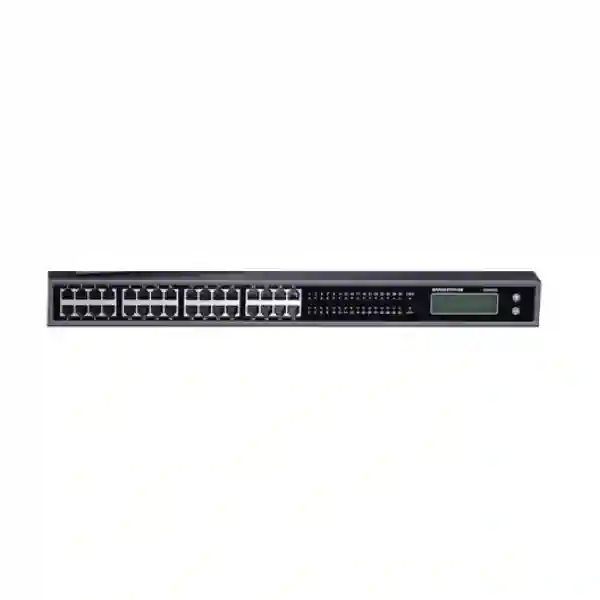
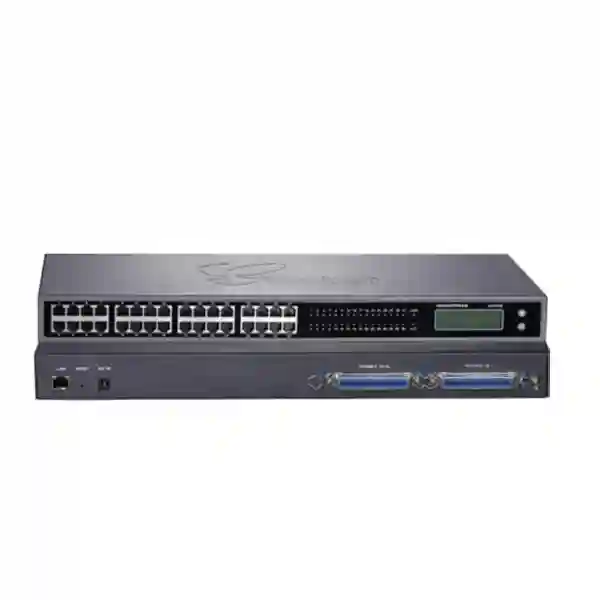
Grandstream GXW4232 V2 Dubai – 32-Port FXS Analog VoIP Gateway
The Grandstream GXW4232 V2 Dubai is a high-density analog VoIP gateway designed for organizations that need to connect a substantial number of existing analog phones, fax machines, elevator phones, hotel-room telephones, legacy PBX extensions, paging endpoints, or other FXS devices to a SIP-based communications environment. It provides 32 FXS ports, 32 SIP accounts across four configurable SIP profiles, Gigabit Ethernet connectivity, front-panel RJ11 interfaces together with two RJ21 telco connectors, and capacity for up to 32 concurrent calls except where secure-media processing can reduce practical concurrency. This makes the GXW4232 V2 especially useful when a business wants to modernize the core PBX or SIP service without replacing every analog endpoint at the same time.
For buyers, the key question is not simply whether the gateway has 32 ports. The more important issue is whether its port density, cabling method, SIP design, fax requirements, security policy, network quality, and future migration plan match the site. Fourteck can help organizations in Dubai and the wider UAE assess these factors, confirm interoperability requirements, plan the analog-to-IP migration, and prepare a suitable quotation without making unsupported assumptions about stock, licensing, or service-provider compatibility.
For analog telephones, fax devices and compatible analog endpoints.
Organized through four configurable SIP profiles for flexible deployment.
Single 10/100/1000 Mbps RJ45 network interface.
32 RJ11 ports plus two 50-pin RJ21 telco connectors for structured analog distribution.
Who should consider the GXW4232 V2?
The GXW4232 V2 is most compelling when a site has roughly 25 to 32 analog endpoints that still provide business value but the organization wants the management, routing and carrier flexibility of SIP. Typical examples include hotels with analog guest-room handsets, hospitals and clinics with legacy room phones, schools and campuses, warehouses, residential towers, staff accommodation, retail groups, industrial facilities, government offices, large villas or compounds, and enterprises that have retained analog extensions for specific operational reasons.
| Customer requirement | Relevant GXW4232 V2 capability | Practical benefit | Buying consideration |
|---|---|---|---|
| Retain many analog phones | 32 FXS ports | Avoids an immediate full endpoint replacement project | Count active and spare ports before selecting the model |
| Use SIP trunks or an IP PBX | SIP support, four profiles, 32 accounts | Enables staged migration into a modern voice core | Confirm PBX, service-provider and dial-plan requirements |
| Preserve structured analog cabling | Two RJ21 connectors plus RJ11 | Supports both direct patching and telco-style distribution | Plan pair mapping and labeling carefully |
| Support analog fax | T.38 fax relay and G.711 pass-through options | Provides migration paths for compatible fax workflows | Fax behavior also depends on SIP provider, PBX and network conditions |
Verified technical profile
Grandstream positions the GXW42xx family as high-density FXS gateways that interoperate with SIP platforms, IP PBXs and softswitch environments. Within that family, the GXW4232 is the 32-port model. The V2 generation is important because it uses V2-specific firmware and can be identified by the model label showing “V2”; V2 hardware also carries a device password on its label. Administrators should therefore treat V1 and V2 firmware as separate and verify the exact hardware generation before any upgrade or recovery procedure.
| Telephone interfaces | 32 FXS ports; 32 RJ11 interfaces; 2 RJ21 50-pin telco connectors |
|---|---|
| SIP capacity | 32 SIP accounts across 4 configurable SIP profiles |
| Concurrent calls | Up to 32 concurrent calls except where SRTP processing affects supported concurrency |
| Network interface | Single 10/100/1000BASE-TX RJ45 LAN interface |
| Voice codecs | G.711, G.722, G.723.1A, G.726, G.729 and iLBC support as documented by Grandstream |
| Fax | T.38 Group 3 fax relay with G.711 pass-through behavior supported by the platform |
| QoS | DiffServ, ToS and 802.1p/Q VLAN tagging features |
| Security | SRTP, TLS/SIPS, HTTPS and 802.1X functions are documented for the series |
| Provisioning | TFTP, HTTP and HTTPS provisioning methods |
| Management | Web management, HTTPS, SSH and Syslog support |
| Display | 128 × 32 pixel LCD |
| Mounting | Desktop or rack-mount deployment |
| Power for 4216/4224/4232 class | 12V DC, 5.0A output from the appropriate supplied power adapter; use the correct Grandstream power supply for the hardware |
Why 32 FXS ports can be the right migration point
A common mistake in VoIP migration projects is to treat every analog endpoint as obsolete. In reality, many analog phones and devices perform simple, reliable roles and may not need to be replaced immediately. The GXW4232 V2 lets an organization move the call-control side to SIP while keeping suitable analog endpoints in service. This can reduce disruption during a PBX migration, help phase capital expenditure, and give the IT team time to decide which users truly need IP phones and which endpoints can remain analog.
The 32-port density is also useful when 24 ports are not enough but a 48-port platform would leave too much unused capacity. The correct choice depends on active port count, growth allowance, redundancy strategy and physical cabling. A site with 26 active endpoints and a realistic need for four to six future ports may fit a 32-port gateway well. A site already close to 32 active analog endpoints may instead need either a second gateway or a higher-density model so that planned growth does not consume every available port on day one.
Analog endpoint migration without changing the whole site at once
The central business value of the GXW4232 V2 is its role as a bridge. On one side, analog endpoints connect to FXS interfaces. On the other side, the gateway registers to a SIP environment such as an IP PBX, hosted voice platform or softswitch, subject to configuration and provider interoperability. This architecture is useful when a business wants modern SIP routing, centralized dial plans, remote administration and trunk flexibility while protecting existing endpoint investments.
For a hotel, the gateway can keep room handsets connected while the back-end telephony platform is modernized. For a school, it can retain classroom analog phones or common-area endpoints while the administration team moves to newer IP phones. For a warehouse, it can connect fixed analog wall phones where replacing cabling or hardware has little operational value. For a hospital or clinic, it can support suitable legacy room phones and other approved analog endpoints while new departments adopt IP endpoints. The same principle applies to residential buildings, labor accommodation, industrial sites and mixed-generation office estates.
The migration plan should still be deliberate. Each analog port should be mapped to a user, room, function or device. Emergency-use endpoints require special attention. Fax lines need testing. Caller ID presentation, DTMF signaling, transfer behavior, ring cadence, hotline or auto-dial requirements and any special analog equipment should be validated. The gateway is not a substitute for a proper design document; it is the component that makes a staged migration technically possible.
Hotels and hospitality
High room counts often leave hotels with a large installed base of analog handsets. A 32-port gateway can form one building block in a phased hotel telephony migration. The implementation should consider room-number mapping, front-desk call flows, wake-up workflows handled by the PBX, emergency dialing policies and the existing MDF/IDF cabling structure.
Campuses and education
Schools and campuses may retain analog phones in classrooms, security desks, halls and service areas. The gateway allows the core call platform to be modernized while endpoint replacement is prioritized by user need rather than by a forced all-at-once refresh.
Warehouses and industrial sites
Rugged or fixed analog sets may still be practical in operational zones. The GXW4232 V2 can connect these endpoints into SIP routing while the IT team keeps office, management and mobile users on newer IP endpoints.
Multi-building properties
Where an existing copper distribution system already reaches many rooms or service areas, RJ21 connectivity can simplify concentration into a communications room. Cable length, pair quality, labeling, surge exposure and local regulations should still be reviewed before deployment.
RJ11 and RJ21 cabling: two practical deployment methods
The GXW4232 V2 supports direct RJ11 analog connections and two RJ21 telco connectors. That combination gives installers flexibility. RJ11 is convenient when individual devices are physically close to the gateway or when a patch-panel design uses separate modular connections. RJ21 is useful when many analog pairs need to be distributed through structured telco cabling, a punch-down field, a breakout panel or an existing building distribution frame.
For larger projects, the cabling plan matters as much as the gateway configuration. Port numbers should be mapped consistently to telephone numbers, room numbers and physical pairs. Labels should exist at the gateway, patch field and endpoint. If an RJ21 breakout is used, pair mapping should be documented before cutover. This makes troubleshooting substantially easier and prevents a simple wiring change from becoming a service-affecting event across many users.
The GXW4232 uses 32 analog pairs across two RJ21 connectors. Pair mapping must follow Grandstream documentation and the installer’s structured-cabling design. Do not assume that an existing telco harness has been terminated to the same numbering convention; verify before connecting live endpoints.
SIP profiles, accounts and call routing
Grandstream documents 32 SIP accounts for the GXW4232 with four configurable SIP profiles. A profile can hold common SIP-server and related parameters while individual FXS ports use their own subscriber credentials. This is useful when many extensions share the same IP PBX or service-provider settings, because administrators can apply common parameters at profile level rather than maintaining every item independently.
Four profiles also provide design flexibility. An organization may separate departments, sites, PBX nodes or provider paths where that matches the telephony architecture. The gateway additionally supports flexible dial-plan behavior and routing functions. The exact configuration should be built around the customer’s numbering plan, local dialing rules, emergency dialing policy, outbound prefix handling and PBX expectations rather than copied from a generic template.
Before commissioning, record the SIP server or outbound proxy address, authentication details, transport choice, registration behavior, DTMF method, codec preference, NAT considerations and any provider-specific requirements. For hosted services, confirm that the provider supports the intended number of registrations and analog gateway use case. For an on-premises PBX, confirm extension licensing and trunk capacity independently because those items are controlled by the PBX or provider, not by the GXW4232 V2 itself.
Voice quality, codecs and fax considerations
A high-density gateway must do more than register 32 ports. Voice quality depends on codec selection, LAN design, WAN performance, jitter, packet loss, latency, QoS, PBX configuration and service-provider routing. The GXW42xx platform supports common telephony codecs including G.711, G.722, G.723.1A, G.726, G.729 and iLBC, as well as echo-cancellation and packet-loss-handling mechanisms documented by Grandstream. These capabilities provide flexibility, but the network still needs to be engineered properly.
For local LAN environments, VLAN and QoS planning can separate or prioritize voice traffic. Grandstream documents DiffServ/ToS and 802.1p/Q tagging capabilities. In a multi-switch network, QoS must be consistent end to end; configuring priority only on the gateway is not enough if the upstream switches, router or WAN service ignore those markings.
Fax deserves separate testing. The series supports T.38 Group 3 fax relay and G.711 fax pass-through behavior, but successful fax transmission also depends on the remote endpoint, SIP carrier, PBX, codec path and network quality. If fax is business critical, include representative inbound and outbound tests during acceptance rather than assuming that a voice call test proves fax reliability.
Security and management checklist
The GXW42xx software platform includes features such as SRTP, TLS/SIPS, HTTPS and 802.1X support, alongside web, SSH and Syslog management functions. These capabilities should be integrated into a wider voice-security policy rather than treated as automatic protection. A secure deployment normally includes strong administrator credentials, restricted management access, current supported firmware, controlled provisioning servers, VLAN separation where appropriate, firewall rules, log collection, configuration backups and change control.
- Confirm that the device is genuinely GXW4232 V2 before selecting firmware; V1 and V2 firmware are different.
- Use the unique device password from the V2 label for initial administrative access, then follow the organization’s credential policy.
- Review the current Grandstream release notes before upgrading because upgrade paths and downgrade restrictions can depend on the starting firmware version.
- Prefer HTTPS for management and provisioning where the surrounding platform supports it.
- Restrict management access to trusted networks and avoid unnecessary exposure of the web or SSH interface to the public Internet.
- Validate SRTP capacity and PBX/provider compatibility if secure media is a mandatory requirement across many simultaneous calls.
GXW4216 V2 vs GXW4224 V2 vs GXW4232 V2 vs GXW4248 V2
The most important difference within the GXW42xx V2 family is analog port density. Selecting the smallest model that barely fits today can create an early expansion problem, while oversizing dramatically may waste rack space and budget. The right choice should account for active ports, spare capacity, growth, cabling and resilience.
| Model | FXS ports | SIP accounts | Physical analog connectivity | Typical fit |
|---|---|---|---|---|
| GXW4216 V2 | 16 | 16 | 16 RJ11 + 1 RJ21 | Smaller analog groups or branch deployments |
| GXW4224 V2 | 24 | 24 | 24 RJ11 + 1 RJ21 | Mid-density sites with fewer than 24 active ports plus growth allowance |
| GXW4232 V2 | 32 | 32 | 32 RJ11 + 2 RJ21 | High-density projects that need more than 24 but not necessarily 48 ports |
| GXW4248 V2 | 48 | 48 | 2 RJ21 connectors; no front-panel RJ11 bank | Very high-density centralized analog distribution |
Deployment workflow for a 32-port gateway project
- Audit analog endpoints. Record every phone, fax machine and special-purpose endpoint, together with room, extension, cable pair and business owner.
- Classify critical functions. Identify emergency phones, security desks, lift/intercom integrations, fax, hotline or auto-dial devices, and any equipment that cannot tolerate extended downtime.
- Confirm the SIP architecture. Decide whether the gateway will register to an on-premises IP PBX, hosted platform or other supported SIP environment, and document the required profiles and credentials.
- Validate the LAN. Check VLANs, QoS, switch uplinks, IP addressing, DNS/NTP access and firewall rules before connecting production endpoints.
- Prepare cabling. Choose direct RJ11 patching or RJ21 distribution, label both ends and keep an accurate port-to-room map.
- Configure a pilot group. Test a small number of extensions first, including inbound, outbound, internal, DTMF, transfer, caller ID and voicemail behavior.
- Test fax and special endpoints separately. These may require different codec, signaling or provider settings from ordinary voice phones.
- Stage cutover. Move logical groups of users rather than all 32 ports simultaneously where operational continuity matters.
- Document the finished system. Save configuration backups, firmware details, port maps, PBX references, test results and support escalation information.
Grandstream GXW4232 V2 Dubai and UAE deployment planning
For a Grandstream GXW4232 V2 Dubai project, the practical design often depends on the building and the existing telecom room. Hotels, business centers, warehouses, clinics, schools and multi-tenant properties may already have copper distribution frames that can be reused. In these environments, the gateway should be positioned where analog cabling, network connectivity, power and maintenance access can be managed cleanly. A rack installation is often preferable in a communications room, while desktop mounting may suit smaller controlled spaces.
Dubai projects also frequently involve a mix of technologies: analog room phones, SIP desk phones, Wi-Fi handsets, mobile clients, contact-center users and SIP trunks may all coexist. The gateway should therefore be viewed as one component of a unified communications design, not as a stand-alone replacement for the PBX. The PBX or hosted platform remains responsible for broader call control, routing policies, voicemail, IVR, reporting and other services.
In Sharjah and Ajman, the same model may be used in warehouses, education facilities, industrial buildings and accommodation projects where existing analog cabling remains useful. In Abu Dhabi, larger enterprise, hospitality, healthcare or institutional deployments may place greater emphasis on structured change control, resilience and security. Across the UAE, customers should verify service-provider requirements, local operational needs and the exact responsibilities of the PBX, gateway and carrier before procurement.
Regional project considerations beyond the UAE
The same migration logic can apply across Fourteck’s wider customer base, but each region has different connectivity, support, procurement and infrastructure conditions. In Uganda or Kenya, a customer may prioritize preserving existing copper cabling and analog phones while introducing SIP gradually. In Kuwait, enterprise and hospitality customers may focus on centralized PBX integration and structured rack deployment. In Tanzania, Nigeria or Ghana, projects may place extra attention on WAN resilience, power quality, local support processes and staged site-by-site rollouts.
Regional availability, delivery, regulatory requirements and service-provider interoperability must always be confirmed for the actual project. Fourteck can use the product specification as the technical starting point, then map the gateway to the customer’s PBX, user count, analog endpoint inventory, cabling and rollout plan.
What to provide when requesting a quotation
A useful quotation request should contain more than the model name. Providing the following information helps determine whether the GXW4232 V2 is the correct fit and reduces back-and-forth during design:
- Number of active analog phones and fax machines today
- Expected analog endpoint count over the next 12 to 36 months
- PBX or hosted SIP platform make, model and version where known
- SIP trunk or service-provider details if already selected
- Whether RJ11 patching or RJ21 telco distribution will be used
- Any fax, emergency, lift, security, paging or special analog devices
- Required installation, configuration, testing or migration assistance
- Site location, rack availability, network VLAN/QoS readiness and cutover constraints
Pricing can vary by region, quantity, channel, project scope and required services. This page therefore does not invent a fixed price or stock status. Request a current quotation based on the exact deployment requirement.
Why engage Fourteck for GXW4232 V2 planning?
A high-density analog gateway sits at the boundary between legacy telephony and IP communications, so buying the correct hardware is only one part of the project. Fourteck can help customers review analog port counts, compare GXW42xx capacities, plan SIP integration, check network prerequisites, organize RJ21/RJ11 cabling, prepare migration steps and define acceptance tests. This consultant-led approach is especially valuable where the gateway will support dozens of room phones or operational endpoints and where a rushed cutover would affect many users.
Customers can also discuss related IP telephony, PBX, switching, Wi-Fi and network requirements through IP Phone Fourteck and broader UAE IT procurement or infrastructure requirements through Fourteck UAE. For deployments outside the UAE, Fourteck’s regional properties can support a country-specific discussion without assuming identical logistics or service conditions in every market.
Frequently asked questions
What is the Grandstream GXW4232 V2?
It is a high-density FXS analog VoIP gateway in Grandstream’s GXW42xx family. The GXW4232 model provides 32 FXS ports and is intended to connect analog telephony devices to SIP-based communications systems.
How many analog ports does the GXW4232 V2 provide?
The GXW4232 provides 32 FXS ports. Grandstream documents 32 front-panel RJ11 interfaces and two RJ21 telco connectors for this model.
How many SIP accounts are supported?
Grandstream documents 32 SIP accounts organized across four configurable SIP profiles for the GXW4232.
Can the GXW4232 V2 handle 32 simultaneous calls?
Grandstream lists 32 concurrent calls for the GXW4232 except when SRTP is used. If a project requires secure media across many ports at the same time, validate the expected concurrency and configuration before deployment.
Does the GXW4232 V2 support fax?
The platform supports T.38 Group 3 fax relay and G.711 fax pass-through behavior. Actual fax performance also depends on the PBX, SIP provider, remote fax endpoint and network quality, so business-critical fax workflows should be tested during commissioning.
What is the difference between GXW4232 V1 and V2?
The V2 hardware is explicitly marked “V2” on the product label and uses different firmware from V1. Grandstream also states that V2 units have a device password printed on the label. Administrators should never assume V1 and V2 firmware are interchangeable.
Can I connect the GXW4232 V2 to an IP PBX?
The GXW42xx family is designed for SIP environments and Grandstream describes interoperability with leading IP PBXs, softswitches and SIP platforms. Exact compatibility and feature behavior should still be checked with the specific PBX version and configuration.
Does it support Gigabit Ethernet?
Yes. The GXW42xx hardware specification lists a single 10/100/1000 Mbps RJ45 LAN interface.
Can I rack mount the GXW4232 V2?
Grandstream documents both desktop and rack-mount deployment for the GXW42xx series.
When should I choose GXW4232 V2 instead of GXW4224 V2?
Choose based on current port count plus realistic growth. If 24 ports do not provide enough capacity, the 32-port GXW4232 V2 may be the better fit. If the site is already close to 32 active analog endpoints, consider whether a 48-port model or multiple gateways would provide healthier expansion margin.
Is the GXW4232 V2 suitable for hotels?
It can be suitable where a hotel wants to keep compatible analog room phones while integrating them with a SIP-based PBX or hosted platform. The project should verify room mapping, cabling, emergency dialing, front-desk call flows and any hotel-specific PBX integration requirements.
Where can I request a Grandstream GXW4232 V2 Dubai quotation?
You can contact Fourteck with the required quantity, analog endpoint count, PBX or SIP platform, cabling preference and installation scope. Fourteck can then prepare a current project quotation and help confirm whether the 32-port model is the right choice.
Plan your GXW4232 V2 deployment with the port count, PBX and cabling in mind
The Grandstream GXW4232 V2 Dubai is best understood as a 32-port migration platform: it preserves useful analog endpoints while moving call control toward SIP. Its combination of 32 FXS ports, four SIP profiles, Gigabit Ethernet, RJ11 access and dual RJ21 connectivity makes it a strong fit for high-density analog estates, but successful deployment still depends on PBX compatibility, network quality, cabling, security and careful cutover planning.
Next action: send Fourteck your analog endpoint count, PBX/SIP platform, site location and cabling requirement to compare the GXW4232 V2 with the GXW4224 V2 or GXW4248 V2 and prepare the appropriate quotation and deployment scope.

Reviews
There are no reviews yet.