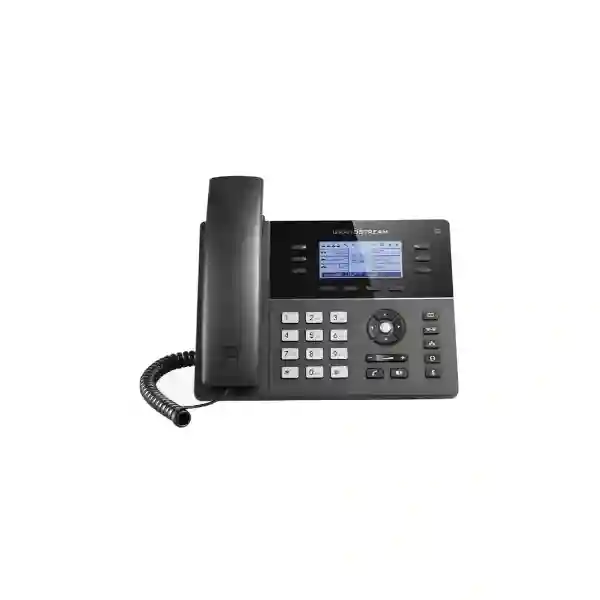
6 Lines · 3 SIP Accounts · PoE · 24 BLF Keys
Grandstream GXP1760 Dubai – Legacy 6-Line IP Phone, Procurement & Replacement Guide
Grandstream GXP1760 Dubai searches now usually represent one of two buyer situations: an organisation needs a matching phone to keep an existing installation consistent, or it is deciding whether an archived GXP endpoint should be replaced by a current Grandstream GRP phone. The GXP1760 remains a capable standards-based business SIP phone on paper, with six line keys, up to three SIP accounts, a 200 × 80 pixel 3.3-inch backlit display, integrated Power over Ethernet, HD audio, 5-way conferencing, a USB data port and 24 digitally programmable BLF or speed-dial positions. Grandstream now lists the GXP1760 in its Product Archive, so lifecycle should influence the buying decision more than an old feature list or an unverified online price.
This page is written as a 2026 procurement, deployment and replacement guide rather than a generic catalogue description. It explains where the GXP1760 still makes practical sense, what should be verified before ordering legacy stock, how to plan SIP/PBX and PoE deployment, why GXP1760 and GXP1760W must not be confused, and when a current GRP-series phone offers a stronger long-term fit. The same logic can be applied to deployments in Dubai, Sharjah, Abu Dhabi, Ajman and the wider UAE, as well as Kuwait, Kenya, Uganda, Tanzania, Ghana and Nigeria.
The first decision: retain the GXP1760, source a matching unit, or migrate?
The GXP1760 was designed for moderate call-volume users who needed more programmable capacity than a basic desk phone. That profile remains common in reception, administration, branch counters, team-lead desks, clinics, schools, hotels, customer service and professional offices. What has changed is lifecycle. Because Grandstream places the model in its archive, a buyer should not evaluate it like a current production endpoint. A legacy unit may be appropriate for continuity, a controlled spare pool, a small extension of an installed fleet or a temporary replacement while a wider migration is planned. A new greenfield deployment needs a stronger reason.
Keep or source GXP1760 when
You already have a stable GXP1760 estate, the PBX and provisioning template are proven, users depend on the same key layout, and procurement can verify condition, firmware, warranty terms and source. Consistency can reduce retraining and configuration work for a small number of replacements.
Move to a current GRP phone when
You are planning a new rollout, replacing many endpoints, need centralised GDMS management, require current-generation security capabilities, want Gigabit Ethernet, Wi-Fi or Bluetooth on selected roles, or expect the phone estate to remain in service for several more years.
Do not decide from price alone
An inexpensive archived endpoint can carry lifecycle cost through uncertain warranty, old firmware, mixed hardware condition, missing accessories or repeated sourcing work. Conversely, replacing every working legacy phone immediately may be unnecessary. Compare total deployment risk and management cost, not only the unit price.
GXP1760 quick facts for procurement and IT teams
6 line keys, up to 3 SIP accounts
3.3-inch, 200 × 80 pixel backlit LCD
24 digitally programmable positions
Dual 10/100 Mbps Ethernet, 802.3af PoE
HD handset and speakerphone
5-way local audio conference
Up to 2,000 contacts; 500 call-log records
Grandstream Product Archive
Important model distinction: integrated dual-band Wi-Fi is a GXP1760W-only feature in Grandstream documentation. The standard GXP1760 should be treated as a wired Ethernet endpoint. If a listing says “GXP1760 Wi-Fi” without a W suffix, verify the exact model before ordering.
What six lines, three SIP accounts and 24 BLF keys actually mean
These numbers describe different capabilities. The GXP1760 supports up to three SIP accounts, meaning up to three registered identities can be configured on the endpoint. The phone also has six dual-colour line keys. Depending on the PBX, firmware and provisioning design, those keys can represent line appearances, accounts, monitored extensions or other functions. Separately, the phone provides 24 digitally programmable BLF or fast-dial positions. BLF, or Busy Lamp Field, is particularly valuable when a user needs to see the status of colleagues and reach or transfer to them quickly.
For a receptionist, office coordinator or team lead, the programmable capacity may be more useful than adding more SIP registrations. A user may have one primary extension and perhaps one department or service identity, while using BLF positions for managers, meeting rooms, sales teams, support desks or shared destinations. The same positions can be used for fast dial and PBX feature functions where supported. The practical value is therefore determined by workflow rather than by headline specifications.
When comparing a replacement, do not look only at the number of physical line keys. Check SIP-account capacity, virtual and physical multipurpose key behaviour, how easily users navigate multiple key pages, PBX provisioning support and whether the organisation wants common templates by job role. A current model can be technically superior yet still require a thoughtful user-adoption plan if the key layout changes significantly.
Verified GXP1760 specification and deployment meaning
| Area | GXP1760 capability | What it means for buyers |
|---|---|---|
| SIP / lines | 6 line keys, up to 3 SIP accounts | Moderate multi-line business use rather than a simple single-account desk |
| Display | 200 × 80 pixel, 3.3-inch backlit LCD | Functional legacy interface; not a current colour-screen experience |
| Programmability | 4 XML context soft keys plus 24 BLF / fast-dial positions | Useful for reception, supervisors and call-routing roles |
| Ethernet | Dual auto-sensing 10/100 Mbps ports | Voice is fine, but PC pass-through can limit a Gigabit workstation |
| PoE | Integrated IEEE 802.3af PoE | One network cable can provide power and network when the switch supports PoE |
| Codecs | G.711, G.722, G.729A/B, G.726, G.723, iLBC, Opus | Codec policy should match PBX, SIP trunk and WAN design |
| Audio | HD handset and full-duplex speakerphone | Appropriate for normal business calling and hands-free use |
| Conference | 5-way local audio conferencing | Useful for ad-hoc calls, not a replacement for a full meeting platform |
| Headset | RJ9; EHS support documented for compatible Plantronics headsets | Verify the exact headset and EHS accessory before volume purchase |
| Provisioning | TFTP/HTTP/HTTPS, TR-069, AES-encrypted XML configuration | Supports structured deployment and existing provisioning workflows |
| Security | TLS, SRTP, 802.1X, encrypted config, admin/user credentials | Use within a wider network and PBX security policy |
| Wi-Fi | Not integrated on standard GXP1760; Wi-Fi is GXP1760W-only | Exact suffix verification is essential for wireless projects |
Network planning: PoE is useful, but 10/100 Mbps pass-through can matter
The GXP1760 includes dual switched 10/100 Mbps Ethernet ports with integrated PoE. A common desk design uses one cable from a PoE switch to the phone and the second Ethernet port to pass network access to a PC. Voice traffic itself needs only a fraction of 100 Mbps, so the phone is not bandwidth constrained for calling. The concern is the computer behind it. If a modern workstation depends on the phone’s downstream port, the Fast Ethernet interface can become the limiting link for that workstation.
In an existing office where the PC has a separate data port, this may not matter at all. In a newly designed office where the phone is expected to feed the workstation through one structured-cabling outlet, a current phone with Gigabit Ethernet often creates a cleaner long-term design. The endpoint decision should therefore consider the whole desk network rather than the voice device in isolation.
Voice quality also depends on VLAN design, PoE budget, DHCP, DNS, NTP, QoS, WAN quality, firewall policy and SIP/PBX configuration. The GXP1760 supports Layer 2 and Layer 3 QoS mechanisms, but marking traffic at the endpoint only helps when switches, routers and WAN devices apply a consistent policy. Branch offices should also test registration recovery after Internet, VPN or SD-WAN failover.
HD audio, speakerphone, headset and conference considerations
Grandstream specifies HD audio on the handset and speakerphone and includes wideband codecs such as G.722. Real call quality is an end-to-end result. Both endpoints, PBX codec negotiation, SIP trunk capabilities, WAN conditions and room acoustics influence what users hear. A wideband phone cannot create a wideband call when the remote endpoint or provider forces narrowband audio. Codec policy should therefore be reviewed during configuration rather than left to default combinations that may not suit the network.
For call-heavy users, headset compatibility can be more important than the handset. The phone provides an RJ9 interface and documentation references EHS with compatible Plantronics headsets. Organisations using Jabra, Poly/Plantronics or other headset estates should confirm the exact model, cable or EHS adapter and firmware behaviour. Accessory replacement can influence the real cost of staying on a legacy endpoint.
The five-way local conference feature is useful for quick collaboration, but it should not be confused with a full conference bridge or modern meeting platform. Larger meetings, scheduled conferences, recording, external guest management, video and analytics should normally be handled by the PBX or collaboration service. For a manager or branch coordinator who occasionally merges a few callers, local conferencing remains convenient.
PBX integration and provisioning: where legacy continuity can help
Grandstream documents firmware and provisioning through TFTP, HTTP, HTTPS, TR-069 and AES-encrypted XML configuration. The GXP1760 also integrates with Grandstream UCM-series IP PBX platforms, where Grandstream has provided Zero Config capabilities for supported endpoint deployments. If an organisation already has a stable GXP1760 template, keeping the same model for a few replacement desks can reduce rollout effort because SIP accounts, BLF keys, dial plans and feature settings have already been validated.
Third-party PBX use should be treated as a standards and current-support question, not assumed from an old reseller list. The GXP1760 supports SIP and a broad set of related protocols, so it can be configured with standards-based SIP systems, but automatic provisioning templates, BLF behaviour, directories, feature codes and firmware requirements depend on the PBX platform and version. For 3CX, Asterisk-based systems, hosted services and other platforms, check the PBX vendor’s present endpoint-support guidance before making the GXP1760 a new standard.
A migration to GRP should capture the user role rather than blindly copy the old configuration. Document SIP identities, monitored extensions, speed dials, shared lines, headset, VLAN, codec policy and any PBX feature keys. Then design the current-phone template around what users actually need. This avoids carrying years of unused configuration into a new endpoint standard.
Security checklist for an archived SIP endpoint
The GXP1760 specification includes TLS, SRTP, 802.1X, user and administrator passwords, encrypted configuration capabilities and a Kensington security slot. Those features are useful, but security is not determined by a protocol list. The practical questions are whether the organisation has an approved firmware baseline, strong administrator credentials, protected provisioning, secure SIP registration, segmented voice networking, controlled management access and an inventory process that identifies phones outside policy.
Before redeploying an existing unit
Reset and re-provision it under the current template, review firmware, replace old credentials, remove previous account and directory data, confirm NTP/DNS behaviour and test the call functions required by the user role.
Before buying legacy stock
Ask about condition, accessories, firmware access, warranty source, return process, batch consistency and whether the unit is GXP1760 or GXP1760W. A model name in an online listing is not enough for controlled procurement.
For a larger fleet, lifecycle management becomes a stronger argument for current endpoints. Current GRP professional phones are designed for mass deployment with GDMS and, depending on model, include newer security mechanisms such as secure boot, dual firmware images and encrypted data storage. This does not automatically make a functioning GXP1760 unusable; it means its support and management burden should be assessed against the organisation’s current policy.
Where the GXP1760 can still fit
Reception and front desk: The 24 programmable BLF or fast-dial positions can make the phone useful for monitoring frequently called extensions and routing calls. A current colour-screen model may be easier for a new user, but an experienced receptionist can value continuity when the same BLF layout is already familiar.
Managers and supervisors: Users needing multiple identities, quick internal access, speakerphone and headset support can match the original GXP1760 profile. If the user now expects Bluetooth headsets, integrated Wi-Fi, mobile contact synchronisation or a larger colour display, a current GRP phone will generally fit better.
Branch offices: A branch with a proven SIP or UCM configuration may prefer like-for-like replacement when only one or two phones fail. If the branch is already refreshing switching or WAN services, that project can be the right time to move to Gigabit-capable current endpoints and a central management standard.
Hotels, clinics, schools and professional offices: Administrative desks may use the multi-line and BLF capabilities, while ordinary rooms or low-call-volume users usually need simpler endpoints. Role-based phone selection is more efficient than deploying one model everywhere.
Temporary spare pool: Archived units can be useful as controlled spares until a planned migration. This is preferable to purchasing a different replacement model each time a legacy phone fails. The spare pool should be tied to a clear migration end state.
GXP1760 compared with current Grandstream GRP choices
A replacement should be selected by requirement rather than by model-number similarity. The current GRP family covers different line, account, programmable-key and connectivity needs. The examples below are comparison points, not guaranteed one-for-one substitutes, and regional availability should be confirmed.
| Model | Why compare it | Key change from GXP1760 | Best-fit question |
|---|---|---|---|
| GXP1760 | Legacy continuity | 6 lines, 3 SIP accounts, 24 BLF, 10/100 Ethernet | Do we need identical behaviour for an installed estate? |
| GRP2613 | Current six-key professional endpoint | Current GRP management/security architecture and Gigabit Ethernet | Do we need a simpler current phone without integrated Wi-Fi? |
| GRP2614 | Dual display and richer connectivity | Colour display, Gigabit, Wi-Fi, Bluetooth, GDMS | Do users want a modern visual and wireless experience? |
| GRP2616 | Six line keys with much higher account capacity | Up to 16 SIP accounts, larger colour LCD, Wi-Fi, Bluetooth, Gigabit | Are we upgrading a heavy multi-account user? |
| GRP2634 | High programmable-key requirement | 8 lines, 12 SIP accounts, extensive VPK/MPK capacity, Gigabit, Wi-Fi and Bluetooth | Does the role need more monitored contacts and current management? |
Build the shortlist around the actual desk. Count active BLF destinations, check whether a PC passes through the phone, identify headset type, define Wi-Fi/Bluetooth policy, confirm PBX support and decide whether centralised device management is a requirement. Different roles in the same office can legitimately use different current models.
GXP1760 versus GXP1760W: verify the suffix before procurement
Grandstream groups the GXP1760 and GXP1760W in the same family documentation, which is why reseller descriptions sometimes blur the two. Both share the general six-line, three-account mid-range platform, but the W version adds integrated dual-band Wi-Fi. The standard GXP1760 should be planned as a wired phone. If an online listing claims Wi-Fi for “GXP1760” without the suffix, verify the label or original manufacturer description before ordering.
The distinction is especially important in temporary offices, retail counters, refurbished sites and areas without structured cabling. Even where Wi-Fi exists, a fixed desk phone is often kept on Ethernet because PoE, VLAN and QoS are simpler to manage. The network architecture should determine the choice.
If wireless connectivity is the main reason for considering GXP1760W, compare current GRP Wi-Fi models at the same time. A current model may combine wireless access with Bluetooth, Gigabit Ethernet, GDMS and a modern security architecture, making the broader lifecycle decision more important than the W suffix alone.
Before requesting a GXP1760 quotation in Dubai or the UAE
A useful quotation request should include more than “GXP1760 price.” Start with quantity and location, then state whether the phones are replacing failed units, expanding an existing fleet, being held as spares or intended for a new deployment. Add the PBX platform and version if known, whether PoE is available, and whether users depend on BLF layouts or a specific headset.
Because the model is archived, also ask for the condition and commercial basis of the offered units. Are they new old stock, open-box, refurbished or another condition? What warranty is provided and by whom? Are the power adapter, stand, handset cord and network cable included? Is there a DOA or return process? For a larger quantity, can all units be supplied in consistent condition? These questions are more important than comparing a single online price.
If suitable legacy stock is not available, the quotation should turn into a replacement proposal rather than substitute a random phone. Compare SIP accounts, line keys, BLF count, display, Ethernet speed, PoE, Wi-Fi, Bluetooth, headset, PBX support and management method. For a mixed estate, it can make sense to quote a small quantity of legacy replacements plus a phased GRP migration plan.
GXP1760 deployment checklist
Verify GXP1760 versus GXP1760W, condition, accessories and label details before provisioning.
Use the organisation’s approved firmware baseline and controlled upgrade procedure.
Confirm 802.3af power, switch budget, voice VLAN and QoS policy.
Fit user identities within the three-account capacity and remove unused registrations.
Group monitored extensions by user role rather than copying years of unused keys.
Validate inbound/outbound calls, transfer, hold, pickup, voicemail, DTMF, conference and failover.
Confirm audio, mute and EHS behaviour with the exact headset/accessory combination.
Define the current GRP replacement for each user role so emergency purchases do not create an uncontrolled mixed estate.
Dubai deployment scenarios
Business Bay and DIFC professional offices: A manager or office coordinator may have inherited the GXP1760 as part of an older PBX system. If the desk uses separate Gigabit data and phone ports, 10/100 Ethernet may not matter. The decision then centres on lifecycle, headset needs and management. During an office refresh, current GRP phones can align better with modern endpoint administration.
JLT and Dubai Internet City technology teams: These environments often prioritise VLAN design, central provisioning and endpoint consistency. A few GXP1760 spares can be reasonable, but a new mass deployment should compare GDMS, current security features and Gigabit Ethernet. PC pass-through is particularly important where one desk outlet serves both phone and workstation.
Deira and Bur Dubai trading offices: Reception and sales desks can benefit from BLF and rapid transfer keys. Like-for-like replacement can preserve workflow when one phone fails. For an office move or PBX refresh, map the existing BLF pattern and choose a current model with enough programmable capacity rather than buying legacy phones solely because the interface is familiar.
Jebel Ali and logistics sites: Administrative desks may need strong call handling while operational staff may rely on DECT, Wi-Fi voice or mobile devices. Separate fixed-desk requirements from mobility needs instead of standardising a desk phone in areas where it does not fit.
Abu Dhabi, Sharjah and Ajman deployment logic
Abu Dhabi: Enterprise, institutional, education and professional-services projects often prioritise lifecycle documentation and repeatable rollout. An archived endpoint can remain in a controlled installed base, but expansion should have a defined current standard. Multi-site projects benefit from one replacement matrix rather than site-by-site buying.
Sharjah: Manufacturing, education, trading and service organisations often combine offices with operational areas. The GXP1760 can serve administrative desks where wired PoE is available. If the network is being refreshed to Gigabit switching, current phones can prevent the voice endpoint becoming the throughput bottleneck for a connected PC.
Ajman and the Northern Emirates: SMEs may prioritise continuity and controlled cost. The strongest plan is often to keep working phones that meet policy, maintain a small verified spare pool and use a staged migration standard for future failures and expansion. This avoids both unnecessary replacement and indefinite dependence on archive stock.
Regional procurement across UAE, Kuwait, Kenya, Uganda, Tanzania, Ghana and Nigeria
The technical selection logic is similar across regions, but stock, warranty source and commercial conditions should never be assumed to be identical. Archive-product availability can vary sharply by country. One market may have unused stock while another has only refurbished units or no dependable source. Define the exact model, acceptable condition, quantity, accessories, warranty expectation and current-model alternative before requesting a regional quote.
Kuwait: For branch and office deployments, consider whether new locations are being standardised on current GRP phones. Legacy matching can be sensible for a small extension, but a multi-year rollout should not depend on unpredictable archive stock.
Kenya: Nairobi headquarters and distributed branches benefit from a clear standard desk, reception and executive-phone hierarchy. Existing GXP1760 units can remain under a controlled spare strategy while new sites adopt the current standard. WAN quality and power resilience can matter as much as the endpoint itself.
Uganda: Kampala offices, schools, clinics, NGOs and businesses should map endpoints by role and infrastructure. Where PoE and structured cabling are already available, the wired phone is straightforward. A PBX or switching upgrade can be a natural point to migrate away from archived endpoints.
Tanzania: Dar es Salaam businesses and regional operations need predictable support across sites. A mixed GXP/GRP environment should have documented templates and replacement rules so repeated emergency purchasing does not increase complexity.
Ghana and Nigeria: As branch counts grow, standardisation, remote provisioning and inventory visibility become more important. Current GRP endpoints and GDMS can be attractive for that reason, while functioning GXP1760 units can remain in controlled roles until planned migration.
For related Fourteck coverage, review Grandstream supplier coverage in the UAE, plus Fourteck regional sites for Kuwait, Kenya, Uganda, Tanzania, Ghana and Nigeria.
How to phase a GXP1760 migration without disrupting users
Start by classifying users: basic callers, receptionists, supervisors, executives, call-heavy staff and special roles. Record how many SIP accounts, BLF destinations and feature keys each role actually uses. Many GXP1760 users may use only a small part of the phone, while a few rely heavily on BLF. This allows replacement models to be matched to roles rather than forcing one expensive device everywhere.
Build and test current-model provisioning templates with a pilot group. Validate registration, inbound and outbound calling, transfer, hold, voicemail, pickup, BLF, directory, conference, headset, VLAN, QoS and failover. Collect user feedback on the new key layout. A technically correct replacement can still slow down a receptionist if programmable keys are poorly designed.
Migrate at natural business events such as office relocation, PBX upgrade, switch refresh, endpoint failure, department expansion or support-policy change. Working GXP1760 phones removed from lower-risk desks can become controlled spares for the remaining legacy fleet, reducing the need to buy unknown archive stock.
Define an end state. Set a date or condition after which no additional GXP1760 phones will be introduced even if inexpensive stock appears. This prevents the organisation from accidentally extending the legacy estate indefinitely while still allowing working equipment to be used responsibly.
GXP1760 price: compare the total project, not a permanent online number
There is no responsible permanent “GXP1760 Dubai price” for an archived product. Pricing can change with source, quantity, condition, accessories and warranty. A new-old-stock phone, open-box phone and refurbished phone are not equivalent commercial items even when the model number is the same. Large quantities also change the sourcing route and batch-consistency risk.
Endpoint price is only one part of project cost. Add PoE switching where required, cabling, PBX licences or subscriptions where applicable, configuration time, provisioning, headset accessories, replacement power supplies, shipping, taxes and support. For current GRP migration, also consider operational value from central management, Gigabit Ethernet and current security features. A device that costs more to buy can cost less to manage across a large fleet.
For an efficient Fourteck quotation, send quantity, location, target date, exact model, acceptable condition, PBX platform, PoE availability, headset requirement and whether current-model alternatives are acceptable. If alternatives are acceptable, specify the non-negotiable capabilities so the comparison remains relevant.
Common buying mistakes
Confusing GXP1760 with GXP1760W: integrated Wi-Fi belongs to the W variant.
Assuming six lines means six SIP accounts: the phone supports up to three SIP accounts.
Ignoring Product Archive status: a legacy phone can work well, but lifecycle must be part of procurement.
Comparing only unit price: add condition, warranty, accessories, management effort and future replacement continuity.
Using the phone as a Gigabit pass-through: its Ethernet ports are 10/100 Mbps.
Assuming every PBX auto-provisions it: SIP standards support does not guarantee current vendor templates or identical feature behaviour.
Choosing a replacement without mapping the user role: a cheaper current phone can be a functional downgrade for a receptionist, while a high-end phone may be unnecessary for a normal office user.
What a Fourteck compatibility review should capture
For a GXP1760 continuity or migration project, capture the PBX brand and software version, SIP server method, extension count, authentication approach, codec policy, trunk type, voice VLAN, switch model, PoE standard, DHCP options, provisioning server, headset models, BLF requirements, shared-line behaviour and special feature codes. For UCM deployments, include the UCM model and firmware. For third-party PBX environments, note whether phones are manually configured or provisioned by template.
For multi-site organisations, also document VPN, SD-WAN, MPLS or direct-Internet topology, plus DNS/NTP and WAN-failover behaviour. A phone can work perfectly at headquarters yet behave differently in a branch where NAT, firewall, DHCP or QoS policies differ. Central management becomes more valuable as the number of sites grows.
The review should finish with a decision matrix rather than a list of facts. Classify each role as retain GXP1760, legacy replacement permitted, migrate on failure or migrate now. Map each migration role to a current-model shortlist and note required changes in BLF layout, headset accessory or network configuration. This turns an archive-product purchase into a controlled lifecycle programme.
Frequently asked questions about Grandstream GXP1760 Dubai
Is the Grandstream GXP1760 still a current model?
Grandstream lists GXP1760 in its Product Archive. Treat it as a legacy model and confirm actual availability, condition, warranty and support requirements before purchase.
How many SIP accounts does GXP1760 support?
It supports up to three SIP accounts and has six dual-colour line keys. Line keys are not the same as SIP registrations.
Does GXP1760 have Wi-Fi?
The standard GXP1760 is wired. Integrated dual-band Wi-Fi is a GXP1760W feature, so verify the model suffix where wireless connectivity is required.
Does GXP1760 support PoE?
Yes. Grandstream specifies integrated IEEE 802.3af PoE. The switch must provide appropriate PoE and sufficient power budget.
How many BLF or fast-dial positions are available?
The phone provides 24 digitally programmable and customisable BLF or fast-dial positions.
Can GXP1760 be used with a Grandstream UCM PBX?
Grandstream documents integration with UCM-series IP PBX platforms, including Zero Config capability for supported deployments. Validate UCM firmware, phone firmware and required features in the actual environment.
Can it work with other SIP PBX systems?
It supports the SIP standard, but PBX-specific auto-provisioning, BLF, directory and feature behaviour depend on the PBX platform and current support policy.
Does GXP1760 have Gigabit Ethernet?
No. It uses dual 10/100 Mbps Ethernet ports. Voice traffic is not a problem, but a PC connected through the phone can be limited to Fast Ethernet.
Which current Grandstream phones should be compared as replacements?
Depending on the role, compare current GRP models such as GRP2613, GRP2614, GRP2616 and GRP2634 for line keys, SIP accounts, BLF capacity, Gigabit Ethernet, Wi-Fi, Bluetooth and GDMS management.
What should I send for a Fourteck quote?
Send quantity, delivery location, PBX platform, replacement/new-deployment context, PoE availability, headset requirement, BLF/key needs, acceptable product condition and whether current-model alternatives can be quoted.
Request a GXP1760 compatibility, sourcing or migration review
If your requirement is specifically for Grandstream GXP1760 Dubai, identify whether you need exact legacy units, a spare quantity, replacement for failed phones or a full upgrade path. The discussion should be based on SIP accounts, BLF usage, PBX platform, PoE, desktop Ethernet, headset compatibility, provisioning method and delivery location.
For a new project, request a side-by-side recommendation against suitable current GRP models. For an existing legacy estate, request a phased migration matrix rather than an all-or-nothing replacement. This keeps the immediate requirement practical while protecting the long-term endpoint standard.
Lifecycle and specification note: Technical positioning is based on Grandstream’s published GXP1760/GXP1760W product resources and GXP17xx documentation. Grandstream currently lists GXP1760 in its Product Archive. Product condition, stock, warranty, firmware support, third-party PBX compatibility and regional commercial terms must be confirmed for the specific project. Wi-Fi references apply to GXP1760W where stated, not the standard GXP1760.

Reviews
There are no reviews yet.