Grandstream GHP631W Dubai: Wi-Fi 6 Hotel IP Phone for Modern Guest Rooms
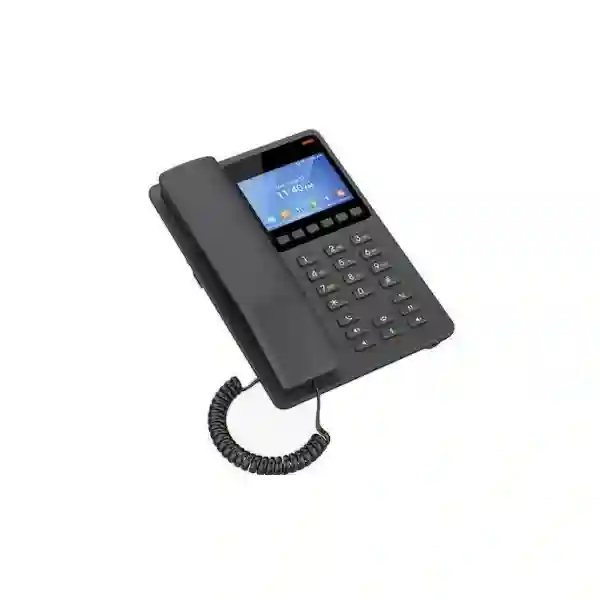
The Grandstream GHP631W is a compact black hospitality IP phone built for properties that want a modern colour display, simple guest operation, managed SIP telephony and flexible network placement. It combines a 3.5-inch 480 × 320 colour LCD, two SIP accounts and two lines, ten speed-dial positions, six context-sensitive soft keys, HD handset audio, three-way conferencing, dual-band Wi-Fi 6, a 10/100 Mbps network interface, USB Type-C charging for an external device and centralized provisioning through Grandstream Device Management System. For hotels in Dubai, serviced apartments in Abu Dhabi, clinics in Sharjah, student housing, residential projects and multi-site hospitality groups, its strongest value is not one specification by itself. The value comes from bringing guest-room calling, departmental shortcuts, standardized configuration and wired-or-wireless deployment choices into one compact endpoint.
Quick answer: who should choose the GHP631W?
Choose the Grandstream GHP631W when the project needs a hospitality-style phone with a colour screen, black finish and integrated Wi-Fi 6 while retaining standard SIP capabilities and centralized device management. It is especially relevant when guest-room or patient-room locations do not have an ideal Ethernet outlet, when a renovation aims to avoid new data cabling, or when the design team wants a compact black handset that visually fits contemporary rooms. The phone can also operate as part of a conventional wired design where appropriate, but the integrated wireless capability is the main reason to select the W variant rather than the corresponding non-W model.
The GHP631W should not be selected merely because Wi-Fi is available. A voice endpoint still depends on stable RF coverage, proper SSID security, VLAN and QoS design where used, SIP/PBX compatibility, power planning, DNS and time configuration, firmware control and clear extension mapping. For a multi-room deployment, the handset should be treated as one element of the property communications design rather than as a stand-alone desk accessory.
Buyer decision dashboard
Guest-room calling, departmental speed dials, reception access and standardized room extensions are natural use cases.
Useful where adding a new data point is inconvenient, provided the wireless design can support real-time voice reliably.
Central provisioning and monitoring are valuable when a property needs to deploy many room phones consistently.
Ten speed-dial positions can support common destinations such as reception, housekeeping, concierge and room service.
Verified Grandstream GHP631W specifications that matter in a project
The GHP631W belongs to Grandstream’s GHP630/GHP631 family of compact hotel phones. For procurement teams, the most useful way to read the specification sheet is to connect every verified capability to a deployment decision. The following matrix focuses on practical impact rather than repeating a raw list of numbers.
| Area | GHP631W capability | Project meaning |
|---|---|---|
| Display | 3.5-inch high-resolution 480 × 320 colour LCD | A clear, modern guest interface for room information and phone operation. |
| SIP | 2 SIP accounts, 2 lines | Well aligned with room-extension workflows without adding unnecessary office-phone complexity. |
| Wireless | Dual-band 2.4 GHz / 5 GHz 802.11 a/b/g/n/ac/ax Wi-Fi 6 | Supports wireless room placement when the property WLAN is designed for reliable voice. |
| Ethernet | One auto-negotiating 10/100 Mbps network interface; Grandstream product data describes integrated PoE | Supports a conventional network path as well as Wi-Fi; confirm the exact power arrangement for the selected hardware/package. |
| Keys | 26 keys including 6 context-sensitive soft keys and 10 speed-dial assignments | Allows simple guest-facing shortcuts to real property services. |
| Audio | HD handset, wideband audio and full-band Opus support | Supports clear internal and external voice when the PBX and network are properly engineered. |
| Conference | Up to 3-way audio conference | Useful for occasional local three-party calling without positioning the device as a meeting-room endpoint. |
| USB | USB Type-C charging for an external device, 500 mA maximum | Provides a convenient bedside or desk charging point within the stated output limit. |
| Security | Secure boot, random default password, device certificate, AES-encrypted configuration support, SRTP, TLS and 802.1X | Supports a controlled endpoint-security baseline when paired with secure PBX, LAN and WLAN practice. |
| Provisioning | GDMS, TR-069 and encrypted XML provisioning options | Makes repeated room-phone deployments easier to standardize. |
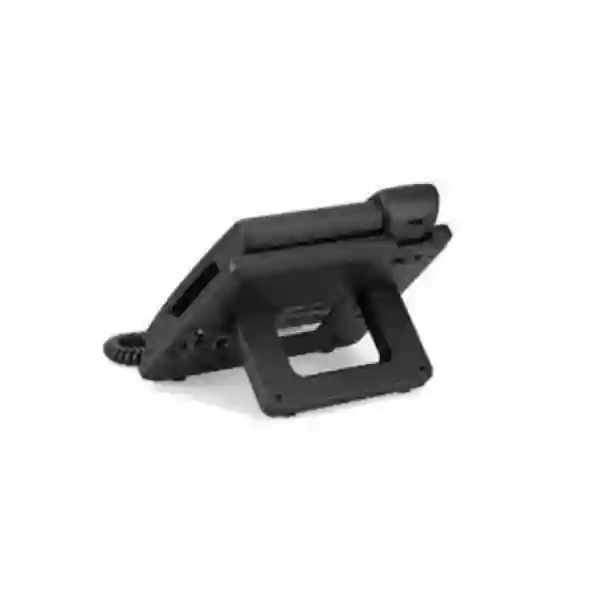
| Mounting | Desktop or wall-mount deployment | Gives interior designers flexibility around bedside, desk and wall layouts. |
| Colour | Black | The GHP631W is the black Wi-Fi 6 variant; GHP630W is the white Wi-Fi 6 counterpart. |
Why Wi-Fi 6 matters for a hotel phone — and what it cannot fix
Integrated Wi-Fi 6 is the signature deployment feature of the GHP631W. In a new property, a wired room-phone design may still be preferred because structured cabling can be installed before walls and finishes are completed. In an operating hotel, however, adding a new Ethernet outlet next to every bed or writing desk can be disruptive and costly. A Wi-Fi-capable endpoint can reduce new cabling work in selected areas and give the design team greater freedom over handset placement.
Wireless flexibility becomes a benefit only when the WLAN is suitable for real-time voice. Coverage measured for ordinary guest internet access does not automatically prove that a SIP phone will perform reliably at the same location. A deployment should check signal strength, interference, access-point density, channel planning, airtime utilization, authentication method, VLAN design and the actual performance of the selected SSID. Voice traffic should not blindly compete with heavy guest downloads or video streaming.
A managed room phone should normally use a controlled corporate or IoT-style SSID rather than the public guest network. That makes it easier to enforce security and reach the PBX without exposing management interfaces to hotel visitors. The WLAN should also provide stable DNS, NTP and IP addressing so the phone can register and remain manageable after reboots.
For this reason, Fourteck treats GHP631W wireless deployment as an RF and network-readiness exercise rather than simply entering an SSID and password. The phone is a strong option for renovated rooms, leased apartments, clinics and locations where new cabling is impractical, but representative rooms should be tested before any bulk rollout.
From customer requirement to phone configuration
A hospitality endpoint should reduce friction for guests while making operations easier for staff. The GHP631W has enough programmable capability to support that objective without becoming a complicated office phone. A useful configuration begins with the property’s service journey, not with the handset menu.
Guest wants immediate assistance
Map a clear shortcut to reception or the operator. The label and call routing should remain consistent across rooms so a guest does not need instructions.
Property wants faster service
Use speed-dial positions for housekeeping, room service, concierge, reservations or engineering where those functions exist. The PBX should route calls correctly by time of day.
IT wants repeatable deployment
Build and test a reference configuration, then use centralized provisioning to reduce manual key programming, SIP account errors and inconsistent settings.
Management wants fewer support calls
Keep the guest-facing workflow simple. Avoid exposing unnecessary advanced functions when the handset’s main job is to reach a small set of predictable services reliably.
A practical hospitality speed-dial plan
The phone supports ten speed-dial assignments. A property does not need to use every position, and the correct destinations depend on the service model. The design goal is consistency. A compact hotel phone becomes easier to use when the label, PBX routing and staffing plan agree with one another.
| Possible key | Destination | Design consideration |
|---|---|---|
| 1 | Reception / Operator | Usually the most important shortcut. Route to a resilient hunt group rather than one unattended desk. |
| 2 | Housekeeping | Confirm service hours and overflow behaviour. |
| 3 | Room Service | Expose only where the property offers this function. |
| 4 | Concierge | Useful for full-service hotels and serviced residences. |
| 5 | Reservations / Front Office | Can support extension-of-stay and booking enquiries if the operating model permits it. |
| 6 | Engineering / Maintenance | Decide whether guests should contact engineering directly or via reception. |
| 7 | Emergency / Security | Must align with local policy, emergency-call requirements and PBX routing. |
| 8–10 | Property-specific services | Spa, transport, nurse station, business centre or other functions can be added when genuinely useful. |
Network, PBX and SIP planning before ordering in quantity
Two SIP accounts and two lines are sufficient for many guest-room workflows, but the phone still needs a compatible SIP environment. Before a bulk purchase, confirm the PBX or hosted platform supports the required registration method, authentication, codecs, dial plan, DTMF behaviour, time synchronization, caller identification, voicemail workflow, call transfer policy and emergency routing. A test unit should be registered on the actual production-style network rather than only on a temporary lab router.
For VLAN-based designs, document how the phone receives network parameters and how traffic reaches the PBX. If the property uses 802.1X, certificate controls, DNS-based provisioning or other network-access policies, test them against the intended configuration. For Wi-Fi deployments, the SSID should be dedicated to managed endpoints or otherwise securely segmented from public guest devices.
The design should also account for routine operational changes after installation. A guest checks out, a room is renumbered, a handset is replaced, the PBX address changes, a password is rotated, or the hotel adds a new service number. Central provisioning and a documented room-to-device or room-to-extension mapping process make these events much easier to handle.
Where the PBX provides hotel or property-management integrations, confirm the workflow separately. The phone itself is a SIP endpoint; features such as room status, wake-up logic, billing or PMS synchronization depend on the larger system and should not be assumed from the handset specification alone.
GDMS provisioning: where the GHP631W becomes easier to scale
A single phone can be configured manually. A 150-room, 300-room or multi-property estate should not depend on technicians repeating the same configuration screen hundreds of times. Grandstream Device Management System provides a centralized interface for supported endpoints, making it possible to standardize settings, provisioning logic and monitoring more consistently.
A sensible rollout begins with one reference configuration. The project team validates SIP registration, audio, speed-dial destinations, date and time, VLAN or WLAN behaviour, firmware, security settings and local calling rules. Once the reference unit passes testing, common parameters can form a deployment template. Room-specific values such as extension credentials still require controlled assignment, but the shared configuration no longer needs to be created from zero for every phone.
This model is especially useful for hotel chains, serviced-apartment groups, healthcare buildings and student accommodation where many endpoints must behave consistently. It can also improve troubleshooting. Instead of asking what a technician entered manually months earlier, the support team works from an approved baseline and compares the affected handset with the expected profile.
Central management does not replace documentation. The operations team should still maintain an inventory that maps device identity, room number, extension, deployment status and replacement history. That record becomes valuable during renovation, PBX migration or hardware swap projects.
Security should be designed around the endpoint, not delegated to it
Grandstream lists secure boot, random default passwords, unique device certificates, administrator-level password protection, encrypted configuration capability, SRTP, TLS and 802.1X among the security features of the family. These controls are useful, but they are only part of a secure voice design. The phone should reside in a network segment appropriate to managed endpoints, and public guest Wi-Fi clients should not be able to administer it or browse internal management services.
Default credentials should not remain in service. Provisioning files should be protected, management interfaces should be restricted, certificates should be handled consistently, and firmware should be managed deliberately rather than left indefinitely at an unknown version. If TLS and SRTP are part of the PBX architecture, certificate trust and server support should be validated before the rollout begins.
Security controls that are only enabled on paper can cause commissioning problems and may be disabled under time pressure. The safer approach is to validate the complete security baseline on the pilot device, capture the working configuration and then reproduce it through the approved provisioning workflow.
For multi-property groups, the most useful security outcome is repeatability: every room phone should follow the same approved baseline while unique credentials remain unique. This turns endpoint security into an operational practice rather than a one-time installation checkbox.
Audio quality: what the phone provides and what the network must provide
The GHP631W supports HD handset audio and a broad codec set that includes G.722 and full-band Opus alongside widely used narrowband options. Grandstream also highlights an advanced jitter-resilience algorithm intended to maintain voice quality under difficult packet conditions. These features can help, but no codec or jitter algorithm can compensate indefinitely for a badly designed network.
For wired deployment, check switch health, duplex negotiation, VLAN configuration, QoS policy, cabling and upstream congestion. For wireless deployment, evaluate signal quality, channel utilization, interference and packet retries. The ideal design gives voice predictable access to the network without allowing a busy guest network, cloud backup or large download to create unnecessary call problems.
A pilot should include real calls during busy periods and from representative rooms, not only a short call beside an access point. Test reception calls, external calls where permitted, transfer behaviour, hold, DTMF interaction and any IVR the guest may encounter. The endpoint’s audio specification is only one part of the experience; the PBX, network and upstream voice service complete the path.
If call quality differs by floor or room, diagnose the network path before changing codecs randomly. A structured test that compares Wi-Fi signal, latency, packet loss and PBX logs is more useful than replacing handsets without evidence.
GHP631W vs GHP631 vs GHP630W vs GHP630
The four names are easy to confuse. The most useful distinction is colour and wireless capability. Grandstream identifies the GHP631W as the black Wi-Fi 6 variant and the GHP630W as the white Wi-Fi 6 variant. The non-W GHP631 is black without the integrated Wi-Fi 6 feature, while GHP630 is white without that W-model wireless capability. All belong to the same colour-LCD hospitality family, so the buying decision is usually driven by room aesthetics and network architecture rather than a completely different user experience.
| Model | Colour | Integrated Wi-Fi 6 | Best-fit reason |
|---|---|---|---|
| GHP630 | White | No | White wired room-phone design. |
| GHP630W | White | Yes | White finish plus wireless deployment flexibility. |
| GHP631 | Black | No | Black wired room-phone design. |
| GHP631W | Black | Yes | Black finish plus dual-band Wi-Fi 6. |
When GHP631W is a stronger choice than a standard office IP phone
A normal office IP phone can make and receive SIP calls, but that does not automatically make it the right guest-room endpoint. Office phones are commonly optimized for personal productivity: multiple line appearances, directories, BLF keys, headsets, extensive menus and frequent use by a trained employee. A hospitality phone has a different job. It should feel obvious to a guest who may use it only once while providing just enough programmable access to the property’s services.
The GHP631W’s compact format, dedicated hospitality positioning, colour screen, speed-dial capability and wall-or-desk installation make it easier to integrate into a room design. Its Wi-Fi 6 option can be more valuable in a refurbished room than the additional office features of a business desk phone. Conversely, receptionists, reservations staff and back-office teams may still need a richer desktop model with more line keys, expansion options or headset support.
The best deployment therefore does not use one model everywhere merely for purchasing convenience. Guest rooms, reception, management offices, call centres and service desks have different user journeys. Fourteck can help map endpoint type to role so the hospitality phone is used where simplicity matters and business phones are used where staff need deeper call handling.
Hotel-room deployment workflow: from sample unit to full rollout
Define room requirements
List room types, phone positions, wall/desk mounting, required service shortcuts, PBX platform, network options and quantity.
Validate a reference device
Register one unit to the intended SIP environment and test audio, keys, display, WLAN/LAN, power and guest workflows.
Create the standard profile
Lock down provisioning, security, codecs, speed dials, date/time, network behaviour and firmware policy.
Pilot representative rooms
Test multiple floors, layouts and access-point zones rather than assuming one successful IT-room test proves the whole building.
Stage and map
Prepare device-to-room and device-to-extension mapping so installation teams do not swap credentials or service labels.
Roll out with acceptance checks
Confirm registration, call routing, speed dials, audio, time display and management visibility before each zone is closed.
Power planning and the importance of confirming the selected hardware package
Grandstream’s family materials describe the GHP630/GHP631 platform with a 10/100 Mbps Ethernet interface and PoE, while the datasheet also identifies a universal power supply for GHP630W/GHP631W and other current documentation describes power-adapter use for the W variants. Because power details may depend on hardware revision, package and regional supply, procurement teams should confirm the exact unit being supplied before installation. This matters when a room has only one available power socket or when the design expects PoE to eliminate a local adapter.
If the project will use Wi-Fi, remember that wireless data does not remove the requirement for electrical power. Bedside and wall locations still need a safe, practical power method. If Ethernet will be used, confirm switch design, cabling, port availability and the applicable power arrangement. The pilot device should be powered exactly as production phones will be powered.
The USB Type-C port is intended to charge an external device up to the specified output. It should not be treated as a replacement for the property’s overall guest charging strategy. If a room promises high-speed smartphone or tablet charging, separate charging hardware may still be required.
Use cases beyond hotels
Grandstream positions the family for hotels and similar environments, but the same design logic is useful wherever a compact, easy-to-understand SIP phone must be deployed in many rooms. The deciding factor is whether the endpoint matches the user journey.
Serviced apartments
Residents can reach reception, maintenance, security or concierge while operators retain a standardized extension plan across units.
Healthcare rooms
A simple handset can support routine calling in patient rooms or consultation areas where the facility’s policy permits SIP endpoints.
Student accommodation
A compact endpoint can support front desk, security and internal-service calling without giving every room a complex office phone.
Staff residences
Large campuses can use a standardized extension scheme for housing blocks, operations and security support.
Retail or showroom counters
Where a simple managed phone is sufficient, the compact black design can work at selected service points without requiring a feature-heavy desktop endpoint.
Dormitories and institutional housing
Common-service shortcuts and centrally managed SIP extensions can support residents and administrators in repeated room layouts.
Grandstream GHP631W Dubai deployment context
Dubai has a broad mix of new hotels, established properties undergoing renovation, serviced apartments, residential hospitality, medical facilities and student accommodation. The GHP631W is especially relevant when a project wants to modernize room communication without making the telephone visually dominant. Its black finish can suit contemporary interiors, while the colour LCD gives the handset a more current presentation than a basic guest-room phone.
For an operating Dubai property, wireless deployment may be attractive when opening walls or adding new network points would disturb occupied floors. The correct decision should follow a wireless survey or representative RF validation. High room density, concrete construction, decorative materials and neighbouring networks can create conditions that are not obvious from a simple Wi-Fi signal icon. A floor-by-floor pilot can expose these conditions before the full installation.
Procurement teams should share quantity, room count, required colour, PBX platform, wired or wireless preference, mounting method and target deployment date when requesting a quote. Stock, lead time and commercial terms should be confirmed at enquiry time rather than assumed from an old listing.
For larger properties, the installation plan should also address staging space, extension credentials, device labeling, floor-by-floor handover and support ownership. Those operational details often determine whether a technically correct phone rollout is smooth for the hotel team.
Abu Dhabi, Sharjah and wider UAE project considerations
Abu Dhabi: Large hospitality properties, serviced residences, healthcare campuses and staff accommodation can benefit from centralized provisioning because the operational challenge is often scale. The design should consider multi-building connectivity, network segmentation, PBX resiliency and whether endpoints are managed by internal IT or an external support provider.
Sharjah: Hotels, educational accommodation, clinics and mixed-use properties may prioritize practical deployment cost. The decision can come down to whether existing cabling is reusable, whether Wi-Fi coverage is strong enough for voice and whether a colour-display endpoint delivers enough benefit compared with a simpler hotel-phone model.
Ajman and the Northern Emirates: Smaller properties often operate with lean IT teams. Central management and a documented standard configuration can be just as valuable in a 40-room property as in a large hotel because it reduces dependence on one technician remembering every setting.
Across the UAE, Fourteck can assist with model selection, SIP/PBX compatibility discussion, network-readiness planning, staging, configuration guidance and quotation support. Exact availability, lead time and project scope remain dependent on the customer requirement and current supply conditions.
GCC deployment: Kuwait and neighbouring markets
Hospitality groups operating across the GCC often want one room-phone standard that can be repeated across properties. The GHP631W can support that strategy when the same SIP architecture, wireless design and provisioning method are available in each location. A regional standard should not ignore local network conditions, ISP design, power arrangements, procurement channels or property-specific service numbers.
In Kuwait and other GCC markets, wireless capability can be useful for refurbishment projects where structured cabling changes are expensive. A centralized configuration can keep the handset interface consistent across the group while room-specific credentials and property-specific speed dials remain local. The result is a familiar guest experience without assuming that every hotel has the same back-end network.
For cross-border projects, request quotations and deployment planning by location rather than assuming one market’s price, stock or lead time applies everywhere. Fourteck’s regional network can support requirement discussions while current commercial details are confirmed for the destination country.
Africa deployment context: Uganda, Kenya, Tanzania, Ghana and Nigeria
For African hospitality and institutional projects, the choice between wired and Wi-Fi room phones should follow the actual reliability of the local network. In some buildings, Wi-Fi 6 can simplify deployment where structured cabling is limited. In others, an existing Ethernet network may offer the most predictable voice path. The GHP631W gives the project team the option of wireless deployment while retaining a conventional network interface, but the chosen mode should be validated before scale-out.
In Uganda and Kenya, hotels, lodges, apartments, campuses and healthcare facilities may benefit from centralized configuration where local technical teams manage many rooms or multiple sites. In Tanzania, tourist properties and city hotels may need a design that balances guest-room aesthetics with practical supportability. In Ghana and Nigeria, larger commercial and hospitality deployments may prioritize standardized provisioning, endpoint security and manageable replacement procedures.
Regional procurement should confirm power accessories, warranty route, local supply, PBX compatibility and support scope before commitment. Fourteck does not assume that one country’s stock status or service package applies to another. The correct process is to define the site requirement, confirm the exact variant and then build the commercial offer around the destination.
Common buying mistakes to avoid
- Buying the W model without checking wireless quality. Wi-Fi 6 support is valuable only when the hotel WLAN delivers stable coverage and secure access in the actual phone locations.
- Assuming every SIP PBX behaves the same. Registration, codecs, dial plans, DTMF, transfer behaviour and security should be tested against the intended PBX or hosted platform.
- Ignoring the room-service key plan. A hospitality phone becomes more valuable when speed dials match real departments and real overflow routes.
- Using guest Wi-Fi for managed voice endpoints. A controlled network segment or SSID is normally a better design.
- Skipping a pilot. One sample on the IT desk does not prove performance on every floor and behind every wall.
- Assuming old online prices or stock are current. Quantity, region and supply conditions change; request a current quotation.
- Failing to document extension mapping. Room number, extension, device identity and configuration profile should be tracked for support and replacement.
- Choosing one phone for every role. Guest rooms, reception desks and back-office users often need different endpoint capabilities.
Procurement checklist for Grandstream GHP631W UAE projects
A useful quotation request contains more than a model number. Providing the following details allows the commercial and technical teams to identify compatibility issues early and reduces the risk of equipment reaching site without a complete deployment plan.
Installation acceptance checklist
After installation, every phone should be checked against a repeatable acceptance list. A handset that powers on is not yet a completed deployment. The objective is to prove the guest experience and the management process at the same time.
- Confirm the correct room extension and SIP account are registered.
- Make a test call to reception or the operator and verify two-way audio.
- Test external calling only where property policy permits it.
- Press each configured speed dial and confirm it reaches the intended department.
- Check hold, mute, redial, volume and speakerphone behaviour required by the property.
- Confirm date, time, timezone and display settings.
- For Wi-Fi deployment, verify the correct managed SSID and stable connectivity in the final handset location.
- Confirm the device appears in the expected management/provisioning system.
- Verify the phone is physically stable on the desk or wall and that cabling does not create a guest hazard.
- Record the final device-to-room mapping for support and replacement.
Why Fourteck for GHP631W planning and supply discussions
A model-specific quotation is most useful when it accounts for the environment around the phone. Fourteck can help customers evaluate whether the GHP631W is the correct room endpoint, compare it with wired or white-finish variants, discuss SIP/PBX compatibility, review network readiness, plan speed-dial and extension logic, and define staging for multi-room deployments.
For UAE projects, requirements can include Dubai, Abu Dhabi, Sharjah, Ajman and the wider Emirates. Regional customers can also discuss requirements through Fourteck properties serving Kuwait and African markets. Product availability, lead time, pricing, warranty handling and project-support scope should be confirmed for the specific country, quantity and requested services.
For broader hospitality and business communication planning, customers can review Grandstream hotel phone solutions in Dubai, explore IP phone and VoIP resources from Fourteck, or visit Fourteck UAE for related business technology requirements.
Frequently asked questions about the Grandstream GHP631W
Is the GHP631W designed for hotel rooms?
Yes. Grandstream positions the GHP630/GHP631 family as compact hotel phones for guest-room and similar deployments. The GHP631W combines that hospitality design with a black finish, colour LCD and integrated Wi-Fi 6.
Does the Grandstream GHP631W support Wi-Fi 6?
Yes. It supports integrated dual-band 2.4 GHz and 5 GHz 802.11 a/b/g/n/ac/ax Wi-Fi 6, making it suitable for wireless deployment when the property WLAN is designed and validated for voice.
How many SIP accounts and lines does it support?
The GHP631W supports two SIP accounts and two lines, which is well suited to typical room-phone workflows.
What is the difference between GHP631W and GHP631?
Both are black models in the same colour-display family, but the GHP631W adds integrated dual-band Wi-Fi 6. The GHP631 is the corresponding non-W model without that integrated wireless feature.
What is the difference between GHP631W and GHP630W?
The primary purchasing difference is colour: GHP631W is black and GHP630W is white. Both are Wi-Fi 6 variants in the same family.
Does the GHP631W have a colour display?
Yes. It has a 3.5-inch high-resolution 480 × 320 colour LCD.
Can the phone be wall mounted?
Yes. Grandstream specifies desktop and wall-mount deployment for the family, allowing the property to choose the placement that best suits each room layout.
Does it support centralized provisioning?
Yes. Grandstream Device Management System is supported, along with other provisioning mechanisms documented for the family.
Can it charge a guest smartphone?
The phone includes a USB Type-C port for charging an external device, with Grandstream specifying a 500 mA maximum. It should be treated as a convenience output rather than a high-power fast charger.
Can Fourteck help check compatibility with an existing PBX?
Fourteck can assist with requirement review, SIP/PBX compatibility discussion, network planning and configuration guidance. A production-style pilot is recommended before a large rollout.
Is current UAE stock guaranteed?
No stock assumption should be made from an old listing. Availability, lead time and pricing should be confirmed at enquiry time based on quantity and location.
What information should I provide for a project quote?
Share quantity, city or country, PBX platform, room count, Wi-Fi or Ethernet preference, power method, mounting requirement, speed-dial needs and expected deployment date.
Plan a GHP631W deployment around the room, network and PBX
The Grandstream GHP631W is most compelling when a property needs a black hospitality handset with a modern colour display and flexible Wi-Fi 6 connectivity. Its two SIP accounts, guest-friendly speed-dial capability, HD audio, USB-C charging and centralized management make it suitable for hotels and similar repeated-room environments, but successful deployment still depends on the network and PBX around it. Before ordering in volume, validate a sample unit, define service shortcuts, confirm power and network design, test representative locations and establish a repeatable provisioning standard.
Contact Fourteck with your quantity, location, PBX platform and deployment requirements to discuss suitability, current availability, configuration scope and quotation options for Grandstream GHP631W Dubai and regional projects.

Reviews
There are no reviews yet.