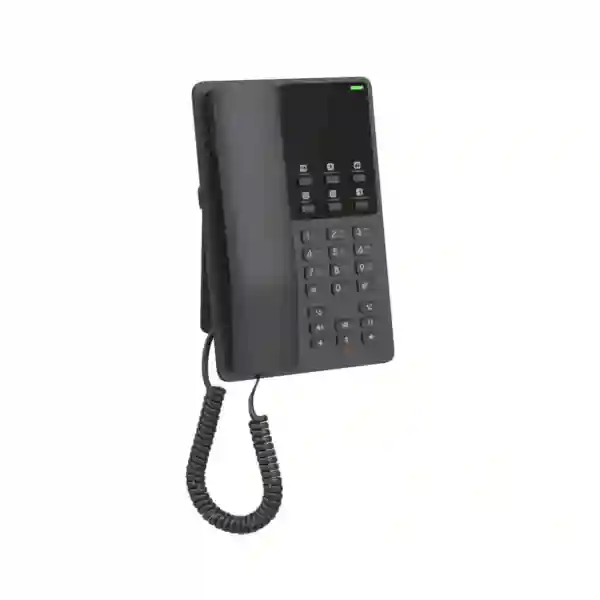
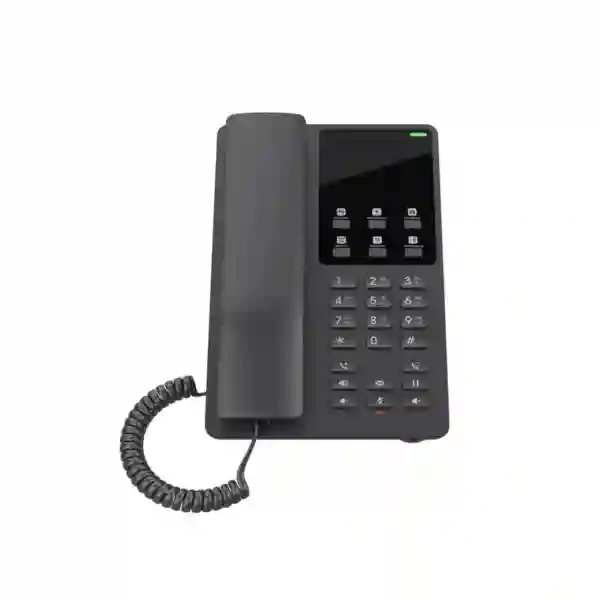
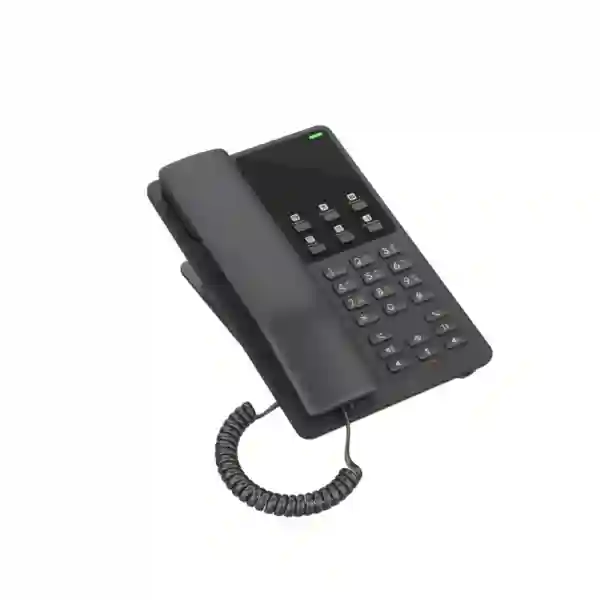
Grandstream GHP621 Dubai UAE – Compact PoE Hotel IP Phone
The Grandstream GHP621 is a compact black hotel IP phone designed for properties that want a simple guest-facing handset without the complexity of a screen-based office phone. It combines 2 SIP accounts and 2 lines, 6 programmable keys, 10 configurable speed-dial positions, HD audio support, 3-way conferencing, a wired 10/100 Mbps Ethernet interface with PoE, wall or desktop mounting, centralized management through Grandstream Device Management System (GDMS), and a swappable faceplate for property branding. For Dubai and UAE hospitality projects, the GHP621 is particularly relevant where the room network already provides structured Ethernet and PoE and where designers want a dark-finish endpoint that fits modern interiors.
Fourteck positions the GHP621 as a project endpoint rather than as an isolated handset purchase. The right deployment decision should consider room count, existing PBX or SIP platform, PoE switch capacity, VLAN and QoS design, guest-service key programming, emergency-calling policy, wall or desk placement, firmware-management method, network-security requirements and future maintenance. This page therefore focuses on how the GHP621 fits a real hospitality deployment, what Grandstream officially specifies, where the wired model differs from the GHP621W wireless version, and what UAE buyers should confirm before requesting a quotation.
PoE Class 2
6 programmable keys
GDMS management
Black finish
Non-LCD design
A direct buying answer: when does the GHP621 make sense?
Choose the GHP621 when the requirement is a wired, centrally manageable SIP hotel phone with a deliberately simple guest interface. It is best suited to properties that have Ethernet available at the phone position and either already use PoE switching or plan to provide it. Its non-LCD format keeps attention on direct calling and property-defined service keys rather than menus. The black casing makes it a natural visual alternative to the white GHP620, while the shared GHP62x feature set means the technology decision can remain consistent across rooms even when interior-design teams want different finishes.
The model is especially practical for guest rooms, serviced apartments, patient rooms, staff residences, dormitories and other spaces where the endpoint must be easy to explain, easy to provision in quantity and easy to replace with a consistent configuration. Six programmable keys can be mapped to frequently used services, while digit-key speed dials allow additional direct destinations. The phone also supports voicemail, hold, transfer, conference, mute, redial, hands-free calling and flexible dial plans, which gives the property enough operational flexibility without turning the endpoint into a complex executive desk phone.
Do not select the GHP621 simply because it is part of a hotel-phone family. First verify that the property wants a wired endpoint. If rooms cannot provide Ethernet conveniently, the GHP621W may be the more appropriate member of the family. If guests require an on-phone graphical display, richer visual applications or a more interactive room interface, a different model category may be more suitable. The GHP621 is strongest when simplicity, controllable service access, PoE, central provisioning, compact dimensions and a dark finish are the dominant requirements.
Verified GHP621 technical profile
The specification below is based on Grandstream’s GHP620/GHP621 family documentation and is presented as a deployment reference. Firmware, hardware revision, regional package contents and supported behavior can change over a product lifecycle, so large projects should validate the exact units and current vendor documentation before final sign-off.
| Area | Grandstream GHP621 | Why it matters in a project |
|---|---|---|
| Product format | Compact non-LCD hotel SIP phone, black finish | Simple room interface and dark interior-design option |
| SIP capacity | 2 SIP accounts, 2 lines | Enough for common guest-room and service-calling needs |
| Network | 1 × auto-negotiating 10/100 Mbps Ethernet port | Fits structured wired room networks |
| Power | Integrated PoE Class 2 on wired GHP621 | One Ethernet run can carry both data and endpoint power |
| Keys | 26 keys total, including 6 programmable keys, digit keys, 5 function keys and 3 volume-control keys | Supports a direct, service-focused guest workflow |
| Speed dial | 10 speed-dial assignments via digit keys | Adds quick access to property-defined destinations |
| Audio | HD handset support, full-band Opus plus multiple standard codecs | Supports modern wideband voice strategies and PBX codec policies |
| Conference | Up to 3-way audio conferencing | Useful for service escalation or adding another party |
| Management | GDMS, TR-069 and documented mass-provisioning methods | Important for multi-room consistency and lifecycle operations |
| Security | Secure boot, unique certificate, AES-encrypted configuration, TLS, SRTP and 802.1X | Supports a stronger managed endpoint security design |
| Advanced functions | Multicast paging, E911 service support, GDS door opening, jitter-resilience features | Adds useful options for property communications and integrations |
| USB | USB Type-C external-device charging, up to 500 mA | Provides a low-power charging convenience at the phone position |
| Installation | Desktop or wall mount | Allows adaptation to room furniture and space constraints |
| Dimensions | 210 × 132 × 89.8 mm with handset and base stand | Useful for room mock-ups and bedside layout planning |
A specification table alone does not decide whether a hotel phone will work well in practice. The value comes from matching these capabilities to how guests call reception, how staff route service requests, how the PBX identifies rooms, how the switch supplies PoE, how voice VLANs are designed, how endpoints are provisioned, and how configuration changes are rolled out across hundreds of rooms. The following sections translate the verified feature set into those operational questions.
Design the guest experience around direct service access
A hotel phone should reduce friction. Guests usually do not want to learn a handset; they want to call reception, room service, housekeeping, concierge, reservations, security or another room with minimal effort. The GHP621 supports this style of experience because the property can define six programmable keys and multiple speed-dial actions. The exact mapping should be planned around the property’s operating model rather than copied from a generic template. A business hotel may emphasize reception, operator, housekeeping, wake-up assistance and business services. A resort may want concierge, spa, dining, transport and activities. A serviced apartment may place greater emphasis on front desk, maintenance, security and housekeeping.
The swappable faceplate is useful because the printed or branded key legend can be aligned with the programmed destinations. This sounds like a small detail, but it directly affects guest usability. A key labeled for a service must always call the correct queue or extension, and the legend should remain readable after cleaning and normal room use. Before mass production of faceplates, the operations team should sign off the naming, numbering and escalation path for every service. If the PBX dial plan changes later, the provisioning profile and physical label should be updated together.
The digit keys can also be configured for speed-dial functions through the phone’s web configuration, giving the property another layer of direct access. This should be used thoughtfully. Overloading every digit with hidden behavior can confuse support teams, whereas a documented speed-dial plan can make the endpoint more efficient. For example, internal staff documentation can define short room-to-service dialing conventions while the guest-facing faceplate highlights only the most important services. The ideal configuration is the simplest one that reliably supports the property’s real call flows.
Why a non-LCD endpoint can be an advantage
The GHP621 is not a screen-led phone. In many guest-room deployments, that is intentional rather than a limitation. A non-LCD endpoint can keep the visual language clean, avoid menu navigation for occasional users and reduce the number of screen elements that need localization or explanation. It also aligns well with hotels that want a discreet handset on a bedside table or wall. The trade-off is equally important: properties that want visual directories, rich on-screen branding, room-automation interfaces or more interactive information should evaluate a display-equipped hotel phone instead of expecting the GHP621 to provide those experiences.
This distinction helps procurement avoid a common error: buying on feature count rather than user journey. If the goal is dependable calling with a few clearly labeled service actions, the GHP621’s simplicity is an asset. If the goal is a digital guest interface with visual workflows, a different endpoint category is more appropriate. Fourteck can help compare those requirements before a model is standardized across an entire property.
PoE and wired network planning for hotel rooms
The GHP621 uses one auto-negotiating 10/100 Mbps Ethernet interface with integrated PoE Class 2. For a hotel project, the important phrase is not simply “supports PoE”; the important question is whether the complete access network is designed to power every endpoint reliably. Room counts can be high, and the switch PoE budget must be checked at the same time as port count, uplink capacity, redundancy strategy, rack space, UPS runtime and floor-distribution design. A project that has enough Ethernet ports but insufficient PoE budget is not complete.
In a new property, the structured-cabling design should reserve an appropriate network outlet at the intended phone position. In an existing property, the team should verify that the room outlet terminates correctly, that patching is documented, and that the switch port can be assigned to the correct voice network. When wall mounting is planned, cable routing and connector clearance should be verified with a physical sample room. When the phone sits on a bedside table, the cable path should remain tidy and should not interfere with housekeeping or guest use.
Voice VLAN and QoS considerations
Grandstream documents Layer 2 QoS functions including 802.1Q and 802.1p, plus Layer 3 QoS using ToS, DiffServ and MPLS-related capabilities. These features are valuable only when the network is configured consistently end to end. A hotel may separate voice endpoints from guest internet traffic by VLAN, prioritize real-time media, apply access-control policies, and monitor packet loss and jitter. The endpoint configuration, switch configuration, DHCP design, routing, firewall policy and PBX must agree with each other. VLAN identifiers should never be copied from another site without checking the local network design.
The GHP62x platform also includes an advanced jitter-resilience algorithm that Grandstream says can tolerate up to 30 percent packet loss without impacting voice quality under its specified conditions. This is a useful resilience feature, but it should not be treated as permission to accept a poor network. The right design objective remains low packet loss, stable latency, controlled jitter and adequate switching performance. Resilience helps protect calls when conditions degrade; it does not replace good cabling, correct QoS, healthy switches or proper WAN engineering.
One port means topology matters
The GHP621 has a single Ethernet port. That is appropriate for a dedicated room-phone position, but it means the phone is not intended to act as a pass-through network device for another workstation in the way some office IP phones can. During site design, do not assume that one room outlet can be shared through the phone with another device. If a smart-room controller, IPTV device, access point or other endpoint needs wired connectivity at the same location, provide the correct switch or cabling topology separately.
For retrofit projects, this is one of the first checks Fourteck recommends. A model can be technically suitable yet operationally inconvenient if the room has only one cable that is already assigned to another service. A short survey of representative room types can reveal these constraints before the bill of materials is finalized.
SIP, PBX and call-flow compatibility
The GHP621 supports SIP RFC3261 and a broad set of network and voice protocols. That makes it suitable for standards-based VoIP environments, but “SIP compatible” should never be interpreted as automatic compatibility with every PBX feature or hotel workflow. A pilot should verify registration, authentication, inbound and outbound calling, DTMF, transfer, hold, voicemail behavior, conferencing, caller identification, emergency dialing, room-to-room restrictions, service queues, codec negotiation, TLS or SRTP policy, failover behavior and any property-management integrations that depend on the wider PBX solution.
For Grandstream-centric deployments, the phone can be considered alongside Grandstream UCM platforms and GDMS-supported management workflows. In mixed-vendor environments, the same fundamentals apply: document the SIP server, transport, port, credentials, outbound proxy if used, dial plan, codec order, time source, VLAN assignment, provisioning path and security settings. A test room should then be used to confirm the guest-facing behavior before the configuration is cloned across the property.
Two SIP accounts can be used strategically
The GHP621 provides two SIP accounts and two lines. A hotel does not have to use both merely because they are available. A simple room may use one account for the room identity and keep the second unassigned. Other designs may use separate account logic for a specialized service or resilience scenario, depending on PBX capability and policy. The correct design should be based on the call architecture rather than a desire to populate every available field.
When a property uses multiple buildings, towers or villas, account naming and extension numbering become operational issues. Provisioning templates should identify each handset by room, floor, building and asset record where appropriate. The PBX caller-identification and emergency-location logic should also be reviewed carefully. If a guest calls security or an emergency service, staff should be able to determine the correct room context according to the property’s operational and regulatory procedures.
Codec planning and audio consistency
Grandstream lists G.729A/B, G.711 µ-law and A-law, G.726, G.722, G.723.1, iLBC and full-band Opus among the supported codecs. A PBX administrator should select a codec policy that matches network capacity, quality expectations and interconnection requirements. Wideband options can improve perceived speech quality when both ends of the call path support them, while external trunks or gateways may negotiate different codecs. The phone also supports in-band and out-of-band DTMF methods, which matters when guests interact with IVR systems or external services.
Consistency is more important than theoretical maximum capability. A hotel should test representative internal calls, reception transfers, service queues, SIP trunks and any analog or cellular gateways in the full call path. Voice quality complaints are easier to prevent through controlled testing than to troubleshoot after hundreds of rooms are live.
Audio, accessibility and room usability
Grandstream specifies HD handset support for wideband audio and includes a hands-free function on the GHP621. The handset experience remains central because guest-room calls are often short and task oriented. Audio quality depends not only on the endpoint but also on codec negotiation, network conditions, PBX processing, gateways and the remote party. The GHP621 includes acoustic and packet-handling functions such as echo cancellation, packet-loss concealment, automatic gain control and adaptive jitter buffering in the documented voice-capability set.
The phone also includes Hearing Aid Compatibility. For hospitality and healthcare environments, this is relevant to inclusive room design, but the property should not rely on one endpoint specification as proof that the entire guest experience meets accessibility rules. Room layouts, mounting height, signage, emergency procedures and other devices can all contribute to accessibility obligations. A project team should evaluate applicable local requirements independently.
Three-way conferencing in a hospitality context
Three-way audio conferencing is available even though the phone is not positioned as a conference-room endpoint. In practice, this can help when a guest needs reception to add another department, when a resident and facility team need a third party, or when a service call must include an external participant. Staff procedures should still be designed so that a guest can reach the correct destination directly whenever possible; conferencing is an additional tool, not a substitute for good call routing.
USB Type-C charging: useful, but understand the limit
A USB Type-C port is provided for charging an external device, and Grandstream specifies a maximum output of 500 mA. This can be convenient for low-power charging, but it should not be marketed as a modern fast-charging station. Guests with high-power smartphones, tablets or laptops will generally expect dedicated charging facilities. The port is best treated as a helpful accessory function on the phone, while the room electrical and USB charging strategy is designed separately.
That distinction matters for buyer expectations. Including “USB-C charging” in a product summary without the output limit could create the wrong impression. Fourteck therefore recommends that hospitality buyers include the capability in room design as a convenience, not as the primary device-charging solution.
Centralized management with GDMS and provisioning discipline
One of the strongest arguments for a managed hotel IP phone is not what a guest sees; it is what the IT team does not have to configure manually. The GHP621 is supported by Grandstream Device Management System, which provides centralized configuration, provisioning, management and monitoring for supported Grandstream endpoints. Grandstream also documents TR-069 and several firmware or configuration delivery methods, including HTTP, HTTPS, FTP and TFTP as part of the platform’s provisioning capabilities.
For a small property, manual setup may appear manageable during installation. The problem appears later when a dial plan changes, a security setting must be tightened, a key mapping needs to be updated, or firmware must be standardized. A central template allows the team to define common settings and then apply room-specific values in a controlled way. It also makes replacement easier: the new handset can be associated with the correct room profile instead of being rebuilt from memory.
Build templates around roles, not just model names
A useful provisioning strategy separates global, property, room-type and room-specific configuration. Global settings might include security policy, time source and common codecs. Property settings might include PBX addresses, VLAN behavior and service destinations. Room-type settings might change key legends or call permissions. Room-specific settings include the extension, account credentials and asset identity. This layered approach reduces configuration drift and makes changes easier to audit.
Hotels with multiple buildings or brands can go further by defining standardized templates for each operating concept. A luxury tower may use one set of service keys while a long-stay residence uses another. The same GHP621 hardware can support both, but the configuration must remain intentional. A good naming convention for profiles, MAC addresses, room numbers and asset records is as important as the technical settings themselves.
Firmware management should be controlled
Grandstream maintains firmware for the GHP61x and GHP62x families. Production properties should not change firmware casually. A safer process is to review release notes, test the proposed build on a small group of non-critical endpoints, validate calling and provisioning, confirm any integration dependencies, and then roll out according to a maintenance plan. Automatic upgrades should be configured only when the organization understands the implications. The current recommended or available version can change over time, so the vendor’s support portal should be checked when a project is being commissioned or maintained.
The same discipline applies to configuration backups, account credentials and remote-management access. Central management is powerful because it scales; that also means an incorrect template can scale quickly. Change control, staged rollout and documented rollback procedures are therefore part of good hospitality telephony operations.
Security features and how to use them properly
Grandstream documents several enterprise-oriented protections on the GHP621 family, including secure boot, a random default password approach, a unique security certificate per device, administrator-level passwords, 256-bit AES encrypted configuration files, SRTP, TLS and 802.1X media access control. These features provide useful building blocks, but endpoint security is a system design issue. A hotel should decide how phones authenticate, which management networks can reach them, whether SIP signaling and media are encrypted, how credentials are generated and rotated, and how unused services are handled.
A dedicated voice VLAN can reduce exposure to guest traffic, but segmentation alone is not enough. Switch-port security, DHCP protection, firewall rules, management access restrictions, PBX hardening, secure provisioning and monitoring all contribute to the final risk posture. Remote web administration should not be exposed broadly without a specific need and appropriate controls. Default or shared credentials should not be treated as a permanent deployment strategy.
802.1X and certificate-based designs
The availability of 802.1X gives network teams another option for controlling access at the switch edge, depending on the organization’s identity infrastructure and operational model. Large hotels and healthcare environments may have stronger network-access requirements than small properties. If 802.1X is used, certificate or credential lifecycle, failed-authentication behavior, staging procedures and replacement-handset workflows need to be documented so that support teams can restore a room quickly without bypassing policy.
Secure voice is end-to-end, not endpoint-only
TLS can protect SIP signaling and SRTP can protect media when the connected platform and configuration support them. Both sides of the call path must be configured consistently. Enabling encryption on the handset while a trunk, PBX or gateway does not support the selected policy can prevent calling. For that reason, security settings should be tested on actual call flows, including reception, external PSTN calls, emergency routes, voicemail and any integration services.
The best deployment balances security with supportability. A room phone should be difficult for unauthorized users to reconfigure while remaining straightforward for trained IT staff to replace and reprovision. Central templates and clear asset records are key to achieving both objectives.
Hospitality deployment scenarios in Dubai and the UAE
Dubai hospitality environments range from compact city hotels to large resorts, hotel apartments, luxury residences and mixed-use developments. The GHP621 is most relevant where the room-communications requirement is intentionally simple and the property already has a wired Ethernet design. A black handset can suit darker contemporary interiors, while the GHP620 offers the corresponding white finish for lighter room concepts. Keeping the core technology consistent while selecting finish by design standard can simplify procurement and support across different room types.
Business hotels and city properties
In a business hotel, the phone may be used mainly for reception, operator, housekeeping, room service, wake-up assistance and internal guest calls. Six programmable keys can place the most important services one press away. The IT team can centrally provision room accounts, while PoE avoids the need for a separate power adapter at each wired handset. For properties in areas such as Deira, Bur Dubai, Business Bay or other dense commercial zones, the same design principles apply: the room phone should remain easy to operate even when the guest stays only one or two nights.
Resorts and larger service ecosystems
A resort may have more complex destinations such as concierge, spa, restaurants, buggy transport, activities, housekeeping and security. The GHP621 can still fit when the property wants a straightforward voice endpoint, but the service-key design becomes more important. The operations team should prioritize the highest-value destinations, and the PBX should route them to queues or hunt groups that remain valid when staffing changes. Avoid programming a key directly to one individual extension if the service is meant to be continuously available.
Serviced apartments and long-stay residences
Long-stay guests may use the room phone less frequently but still need a dependable route to reception, maintenance and security. The compact form and wall-mount option can be useful in smaller apartments where bedside space is limited. Central provisioning also helps when the same operator manages multiple buildings. Each room can retain a consistent service experience while account and location data remain property-specific.
Healthcare, patient rooms and assisted environments
Grandstream positions the GHP62x family for hospitals and other environments in addition to hotels. In patient-room scenarios, the simple interface, hearing-aid compatibility, wall mounting and direct service keys can be relevant. Healthcare deployments, however, may have stricter infection-control, network-security, accessibility and emergency-procedure requirements. Grandstream documents antimicrobial casing arranged to ISO 22196:2011 testing, but a healthcare organization should evaluate that specification within its own cleaning protocols, infection-control policy and approved-device process rather than treating it as a complete compliance claim.
Dormitories, staff accommodation and institutional rooms
Dormitories and staff residences often need a low-complexity endpoint for internal calling, security and administration. A centrally managed SIP phone can be easier to standardize than consumer handsets. The same caution applies to call permissions and emergency behavior: the PBX must define what users can dial, how external calls are handled and how a room is identified. A device is only one component of that communication policy.
For projects in Abu Dhabi, Sharjah, Ajman and other UAE locations, buyer requirements may differ in building scale, procurement process, installation window and existing infrastructure, but the technical selection method is the same. Confirm room network availability, PoE, PBX design, service-key map, security policy, mounting, quantity and support scope before locking the model into the bill of materials.
GHP621 vs GHP620 vs GHP621W: choose by room design and connectivity
The GHP620, GHP621 and their W variants belong to the same compact GHP62x family, so the decision should focus on the few differences that actually change the deployment. The GHP620 and GHP621 are wired models. Grandstream documents the GHP620 in white and the GHP621 in black. For a property that already has Ethernet and PoE at the phone position, this choice can therefore be driven largely by interior-design standard and purchasing preference.
The GHP621W adds integrated dual-band Wi-Fi and uses a power-adapter option. Grandstream’s current documentation notes Wi-Fi 6 support on applicable hardware version 5.0 and above, while older hardware revisions may have different wireless specifications. This hardware-revision detail is important. A wireless requirement should not be translated into a generic “GHP621W supports Wi-Fi 6” purchasing assumption without confirming the exact units being quoted.
| Decision point | GHP620 | GHP621 | GHP621W |
|---|---|---|---|
| Finish | White | Black | Black |
| Primary connectivity | Wired Ethernet | Wired Ethernet | Integrated dual-band Wi-Fi plus documented family connectivity |
| PoE | Yes, wired model | Yes, wired model | Power method and PoE behavior depend on documented hardware revision; confirm quoted unit |
| Best fit | Light-interior wired rooms | Dark-interior wired rooms | Rooms where integrated wireless is a project requirement |
A wired model is usually preferable when the property has reliable structured cabling because it gives the network team deterministic connectivity and PoE power from managed switching. A wireless model can solve cabling constraints, but then WLAN coverage, channel planning, client density, roaming behavior, security, power-adapter placement and hardware revision become part of the endpoint design. Neither approach is universally better; the building decides.
If the property needs a color display or a richer interactive hotel endpoint, it should also evaluate display-equipped members of the wider GHP family rather than forcing the GHP621 to satisfy a requirement it was not designed for. Fourteck can help align the model decision with room category, connectivity and guest-experience requirements.
Plan the service-key map before ordering large quantities
A programmable hotel phone becomes useful when the key layout reflects real operations. Before a mass deployment, the hotel should document which service destinations are stable enough to deserve a dedicated key. The ideal candidates are functions that guests use frequently and that route to durable queues or service numbers. Reception, operator, housekeeping, room service and emergency or security assistance are common examples, but the right list differs by property.
Every key should have an owner on the operations side. If a “Room Service” key routes to a restaurant queue, who owns that queue after midnight? If a “Concierge” key is present, what happens when the desk is unstaffed? If a property uses a centralized contact center for several hotels, does the destination preserve the room and property identity? These are PBX and business-process questions that must be answered before the handset faceplate is finalized.
Keep labels and routing synchronized
The GHP621 supports a swappable faceplate, which allows logo or service labeling to be adapted to the property. The faceplate is not just branding; it is part of the user interface. If the printed label and programmed action diverge, the phone becomes confusing. The change-management process should therefore treat key programming and faceplate artwork as linked items. When a service name changes, both should be reviewed.
Use queues and hunt groups where continuity matters
A direct key should usually reach a service, not an individual, when the goal is continuous guest access. PBX queues, ring groups or hunt groups can help maintain continuity across shifts. The exact design depends on the communication platform, but the principle is simple: a guest should not have to know which staff member is on duty. The phone provides the button; the PBX provides the resilient service path.
Document speed-dial behavior for support teams
Ten speed-dial assignments can be configured using digit keys. These may be useful for operational shortcuts, but hidden functions should be documented in the hotel’s IT and front-office support material. When troubleshooting a room, engineers should be able to verify whether the issue is the handset, its provisioning profile, the PBX route or the service destination. Clear documentation reduces the time needed to isolate those layers.
Installation workflow for a reliable GHP621 rollout
A smooth installation begins before the boxes arrive. Fourteck recommends treating the rollout as a repeatable room-commissioning process. The sequence should be tested in a representative room, refined, documented and then used by the deployment team. This creates consistency across floors and reduces the chance that different installers apply different settings.
- Confirm the exact model and finish: GHP621 is the black wired model; do not substitute a W variant without revisiting the network and power design.
- Validate the intended physical placement, whether desktop or wall mounted, including cable routing, furniture clearance and housekeeping access.
- Verify the network outlet, patching record, switch port, PoE availability and PoE budget before connecting the phone.
- Apply the correct voice VLAN, QoS, DHCP, DNS and time-source settings according to the site network design.
- Provision the SIP account, PBX server, authentication, dial plan, codec policy, service keys and security settings using the approved template.
- Confirm inbound and outbound calls, service keys, room-to-room policy, reception transfer, DTMF, voicemail, hold, redial, hands-free behavior and any required conference flow.
- Check emergency and security calling procedures according to the property’s policy and applicable regulations.
- Validate GDMS or other provisioning visibility, asset naming and room mapping so the endpoint can be managed later.
- Inspect the faceplate, key labels, handset cord, mounting and final room appearance before sign-off.
- Record the endpoint asset information, room assignment, MAC address or other required identifier in the property’s inventory system.
A pilot floor can be worthwhile for a large hotel. It exposes design issues that a lab cannot: real cable lengths, housekeeping routines, guest Wi-Fi coexistence, PBX traffic patterns, staff behavior and room-specific furniture. Feedback from front-office, engineering and housekeeping teams can then be incorporated before the wider rollout.
For existing hotels, deployment scheduling also matters. Room access may only be available during low occupancy or renovation windows. A model that is fast to provision and uses PoE can simplify the physical installation, but the project plan still needs room-release coordination, inventory staging, testing, defect handling and rollback procedures.
Procurement checklist for Dubai and UAE buyers
A useful quotation request includes more than a model number. The clearer the requirement, the easier it is to compare the right configuration and supporting infrastructure. Fourteck recommends that procurement and IT teams provide the approximate room count, required quantity including spares, property location, existing PBX or planned PBX, switch and PoE environment, room cabling condition, preferred mounting, service-key requirements, any custom faceplate expectations, target deployment window and whether configuration or installation assistance is needed.
Availability, lead time, warranty route and commercial terms can vary with quantity, supply conditions and project timing, so these should be confirmed on the actual quotation rather than copied from an old web listing. The same applies to accessories and packaging. A project may require spare handsets, replacement cords, switches, UPS capacity, PBX licenses or trunks, but those items should be specified from the design rather than assumed to be part of the phone package.
Quantity planning and spares
Hotels often benefit from keeping a controlled number of spare endpoints on site so that a failed or damaged room phone can be replaced quickly. The spare strategy should account for the exact model, finish and approved hardware revision. A replacement process should also define how the new device receives the room configuration and how the old device is removed from management systems. Central provisioning makes this easier when the inventory process is well designed.
Mock-up room approval
For new hotels and refurbishment projects, a sample handset in the mock-up room can prevent aesthetic and functional surprises. The interior designer can approve the black finish and placement, the operator can review key labels, the IT team can test PoE and SIP behavior, and the owner can confirm that the guest experience is appropriate. This is particularly useful when thousands of room components are being standardized simultaneously.
Avoid buying the W model by accident
The GHP621 and GHP621W names are similar, but the connectivity decision is different. Purchase orders should clearly identify the required model and, for wireless projects, the expected hardware revision and Wi-Fi capability. The safest process is to match the supplier quotation, vendor description and approved bill of materials before ordering.
Network resilience, failover and operational continuity
The GHP621 supports server-redundancy and failover-related calling capabilities within the documented telephony feature set, but overall service continuity depends on the PBX and network design. A hotel phone can remain powered only as long as the PoE switch and upstream infrastructure have power. If telephony is considered operationally important during outages, switches, PBX systems, routers, firewalls and relevant WAN equipment should be included in the UPS or generator strategy according to the property’s resilience requirements.
For multi-site hotel groups, voice services may be centralized, local or hybrid. A centralized PBX can simplify administration but increases dependence on WAN connectivity. A local PBX can preserve site calling during WAN outages but adds systems to manage. The GHP621 can participate in either model as a SIP endpoint, but the architecture choice must be made at the platform level. Failover behavior should be tested rather than assumed, especially for security, front desk and emergency call paths.
Monitor the network, not just the phone
When a guest reports poor voice quality, the endpoint is only one possible cause. Troubleshooting should include switch-port errors, PoE stability, packet loss, jitter, latency, VLAN assignment, DHCP lease status, DNS, PBX load, trunk behavior and codec negotiation. Central endpoint visibility is helpful, but network monitoring and PBX logging complete the picture. A hotel with hundreds of rooms benefits from a standard troubleshooting playbook so engineers can separate device faults from infrastructure faults quickly.
That operational discipline is one reason Fourteck treats hotel telephony as a system rather than a box sale. The handset is visible to the guest, but reliability is produced by the design behind it.
Advanced functions: multicast paging, GDS door opening and emergency considerations
Grandstream lists multicast paging support on the GHP621 family. Paging can be useful in selected institutional or operational scenarios, but it should be configured carefully. A hotel should define who can originate a page, which endpoints belong to each group, what happens during an active call, and whether guest-room paging is appropriate at all. In many properties, paging is more relevant to staff or back-of-house endpoints than guest rooms. The feature should therefore be enabled only where the operating model requires it.
The platform also supports GDS door-opening integration. This can be useful within a broader Grandstream ecosystem, but the exact access-control workflow, permissions and security implications should be validated before use. A guest-room phone should not be given a door-control action merely because the feature exists. Access functions must follow the property’s physical-security design.
Emergency calling requires policy, routing and location data
Grandstream documentation includes E911 service support among advanced functions. The practical emergency-calling design depends on country, PBX, trunk provider, property policy and local regulation. UAE deployments should be engineered around the applicable local emergency numbers and procedures rather than copying North American terminology from a datasheet. The important project questions are whether the call can be placed, whether restrictions permit it, whether the correct location can be identified, and how hotel staff are alerted or involved when required.
Emergency behavior must be tested during commissioning according to the property’s approved process. It should not be left until a real incident. Room numbering, PBX extension identity and any location mapping should remain accurate after room changes or endpoint replacement.
Where the GHP621 fits in a complete Grandstream hotel solution
A room phone is usually part of a wider communications environment. The PBX handles extensions, trunks, routing, IVR, queues and policies. PoE switches provide access connectivity and power. Wireless access points support mobile and guest connectivity. Door systems, paging and other endpoints may integrate according to the project. The GHP621’s role is intentionally focused: provide a simple, managed SIP voice endpoint at the room.
This focused role is useful during solution design because it keeps responsibilities clear. The phone does not replace the PBX, the switch or the guest-services platform. Instead, it exposes the call flows that those systems create. If the service keys are well designed, the network is stable and the PBX routes correctly, the guest experiences one-button simplicity even though the infrastructure behind that button may be sophisticated.
Fourteck’s existing Grandstream hotel phone solutions in Dubai and the UAE guide can be used as a broader family-level reference when the project has not yet selected a specific GHP model. Buyers comparing hotel-room endpoints with office phones, cordless phones, PBX platforms or network components can also start from Fourteck IP Phone and then narrow the requirement by room type and deployment architecture.
For technical verification, Grandstream’s official hotel phone family information and current product documentation should remain the authoritative source for model specifications, hardware-revision notes, firmware and lifecycle changes.
Customer requirement to capability: a practical decision matrix
| Customer requirement | Relevant GHP621 capability | Practical benefit | Buying consideration |
|---|---|---|---|
| Simple guest-room calling | Non-LCD layout with direct function and service keys | Low-learning-curve guest interface | Not intended for rich on-screen workflows |
| One-touch access to hotel services | 6 programmable keys plus speed-dial options | Faster access to reception, dining, housekeeping or security | Key labels and PBX routes must be planned together |
| Central control across many rooms | GDMS and mass-provisioning support | Consistent settings and easier replacements | Requires disciplined template and change management |
| Avoid separate power adapters | PoE Class 2 on wired GHP621 | Power and data on the Ethernet run | Switch PoE budget and UPS design must be checked |
| Dark room aesthetic | Black GHP621 finish | Better visual match for selected interiors | GHP620 is the white counterpart |
| Secure managed voice endpoint | Secure boot, TLS, SRTP, encrypted configuration, 802.1X | Supports stronger endpoint policy | PBX and network must support the same security design |
| Wireless room deployment | Not a GHP621 capability; evaluate GHP621W | Avoids forcing a wired model into a wireless requirement | Confirm W-model hardware revision and WLAN design |
This matrix is a better purchasing tool than a long feature list because it connects each capability to a requirement and a limitation. A model is suitable when its strengths match the real deployment. Features that are irrelevant to the property should not influence the decision simply because they appear in a datasheet.
Pre-deployment test plan for IT teams
Before approving a GHP621 configuration for production, build a short but complete test plan. Start with basic registration and calling, then move through each operational dependency. Test a cold boot after PoE loss, DHCP renewal, DNS resolution, time synchronization and provisioning retrieval. Confirm that the phone receives the expected VLAN and that unauthorized network access is not introduced by the switch configuration.
Next validate voice behavior. Place internal room-to-room calls if the hotel permits them, call reception and service queues, place an external call through the intended trunk, test DTMF against an IVR, perform hold and transfer, test voicemail access, use hands-free mode and create a three-way conference. If secure signaling or media is required, verify that the negotiated transport actually matches the policy rather than relying only on configuration labels.
Then test the guest-service keys exactly as they will appear on the faceplate. Each button should reach the correct destination at different times of day when applicable. If queues have night modes or overflow routes, test those too. If a key calls security, verify how the receiving team sees the room identity. If the property uses paging or GDS integration, test only the approved use cases and access permissions.
Finally, test operations. Can the help desk find the phone in GDMS or the selected management system? Can a replacement unit receive the correct profile? Can a support engineer identify the room from the asset record? Does a configuration change reach a controlled test group before the full fleet? Can the organization roll back? These questions determine whether the deployment will remain manageable six months after opening.
A completed test plan should become part of the handover documentation. Hotels frequently change staff, service names and operational procedures; having a record of the intended behavior makes future troubleshooting and upgrades much easier.
Cleaning, handling and lifecycle considerations
Guest-room phones are touched frequently and may be cleaned more often than ordinary office endpoints. Grandstream documents antimicrobial casing arranged to ISO 22196:2011 testing for the family. That information can support a product evaluation, but cleaning procedures should still follow the manufacturer’s guidance and the property’s approved housekeeping policy. Do not assume that antimicrobial material eliminates the need for routine cleaning or that every cleaning chemical is safe for the handset, faceplate, labels or cord.
Physical wear should also be considered in the spare-parts plan. Handset cords, faceplates and mounting components are visible parts of the guest experience. A technically working phone with a damaged cord or unreadable label can still create a poor impression. Properties should define inspection criteria so housekeeping or engineering teams can report cosmetic and functional issues before the next guest arrives.
Plan for replacement and configuration recovery
The most important lifecycle question is how fast the hotel can replace a failed phone. A spare GHP621 should not sit in a storeroom without a process. The support team should know how to identify the room, assign the replacement device to the correct profile, confirm the extension, run a short call test and update the asset record. Central provisioning reduces manual effort, but the operational sequence still needs ownership.
Keep model and hardware-revision records
Hardware revisions can matter, particularly when comparing W variants with evolving Wi-Fi specifications. Even for the wired GHP621, maintaining an inventory record of purchase batch, firmware policy and deployment location helps future support. When a property expands years later, the team can compare the newly quoted units with the installed estate instead of assuming every unit is identical.
Why Fourteck for a GHP621 project discussion
Fourteck can help UAE buyers evaluate the GHP621 within the wider voice and network requirement rather than treating the phone as a standalone accessory. A useful project discussion can cover model selection, wired versus Wi-Fi room design, PBX compatibility, extension planning, service-key requirements, PoE switching, VLAN and QoS considerations, deployment quantities, spares, configuration expectations and rollout support. This approach is particularly valuable for hotels, serviced apartments, healthcare facilities and multi-building properties where endpoint decisions affect hundreds of rooms.
Commercial details such as current stock, project price, lead time, warranty route and delivery schedule must be confirmed at the time of quotation. Fourteck does not need to invent those details on a product page. Instead, the page gives procurement teams the technical context needed to request an accurate quote. When the requirement is clear, the quotation can be aligned with the correct model, quantity and supporting infrastructure.
For Dubai, Sharjah, Abu Dhabi, Ajman and wider UAE enquiries, provide the project location, approximate room count, required handset quantity, existing or proposed PBX platform and whether the property already has PoE. If the project is still at design stage, include floor plans or room-type information where appropriate so the endpoint and network assumptions can be reviewed before procurement.
Recommended next action
Request a project quotation or compatibility review for Grandstream GHP621 Dubai UAE. Include room count, quantity, PBX platform, PoE availability, preferred mounting and any programmed service-key requirements. Fourteck can then help determine whether the wired GHP621, the corresponding white GHP620, a Wi-Fi variant or another hospitality endpoint is the better fit.
Grandstream GHP621 FAQs
What is the Grandstream GHP621 designed for?
The Grandstream GHP621 is a compact wired SIP hotel phone designed primarily for guest rooms and hospitality environments. Its programmable service keys, speed-dial capability, compact form, desktop or wall mounting, centralized provisioning and black finish also make it suitable for serviced apartments, patient rooms, dormitories, residences and other spaces where a simple managed room phone is preferred.
Does the Grandstream GHP621 support Wi-Fi?
No. The GHP621 is the wired model and uses a 10/100 Mbps Ethernet port with PoE. Buyers who need integrated wireless connectivity should evaluate the GHP621W. Wi-Fi capabilities can vary by GHP621W hardware revision, so the exact hardware version should be confirmed before ordering.
How many SIP accounts and lines does the GHP621 support?
The GHP621 supports 2 SIP accounts and 2 lines. This is suitable for common guest-room or service-room calling requirements while keeping the user experience simple.
How is the GHP621 powered?
The wired GHP621 includes one auto-negotiating 10/100 Mbps Ethernet interface with integrated PoE Class 2. In a properly designed hotel network, this allows network connectivity and endpoint power to use the same Ethernet run.
Can the Grandstream GHP621 be wall mounted?
Yes. Grandstream specifies desktop and wall-mount installation support for the GHP621. This helps properties select the placement that best matches the room layout, bedside furniture, accessibility needs and housekeeping workflow.
Does the GHP621 have a display?
The GHP621 is a compact non-LCD hotel phone. Its design prioritizes direct calling, programmable service access and a clean guest-room interface rather than a screen-driven desktop-phone experience.
How many programmable keys are available?
The GHP621 provides 6 programmable keys and supports 10 speed-dial assignments through its digit keys. Hotels can use these capabilities for suitable room-service, reception, housekeeping, concierge, emergency or other property-defined calling workflows.
Does the GHP621 support HD audio and Opus?
Yes. Grandstream specifies HD handset support for wideband audio and includes full-band Opus among the supported voice codecs. The phone also supports codecs including G.722, G.711, G.729A/B, G.726, G.723.1 and iLBC.
Can the GHP621 be centrally provisioned?
Yes. The GHP621 supports Grandstream Device Management System, or GDMS, and other provisioning methods documented by Grandstream. Central management is useful when a property needs to configure, monitor and maintain many room phones consistently.
What security functions are included on the GHP621?
Grandstream documents features including secure boot, a unique device security certificate, administrator-level passwords, 256-bit AES encrypted configuration files, SRTP, TLS and 802.1X media access control. The final security posture still depends on the PBX, switching, network segmentation, credentials, firmware and deployment policy.
Can the GHP621 charge another device?
Yes. The GHP621 includes a USB Type-C port that Grandstream specifies for charging external devices at up to 500 mA. This should be treated as a convenience charging output rather than a replacement for high-power modern fast chargers.
Is the GHP621 suitable for hearing-aid users?
Grandstream lists Hearing Aid Compatibility for the GHP620 and GHP621 family. Properties with formal accessibility requirements should still validate their complete room solution and local compliance obligations before deployment.
Can the GHP621 work with an existing SIP PBX?
The GHP621 is standards-based and supports SIP RFC3261 together with common voice, security and network protocols. Compatibility should still be confirmed against the specific PBX, SIP platform, provisioning method, codec policy, dial plan, authentication method and required hotel integrations before a large rollout.
What is the difference between the GHP620 and GHP621?
The principal visible distinction documented by Grandstream is color: the GHP620 is white and the GHP621 is black. They share the same core wired GHP62x feature set. The final choice can therefore be driven by room interior, brand standard and property design preference.
What is the difference between GHP621 and GHP621W?
The GHP621 is the wired PoE model, while the GHP621W adds integrated dual-band Wi-Fi and can use an external power adapter. Current Grandstream documentation also notes Wi-Fi 6 support on applicable later hardware versions. Buyers should confirm the precise GHP621W hardware revision when wireless capability is a deciding factor.
Where can UAE buyers request a Grandstream GHP621 quotation?
Businesses and hospitality projects in Dubai and the wider UAE can contact Fourteck to discuss required quantities, room counts, PBX compatibility, PoE switching, deployment requirements and quotation details. Product availability, lead time, warranty route and final commercial terms should be confirmed at the time of enquiry.
Final selection summary
The Grandstream GHP621 is a strong fit when a property wants a black, compact, wired hotel SIP phone with a simple non-LCD interface, PoE, programmable service access and centralized management. Its two SIP accounts, six programmable keys, speed-dial capability, HD audio support, three-way conferencing, GDMS integration, security features, wall-mount support and USB Type-C charging output create a practical feature set for guest rooms and other managed room environments.
Its limits are just as important as its strengths. It is not the Wi-Fi model, it is not a display-led guest interface, and its single Ethernet port means it should be treated as a dedicated endpoint rather than a pass-through device for another network client. The best deployments are those that already have or intentionally design the surrounding infrastructure: PoE switching, voice VLANs, QoS, PBX routing, secure provisioning, service queues, asset records, spares and a repeatable room-commissioning process.
For UAE buyers, the decision should therefore be made at project level. Confirm room connectivity, required finish, guest-service workflow, PBX compatibility and management strategy first; then request the final quotation and current availability. This keeps the GHP621 purchase aligned with the actual guest experience and with the operational model that hotel IT and engineering teams must support after installation.
Reviews
There are no reviews yet.