Wi-Fi Variant
Black Finish
Dubai & UAE Project Enquiries
Grandstream GHP611W Dubai – Black Wi-Fi Hotel IP Phone for Guest Rooms
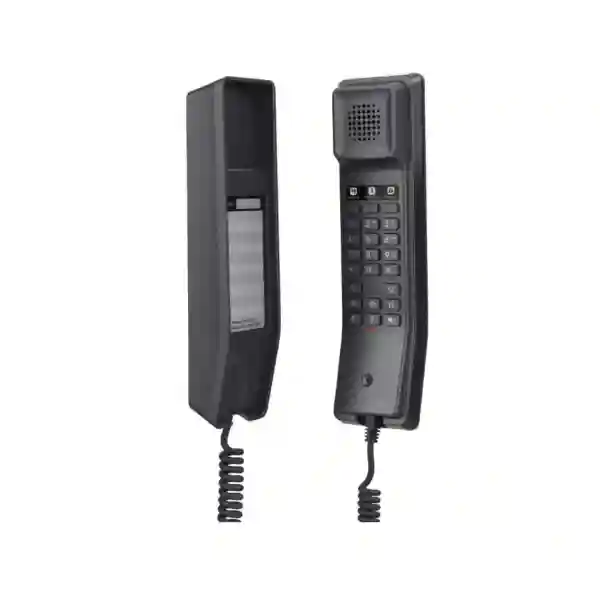
The Grandstream GHP611W is a compact black hotel IP phone designed for guest rooms and other environments where simple calling, programmable service access, wireless network connectivity and centralized administration are more important than a large screen or complex desktop interface. It supports two SIP accounts and two lines, an HD handset speaker, ten speed-dial keys, three programmable keys, three-way voice conferencing, Grandstream Device Management System (GDMS) provisioning and integrated dual-band Wi-Fi on the W variant. Current Grandstream documentation also shows an important hardware-version distinction: newer hardware revisions support Wi-Fi 6 and may support PoE, while earlier GHP611W hardware uses earlier Wi-Fi standards and is powered by an adapter. For Dubai and UAE hospitality projects, this makes hardware-version confirmation a practical procurement step rather than a minor specification detail.
Fourteck positions the GHP611W as a requirement-led choice for hotels, serviced apartments, healthcare rooms, dormitories, staff accommodation and similar deployments that want a discreet black handset-style endpoint. The right deployment starts with room count, PBX platform, Wi-Fi coverage, power availability, service-key plan, wall or desk placement and lifecycle requirements. Request a project review before ordering so the selected hardware revision, connectivity method and room design match the actual site.
Quick decision snapshot: when does the GHP611W make sense?
| Customer requirement | How GHP611W fits | Important consideration |
|---|---|---|
| Compact hotel-room calling | Trim-style phone with keys on the handset and wall/desk deployment options. | It is intentionally simple and does not provide a color screen. |
| Wireless network connectivity | GHP611W includes integrated dual-band Wi-Fi. | Wi-Fi capability differs by hardware version; confirm the supplied revision. |
| Guest service shortcuts | Ten speed-dial keys plus three programmable keys can support hotel service workflows. | Key functions depend on PBX and provisioning design. |
| Centralized endpoint operations | GDMS can provision, configure, monitor and manage supported Grandstream endpoints centrally. | Define templates, credentials and firmware policy before large rollouts. |
| Black room-phone aesthetic | GHP611W is the black Wi-Fi model in the GHP61x family. | GHP610W is the corresponding white Wi-Fi option. |
Why the GHP611W is different from a standard office IP phone
A hotel guest-room phone has a different job from an executive desk phone. Guests normally need fast access to reception, operator services, housekeeping, room service, emergency assistance and a small number of other functions. They do not generally need a large contact directory, multiple visual line appearances, a touchscreen or a dense set of collaboration features. The GHP611W reflects that workflow. Its compact trim-style design puts the keypad and operational keys on the handset, while programmable and speed-dial functions allow the deployment team to create a familiar hospitality experience.
That simplicity can also help operations teams standardize rooms. Instead of teaching temporary users how to navigate a complex interface, the property can map the important services to clearly labelled keys. The swappable faceplate and speed-dial label support customization, while centralized provisioning can keep account, network and service-key settings consistent across rooms. The model also supports wall installation, which is useful where bedside tables are small or where the property wants to keep the room surface uncluttered.
The GHP611W should therefore be evaluated as a purpose-built room endpoint rather than as a reduced-feature business phone. If a deployment needs a visual directory, richer soft-key interaction or a color display, another GHP model may be more suitable. If the project goal is compact room calling with Wi-Fi, black styling, SIP interoperability and centrally managed service keys, the GHP611W is a stronger fit.
Hardware version matters: Wi-Fi 6 and PoE must be confirmed
Grandstream’s current documentation distinguishes between older and newer GHP61xW hardware. The manufacturer states that GHP611W hardware version 5.0 and above supports dual-band 2.4 GHz and 5 GHz Wi-Fi using 802.11 a/b/g/n/ac/ax, bringing Wi-Fi 6 capability to newer revisions. Documentation for earlier hardware describes dual-band 802.11 a/b/g/n/ac operation. This means a product listing that simply says “GHP611W with Wi-Fi” does not tell the full deployment story. Procurement teams should ask which hardware revision is being supplied, especially when a project standard specifically calls for Wi-Fi 6.
Power should be checked in the same way. Grandstream’s 2026 user and installation documentation states that hardware version 5.0 and above can use PoE across the GHP610, GHP611, GHP610W and GHP611W family, while earlier W versions rely on a power adapter. Older reseller pages and legacy datasheets may still describe the Wi-Fi models as adapter-powered only. For a project, the safe approach is not to assume that every GHP611W in distribution behaves identically. Confirm hardware revision, PoE support and included power accessories before finalizing the room design or bill of materials.
This is particularly important during hotel renovation. Wi-Fi can reduce dependence on a dedicated Ethernet data drop at the exact phone position, but the endpoint still needs power. A wireless design therefore does not mean “no cabling” in every room. The project team should review electrical outlets, PoE-capable wiring if applicable, wireless signal quality, VLAN and security design, failover expectations and room-service availability before choosing the final connection method.
Guest-service keys: design the workflow before you deploy the phones
The ten speed-dial keys and three programmable keys are among the most useful features of the GHP611W in hospitality, but their value depends on the PBX and service workflow behind them. A hotel can use speed dials to reach reception, concierge, housekeeping, room service, reservations, spa, transport, security or other property-specific destinations. The correct mapping should reflect how guests actually request services, not a generic template copied from another property.
Before mass provisioning, decide which extensions or dial strings each label will call, how after-hours routing should work, what happens when a department is unavailable and whether calls should go to a queue, ring group, IVR or individual extension. Multi-property hotel groups should also decide whether they want one standard key layout across every site or local variations for each property. Clear labeling is important because a speed-dial key is only useful when a guest can understand it immediately.
The three programmable keys can support additional room-specific functions depending on the supported configuration and PBX environment. The wider phone interface also includes standard calling functions such as flash, redial, hands-free, voice mail, hold, volume control and mute. The best configuration is normally the one that keeps guest interaction simple while giving hotel operations enough flexibility to update call destinations centrally.
Audio quality and packet-loss resilience for room communication
Grandstream equips the GHP61x family with an HD handset speaker and support for a broad set of voice codecs including G.711, G.722 wideband, G.729A/B, G.726, G.723.1, iLBC and full-band Opus. The phone also supports standard voice-processing functions such as echo cancellation, packet-loss concealment, automatic gain control, comfort noise generation and adaptive jitter buffering. These features are relevant in hospitality because guest-room networks may carry many different types of traffic, particularly in properties where voice, IPTV, Wi-Fi, building systems and guest internet access share common infrastructure.
The manufacturer also highlights an advanced jitter-resilience algorithm that can tolerate up to 30 percent packet loss without impacting voice quality under its stated conditions. This is a useful resilience feature, but it should not be treated as permission to run the phone on a poorly designed network. Voice still benefits from stable latency, appropriate QoS, reliable wireless coverage, controlled interference and sensible network segmentation. For large properties, a site survey and proper WLAN design remain important even when the endpoint itself is designed to cope with difficult packet conditions.
Three-way voice conferencing is supported for simple calls that involve more than two parties. For guest rooms this may be useful in limited scenarios, while staff accommodation, healthcare or apartment deployments may use it more frequently. The key point is that the GHP611W provides practical SIP calling features without turning the room phone into a full office collaboration device.
Network planning for GHP611W hotel deployments
The GHP611W supports SIP and common IP networking standards, including IPv4, IPv6, HTTP/HTTPS, DNS, DHCP, NTP, STUN, LLDP, 802.1X and other protocols documented by Grandstream. It also supports Layer 2 and Layer 3 QoS mechanisms. Those capabilities give integrators multiple options, but the deployment should still be intentionally designed.
Wi-Fi coverage
Validate 2.4 GHz and 5 GHz coverage at the exact bedside or wall location. Do not rely only on hallway readings. Room construction, mirrors, concrete and furniture can change signal performance.
Voice VLAN and QoS
Where the network design supports it, separate voice traffic logically and prioritize real-time packets. Confirm how wireless SSIDs map to VLANs and QoS policies.
PBX reachability
Confirm SIP registration, DNS, firewall traversal, TLS/SRTP policy, extension plan and emergency calling requirements before room rollout.
Resilience
Define what happens if WAN, WLAN, PBX or power is unavailable. Requirements differ between guest convenience calling and regulated emergency communication.
The phone supports two SIP accounts and two lines, which can be useful when a project needs separation between different calling identities or services. Whether both accounts should be used depends on the PBX design. In many hotel rooms a single primary extension is enough; the second account should not be configured merely because it is available. Simpler configurations are often easier to support at scale.
GDMS provisioning and the operational value of centralized management
Grandstream Device Management System is a major part of the GHP611W deployment story. Grandstream describes GDMS as a centralized platform for provisioning, configuration, monitoring and management of supported endpoints. In a property with dozens or hundreds of guest rooms, this is more practical than manually configuring every phone one by one. Administrators can standardize templates, apply account settings, manage firmware and monitor devices from a central workflow.
A disciplined rollout should still start with a pilot. Configure a small number of GHP611W units with the intended PBX accounts, Wi-Fi parameters, speed dials, programmable keys, time settings, security controls and firmware. Test check-in/check-out scenarios, room moves, extension renumbering, help-desk procedures and device replacement. Once the pilot behaves as expected, convert the working configuration into the standard deployment template.
Hotels should also document ownership of the GDMS tenant, administrator roles, recovery contacts and change-control process. Central management is most useful when the property knows who is authorized to change room-phone settings and how emergency changes are approved. For hotel groups, separate site or property groupings can help operational teams manage multiple locations without losing control of local differences.
Security features for hospitality and managed-room environments
The GHP611W includes several enterprise-oriented security capabilities documented by Grandstream. These include secure boot, a unique security certificate per device, administrator-level passwords, 256-bit AES encrypted configuration files, TLS, SRTP and 802.1X media access control. The platform also uses secure provisioning options such as HTTPS and encrypted XML configuration files. These capabilities are valuable because a room phone is part of the property network and should be managed as an endpoint rather than treated as an isolated appliance.
Security configuration should follow the wider hotel IT policy. Use strong administrator credentials, restrict management access, prefer encrypted provisioning channels, segment voice traffic where appropriate, keep firmware under controlled maintenance, and verify certificate or TLS settings with the PBX environment. If guest-room Ethernet access is exposed physically, the network design should also account for unauthorized device connection and port-security requirements.
The GHP611W should not be expected to compensate for weak network architecture. Its built-in security features are most effective when combined with secure WLAN design, endpoint isolation, firewall policy, PBX hardening, role-based administration and a process for removing or reprovisioning devices that leave service.
Technical specification summary for Grandstream GHP611W
| Model | Grandstream GHP611W |
|---|---|
| Product type | Compact hotel / room SIP IP phone |
| Color | Black |
| SIP accounts / lines | 2 SIP accounts, 2 lines |
| Programmable / speed-dial keys | 3 programmable keys and 10 speed-dial keys |
| Wi-Fi | Integrated dual-band 2.4 GHz / 5 GHz. Hardware version 5.0+ supports 802.11 a/b/g/n/ac/ax; earlier hardware documentation describes a/b/g/n/ac. |
| Ethernet | One auto-negotiating 10/100 Mbps port documented on current datasheet. |
| Power | Hardware-version dependent. Grandstream’s newer documentation states PoE on hardware version 5.0+; older GHP611W hardware uses a power adapter. Confirm supplied revision. |
| Audio | HD handset audio; full-band Opus plus G.722, G.711, G.729A/B, G.726, G.723.1 and iLBC support. |
| Conference | Up to 3-way voice conference |
| Provisioning | GDMS, TR-069 and encrypted XML provisioning; firmware delivery over common supported protocols. |
| Security | Secure boot, device certificate, administrator passwords, AES-encrypted configuration, TLS, SRTP and 802.1X. |
| Mounting | Desktop or wall mount using the base. |
| Accessibility | Hearing Aid Compatibility (HAC) |
| Other documented functions | Multicast paging, GDS door opening support, flexible dial plan, hold, mute, redial, voicemail function and server redundancy/failover calling features. |
Black trim-style design: where the GHP611W fits visually
The GHP611W is the black member of the GHP611/GHP611W pair. That may sound like a cosmetic distinction, but room aesthetics matter in hospitality procurement. Some properties prefer a dark handset that blends with contemporary bedside controls, black switches, dark headboards or modern interior finishes. Others standardize on white devices for a lighter visual theme, in which case the GHP610W may be more appropriate.
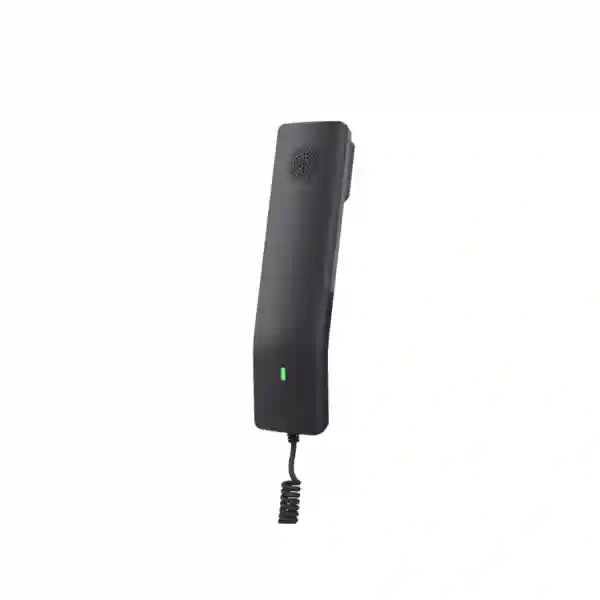
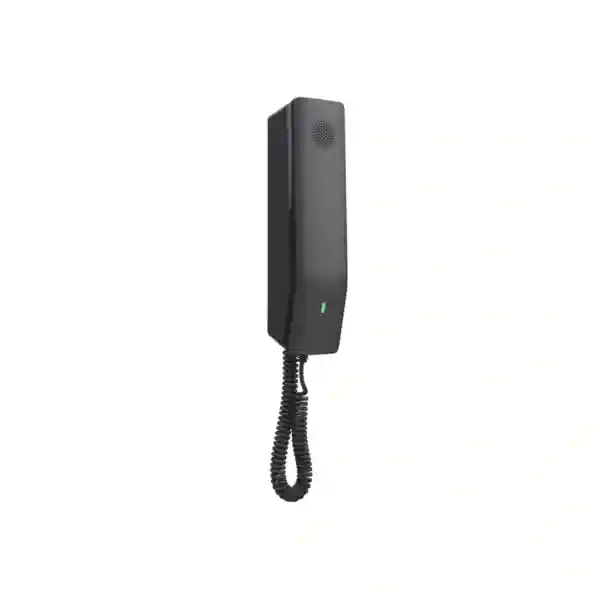
The GHP611W’s trim-style shape differs from traditional desktop phones because the working keys are integrated into the handset assembly. This creates a narrow footprint that can be useful on compact bedside tables. Wall mounting can further reduce surface clutter. When planning a wall installation, the project team should coordinate the mounting height, cable path, power access, handset reach and housekeeping requirements. A good installation should look intentional and remain easy to service.
For multi-room projects, consistency is more important than choosing black or white in isolation. The same faceplate style, key labels, mounting position and cable management should be repeated across rooms so maintenance teams can troubleshoot quickly and guests receive the same experience throughout the property.
GHP611W for hotel renovations and retrofit projects
Renovation projects often create the strongest case for a Wi-Fi hotel phone. A legacy property may have analog room telephones but no convenient Ethernet outlet at the bedside. Pulling new structured cabling into every occupied room can increase project time and coordination. A Wi-Fi-capable SIP endpoint can give the design team another option, provided that the wireless network is engineered for voice and power is available at the phone location.
A retrofit assessment should begin with the current PBX, extension numbering, analog gateway usage, cabling pathways, switch capacity, wireless coverage, power outlets and emergency-calling requirements. The team should then decide whether to move every room to IP at once or phase the conversion by floor or building. If the property already has strong Wi-Fi coverage, a pilot with GHP611W units can reveal whether roaming behavior, interference, voice latency and device density meet expectations.
Renovation is also a good time to simplify guest service dialing. Old room phones may have labels that no longer match the hotel’s departments or call routing. Rebuilding the key plan during the IP migration can reduce guest confusion and improve the consistency of service calls. Because the GHP611W supports centralized provisioning, future destination changes can be easier to manage than manual reprogramming of large numbers of legacy analog phones.
Beyond hotels: apartments, healthcare rooms, dormitories and managed accommodation
Grandstream also positions the GHP61x family for hospitals, apartments, dormitories, retail and similar environments. The reason is straightforward: these locations often need a simple endpoint with direct calling and a small set of service shortcuts rather than a full office phone. In a hospital or clinic room, programmable destinations might include a nurse station, reception or internal service desk. In student accommodation, the phone could connect to reception, security or facilities. In serviced apartments, it may provide concierge and building support access.
The deployment rules still differ by industry. Healthcare projects may have stronger infection-control, emergency calling and availability requirements. Dormitory networks may have tighter device isolation and authentication policies. Residential or serviced-apartment environments may prioritize compact appearance and low training requirements. The GHP611W’s feature set can serve these contexts, but the solution architecture should reflect the actual operational standard of the property.
The casing is described in the current Grandstream datasheet as antimicrobial and arranged for ISO 22196:2011 testing. That manufacturer statement can be relevant when evaluating shared or managed environments, but procurement teams should review the exact compliance documentation and cleaning guidance required by their organization rather than treating one material statement as a complete hygiene policy.
GHP611W vs nearby Grandstream hotel-phone options
| Model family | Key distinction | Best-fit reasoning |
|---|---|---|
| GHP611W | Black trim-style model with integrated Wi-Fi. | Choose when wireless connectivity and black styling suit the room design. |
| GHP611 | Black trim-style wired variant. | Choose where Ethernet/PoE is preferred and Wi-Fi is unnecessary. |
| GHP610W | White Wi-Fi counterpart with the same GHP61x trim-style concept. | Choose mainly for white-room aesthetics or standardized white fixtures. |
| GHP620W / GHP621W | More traditional hotel-phone form factor with more programmable keys in the GHP62x family. | Consider when the property wants a conventional desk layout and additional programmable-key capacity. |
| GHP630W / GHP631W | Hotel-phone family with a color LCD. | Consider when a visual display and richer user interface are required. |
The correct choice should be based on room workflow, cabling, Wi-Fi design, number of service keys, display requirements and color preference. Avoid choosing only by unit price because changing the model later can affect wall mounting, power design, labeling, provisioning and guest training.
PBX compatibility and SIP deployment planning
The GHP611W is a standards-based SIP phone. Grandstream documents SIP RFC3261 and common RTP, TLS and SRTP capabilities, which allows the phone to be considered for Grandstream UCM systems and many other SIP-based PBX or hosted voice platforms. Compatibility should still be confirmed with the selected PBX version, provisioning method and feature requirements before a bulk purchase.
A basic compatibility test should verify registration, inbound and outbound calling, DTMF behavior, hold, transfer, voicemail, three-way conference, service speed dials, caller ID, codec negotiation, failover behavior, time synchronization and any hotel-specific middleware or PMS-related call workflow. If a property uses a hospitality middleware layer to activate extensions at check-in or reset room settings at check-out, that process needs its own validation because the endpoint itself does not replace the hotel integration layer.
Security settings can also affect interoperability. TLS versions, certificates, SRTP policy, 802.1X and firewall rules should be matched to the network and PBX environment. A small pilot is usually the fastest way to discover these issues before the phones are mounted across hundreds of rooms.
Procurement checklist for Dubai and UAE buyers
For a Grandstream GHP611W Dubai quotation, provide more than the model number. A useful commercial request should include the room count, required quantity, preferred delivery location, target installation date, PBX platform, whether Wi-Fi 6 is mandatory, desired power method, wall or desk mounting plan and any required service-key customization. This allows the supplier to confirm the appropriate hardware revision and identify related items before the order is finalized.
Ask whether the supplied units are hardware version 5.0 or later when Wi-Fi 6 or newer power behavior is required.
Do not assume every batch is powered the same way. Confirm PoE capability and whether an adapter is included or required.
Room count influences staging, labeling, testing, spares and delivery planning.
Share the PBX model or hosted platform and whether GDMS, local provisioning or another method will be used.
Fourteck can review project requirements and prepare a quotation based on the requested quantity and configuration. Stock, delivery time, pricing, warranty route and hardware revision should always be confirmed at the time of quotation rather than assumed from a static web page.
Dubai, Abu Dhabi, Sharjah, Ajman and wider UAE deployment considerations
Dubai hotel projects often involve a mix of new builds, renovations, serviced apartments and multi-property operators. In a new build, the GHP611W can be assessed alongside the structured cabling, PoE switching, WLAN, IP PBX and room automation design before fit-out. In a renovation, Wi-Fi may provide more flexibility where adding new data outlets is difficult. The technical team should still verify voice coverage inside actual guest rooms, not only public areas.
Abu Dhabi hospitality and healthcare deployments may involve larger campuses, multiple buildings or controlled enterprise networks. These projects benefit from a clear VLAN, authentication, firmware and centralized-management plan before endpoints are staged. Sharjah and Ajman properties may prioritize straightforward modernization and cost control, making a compact SIP room phone attractive when a large display is unnecessary. The same requirement-led method applies across the Emirates: match the endpoint to the room workflow, PBX and network rather than choosing a phone in isolation.
For Deira, Bur Dubai and other dense hospitality areas, renovation logistics can be as important as the endpoint specification. Limited access windows, occupied rooms and existing cabling may influence whether deployment is staged floor by floor or carried out during planned refurbishment. A pilot room can validate wall mounting, labels, handset placement, Wi-Fi performance and PBX behavior before the rollout team repeats the design.
Regional procurement: Kuwait, Kenya, Uganda, Ghana, Nigeria and Tanzania
The GHP611W can also be considered for hospitality and managed-accommodation projects outside the UAE, but regional procurement should account for local power arrangements, Wi-Fi design, PBX hosting location, import lead time and support model. A specification developed for a Dubai hotel should not automatically be copied into another country without checking the site conditions.
Kuwait projects may focus on hospitality, staff housing and serviced residences where central provisioning and a simple room endpoint are useful. Kenya, Uganda, Ghana, Nigeria and Tanzania projects may involve a wider range of network conditions, from modern campus WLANs to properties upgrading from analog telephony. In these environments, confirming stable LAN/WLAN architecture, local power reliability, remote provisioning and spare-unit strategy can be more important than adding user-interface features that guests rarely use.
Fourteck’s regional network can support requirement discussions through its country-focused channels where relevant. For buyers planning multi-country deployments, it is useful to standardize the PBX policy, configuration templates, labels and device-management method while still allowing country-specific power, logistics and support arrangements.
Fourteck Kuwait
Fourteck Kenya
Fourteck Uganda
Fourteck Ghana
Fourteck Nigeria
Fourteck Tanzania
Installation sequence for a controlled hotel rollout
A successful GHP611W deployment is easier to manage when installation follows a repeatable sequence. Start by confirming the final room list and extension plan. Next, validate the PBX template, Wi-Fi or Ethernet method, power design, firmware target and key mapping on a pilot set. Label the phones before they are delivered to rooms so installers do not have to identify devices manually during the rollout.
When each phone is installed, test power, network association, SIP registration, inbound calling, outbound calling, emergency or operator dialing where applicable, each service shortcut, hold, mute, speaker function and voicemail behavior. If wall mounted, confirm that the handset sits securely and that cables do not create a snag or cleaning problem. Record the room number, MAC address or device identifier according to the property’s asset-management process.
After installation, monitor registration and call quality during a bedding-in period. Wireless deployments should be reviewed for rooms with weak signal, interference or unusual roaming behavior. Changes made during the pilot or early rollout should be added to the master configuration rather than applied as undocumented one-off fixes. This keeps the final estate supportable when staff or contractors change.
Operational support after installation
Room phones are often expected to work quietly for years, so support planning should be simple and repeatable. Keep a small number of pre-staged spares for large properties. Document how to factory-reset and re-provision a replacement, how extensions are assigned, which team owns Wi-Fi credentials and where the approved firmware baseline is recorded. If a phone fails, the support team should be able to swap it without rebuilding its configuration from memory.
Use centralized management to monitor devices and schedule controlled firmware updates. Firmware should be tested on a limited group before broad rollout, particularly if the property relies on PBX features, wireless authentication or custom provisioning. A maintenance window can reduce the risk of guest disruption. For multi-property groups, separate pilot rings can be useful so one property validates a new firmware version before it is deployed across the group.
Housekeeping and engineering teams should also know the basic physical checks: handset cable connection, power source, wall mount, visible damage and room network status. Many room-phone incidents can be triaged quickly when the first-line team knows what to inspect before escalating to telecom support.
Questions to answer before requesting a GHP611W project quotation
Quantity affects staging, labeling, rollout timing and spare strategy.
Compatibility and provisioning should be validated against the actual platform.
If yes, specify that hardware version 5.0+ is required and confirm availability.
Verify PoE capability or adapter requirements for the exact hardware revision.
Mounting influences cable routing, room aesthetics and serviceability.
Provide the intended destinations and labels so the provisioning template can be planned.
Why choose Fourteck for a GHP611W requirement review?
A hotel-phone order should connect product selection with the PBX, network and room environment. Fourteck can help buyers structure the requirement around quantity, hardware revision, wireless design, power method, PBX compatibility, deployment geography and related infrastructure. The objective is to reduce avoidable mismatches such as ordering an older hardware revision when Wi-Fi 6 is mandatory, assuming PoE on a batch that requires adapters, or selecting a trim-style phone when the property actually needs a screen or additional programmable keys.
For UAE buyers, Fourteck can coordinate quotation discussions for Dubai, Abu Dhabi, Sharjah, Ajman and other Emirates. For regional projects, the requirement can be aligned with the relevant Fourteck country channel. Availability, commercial terms, delivery, warranty path and exact included accessories should be confirmed on the live quotation.
Explore Grandstream Hotel Phone Solutions
Request UAE Project Support
Frequently asked questions about Grandstream GHP611W
Is the Grandstream GHP611W a Wi-Fi hotel phone?
Yes. The GHP611W is the Wi-Fi variant of the black GHP611 family. It supports integrated dual-band 2.4 GHz and 5 GHz Wi-Fi. Newer hardware version 5.0 and above supports 802.11 a/b/g/n/ac/ax, while older hardware documentation lists a/b/g/n/ac.
Does the GHP611W support PoE?
PoE support is hardware-version dependent. Grandstream’s current documentation states that GHP61xW hardware version 5.0 and above supports PoE, while earlier GHP611W versions are powered by a power adapter. Confirm the exact supplied hardware revision before designing the power method.
How many SIP accounts does the GHP611W support?
The GHP611W supports two SIP accounts and two lines. A hotel may use one or both depending on its PBX and room-calling design.
How many programmable and speed-dial keys are available?
The GHP611W provides three programmable keys and ten speed-dial keys. These can be planned for reception, housekeeping, room service, concierge, security and other property-specific destinations, subject to the PBX and provisioning design.
Can the GHP611W be wall mounted?
Yes. Grandstream documents both desktop and wall-mounted installation for the GHP61x family. The base supports wall mounting.
What is the difference between GHP611 and GHP611W?
Both are black compact hotel phones in the same family. The GHP611W adds integrated Wi-Fi, while the GHP611 is the wired-focused variant. Power behavior also depends on hardware revision, so confirm the exact model and version for the project.
What is the difference between GHP611W and GHP610W?
The key visual difference is color: GHP611W is black and GHP610W is white. They belong to the same compact GHP61x Wi-Fi family, so the choice is often driven by room aesthetics and fixture standards as well as availability.
Does the GHP611W support GDMS?
Yes. Grandstream supports the GHP series through GDMS for centralized configuration, provisioning, management and monitoring of endpoints.
Is the GHP611W suitable only for hotels?
No. Grandstream also identifies hospitals, apartments, dormitories, retail and similar settings as suitable environments for the GHP61x family where a compact and simple SIP phone is useful.
What should I confirm before ordering GHP611W in Dubai?
Confirm quantity, hardware revision, Wi-Fi requirement, power method, PBX platform, mounting style, service-key plan, delivery location and target timeline. Live stock, price, warranty path and included accessories should be confirmed on the quotation.
Request a Grandstream GHP611W Dubai quotation
For a useful quotation, send Fourteck the required quantity, hotel or project location, PBX platform, preferred wall or desk installation, whether Wi-Fi 6 is mandatory, and whether you plan to power the phones by PoE or adapter. The team can use those details to review the correct GHP611W hardware revision and related network or PBX requirements. Pricing, stock, lead time and warranty arrangements are confirmed at the time of enquiry.

Reviews
There are no reviews yet.