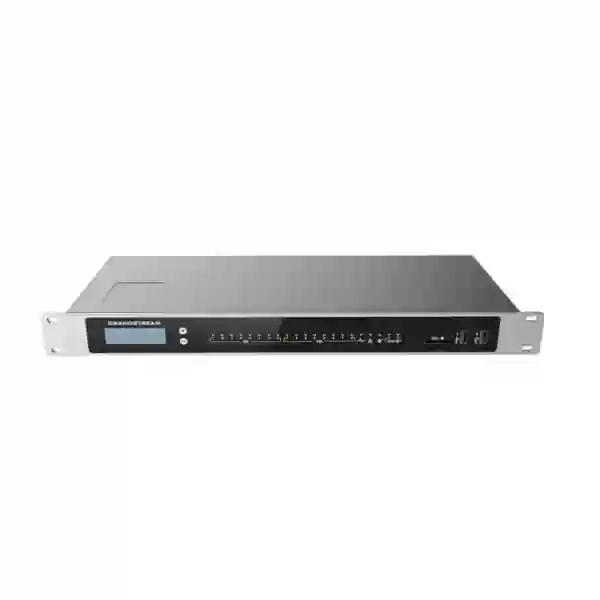
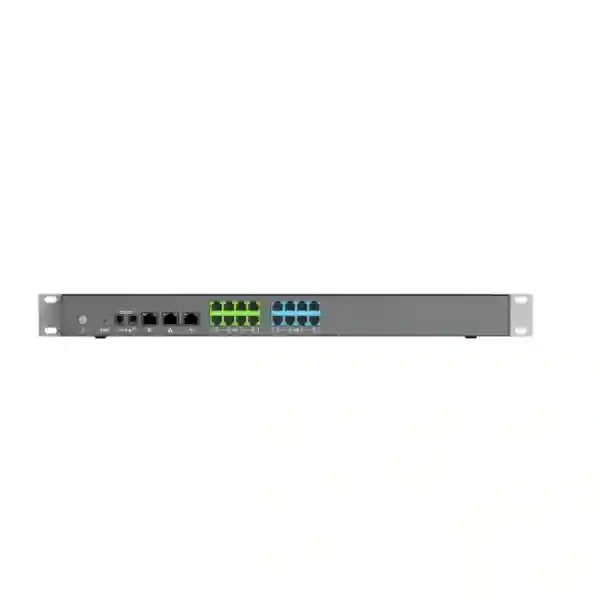
Grandstream UCM6308A Audio IP PBX Dubai
The Grandstream UCM6308A is the highest-capacity model in Grandstream’s UCM6300 Audio series, designed for organizations that need a centralized, on-premises IP PBX with strong voice capacity, analog connectivity, remote-user support, meeting tools, and straightforward integration with Grandstream endpoints. For Dubai and UAE businesses planning a larger office, multi-department voice system, hotel telephony environment, education campus, healthcare network, contact-centre deployment, or multi-branch communications platform, the UCM6308A provides room for up to 1,500 users and up to 200 concurrent G.711 calls.
Unlike the non-A UCM6308, which belongs to Grandstream’s multimedia-focused UCM6300 series, the UCM6308A is positioned as an audio unified communications appliance. It combines SIP telephony, 8 FXS ports, 8 FXO ports, call routing, IVR, queues, meetings, Wave soft-client access, UCM RemoteConnect compatibility, security controls, API integration and centralized Grandstream device management. Fourteck can help UAE organizations assess whether this model matches their user count, call concurrency, SIP trunk design, analog-line requirements, branch topology, endpoint mix, remote-working plan and future expansion requirements before deployment.
Who should consider the UCM6308A?
The UCM6308A is best considered when the communication requirement is too large for a small-office PBX but does not require the higher multimedia capacity of the standard UCM6308. Its 1,500-user ceiling makes it suitable for larger enterprises, distributed office groups, campuses, hospitality properties, schools, healthcare operations, retail groups, warehouses, professional services organizations, call-handling teams and institutions that want centralized voice control while retaining direct ownership of their PBX infrastructure.
A buyer should not select an IP PBX on extension count alone. The more useful sizing questions are: How many users will actually register? What is the busiest-hour simultaneous call load? How many calls must be encrypted with SRTP? How many SIP trunks or channels are required? Are there existing PSTN lines that must remain active? Are analog phones, fax devices, intercoms, lift phones or legacy room phones part of the design? How many remote or mobile users will connect through Wave or UCM RemoteConnect? Does the business need call queues, recording, complex IVR, multiple departments, branch routing, CRM integration, failover planning or meeting rooms? The UCM6308A becomes compelling when several of these requirements converge in one deployment.
Verified UCM6308A technical profile
| Model | Grandstream UCM6308A |
|---|---|
| Series | UCM6300 Audio Series |
| Maximum users | 1,500 |
| Maximum concurrent calls | 200 G.711 calls |
| Maximum concurrent SRTP calls | 150 |
| Analog FXS ports | 8 RJ11 |
| Analog FXO ports | 8 RJ11 |
| Network interfaces | Three self-adaptive Gigabit ports with PoE+; switched, routed or dual mode |
| NAT router | Supported |
| Peripheral interfaces | 2 × USB 3.0 and 1 × SD card interface |
| Display | 128 × 32 dot-matrix graphic LCD with controls |
| Power | 2 × DC 12V power inputs; 12V/2A adapters |
| Mounting | Rack mount or desktop |
| Dimensions | 485 × 187.2 × 46.2 mm |
| Unit weight | 2,538 g |
| Telephony platform | Asterisk version 16 based |
Capacity values describe platform limits under Grandstream’s documented conditions. Real deployment sizing should also consider codec choice, encryption, recording, call queues, conference usage, remote connectivity, storage planning, integration load and traffic peaks.
Why the 8 FXS and 8 FXO ports matter
The analog interfaces are one of the strongest reasons to choose the UCM6308A. Eight FXS ports can connect supported analog endpoints such as legacy telephones or compatible analog devices, while eight FXO ports can terminate traditional PSTN lines. This can be important in Dubai and UAE environments where an organization is modernizing to SIP but still has analog dependencies that cannot be removed immediately. Hotels may have legacy room phones or service areas. Warehouses may have analog paging or emergency devices. Schools, clinics and older offices may retain fax or specialist equipment. Businesses may also need local PSTN lines as a transitional or backup path while their SIP trunking strategy evolves.
The integrated analog ports reduce the need for separate external gateways in many deployments. That does not mean every analog requirement should automatically be terminated on the PBX: cable distance, surge protection, building topology, line ownership, fax behavior, emergency calling rules, carrier signalling and resilience must still be assessed. For projects spanning several floors, buildings or branches, dedicated gateways can sometimes be operationally cleaner. Fourteck can evaluate whether the built-in interfaces should be used centrally or whether a distributed gateway design makes more sense.
Audio-first unified communications, not a basic PBX
Calling the UCM6308A an “audio PBX” can make it sound simpler than it is. In practice, it is a unified communications platform built around enterprise voice. The system includes SIP extension management, inbound and outbound routing, IVR, ring groups, queues, voicemail, time conditions, call recording, fax workflows, conferencing, presence-oriented collaboration through Wave, remote-user connectivity, API access and endpoint provisioning. It is designed to centralize communication logic so that users, departments, branches and external trunks can be managed under one coherent dial plan and policy set.
For customers who primarily want business telephony, instant messaging and audio collaboration, this focus can be an advantage. It avoids paying attention to video capacity that may not be relevant to the project and keeps the buying decision centred on extensions, voice calls, analog connectivity, remote access, call handling and operational resilience. Organizations that need larger multimedia conference capacity or a higher user ceiling should compare the UCM6308A with the non-A UCM6308 before ordering.
Wave and remote working
Grandstream’s Wave client extends the UCM environment beyond desk phones. Users can communicate from supported desktop, web and mobile environments, allowing the UCM6308A to support hybrid workers, travelling managers, remote teams and staff who require a soft-client experience. This is particularly useful when a Dubai headquarters supports employees in Abu Dhabi, Sharjah, other Emirates or overseas locations and wants internal extension dialing and corporate calling features without requiring every person to be physically connected to the office LAN.
Remote access should always be designed as a security and quality-of-service project rather than treated as a simple feature switch. The user experience depends on WAN quality, firewall policy, DNS, NAT behavior, endpoint security, account credentials, encryption, bandwidth, jitter, packet loss and the remote user’s network. UCM RemoteConnect is designed to simplify secure remote connectivity and NAT traversal for the UCM ecosystem, but the correct service tier and deployment design should be checked against the organization’s current Grandstream licensing/service options and required scale.
Meeting and collaboration capacity
The UCM6308A supports audio-focused meeting collaboration with a documented maximum of 150 simultaneous participants across its meeting capacity, with up to nine simultaneous public meeting rooms. This is useful for organizations that want scheduled or ad-hoc audio collaboration for internal teams, project groups, branch managers, suppliers or customers without deploying a separate voice-conference bridge for ordinary business use.
Conference sizing should be considered separately from ordinary call sizing. A company may have 800 registered extensions but only 50 concurrent business calls most of the day; alternatively, a large service organization may create heavy peaks during campaigns, support incidents or scheduled conference periods. If meetings are a critical workflow, Fourteck recommends modelling the busiest realistic concurrency scenario, including SIP trunk channels and any recording or remote-user requirements, rather than relying only on the headline 1,500-user capacity.
Call handling for reception, sales, support and operations
The UCM6308A supports a broad range of call-control functions that can be adapted to different business departments. A reception team can use ring groups, transfer, BLF, time conditions and centralized directory functions. Sales teams can use DID routing, hunt behavior, voicemail, call recording policies and CRM integration where supported. Service desks can use queues, announcements and routing logic. Management can use scheduled routing and mobile clients, while warehouse or facilities staff can integrate intercom and paging scenarios using compatible SIP endpoints.
The best PBX design is not the one with the most features enabled. It is the one that mirrors the organization’s actual customer journey and internal responsibilities. A clean inbound route can answer with a short IVR, send VIP or direct numbers to the correct team, send overflow calls to a backup group, route after-hours calls to voicemail or an on-call extension, and provide reporting that managers can understand. Complex 10-level menus often create frustration. Fourteck therefore treats IVR design, queue strategy, ring timing and failover routing as part of the business process rather than only a technical configuration task.
SIP trunk and PSTN migration planning in the UAE
Many UAE organizations are transitioning from traditional PBX platforms toward SIP-based communications. The UCM6308A can sit at the centre of that migration. Existing analog lines can be connected through its FXO ports where technically appropriate, while SIP trunks provide scalable IP-based call capacity. This lets a customer phase the migration instead of replacing every dependency at once.
A successful SIP trunk deployment requires more than entering a username and password. The design must account for the provider’s authentication method, DID presentation, inbound number mapping, outbound caller ID policy, codec support, DTMF method, NAT behavior, firewall rules, failover routes, emergency-call requirements and channel capacity. UAE carrier rules and available services can vary by provider and contract, so trunk compatibility and regulatory requirements should be confirmed before implementation. Fourteck can work from the customer-provided carrier parameters and desired call-flow plan to configure and test the PBX.
Security architecture for a business IP PBX
An IP PBX is part of the organization’s security perimeter because it handles credentials, call routing, remote access and often personally or commercially sensitive communications. Grandstream documents security measures for the UCM6300 Audio series including secure boot, unique device certificates and randomized default passwords. The platform also supports encrypted protocols such as TLS, SRTP, HTTPS, SSH and 802.1X in applicable configurations.
Those capabilities still require correct administration. A secure UAE deployment should use strong unique administrator credentials, role-based access where practical, restricted management interfaces, current firmware, trusted certificates, protected SIP trunks, limited remote exposure, firewall controls, intrusion monitoring, account lockout policies, controlled international dialing, encrypted remote clients where appropriate and regular backups. The PBX should normally be placed in a structured voice/data VLAN design rather than left on an unrestricted flat network. Remote administration should be limited to approved sources or secure access paths.
Toll fraud is one of the most important telephony-specific risks. Outbound routes, PIN requirements, international destinations, after-hours calling and extension permissions should be configured according to real business need. A stolen SIP credential should not automatically provide unrestricted global dialing. Fourteck can align route permissions with departments, working hours and user roles to reduce this exposure.
Network design: VLAN, QoS and bandwidth
Voice quality is determined by the complete path, not just the PBX. The UCM6308A supports QoS-related networking features, but switches, routers, firewalls, WAN links and endpoint configurations must preserve the design. Business voice is sensitive to latency, jitter and packet loss, especially when calls cross site-to-site links or public internet connections.
For larger deployments, Fourteck typically recommends separating voice and general user traffic logically with VLANs, applying appropriate QoS markings and switch policies, confirming DHCP and provisioning behavior, validating PoE budgets for IP phones, and testing WAN utilization during busy periods. A high-capacity PBX cannot compensate for an overloaded internet link or incorrectly configured switch. When remote branches register to a central UCM6308A, WAN resilience and failover become even more important because a branch that loses connectivity can also lose access to centralized voice services unless the design includes an appropriate contingency.
Grandstream endpoint provisioning and GDMS
The UCM6308A supports zero-configuration provisioning for compatible Grandstream SIP endpoints, helping administrators roll out larger numbers of IP phones with consistent account, network and feature settings. This is especially valuable in offices with dozens or hundreds of extensions, because manual per-phone configuration is slow and creates inconsistency.
Grandstream also provides GDMS, its cloud device-management platform, for compatible Grandstream products. The UCM6300 Audio series is designed to work with GDMS for cloud-based setup, management and monitoring workflows. The practical value is centralized visibility: administrators can standardize firmware policies, templates and device information rather than treating every phone as an isolated appliance. For enterprises with multiple sites, this can materially reduce support effort.
High Availability and resilient deployment planning
The UCM6300 Audio series includes support for Hot Standby High Availability and local dual-deployment scenarios. The UCM6308A hardware also provides dual DC power inputs, which can be part of a more resilient installation strategy. These capabilities are important for organizations where telephony is operationally critical.
High availability should be approached as a complete architecture, not just a PBX checkbox. The project should consider power sources, UPS capacity, switch redundancy, internet or SIP trunk failover, DNS, cabling, backup configuration, remote sites, carrier diversity and the human process for responding to faults. If both PBX appliances share the same single switch, single power circuit and single WAN connection, resilience remains limited. Fourteck can help identify the actual failure domains so the customer invests in redundancy where it produces a meaningful business outcome.
CRM, PMS and third-party integration
Grandstream provides API capabilities for third-party platform integration, including common business scenarios such as CRM and property-management-system workflows. Integration can improve productivity when a business wants click-to-call, caller identification, activity logging, screen-pop behavior, room/status workflows or custom application logic.
API availability does not guarantee compatibility with every software product. The integration must be validated against the target application’s API, authentication, event handling, data model and supported workflow. For hospitality, a PMS integration may have very different requirements from a CRM used by a sales team. Before promising a result, Fourteck recommends confirming the exact platform name and version, documenting required call events and business actions, and testing in a controlled environment.
UCM6308A vs UCM6304A vs UCM6308
| Decision point | UCM6304A | UCM6308A | UCM6308 |
|---|---|---|---|
| Series focus | Audio UC | Audio UC | Multimedia UC |
| Maximum users | 1,000 | 1,500 | Up to 3,000 |
| Maximum concurrent G.711 calls | 150 | 200 | Up to 450 |
| FXS / FXO | 4 / 4 | 8 / 8 | 8 / 8 |
| Best fit | Mid-sized audio UC | Large audio UC with high analog density | Larger multimedia and higher call/user capacity |
Choose the UCM6308A when the project is fundamentally voice-centric, needs significant analog connectivity, and fits within 1,500 users and 200 concurrent G.711 calls. Choose the UCM6304A when the user and call load is lower and four analog lines/extensions are sufficient. Consider the UCM6308 when the customer needs a higher user/call ceiling or broader multimedia capacity. Exact sizing should be based on the project workload rather than model naming alone.
Deployment example: multi-floor Dubai headquarters
Consider a Dubai headquarters with 550 desk users, 120 mobile or hybrid users, multiple reception points, a customer-service queue, a finance team, executive offices, meeting rooms and several legacy analog lines. The company expects growth to 850 users over three years and wants all extensions managed centrally. A UCM6308A can provide a suitable capacity envelope if concurrent calls remain within the platform’s limits.
The implementation could place the PBX in the main server room, separate voice traffic into dedicated VLANs, use PoE switches for IP phones, map DIDs to departments, design a short IVR, create queues for customer service, register remote workers through the approved remote-access method, connect retained PSTN lines through FXO ports, use FXS ports for selected analog endpoints and integrate a CRM after API validation. The critical point is that each component is sized together: PBX calls, SIP trunk channels, WAN bandwidth, switch PoE budget, recording storage, backup strategy and failover.
Deployment example: hotel or serviced residence
Hospitality projects often mix modern IP endpoints with analog room devices, front-desk phones, service extensions, lift/intercom requirements and a property-management platform. The UCM6308A’s eight FXS and eight FXO ports can be useful in this mixed environment, but larger properties may still require external gateways because the total analog-port count can exceed the PBX’s onboard interfaces.
For a hotel, the project should map guest rooms, reception, reservations, housekeeping, engineering, restaurants, management, security and emergency phones separately. Call permissions and class of service should reflect each role. PMS integration should be tested against the actual PMS. If many room phones are analog, distributed gateways may reduce long copper runs. If rooms use SIP handsets, network segmentation, PoE switching and device templates become more important. The UCM6308A can act as the central call-control platform while the endpoint architecture is designed around the property.
Deployment example: school, college or training campus
Education environments need simple dialing, reception coverage, administration lines, security communications, paging/intercom integration, staff mobility and reliable emergency contact paths. A large school or multi-building campus may have hundreds of extensions but relatively moderate everyday call concurrency, which can make the UCM6308A a sensible fit if the user count and network design align.
The campus network should be planned so that voice services remain stable during periods of heavy student internet use. VLAN and QoS design, switch redundancy, UPS power and branch/building uplinks therefore matter. Emergency routing and after-hours numbers should be explicitly documented. Where analog endpoints remain in guard rooms, reception counters or legacy facilities, the onboard ports may ease transition while the rest of the campus moves to SIP.
Deployment example: clinic or healthcare group
Clinics and healthcare organizations often need predictable call routing because patients may call for appointments, billing, insurance, pharmacy, nursing desks or emergency information. The UCM6308A can support central IVR and queue logic, departmental DIDs, internal extensions, voicemail and remote-user access for approved staff. Analog interfaces may help with legacy fax, specialized lines or older endpoints where continued use is required.
Because communications can involve sensitive information, administrative access, recordings, retention and remote connectivity need clear policy. The PBX should be integrated into the organization’s broader security and compliance approach. Fourteck can configure technical controls, but the customer remains responsible for defining retention, privacy, legal and operational requirements for its jurisdiction and industry.
How Fourteck approaches a UCM6308A project
Dubai and UAE deployment considerations
Dubai: Multi-floor offices, business parks, hotels and distributed service companies often need structured cabling, PoE switching and SIP trunk coordination as part of the PBX project. Network-room readiness and carrier handoff details should be confirmed before installation day.
Abu Dhabi: Larger corporate, institutional and multi-site environments may place greater emphasis on centralized management, resilient WAN design, security policy and branch routing. Capacity should be reserved for growth rather than sized only for the day-one extension count.
Sharjah and Ajman: Manufacturing, education, retail, warehouse and professional-office deployments can benefit from the UCM6308A when a central PBX must serve a mix of desk phones, service areas, analog endpoints and remote branches.
Across the UAE: The correct telephone service, SIP trunk, number allocation, emergency-calling arrangement and carrier configuration depend on the provider and customer contract. Fourteck does not assume carrier compatibility from a model number alone; the service details should be validated during planning.
Procurement checklist before requesting a quotation
- Current number of users and three-year expected growth.
- Peak simultaneous inbound and outbound calls.
- Required SIP trunk channels and telephone-number ranges.
- Number of existing PSTN lines to retain.
- Analog extensions, fax, lift phones, intercom or other legacy devices.
- Grandstream and third-party SIP endpoint models.
- Remote users and branch locations.
- Call queues, recording and meeting requirements.
- CRM, PMS or other software integration requirements.
- Network switches, PoE capacity, VLANs, firewall and WAN topology.
- High-availability, UPS and carrier-failover expectations.
- Installation, migration, configuration, training and post-cutover support scope.
Providing these details allows a quotation to reflect the complete solution rather than only the PBX appliance. The UCM6308A itself may be the correct core, but a working communications platform can also require phones, switches, gateways, licenses or cloud services where applicable, installation, configuration, structured cabling, rack accessories, UPS capacity and carrier services.
When the UCM6308A may be the wrong choice
A good product page should also explain when not to buy the product. The UCM6308A may be oversized for a small office with 30 users and minimal analog requirements. In that situation, a smaller UCM6300 Audio model may reduce cost and complexity while still providing the required features. At the opposite end, a company expecting more than 1,500 registered users, more than 200 concurrent G.711 calls, or significantly larger multimedia collaboration requirements should evaluate the non-A UCM6300 series or another architecture.
It may also be the wrong choice if the organization requires a fully hosted PBX with no on-premises appliance, if its required CRM/PMS platform cannot be integrated, or if a carrier mandates a different certified solution. Fourteck recommends confirming these constraints before procurement rather than trying to force a product into a mismatched design.
Migration from an older PBX
Moving from a legacy PBX to the UCM6308A should be planned as a controlled migration. The project begins by inventorying extensions, telephone numbers, analog lines, hunt groups, IVRs, voicemail boxes, call-forwarding rules, fax devices, paging systems, door phones and special dial codes. Existing carrier services and number ownership should be documented before any cutover.
Where possible, a parallel build is safer than a same-day rebuild. The new UCM can be configured with the target dial plan, phones can be provisioned and test numbers can be used before the main numbers move. Critical departments should have defined fallback paths. After cutover, the team should test inbound DIDs, outbound CLI, emergency calls, transfers, voicemail, queues, call recording, fax if required, remote users and branch connectivity. Configuration backups should be captured at key milestones.
UCM6308A support, maintenance and lifecycle practice
Business telephony should be maintained as an operational system. Administrators should review firmware releases, security advisories, certificates, backup integrity, storage consumption, trunk status, call logs, failed registrations, disk health, queue performance and unusual outbound-call activity. Changes should be documented rather than made ad hoc during incidents.
Firmware upgrades are best handled with preparation: confirm the supported upgrade path, read release notes, take backups, schedule a maintenance window and test core call flows after the upgrade. Grandstream’s GDMS can assist with centralized device-management workflows, but PBX changes still require change control. Fourteck can support planned maintenance, troubleshooting and configuration reviews based on the customer’s agreed support scope.
Regional procurement and multi-country organizations
Organizations with operations beyond the UAE often want one communications design philosophy across multiple countries. The UCM6308A can be evaluated for branches in markets such as Kenya, Uganda, Tanzania, Nigeria, Kuwait and other regions where Grandstream solutions are used, but each site must be checked for local carrier services, power standards, compliance requirements, numbering rules and support logistics. A configuration that works in Dubai should not be copied blindly into another country.
Fourteck maintains regional technology properties including Fourteck UAE, Grandstream UAE, Fourteck Kenya, Fourteck Uganda, Fourteck Tanzania and Fourteck Nigeria. Customers planning multi-country rollouts can use a common requirement template while validating local implementation details separately.
Frequently asked questions
How many users does the Grandstream UCM6308A support?
Grandstream documents support for up to 1,500 users on the UCM6308A. The practical design should still consider concurrent calls, encryption, conferencing, recording, queues and integration load.
How many concurrent calls can the UCM6308A handle?
The documented maximum is 200 concurrent G.711 calls, with up to 150 concurrent SRTP calls. Actual deployment sizing should be validated against the chosen codecs and feature usage.
Does the UCM6308A include analog ports?
Yes. It includes eight FXS RJ11 ports and eight FXO RJ11 ports. These can be useful for integrating supported analog endpoints and PSTN lines into a SIP-based deployment.
Is the UCM6308A the same as the UCM6308?
No. The UCM6308A is part of the UCM6300 Audio series and supports up to 1,500 users and 200 concurrent G.711 calls. The UCM6308 belongs to the multimedia UCM6300 series and has a higher maximum user and call capacity. The correct model depends on the project’s communication profile.
Can remote workers use the UCM6308A?
Yes. The UCM6300 Audio ecosystem includes Wave clients and compatibility with UCM RemoteConnect for remote connectivity. The network, security and required service options should be designed for the expected number of remote users.
Does it support Grandstream phone auto-provisioning?
Yes. Grandstream documents zero-configuration provisioning support for compatible Grandstream SIP endpoints, which can simplify larger deployments.
Can the UCM6308A integrate with CRM or PMS software?
The platform provides API capabilities for third-party integrations, including CRM and PMS use cases. Compatibility must be confirmed against the specific software, version and required workflow.
Can the UCM6308A be rack mounted?
Yes. Grandstream lists the UCM6308A for rack-mount or desktop installation. Its dimensions are approximately 485 × 187.2 × 46.2 mm.
Does it support secure calling?
The UCM6300 Audio series supports security technologies including TLS, SRTP, HTTPS, SSH and 802.1X in applicable configurations, along with platform protections such as secure boot and unique certificates. Correct administration is still essential.
Can Fourteck help size and configure the UCM6308A in Dubai?
Yes. Fourteck can assess user and call capacity, SIP trunk requirements, analog connectivity, VLAN and QoS design, call flows, endpoint provisioning, remote access, migration and implementation scope. Product availability, price and delivery should be confirmed at quotation time.
Plan your UCM6308A deployment with Fourteck
If you are evaluating the Grandstream UCM6308A in Dubai or the UAE, share your extension count, expected concurrent calls, telephone-provider details, analog-line requirements, endpoint list, branch locations, remote-user count and desired call flows. Fourteck can help determine whether the UCM6308A is the right fit or whether another UCM model provides a better capacity and feature match.
Reviews
There are no reviews yet.