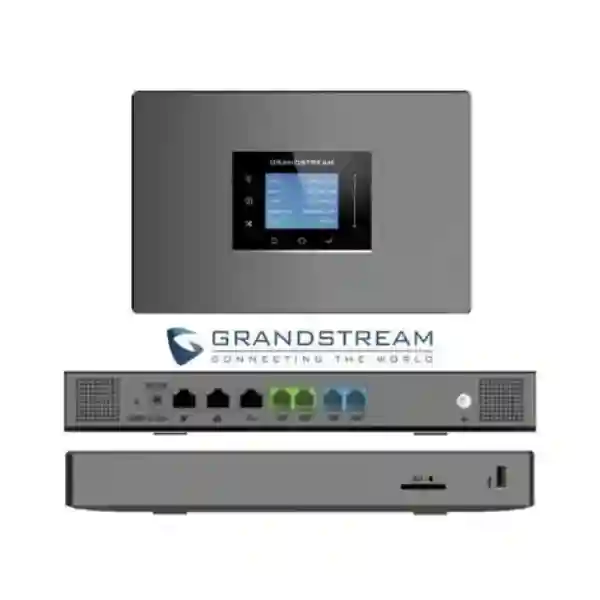
Grandstream UCM6304 Dubai – 2,000-User IP PBX for UAE Business Communications
The Grandstream UCM6304 is an enterprise-capable IP PBX designed for organizations that need a substantial user ceiling, strong concurrent-call capacity, integrated analogue connectivity, remote-user support, conferencing, centralized endpoint management, and an on-premise communications platform that can still participate in modern hybrid workflows. For Dubai and UAE buyers, the model is especially relevant when a project must serve a large head office, several departments, a hotel or hospitality environment, a school or campus, a healthcare group, a contact-oriented operation, or a multi-branch business that wants to consolidate voice, video, mobility, queues, IVR, collaboration, and selected legacy telephone services into one controlled communications architecture.
Grandstream specifies the UCM6304 for up to 2,000 users, 300 concurrent G.711 calls, and up to 200 concurrent SRTP calls. It includes 4 FXS and 4 FXO ports, three Gigabit network interfaces with PoE+, two USB 3.0 ports, an SD card interface, rack or desktop mounting, Wave application support, GDMS compatibility, UCM RemoteConnect capability, conferencing, call queues, IVR, API integration, and Grandstream ZeroConfig provisioning. Fourteck can help UAE buyers review whether that combination is appropriate for the real extension count, busy-hour call load, SIP trunk design, branch connectivity, analogue migration requirement, endpoint mix, security policy, and future growth plan before quotation.
Decision Snapshot: When the UCM6304 Makes Sense
Up to 2,000 registered users and 300 concurrent G.711 calls place the UCM6304 above the UCM6302 and below the UCM6308 in the standard UCM6300 hardware family.
Four FXS and four FXO ports make it practical for projects that still need selected analogue phones, fax devices, lift/emergency lines, legacy endpoints, or PSTN lines while moving the wider organization to SIP.
Wave, UCM RemoteConnect, conferencing, secure SIP media options, and browser/mobile access can support office, branch, and remote-user communication from the same PBX environment.
GDMS, ZeroConfig, centralized endpoint management, call queues, IVR, CDR/reporting functions, API access, and integration options can reduce administration effort when the deployment is designed correctly.
What Problem Does the UCM6304 Solve?
Many communication projects fail because the PBX is selected only by extension count. A company may have 300 employees but still require a larger platform because it runs several departments with heavy external calling, records selected conversations, connects remote users, operates call queues, maintains analogue interfaces, uses multiple SIP trunks, hosts meetings, supports different time schedules, or expects substantial growth. Another organization may have 1,000 extensions but a much lighter call pattern and therefore require a different sizing approach. The UCM6304 should be treated as a communications platform to be sized by actual workload rather than as a simple “2,000-user box.”
Its strongest role is in the middle of the UCM6300 hardware range, where organizations need more scale than the UCM6302 while not necessarily requiring the maximum capacity of the UCM6308. That makes it attractive for medium-to-large deployments, multi-floor offices, central administration sites, hospitality groups, educational facilities, hospitals and clinics, logistics businesses, industrial environments, larger retail operations, professional-service organizations, and multi-site companies that want one central PBX with controlled branch or remote access.
The practical buying question is therefore not “Is 2,000 users enough?” but “Does the UCM6304 provide the right combination of user capacity, concurrent calls, encrypted-call capacity, analogue interfaces, network architecture, endpoint management, conferencing, remote-user design, redundancy, and future expansion for this project?” Fourteck uses that requirement-first approach when discussing Grandstream UCM deployments in Dubai and the UAE.
Verified UCM6304 Technical Profile
| Item | Grandstream UCM6304 | Why it matters |
|---|---|---|
| Maximum users | 2,000 | Provides significant headroom for larger organizations, campuses, departments, branches, and future extension growth. |
| Concurrent calls | 300 with G.711 | A key sizing figure for busy-hour traffic, reception, sales, service desks, contact-oriented operations, and multi-site use. |
| Concurrent SRTP calls | 200 with G.711 | Important when encrypted media is part of the design; the security requirement should be included in sizing rather than added later. |
| FXS ports | 4 RJ11 ports | Allows direct connection of a limited number of analogue endpoints or devices where migration cannot be fully IP on day one. |
| FXO ports | 4 RJ11 ports | Supports direct integration of analogue PSTN lines and helps staged migration where SIP trunks and legacy trunks coexist. |
| Network | Three self-adaptive Gigabit ports with PoE+ | Supports switched, routed, or dual-mode network design and helps integrate the PBX into a segmented voice architecture. |
| Peripheral interfaces | 2 × USB 3.0 plus SD card interface | Useful for supported storage, backup, recording, and maintenance workflows depending on configuration. |
| Display | 128 × 32 dot-matrix LCD | Provides local appliance status and basic menu access for rack or communications-room operation. |
| Mounting | Rack mount or desktop | Fits both structured communications racks and suitable secure equipment-room deployments. |
| Meeting capacity | Up to 15 simultaneous public rooms; up to 200 simultaneous participants across rooms; up to 9 video feeds per room | Supports internal meetings and collaborative workflows without requiring the PBX to be used only for conventional desk-phone calling. |
| Platform | Asterisk 16-based telephony platform with Grandstream UC ecosystem integration | Supports SIP telephony, call control, application integration, management, conferencing, mobility, and modern UC workflows. |
The 4 FXS + 4 FXO Advantage in Migration Projects
One of the reasons the Grandstream UCM6304 is useful in real-world UAE upgrades is that it does not force every telephone connection to become IP immediately. The four FXS ports provide direct analogue station interfaces, while the four FXO ports allow analogue PSTN line connectivity. Grandstream also specifies lifeline capability on these ports in a power-outage scenario. In a practical migration, that can help an organization move departments, reception areas, executives, meeting rooms, and knowledge workers to SIP phones while retaining a smaller number of analogue services that still have a business purpose.
The exact analogue requirement varies by building and industry. A hotel may retain selected back-office or service devices. A school may have older analogue endpoints in certain locations. A warehouse may need to keep a legacy line during a phased rollout. A clinic may have a fax-dependent workflow that is being migrated gradually. A branch may still receive one or more traditional PSTN lines while SIP services are under review. The UCM6304 can act as the bridge during that transition, but those eight analogue interfaces should be treated as limited local connectivity rather than an unlimited analogue gateway.
If the project needs far more analogue devices or trunks, Fourteck would normally review external Grandstream gateway options or another architecture instead of forcing every connection directly onto the PBX. That is a better design principle because the central appliance can remain focused on call control and unified communications while gateway capacity is added where the analogue requirement actually exists.
Capacity Planning: 2,000 Users Does Not Mean 2,000 Simultaneous Calls
Grandstream rates the UCM6304 for up to 2,000 users and 300 concurrent G.711 calls. These are different limits and should be interpreted separately. User capacity describes how many extensions or users the platform can support at its maximum specified scale. Concurrent-call capacity describes how many calls can be active at the same time under the stated codec condition. For secure media using SRTP with G.711, Grandstream specifies up to 200 concurrent calls. That distinction is critical for any business that expects heavy outbound sales activity, customer-service queues, seasonal traffic, large internal calling peaks, or substantial encrypted-call use.
A 700-user organization may be a stronger candidate for the UCM6304 than a 1,200-user organization if the first has a higher busy-hour ratio. Conversely, a distributed organization with many registered users but relatively low simultaneous voice traffic may stay comfortably inside the concurrent-call ceiling. The same logic applies to SIP trunk sizing. Buying a PBX with 300-call capacity does not automatically mean the service provider should provision 300 external SIP channels. External trunk capacity should follow measured or estimated call demand, business continuity requirements, DIDs, call queues, branch traffic, failover design, and cost.
For a new deployment, Fourteck recommends planning around current users, expected three-to-five-year growth, busy-hour call estimates, queue concurrency, internal versus external traffic, encrypted media, conferencing demand, remote workers, call recording, SIP trunk channels, analogue usage, and disaster-recovery expectations. That creates a more defensible sizing decision than comparing only brochure maximums.
Call Flow, IVR, Queues, and Reception Design
The UCM6304 is not simply an extension registrar. Grandstream includes business telephony functions such as call park, forwarding, transfer, waiting, caller ID, recording, call history, music on hold, routing, DID/DOD control, Do Not Disturb, ring groups, time schedules, PIN groups, call queues, paging/intercom, voicemail, voicemail-to-email, fax-to-email, speed dial, follow-me, blacklist/whitelist functions, conference features, busy camp-on/call completion, and additional call-control capabilities. These functions allow an organization to design call handling around departments and customer journeys rather than around physical telephone wiring.
For a Dubai office, one common design may route a main company number into a multilingual IVR, then send callers to sales, service, accounts, reception, or an after-hours destination. A hotel may route calls by reservations, front desk, housekeeping, administration, and events. A clinic may separate appointments, billing, nursing stations, pharmacy, and general reception. A school may divide administration, admissions, transport, finance, and emergency contacts. The exact structure should be kept as simple as possible for callers, even though the platform supports very deep IVR logic.
Grandstream’s current UCM6300 datasheet specifies up to 64 layers of customizable IVR. That maximum should not be interpreted as a design target. A good caller experience normally uses only the number of levels needed to route calls clearly. The more important questions are whether the organization has accurate business hours, department ownership, overflow behavior, no-answer rules, holiday schedules, voicemail handling, queue announcements, escalation paths, and a tested failover route when a trunk or internet connection has a problem.
Wave and Remote Users: Extending the PBX Beyond the Desk
Grandstream positions Wave as the user application layer for the UCM6300 ecosystem. On supported desktop, web, Android, and iOS environments, Wave allows UCM users to communicate, make and receive calls, and participate in meetings through accounts registered to the UCM6300 series. This gives the UCM6304 a practical role in hybrid work because a user does not always need to be sitting beside a physical desk phone to remain part of the company telephone system.
Remote access should still be designed as an IT security project, not merely enabled because a mobile application exists. Organizations should review account security, extension-password policy, role permissions, firewall behavior, internet quality, NAT traversal, public exposure, logging, firmware maintenance, and remote-user onboarding. Grandstream’s UCM RemoteConnect service is intended to facilitate secure remote connections and NAT traversal for the UCM6300 ecosystem. Service availability, plans, capacity, and commercial terms should be confirmed for the intended deployment rather than assumed from the PBX hardware alone.
For UAE companies with staff moving between Dubai, Abu Dhabi, Sharjah, client sites, home offices, regional branches, or overseas locations, a well-designed Wave deployment can reduce dependence on unmanaged mobile calling and can keep business identities, extension dialing, call history, voicemail, and collaboration closer to the controlled PBX environment. The exact user experience will depend on network quality, device type, security settings, application version, and the organization’s communications policy.
Conferencing and Collaboration Capacity
The current Grandstream UCM6300 series datasheet specifies that the UCM6304 can support unlimited meeting rooms with up to 15 simultaneous public rooms, a maximum of 200 simultaneous participants across all rooms combined, and up to nine video feeds per room. Those figures make the appliance useful not only for traditional PBX calling but also for departmental meetings, internal collaboration, branch coordination, vendor discussions, remote training, and hybrid communication workflows.
Capacity planning should distinguish between “rooms created,” “rooms simultaneously active,” “participants across all rooms,” and “video feeds displayed.” A business that runs many scheduled meetings should calculate expected overlap rather than only the number of departments that may create meetings. Network bandwidth also matters. Voice calls may tolerate conditions that produce an unacceptable video experience, and internet routing, WAN design, Wi-Fi coverage, QoS, endpoint capability, and user location can affect perceived meeting quality.
For organizations that already standardize on separate enterprise meeting platforms, the UCM6304’s native conferencing may still be useful for telephony-centric collaboration and internal workflows. For organizations that want to keep more communication functions inside the UCM ecosystem, the built-in meeting capability can reduce the number of independent systems users need to learn. Fourteck can help map these requirements before deciding how much of the collaboration workflow should sit on the UCM platform.
Grandstream Endpoint Provisioning and GDMS
Endpoint administration becomes increasingly important as a project grows from tens of phones to hundreds or more. The UCM6304 supports Grandstream ZeroConfig provisioning methods that can auto-discover and auto-provision compatible Grandstream SIP endpoints. Grandstream also lists compatibility with GDMS, its cloud-based device management system used for provisioning, management, monitoring, and troubleshooting across supported Grandstream products.
In a correctly segmented enterprise network, this can help the IT team avoid configuring every phone manually. Model templates, extension mapping, firmware governance, configuration control, and centralized monitoring can all contribute to a cleaner operational model. However, zero-touch or automated provisioning does not remove the need for network design. Voice VLANs, DHCP behavior, DNS, NTP, PoE budgets, switch topology, QoS, firewall rules, and site-to-site connectivity still need to be planned so phones can reach the right provisioning and SIP services reliably.
For procurement, the PBX and phone order should therefore be considered together. A UCM6304 project may involve GRP business phones, DECT cordless devices, video phones, door/intercom endpoints, gateways, PoE switches, headsets, Wi-Fi, firewalls, UPS equipment, rack accessories, and structured cabling. The exact bundle is determined by user roles rather than by purchasing one phone model for every employee.
Security: Build the Deployment Around Controlled Access
Grandstream lists security capabilities for the UCM6300 series that include secure boot, a unique device certificate, a random default password, SRTP, TLS, HTTPS, SSH, 802.1X, and other supported security mechanisms. These platform features are valuable, but security depends on configuration and operating discipline. A secure PBX can still be exposed by weak extension credentials, unnecessary internet publishing, overly permissive firewall rules, unmaintained firmware, shared administrator accounts, unreviewed remote access, or poor logging practices.
A UAE enterprise deployment should normally establish administrative ownership, backup responsibility, update procedures, account lifecycle rules, extension credential standards, VLAN and QoS policy, remote-access design, SIP trunk security, firewall policy, trusted source ranges where applicable, alerting, logging, and recovery procedures. If the organization has compliance or industry-specific requirements, those rules should be mapped to the PBX configuration before go-live instead of retrofitted later.
Grandstream currently groups the UCM6301, UCM6302, UCM6304, and UCM6308 together in its active firmware resources. Because firmware evolves, the product page should not be used as a substitute for checking the latest Grandstream release notes before an upgrade. Administrators should review the current recommended firmware, prerequisites, backup requirements, and downgrade limitations at the time of maintenance.
High Availability and Resilience Planning
Grandstream lists Hot Standby High Availability support as a UCM6300 series capability. For businesses where voice availability has operational importance, that feature can become part of a broader resilience design. The key phrase is “broader design,” because PBX redundancy alone does not protect against every failure. Internet services, SIP trunks, switches, routers, firewalls, PoE, power, cabling, DNS, branch links, and endpoint networks can all affect service continuity.
A resilient UCM6304 deployment may therefore combine appropriate PBX high-availability configuration with UPS-backed power, redundant switching where justified, diverse WAN links, SIP trunk failover, documented recovery procedures, configuration backups, monitored storage, and tested call-routing alternatives. Some sites may need only basic continuity. Others may need a formal business-continuity design with agreed recovery objectives. The appliance should be sized and implemented according to the business impact of downtime.
For multi-site organizations, resilience also involves deciding which functions remain local and which depend on the central PBX. A branch that relies entirely on headquarters connectivity may need different failover planning from a branch with local trunks or independent emergency-call requirements. Fourteck can review those questions during system design rather than treating high availability as a single checkbox.
UCM6302 vs UCM6304 vs UCM6308: Where This Model Fits
| Model | Users | Concurrent G.711 calls | FXS / FXO | Best fit |
|---|---|---|---|---|
| UCM6302 | 1,000 | 150 | 2 / 2 | Growing offices and multi-department businesses that do not need UCM6304-level user or call headroom. |
| UCM6304 | 2,000 | 300 | 4 / 4 | Medium-to-large and multi-site projects needing a strong balance of scale, analogue integration, collaboration, and manageable rack deployment. |
| UCM6308 | 3,000 | 450 | 8 / 8 | Larger environments that genuinely require the higher ceiling for users, simultaneous calls, analogue interfaces, or meeting scale. |
The UCM6304 is therefore not automatically the “best” model simply because it sits in the middle. A customer with 350 users may still choose it for call concurrency, future expansion, or analogue requirements. A customer with 900 users may find the UCM6302 sufficient if call traffic and feature use remain modest. A larger deployment may justify the UCM6308. The correct selection depends on measured or defensible requirements rather than model-number progression.
Network Design for a UCM6304 Deployment
The UCM6304 provides three self-adaptive Gigabit Ethernet interfaces that can operate in switched, routed, or dual modes, and Grandstream lists PoE+ support on the network interfaces. The PBX also supports NAT router functionality. That flexibility is useful, but in a business network the PBX should be placed into a deliberate architecture rather than being allowed to define the whole topology by accident.
A structured deployment usually considers a dedicated voice VLAN, QoS treatment, trusted DNS and NTP, PoE capacity at access switches, DHCP options where required for provisioning, network security controls, firewall rules, WAN resilience, branch connectivity, and monitoring. Grandstream supports Layer 2 and Layer 3 QoS mechanisms, including 802.1Q/802.1p and ToS/DiffServ-related functions, but those settings are effective only when the surrounding network honors them.
Voice quality problems are frequently blamed on the PBX even when the root cause is packet loss, Wi-Fi instability, overloaded internet links, incorrect duplex/speed negotiation, unmanaged switches, ISP routing, bufferbloat, weak branch VPN performance, or an underpowered PoE environment. For that reason, Fourteck recommends validating the LAN and WAN during PBX planning, especially for organizations that expect many concurrent calls or rely on Wave and remote users.
When a project spans several sites, the design should also consider whether phones register directly to the central UCM, whether site-to-site VPN is used, how DNS resolution works across branches, whether QoS crosses WAN boundaries, what happens if the branch loses headquarters connectivity, and how emergency or local calling should behave during an outage. These decisions affect the user experience far more than the headline user capacity alone.
SIP Trunks, DIDs, and PSTN Strategy in the UAE
A modern UCM6304 installation will often use SIP services for external calling while retaining selected analogue lines only where needed. The exact service-provider design must be confirmed with the customer’s telecom provider because numbering, trunk authentication, IP requirements, SBC requirements, firewall rules, failover behavior, and supported features can vary. Fourteck does not assume that any specific UAE operator configuration is identical across all business accounts.
The PBX can use DIDs and call routes to map incoming numbers to departments, individuals, queues, IVRs, or specific business workflows. Outbound routing can apply rules based on number patterns, user groups, time schedules, or trunks. This is useful for organizations that want different departments, branches, or business units to use controlled calling policies. PIN groups and permissions can be added where needed, but the final design should remain maintainable for the IT team.
A sensible procurement brief should specify the quantity of existing numbers to retain, planned new DIDs, expected simultaneous external calls, international calling requirements, failover expectations, emergency-call policy, fax requirements, after-hours routing, call recording requirements, and any analogue lines that must remain connected. Those inputs allow the PBX, trunk, and gateway design to be sized together.
Business Scenarios Where UCM6304 Is a Strong Candidate
Head office with several departments
A Dubai headquarters with reception, finance, sales, support, HR, management, operations, and shared services may need hundreds of endpoints but a much more important requirement is controlled routing between departments. The UCM6304 can support a central extension plan, department ring groups, call queues, direct numbers, scheduled routes, executive mobility, conferencing, and remote-user access while leaving enough headroom for growth. If the organization expands into Abu Dhabi or Sharjah, branch extensions can be integrated into the overall dial plan subject to network and security design.
Hotel or hospitality operation
Hospitality telephony often combines guest-facing numbers, front-desk workflows, back-office users, cordless or mobile staff, service departments, analogue dependencies, and PMS integration requirements. Grandstream provides API capabilities for third-party platforms, including PMS use cases, but compatibility should always be validated with the specific application and required workflow. The UCM6304’s user scale, analogue interfaces, call routing, conferencing, and endpoint ecosystem can make it a viable core for a mid-to-large hospitality project.
Education or campus communication
A school, college, training center, or multi-building campus may need administrative phones, admissions, finance, security, paging/intercom, reception, transport teams, and remote staff. The PBX can centralize numbering and call control while Grandstream endpoints cover different roles. Capacity planning should account for paging, emergency communications, branch buildings, Wi-Fi calling where applicable, and any analogue devices that remain part of the environment.
Healthcare and clinic groups
Healthcare communication can involve reception, appointments, nursing stations, doctors, administration, billing, pharmacy, labs, and after-hours routing. A UCM6304 deployment can separate queues and numbers by function, provide internal extension dialing, support remote staff where policy allows, and preserve selected analogue connectivity. Security, privacy, recording, retention, and access controls should be aligned with the organization’s own policy and applicable requirements.
Logistics, warehouse, and industrial sites
These businesses often mix fixed desks, supervisors, reception, security, warehouse users, branch sites, and mobile personnel. A central UCM6304 can provide extension management and call routing, while cordless, Wi-Fi, desk, or ruggedized endpoint choices are selected based on actual work areas. Network resilience and power continuity may be more important here than visual phone features, so the PBX should be designed together with switching, Wi-Fi, UPS, and WAN connectivity.
Integration Through API, CRM, and PMS Workflows
Grandstream states that the UCM6300 series provides a full API for third-party platform and application integration and specifically references CRM and PMS integrations. That opens the door to useful workflows such as click-to-call, screen-pop behavior, contact synchronization, call events, reporting, or hospitality-specific integrations, depending on the third-party application and the API functions it supports.
The presence of an API does not guarantee compatibility with every CRM, hotel platform, helpdesk, ERP, or custom application. Integration should be treated as a separate technical workstream. The project team should identify the exact third-party platform, current software version, required data exchange, authentication model, supported Grandstream connector or API method, expected call events, user mapping, and vendor support position before promising functionality to end users.
This validation is especially important in procurement because an otherwise suitable PBX can become the wrong choice if a business-critical application requires a feature or connector that is unavailable. Fourteck can help customers list integration requirements during system selection so they can be verified before the hardware is finalized.
Call Recording, Storage, Backup, and Operational Discipline
The UCM6304 supports call recording features and provides USB 3.0 and SD storage interfaces, but recording design should be approached carefully. The amount of storage required depends on codec, recording policy, retention period, call volume, and whether recordings are exported or retained locally. Organizations should also consider privacy, access permissions, encryption, backup, legal retention rules, and who is allowed to search or replay recordings.
A project that records only selected service calls has a very different storage profile from a business that records hundreds of simultaneous conversations for long retention periods. The PBX should not be sized solely on call capacity while ignoring storage operations. Recording requirements should be documented during the design phase, and external storage or workflow integration may be appropriate depending on scale.
Backups are equally important. A communication system includes configuration, users, routes, trunks, prompts, queues, schedules, certificates, and potentially recordings or custom data. The organization should define backup frequency, storage location, restore testing, administrator responsibility, and recovery documentation. A reliable system is one that can be restored predictably, not merely one that runs well during normal conditions.
Deployment Checklist for Dubai and UAE Projects
Current extension count, expected hires, seasonal users, branch additions, meeting-room phones, common-area phones, DECT users, door/intercom endpoints, and remote staff.
Peak internal and external calls, queue traffic, encrypted calls, conference use, call-center behavior, and the busy-hour ratio that determines whether 300 concurrent calls are sufficient.
SIP providers, DIDs, channel quantities, analogue PSTN lines, inbound/outbound routes, failover, emergency requirements, and number-porting or migration stages.
Reception consoles, executive phones, standard user phones, video phones, cordless handsets, softphones, conference devices, analogue devices, and special-location endpoints.
PoE switching, VLANs, QoS, DHCP, DNS, NTP, internet circuits, branch connectivity, Wi-Fi coverage, firewall rules, UPS capacity, and monitoring.
Main numbers, IVR choices, departments, queues, ring groups, business hours, holidays, overflow, voicemail, after-hours handling, paging, and escalation rules.
Administrator access, extension passwords, remote-user policy, firewall exposure, firmware procedure, logging, encryption, backups, certificates, and account lifecycle.
CRM, PMS, helpdesk, recording, reporting, door access, intercom, conferencing, and any custom application that must interact with call events or users.
Dubai, Deira, JLT, Bur Dubai, Abu Dhabi, Sharjah, and Wider UAE Requirements
Business communications projects differ even within the UAE. A compact Deira trading company may prioritize simple inbound routing, multilingual reception, and a clear migration from older analogue lines. A JLT professional-services office may place greater emphasis on executive extensions, mobile users, conference rooms, SIP services, and remote work. A Bur Dubai retail or service organization may need mixed desk phones, reception, branches, and analogue dependencies. Larger Dubai head offices may focus on centralized administration, high concurrent-call capacity, redundancy, integrations, and multi-floor network design.
Abu Dhabi projects may include larger institutional, industrial, healthcare, education, or multi-site requirements where resilience, security, branch architecture, and documentation matter as much as the telephone features themselves. Sharjah and Ajman businesses may be scaling from smaller PBX systems and need a migration plan that reuses suitable infrastructure while improving remote access, endpoint management, and call routing. The UCM6304 can serve all of these environments when its capacity and interfaces fit, but the configuration should reflect the operating model of the customer rather than a generic template.
For regional projects, Fourteck also supports broader communications discussions through its network properties for UAE technology solutions, Kenya, Uganda, Kuwait, Tanzania, Ghana, and Nigeria. Product availability, telecom services, support scope, regulations, and deployment conditions vary by country and should be confirmed per project.
How UCM6304 Fits into a Complete Grandstream Solution
The PBX is only one layer of a business communications system. Grandstream’s wider ecosystem includes business IP phones, cordless solutions, video phones, conferencing devices, gateways, facility access devices, switches, and wireless networking products. A UCM6304 deployment can use that ecosystem to create a more centrally managed solution, especially where ZeroConfig and GDMS are relevant to endpoint operations.
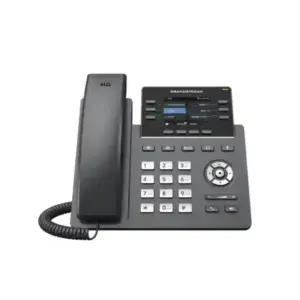
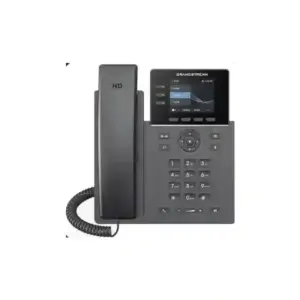
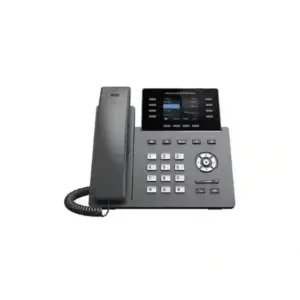
Phone selection should follow user roles. A receptionist may need many programmable keys, visibility of multiple lines, and an expansion module. An executive may value a larger display, Bluetooth, Wi-Fi, or video. A general office worker may need a cost-effective multi-line phone with headset support. A warehouse supervisor may need cordless mobility. A meeting room may need speakerphone or conferencing hardware. A door or gate may need intercom and access-control integration. Trying to standardize every user on one endpoint can either overspend on simple roles or under-serve specialized users.
For broader planning, Fourteck also maintains contextual information on Grandstream IP PBX solutions in Dubai and Grandstream UCM IP PBX planning for Dubai and UAE. Those resources help buyers understand the larger UCM family while this page focuses specifically on the UCM6304 model.
When the UCM6304 May Be Too Large or Too Small
It may be larger than necessary when the company has a modest extension count, low concurrent-call traffic, few or no analogue requirements, limited branch plans, and no expected growth that would justify the additional capacity. In that case, another UCM model can provide the same general ecosystem in a more proportionate appliance.
It may be too small when the required registered-user count, simultaneous calls, encrypted-call concurrency, analogue port requirement, meeting demand, or future growth approaches the platform ceiling. A PBX should not be designed to operate permanently at its headline maximum under normal peak conditions. Engineering headroom is valuable for growth, maintenance, unusual traffic spikes, and changes in business process.
It may be the right size when the organization needs significantly more than entry-level PBX capacity but still sits comfortably inside the UCM6304 limits with headroom. The ideal fit is a deployment where its 2,000-user ceiling, 300-call concurrency, 4 FXS/4 FXO ports, meeting scale, remote-user capabilities, and management ecosystem align with real requirements rather than being selected only because the product is familiar.
Procurement Questions to Answer Before Requesting a Quote
A useful UCM6304 quotation needs more than the model number. Buyers should provide the approximate number of users, desk phones, cordless users, softphone users, reception positions, conference rooms, branches, analogue phones, analogue PSTN lines, SIP trunks, DIDs, and expected concurrent calls. They should also identify whether installation, configuration, migration, training, remote-user enablement, call recording, CRM/PMS integration, gateway hardware, network switches, Wi-Fi, firewall changes, UPS equipment, or annual support will be part of the project.
The exact hardware price and availability can change with distributor stock, quantity, project bundle, accessories, and market conditions. Fourteck therefore recommends requesting current pricing instead of relying on stale online prices. The quotation should also distinguish the PBX appliance from optional phones, gateways, network equipment, installation labor, remote-access services, third-party integration work, support, and any service-provider charges.
For replacement projects, it is also helpful to share the current PBX model, number of extensions, trunk type, phone models, cabling condition, switch infrastructure, IP addressing, voice VLAN status, remote sites, call flow, and any problems the organization wants the new system to solve. That makes the conversation about outcomes rather than simply swapping one box for another.
Migration from Legacy PBX to UCM6304
A phased migration is usually safer than an unstructured cutover. The first step is discovery: document existing extension numbers, DIDs, trunks, hunt groups, IVRs, business hours, voicemail, fax services, paging, call recording, door phones, emergency lines, billing or hotel integrations, and the physical location of analogue devices. Many legacy systems have years of hidden routing logic that users depend on without realizing it.
The second step is design. Decide which extensions stay the same, which devices become SIP phones, whether old analogue phones are retained temporarily, how external numbers map to the new dial plan, and whether branches will cut over together or separately. Voice VLANs, switch PoE, DHCP, firewall rules, SIP trunk readiness, internet resilience, and remote-user policy should be prepared before phones are deployed.
The third step is testing. Validate inbound and outbound calling, caller ID, transfer, hold, conference, voicemail, IVR, queue behavior, emergency calls, after-hours routing, fax where applicable, remote users, branch calling, failover, recording, and integrations. A pilot group can identify workflow issues before the full organization changes platforms.
The final step is handover. Administrators should receive documentation, backup procedures, support contacts, account policies, firmware guidance, trunk information, and a clear record of how the system is configured. Users need only the features relevant to their roles. A carefully planned migration reduces the risk that a technically successful installation feels disruptive to the people who use it every day.
UCM6304 FAQ for UAE Buyers
How many users does the Grandstream UCM6304 support?
Grandstream specifies the UCM6304 for up to 2,000 users. Actual system design should still leave practical headroom and account for simultaneous calls, encrypted media, meetings, integrations, remote users, recording, and future growth.
How many concurrent calls can the UCM6304 handle?
The published maximum is 300 concurrent calls using G.711 and up to 200 concurrent SRTP calls using G.711. Busy-hour traffic should be estimated before choosing the model or SIP trunk channel quantity.
Does the UCM6304 have analogue ports?
Yes. It has 4 FXS ports for analogue endpoints and 4 FXO ports for analogue PSTN lines. If a project needs more analogue capacity, external gateways can be considered rather than relying only on the built-in interfaces.
Can the UCM6304 support remote workers?
Yes. The UCM6300 ecosystem includes Wave and UCM RemoteConnect capabilities for remote and mobile communication. Security policy, internet quality, service plan details, firewall design, and user provisioning should be validated for the intended deployment.
Does the UCM6304 support video meetings?
Yes. Grandstream’s current datasheet specifies up to 15 simultaneous public meeting rooms, up to 200 simultaneous participants across all rooms combined, and up to 9 video feeds per room for the UCM6304.
Can Grandstream phones be provisioned automatically?
The UCM6300 series supports Grandstream ZeroConfig provisioning for compatible endpoints and is compatible with GDMS for centralized cloud-based setup, management, monitoring, and troubleshooting of supported Grandstream devices.
Is the UCM6304 suitable for hotels or hospitality?
It can be a strong candidate because of its user scale, analogue interfaces, call routing, remote access, conferencing, and API capabilities that can support third-party integrations, including PMS use cases. The exact hotel or PMS integration must be validated with the specific third-party platform.
Can the UCM6304 integrate with CRM software?
Grandstream provides API capability for third-party integrations, including CRM use cases. Compatibility is application specific, so the required workflow, connector, API functions, software versions, and vendor support should be confirmed before procurement.
Should I choose UCM6304 instead of UCM6302?
Choose based on requirements rather than model number. The UCM6304 increases the published ceiling to 2,000 users and 300 concurrent G.711 calls and provides 4 FXS plus 4 FXO ports, while the UCM6302 is rated for 1,000 users, 150 concurrent G.711 calls, and 2 FXS plus 2 FXO ports.
How can I get current UCM6304 pricing in Dubai or the UAE?
Request a current Fourteck quotation with the required quantity, user count, phone models, gateways, network equipment, installation scope, and support requirement. Price and availability should be confirmed at the time of purchase rather than assumed from older online listings.
Plan a Grandstream UCM6304 Deployment with Fourteck
For a useful UCM6304 quote, share your current and planned users, peak calls, branch locations, SIP trunk requirement, analogue devices, phone models, remote-user needs, call queues, integrations, recording policy, and expected project timeline. Fourteck can then help review whether the UCM6304 is correctly sized and identify the supporting phones, gateways, switches, Wi-Fi, security, installation, and configuration work required for the project.
The goal is not simply to sell a larger PBX. The goal is to build a communications platform that matches the organization’s call traffic, user roles, network, growth plan, security expectations, and regional operating requirements across Dubai, Abu Dhabi, Sharjah, the wider UAE, and suitable regional projects.

Reviews
There are no reviews yet.