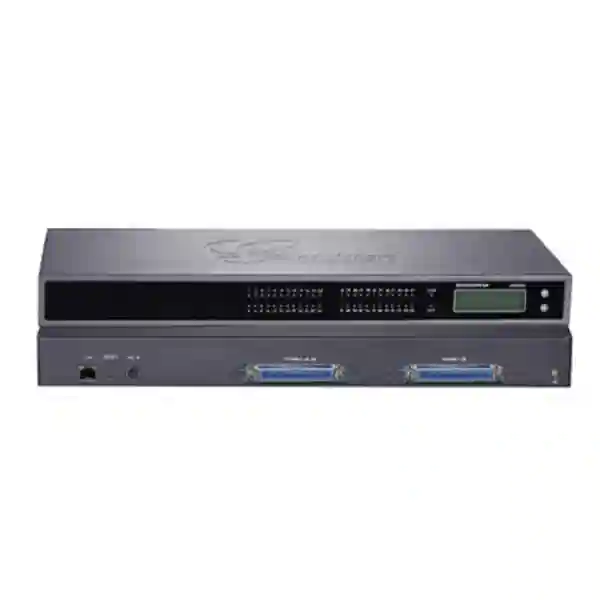
2 × RJ21 Telco
1U Rack Format
SIP + T.38
Grandstream GXW4248 V2 Dubai – 48-Port FXS VoIP Gateway
The Grandstream GXW4248 V2 Dubai is a high-density analog FXS VoIP gateway for organizations that need to keep a large installed base of analog telephones, fax machines, intercom endpoints, legacy PBX extensions, or other two-wire devices while moving call control to SIP and IP telephony. The gateway provides 48 FXS channels, four SIP server profiles, an independent SIP account per telephone port, a Gigabit Ethernet interface, and two 50-pin RJ21 Telco connectors for dense structured analog cabling. In practical terms, it is designed for sites where replacing every analog endpoint is unnecessary, disruptive, or too expensive, but the organization still wants centralized IP-PBX services, modern routing, better management, and a controlled migration path.
For Dubai and UAE deployments, the strongest reason to select this model is not simply the number “48.” The real value is the ability to consolidate a large block of analog extensions into a single 1U gateway while preserving existing handset and cabling investments. That makes the GXW4248 V2 especially relevant to hotels, hospitals, schools, campuses, warehouses, staff accommodation, government facilities, factories, property portfolios, and enterprises with legacy analog infrastructure. Fourteck can help buyers validate the port requirement, RJ21 breakout method, SIP platform compatibility, fax expectations, VLAN/QoS design, firmware generation, and rollout sequence before quotation or deployment.
A direct answer for buyers: when is GXW4248 V2 the right choice?
Choose the GXW4248 V2 when a site has a concentrated requirement for dozens of analog FXS endpoints and you want to register those endpoints to a SIP-based PBX or hosted platform without replacing the endpoint hardware immediately. It is particularly efficient when analog runs already terminate on patch panels, MDF/IDF frames, punch-down blocks, Telco harnesses, or centralized equipment rooms. Instead of installing many small ATAs, a high-density gateway can reduce power adapters, shelf space, Ethernet switch ports, configuration points, and operational fragmentation. The result is a cleaner migration architecture, provided the analog wiring is documented and the SIP/PBX design is prepared before cutover.
The GXW4248 V2 is less suitable when the requirement is only a handful of analog endpoints, when each endpoint is geographically isolated, or when the organization expects to retire analog equipment almost immediately. In those cases, a smaller FXS gateway or endpoint-level ATA may be simpler. It is also important to distinguish FXS from FXO. The GXW4248 V2 presents FXS ports to analog devices such as telephones and fax machines. It is not an FXO gateway for receiving public analog PSTN lines. Buyers migrating PSTN trunks, analog CO lines, or an old PBX trunk interface should validate the required gateway direction before ordering.
A good procurement decision therefore starts with a port map, not a model name. Count the active analog endpoints, separate voice from fax and special devices, note extensions that can be retired, identify endpoints that need long-loop operation, determine how many ports should remain spare, and confirm whether the existing analog cables can be presented through RJ21 breakouts. Fourteck can use that information to recommend whether one GXW4248 V2, multiple high-density gateways, or a mixed design with smaller GXW42xx models provides the better operational fit.
The most important procurement detail: GXW4248 V2 uses RJ21, not 48 individual RJ11 sockets
The GXW4248 V2 is different from smaller members of the GXW42xx family in a way that directly affects installation planning. Its 48 FXS channels are presented through two 50-pin RJ21 Telco connectors. There are no individual front-panel RJ11 FXS jacks for the 48 channels. This design is intentional: forty-eight separate RJ11 connectors would consume panel space and create untidy cabling in a rack. RJ21 lets installers break a dense group of analog pairs into a patch panel, Krone block, 110 block, distribution frame, or custom harness that matches the building’s telephony cabling.
Before ordering, the installer should verify how the current analog extensions terminate. A hotel may already have hundreds of room pairs arriving at an MDF. A hospital may use structured voice blocks for bedside and department phones. A school or industrial site may have long copper runs that end in a telecom room. In these cases, RJ21 can be a major advantage because the gateway can be patched directly into an organized distribution system. If the site currently expects individual RJ11 leads at the gateway, a suitable RJ21 breakout cable or patch panel must be included in the deployment plan.
Grandstream’s current installation guidance states that the GXW4248 V2 requires the Telco interface for analog connection and that standard male RJ21 50-pin 25-pair cabling can be used to connect to analog devices through a suitable breakout or patching method. This is one of the points Fourteck recommends validating during the site survey because miscounting pairs, using an unsuitable harness, or assuming RJ11 presentation can delay commissioning even when the SIP configuration is perfect.
Labeling is equally important. A 48-port migration should include a port-to-extension schedule showing the gateway FXS port, physical pair, patch-panel position, room or desk, existing analog number, new SIP account, and test status. That document becomes the handover reference for future troubleshooting. It also makes phased migration possible: a team can move a group of extensions, test them, and continue in batches rather than treating all 48 ports as one irreversible cutover.
What the 48 FXS ports actually enable
Each FXS channel is intended to behave like the analog line interface that a conventional analog telephone expects. It provides the electrical line conditions and signaling required for a connected analog endpoint while the gateway translates that endpoint’s call signaling and media into SIP/RTP on the IP side. This lets organizations keep traditional handsets or fax devices while benefiting from centralized call control, SIP trunking, PBX dial plans, extensions, transfers, voicemail, hunt groups, and other functions provided by the chosen SIP platform.
The gateway supports an independent SIP account per telephone port and four distinct SIP server profiles per system. That creates useful flexibility. A single gateway can register groups of ports to different SIP servers or logical service profiles where the deployment design requires it. For example, a building may separate guest-room extensions from administrative phones, or a managed-service environment may require different SIP destinations. The design should still remain as simple as possible, because operational clarity matters more than using every available configuration option.
Grandstream documents up to 48 concurrent calls for the GXW4248 under normal conditions, with a note that concurrency differs when SRTP is in use. This is an important capacity-planning distinction. Forty-eight physical ports do not automatically mean that every deployment should expect forty-eight simultaneous encrypted calls without checking the current firmware guidance and real call profile. Fourteck recommends sizing the SIP trunk, PBX licenses, WAN or LAN capacity, codec strategy, and security mode around the actual busy-hour call pattern rather than simply matching the physical port count.
For environments with many analog extensions, the gateway can also simplify numbering. Rather than preserving an old PBX numbering scheme indefinitely, an organization can use the migration as an opportunity to map each analog endpoint to a clean SIP extension plan. Departments, floors, buildings, or room numbers can be grouped logically, making later migration from analog handsets to IP phones easier because the numbering structure is already controlled by the IP-PBX.
Voice quality, codecs, echo control, and analog behavior
A high-density analog gateway sits between two very different worlds: traditional two-wire analog endpoints and packet-based IP voice. Voice quality therefore depends on more than the gateway specification. The analog loop, handset quality, building cabling, grounding, codec choice, LAN congestion, SIP platform, and WAN path can all influence the user experience. The GXW42xx V2 family supports commonly used codecs including G.711, G.722, G.723.1, G.726, G.729, iLBC, and Opus according to Grandstream’s product documentation. Wideband codecs can improve audio quality where the complete call path supports them, while G.711 remains common for compatibility and fax pass-through scenarios.
Grandstream also documents carrier-grade line echo cancellation, a dynamic jitter buffer, modem detection, packet-loss handling functions, voice activity detection, comfort-noise generation, and automatic switching behavior for certain modem or fax conditions. These functions help the gateway bridge analog behavior into IP networks, but they do not eliminate the need for good network engineering. Poorly configured QoS, overloaded WAN circuits, packet loss, excessive jitter, or mismatched SIP timers can still produce call-quality problems that appear to be “gateway faults.”
For long analog loops, cabling quality and electrical conditions matter. Grandstream’s published specifications describe support for 2 REN and long-haul copper distances on 24-AWG wiring. Real sites can differ because of cable gauge, joins, moisture, interference, shared pathways, and legacy distribution hardware. Where long loops are involved, especially in campuses, hotels, warehouses, villas, or industrial facilities, Fourteck recommends testing the actual pair at commissioning rather than relying only on theoretical cable distance.
The same principle applies to caller ID, message waiting, disconnect supervision, and special analog features. The gateway supports multiple caller-ID standards and disconnect methods, but the endpoint and PBX must agree on signaling expectations. A successful migration test should therefore include inbound and outbound calling, caller ID, transfer, hold, call waiting where needed, DTMF to IVR systems, voicemail indication, disconnect detection, and any site-specific analog function that matters to users.
Fax over IP: plan it as a service, not as an afterthought
The GXW4248 V2 supports T.38 fax relay and G.711 fax pass-through methods, making it a practical choice where organizations still depend on analog fax machines. However, fax over IP can be sensitive to network quality, SIP provider behavior, codec negotiation, transcoding, NAT devices, and PBX settings. A fax port should therefore be treated differently from an ordinary voice extension during design and testing. Simply connecting a fax machine to an FXS port does not guarantee reliable end-to-end faxing across every SIP carrier or cloud PBX.
A proper fax validation plan identifies which ports carry fax, the expected destinations, the SIP trunk/provider’s T.38 support, fallback behavior, maximum transmission rate, and whether the PBX or SBC alters media. The test set should include short and multi-page faxes, inbound and outbound calls, busy/redial behavior, and different remote destinations. If the organization uses fax for legal, healthcare, logistics, banking, government, or compliance workflows, this testing should happen before the legacy line is disconnected.
The same caution applies to analog modems, alarm panels, elevator phones, card terminals, door systems, and other specialty devices. Some may work on an FXS gateway, while others depend on timing or signaling behavior that does not translate reliably through VoIP. Fourteck recommends listing every non-voice analog endpoint separately and confirming compatibility with the application vendor or service provider before migration. The safest design avoids assuming that “analog port” automatically means “compatible with every analog device.”
For a mixed voice-and-fax installation, separating port groups and documenting their media settings can simplify support. Voice ports can follow the codec and security policy selected for ordinary calling, while fax ports can use an explicitly tested configuration. This reduces troubleshooting time because the engineering team knows which ports are expected to negotiate T.38, which use pass-through, and which should never be changed without a controlled test.
SIP, IP-PBX, softswitch, and hosted-voice integration
Grandstream positions the GXW42xx V2 family for interoperability with SIP-based environments, including IP-PBXs, softswitches, and service-provider platforms. The GXW4248 V2 supports SIP over UDP, TCP, and TLS, with an independent SIP account per analog port and four SIP server profiles. This gives an integrator the building blocks required for both simple office deployments and more complex environments where different groups of ports register to different servers or profiles.
The gateway also supports a SIP server failover mechanism so the device can move to a secondary server when the primary becomes unavailable, subject to configuration and platform behavior. Failover is useful, but it should be designed end to end. If the PBX has a secondary node, the dial plan, registrations, media routes, DNS records, NAT/firewall rules, and SIP trunk path should all support the intended recovery behavior. A secondary address entered into the gateway cannot compensate for a PBX or network that has no working failover architecture.
For Grandstream UCM deployments, the GXW42xx family can fit naturally into a Grandstream communication environment. For third-party PBXs, the important checks are SIP registration method, authentication, transport, codec support, DTMF method, caller-ID format, fax handling, keepalive behavior, NAT traversal, and any vendor-specific feature requirements. Fourteck can prepare a compatibility checklist before deployment so that the gateway configuration is based on the target platform rather than generic defaults.
Hosted PBX projects deserve particular attention to WAN resilience and firewall behavior because every analog extension ultimately depends on IP reachability to the cloud platform. A local analog phone may look independent to the user, but its call control can still rely on the internet. For critical environments, consider redundant WAN, suitable SIP failover, UPS protection, monitored switching, and a documented contingency plan. The GXW4248 V2 can preserve analog endpoints, but it does not remove the availability requirements of the IP network behind them.
Network design: Gigabit Ethernet, VLANs, QoS, and voice-path discipline
Grandstream’s official GXW4200 V2 datasheet specifies a single 10/100/1000 Mbps auto-sensing RJ45 network interface. The value of Gigabit connectivity here is not that forty-eight voice calls require anything close to a gigabit of raw bandwidth; rather, it gives the gateway a modern Ethernet interface while the network design focuses on latency, jitter, packet loss, segmentation, and predictable forwarding. Voice is sensitive to timing, so a lightly used but poorly engineered network can perform worse than a busy network with correct QoS and segmentation.
The platform supports QoS mechanisms including DiffServ and 802.1p/Q VLAN tagging. In a managed business network, the gateway is commonly placed on a dedicated voice VLAN or another controlled segment. The exact design depends on the PBX location, DHCP/DNS architecture, firewall policy, monitoring system, and security standards. Fourteck recommends documenting the gateway IP, VLAN ID, switch port, default gateway, DNS/NTP sources, SIP server addresses, management access path, and QoS markings before commissioning.
QoS should be consistent across the path. Marking RTP traffic at the gateway is useful only if switches, routers, SD-WAN devices, firewalls, and WAN links preserve or intentionally remap those markings. For multi-site or cloud-PBX environments, the design should also account for internet congestion, upstream bandwidth, failover links, and VPN or SBC placement. If call quality degrades only during backup traffic, software updates, CCTV synchronization, or cloud replication, the problem may be network contention rather than an analog gateway fault.
Time synchronization, DNS, and routing should not be overlooked. Incorrect NTP can complicate logs, certificates, and troubleshooting. DNS failure can break SIP destinations that depend on hostnames or SRV records. A firewall that times out NAT mappings too aggressively can create intermittent registration or one-way audio. A professional deployment therefore treats the GXW4248 V2 as part of the network infrastructure, not as an isolated telephony appliance.
Security and firmware: V2 identification matters
The V2 designation is operationally important. Grandstream publishes different firmware handling for GXW42xx V1 and V2 devices, and the manufacturer explains that V2 hardware can be identified by the “V2” marking on the product label and by the device-specific password information printed on the label. Administrators should therefore confirm the hardware generation before any firmware work. Loading instructions intended for the wrong generation can create avoidable risk.
Security capabilities documented for the GXW4200 V2 family include SIP over TLS, SRTP, HTTPS management, secure boot, unique certificates, random default passwords, and dual firmware images. Current firmware also includes continued security-oriented changes and updated TLS behavior. These controls are valuable, but they should be combined with standard network practices: restrict management interfaces, use strong administrator credentials, avoid exposing the web interface directly to the public internet, apply firewall rules, separate voice and management traffic where appropriate, monitor logs, and keep firmware under controlled change management.
Firmware upgrades should be planned, especially in a 48-port gateway. A single reboot can affect many users. Before upgrading, confirm the exact model generation, read current release notes, back up configuration, verify a maintenance window, and document rollback limitations. Grandstream warns that certain V2 firmware transitions cannot be downgraded to much older releases because of certificate-generation changes. That means a firmware upgrade is not just a routine “click update” task in an operational site.
For regulated or security-conscious environments, the PBX and gateway security modes should be considered together. Enabling TLS for SIP signaling while leaving management exposed weakens the overall posture. Enabling SRTP without checking capacity or interoperability can cause media issues. The target is a tested policy that protects signaling, media, administration, provisioning, credentials, and firmware while preserving reliable operations.
Capacity planning: why one 48-port gateway can be better than many small ATAs
A common design question is whether to deploy one high-density gateway or many small analog telephone adapters. For a centralized equipment room, a high-density gateway usually reduces operational overhead. There are fewer power supplies, fewer Ethernet switch ports, fewer IP addresses, fewer firmware targets, and fewer devices to label and monitor. A 1U chassis can also produce a cleaner rack layout than a shelf filled with small adapters and wall transformers.
The trade-off is concentration. If one high-density gateway fails or loses power, many analog users can be affected at once. That makes power protection, environmental conditions, cable management, configuration backup, spare strategy, and monitoring more important. Some organizations prefer two or more gateways even when one could theoretically carry all ports, because dividing departments or floors can reduce the blast radius of maintenance. The right answer depends on service criticality and budget, not only on total port count.
A useful sizing method is to count active analog ports, add near-term growth, reserve a practical spare percentage, and then decide whether that spare capacity should exist in the same chassis or in a second gateway. For example, a site with 42 active analog endpoints might fit comfortably on a 48-port chassis if growth is limited, while a site with 46 active endpoints and planned expansion should not buy based only on today’s count. Spare ports are also useful during migration because they let installers move or test endpoints without immediately disturbing the live pair.
Concurrent-call planning is separate from port planning. A hotel may have many room phones but comparatively low simultaneous usage, while a contact center with analog endpoints may generate a much higher busy-hour ratio. SIP trunk channels, PBX resources, firewall sessions, WAN capacity, and licensing should be sized from actual call patterns. Fourteck can help map physical port density to call concurrency so the gateway is not purchased in isolation from the broader voice system.
GXW4248 V2 vs GXW4232 V2, GXW4224 V2, and GXW4216 V2
| Model | FXS capacity | Analog presentation | Typical fit |
|---|---|---|---|
| GXW4216 V2 | 16 FXS | RJ11 plus Telco connector | Small analog blocks and branch sites |
| GXW4224 V2 | 24 FXS | RJ11 plus Telco connector | Medium-density analog migration |
| GXW4232 V2 | 32 FXS | RJ11 plus Telco connectors | Larger offices and mixed patching needs |
| GXW4248 V2 | 48 FXS | Two RJ21 Telco connectors only | High-density MDF/rack environments |
The biggest selection factor is not only port count; it is also cable presentation. Smaller GXW42xx V2 models provide individual RJ11 interfaces in addition to Telco connectors, while the GXW4248 V2 is designed around dense Telco connectivity. If technicians frequently need to plug individual handsets directly into the gateway, a smaller model may be operationally convenient even if multiple units are required. If all analog pairs are already centralized at a patch frame, the GXW4248 V2 can be cleaner and more scalable.
A mixed deployment can also be sensible. A headquarters MDF might use GXW4248 V2 units for bulk analog migration, while remote security rooms, warehouses, or branches use smaller models. Standardizing on the same family preserves a similar management and feature approach without forcing every location into the same physical density.
Where GXW4248 V2 delivers the most practical value
Hotels and hospitality
Hotels often have a large number of guest-room analog phones even after front-office and management users move to IP phones. Replacing every room handset may not create enough business value to justify the cost, yet the property still wants a modern PBX, centralized SIP trunks, updated call routing, and better management. A GXW4248 V2 can bridge groups of room extensions into the IP-PBX while existing room cabling remains in place. The project should verify room-number mapping, wake-up or hospitality application behavior, emergency dialing, voicemail interaction, caller ID, long loops, and any PMS/PBX integration that depends on extension identity.
Healthcare and clinics
Hospitals and medical facilities may retain analog phones in patient rooms, nursing areas, service spaces, labs, or auxiliary buildings. The gateway can help move those endpoints to centralized SIP call control without forcing a large-scale endpoint replacement. The design should separate ordinary telephones from fax machines and special systems, because healthcare facilities often depend on both. Resilience, UPS, network monitoring, emergency call routing, and documented change control become more important because a single high-density gateway can affect many endpoints.
Schools, colleges, and campuses
Education campuses commonly have analog phones distributed across classrooms, offices, security posts, labs, hostels, and maintenance areas. Existing copper can remain useful for years. The GXW4248 V2 lets the institution centralize call control while gradually replacing analog endpoints only where new features justify it. Campus planning should include building-to-building cable quality, lightning and surge protection, long-loop testing, VLAN design, extension numbering, paging requirements, and remote-site survivability where applicable.
Industrial sites, warehouses, and staff accommodation
Factories and logistics environments often contain analog phones in locations where a simple handset is preferable to a more complex IP endpoint. Staff accommodation projects may also have hundreds of rooms already wired for analog voice. A high-density FXS gateway can preserve that infrastructure while the PBX and trunks move to IP. The project team should pay attention to cable length, electrical noise, switch-room environmental conditions, labeling, UPS, and the physical protection of Telco harnesses.
Government, enterprise campuses, and multi-building portfolios
Large organizations often have mixed generations of telephony. Executives may use modern SIP phones, contact centers may use soft clients, while storerooms, reception overflow, elevators, service desks, remote buildings, or older departments still use analog. The GXW4248 V2 can become a migration bridge that allows the organization to modernize call control first and endpoint hardware later. This approach is most successful when the analog estate is documented and each retained device has a clear business reason to remain.
Dubai and UAE deployment guidance
For a Grandstream GXW4248 V2 Dubai deployment, Fourteck recommends beginning with the physical voice infrastructure. Dubai properties can range from modern structured cabling to older buildings with legacy telephone risers and distribution frames. The gateway works best when the installer can map the analog pairs confidently. In a hotel in Deira or Bur Dubai, for example, room pairs may terminate on legacy blocks that need carefully labeled RJ21 breakouts. In a newer office in Business Bay, JLT, Dubai Internet City, or Dubai South, the same project may use a cleaner structured patching approach. The model is identical, but the installation method can be very different.
The next step is to define the SIP destination. The gateway may register to an on-premises IP-PBX, a Grandstream UCM system, a virtual PBX, a hosted UC platform, or another SIP service. Dubai businesses with cloud-hosted PBX services should confirm firewall/NAT requirements and internet resilience. Sites with an on-premises PBX should confirm LAN/VLAN design, server redundancy, and local dial-plan behavior. For organizations with multiple UAE branches, the architecture should clarify whether analog extensions register locally or backhaul to a central system.
Sharjah and Ajman projects often include warehouses, factories, staff accommodation, retail back offices, or mixed office/industrial environments where existing analog copper remains economically useful. Abu Dhabi projects may involve larger campuses, government-related environments, hospitality, healthcare, or multi-building enterprises where structured migration and documentation are especially important. The GXW4248 V2 can serve these requirements, but the quotation should reflect cabling, RJ21 accessories, rack space, UPS, configuration, testing, PBX work, and support—not just the gateway hardware.
UAE procurement teams should avoid treating an online unit price as the complete project cost. The device may be only one line item. A complete migration can also require Telco cables, patch panels, rack accessories, managed switching, UPS capacity, PBX licenses, SIP trunk changes, on-site engineering, number-plan work, documentation, and post-cutover support. Fourteck can provide a requirement-based quotation after the port count, location, PBX platform, and wiring method are known.
Buyers should also confirm the exact model generation on procurement documents. “GXW4248” and “GXW4248 V2” should not be treated as interchangeable names when firmware, security behavior, and lifecycle planning are involved. The purchase order, delivery inspection, configuration record, and asset inventory should all identify V2 clearly.
Regional planning beyond the UAE
Kuwait: Enterprise offices, hotels, clinics, educational institutions, and large residential or staff facilities can use the GXW4248 V2 when a centralized analog estate must be integrated with a SIP-based PBX. The most important checks remain RJ21 presentation, PBX compatibility, fax requirements, network QoS, and the availability of local technical support. For regional infrastructure and communication requirements, Fourteck can coordinate planning through its wider network, including Fourteck Kuwait.
Uganda: Kampala and other business centers can benefit from retaining analog handsets in hotels, schools, clinics, offices, and accommodation projects while centralizing call control. Network reliability and power continuity deserve careful attention because a high-density gateway depends on both. UPS sizing, internet failover for hosted PBX, and clear extension documentation can materially improve supportability. Regional buyers can also use Fourteck Uganda for related technology planning.
Kenya: Nairobi enterprises, education campuses, hotels, and multi-building organizations often operate a mixture of new IP endpoints and older analog extensions. A high-density gateway can provide a controlled bridge between those generations. Where copper loops span buildings, technicians should test actual cable conditions and include surge protection and grounding in the design. Related regional solutions are available through Fourteck Kenya.
Nigeria: Large sites in Lagos, Abuja, industrial locations, education environments, hospitality projects, and branch networks may value a high-density FXS design where replacing all analog endpoints is impractical. Power resilience, rack cooling, network segmentation, and WAN redundancy are especially important for centralized voice equipment. Regional project discussions can also be coordinated through Fourteck Nigeria.
Tanzania: Dar es Salaam businesses, hotels, schools, clinics, warehouses, and mixed legacy estates can use the GXW4248 V2 as part of a phased IP migration. The project should document existing copper pairs, PBX requirements, SIP trunk behavior, fax usage, and power/network resilience before equipment selection. Fourteck’s broader regional coverage includes Fourteck Tanzania for complementary technology requirements.
A practical migration workflow for 48 analog endpoints
Count endpoints, identify fax/special devices, trace pairs, record existing extensions.
Choose PBX/SIP profiles, VLAN, IP addressing, codec, security, failover, and numbering.
Load firmware carefully, configure templates, prepare RJ21 breakouts, and label ports.
Move a controlled group of voice/fax endpoints and validate real call behavior.
Migrate by floor, department, or cable block with rollback points.
Back up configuration, deliver port maps, test records, credentials process, and support notes.
The audit phase is where most migration risk can be removed. Do not assume every pair on an old PBX is still in use. Large sites often contain abandoned extensions, unlabelled fax lines, analog devices that have been replaced, or cross-connects that no longer match documentation. Physical tracing and a live call test can reduce the required port count and reveal special endpoints before the new gateway is configured.
During design, decide whether the gateway will use static addressing or DHCP reservation, which VLAN and switch port it belongs to, where DNS/NTP comes from, which SIP transport will be used, how many SIP profiles are needed, what codec priorities apply, how fax ports differ from voice ports, whether SRTP/TLS is required, and how remote management will be restricted. Document these decisions in a build sheet rather than relying on an engineer’s memory.
Staging should happen before the live cutover wherever possible. The team can verify model generation, firmware, admin access, PBX registration, switch/VLAN connectivity, NTP, basic calling, and one or two test ports in a controlled environment. RJ21 harnesses and patch panels should be labelled before they are introduced into the live MDF. A single reversed or mislabelled pair can make a user appear to have the wrong extension even though the gateway itself is functioning correctly.
A pilot migration should include different endpoint types. Test a normal analog desk phone, a fax machine if used, a long-loop extension if present, and any critical department. Validate inbound and outbound calls, DTMF, caller ID, hold/transfer, call waiting, voicemail, emergency or operator dialing, fax, and disconnect behavior. Only after these cases pass should the deployment scale to the remaining ports.
Handover is the final engineering step, not an administrative extra. The customer should receive a current port map, IP/VLAN information, PBX registration references, firmware record, configuration backup, login-management process, support escalation path, and a list of any ports that use special settings. This documentation turns a 48-port gateway from a “black box” into a maintainable part of the communications infrastructure.
Procurement checklist before requesting a GXW4248 V2 quotation
- Confirm the number of active analog voice endpoints and expected near-term growth.
- Identify fax machines, modems, alarms, elevator phones, door systems, or any non-standard analog device separately.
- Confirm that two RJ21 Telco connectors and the planned breakout method match the site cabling.
- Specify the target IP-PBX, hosted PBX, softswitch, or SIP service provider.
- State whether the PBX is on premises, in a data center, or in the cloud.
- Provide SIP trunk requirements, busy-hour call estimate, and any licensing constraints.
- Define fax expectations and confirm T.38/pass-through support with the carrier or PBX.
- Identify VLAN, IP addressing, QoS, firewall, DNS, NTP, and management-network requirements.
- Confirm UPS availability, rack space, grounding, surge protection, and equipment-room conditions.
- Decide whether configuration, installation, migration, testing, documentation, and post-cutover support are required.
This information lets Fourteck quote the solution rather than only the hardware. A gateway that arrives without the correct cabling, PBX readiness, or migration services can remain unused even though the model itself is correct. Conversely, a well-prepared project can often migrate large analog blocks quickly because most of the engineering work has already been completed before the maintenance window begins.
Price and availability can change by region, supplier, exchange rate, freight, and project quantity, so this page does not publish an unverified fixed price or stock claim. For a current commercial offer, share the quantity, delivery location, PBX platform, and whether you need supply only or a complete configured deployment.
Operations, monitoring, and support after go-live
A 48-port analog gateway should be monitored like shared infrastructure. Administrators should know whether the device is reachable, whether SIP registrations are healthy, whether ports are behaving as expected, and whether firmware or security changes are required. Grandstream supports management methods including the web interface, HTTPS, SSH, Syslog, voice prompts, and TR-069-related provisioning capabilities. The exact operational toolset should match the customer’s security policy and management platform.
Configuration backups are essential. If the gateway must be replaced, a current backup plus a reliable port map can reduce recovery time dramatically. Backups should be protected because they may contain account names, server addresses, or other sensitive information. Store them in the customer’s approved configuration-management system rather than on an engineer’s personal laptop.
When troubleshooting, separate the problem by layer. If only one analog phone fails, inspect the handset, pair, patching, and FXS-port settings. If a group of ports loses registration, inspect the SIP profile and PBX. If all ports experience one-way audio, check routing, NAT, firewall, and media paths. If call quality degrades across the gateway, review packet loss, jitter, WAN utilization, codec negotiation, and switch errors. Layered troubleshooting prevents unnecessary device replacement.
Fourteck can support customers who need help with requirement assessment, gateway configuration, SIP/PBX integration, VLAN/QoS design, phased migration, documentation, and troubleshooting. Related IP-telephony and infrastructure services can be discussed through Fourteck IP Phone and Fourteck UAE.
Grandstream GXW4248 V2 FAQ
What is the Grandstream GXW4248 V2?
The GXW4248 V2 is a high-density FXS VoIP gateway designed to connect up to 48 analog telephone interfaces to SIP-based IP telephony. It is useful when an organization wants to preserve analog phones, fax machines, or legacy wiring while moving call control to an IP-PBX, softswitch, or hosted SIP platform.
Does the GXW4248 V2 have 48 RJ11 ports?
No. The GXW4248 V2 presents its 48 FXS channels through two 50-pin RJ21 Telco connectors. It does not provide 48 individual RJ11 sockets. Buyers should plan the required RJ21 breakout cable, patch panel, distribution frame, or other structured analog termination method before installation.
How many SIP accounts can it support?
Grandstream documents an independent SIP account per telephone port for the GXW42xx family, so the GXW4248 V2 can map its 48 FXS ports to individual SIP accounts. It also supports four SIP server profiles per system, allowing groups of ports to use different SIP-profile settings where required.
Can GXW4248 V2 work with non-Grandstream PBX systems?
The GXW42xx V2 family is designed for SIP interoperability with IP-PBXs, softswitches, and SIP-based environments. Compatibility should still be validated against the exact PBX, hosted service, SIP transport, codecs, DTMF method, fax behavior, caller-ID format, and authentication requirements before a large migration.
Does GXW4248 V2 support fax?
Yes. Grandstream documents T.38 fax relay and G.711 fax pass-through support. End-to-end fax reliability also depends on the PBX, SIP carrier, network quality, media path, and remote fax destination, so Fourteck recommends testing real inbound and outbound fax scenarios before retiring the previous service.
What Ethernet interface does the gateway use?
Grandstream’s official GXW4200 V2 datasheet specifies one 10/100/1000 Mbps auto-sensing RJ45 network interface. Voice performance depends more on latency, jitter, packet loss, VLAN/QoS design, routing, and firewall behavior than on raw Gigabit bandwidth.
Can the GXW4248 V2 be rack mounted?
Yes. The GXW4248 V2 uses a 1U form factor and is intended for desktop or rack installation with appropriate brackets. High-density deployments should also plan cable management, RJ21 strain relief, power protection, ventilation, labeling, and access for maintenance.
What is the difference between GXW4248 V1 and V2?
V2 is a distinct hardware/firmware generation. Grandstream instructs administrators to identify V2 using the product label and to use the correct V2 firmware. V2 devices also use device-specific password information and newer certificate/security behavior. Firmware procedures and downgrade limitations should be checked before an upgrade.
Does the gateway support secure SIP?
The GXW4200 V2 family supports SIP over TLS and SRTP along with HTTPS management and additional platform security features. The complete solution should still include firewall restrictions, strong credentials, secure provisioning, controlled management access, firmware governance, and testing of PBX interoperability.
Can I use the GXW4248 V2 for analog PSTN lines?
Not as an FXO gateway. The GXW4248 V2 provides FXS interfaces intended to connect analog endpoint devices such as phones and faxes. If your requirement is to connect incoming analog PSTN lines to an IP-PBX, you need to evaluate an FXO gateway instead.
Is one GXW4248 V2 better than multiple smaller gateways?
For a centralized MDF or rack, one high-density gateway can reduce power adapters, Ethernet ports, device count, and management overhead. Multiple smaller gateways may be better when analog endpoints are geographically distributed or when the organization wants to reduce the impact of a single-device outage. The best architecture depends on cabling, site layout, resilience, and expansion plans.
How do I get a GXW4248 V2 quotation in Dubai or the UAE?
Send Fourteck the required quantity, delivery location, approximate analog-port count, PBX or hosted SIP platform, fax requirements, and whether you need supply only or installation/configuration. Fourteck can then prepare a requirement-based quotation without relying on unverified fixed stock or price claims.
Plan the analog migration before you buy the gateway
The GXW4248 V2 is most effective when port density, RJ21 cabling, SIP/PBX design, fax behavior, security, network QoS, and cutover steps are decided together. Share your current analog extension count and PBX environment with Fourteck, and the team can help determine whether a single 48-port gateway or a mixed GXW42xx design is the better fit.
Reviews
There are no reviews yet.