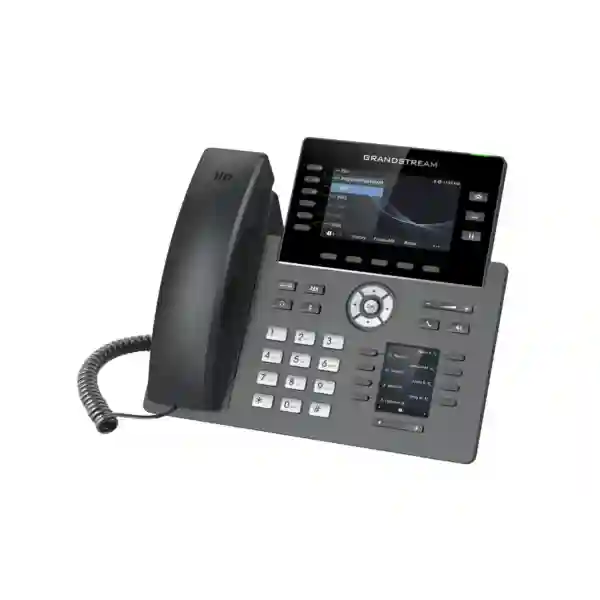
Grandstream GRP2616 Dubai – Professional 6-Line IP Phone for Managed Business Voice
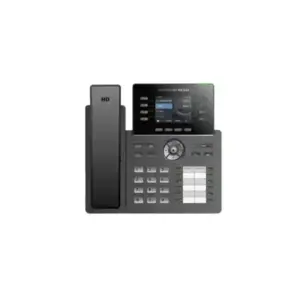
The Grandstream GRP2616 Dubai is designed for organizations that need a high-capacity desk phone for executives, managers, reception teams, customer-facing staff and other users who handle many extensions, call appearances or monitored colleagues. It combines six line keys, support for up to 16 SIP accounts, dual color displays, digital BLF functionality, dual Gigabit Ethernet with integrated PoE, Bluetooth, HD audio and centralized Grandstream Device Management System support. The result is a desktop endpoint that can fit both individual power users and larger standardized rollouts where IT teams want consistent provisioning, security and remote management.
A particularly important buying detail is Wi-Fi capability. Current Grandstream documentation states that integrated dual-band Wi-Fi 6 support applies to hardware version 5.0 and above, while older product references describe dual-band 802.11 a/b/g/n/ac Wi-Fi. For any project where wireless connectivity is a deciding requirement, Fourteck recommends confirming the hardware revision before ordering rather than assuming every GRP2616 unit has the same wireless specification.
Is the GRP2616 the right phone for your requirement?
The GRP2616 makes the most sense when the user needs more than basic call handling. A standard desk phone may be enough for a small extension with one or two identities, but busy staff often need rapid visibility of colleagues, lines, parking positions, speed dials and frequently used functions. The GRP2616 addresses that workflow through its dual-screen layout and virtual multi-purpose key design. This can reduce the need to navigate menus during a call and can make monitored-extension workflows easier to operate from the desk.
| Customer requirement | Relevant GRP2616 capability | Practical benefit | Buying consideration |
|---|---|---|---|
| Monitor many extensions or call states | Dual displays, digital BLF/MPK workflow | Faster access to frequently used destinations | Confirm PBX BLF support and provisioning design |
| Use multiple SIP identities | Up to 16 SIP accounts | One desk phone can represent several business identities | Actual registration design depends on the PBX or service provider |
| Connect a workstation through the phone | Dual Gigabit Ethernet ports | Supports high-speed LAN pass-through without a separate desk switch in many layouts | Voice/data VLAN and QoS should be planned correctly |
| Reduce power adapters at desks | Integrated 802.3af PoE | Centralized switch power can simplify cabling and UPS planning | Check PoE switch budget and port capacity |
| Centrally manage many phones | GDMS support and mass provisioning options | Consistent configurations and easier remote administration | Define templates, firmware policy and credentials before mass rollout |
| Wireless desk placement | Integrated dual-band Wi-Fi; Wi-Fi 6 on hardware v5.0+ | Can support locations where wired access is impractical | Confirm hardware revision and assess WLAN voice quality before deployment |
What is verified on the Grandstream GRP2616?
For procurement and project design, specifications should be separated from marketing assumptions. Grandstream’s current product information identifies the GRP2616 as a six-line professional carrier-grade IP phone supporting up to 16 SIP accounts. It provides a 4.3-inch 480×272 TFT color display together with a 2.4-inch additional screen for the digital key workflow. Its network interface consists of dual switched auto-sensing 10/100/1000 Mbps Gigabit Ethernet ports with integrated PoE. Bluetooth is integrated, and the device supports Grandstream’s GDMS platform for provisioning, monitoring and device management.
The phone also supports HD audio on both handset and speakerphone with wideband audio. The published codec set includes G.729A/B, G.711 µ-law and A-law, G.726, G.722 wideband, G.723, iLBC and OPUS, together with standard DTMF options and voice-processing functions. These capabilities are useful in heterogeneous SIP environments, but the codec actually used on a call still depends on the PBX, SIP trunk, remote endpoint, network design and configured codec preference.
Security features described by Grandstream include secure boot, dual firmware images and encrypted data storage, along with TLS, SRTP, 802.1X support and encrypted configuration options. Those features give administrators useful building blocks, but a secure deployment still depends on credential policy, firmware governance, access control, network segmentation, certificate handling and PBX security. A phone with security capabilities should not be treated as automatically secure without correct configuration.
Dual-screen workflow
The main 4.3-inch display provides the primary user interface, while the additional 2.4-inch display is designed to support digital keys. For managers, assistants and reception-style users, that separation can make it easier to keep monitored destinations visible without filling the primary screen with every function.
48 virtual multi-purpose keys
Grandstream markets the GRP2616 with 48 virtual multi-purpose keys. Their usefulness depends on how the PBX and provisioning template map BLF, speed dial, call park, presence or other supported functions. Plan the key map around actual job roles instead of configuring every phone identically.
Gigabit + PoE desk design
With two Gigabit Ethernet interfaces and integrated PoE, the phone can fit modern switched networks and can often share a desk data drop with a computer. IT teams should still calculate PoE capacity, configure voice VLANs, apply QoS and verify switch-level security policies.
Bluetooth and USB
Integrated Bluetooth and the available USB interface broaden peripheral options. Headset selection should be confirmed for the required wearing style, call-control features and compatibility rather than assumed from connector type alone.
Wi-Fi 6 on GRP2616: why hardware version matters
A buyer searching for a GRP2616 Wi-Fi 6 phone in Dubai should pay attention to hardware revision. Grandstream’s current datasheet states that integrated dual-band 2.4 GHz and 5 GHz Wi-Fi 6, covering 802.11a/b/g/n/ac/ax, applies to hardware version 5.0 and above. Older Grandstream product descriptions for the GRP2616 refer to integrated dual-band 802.11a/b/g/n/ac Wi-Fi. This is not a small wording difference when wireless connectivity is part of the project requirement.
For a wired PoE deployment, the hardware revision may not materially change the desk design if Wi-Fi is not being used. For wireless projects, however, Fourteck recommends including the required wireless generation in the quotation request and confirming the supplied hardware version. The WLAN itself should also be designed for voice: adequate signal strength, controlled roaming, appropriate channel planning, stable latency and properly configured QoS matter more than simply seeing a Wi-Fi icon on the specification sheet.
Wireless voice can be convenient in temporary offices, renovated spaces, executive rooms and locations where new cabling is difficult. For fixed desks with structured cabling, wired Ethernet and PoE may still provide a simpler operational model. The choice should be based on the workplace, network and resilience requirement rather than selecting Wi-Fi merely because the endpoint supports it.
Who benefits most from the GRP2616?
Executives and senior managers
Senior staff often need multiple identities, rapid access to assistants or teams, a clear display, Bluetooth headset support and a phone that remains manageable by IT. The GRP2616 can suit this environment particularly well when the organization wants a standardized SIP endpoint rather than a device tied to a proprietary call-control ecosystem. Administrators can build a clean key layout around assistants, call park positions, VIP contacts, branch numbers or team presence.
Reception, front desk and administrative coordination
The dual-display design and virtual MPKs can help users who monitor multiple colleagues or frequently transfer calls. It is important, however, to test the actual receptionist workflow with the selected PBX. Some organizations need very large attendant consoles, queue dashboards or specialized soft-console functions that may be better handled on a PC application or a different endpoint architecture.
Sales, account management and customer service desks
For users who spend much of the day on calls, HD audio, headset options, dedicated call-control keys and flexible SIP registration can support a productive desk setup. If the organization uses a call-center platform, confirm the endpoint’s role in login/logout, queue status, recording notifications and CRM integration because those functions are usually PBX or application dependent rather than phone-only capabilities.
Multi-site IT-managed organizations
The GRP family’s mass-deployment orientation and GDMS support are valuable when the same endpoint profile needs to be rolled out across branches. Standardized templates can reduce configuration drift and simplify firmware, account and feature-key administration. For larger deployments, define naming conventions, site groups, device ownership, provisioning credentials and change-control procedures before onboarding hundreds of endpoints.
PBX, SIP and network planning before installation
The GRP2616 is a SIP phone, so successful deployment depends on more than the handset itself. The first question is which PBX, hosted voice platform or SIP service will control the extension. Registration details, authentication, BLF behavior, voicemail access, call forwarding, corporate directory, hot desking, failover and feature codes are determined partly by that system. A phone may technically register to a SIP platform while still requiring additional work to deliver the exact user experience expected by the business.
At the LAN layer, plan addressing, DHCP, DNS, NTP, voice VLANs and quality of service. Grandstream publishes support for common protocols including SIP, HTTP/HTTPS, LLDP, LDAP, TR-069, 802.1X, TLS, SRTP and IPv6. Which of these should be enabled depends on the environment. For example, LLDP can help automate VLAN placement on compatible switching infrastructure, while 802.1X can support network access-control designs. TLS and SRTP can improve signaling and media protection when correctly configured end to end.
For PoE, verify switch compatibility and total power budget. A large rollout can fail operationally if the access switch has enough Ethernet ports but insufficient PoE capacity for all attached endpoints. UPS runtime is also worth planning. One advantage of centralized PoE is that phones can continue operating during a local desk power interruption if the switching and PBX infrastructure are backed by suitable UPS or generator capacity.
For remote or branch deployments, internet quality and firewall/NAT policy become part of the voice design. Avoid treating SIP as a generic web application. Evaluate latency, jitter, packet loss, NAT traversal, SIP ALG behavior, VPN requirements, DNS reliability and failover. The best endpoint cannot compensate for an unstable WAN path.
GDMS and zero-touch deployment value
Grandstream positions the GRP2616 for mass deployment and centralized management. GDMS can provide a central interface to configure, provision, manage and monitor supported Grandstream endpoints. For IT teams, the practical value is consistency: a new branch can receive phones that inherit an approved template rather than relying on technicians to manually configure every menu item.
A well-designed device template can include SIP account parameters, time and locale settings, key layouts, network behavior, directory options, firmware policy and other supported preferences. Before mass assignment, test the template on a small pilot group representing several user roles. Executives, receptionists and ordinary office users often need different key layouts even when they use the same hardware.
Centralized management also makes documentation more important. Keep records of firmware baselines, provisioning ownership, administrator credentials, device groups and change history. A cloud management platform can simplify operations, but it should be integrated into the organization’s broader identity, security and change-control procedures rather than managed as an isolated convenience tool.
Security considerations for enterprise voice deployments
The GRP2616 includes enterprise-oriented security capabilities such as secure boot, dual firmware images and encrypted data storage. Grandstream also lists TLS, SRTP, 802.1X and encrypted configuration mechanisms. These features are valuable when voice endpoints are treated as managed network devices rather than simple appliances.
A secure deployment begins with unique credentials and restricted management access. Default or shared administrator passwords create unnecessary risk. Configuration interfaces should be limited to trusted management networks where practical, and remote access should follow the organization’s security policy. Firmware should be sourced through controlled channels and updated according to a tested maintenance process.
Voice VLANs can reduce unnecessary lateral exposure, although VLAN separation alone is not a complete security control. Firewalls, access-control lists, switch protections and monitoring can be layered around the endpoint network. Where TLS and SRTP are required, confirm certificate handling and end-to-end support on the PBX or service provider. Enabling encryption only on one side does not create an end-to-end encrypted call path.
For regulated or security-sensitive environments, document which logs are available, where device management data is stored, how credentials are rotated, who can change provisioning templates and what happens when a phone is reassigned. The hardware supports useful controls, but governance turns those controls into an operational security posture.
GRP2616 vs GRP2615 vs GRP2614: choose by workflow, not model number
Businesses comparing the GRP2616 with nearby GRP professional models should focus on desk workflow. The GRP2616 is differentiated by its six line keys, up to 16 SIP accounts, 4.3-inch main display and additional 2.4-inch display with digital key functionality. The GRP2615 is another high-end option and is commonly chosen when users want more physical line keys and expansion flexibility. The GRP2614 targets users who need a professional multi-line phone in a somewhat different key/display arrangement.
| Decision point | GRP2616 | When another model may fit |
|---|---|---|
| Digital BLF/MPK visibility | Strong fit due to additional display and virtual MPKs | Choose based on required physical vs digital key workflow |
| Multiple SIP identities | Up to 16 SIP accounts | Lower-capacity models may be sufficient for simpler users |
| Desk role | Executives, managers, reception/admin, advanced office users | Basic office users may not need this level of key and account capacity |
| Wireless requirement | Integrated dual-band Wi-Fi; Wi-Fi 6 on hardware v5.0+ | Confirm exact wireless support on every model and hardware revision considered |
A good comparison starts with the number of monitored extensions, number of registrations, preferred screen size, headset requirement, wired or wireless network design and the user’s call-handling pattern. Paying for a higher model that does not improve the user’s workflow adds complexity without business value; selecting too small a phone can force users into slow menu navigation or repeated transfers.
Dubai and UAE deployment scenarios
Dubai corporate offices: The GRP2616 can suit executive floors, shared administrative teams, sales departments and regional headquarters where a consistent managed endpoint is preferred. In offices with structured cabling, Gigabit PoE allows the phone and a connected PC to share the desk network path while remaining logically separated through VLAN policy when the switching design supports it.
Deira and Bur Dubai trading businesses: Companies with active supplier, customer and logistics communication may value quick transfer keys, multiple SIP identities and a visible BLF layout. The design should reflect the actual call flow—sales, accounts, warehouse, management and reception—rather than assigning dozens of unused keys.
JLT, Business Bay and professional services: Law firms, consultancies, property teams and financial-service offices often prioritize clear desk presentation, headset compatibility and reliable multi-line handling. Bluetooth can broaden headset choices, while centralized provisioning can help IT support staff across multiple offices.
Abu Dhabi enterprises: Multi-department organizations can use templates to standardize phones by role and site. Before deployment, confirm PBX compatibility, security policy, VLAN design and firmware governance. Government-related or regulated projects may have additional network-security and procurement requirements that should be reviewed independently.
Sharjah and Ajman SMEs: A GRP2616 can be appropriate for owners, managers and reception staff even in smaller companies when those users handle many calls or need multiple monitored extensions. Other employees may be better served by simpler GRP models, allowing a mixed-endpoint design that controls cost while keeping advanced features where they matter.
For multi-emirate organizations, standardization can simplify training and support, but standardization does not require every employee to receive the same phone. Define two or three user profiles—basic, professional and power user—and map each profile to an endpoint based on actual tasks.
Regional procurement for distributed organizations
Some Fourteck customers standardize voice systems beyond the UAE. If the same Grandstream platform is being considered for offices in Kuwait, Kenya, Uganda, Nigeria, Tanzania or Ghana, treat the phone model as only one component of the standard. Local WAN quality, SIP trunk availability, power stability, tax/import processes, PBX hosting location and onsite support options can differ significantly by country.
A useful multi-country standard defines the endpoint configuration at a logical level—SIP settings, security baseline, naming, key profiles, directory behavior and firmware policy—while allowing site-specific network parameters. This avoids creating a completely different phone configuration for every office while still recognizing local network conditions.
For related regional planning, Fourteck maintains country and solution resources through Kuwait Fourteck, Kenya Fourteck, Uganda Fourteck, Nigeria Fourteck, Tanzania Fourteck and Ghana Fourteck. Regional requirements should still be confirmed project by project.
Headset and audio planning
Grandstream specifies HD audio for the handset and speakerphone and lists wideband codec support including G.722 and OPUS. In practice, users perceive call quality as a combination of endpoint acoustics, headset quality, codec negotiation, PBX configuration and network performance. An HD-capable phone cannot deliver consistent HD audio if the call path is constrained to narrowband codecs or experiences packet loss and jitter.
The GRP2616 includes an RJ9 headset interface and USB, with Bluetooth integrated. This gives organizations several ways to build a hands-free workflow. Before selecting a headset, identify whether the user needs mono or stereo audio, wireless mobility, active noise control, electronic call answer/end, long wearing comfort or compatibility with both phone and PC applications. Exact call-control behavior should be confirmed for the chosen headset.
In open offices, headset choice can affect productivity more than adding another SIP account or programmable key. Reception and sales desks may need fast call-control and voice pickup, while executives may prioritize wireless movement and comfort. Include the headset in the endpoint design rather than treating it as an afterthought.
Installation checklist for a GRP2616 project
Document PBX, hosted platform, SIP trunk design, extension ranges and any required feature integration.
Separate reception, management, standard user and special-purpose key layouts rather than applying one template to everyone.
Check VLANs, DHCP, DNS, NTP, QoS, switch port configuration, PoE power budget and UPS capacity.
If Wi-Fi 6 is required, ensure the project specifies hardware version 5.0 or above according to current Grandstream documentation.
Create controlled templates, account settings, BLF maps, locale, time, firmware and security parameters.
Test representative users and call flows before deploying the same configuration to a large group.
Change credentials, restrict management, confirm TLS/SRTP policy where required, and document firmware/update ownership.
Give users role-specific instructions and provide IT with the final configuration baseline and escalation path.
Common deployment mistakes to avoid
Buying by specification count alone: Six lines, 16 SIP accounts and dozens of virtual keys are useful only when the job role benefits from them. Start from call flow and user behavior.
Assuming every GRP2616 has identical Wi-Fi capability: Wi-Fi 6 is hardware-revision dependent. Confirm the required revision in writing when wireless generation is a procurement requirement.
Ignoring PoE capacity: A switch may have enough physical ports but not enough total PoE budget. Calculate the complete access-layer load.
Skipping QoS and VLAN planning: Voice quality problems frequently come from the network rather than the phone. Treat voice traffic as a designed service.
Overloading BLF keys: More keys do not automatically improve productivity. Group and label the most important destinations based on the user’s role.
Deploying directly at scale: Test firmware, provisioning and call flows on a pilot group first. This reduces the impact of template mistakes.
Assuming SIP registration equals full compatibility: Registration proves only part of the integration. Validate transfer behavior, BLF, voicemail, directories, failover, time settings and any advanced PBX features that matter to users.
GRP2616 quotation and procurement guidance in Dubai
A meaningful Grandstream GRP2616 price in Dubai request should include more than quantity. Pricing can vary with supply source, hardware revision, project quantity, accessories, headset choice, wall-mount requirements, installation, PBX configuration and support scope. Fourteck does not recommend using an old online price as the basis for a live project budget because it may not reflect the required hardware revision or project services.
For a cleaner quotation, specify the number of phones, required delivery location, existing PBX or SIP platform, PoE availability, wired or Wi-Fi deployment, desired headset type, number of monitored extensions and whether provisioning assistance is required. If Wi-Fi 6 is mandatory, call out hardware v5.0+ explicitly. If the deployment spans several sites, provide a device count per branch so the provisioning and logistics plan can be estimated correctly.
For broader UAE communications projects, you can also review Fourteck UAE, IP Phone Fourteck and Grandstream UAE solutions. Final suitability, pricing and availability should always be confirmed for the specific project.
Frequently asked questions
How many SIP accounts does the Grandstream GRP2616 support?
The GRP2616 supports up to 16 SIP accounts and has six line keys. The actual number of accounts you should configure depends on the user role and PBX design.
Does the GRP2616 support Wi-Fi 6?
Yes, current Grandstream documentation states that hardware version 5.0 and above supports integrated dual-band Wi-Fi 6 using 802.11a/b/g/n/ac/ax. Older hardware references may support dual-band Wi-Fi without 802.11ax, so confirm the hardware revision when Wi-Fi 6 is required.
Does the GRP2616 support PoE?
Yes. The GRP2616 has integrated 802.3af Power over Ethernet and dual Gigabit Ethernet ports. Check the access switch’s total PoE budget for larger deployments.
Can the GRP2616 connect to Bluetooth headsets?
The phone has integrated Bluetooth. Exact headset features and call-control behavior depend on the selected headset, so compatibility should be confirmed before standardizing a model.
What is the purpose of the second screen?
The additional 2.4-inch display supports the phone’s digital key workflow, helping users access BLF, speed-dial and other provisioned functions without relying only on the main display.
Can the GRP2616 be managed remotely?
Yes. Grandstream supports the GRP2616 through GDMS for centralized provisioning, management and monitoring. Deployment governance, credentials and firmware policy should still be defined by the administrator.
Is the GRP2616 suitable for reception?
It can be a strong fit for reception and administrative users who need multiple monitored extensions and frequent transfers. For very large attendant operations, compare the required BLF count and workflow with software consoles or alternative endpoint designs.
Does the GRP2616 work with any SIP PBX?
The GRP2616 uses standard SIP, but complete feature compatibility is platform dependent. Registration, BLF, directory, voicemail, transfer, failover and provisioning behavior should be tested with the intended PBX or hosted service.
What should I send for a GRP2616 quotation in Dubai?
Provide quantity, delivery location, PBX or SIP platform, wired or Wi-Fi requirement, headset requirement, PoE availability, expected BLF layout and any installation or provisioning scope. State explicitly if Wi-Fi 6 hardware v5.0+ is mandatory.
Plan your Grandstream GRP2616 deployment with Fourteck
The GRP2616 is best evaluated as part of a complete voice endpoint design: user role, SIP/PBX compatibility, key layout, wired or wireless connectivity, PoE, headset choice, security, provisioning and support. Fourteck can help scope the requirement before quotation so the selected phone and configuration match the way your team actually handles calls.
Request a GRP2616 quotation or compatibility review with your quantity, location, PBX platform and user requirements. For wireless projects, include the required hardware revision or Wi-Fi generation so it can be checked as part of the project specification.
Reviews
There are no reviews yet.