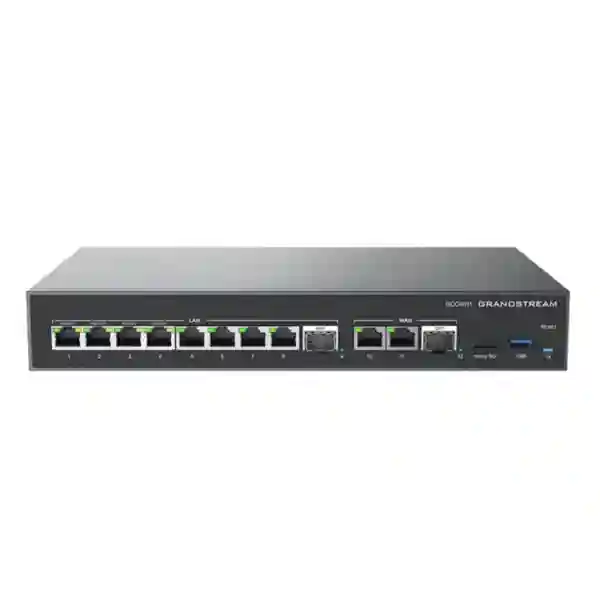
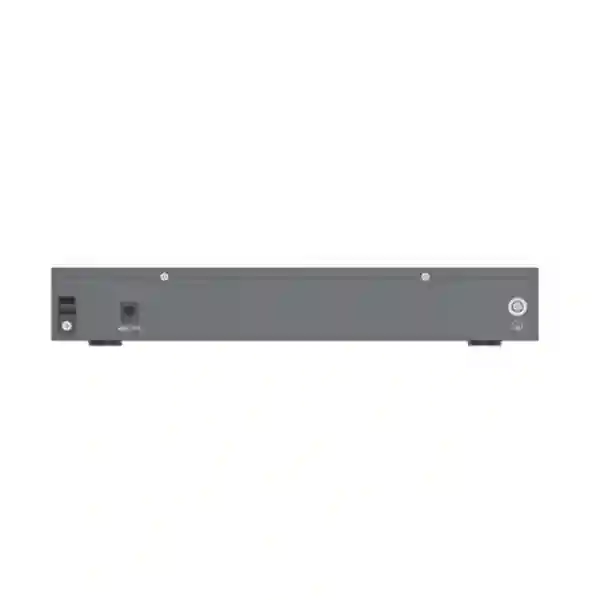
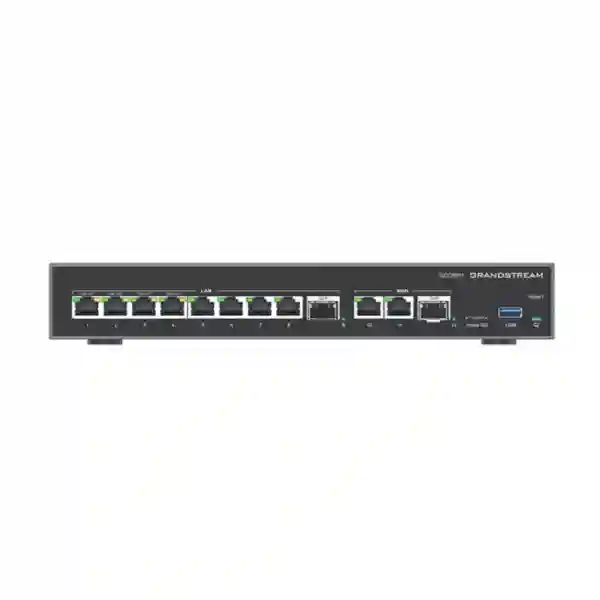
Grandstream GCC6011 Dubai – Unified Communications, Security and Network Gateway
The Grandstream GCC6011 Dubai solution is designed for organizations that want to reduce the number of separate appliances needed for business communications, routing, security and wired access. Instead of treating the IP PBX, VPN router, next-generation firewall and managed network switch as isolated systems, the GCC6011 brings these functions together in one Grandstream platform. For UAE offices, branches, schools, hotels, professional firms, clinics, retail groups and multi-site businesses, that convergence can simplify day-to-day administration while still giving the IT team clear control over voice, network segmentation, remote access and endpoint management.
The GCC6011 is the higher-port wired model in the GCC6010 family. It provides ten Gigabit Ethernet ports, two 2.5G SFP+ ports, three dedicated WAN ports, four PoE output ports, an integrated IP PBX, a 2.5 Gbps router, 1 Gbps IPsec VPN throughput, 900 Mbps IDS/IPS performance, optional M.2 SSD storage and centralized management options. Fourteck helps customers evaluate whether this consolidated architecture is the right fit, size the deployment around users and traffic, plan VLANs and WAN resilience, and integrate the gateway with Grandstream phones, access points, switches and other compatible SIP endpoints.
Why GCC6011 is different from a conventional IP PBX
A conventional IP PBX focuses mainly on telephony. It registers extensions, connects SIP trunks, controls inbound and outbound call routing, hosts IVR and voicemail, and manages features such as ring groups, queues or conferencing. The GCC6011 includes that communications role, but the device is also responsible for functions that would normally sit in separate network and security products. This matters because voice quality, branch connectivity, remote-user access, application control and endpoint provisioning are all dependent on the network around the PBX.
For a smaller or mid-sized organization, the usual stack may include an ISP router, an edge firewall, a managed switch, an IP PBX, a VPN concentrator and a separate management platform for phones and access points. Each product can be excellent on its own, but every additional platform introduces its own configuration model, software lifecycle, credentials, logs and troubleshooting workflow. GCC6011 offers a different architectural choice: consolidate several core functions when the operational simplicity of one platform is more valuable than maintaining separate appliances for every role.
That does not mean one design is automatically better for every customer. Very large networks, highly regulated environments, organizations with complex security policies or companies that already standardize on separate enterprise firewalls may prefer a distributed architecture. The useful question is whether GCC6011 provides the required capacity, security controls, routing features, PBX scale and management model for the site. Fourteck approaches the product from that requirement-first perspective rather than treating convergence as a reason to replace every existing system.
Requirement-to-capability guide
| Customer requirement | Relevant GCC6011 capability | Practical value | What to check before buying |
|---|---|---|---|
| One platform for voice and networking | Integrated IP PBX, router, firewall and managed switching | Fewer standalone management layers at the branch or office edge | Required PBX scale, security policy and network complexity |
| Multi-WAN resilience | Three dedicated WAN ports | Supports architectures using multiple internet links for availability and traffic planning | ISP handoff type, failover policy, public IP requirements and application behavior |
| Secure branch connectivity | IPsec, OpenVPN, WireGuard and other VPN options | Connect branches or remote users to private resources | Tunnel count, encryption expectations, routing design and peer compatibility |
| Threat inspection at the edge | DPI, antivirus, IDS/IPS, SSL inspection and content controls | Adds security inspection to a converged branch platform | Current firewall service plan, signature updates and required performance under inspection |
| Voice deployment for a small or growing office | 24 PBX users and 8 concurrent calls by default, with upgrade options available | Built-in call control without a separate PBX appliance for suitable sites | Extension count, simultaneous-call requirement, SIP trunks, call queues and growth |
| Power a few edge devices directly | Four IEEE 802.3af/at PoE output ports with 36 W maximum PoE budget | Can reduce power-adapter needs for selected phones, APs or other supported devices | Per-device power draw and total 36 W PoE budget |
The wired network platform inside GCC6011
GCC6011 is built for wired deployments. It includes ten Gigabit Ethernet ports and two 2.5G SFP+ ports. Grandstream identifies three WAN ports as dedicated WAN interfaces on this model. That port mix gives an installer room to separate internet uplinks, LAN segments, voice devices, access points, local servers and other business systems without immediately depending on a second switch for a small deployment. In larger installations, the GCC6011 can still sit at the edge while downstream access switches handle the higher port count required by the office floor.
The device supports up to 128 VLANs according to Grandstream’s current technical documentation. VLAN capability is important in converged communications because a practical business network should not place every device into one flat broadcast domain. Voice endpoints can be separated from staff computers, guest traffic can be isolated from corporate systems, building or IoT devices can be segmented, and administrative interfaces can be restricted to the IT network. A good GCC6011 design therefore starts with the logical network before anyone begins plugging cables into ports.
Grandstream also lists 15 Gbps total non-blocking throughput and 30 Gbps switching capacity when hardware acceleration applies. These figures should be interpreted as platform performance characteristics rather than a promise that every real-world application will see the same speed. Actual usable performance depends on packet sizes, enabled security features, VPN encryption, traffic patterns, ISP bandwidth and endpoint behavior. For UAE customers with multiple WAN links, the more useful exercise is to map internet circuit speeds and critical applications against routing, inspection and VPN requirements.
The two 2.5G SFP+ ports are particularly useful where an organization has an optical handoff, a higher-speed uplink to another switch, or a requirement to avoid forcing every backbone connection through 1 Gigabit copper. The exact optics and cabling must be selected for the deployment environment. Fourteck can help the customer confirm interface type and topology rather than assuming that every SFP module or fiber link is interchangeable.
Routing, internet resilience and remote connectivity
The router component is rated at 2.5 Gbps, with 160,000 NAT sessions. For many SMB and branch environments, those figures position GCC6011 well above the requirements of a basic broadband router. The larger benefit, however, is not simply raw throughput. A business edge must decide how different networks reach the internet, what happens when an ISP fails, which applications can initiate outbound sessions, how remote offices reach internal services and how voice traffic is protected from congestion.
Multiple WAN connectivity can support load-balancing and failover strategies. In a Dubai head office, for example, the organization might use a primary fiber circuit for normal corporate traffic and a secondary link for resilience. A branch in Sharjah may use a simpler active/standby design. The right implementation depends on whether the business publishes inbound services, uses hosted SaaS platforms, has site-to-site tunnels, requires static public IP addresses or depends on SIP trunks that expect traffic from a particular WAN address. The technical design should account for those dependencies before failover is enabled.
The GCC6011 supports several VPN technologies, including IPsec, OpenVPN and WireGuard. Grandstream rates IPsec VPN throughput at 1 Gbps. Site-to-site VPN can be used to connect offices, while client VPN can provide controlled access for administrators or remote staff where appropriate. The presence of several VPN protocols is useful for interoperability, but protocol choice should be based on security policy, peer compatibility, ease of support and the number of remote users or tunnels. Older VPN methods may remain available for compatibility, yet organizations should prefer modern and supportable configurations where possible.
For voice deployments, VPN design deserves special attention. An IP phone at a branch or remote site is sensitive not just to average bandwidth but also to latency, jitter, packet loss and path changes. A failover event can preserve network connectivity while still interrupting an active call. Consequently, business continuity planning should distinguish between keeping the network reachable and maintaining every real-time session without interruption.
Next-generation firewall capabilities and licensing considerations
Grandstream positions the built-in firewall as a next-generation security component with functions including deep packet inspection, antivirus, IDS/IPS, SSL inspection or proxy functions, DNS and web filtering, application identification and control, traffic rules, NAT, port forwarding, DMZ support and defenses against certain denial-of-service or spoofing activity. GCC6011 is rated at 900 Mbps for IDS/IPS. These controls can be useful for organizations that want the edge security layer to be managed within the same converged platform as networking and communications.
Security performance should never be planned only from the headline router number. A 2.5 Gbps routing figure describes a different workload from 900 Mbps IDS/IPS. Enabling threat inspection, VPN encryption, application controls and SSL-related inspection can alter the effective throughput available to a real deployment. If the customer has a 1 Gbps or faster internet circuit and expects continuous inspection of most traffic, Fourteck recommends checking the security profile and traffic pattern before final sizing.
Grandstream’s current GCC firewall documentation states that the firewall service includes a free one-year trial from first activation. If the service plan is not renewed, the firewall continues to run with the last installed security engines, signatures and current configuration, but new firewall security updates are no longer received. That distinction is important for procurement. The appliance itself does not simply stop routing at the end of the trial, yet ongoing signature updates matter because threat intelligence changes over time. Customers should therefore include the renewal model in the total operational plan.
Fourteck does not recommend treating any multifunction gateway as a substitute for an organization’s complete security policy. Endpoint protection, identity controls, secure administration, backups, patching, email security and user awareness remain relevant. The GCC6011 firewall is one layer within the wider architecture. Where a customer has regulatory requirements, very high security throughput, complex segmentation or advanced inspection needs, Fourteck can assess whether a dedicated enterprise firewall should remain part of the design.
Built-in IP PBX: where the GCC6011 fits
The GCC6011 includes an IP PBX with 24 users and 8 concurrent calls by default, with capacity upgrades available from Grandstream. That makes it suitable for many small-office and departmental deployments without requiring a separate PBX appliance. The PBX can support voice and video communications, and it is designed to operate alongside the device’s routing, switching and security functions rather than as an independent server.
User count and concurrent-call capacity are different planning variables. A company may have 24 registered users but only a few simultaneous external calls, while a customer service operation may need a much higher call-concurrency ratio. SIP trunks, inbound queues, outbound calling patterns, conferencing, remote extensions, recording requirements and business hours all affect capacity. For that reason, Fourteck sizes the telephony component from real call behavior rather than simply matching the number of staff to the published user limit.
The integrated PBX is particularly attractive when the customer is already deploying Grandstream endpoints. GCC can centrally manage Grandstream IP phones and other supported endpoints, and Grandstream documents fast-provisioning workflows for compatible devices. This can reduce repetitive configuration when extensions are rolled out across an office. Selected third-party SIP endpoints can also be supported depending on compatibility and provisioning method, but customers should verify feature expectations before standardizing on a mixed endpoint environment.
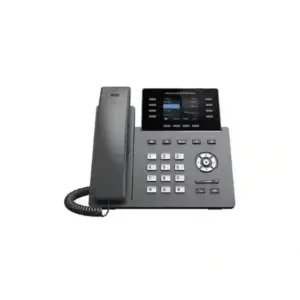
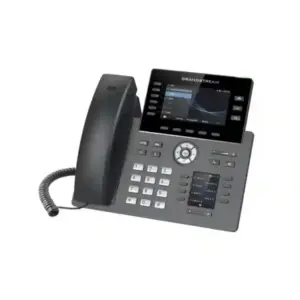
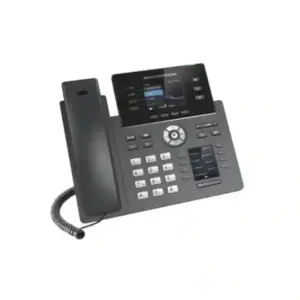
A receptionist, manager, meeting room and warehouse station may all need different devices even though they register to the same PBX. The correct phone portfolio can therefore include entry-level desktop phones, executive models with larger displays, cordless handsets, video phones or conference endpoints. GCC6011 should be viewed as the call-control and network foundation, not as a reason to use one endpoint model everywhere.
Customers comparing GCC6011 with the Grandstream UCM family should focus on architecture. A UCM appliance is primarily an IP PBX platform, while GCC6011 combines communications with network gateway, firewall and switching functions. If the organization already has a preferred firewall and switching stack, a UCM may fit more naturally. If the goal is to simplify a smaller branch or office by converging those functions, GCC6011 can be the stronger architectural match.
PoE planning: useful convenience, not a full-access-switch replacement
GCC6011 provides four PoE output ports supporting IEEE 802.3af/at with a maximum total PoE budget of 36 W. This is useful for a compact installation because selected phones, access points or other compatible devices can potentially be powered directly from the gateway. It can reduce the need for local power adapters and simplify a small communications cabinet.
The 36 W total budget is the key design limit. Four PoE-capable ports do not mean that every attached device can draw the maximum power allowed by its PoE class at the same time. The combined requirement must fit within the available budget. An access point or video endpoint may consume more power than a basic IP phone, so device selection matters. Before deployment, the IT team should list the maximum power draw of each planned endpoint and leave sensible operating headroom.
For a larger office, a dedicated Grandstream managed PoE switch will usually remain appropriate. The gateway can handle routing, WAN, firewall, PBX and management functions while access switches provide the port density and PoE budget for dozens of phones or APs. Convergence should simplify the architecture, not force every endpoint directly into the GCC6011 chassis.
Centralized management and operational workflow
Grandstream provides several management paths for the GCC6011, including GDMS cloud management, local web interface, SSH and SNMP. The right method depends on the customer’s operational model. A single office may be comfortable with local management, while a multi-site organization or managed-service environment benefits from centralized visibility and standardized configuration practices.
Central management becomes valuable when the network, security and voice systems interact. If an IP phone has poor audio, the root cause may be the phone configuration, VLAN assignment, switch port, QoS policy, WAN congestion, VPN path or SIP provider. A converged platform does not eliminate troubleshooting, but it can reduce the number of disconnected consoles required to build a complete picture. Logs, topology, endpoint registration and network policy can be examined within a more unified workflow.
For organizations with internal IT teams, Fourteck can document the administration model so that normal operational tasks do not depend on one installer. That handover can include network addressing, VLAN naming, WAN roles, backup procedures, extension structure, SIP trunk details, firmware policy and escalation contacts. Good documentation is especially important when several technical roles are combined in one appliance because a change intended for networking can affect telephony or security.
Grandstream recommends keeping firmware current because updates can address security and stability issues. The vendor’s current firmware page lists system and PBX firmware branches for GCC6010, GCC6010W and GCC6011. Production upgrades should still be planned carefully, with configuration backups, release-note review, maintenance windows and post-upgrade testing. A firmware update is not simply an administrative checkbox when the device is simultaneously responsible for internet access, firewalling and business calls.
Where GCC6011 makes sense in Dubai and the UAE
Dubai businesses often operate from offices where communications and connectivity need to be deployed quickly but still managed professionally. A consultancy, trading company, clinic, school administration office, hospitality back office or growing SME may need dual-ISP resilience, secure remote access, segmented networks, IP telephony and centralized management without building a full enterprise data-center stack. GCC6011 can be a good fit when those requirements align with its published capacity.
In a Deira or Bur Dubai office, the immediate requirement may be to replace an aging analog PBX and unmanaged network at the same time. Rather than introducing unrelated platforms, the customer can design voice VLANs, staff networks, guest access, SIP trunks and firewall policy together. In a JLT or Business Bay office with hybrid workers, VPN and remote-extension planning may be more important. In a warehouse or industrial office, stable wired connectivity, PoE endpoint power and branch VPN may take priority over Wi-Fi functions inside the gateway.
Abu Dhabi customers may use the GCC6011 at a branch while a larger headquarters retains a separate enterprise security stack. Sharjah and Ajman businesses may value the appliance as a compact all-in-one platform for a main office, especially where the organization wants one support path for Grandstream phones, APs and network components. The same product can therefore appear in very different topologies; Fourteck does not assume that every GCC6011 should be deployed in an identical template.
For projects outside the UAE, Fourteck can also support planning across parts of the GCC and Africa through its wider regional network. Procurement, ISP connectivity, SIP services, support availability and compliance expectations can vary by country, so deployment assumptions should be reviewed for each location rather than copied from a Dubai design.
Deployment blueprint for a typical SMB office
1. Define WAN roles
Identify primary and backup internet links, public IP requirements, SIP trunk dependencies, inbound services and the intended failover behavior.
2. Build segmentation
Create a logical plan for voice, staff, guest, server, management and IoT networks. Apply VLANs only where they have a clear operational or security purpose.
3. Size PBX use
Count users, estimate concurrent calls, confirm SIP trunks, identify reception and queue needs, and allow for future growth before deciding whether the default PBX capacity is enough.
4. Plan PoE
Decide which devices can be powered from the four local PoE ports and whether a dedicated PoE access switch is required for the wider endpoint estate.
5. Apply security policy
Set firewall rules, filtering, VPN access and management restrictions according to business requirements rather than enabling every function without a policy.
6. Validate and document
Test calls, WAN failover, DNS, internet access, VPN, VLAN isolation, PoE load, endpoint provisioning and administration before handover.
GCC6011 versus GCC6010 and GCC6010W
All three models belong to the same GCC6010 family, but they target different physical deployment needs. GCC6010 is a smaller wired appliance with five Gigabit Ethernet ports and two 2.5G SFP+ ports. GCC6011 expands the wired interface count to ten Gigabit Ethernet ports and is rack-mountable. GCC6010W is the wireless model with an integrated dual-band Wi-Fi 6 access point, while the GCC6011 does not use an integrated Wi-Fi AP as its defining feature.
| Decision point | GCC6010 | GCC6010W | GCC6011 |
|---|---|---|---|
| Primary physical profile | Compact wired model | Wireless all-in-one model | Higher-port wired model |
| Gigabit Ethernet ports | 5 | 5 | 10 |
| 2.5G SFP+ ports | 2 | Not the defining interface set | 2 |
| Integrated Wi-Fi | No integrated AP focus | Wi-Fi 6 AP | No integrated AP focus |
| Rack mount | Desktop/wall | Desktop | Desktop/wall/rack |
| Best fit | Smaller wired office | Compact site wanting integrated wireless | Wired office needing more local ports and rack deployment |
The choice should be based on topology rather than assuming that the numerically larger model is always the best purchase. If a site already uses several ceiling-mounted access points, an integrated Wi-Fi radio in the gateway may add little value. Conversely, a very small location may benefit from GCC6010W because the wireless function reduces the number of devices needed. GCC6011 is strongest where the design is wired, port density matters and the customer wants a rack-friendly convergence appliance.
Who should consider GCC6011?
Growing SMEs: A business moving from consumer-grade networking and an aging phone system can use GCC6011 as the foundation for a more structured environment with VLANs, managed voice, VPN and centralized administration.
Branch offices: A branch can combine local call control, WAN connectivity, firewalling and switching in one appliance, particularly when the organization wants a compact deployment with remote management.
Hotels and hospitality back offices: Administrative phones, staff networks, management systems and remote connectivity can be segmented while the PBX component supports internal communications. Guest-network design may still require additional access points and switching.
Schools and training centers: The device can support separate staff, administration, voice and service networks, with policy controls at the edge. Larger campuses should evaluate switch capacity, redundancy and security architecture beyond the gateway itself.
Professional offices: Law firms, consultancies, accounting offices and similar organizations often need reliable calling, secure remote access and clear separation between business and guest traffic without maintaining a large infrastructure team.
Retail and distributed sites: A branch with POS systems, staff devices, IP phones, CCTV uplinks or management access can benefit from segmentation and VPN connectivity, provided bandwidth, security and port requirements remain within the platform’s capabilities.
When a separate firewall, switch or PBX may still be better
Convergence is valuable because it reduces platforms, but consolidation also means one device carries more responsibility. Organizations that require firewall clustering, specialized threat intelligence, very high inspected throughput, hundreds of switch ports, extensive PoE budgets or large call-center capacity should evaluate dedicated platforms. The GCC6011 can still participate in such an architecture, but it may no longer be the single device responsible for everything.
A customer that already owns a mature Fortinet, Palo Alto, Cisco, Sophos or other enterprise security environment may not gain operational value by replacing it just to use the GCC firewall functions. Likewise, a company with an established Grandstream UCM deployment may prefer to keep the PBX separate while using dedicated routers and switches. Fourteck’s role is to identify the simplest architecture that still meets the real technical and business requirements.
Redundancy is another consideration. If internet access, office switching and telephony all depend on one appliance, the business should understand the operational impact of a device failure or maintenance event. Backup configuration, spare strategy, support process and maintenance windows become more important in a converged design. For critical sites, Fourteck can discuss architectures that distribute risk rather than relying on a single point of failure.
Procurement checklist for Grandstream GCC6011 Dubai
- Confirm the actual user and call profile. Count extensions, concurrent calls, SIP trunks, queues, conference requirements and future staff growth.
- List WAN circuits. Record ISP speeds, handoff type, static public IPs, primary/backup roles and whether inbound applications depend on a specific WAN.
- Define segmentation. Decide which VLANs are needed for voice, users, guests, servers, management, CCTV or IoT systems.
- Estimate inspected bandwidth. Router capacity and IDS/IPS capacity are not the same; security features must be included in performance planning.
- Check PoE demand. Four PoE output ports share a maximum 36 W PoE budget, so verify connected device requirements.
- Plan downstream switching. Ten local Gigabit ports may be enough for a compact site, while larger deployments will need managed access switches.
- Plan Wi-Fi separately. GCC6011 is the wired model; use suitable Grandstream GWN access points when wireless coverage is required.
- Review firewall service renewal. Include the ongoing update plan in the operating budget if advanced security signatures are part of the design.
- Confirm storage needs. GCC6011 supports optional M.2 SSD storage. Select storage only after identifying the intended application and vendor support requirements.
- Plan support and firmware. Document backup, upgrade, monitoring and recovery procedures before the system becomes production-critical.
How Fourteck supports GCC6011 projects
Fourteck supports customers who need more than a product model number. A GCC6011 project can include requirement discovery, bill-of-material planning, LAN and VLAN design, WAN failover planning, SIP trunk coordination, IP phone selection, Grandstream access point and switch integration, VPN setup, firewall policy planning, endpoint provisioning, testing and handover. The service scope can be adapted for a new office, an upgrade from an older PBX, or a branch deployment connected to an existing head-office environment.
For UAE buyers, Fourteck can help compare GCC6011 with GCC6010, GCC6010W, Grandstream UCM systems or an architecture using separate network and security appliances. That comparison is useful because the correct choice is usually determined by topology and operational preference rather than a single specification. A small wired office with several WAN links and modest PBX requirements may benefit greatly from convergence. A larger site may need dedicated switching or security while still using Grandstream for communications.
For additional Grandstream and IP communication options, visit Fourteck IP Phone, explore Grandstream UAE solutions, or review broader technology services at Fourteck UAE. Product availability, exact configuration, licensing, project scope and commercial terms should be confirmed at quotation stage.
GCC6011 FAQ
What is the Grandstream GCC6011?
The Grandstream GCC6011 is a wired UC and networking convergence appliance that combines a VPN router, next-generation firewall, IP PBX and managed network switching functions in one platform. It is designed for organizations that want unified management of communications and network services.
How many Ethernet ports does GCC6011 have?
GCC6011 provides ten Gigabit Ethernet ports and two 2.5G SFP+ ports. Grandstream specifies three dedicated WAN ports on this model.
Does GCC6011 include PoE?
Yes. It includes four PoE output ports supporting IEEE 802.3af/at with a maximum total PoE budget of 36 W. The power requirement of all connected devices should be checked before deployment.
How many PBX users does GCC6011 support by default?
Grandstream’s current documentation lists 24 users and 8 concurrent calls by default for GCC6011. PBX capacity upgrades are available from Grandstream, so larger requirements should be verified against the current upgrade options before ordering.
What is the routing speed of GCC6011?
Grandstream rates the router at 2.5 Gbps. The device is also specified for 1 Gbps IPsec VPN throughput and 900 Mbps IDS/IPS. Real-world results depend on configuration, security features, traffic and hardware acceleration conditions.
Does GCC6011 have built-in Wi-Fi?
GCC6011 is the higher-port wired model in the GCC6010 family. Customers that want an integrated Wi-Fi 6 access point should compare it with GCC6010W. For normal office Wi-Fi coverage, GCC6011 can be paired with suitable Grandstream GWN access points.
Can GCC6011 be rack mounted?
Yes. Grandstream lists desktop, wall and rack mounting for GCC6011, and the rack mount kit is included with the GCC6011 package according to the current datasheet.
Can GCC6011 be used for site-to-site VPN?
Yes. The platform supports IPsec site-to-site VPN and also supports additional VPN technologies including OpenVPN and WireGuard. VPN design should be checked for peer compatibility, security policy and expected tunnel throughput.
What happens when the GCC firewall service plan expires?
Grandstream states that the firewall continues operating with the last installed security engines, signatures and existing configuration, but it no longer receives new firewall security updates if the service is not renewed. Customers using the security services should therefore include renewal in lifecycle planning.
Is GCC6011 suitable for a Dubai office?
It can be a strong fit for a small or mid-sized Dubai office when its PBX scale, WAN design, security throughput, switch ports and PoE budget match the requirement. Fourteck can evaluate the complete deployment rather than sizing the appliance from staff count alone.
Can I use third-party SIP phones with GCC6011?
Grandstream documentation indicates support for selected third-party SIP devices as well as Grandstream endpoints, depending on compatibility and provisioning method. Feature behavior should be validated when mixing vendors.
Should I choose GCC6011 or a Grandstream UCM IP PBX?
Choose based on architecture. GCC6011 is attractive when you want routing, firewall, switching and IP PBX functions in one converged platform. A UCM may be more suitable when telephony should remain a dedicated system alongside an existing firewall and network infrastructure.
Plan your Grandstream GCC6011 deployment with Fourteck
If you are evaluating Grandstream GCC6011 Dubai for a new office, branch upgrade or unified communications refresh, start with the required user count, simultaneous calls, WAN links, security throughput, VLANs, PoE devices and future growth. Fourteck can use those inputs to confirm whether GCC6011 is the right fit and build a practical bill of materials around the gateway, phones, access points, switches and support services required by the project.
Next step: request a quotation or technical consultation with your expected number of users, internet circuit details, number of sites and endpoint requirements. Exact product availability, PBX upgrades, firewall service plans and compatible accessories should be confirmed at the time of quotation.
Reviews
There are no reviews yet.