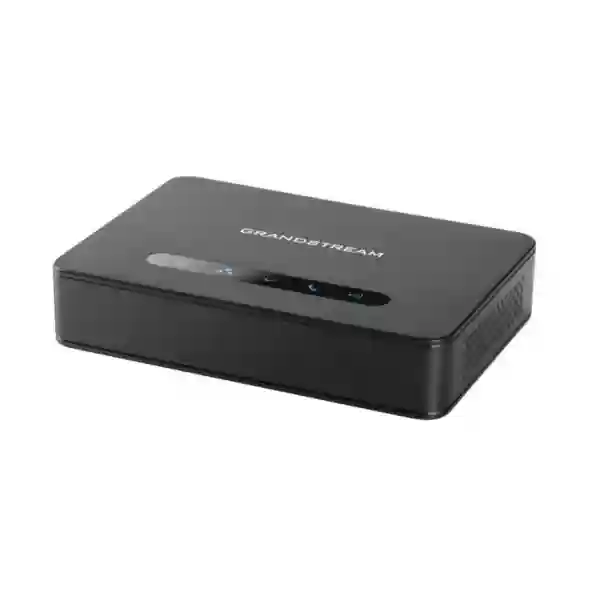
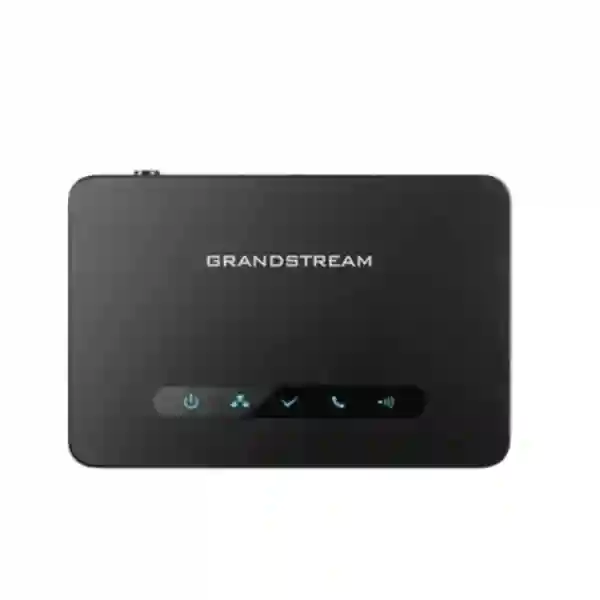
Grandstream DP760 Long-Range Wideband DECT Repeater
The Grandstream DP760 is a wideband DECT repeater designed to extend cordless voice coverage for compatible Grandstream DP Series DECT deployments. It is intended for offices, warehouses, retail environments, hospitality sites, schools, clinics, homes and other locations where users need to continue calls while moving beyond the practical radio coverage of the base station. Grandstream specifies an additional range of up to 300 metres outdoors and 50 metres indoors, support for up to two concurrent HD calls, automatic or manual association, seamless call handover, XML-based provisioning, five LED indicators and a 10/100 Mbps Ethernet interface with integrated IEEE 802.3af PoE. Real-world coverage depends on walls, shelving, doors, construction materials, interference, repeater placement and the selected base-station topology, so the correct design should be based on the site rather than the maximum distance figure alone.
Up to 300 m outdoor extension
Up to 50 m indoor extension
PoE · IEEE 802.3af Class 1
DP760 in one answer: coverage extension, not extra SIP capacity
Choose the DP760 when the existing or planned Grandstream DP Series DECT system already meets the customer’s handset and call-control needs, but the radio footprint does not reliably reach every working area. A repeater does not replace the PBX, create new SIP accounts or convert a single base station into an unlimited high-capacity cordless platform. Its primary job is to relay DECT coverage so supported handsets can remain connected across a larger physical area.
This distinction matters because customers often describe every cordless problem as a “range problem.” If calls fail only in a distant warehouse aisle, back office, upper floor or remote room, a coverage extension may be appropriate. If the real problem is too many simultaneous calls, too many users for the chosen base, independent buildings, complex roaming requirements or a PBX/network fault, adding a repeater without redesign can leave the underlying limitation untouched. Fourteck can help separate coverage, capacity, network and PBX requirements before hardware is ordered.
Verified Grandstream DP760 specifications
The figures below are based on Grandstream’s current product information and datasheet. Regional frequency profiles and regulatory requirements differ, so the supplied unit should always match the deployment country and the actual base-station environment.
| Product type | Long-range wideband DECT repeater / wireless relay station |
|---|---|
| Concurrent HD calls | Up to 2 |
| Additional range | Up to 300 m outdoors and 50 m indoors under suitable conditions |
| Association | Automatic or manual association to compatible DP Series base stations; repeater-management workflows are also documented on supported DP75x bases |
| Repeater topology | Up to 5 repeaters in a star arrangement |
| Voice codecs | G.722 for HD audio; G.726 for narrowband audio |
| Ethernet | 1 × 10/100 Mbps auto-sensing Ethernet port with integrated PoE |
| PoE | IEEE 802.3af Class 1, published power range 0.44 W–3.84 W |
| Indicators | 5 LEDs: Power, Network, Association, Activity and DECT Signal Strength |
| Provisioning / upgrade | TFTP/HTTP/HTTPS firmware upgrade; AES-encrypted XML configuration file support |
| Security items | User/admin access control, MD5 and MD5-sess authentication, 256-bit AES encrypted configuration file, HTTPS and 802.1X media access control |
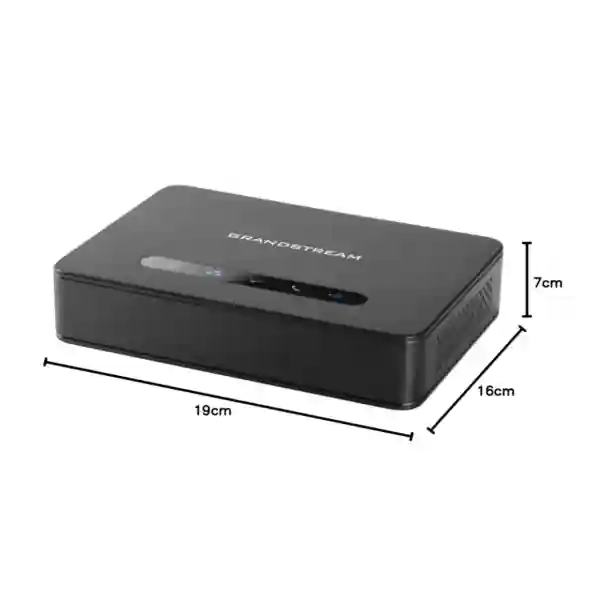
| Dimensions | 28.5 × 130 × 90 mm (H × W × D) |
| Repeater weight | 143 g |
| Operating environment | -10°C to 50°C; 10% to 90% non-condensing humidity |
Compatibility with DP750, DP752 and DP755
Grandstream currently presents the DP760 within its DP7xx cordless family and documents operation with DP75x base-station environments. The current DECT family page specifically lists DP750 and DP752 association, while the DP755 administration guide contains a dedicated DP760 association section. For DP755, Grandstream documents auto association, manual association and repeater-management methods. This is important because compatibility should be checked against the real base model and firmware rather than assumed from the “DP Series” family name alone.
For DP750 and DP752 environments, repeater mode must be enabled on the base according to the administration guidance before association. For DP755, repeater mode is also enabled before the DP760 is paired. Grandstream notes that the DP760 can work as an extended-range device with DP755 while remaining separately managed from the base station’s own firmware releases. That makes firmware documentation and change control useful in business deployments.
Handset behavior must also be considered. The repeater extends the radio path between the handset environment and the base architecture; it does not redefine the handset account limits or the base station’s primary simultaneous-call capacity. In a procurement discussion, identify the base, handsets, PBX, firmware, coverage issue and expected concurrency together. That produces a more reliable recommendation than purchasing the repeater in isolation.
Coverage planning: the published distance is a planning reference
Grandstream specifies up to 300 metres of additional outdoor range and 50 metres indoors. Those numbers are useful for first-stage planning, but they should not be interpreted as a guaranteed radius in every property. DECT radio performance is influenced by reinforced concrete, metal racks, lift shafts, fire doors, glass treatments, machinery, refrigeration equipment, storage density, room layout and competing radio environments. A repeater positioned behind the same obstruction that already weakens the base signal may not solve the problem.
The usual objective is to place the DP760 where the parent DECT signal is still healthy, while the repeater can project useful coverage into the weak area. In a warehouse this may mean a position above dense shelving or near the transition between office and storage space. In a multi-room office, a corridor or junction may be more effective than a closed room. In a villa or hospitality property, floor slabs and stair cores may have more effect than horizontal distance. Placement therefore becomes an RF design task, not simply a matter of measuring metres from the base.
Validation should include live calls while walking the paths users actually take. Test the edge of base coverage, the transition area, the target remote zone and any point where users regularly turn corners, enter lifts or pass through heavy doors. The DP760 provides a DECT signal-strength indicator that helps during installation, but user experience should be confirmed with real handsets and normal call traffic.
Star topology and the two-call repeater limit
Grandstream documents support for up to five DP760 repeaters in a star arrangement with compatible DP75x base stations. A star design is useful when the base sits near a central point and coverage needs to be extended toward different wings or operational areas. For example, one direction may serve a warehouse, another a reception or meeting area, and another a back office. Each repeater should still have an appropriate relationship to the base coverage and should not be positioned simply because a cable route is convenient.
The second sizing factor is call concurrency. The DP760 relays up to two concurrent HD calls. A remote storeroom used by one or two supervisors has a very different requirement from a busy sales floor or dispatch team with many roaming staff. If several users are likely to be active simultaneously in the repeater-served zone, capacity should be reviewed before the design is approved. Adding coverage without checking the call profile can result in a system that reaches the location but does not meet peak usage.
This is why Fourteck separates four design questions: how far users need to roam, how many handsets are registered, how many calls occur at once, and how many separate coverage zones exist. The correct cordless architecture follows from those requirements rather than from the repeater count alone.
PoE and network integration
The DP760 includes a 10/100 Mbps Ethernet interface with integrated IEEE 802.3af Class 1 PoE. In business installations, PoE can improve placement flexibility because the repeater does not have to sit next to a wall outlet. A suitable Ethernet run from a PoE switch or injector can place the device closer to the best RF position. Where PoE is not available, Grandstream also specifies a 5 V DC Micro-USB power option using the appropriate supply.
For managed networks, the repeater should be documented like other voice-infrastructure endpoints. Confirm IP addressing, DHCP or static policy, management access, switch port, firmware reachability, HTTPS settings and any 802.1X requirement. Grandstream lists protocols including TCP/IP/UDP, HTTP/HTTPS, DNS, DHCP, SSH, TFTP, NTP, LLDP-MED and UPnP. The presence of these protocols does not mean every one must be enabled in every environment; configuration should follow the organization’s security and management policy.
PoE also matters to business continuity. If the PBX, voice switch and base station are protected by UPS but the repeater is powered from an unprotected local adapter, a short power interruption can create a coverage outage in only part of the property. Power dependencies should therefore be mapped end to end. In locations where voice mobility is operationally important, powering the repeater from the same protected PoE infrastructure can simplify resilience planning.
Provisioning, firmware and security
The published DP760 specification includes user- and administrator-level access control, MD5 and MD5-sess based authentication, 256-bit AES encrypted configuration files, HTTPS and 802.1X media access control. These capabilities are most useful when they are incorporated into an actual device-management standard. Use appropriate administrative credentials, restrict management access, document the device and review firmware as part of the wider voice platform rather than treating the repeater as an invisible accessory.
Grandstream specifies firmware upgrade via TFTP, HTTP and HTTPS, with mass provisioning through AES-encrypted XML configuration files. This supports repeatable configuration in multi-site environments. A business deployment should maintain a known firmware baseline and test updates before broad rollout, especially when repeaters are part of coverage for operational teams. When GDMS or another approved Grandstream management workflow is used, confirm the current feature support for the exact device and firmware version.
A useful asset record includes model, MAC address, IP address, switch port, parent base station, physical location, power source, firmware version and intended coverage zone. If users later report that calls fail only in one wing or during movement between two areas, this documentation makes troubleshooting much faster.
Recommended DP760 deployment workflow
1. Confirm the installed system
Identify the DP base-station model, handset models, firmware, PBX platform, SIP account design and current simultaneous-call requirement. Confirm that the reported issue is genuinely coverage-related.
2. Survey the weak area
Walk the real user route on active calls. Record where audio, registration or signal quality declines, and note construction materials or equipment that may affect radio propagation.
3. Enable repeater mode
Use the compatible DP75x web interface and model-specific administration guidance to enable repeater mode, save configuration and reboot where required.
4. Associate the DP760
For automatic association, begin close enough to the base for reliable discovery. Manual association or repeater-management mode can be used where supported and appropriate.
5. Install in the planned RF position
Move the repeater to a location that still receives a healthy parent signal while extending useful coverage toward the weak zone. Use PoE if it supports better placement and serviceability.
6. Validate mobility and concurrency
Test inbound and outbound calls, movement, handover, peak concurrent calls and edge locations. Document the final position and any site-specific limitations.
Business environments where DP760 can fit well
Warehouses and distribution facilities
Warehouse users often move between receiving bays, storage racks, packing stations and dispatch areas. Metal shelving can alter radio propagation significantly, so a repeater should be positioned according to the real aisle and walking pattern rather than only the building dimensions. The DP760 is suitable when the compatible Grandstream base covers most of the site but a particular aisle group, loading zone or operational room falls outside reliable coverage. The two-call repeater capacity must still be checked against the number of active users in that area.
Retail, showroom and service locations
Retail staff may move between the customer floor, cash area, stock room, office and service counter. A DP760 can support a more continuous cordless experience when a base station cannot reliably reach the back-of-house area. The practical benefit is not simply distance; it is keeping staff reachable while they move between customer-facing and operational spaces.
Hotels, clinics and education sites
Corridors, fire doors, service rooms and multiple partitions can create isolated weak zones. In smaller properties where a DP Series design otherwise meets the handset and capacity requirement, strategically placed repeaters can extend coverage without changing the user workflow. Emergency-calling policy, resilience and call concurrency should still be reviewed at the wider system level.
Offices, villas and multi-room properties
A single DECT base can work well through open office areas but lose strength through reinforced stair cores, thick walls or separate wings. The DP760 can bridge these spaces when it remains within suitable parent coverage. PoE can help place the device where radio performance is better rather than where power happens to be available.
When a repeater may not be the correct solution
The DP760 should not be used as a universal fix for every cordless problem. If the base station is poorly positioned, firmware is inconsistent, the handset is faulty, the LAN is unstable, SIP registration is failing or the PBX is overloaded, a repeater may add hardware without fixing the root cause. Troubleshooting should first establish whether the failure is radio, network, handset, base or call-control related.
A repeater is also not a substitute for a larger cordless architecture when the customer requires substantially more simultaneous calls, very high handset density, independent buildings or broad multi-cell roaming. Large campuses, hospitals, high-density logistics operations and other complex sites may need a different approach. The right answer depends on user count, call concurrency, mobility pattern, resilience and management requirements.
For a new project, begin with the required coverage area, number of handsets, peak simultaneous calls and number of distinct mobility zones. Then add the PBX/SIP platform and building constraints. This prevents the product choice from driving the architecture when the architecture should drive the product choice.
DP760 repeater versus changing the base architecture
| Decision factor | DP760 approach | Different / additional base approach |
|---|---|---|
| Primary objective | Extend DECT coverage | Potentially add registrations, capacity or an independent coverage zone depending on design |
| Concurrent calls | Repeater relays up to 2 concurrent HD calls | Depends on chosen base, PBX and architecture |
| Best fit | Coverage gap in an otherwise suitable DP75x system | Capacity growth, new zone, different roaming requirement or broader redesign |
| Main planning risk | Adding repeaters without RF or concurrency review | Creating unnecessary complexity without coordinated cordless planning |
The comparison is architectural rather than tied to one alternative product. Fourteck can review the current Grandstream system and decide whether a repeater extension is sufficient or whether the base/handset design should be revisited.
Regional deployment and procurement context
Dubai, Sharjah, Abu Dhabi and the UAE
UAE deployments include offices, retail stores, warehouses, clinics, schools, hospitality sites, villas and mixed commercial spaces. A common requirement is extending cordless coverage from an office core into storage, service or dispatch space without moving the PBX. In Dubai and Sharjah warehouses, metal racking can make placement more important than raw distance. In Abu Dhabi offices and institutions, long corridors, separated departments and reinforced construction can create local weak zones. A DP760 proposal should therefore confirm the base model, handset mix, call concurrency, regional unit, PoE availability and the actual floor plan. For broader UAE technology requirements, see Fourteck UAE.
Kuwait
Kuwait business sites can face the same combination of long floor plans, partitions and back-of-house operational areas. DP760 is most relevant when a compatible DP base already satisfies user capacity and the remaining issue is coverage. The supplied hardware should match the destination region, and current price, stock and warranty terms should be confirmed at quotation time. Regional Fourteck information is available at Fourteck Kuwait.
Uganda, Kenya, Tanzania, Ghana and Nigeria
Across East and West African business environments, cordless voice projects often combine coverage planning with power continuity, network switching and supportability. In warehouses, schools, clinics, hospitality sites and offices, PoE can help simplify placement and backup-power design when a protected switch is available. Device records and firmware control also make remote support easier. Fourteck regional resources include Uganda, Kenya, Tanzania, Ghana and Nigeria.
These regional references do not imply current stock, price, local authorization, warranty terms or delivery time. Those commercial details should be confirmed for the requested quantity and destination.
DP760 procurement checklist
- Base station: exact DP750, DP752, DP755 or other DP Series model and firmware.
- Handsets: exact Grandstream DP handset models and quantity.
- Coverage gap: floor dimensions, walls, racks, corridors, outdoor transition zones and problem locations.
- Concurrent calls: expected peak active calls specifically in the repeater-served area.
- PoE: availability of a compatible PoE switch or injector and Ethernet cabling.
- PBX: Grandstream UCM, 3CX, hosted SIP or other call-control platform.
- Management: provisioning, firmware control, HTTPS administration and any GDMS requirement.
- Destination: country and city so regional compatibility and logistics can be checked.
- Service scope: supply only, installation, configuration, survey, troubleshooting or broader voice/network support.
Frequently asked questions about Grandstream DP760
What is the Grandstream DP760?
The DP760 is a long-range wideband DECT repeater that extends radio coverage for compatible Grandstream DP Series base-station deployments and relays up to two concurrent HD calls.
How much extra range can the DP760 provide?
Grandstream specifies up to 300 metres outdoors and 50 metres indoors of additional range. Actual results depend on building materials, interference, placement and parent signal quality.
How many calls can the DP760 relay?
Grandstream specifies up to two concurrent HD calls through the repeater.
Does DP760 support PoE?
Yes. Its Ethernet interface supports IEEE 802.3af Class 1 PoE. Grandstream also specifies a 5 V DC Micro-USB power option with the appropriate supply.
Can DP760 work with DP755?
Yes. Grandstream’s DP755 administration documentation includes DP760 association using auto association, manual association or repeater-management mode. Confirm firmware and regional compatibility for the actual project.
Can DP760 work with DP750 and DP752?
Grandstream’s current DECT product-family information lists automatic or manual association of DP760 with DP750 and DP752 base stations.
How many DP760 repeaters can be used?
Grandstream documents up to five DP760 repeater stations in a star arrangement with compatible DP75x base stations.
Does DP760 add SIP accounts or handset registrations?
No. It extends DECT coverage. SIP accounts, handset registrations and primary call capacity are handled by the base station and PBX architecture.
Does DP760 support seamless handover?
Grandstream lists seamless call handover as a supported feature. Correct RF placement and signal overlap remain important.
What codecs does the DP760 support?
Grandstream lists G.722 for HD audio and G.726 for narrowband audio.
Can DP760 be centrally provisioned?
The specification supports XML configuration files and firmware upgrade using TFTP, HTTP and HTTPS. Management should follow the organization’s approved Grandstream workflow.
What should I provide for a Fourteck quotation?
Provide the deployment country, base-station and handset models, required quantity, approximate coverage area, expected simultaneous calls, PoE availability and whether installation or configuration support is required.
Why discuss the DP760 with Fourteck before ordering?
The hardware decision is simple only when the system requirement is already understood. Fourteck can connect the published DP760 specification to the actual customer environment: base model, handset mix, firmware, PBX, call concurrency, PoE availability, building layout and weak-signal areas. This reduces the risk of buying a repeater for a problem caused by base placement, network configuration, handset issues or insufficient call capacity.
For new projects, the same review helps decide whether DP760 repeaters should be part of the architecture at all. The answer may be one repeater, several star-connected repeaters, a base-station change or a wider cordless redesign. The objective is dependable business communication and sensible future growth rather than adding devices without a clear requirement.
Fourteck can also align the DECT design with switching, PoE, VLAN, PBX, SIP trunk and broader IT infrastructure requirements where those elements are in scope.
Plan the DP760 around your real coverage requirement
If you are extending a Grandstream DP750, DP752 or DP755 deployment, share the base model, handsets, floor layout, weak-signal areas and expected concurrent calls. Fourteck can help determine whether DP760 is the right coverage tool, how many repeaters are reasonable, where PoE fits into the design and what should be verified before ordering.
Request a compatibility check, deployment discussion or quotation from Fourteck.
Reviews
There are no reviews yet.