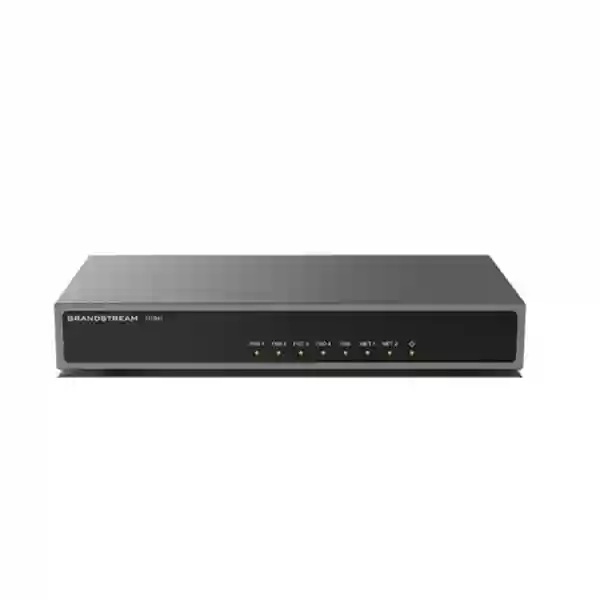
Grandstream HT841 4-Port FXO Gateway for Hybrid PSTN and VoIP Deployments
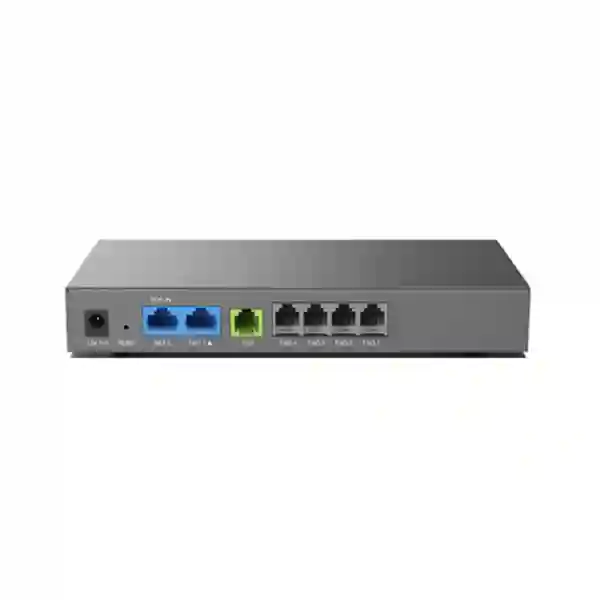
The Grandstream HT841 is a compact analog FXO gateway designed for organizations that need to connect traditional PSTN lines to a modern SIP-based communication platform. It provides four RJ11 FXO ports for analog carrier or PBX trunk connections and one RJ11 FXS port, allowing businesses to preserve selected analog services while moving call control, extensions, routing and management to an IP PBX, hosted PBX or another compatible SIP environment.
For Dubai and UAE businesses, the HT841 is most relevant when the requirement is a controlled bridge between four incoming or outgoing analog lines and an IP telephony system. It can support branch migration, legacy line retention, PSTN fallback designs, analog trunk integration and phased modernization projects without forcing every telephone service to be replaced at once. Fourteck can help assess the line type, PBX architecture, SIP routing plan, network design and deployment requirements before quotation.
A four-line bridge between analog trunks and SIP
Many organizations continue to use useful analog connections after moving users to IP phones. Those connections may be carrier PSTN lines, existing PBX trunks, fax-related services, emergency lines, backup lines or telephone circuits tied to an operational process that cannot be migrated immediately. An IP PBX communicates using SIP and RTP, while a conventional analog public line requires an FXO interface. The HT841 sits between these two worlds and converts call signaling and media so the analog line can participate in an IP-based call-routing environment.
This distinction matters during product selection. FXS gateways are primarily used to connect analog endpoints such as telephones or fax machines to VoIP. FXO gateways are used to connect analog exchange lines or analog PBX interfaces into VoIP. The HT841 includes four FXO ports for that trunk-side requirement and one FXS port for an analog endpoint. A typical requirement is therefore “bring four PSTN lines into our SIP PBX,” “retain local analog lines during a migration,” or “connect a legacy trunk interface to an IP communications platform.”
Where the HT841 fits best
The HT841 is suitable for small and medium environments that need four analog trunk interfaces rather than a high-density gateway. Typical projects include branch offices retaining local carrier lines, offices transitioning from analog trunks to SIP trunks in stages, organizations that need PSTN connectivity alongside a hosted or on-premise PBX, legacy PBX interconnection, remote sites that need local telephone access and continuity designs where selected analog lines remain available alongside IP calling.
It can also be useful when the organization must preserve an existing telephone number delivered over an analog line while moving users and call handling to an IP PBX. An incoming analog call terminates on an FXO port and is presented to the SIP environment according to the configured routing. The PBX can then apply normal logic such as an IVR, ring group, queue, time condition or extension routing. Outbound call routing can be designed in the opposite direction so selected calls leave the IP system through an analog carrier line.
Verified Grandstream HT841 specification
The following summary follows Grandstream’s current HT841/HT881 datasheet. Where older documentation differs, the current datasheet should be used as the purchasing reference and firmware-specific behavior should be confirmed during deployment planning.
| Telephony interfaces | 4 × RJ11 FXO ports and 1 × RJ11 FXS port |
|---|---|
| SIP profiles | 3 SIP profiles |
| Network interfaces | Two 10/100/1000Mbps RJ45 ports; one with 802.3af PoE-PD support. Up to 1000Mbps in bridge mode and up to 100Mbps in NAT mode. |
| Voice codecs | G.711, G.723.1, G.729, G.726-32, iLBC and Opus, with dynamic jitter buffer and advanced line echo cancellation. |
| Fax over IP | T.38 Group 3 fax relay up to 14.4kbps with automatic switching to G.711 for fax pass-through. |
| Caller ID | Bellcore Type 1 & 2, ETSI, BT, NTT and DTMF-based caller ID. |
| Dial / disconnect | DTMF and pulse dialing; busy tone, polarity reversal/wink and loop-current disconnect methods. |
| QoS | 802.1Q VLAN, 802.1p, ToS, DiffServ, MPLS and traffic shaping. |
| Security | SRTP for media; TLS/SIPS/HTTPS for control; AES-secured provisioning. |
| Provisioning | HTTP, HTTPS, TFTP, SSH and TR-069, with automated provisioning and syslog support. |
| Power | 48V / 0.5A PoE input or 12V / 1A DC input. |
| Environment | 0°C to 40°C operation; -10°C to 60°C storage; 10–90% non-condensing humidity. |
| Dimensions / weight | 190 × 100 × 28 mm; 0.46 kg. |
| Compliance | FCC, CE, RCM, IC and UKCA. |
Understanding the four FXO ports
Each FXO port is designed to connect to an analog telephone line or compatible analog trunk presentation. The four-port design therefore suits environments where a small number of PSTN circuits must be integrated into SIP call routing. Port count is a physical capacity decision and should be checked against the actual number of analog lines in service and the intended growth plan. If the design already requires more than four analog trunk connections, the eight-FXO HT881 sibling should be considered.
FXO port count should not be confused with the number of IP extensions on the PBX. An IP PBX can support many users while the gateway handles only the analog trunk channels attached to it. A business with dozens of IP extensions may need only two or four FXO ports if that is the number of analog external lines being retained. Conversely, a smaller organization could require more FXO ports if several separate analog circuits must remain active for operational or resilience reasons.
Inbound PSTN to SIP
A call arrives on an analog line connected to an FXO port. The HT841 detects it and presents the call to the SIP environment. The PBX can then apply its normal routing logic.
Outbound SIP to PSTN
A call originating from the PBX can be routed to the gateway and sent through an available analog line. The final dial plan depends on PBX configuration, carrier behavior and numbering rules.
Phased migration
Selected analog services can remain active while phones, PBX infrastructure and inter-office calling are modernized. This reduces pressure to replace every telephony component at the same time.
The FXS port and lifeline role
In addition to the four FXO ports, the HT841 includes one FXS port for an analog telephone or compatible analog device. Grandstream documents lifeline behavior in which the FXS port can be hard-relayed to an FXO port during a power outage. This can be useful in continuity-oriented designs, but the exact line assignment and behavior should be validated during installation.
The FXS port also provides a practical local setup path. Grandstream documentation describes using a connected analog telephone and the IVR to obtain network information such as the device IP address. This can simplify commissioning when DHCP has assigned an address and the administrator needs to locate the web interface.
Network design: dual Gigabit, NAT mode and PoE
The HT841 provides two Gigabit Ethernet ports and supports 802.3af PoE-PD on one network interface. Grandstream specifies up to 1000Mbps in bridge mode and up to 100Mbps in NAT mode. That distinction matters when the gateway is being inserted into a network path rather than simply connected as an endpoint.
For business deployment, the gateway should be placed according to a documented IP addressing, VLAN and security plan. Administrators should decide whether it uses DHCP or a reserved/static address, whether voice belongs in a dedicated VLAN, which interface mode is appropriate, how the firewall treats SIP and RTP, whether remote management is permitted and which services should be disabled when they are not needed. PoE can simplify installation, but the switch and power budget should be checked before PoE is used as the normal power source.
QoS support includes 802.1Q VLAN, 802.1p, ToS, DiffServ, MPLS and traffic shaping. These mechanisms are most effective when switches, routers, WAN links and PBX infrastructure follow the same end-to-end quality-of-service design.
Voice codecs, analog line behavior and call quality
The HT841 supports G.711, G.723.1, G.729, G.726-32, iLBC and Opus. Codec choice affects bandwidth, compatibility and media behavior. G.711 is commonly selected when straightforward interoperability and adequate bandwidth are available, while compressed codecs can be useful on bandwidth-constrained links. Opus provides a flexible modern codec option when the PBX and the other side of the SIP media path support it.
Analog line quality still matters even when the IP side is well engineered. Echo, low audio level, incorrect disconnect supervision or inconsistent caller ID may originate from the connected PSTN line. The HT841 provides dynamic jitter buffering, advanced line echo cancellation, multiple caller-ID formats and several disconnect methods. Commissioning should include inbound and outbound calls on every FXO port, caller-ID validation, hang-up detection, DTMF tests and verification of the expected dial plan.
T.38 fax and G.711 pass-through
Grandstream specifies T.38 Group 3 fax relay up to 14.4kbps and automatic switching to G.711 fax pass-through. This can help in environments that still depend on fax within a hybrid telephony design. Successful fax transmission, however, depends on the PBX, SIP provider, carrier path, codec negotiation and network quality as well as the gateway.
For business-critical fax workflows, testing should use the actual provider path and expected destination types. The project team should document whether T.38 is supported end to end, whether G.711 fallback is permitted and whether the receiving service has specific limitations.
Security, provisioning and SIP failover
The HT841 supports SRTP for media and TLS/SIPS/HTTPS for protected signaling and management scenarios. It also supports automated provisioning with AES encryption and a security certificate per unit. These capabilities make it appropriate for professionally managed deployments where repeatable configuration and protected administration are important.
Supported provisioning and management methods include HTTP, HTTPS, TFTP, SSH and TR-069, with syslog available for operational visibility. The chosen management model depends on the deployment. A single office may use the local web interface, while a multi-site environment may need standardized configuration templates and central log collection. Default credentials should be changed, unneeded management services should be disabled, remote access should follow policy, firmware should be managed deliberately and configuration backups should be retained.
Grandstream also states that a failover SIP server can be used so the gateway switches to a secondary server if the main server loses connection. This is useful, but it is only one part of resiliency. The overall design should also consider WAN connectivity, DNS behavior, power, switching, PBX availability and the condition of the analog carrier lines.
IP PBX compatibility and Grandstream UCM integration
Grandstream positions the HT841/HT881 family for interoperability with leading IP PBXs, softswitches and SIP-based environments. Documentation also describes use with Grandstream UCM systems for Zero Configuration provisioning. The HT841 is therefore a natural fit in a Grandstream communication environment while remaining relevant to other SIP platforms.
For any PBX, the implementation should confirm the SIP registration or trunk model, authentication, inbound and outbound routes, codec order, DTMF transport, TLS/SRTP requirements and network/firewall rules. A SIP-compatible platform can still produce poor results if the route logic and telephone-number normalization do not match the actual carrier and business requirements.
HT841 vs HT881: choose by analog trunk density
The clearest difference between the related models is FXO port density. The HT841 provides four FXO ports while the HT881 provides eight. Both share the same basic role as analog FXO gateways, so selection should start with how many analog trunks are required now and how likely that count is to increase.
| Decision factor | HT841 | HT881 |
|---|---|---|
| FXO ports | 4 | 8 |
| FXS ports | 1 | 1 |
| Typical fit | Four-line PSTN integration and branch deployments. | Projects requiring five to eight analog trunk interfaces. |
If the requirement is exactly four analog lines and there is no realistic need for more, the HT841 aligns capacity with the project. If five to eight FXO interfaces are expected, starting with the HT881 may be simpler than adding a second gateway later.
Deployment checklist before installation
A reliable FXO installation begins with line discovery. Document each analog line, the number presented to callers, caller-ID behavior, disconnect supervision, whether any line is dedicated to fax or emergency use, and the desired inbound and outbound routing. This prevents a technically working gateway from being connected to the wrong business process.
Analog line audit
Confirm line count, phone numbers, caller ID, disconnect behavior, fax use and any special signaling requirements.
SIP architecture
Define PBX or SIP server addresses, authentication, codec order, DTMF transport, TLS/SRTP requirements and failover behavior.
Dial plan
Map incoming lines to destinations and decide which users, departments or call patterns may use each analog route.
Network readiness
Choose IP addressing, VLAN, PoE or DC power, DNS/NTP behavior, firewall policy and remote-management restrictions.
Acceptance tests
Test every FXO port, inbound and outbound calls, caller ID, hang-up detection, DTMF, fax where relevant and lifeline behavior when included in the design.
Handover records
Record port mapping, IP settings, routing rules, firmware, configuration backups, support contacts and line-specific tuning.
HT841 for Dubai, Abu Dhabi, Sharjah and UAE deployments
Business telephony in the UAE is often hybrid rather than purely analog or purely IP. A branch may already use IP phones and a hosted or on-premise PBX while retaining a few local analog lines. Another office may be modernizing an older telephone system but needs a transition period before all carrier services can be changed. The HT841 addresses this integration gap by allowing four analog lines to participate in a SIP-based call-routing environment.
For multi-site organizations, planning should consider whether each branch requires local PSTN breakout or whether calls can be centralized through SIP trunks at a main location. Local breakout adds gateway and carrier management at each site but can preserve local telephone access. Centralization can simplify telephony operations but creates greater dependence on WAN connectivity. The HT841 supports the local-gateway model where four analog trunk ports per site are sufficient.
A quotation should therefore be based on more than the gateway model. Important inputs include the number of analog lines, PBX platform, site count, installation service, PoE availability, network configuration, routing complexity, remote-support expectations and whether analog endpoints must also be retained. Fourteck can use these inputs to determine whether the HT841, HT881 or another ATA/gateway architecture is the better fit.
Procurement points to confirm before ordering
Confirm the exact model and required FXO capacity first: HT841 is the four-FXO model and HT881 is the eight-FXO model. Then confirm the intended power method. Grandstream’s current datasheet lists PoE input and 12V DC input and states that the package contains the gateway, Ethernet cable and quick installation guide while noting that the power supply is not included. Procurement teams should therefore verify the actual package supplied by the seller and whether PoE will be used.
Do not choose an FXO gateway only because an existing telephone system is described as analog. Determine whether the interface being connected is the line/trunk side or the analog endpoint side. If the goal is to retain analog handsets, an FXS-oriented ATA may be the correct product. If the goal is to connect PSTN or analog trunk lines into SIP, the HT841 is the relevant product class.
Price, stock, delivery and warranty terms can change and should be confirmed at quotation time. This page therefore avoids fixed commercial claims and focuses on verified technical suitability and deployment planning.
Related Fourteck and vendor resources
Explore IP Phone Fourteck for IP telephony products, Fourteck IP PBX Dubai for call-control planning, Fourteck UAE for broader technology services and Fourteck global for company and solution information. Regional organizations can also review Fourteck resources for Uganda, Kenya, Tanzania, Ghana and Nigeria.
For technical reference, see the Grandstream HT841/HT881 product page and Grandstream HT841/HT881 documentation.
Frequently asked questions about the Grandstream HT841
What is the Grandstream HT841?
The Grandstream HT841 is an analog FXO gateway that connects up to four PSTN or compatible analog trunk lines to a SIP-based IP telephony environment. It also includes one FXS port for an analog endpoint.
How many FXO ports does the HT841 have?
The HT841 has four RJ11 FXO ports. If a project requires eight FXO ports, the related HT881 model is the higher-density option in the same product family.
Does the HT841 include an FXS port?
Yes. It includes one RJ11 FXS port. Grandstream documents lifeline behavior in which the FXS port can be hard-relayed to an FXO port during a power outage.
Can the HT841 connect PSTN lines to an IP PBX?
Yes. The gateway converts between the analog PSTN side and SIP/RTP so calls can be routed through a hosted or on-premise IP PBX or another compatible SIP environment.
Does the HT841 support PoE?
Yes. Grandstream’s current datasheet specifies 802.3af PoE-PD support on one of the two network interfaces, with 48V / 0.5A PoE input. It also supports 12V / 1A DC input.
Does the HT841 support T.38 fax?
Yes. It supports T.38 Group 3 fax relay up to 14.4kbps and can automatically switch to G.711 for fax pass-through. End-to-end fax reliability still depends on the PBX, provider and network path.
What security features are available on the HT841?
The datasheet lists SRTP for media, TLS/SIPS/HTTPS for control, secure automated provisioning with AES encryption and a security certificate per unit.
What is the difference between HT841 and an FXS-only ATA?
The HT841 is primarily an FXO gateway for connecting analog exchange or PSTN lines into SIP. An FXS-only ATA is primarily used to connect analog telephones, fax machines or similar endpoints to a VoIP system.
Can Fourteck help with HT841 configuration in Dubai and the UAE?
Fourteck can assess the gateway requirement, PBX compatibility, analog line mapping, SIP routing, network readiness and installation scope. Configuration and commercial details should be confirmed against the actual project requirements before ordering.
Plan the HT841 around your actual line and PBX requirement
The Grandstream HT841 is a focused integration device: four FXO trunk ports, one FXS port, SIP connectivity, dual Gigabit networking, PoE capability, fax support, secure provisioning and business-oriented management features. Its value is highest when those capabilities match a defined hybrid telephony requirement.
For a quotation or deployment review, provide the number of analog lines, PBX or SIP platform, whether the lines are used for inbound, outbound, fax or fallback calling, the installation location and any requirement for PoE, remote management or failover. Fourteck can then help determine whether the HT841 is the right fit and what configuration work should be included.


Reviews
There are no reviews yet.