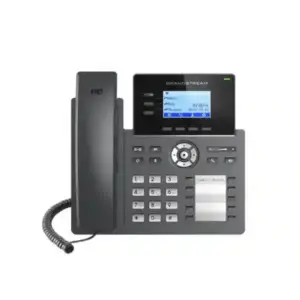
Grandstream GRP2612P IP Phone Dubai
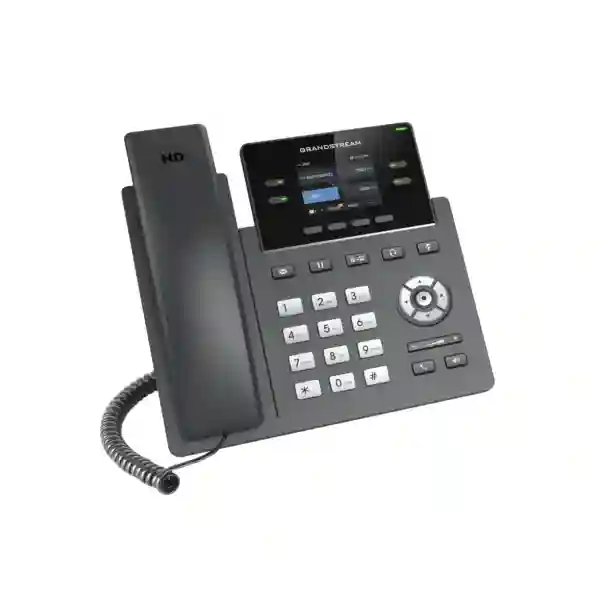
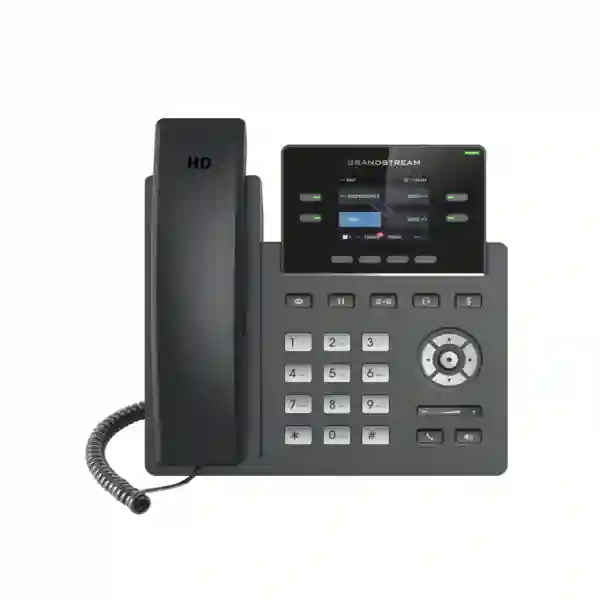
The Grandstream GRP2612P is the Power over Ethernet variant of Grandstream’s GRP2612 professional carrier-grade desk phone family. It is designed for organizations that want a manageable, standardized SIP endpoint for everyday business calling without adding a separate power adapter at every desk. Current Grandstream product information identifies the GRP2612P with four SIP accounts, four multi-purpose line keys, a 2.4-inch 320 × 240 color display, integrated 802.3af PoE, dual switched 10/100 Mbps Ethernet ports, HD audio with wideband codecs including G.722 and Opus, support for up to 16 digital BLF keys, five-way audio conferencing, centralized GDMS management, and security capabilities including secure boot, dual firmware images and encrypted data storage.
For Dubai and UAE businesses, the practical value of the GRP2612P is not simply its feature count. Its strongest use case is repeatable deployment: a company can connect the phone to a PoE-enabled access switch, apply voice VLAN and QoS policies, provision the endpoint through an appropriate PBX or Grandstream Device Management System, and give employees a consistent calling interface across offices, branches and departments. Fourteck can help organizations evaluate the GRP2612P against user count, PBX platform, PoE switching, headset requirements, network design and alternative Grandstream models before an order is finalized.
Quick decision: when does the GRP2612P make sense?
PoE-enabled offices that need a professional wired SIP desk phone for general users, supervisors, front-office teams and multi-site deployments.
Centralized deployment with GDMS, carrier-grade security features, HD audio and practical line/BLF handling in a compact color-screen endpoint.
The GRP2612P uses dual 10/100 Mbps Ethernet ports. Buyers who require Gigabit pass-through should evaluate the GRP2612G or another Gigabit model.
Check PoE budget, PBX/SIP compatibility, VLAN/QoS design, headset needs, provisioning method and required number of monitored extensions before standardizing.
Verified GRP2612P technical profile
The following profile is based on current Grandstream product and datasheet information. It is useful for buyer shortlisting, but deployment decisions should still be checked against the exact hardware revision, firmware, PBX environment and local project requirement because documentation can evolve over a product family’s lifetime.
| Product family | Grandstream GRP2612 series, professional/carrier-grade IP phone family |
|---|---|
| Variant meaning | P indicates the PoE-capable variant |
| Lines / SIP accounts | 4 lines and, in current Grandstream product information, 4 SIP accounts |
| Display | 2.4-inch 320 × 240 TFT color LCD |
| Ethernet | Dual switched auto-sensing 10/100 Mbps Ethernet ports |
| Power | Integrated IEEE 802.3af Power over Ethernet |
| Programmable keys | Up to 16 digital BLF / virtual multi-purpose keys, depending on configuration |
| Audio | HD handset and speakerphone; wideband codec support includes G.722 and Opus |
| Conference | Up to 5-way audio conferencing in current datasheet information |
| Headset | RJ9 headset interface with EHS support for compatible Plantronics/Poly headset arrangements |
| Management | Grandstream Device Management System (GDMS), plus supported provisioning methods such as TR-069 and encrypted XML configuration |
| Security | Secure boot, dual firmware images, encrypted data storage/configuration capabilities, TLS, SRTP and 802.1X support as documented by Grandstream |
Why the “P” matters: PoE simplifies structured office deployment
The key buying reason to select the GRP2612P instead of the base GRP2612 is integrated Power over Ethernet. In a correctly designed business network, PoE allows the Ethernet cable from the access switch to carry both data connectivity and electrical power to the phone. That can reduce desk-level cabling, make moves and additions easier to manage, and centralize power protection when PoE switches are backed by suitable UPS infrastructure. It is particularly relevant to Dubai offices with structured cabling, branch rollouts, reception areas, customer-service teams and managed workplace environments where a consistent endpoint standard matters more than stand-alone consumer-style features.
PoE does not mean every network is automatically ready for a phone rollout. The switch must provide compatible IEEE 802.3af power, and the project team should calculate the available PoE budget across all connected endpoints. If a switch powers IP phones, wireless access points, cameras and other devices simultaneously, the total power requirement can become more important than the per-port specification. Network design should also account for switch redundancy, UPS runtime, port security, voice VLAN assignment, DHCP services and the operational impact of a switch failure.
Grandstream’s current datasheet lists a maximum PoE consumption of 3.8 W for the GRP2612P family variant. That is useful for initial planning, but real project design should use the current vendor documentation and the exact switch budget rather than multiplying a single brochure number without checking model mix. If the project cannot use PoE, confirm the correct external power accessory before ordering; Grandstream’s package information differentiates the P model from variants supplied with an adapter.
10/100 Mbps Ethernet: an important buying consideration
One of the most important specification checks is the network interface. The GRP2612P has dual switched auto-sensing 10/100 Mbps Ethernet ports with integrated PoE. It is not the Gigabit model in the GRP2612 family. This matters because a common desk layout connects the wall network outlet to the phone and then connects the user’s computer through the phone’s second Ethernet port. If that PC regularly transfers large files, works with heavy cloud synchronization, uses high-bandwidth local applications or otherwise benefits from a Gigabit wired connection, placing it behind a 10/100 phone can become an unnecessary bottleneck.
For users whose workstation traffic is modest, 100 Mbps can still be adequate for voice plus ordinary business applications. The decision therefore depends on the workstation profile, not simply on whether “Gigabit” sounds newer. A reception desk, shared service counter, meeting-room telephone position or light office workstation may have very different network needs from a design workstation, engineering system or data-heavy desktop.
Organizations that want the GRP2612 form factor but require Gigabit pass-through should compare the GRP2612G, which Grandstream identifies with dual 10/100/1000 Mbps Ethernet and integrated PoE. Another option is to give the phone and computer separate switch ports where cabling and switch capacity permit. Fourteck can help map the phone model to the network architecture rather than selecting endpoints in isolation.
Call handling for everyday business users
The GRP2612P is positioned as a professional business endpoint rather than a minimalist single-line telephone. Its four line keys and digital multi-purpose key capability can support users who need to move between calls, monitor selected extensions, use speed dials or access configured telephony features without navigating deeply through menus. For a receptionist with very high attendant-console requirements, a larger model or dedicated console workflow may still be preferable, but the GRP2612P gives general office users more operational flexibility than a basic two-line endpoint.
Current Grandstream product information lists four SIP accounts for the GRP2612 family. Older Grandstream documentation and some third-party pages may show two SIP accounts for earlier hardware or documentation generations. This is a useful reminder that procurement teams should not mix old brochures, marketplace listings and current specifications without reconciliation. When a deployment depends on the exact number of accounts, confirm the hardware revision and current firmware documentation for the units being quoted.
Typical business functions include call hold, transfer, forward, park, pickup, call waiting, shared call appearance/bridged line appearance, downloadable phonebook support, flexible dialing plans, hot desking and server redundancy/failover features when supported by the overall telephony platform. The phone also supports five-way audio conferencing according to the current datasheet. Whether every feature is exposed to users depends on PBX configuration, SIP service capability, firmware and administrator policy.
The best way to evaluate this capability is to start from user behavior. A sales coordinator may need two registrations and a few BLF keys; a manager may need one primary extension, a shared department line and conference capability; a branch employee may need hot desking and central directory access; a help-desk user may require headset operation, call pickup and monitored extensions. The phone becomes valuable when those functions are mapped intentionally rather than enabled indiscriminately.
HD audio, speakerphone and headset planning
Voice quality depends on the complete communications path: handset and speaker design, codec selection, PBX configuration, LAN quality, WAN quality for remote trunks or cloud calling, SIP service performance and user environment. The GRP2612P supports HD audio and wideband codecs including G.722 and Opus. In a compatible end-to-end environment, wideband audio can make speech sound more natural and improve intelligibility compared with narrowband telephony. The phone also includes a full-duplex speakerphone for hands-free conversations.
Codec availability alone does not guarantee an HD call. The PBX, SIP trunk, remote endpoint and network path must support the negotiated codec, and administrators may intentionally prioritize specific codecs for bandwidth, interoperability or policy reasons. Voice VLANs and QoS can help preserve call quality during periods of network congestion, but they need coordinated configuration across switching, routing and WAN components. Poorly designed QoS, duplex problems, packet loss or jitter can undermine the experience regardless of endpoint quality.
For staff who spend much of the day on calls, headset compatibility can be as important as the phone itself. The GRP2612P includes an RJ9 headset jack and documented EHS support for compatible Plantronics/Poly arrangements. Buyers should confirm the specific headset model, EHS cable or adapter requirements and desired call-control functions before purchase. A headset that provides audio may not automatically provide remote answer/end control unless the correct interface chain is supported.
In open-plan offices, call quality planning should also include environmental factors. Desk position, nearby conversations, background equipment noise and speakerphone habits all influence perceived clarity. Endpoint selection should be combined with user guidance and, where appropriate, a headset standard rather than assuming that a premium codec alone solves acoustic issues.
GDMS and zero-touch style deployment
Grandstream Device Management System is one of the reasons GRP-series phones are attractive for multi-device projects. GDMS is designed to provide a centralized interface for configuring, provisioning, managing and monitoring supported Grandstream endpoints. For an organization with dozens or hundreds of phones, centralized management can reduce the amount of desk-by-desk configuration and help IT teams apply consistent settings across locations.
A sound rollout still begins with configuration design. Administrators should define how extensions are assigned, how devices authenticate, what firmware baseline is approved, which VLAN and QoS settings apply, how time and NTP are handled, which codecs are allowed, how phonebooks are delivered, what BLF keys are mapped, which admin credentials are used and how configuration changes are controlled. A management platform makes these tasks scalable; it does not replace the need for a well-designed baseline.
The GRP2612P also supports other provisioning approaches documented by Grandstream, including TR-069 and encrypted XML configuration files. The correct method depends on the PBX ecosystem, service-provider model, security requirements and operational processes. A managed service provider may prioritize remote provisioning across customer sites, while an internal IT team may integrate the phones with an on-premises or hosted PBX and maintain its own provisioning policies.
For branch expansion, centralized device management becomes particularly useful. A Dubai head office can define a standard endpoint profile and then adapt extensions, time zones, network details and user assignments for satellite offices. The important procurement question is therefore not merely “Does it support GDMS?” but “How will our team use provisioning, monitoring and firmware management throughout the phone lifecycle?”
Security features and what they mean in practice
Grandstream positions the GRP family with carrier-grade security features. The current GRP2612P information includes secure boot, dual firmware images and encrypted data storage, while the datasheet documents technologies such as TLS, SRTP, 802.1X and encrypted configuration capabilities. These features provide useful building blocks, but the security of a business voice system depends on how the endpoint, PBX, network, credentials and remote access are configured together.
Secure deployment should include strong and unique administrator credentials, appropriate user permissions, restricted management access, a controlled firmware policy, trusted provisioning sources and network segmentation where appropriate. SIP services exposed to the internet require careful firewall, SBC or service-provider design. TLS and SRTP can help protect signaling and media when supported and correctly configured end to end, but merely enabling a checkbox without certificate and interoperability planning can create operational problems.
802.1X can be relevant in organizations that authenticate devices before granting LAN access. Its practical use requires coordination with the switching and identity infrastructure. Similarly, voice VLANs can separate telephony traffic logically, but VLAN separation should be part of an overall access-control and routing policy rather than treated as a complete security boundary by itself.
For procurement teams, the useful conclusion is that the GRP2612P has business-oriented security capabilities that can support a disciplined deployment. The project still needs configuration standards, credential management, patching, change control and monitoring. Fourteck can assist with endpoint planning as part of a broader IP telephony and network design rather than presenting the phone as a self-securing device.
PBX and SIP compatibility: what to verify before ordering
The GRP2612P is a SIP endpoint and Grandstream documents SIP RFC3261 support along with common network and telephony protocols. That makes it suitable for many standards-based VoIP environments, but “SIP compatible” should never be interpreted as a guarantee that every PBX feature will behave identically on every platform. Basic registration and calling are only the starting point. Organizations should validate the features they actually depend on.
Important checks include extension registration, inbound and outbound dialing, caller ID presentation, attended and blind transfer behavior, hold/retrieve, voicemail access, BLF state, call pickup, shared-line behavior, directory integration, emergency dialing policy, DTMF, conference behavior, codec negotiation, NAT traversal for remote scenarios, time synchronization and firmware compatibility. If a hosted PBX provider uses a certified-device list, confirm whether the GRP2612P is supported under the provider’s current provisioning template.
Organizations using a Grandstream UCM platform may benefit from ecosystem alignment, but configuration still has to reflect the deployment. Organizations using 3CX, Asterisk-based systems, hosted SIP platforms or other PBXs should verify the vendor or service-provider guidance for the exact endpoint model and software version. Some advanced features depend on platform-specific templates or provisioning methods.
The most efficient procurement process is to provide the PBX model or hosted service name, user count, branch count, network topology and required user features with the quotation request. That lets Fourteck identify compatibility questions before a bulk order rather than discovering them during staging.
Who should use the Grandstream GRP2612P?
General office users
Employees who need reliable desk calling, transfer, hold, directory access, a few monitored extensions and a clear color display without the complexity of an executive touchscreen phone.
Branch offices
Organizations standardizing endpoints across multiple sites can benefit from PoE and centralized provisioning, particularly when network and PBX policies are managed centrally.
Service desks
Customer-facing desks with moderate call handling can use line keys, BLF functions, call pickup and compatible headsets without requiring a large operator console.
Managed deployments
IT teams and service providers that value repeatable profiles, remote provisioning and lifecycle management can use GDMS and other supported provisioning methods.
The GRP2612P may be less suitable for users who specifically require Gigabit Ethernet pass-through, integrated Wi-Fi, a very large number of physical programmable keys, a touchscreen application interface, built-in video, or advanced executive connectivity. In those cases, another GRP variant or a higher-tier Grandstream model may be a better match. Selecting the right phone by job role avoids overspending on basic desks while also preventing under-specification for demanding users.
GRP2612P vs GRP2612, GRP2612W and GRP2612G
These variants share a family identity but target different network requirements. Choosing the correct suffix prevents one of the most common procurement mistakes: assuming all GRP2612 versions have the same Ethernet and wireless capabilities.
| Variant | PoE | Ethernet | Wi-Fi | Good reason to choose it |
|---|---|---|---|---|
| GRP2612 | No integrated PoE on base variant | 10/100 Mbps | No | Standard wired desk use where local power is acceptable |
| GRP2612P | Yes, 802.3af | 10/100 Mbps | No | PoE office standardization without requiring Gigabit pass-through |
| GRP2612W | Yes | 10/100 Mbps | Yes; current hardware revisions include dual-band Wi-Fi 6 per Grandstream product information | Locations that need wireless network flexibility |
| GRP2612G | Yes | 10/100/1000 Mbps | No | Desks that need Gigabit Ethernet pass-through |
If the user’s PC connects through the phone, the P-versus-G decision deserves special attention. If the phone has a dedicated wall outlet and the PC has its own Gigabit outlet, the 10/100 pass-through limitation may be irrelevant. If the desk has only one Ethernet drop, the network demand of the connected workstation can determine whether the GRP2612P is appropriate.
GRP2612P vs nearby Grandstream business phone choices
A good model comparison should focus on the user’s work rather than on a simple “higher number is better” assumption. The GRP2612P is attractive when four-line operation, a color screen, PoE and digital BLF capability fit the requirement. Other models can be better when the network, key count, display or connectivity priorities are different.
For essential deployments, Fourteck already works with related Grandstream models such as the Grandstream GRP2603P IP Phone and Grandstream GRP2604P. Those phones belong to a different GRP2600 essential tier and should be compared on actual account, line, key, display and networking needs. The point is not to replace the GRP2612P automatically, but to avoid buying a feature set that does not match the job role.
For a user who needs only straightforward SIP calling and basic line handling, an essential-tier phone may reduce complexity. For a user who monitors more colleagues or wants a color display and a more professional carrier-grade interface, the GRP2612P can be more suitable. For a user who needs Gigabit pass-through, move toward a Gigabit-equipped model. For an executive or power user who needs wireless connectivity, Bluetooth, larger displays or more programmable keys, review higher-tier GRP models.
A mixed-model rollout is often more cost-effective than standardizing every desk on the same endpoint. Reception, managers, general employees, meeting spaces and support staff can have different phone profiles while still remaining within a manageable Grandstream ecosystem.
Dubai deployment scenarios
Dubai organizations often have a mixture of new structured offices, refurbished spaces, branch locations and customer-facing environments. The GRP2612P works best where PoE switching is already part of the design or is being introduced as part of an IP telephony refresh. A company moving from analog extensions to SIP can use the project as an opportunity to standardize voice VLANs, QoS, switch power budgets and device management rather than treating each phone as an isolated replacement.
In a corporate office, general employees can use the GRP2612P for day-to-day calls while managers or executives receive higher-tier phones where required. In a retail or service environment, the phone can support counter staff who need transfer, pickup and directory access. In a branch office, centralized provisioning can simplify deployment when local IT resources are limited. In a warehouse administration area, PoE can reduce reliance on nearby power sockets, provided the structured cabling and switch design are suitable.
Deira and Bur Dubai businesses may face older cabling layouts or mixed switching infrastructure, making the 10/100 Ethernet consideration particularly important. Before using the phone as a pass-through connection for a desktop PC, check whether the desk needs more than Fast Ethernet performance. In newer business districts where Gigabit access is the norm, the GRP2612G or a different Gigabit phone may be a more natural standard if the PC shares the phone’s network path.
Dubai procurement should also distinguish between product availability and technical suitability. Stock, delivery time and commercial terms can change, so Fourteck does not treat them as fixed specifications. A quotation request should identify quantity, required delivery location, PBX environment, PoE readiness and any headset or accessory requirements so the proposed bill of materials can be checked before confirmation.
Abu Dhabi, Sharjah and Ajman business use
For Abu Dhabi enterprises, multi-floor offices, professional services firms, education environments and institutional deployments may require a stronger emphasis on standardized configuration, change control and lifecycle management. The GRP2612P can fit the general-user tier where four-line handling and PoE are sufficient, while specialized roles can use other models. Large deployments should be validated through pilot testing before organization-wide rollout.
Sharjah businesses often combine office, industrial and warehouse operations. In this type of environment, endpoint selection should be linked to network segmentation, cabling routes, switch placement and UPS design. The phone itself is intended for normal indoor office operating conditions; it should not be treated as an industrial outdoor handset simply because it is deployed near warehouse operations. Administrative desks and controlled indoor work areas are the more appropriate use case.
Ajman offices and growing small-to-medium businesses may value the ability to start with a manageable endpoint and expand the system as extensions increase. The GRP2612P can serve as a standardized desk device while the PBX and SIP trunk capacity scale independently. Growth planning should consider extension licenses or PBX limits where applicable, simultaneous call requirements, internet resilience for hosted systems, PoE switch capacity and future branch connectivity.
Across the UAE, the core design principle remains the same: select the endpoint by role and network requirement, not just by model name. The GRP2612P is a strong candidate for PoE-based general business calling, but projects that require Gigabit, Wi-Fi, larger key capacity or richer executive features should compare alternatives before a large purchase.
Regional deployments beyond the UAE
Organizations operating across the GCC and Africa often want a consistent phone standard while dealing with different internet providers, branch sizes, PBX hosting models and local support arrangements. The GRP2612P can be considered for Kuwait, Uganda, Kenya, Tanzania, Nigeria, Ghana and other markets where the same business requirement exists: a wired PoE SIP endpoint with centralized management potential. The model specification does not change the need to validate local power, network, regulatory, service-provider and procurement requirements.
A multi-country organization should first define a global baseline—firmware policy, SIP account structure, directory format, codec policy, security settings, key mappings and user roles—then create local profiles for time zone, dialing rules, emergency calling, SIP trunks and network details. Centralized device management can reduce configuration drift, but local connectivity and support conditions still need to be addressed.
Fourteck’s broader network can support related requirements through regional properties such as Fourteck Uganda, Fourteck Kenya, Fourteck Kuwait, Fourteck Tanzania, Fourteck Nigeria and Fourteck Ghana. These links are useful when the requirement extends beyond a single UAE office.
For cross-border projects, do not assume one quotation or stock position applies everywhere. Commercial availability, shipping, taxes, warranties, certifications and service conditions can vary by country and supplier channel. The technical design can be standardized while procurement remains locally validated.
Network checklist before deploying GRP2612P phones
PoE capacity
Confirm IEEE 802.3af support and total switch power budget for all phones and other PoE devices.
Data throughput
Decide whether the PC will connect through the phone and whether 100 Mbps is acceptable for that workstation.
Voice VLAN
Define VLAN assignment, DHCP behavior and LLDP or provisioning logic according to the switching environment.
QoS
Coordinate Layer 2 and Layer 3 QoS policies across the LAN and WAN where congestion is possible.
PBX reachability
Validate DNS, routing, firewall and SIP/RTP requirements for the intended PBX or hosted voice service.
Resilience
Consider UPS, switch redundancy, WAN backup and SIP service failover where telephony is business-critical.
A phone rollout is a network project as much as a handset purchase. If users report poor voice after deployment, the root cause may be WAN loss, congested uplinks, incorrect QoS, SIP trunk behavior, cabling problems or switch configuration. Staging a representative group of phones before a large rollout can expose these issues early and provide a stable configuration template for production.
Provisioning and implementation workflow
1. Define the user profiles. List the types of users receiving phones and the functions they actually need. Separate general employees, supervisors, reception, executives, shared desks and support teams. This prevents a one-model-fits-all decision from becoming unnecessarily expensive or operationally limiting.
2. Validate the voice platform. Confirm the PBX or hosted service, SIP account requirements, extension numbering, trunk design, call routing, licensing and simultaneous call capacity. If the service provider maintains a certified endpoint list, confirm the GRP2612P and required firmware release.
3. Audit the network. Check cabling, switch port availability, PoE budget, VLAN configuration, DHCP, DNS, QoS, firewall policy and WAN performance. Pay particular attention to desks where the computer will share the phone’s 10/100 Mbps switch path.
4. Build the baseline. Create a controlled phone profile covering firmware, administrator access, SIP registration, codec preferences, time settings, directories, BLF mappings, screen behavior and security settings. Document deviations by user group.
5. Pilot before mass deployment. Test real inbound and outbound calls, transfers, conference, voicemail, BLF, pickup, headset operation, reboot/provisioning behavior and failover. Include different network segments and at least one branch if the organization is multi-site.
6. Roll out in controlled batches. Use GDMS or the chosen provisioning method to apply configurations consistently. Record device assignment and asset details according to the organization’s support process.
7. Monitor and maintain. Keep firmware and configuration changes under change control, review security advisories, update provisioning templates when needed and maintain a small pool of staged replacements for larger environments where downtime matters.
Common procurement mistakes to avoid
Confusing GRP2612P with GRP2612G. The P model provides PoE but remains a 10/100 Mbps Ethernet phone. The G variant is the Gigabit member of the family. This distinction is especially important when the computer connects through the phone.
Assuming all documentation generations show the same SIP-account count. Current Grandstream pages list four SIP accounts, while older guides and third-party listings may show two. For quantity purchases, validate the exact hardware revision and current firmware documentation rather than relying on a marketplace title.
Buying phones before checking PoE budget. A PoE phone only simplifies the desk if the access switch can power the full deployment. Include access points, cameras and other powered devices in the switch calculation.
Ignoring headset details. “EHS supported” does not mean every headset and cable combination works identically. Confirm the precise headset model, required adapter/cable and desired call-control behavior.
Treating SIP as universal feature parity. Registration may work while advanced features behave differently across PBXs. Test the functions that matter to the organization.
Using a reseller specification when it conflicts with the manufacturer. Product listings sometimes copy family-wide features into the wrong variant. Grandstream’s current product page and datasheet should be the primary source for model-level technical facts.
How to size a GRP2612P project
Start with the number of physical desks, but do not stop there. A complete count should include shared desks, reception positions, meeting areas that need fixed telephony, spare devices, training or testing units and growth. Then separate desks by role so that high-demand users can be assigned a different model when necessary. The phone count drives not only the endpoint order but also switch ports, PoE budget, patching, provisioning workload and support inventory.
Next, estimate simultaneous call requirements at the PBX and SIP trunk level. A company may have 100 extensions but far fewer concurrent external calls. The phone model does not determine trunk capacity; the voice platform and service do. However, endpoint deployment affects how users interact with shared lines, hunt groups, queues and conferences, so the design should be reviewed as a system.
Consider branch connectivity. A hosted PBX deployment may depend heavily on internet resilience, while an on-premises PBX may use local survivability differently. Remote branches should be assessed for WAN latency, loss and backup connectivity. Where voice continuity is critical, failover design should be agreed before deployment rather than after the first outage.
Finally, define support ownership. Decide who adds extensions, resets devices, handles firmware, changes BLF keys, replaces phones and manages user moves. A centralized platform such as GDMS can simplify operational work, but responsibilities and approval processes still need to be clear.
GRP2612P for reception and customer-facing desks
The GRP2612P can suit a reception or front-office position when call volume is moderate and the user primarily needs transfer, hold, pickup, directory access and a practical set of monitored extensions. Up to 16 digital BLF keys can provide useful visibility without requiring a large physical key array. For smaller offices, this can be enough to handle common receptionist workflows.
High-volume reception environments are different. If the receptionist must monitor many extensions simultaneously, manage multiple departments, handle queue overflow or operate as a switchboard attendant, a model with a larger display, more physical or expandable keys, or a software attendant console may provide a better experience. The correct choice depends on the number of monitored users and the speed with which calls must be routed.
Customer-facing desks also benefit from consistent labeling and directory configuration. Grandstream provides a swappable faceplate concept for customization, and the screen/interface can be configured for organization-specific needs within supported options. This can be helpful for managed deployments where visual consistency matters, but branding should not be allowed to obscure functional labels or confuse users.
GRP2612P for education, healthcare, hospitality and retail
Education: Administrative offices, faculty areas and support desks may use PoE phones to standardize internal calling. Network teams should separate classroom, student, guest and voice traffic according to policy and ensure emergency calling requirements are addressed at the PBX and carrier level.
Healthcare: Non-clinical offices, reception and back-office teams can use SIP desk phones, but healthcare deployments should align with the organization’s availability, privacy and security requirements. The GRP2612P should not be assumed to meet specialized medical-device requirements simply because it is a business phone.
Hospitality: Back-office, reservation and administrative staff may benefit from professional SIP endpoints and centralized management. Guest-room telephony has different feature, form-factor and hospitality-PBX requirements, so the GRP2612P is more naturally evaluated for staff and office positions unless the hotel’s design specifically calls for it.
Retail: Store managers, service counters and back-office staff can use PoE phones for extension calling, transfers and directory access. Branch-heavy retail groups should prioritize remote provisioning, consistent templates and WAN resilience because support teams may manage many geographically dispersed devices.
Firmware, lifecycle and operational ownership
Business phones remain in service for years, so lifecycle management matters as much as initial installation. Organizations should maintain an approved firmware baseline and test updates before mass deployment, particularly when the PBX platform or service provider certifies specific versions. Automatic updates without change control can introduce unexpected behavior, while never updating can leave bugs or security issues unresolved.
Grandstream’s dual firmware image capability is part of the family’s resilience and security design, but administrators should still manage upgrades deliberately. Maintain configuration backups where supported, document provisioning templates and keep a small test group that receives changes before the wider fleet. For large environments, staged deployment rings can reduce operational risk.
Lifecycle planning also means tracking hardware revisions. The GRP2612 family has had documentation changes over time, including differences in how account counts are presented. Asset records should therefore capture more than the model name when the environment is large enough for revision-specific behavior to matter. Serial information, purchase batch, firmware and assigned user can make troubleshooting faster.
When a model eventually reaches replacement planning, organizations can compare the current Grandstream lineup against their real usage data. If most users never use advanced keys, a simpler model may be appropriate. If network demand has moved to Gigabit or users now rely on wireless and richer collaboration features, replacement can move upward. A managed endpoint inventory makes that decision evidence-based.
Frequently asked questions about Grandstream GRP2612P
Does the Grandstream GRP2612P support PoE?
Yes. The “P” suffix identifies the PoE-capable GRP2612 variant. Grandstream documents integrated IEEE 802.3af Power over Ethernet for the GRP2612P.
Does the GRP2612P have Gigabit Ethernet?
No. Grandstream’s current GRP2612 datasheet specifies dual switched 10/100 Mbps Ethernet ports with integrated PoE for the GRP2612P. The GRP2612G is the Gigabit variant with dual 10/100/1000 Mbps ports and PoE.
How many SIP accounts does the GRP2612P support?
Current Grandstream product information lists four SIP accounts and four multi-purpose line keys. Some older documentation and third-party listings show lower account counts, so quantity buyers should confirm the exact hardware revision and current firmware documentation for the units being supplied.
Does the GRP2612P support Wi-Fi?
The GRP2612P is a wired PoE model. Wi-Fi belongs to the GRP2612W variant. Buyers who need wireless connectivity should compare the W model and verify the current hardware-revision wireless specification.
Can the GRP2612P be managed through GDMS?
Yes. Grandstream lists GDMS support for the GRP2612 family, providing centralized configuration, provisioning, management and monitoring capabilities for supported deployments.
Does the GRP2612P support HD voice?
Yes. Grandstream documents HD audio and support for wideband codecs including G.722 and Opus. End-to-end call quality still depends on the PBX, remote endpoint, codec negotiation and network conditions.
Can I connect a computer through the GRP2612P?
The phone has dual switched Ethernet ports, so pass-through connectivity can be used in suitable network designs. However, the ports are 10/100 Mbps, so check the workstation’s bandwidth requirement before placing a PC behind the phone.
Does the GRP2612P support a headset?
Yes. It includes an RJ9 headset interface and documented EHS support for compatible Plantronics/Poly arrangements. Confirm the exact headset and any required EHS cable or adapter before ordering.
Is the GRP2612P suitable for a receptionist?
It can suit moderate reception workflows that need transfer, pickup, directory access and a practical number of BLF keys. High-volume attendant roles that monitor many extensions may be better served by a larger phone, expansion-key solution or software console.
Can Fourteck help with GRP2612P deployment in Dubai?
Fourteck can help businesses evaluate the GRP2612P against PBX compatibility, user roles, PoE switching, VLAN and QoS design, headset requirements, provisioning and alternative Grandstream models. Commercial availability, delivery timing and final configuration should be confirmed for the specific project.
Why work with Fourteck for GRP2612P projects?
A business IP phone should be selected as part of a communication system, not as an isolated desk accessory. Fourteck can review the user requirement, PBX platform, extension plan, PoE switching, network segmentation, headset needs and branch architecture before recommending a model mix. This approach is especially useful when a project combines general-user phones with reception, executive and support-desk requirements.
For broader UAE IT requirements, customers can also visit Fourteck UAE, while Grandstream-focused regional information is available through Fourteck Grandstream UAE. The objective is to align the endpoint with the surrounding voice and network design, reducing surprises during staging and rollout.
When requesting a quotation, include the quantity, delivery location, PBX or hosted voice platform, whether PoE is available, whether computers will connect through the phones, the number of monitored extensions, headset requirements and any branch-office details. This gives Fourteck enough information to confirm whether the GRP2612P is the right fit or whether another GRP model should be considered.
Request a GRP2612P quotation or deployment review
Planning a Grandstream GRP2612P deployment in Dubai, Abu Dhabi, Sharjah, Ajman or another UAE location? Share your required quantity, PBX platform, user roles and PoE/network details. Fourteck can help confirm the correct GRP2612 variant, identify network or compatibility considerations and prepare a project-focused quotation.
Discuss your requirement with Fourteck before standardizing the endpoint across your organization.

Reviews
There are no reviews yet.