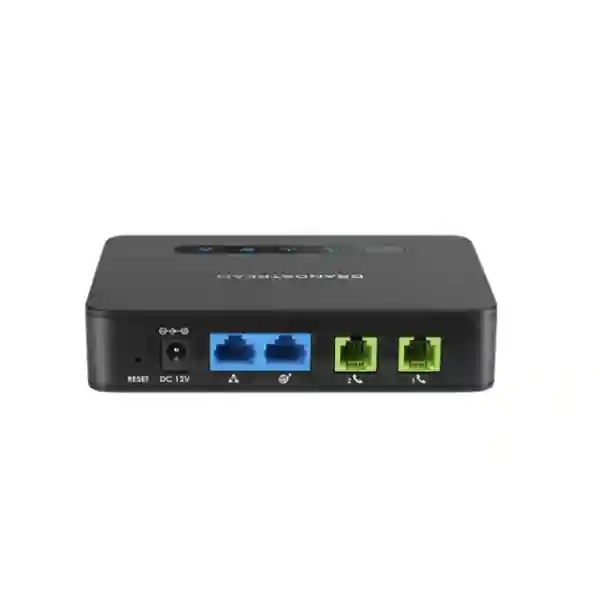
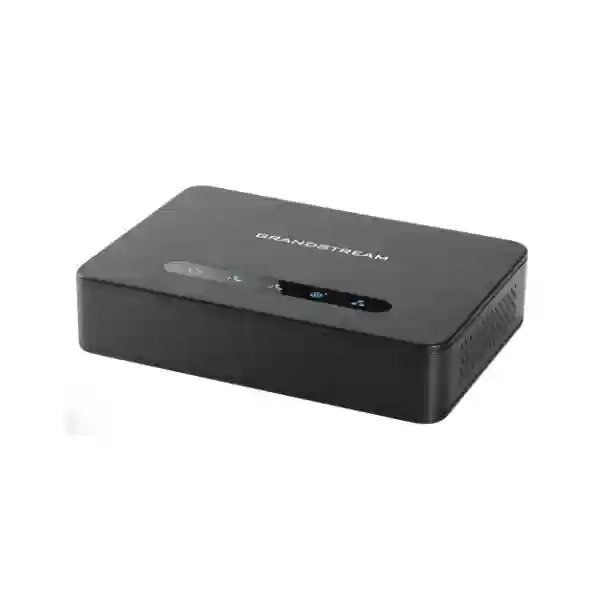
Grandstream HT812 2-Port ATA with Gigabit NAT Router
The Grandstream HT812 is a two-port analog telephone adapter designed to connect conventional analog telephones, fax equipment and similar FXS devices to SIP-based voice services. The original HT812 combines two RJ11 FXS interfaces with two Gigabit Ethernet interfaces and an integrated NAT router, making it useful where an organization wants to retain working analog endpoints while moving the voice platform to IP. Instead of replacing every analog handset at once, the HT812 provides a controlled bridge between legacy telephone hardware and a modern SIP environment.
For businesses in Dubai, Abu Dhabi, Sharjah and other UAE locations, the practical value of an ATA is usually not the device alone. The important questions are whether the existing telephone or fax equipment is electrically suitable, whether the chosen SIP platform supports the required signaling and codecs, whether the network is prepared for voice traffic, and whether provisioning and security policies can be managed consistently. Fourteck can help customers evaluate those deployment questions before a quotation or rollout is finalized.
Where the HT812 fits in a modern voice network
The HT812 is most relevant when the business requirement starts with an existing analog device rather than a new IP phone. Typical examples include a reception handset that must remain in service, a fax machine that still forms part of an operational workflow, a door phone or paging-related analog endpoint that needs SIP connectivity, a small branch with one or two analog extensions, or a phased PBX migration where some devices will be replaced later. In these cases, the ATA becomes the conversion point between analog signaling at the endpoint and SIP signaling on the IP network.
The device should not be treated as a universal replacement for every analog gateway. Two FXS ports make the HT812 suitable for low-port-count requirements. If a location needs four, eight or many more analog extensions, a higher-density ATA or gateway may be operationally cleaner. Likewise, if the project needs an FXO interface to connect an analog PSTN line, the requirement is different from a pure FXS ATA and should be matched to a product designed for that role.
The strongest buying decision therefore comes from matching port type, port count, SIP design, network topology and management method to the real environment. Fourteck uses this requirement-led approach to avoid a common procurement mistake: choosing an ATA because the number of telephone sockets looks correct, without confirming what those sockets actually need to do.
HT812 model identity: original HT812 versus HT812 V2
Grandstream currently documents both the original HT812 and the newer HT812 V2 in the wider analog telephone adapter family. This page is specifically about the original Grandstream HT812 requested by model name. The two products share the same broad market role—two-port analog-to-SIP connectivity with Gigabit networking—but they are distinct hardware revisions. Procurement teams should therefore confirm the exact model revision, firmware branch and accessory expectations before ordering, especially when adding units to an existing installed base.
| Decision point | Original HT812 | Why it matters |
|---|---|---|
| Product role | 2-port analog telephone adapter with integrated Gigabit NAT router | Appropriate when two analog FXS endpoints must register into a SIP environment. |
| Telephone interfaces | Two FXS ports | Confirms the unit presents analog station ports; it is not a two-line FXO gateway. |
| Network interfaces | Two 10/100/1000 Mbps RJ45 ports | Useful for routing or local LAN design where the ATA sits between network segments. |
| Revision control | Confirm “HT812” rather than “HT812 V2” | Prevents accidental mixing of hardware revisions in a managed deployment. |
Core capabilities that matter to buyers
Two analog station ports
The two FXS interfaces let standard analog endpoints connect to a SIP service through the ATA. Each connected device should be checked for functional compatibility, ringing requirements and the intended call flow before deployment.
SIP-based voice integration
The HT812 supports SIP registration and common telephony functions such as caller ID, call waiting, call transfer, call forwarding, hold, do-not-disturb and three-way conferencing, subject to service and PBX configuration.
Secure signaling and media
Grandstream documents TLS/SIPS/HTTPS controls and SRTP media security. Effective security still depends on the SIP platform, certificate policy, credentials, firewall design and correct configuration.
Automated provisioning
HTTP, HTTPS, TFTP and TR-069 provisioning options support more structured deployment than configuring every unit manually. This becomes especially valuable for service providers, branches and multi-site estates.
Fax-over-IP support
T.38 Group 3 fax relay is supported, with G.711 fax pass-through behavior available. Fax reliability over IP remains dependent on the upstream carrier, SIP platform, codec negotiation, packet quality and configuration.
Integrated NAT routing
The HT812 includes an integrated NAT router and dual Gigabit network ports. This can simplify certain small-site topologies, although many managed business networks will still place routing, security and VLAN control on dedicated infrastructure.
Technical specification summary
The following summary focuses on characteristics documented by Grandstream for the original HT812. Firmware behavior and available settings can change over a product lifecycle, so configuration teams should use the firmware-appropriate Grandstream administration guide when implementing a live system.
| Specification area | HT812 details |
|---|---|
| Telephone interfaces | Two RJ11 FXS ports. |
| Network interfaces | Two 10/100/1000 Mbps RJ45 Ethernet ports. |
| SIP capacity | Supports two SIP profiles through two FXS ports. |
| Telephony functions | Caller ID display/block, call waiting, flash, blind or attended transfer, forwarding, hold, do-not-disturb and three-way conference. |
| Voice codecs | Grandstream documentation lists G.711, G.722, G.723.1, G.729A/B, G.726, iLBC and, in current documentation for the HT812/HT814 family, OPUS, with dynamic jitter buffering and echo-cancellation functions. |
| Fax | T.38 compliant Group 3 fax relay up to 14.4 kbps and automatic switching to G.711 for fax pass-through. |
| DTMF | In-audio, RFC2833 and/or SIP INFO methods are documented. |
| QoS | Layer 2 802.1Q VLAN/802.1p and Layer 3 ToS/DiffServ/MPLS-related controls are documented. |
| Provisioning and management | HTTP, HTTPS, TFTP, TR-069, web management and syslog-related management capabilities are documented. |
| Security | SRTP for media plus TLS/SIPS/HTTPS controls; secure provisioning options include AES-based mechanisms described by Grandstream. |
| Power | Grandstream datasheet: universal input 100–240 VAC, 50–60 Hz, with 12 V / 0.5 A output adapter specification. |
| Indicators | POWER, LAN, WAN, PHONE1 and PHONE2 indicators are documented for the original HT812. |
A deployment decision in five questions
- What analog device is being retained? A basic telephone, fax machine, paging interface, modem-like device or specialized analog endpoint can behave differently. Confirm the actual endpoint and its required signaling.
- Does the project need FXS or FXO? The HT812 provides FXS ports for analog station devices. If the requirement is to connect analog PSTN lines into an IP system, an FXO-capable gateway should be evaluated instead.
- How many analog endpoints are required? Two ports are efficient for a small requirement. Higher-density environments should compare operational simplicity, rack/desktop space, power points, provisioning and troubleshooting effort against multi-port gateway alternatives.
- Which SIP platform will register the ports? Confirm SIP server details, authentication model, dial plan, codec policy, DTMF method, fax handling and failover expectations before installation.
- How will the ATA be managed? A single unit can be configured locally, while larger estates benefit from repeatable provisioning, configuration backups, centralized logging and a documented firmware policy.
Network design: the ATA is only one part of voice quality
A SIP ATA can support capable codecs and voice features, but end-to-end call quality is determined by the entire path. Local switching, WAN utilization, packet loss, jitter, latency, firewall behavior, SIP ALG settings, NAT traversal, DNS availability and service-provider performance can all affect the user experience. For this reason, diagnosing poor voice on an ATA should not begin by assuming the ATA itself is defective.
In a business network, voice traffic is usually easier to operate when addressing, VLAN, QoS and firewall policy are documented. The HT812 provides Layer 2 and Layer 3 QoS-related controls, but the surrounding switches, routers and WAN service must be configured consistently if those markings are expected to influence traffic handling. A mismatch—for example, setting a priority on the ATA while the switch ignores it—does not create an effective voice-quality policy.
The integrated NAT router can be useful in compact deployments. However, organizations with managed firewalls, SD-WAN, enterprise switching or centralized security may prefer the HT812 to behave as an endpoint within a pre-existing network design rather than as the main routing boundary. The correct topology depends on who owns DHCP, NAT, firewall policy, WAN failover and remote-management responsibility.
Secure provisioning and operational control
The HT812 supports multiple provisioning approaches, including HTTP, HTTPS, TFTP and TR-069-related workflows. For one-off deployments, the embedded web interface can be sufficient. For a fleet of devices, automated provisioning can reduce inconsistent settings, speed replacement, support configuration versioning and make onboarding easier. The strongest design is not simply “automatic”; it is controlled automation with protected credentials, known configuration sources and change management.
Grandstream also documents TLS-based signaling controls, SRTP media protection and HTTPS management. These capabilities are valuable only when the other side of the connection supports a compatible secure configuration. A SIP provider that accepts only a different transport, an incorrectly trusted certificate or an inconsistent encryption policy can prevent registration or media establishment. Security settings should therefore be validated with the exact PBX or hosted SIP service rather than enabled in isolation.
Basic hardening should include changing default credentials, restricting management access, keeping the device on an appropriate network segment, using secure provisioning where supported, disabling unnecessary exposure from public networks and maintaining a documented firmware process. If WAN-side management is required, it should be intentionally designed and protected instead of being left broadly reachable.
Fax over IP: what the HT812 can do and what must still be tested
Fax is one of the most common reasons organizations retain analog interfaces after moving voice to SIP. The HT812 supports T.38 fax relay and G.711 fax pass-through behavior. That capability makes it a candidate for connecting a compatible analog fax machine to an IP network, but a successful fax service still depends on the complete path. The SIP platform or carrier must support the selected method, the network must have sufficiently stable packet delivery, and codec or media negotiation must be configured correctly.
For a critical fax workflow, test inbound and outbound transmission with the actual destination types the business uses. A configuration that works for one local number may not prove every international, multi-page or high-resolution fax case. It is also worth documenting whether the organization still needs fax at all; in some projects a managed digital-fax service is more appropriate than maintaining an analog device. Fourteck can help position the ATA within that wider decision rather than treating T.38 support as an automatic guarantee of end-to-end fax performance.
Use cases across UAE business environments
Dubai offices
A small office upgrading to SIP may keep two analog devices during a phased migration. The HT812 can provide the bridge while the main PBX, SIP trunk and LAN are modernized separately.
Abu Dhabi branches
A branch with an established analog fax or telephone can register back to a central SIP platform, subject to secure connectivity, WAN policy and service compatibility.
Sharjah warehouses
Operational teams sometimes prefer robust, familiar analog handsets in fixed locations. An ATA can preserve the endpoint while the transport and call control move to IP.
Hospitality and serviced spaces
Where only a small number of analog endpoints need SIP connectivity, a two-port ATA can be simpler than deploying a larger gateway, provided the port count and telephony behavior match the requirement.
For multi-site UAE projects, the practical design should also account for device labeling, configuration ownership, spare strategy, remote access method, SIP credential handling and who is responsible for testing after a WAN, firewall or PBX change. Those operational details often determine whether a small ATA deployment stays easy to support over time.
HT812 compared with common ATA alternatives
The right comparison is based on interface type and deployment scale rather than model number alone. Within Grandstream’s ATA family, lower-port-count models are often chosen for individual analog endpoints, while larger models serve higher-density analog requirements. The HT812 occupies a useful middle position for a customer who needs two FXS ports plus dual Gigabit networking and integrated NAT functionality.
| Requirement | HT812 fit | Consider another model when… |
|---|---|---|
| One analog endpoint | Works, but leaves one FXS port unused. | A single-port ATA better matches the requirement and network design. |
| Two analog endpoints | Strong match: two FXS ports, two SIP profiles and Gigabit network interfaces. | The project requires a different interface type, special analog behavior or a newer hardware revision. |
| Four or more endpoints | Multiple units are technically possible but increase device count. | A four-port or higher-density FXS gateway simplifies power, management and physical deployment. |
| Analog PSTN line connection | Not the correct port role; HT812 is FXS-focused. | An FXO-capable gateway is required to terminate analog carrier lines. |
| New deployment requiring current revision | Confirm whether original HT812 is specifically required. | HT812 V2 is the intended procurement target and compatibility has been validated. |
PBX and SIP service planning
An ATA is usually straightforward to register when the SIP parameters are known, but a business deployment should document more than server address, username and password. The dial plan determines how local, mobile, emergency, international and extension dialing are interpreted. DTMF behavior matters for IVR navigation. Codec preference can affect interoperability and bandwidth. Caller ID presentation and privacy settings can influence outbound calls. Registration expiry, failover server policy and DNS behavior can affect resilience.
Grandstream positions the HT812 for use with SIP platforms including the company’s own UCM PBX family, and Grandstream documentation describes zero-configuration benefits in supported UCM scenarios. In mixed-vendor environments, standard SIP interoperability remains the key concept, but the exact feature set should be tested. A third-party PBX may register the ATA successfully while handling provisioning, transfer behavior, fax or secure signaling differently.
For hosted voice, confirm whether the provider allows customer-managed ATAs, whether credentials are exposed, whether the provider supplies a configuration profile, and whether T.38 is supported. Some services intentionally control the endpoint configuration. That service policy can be more important to a successful deployment than the ATA’s raw feature list.
Installation workflow for a controlled deployment
Confirm the analog endpoint
Identify whether each device is a phone, fax or specialized analog unit. Document its function and the business workflow that depends on it.
Prepare network and SIP parameters
Confirm IP addressing, VLAN if used, gateway, DNS, NTP, firewall policy, SIP server, credentials, codecs, DTMF method and any proxy or failover server.
Connect and provision
Connect the network and FXS devices, then provision through the chosen local or automated method. Change default administrative credentials and record the final configuration state.
Test call scenarios
Validate inbound and outbound calls, transfer, hold, caller ID, DTMF to IVRs, failover expectations and fax behavior if required. Test from the real business location rather than only at a staging bench.
Document and hand over
Record model revision, location, connected endpoint, FXS port assignment, SIP identity, network details, provisioning source, firmware policy and support ownership so future troubleshooting is efficient.
What to include in an HT812 quotation request
A useful quotation request provides enough technical context to confirm that the HT812 is actually the right product. This is especially important for legacy or revision-sensitive hardware. Instead of requesting only “HT812 price,” include the quantity, destination, analog device type, required number of FXS ports, existing PBX or hosted SIP platform, whether fax is required, whether the unit will use its routing function, and whether configuration or installation assistance is needed.
- Required quantity and deployment city or site.
- Confirmation that the original HT812—not HT812 V2—is required, if revision matters.
- Type and number of analog endpoints to be connected.
- PBX, SIP trunk or hosted voice service being used.
- Fax/T.38 requirement, if applicable.
- Network, VLAN, security or remote-management constraints.
- Need for configuration, onsite installation, remote setup or post-installation support.
Fourteck does not assume stock, price, lead time or model revision on this page. Those commercial details should be confirmed at quotation stage because they can vary with sourcing and project requirements.
Common deployment mistakes to avoid
Buying FXS when FXO is required
An analog phone plugs into FXS. An analog PSTN carrier line normally terminates on FXO. Confusing the roles can make the purchased device unsuitable for the intended connection.
Ignoring model revision
HT812 and HT812 V2 should not be treated as automatically interchangeable in managed estates. Confirm exact hardware revision when configuration, firmware consistency or replacement matching matters.
Assuming fax is guaranteed
T.38 capability is important, but successful faxing depends on the PBX/carrier and network path. Test real fax workflows before declaring the service complete.
Leaving management exposed
Remote administration must be protected. Default credentials, unrestricted public access and unmanaged firmware create avoidable operational and security risk.
Skipping network validation
A SIP registration test is not a complete voice test. Validate packet quality, inbound and outbound media, DTMF, transfers, caller ID and failover behavior.
Overlooking support ownership
When multiple parties manage PBX, SIP trunk, LAN and firewall, define who troubleshoots each layer. Otherwise a simple endpoint issue can become a lengthy multi-vendor escalation.
Why businesses involve Fourteck
Fourteck approaches ATA projects as part of the wider telephony and network environment. That means the conversation can include PBX compatibility, SIP registration, analog endpoint requirements, LAN readiness, VLAN and QoS planning, secure provisioning, branch connectivity, migration sequencing and support scope. This is more useful than selecting an adapter from a specification list without understanding how the customer intends to operate it.
For UAE organizations, Fourteck can support requirement assessment for Dubai, Abu Dhabi, Sharjah and other business locations, while Fourteck’s broader regional network can support technology discussions for projects in markets such as Kenya, Uganda, Tanzania, Kuwait, Ghana and Nigeria. Service scope, delivery, stock and commercial terms should always be confirmed for the specific project.
Related Fourteck resources include Fourteck UAE, Fourteck global technology solutions, IP PBX solutions in Dubai, IT services in the UAE, Grandstream UAE solutions, Fourteck Uganda, Fourteck Kenya, Fourteck Tanzania, Fourteck Kuwait, Fourteck Ghana and Fourteck Nigeria.
HT812 buyer checklist
Frequently asked questions about Grandstream HT812
What is the Grandstream HT812?
The Grandstream HT812 is a two-port analog telephone adapter with two FXS ports, two Gigabit Ethernet ports and an integrated NAT router. It is used to connect supported analog telephone or fax devices to SIP-based voice services.
How many analog phones can the HT812 connect?
The HT812 provides two FXS ports, so it can physically connect two supported analog station devices. The exact call behavior and account assignment depend on the SIP and port configuration.
Does the HT812 support two SIP accounts?
Grandstream documents support for two SIP profiles through the two FXS ports. The way profiles and ports are mapped should be planned according to the PBX or hosted SIP service.
Does the HT812 have Gigabit Ethernet?
Yes. The original HT812 is documented with two 10/100/1000 Mbps RJ45 Ethernet interfaces and an integrated NAT router.
Can the HT812 be used for fax?
The HT812 supports T.38 Group 3 fax relay and G.711 fax pass-through behavior. End-to-end fax reliability still depends on the SIP provider or PBX, media negotiation, network quality and the connected fax equipment.
Does the HT812 support secure SIP?
Grandstream documents TLS/SIPS/HTTPS controls and SRTP media protection. Secure operation depends on compatible configuration at the SIP platform and on correct certificate, firewall and credential policies.
Is HT812 the same as HT812 V2?
No. HT812 and HT812 V2 are distinct hardware revisions in Grandstream’s ATA family. If replacement matching, firmware consistency or procurement revision matters, confirm the exact model before ordering.
Can the HT812 connect an analog PSTN line?
The HT812 is an FXS ATA intended to connect analog station devices. A project that needs to terminate an analog PSTN carrier line normally requires an FXO-capable gateway instead.
Can the HT812 be automatically provisioned?
Yes. Grandstream documentation includes HTTP, HTTPS, TFTP and TR-069-related provisioning methods, allowing organizations and service providers to use repeatable deployment workflows.
How do I request an HT812 quotation from Fourteck?
Provide the required quantity, destination, confirmation of the required model revision, the analog devices being connected, the PBX or SIP service, any fax requirement and whether configuration or installation support is needed. Fourteck can then confirm the appropriate product and commercial details for the project.
Discuss your HT812 requirement with Fourteck
If your project needs to retain one or two analog devices while moving voice services to SIP, the Grandstream HT812 may be a suitable fit. Fourteck can help confirm the analog interface requirement, SIP platform compatibility, network design, fax considerations, provisioning method and whether the original HT812 or another ATA model better matches the deployment.
Next step: share the quantity, deployment location, analog device type and SIP/PBX environment so the requirement can be reviewed before quotation.
Technical references
Technical characteristics on this page are based on Grandstream’s HT812 datasheet and current HT812/HT814 documentation. Configuration options can vary by firmware, so implementation teams should verify the firmware-appropriate guide before making changes.
Vendor references: Grandstream Analog Telephone Adaptors and HT812/HT814 Administration Guide.




Reviews
There are no reviews yet.