
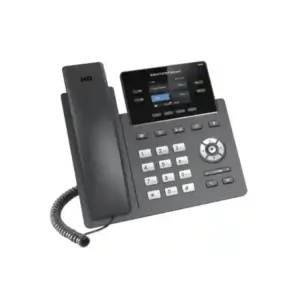
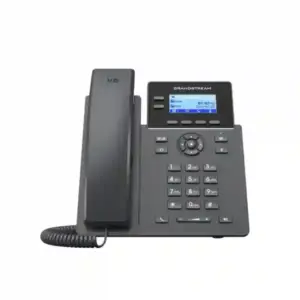
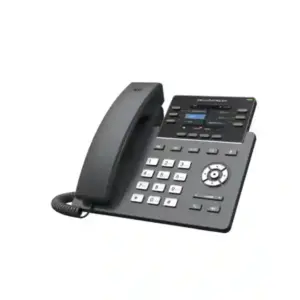
Grandstream GHP621W Dubai – Black Wi‑Fi Hotel IP Phone for Guest Rooms
The Grandstream GHP621W Dubai is a compact black hotel IP phone designed for guest rooms and other environments that need a simple, familiar telephone interface with SIP calling, centralized provisioning, programmable service access and wireless network connectivity. It belongs to Grandstream’s GHP62x family and is particularly relevant to hotels, serviced apartments, hospitals, dormitories, staff accommodation and similar multi-room deployments where ease of use matters more than a large display or complex desktop-phone feature set. The GHP621W supports two SIP accounts and two lines, HD audio, three-way audio conferencing, six programmable keys, ten speed-dial positions, Grandstream Device Management System (GDMS) provisioning and dual-band Wi‑Fi. Current Grandstream documentation also identifies Wi‑Fi 6 support on hardware version 5.0 and above, so project teams should confirm the supplied hardware revision before finalizing wireless and power assumptions.
For Dubai and UAE hospitality projects, the practical attraction is not simply “Wi‑Fi on a hotel phone.” The value comes from being able to standardize room telephony, map commonly used services such as reception, housekeeping or concierge to visible keys, remotely manage fleets through GDMS, and choose a black handset that can complement darker room interiors or hospitality design schemes. Fourteck can help buyers assess room count, PBX/SIP compatibility, Wi‑Fi coverage, provisioning, handset labeling, mounting, VLAN/QoS requirements and rollout planning before quotation.
What the GHP621W Is — and What It Is Not
The GHP621W is a purpose-built hospitality-oriented SIP endpoint, not a conventional office executive phone. Its design deliberately minimizes complexity. There is no color LCD and no need for a guest to navigate through a business-phone user interface. Instead, the handset focuses on calling, familiar hard keys, programmable service access, speed dialing and reliable audio. This distinction is important because hotel room phones are typically used for short, predictable interactions: contact reception, call housekeeping, reach room service, dial another room, access voicemail where configured, or place an outside call according to hotel policy.
The “W” in GHP621W identifies the wireless-capable variant. Grandstream lists integrated dual-band 2.4 GHz and 5 GHz wireless connectivity, with Wi‑Fi 6 capability on hardware version 5.0 and above. Earlier hardware may use 802.11a/b/g/n/ac rather than 802.11ax. This matters for UAE projects because procurement teams may see different stock generations in the channel. A quote should therefore identify the exact hardware revision where wireless generation or powering method is project-critical.
The GHP621W is also the black-color counterpart in this family. The GHP620W is generally the white wireless version, while GHP621 and GHP621W use black housings. That gives designers and hospitality operators a straightforward visual choice without changing the essential use case. For properties where a screen is required for richer guest information or menu-driven interaction, another GHP-series model with a display may be a better fit.
Verified Feature Snapshot for Procurement Teams
| Area | GHP621W capability | Why it matters in a hotel project |
|---|---|---|
| SIP | 2 SIP accounts, 2 lines | Supports straightforward room extension and alternate account/service design. |
| Audio | HD handset audio, full-band Opus support | Helps improve intelligibility for guest and staff calls when the SIP path supports appropriate codecs. |
| Conference | Up to 3-way audio conferencing | Useful for basic multi-party coordination without adding a complex room endpoint. |
| Programmable access | 6 programmable keys plus 10 speed-dial positions | Allows guest-service destinations to be presented clearly and consistently. |
| Wireless | Dual-band Wi‑Fi; Wi‑Fi 6 on hardware version 5.0 and above | Supports rooms where wireless deployment is preferred or cabling is constrained. |
| Management | GDMS centralized provisioning and management | Important for batch configuration, monitoring, firmware and operational standardization. |
| Security | Secure boot, TLS/SRTP and additional device/configuration protections | Supports safer SIP deployment when configured with an appropriate network and PBX security policy. |
| Installation | Desktop or wall mounting | Gives flexibility for bedside tables, desks, corridors or wall-based room layouts. |
| Accessibility | Hearing Aid Compatibility (HAC) | Relevant for inclusive guest-room design and hospitality accessibility planning. |
| Finish | Black | Useful where room design standards favor darker devices and accessories. |
Why Dubai Hotels Consider a Wireless Room Phone
In new-build hotels, structured cabling is normally planned early, and a wired PoE room phone can be an obvious choice. The GHP621W becomes especially interesting when the property has constraints that make a fully wired phone rollout less attractive. Examples include renovated buildings, serviced apartments converted from residential use, guest rooms where the bedside position is not near an Ethernet outlet, temporary hospitality facilities, and projects where the room layout changes after fit-out. Wireless connectivity can reduce dependence on a dedicated network drop at the exact handset location, but it does not eliminate network design responsibilities.
Voice over Wi‑Fi still requires good RF coverage, predictable roaming behavior, sensible channel planning, controlled interference, secure authentication and adequate upstream connectivity to the PBX or SIP platform. A phone that can associate with an access point is not the same as a validated hospitality voice design. Before deploying large quantities, an IT team should test actual rooms, corridors and floor layouts. Concrete walls, decorative materials, mirrors, metal finishes, elevator cores and dense neighboring access points can influence the wireless environment. The right approach is to confirm coverage and latency where the GHP621W will physically sit, then validate calls during busy network periods.
For Dubai hospitality projects, this is particularly relevant because premium rooms often prioritize interior design and may have hidden or relocated technology infrastructure. Wireless room phones can provide placement flexibility, but the infrastructure should still be engineered for predictable service rather than treated as a consumer Wi‑Fi accessory.
Hardware revision check: an important buying step
Grandstream’s current documentation distinguishes capabilities by hardware version. Wi‑Fi 6 is associated with hardware version 5.0 and above, and powering behavior also varies by revision in the documentation. For a project where PoE support on the wireless model, Wi‑Fi generation, or exact electrical design is mandatory, ask the supplier to confirm the hardware revision and match it to the current Grandstream datasheet/user guide before installation. Fourteck should not assume that every GHP621W in every supply channel has identical revision-dependent behavior.
Guest Experience: Simplicity Usually Wins
A guest-room phone has a different usability target from an office IP phone. Most guests should not need training, login credentials, extension directories or configuration menus. They should see the handset, understand how to call, and find the hotel services they need. That is why the GHP621W’s physical-key design can be a strength rather than a limitation. Six programmable keys can be assigned to frequently used destinations, while speed-dial labeling can support clearly presented services.
A hotel might map keys to Front Desk, Housekeeping, Concierge, Room Service, Emergency/Assistance and Voicemail, although the exact mapping should follow property policy and PBX configuration. In a hospital, the same concept could support nursing station, reception, internal service desk, security and commonly used departments. In staff housing or dormitories, programmable access can simplify calls to administration or facility support. The value is the repeatable user experience across many rooms.
The swappable faceplate is also relevant because hospitality operators frequently want room instructions, branding or service labels to be presented consistently. The faceplate should be designed for clarity rather than crowded with marketing. A simple label scheme and a PBX dial plan that matches the printed functions reduce guest confusion and help front-desk staff support rooms more efficiently.
Best fit
Guest rooms, serviced apartments, dormitories, staff accommodation, hospitals and other locations needing a simple SIP handset, wireless connectivity, centralized management and direct service keys.
Consider an alternative when
The user needs a large screen, directory browsing, many line appearances, video, touchscreen workflows, advanced receptionist functions or rich enterprise productivity features.
Validate first
PBX/SIP interoperability, Wi‑Fi coverage, hardware revision, power method, VLAN/QoS policy, firmware baseline, emergency-call policy, service-key mapping and room mounting position.
SIP, PBX and Call-Control Planning
The GHP621W is a SIP endpoint, so successful deployment depends on the surrounding call-control system. Two SIP accounts/lines provide flexibility, but the design should remain intentionally simple. A hotel may use one account for the room extension and a secondary account for an alternate service or failover design, depending on the PBX. The phone supports common SIP signaling and voice protocols, but interoperability should be tested with the actual PBX platform, firmware and feature set used by the property.
Buyers often ask whether a hotel phone will “work with” a particular IP PBX. The correct answer is that standard SIP support makes integration broadly practical, but specific functions such as message waiting, transfer behavior, dial-plan rules, emergency routing, speed-dial behavior, provisioning templates and voicemail keys depend on the PBX and configuration. A pilot unit is therefore valuable before a full room rollout. Testing should cover inbound and outbound calls, internal extensions, guest-service speed dials, hold, transfer where required, voicemail indication, call termination, DTMF, codec negotiation and failover behavior.
In hospitality, PBX integration is also part of a wider operational workflow. Room-status integrations, property-management-system functions, billing or guest check-in/check-out behaviors may be handled by systems beyond the handset itself. Do not assume those functions are provided by the GHP621W. Define what the PBX, PMS, gateway or middleware must accomplish and treat the phone as the room endpoint within that architecture.
Network Design: Wi‑Fi Is Only One Layer
A stable hotel voice service depends on the complete path from handset to access point, switching network, firewall/router, call controller and SIP trunk or service provider. For wireless deployments, administrators should examine coverage, RSSI targets, interference, channel utilization, access-point density, client isolation policies and security settings. Voice traffic is sensitive to loss, jitter and delay, so an RF survey and practical call testing are more useful than relying only on signal bars.
Grandstream specifies Layer 2 and Layer 3 QoS capabilities, including 802.1Q/802.1p and ToS/DiffServ-related functions. Whether these mechanisms deliver a benefit depends on how the network is designed end to end. A QoS mark on the handset does not help if access points, switches, gateways and WAN links ignore it. For properties with a converged network carrying guest Internet, IPTV, CCTV, building systems and staff traffic, voice policy should be documented rather than assumed.
Security policy is equally important. The device supports secure-boot and encrypted communications/provisioning capabilities, including TLS and SRTP. These should be integrated with the organization’s actual SIP-security design, credential policy, certificate handling, network access control and management practices. Segmenting voice endpoints from open guest Wi‑Fi is generally a sensible architectural goal; the exact VLAN, SSID and firewall design should be decided by the network team.
GDMS: Why Centralized Management Matters at Scale
Managing one phone manually is easy. Managing hundreds of room phones across floors, buildings or multiple properties is a different operational problem. Grandstream Device Management System (GDMS) is designed to centralize provisioning, device configuration, monitoring and firmware management for Grandstream endpoints. For hotel operators, this can reduce the need to visit rooms for routine configuration changes and make it easier to maintain a standard profile across many devices.
A deployment plan can group devices by property, building, floor or operational purpose. Provisioning templates can standardize SIP accounts, service-key mappings, network settings and firmware policy. When a hotel wants to change a speed-dial target or update configuration across many rooms, centralized management is more practical than editing handsets individually. That said, administrators should maintain change control: test updates on a small set of rooms, verify call behavior, then roll out more broadly.
GDMS is an operational tool, not a substitute for sound architecture. The hotel still needs a clear inventory, labeling standard, extension plan, network design and backup process. The strongest result comes from combining centralized device management with disciplined project documentation.
GHP621W vs Related Grandstream Hotel Phone Choices
| Model family choice | Typical reason to choose it | Decision note |
|---|---|---|
| GHP621W | Black finish, wireless-capable GHP62x format, 6 programmable keys. | Good for guest rooms where Wi‑Fi and a dark finish fit the design. |
| GHP620W | Similar wireless GHP62x functionality in white. | Choose primarily for room-design/color standardization. |
| GHP621 | Black GHP62x model where wired networking is preferred. | Often simpler where each room already has a planned Ethernet/PoE point. |
| GHP61x family | Slimmer trim-style concept with fewer programmable keys. | Useful where footprint and very simple control layout are priorities. |
| GHP63x family | A hotel phone with a color display for richer visual interaction. | Consider when the property actually needs display-driven features. |
The most important comparison is not “which model has the longest feature list?” It is “which model matches the room design, network topology and guest interaction model?” A screen can add capability but also cost and complexity. Wi‑Fi can add placement flexibility but increases dependence on RF quality. More programmable keys can make service access easier, but only if the hotel defines and maintains the underlying destinations. Fourteck can help map these trade-offs before the purchasing team standardizes on one model.
Choose GHP621W when
- A black hotel-room phone matches the property design.
- Wireless networking is required or preferred at the phone location.
- Six programmable keys are useful for hotel services.
- The project benefits from GDMS fleet management.
- Guests do not need an LCD-driven user interface.
- Two SIP accounts/lines are sufficient for the room workflow.
Reconsider if
- The room requires a visual directory or color information screen.
- The network cannot provide reliable, engineered Wi‑Fi coverage.
- The position already has dependable Ethernet and a wired model is simpler.
- The endpoint must behave like a receptionist or executive business phone.
- Project specifications require capabilities not verified for the selected hardware revision.
Deployment Scenarios Across Dubai and the UAE
Dubai hotels and resorts
Large Dubai hospitality properties may have hundreds of rooms, multiple room categories, restaurants, spas, concierge desks and back-of-house departments. A GHP621W rollout can standardize the guest-room endpoint while allowing centrally managed configuration. The planning focus should be on room count, extension numbering, service-key design, Wi‑Fi coverage, PBX capacity, SIP trunk sizing where applicable, emergency calling requirements and staged deployment. If the property remains operational during replacement, floor-by-floor migration can reduce disruption.
Serviced apartments and hospitality residences
Serviced apartments often inherit building layouts that were not designed around a hotel-style room phone. Wireless connectivity may provide useful flexibility when no Ethernet outlet exists beside the preferred handset position. The project should still keep voice traffic separate from unmanaged resident/guest connectivity and verify the wireless design under realistic occupancy.
Hospitals and healthcare facilities
The compact interface, programmable service access, wall-mount option and HAC support can be relevant in patient rooms or related environments. Healthcare deployments should define cleaning procedures, emergency-call behavior, network security and uptime expectations separately from normal hospitality use. The handset is not a nurse-call replacement; it should be treated as a SIP communications endpoint within the facility’s approved system design.
Dormitories, staff accommodation and education residences
Where the primary requirement is simple voice access to administration, security or facility support, a hotel-oriented phone can make more sense than a feature-heavy office phone. Administrators can standardize key functions and manage endpoints centrally while keeping the room user interface straightforward.
A Practical 10-Step Rollout Method
- Define the room count and room types. Separate standard rooms, suites, staff areas, reception and back-office positions because they may need different endpoints.
- Confirm the PBX architecture. Identify the SIP platform, extension plan, trunking, voicemail behavior and any PMS/middleware responsibilities.
- Confirm GHP621W hardware revision. Match the actual units to current Grandstream documentation, especially for Wi‑Fi generation and power design.
- Validate Wi‑Fi in real rooms. Measure and test at the intended handset position, not only in corridors or access-point locations.
- Create the guest service map. Decide exactly which service functions will appear on programmable keys and speed-dial labels.
- Build a provisioning template. Standardize SIP, network, security, firmware and key configuration before mass deployment.
- Pilot a limited number of rooms. Test calls, DTMF, voicemail, hold/transfer behavior, emergency routing and support workflows.
- Document the physical install. Record desk/wall position, power method, labels, device identity and room assignment.
- Roll out by controlled groups. Deploy floor by floor or building by building, especially in an operating property.
- Maintain lifecycle records. Track firmware baseline, device replacements, configuration changes and spare-unit strategy.
Audio Quality and Jitter Resilience
Grandstream positions the GHP62x series with HD audio, full-band Opus support and an advanced jitter-resilience algorithm designed to maintain voice quality in the presence of packet loss. These capabilities are useful, but no endpoint feature can compensate indefinitely for a poorly engineered network. For a hotel, clear voice depends on codec negotiation, Wi‑Fi quality, local switching, WAN performance, firewall behavior, SIP trunk quality and the remote network.
During a pilot, test both internal calls and external calls during periods of higher guest Internet usage. Listen for clipping, one-way audio, delay, robotic speech and dropped calls. Examine jitter and packet-loss data where available. If the hotel uses multiple access points per floor, check calls near cell boundaries and in rooms with weaker coverage. A wireless phone that works perfectly in an empty property may behave differently when hundreds of guest devices are active.
The GHP621W’s support for common voice codecs and QoS mechanisms gives network teams the building blocks for a good experience. The operational result depends on configuring and validating those building blocks consistently.
Security Considerations for Hotel IP Phones
Hotel endpoints sit in semi-public environments, so security should be designed deliberately. Grandstream lists enterprise-level protections including secure boot, encrypted configuration mechanisms, administrator-level controls, TLS, SRTP and 802.1X-related network access capabilities. The property should decide which of these features fit its architecture and ensure the surrounding systems support them.
A sensible security checklist includes unique device credentials, protected provisioning, restricted management access, segmented voice networks, firewall policies that permit only required services, firmware governance and monitoring. Avoid exposing phone administration interfaces to guest networks. If a centralized management platform is used, administrator accounts should follow the organization’s identity and access-control policy.
Physical access must also be considered. Guests can touch the device, disconnect cables or move the phone. Room-reset and replacement procedures should therefore be simple enough for hotel IT staff to execute without leaving stale credentials or inconsistent configuration on reused devices.
Powering and Installation: Verify the Exact Revision
Power design is one area where buyers should avoid assumptions based only on the model name. Grandstream documentation indicates revision-dependent behavior in the GHP6xx wireless family. Current guidance notes PoE availability on newer hardware versions while earlier GHP621W hardware may rely on a power adapter. Because stock can vary, Fourteck recommends verifying the exact hardware revision and package configuration before designing room power or removing planned electrical outlets.
The phone supports desk and wall installation. For desk use, consider reach, cable visibility, accessibility, proximity to power and whether guests can easily see service labels. For wall mounting, consider height, handset retention, maintenance access and local hospitality standards. Sample installation in a finished room is worthwhile because the best technical position is not always the best guest-experience position.
For refurbishment projects, test the mounting method against the actual wall finish. Stone, decorative panels, acoustic treatments or built-in furniture can change installation options. A small mock-up can prevent large-scale rework later.
What to Include in a GHP621W Request for Quotation
A strong RFQ gives the supplier enough context to confirm the right model, accessories and services. Instead of asking only for “GHP621W price Dubai,” include project information that affects the deployment. This helps avoid comparing quotes that contain different assumptions.
- Required quantity and number of properties/floors.
- Whether the black GHP621W is required throughout or mixed colors/models are acceptable.
- Required hardware revision or mandatory Wi‑Fi 6/PoE behavior, if specified by the project.
- PBX or SIP platform in use.
- Need for provisioning, configuration templates or GDMS onboarding.
- Expected programmable-key labels and service destinations.
- Desk versus wall-mount requirements.
- Delivery phasing and project timeline.
- Need for Wi‑Fi/network assessment, VLAN/QoS planning or installation support.
- Required spare-unit percentage and handover documentation.
Price, Stock and Availability in Dubai
Grandstream GHP621W pricing in Dubai can vary by quantity, hardware revision, distribution channel, accessories, project services and current supply conditions. For that reason, Fourteck does not present an invented fixed price or stock claim on this page. A hospitality project quote should be confirmed against the exact quantity and specification at the time of purchase.
For small quantities, the buyer may focus primarily on unit cost. For larger room deployments, the more meaningful number is the project cost: phones, power requirements, labeling, configuration, provisioning, spare units, installation, testing and handover. A unit that is slightly cheaper but requires more site labor or does not match the network design may produce a higher overall rollout cost.
If you are comparing multiple suppliers, ask each one to identify the exact model, color and revision, and to separate hardware from optional engineering services. This makes commercial comparisons easier and reduces the chance of accepting a quote based on a different generation of stock.
Fourteck Support for Hospitality Voice Projects
Fourteck can support a GHP621W requirement as part of a broader hotel communications project rather than treating the handset as an isolated product. The correct endpoint choice depends on PBX architecture, room count, network readiness, wireless coverage, provisioning, guest service design and operational support. For a new property, those decisions can be aligned before opening. For an existing hotel, replacement can be staged to reduce disruption.
A useful project discussion starts with the customer requirement: how many rooms, which room types, what PBX is in place, whether structured cabling is available, which guest services need one-touch access, and whether the IT team wants centralized Grandstream management. From there, the solution can be narrowed to the appropriate GHP model and deployment method.
For related infrastructure and communications requirements, buyers can also review Fourteck’s UAE technology portfolio at Fourteck UAE, IP PBX-focused resources at IPBX Dubai, Grandstream-focused UAE information at Grandstream UAE, and IT services at Fourteck IT Services. These links provide context for network, PBX, endpoint and service planning around the room phone.
Procurement Checklist Before Ordering
Common Buyer Questions About the Grandstream GHP621W
Does the GHP621W have Wi‑Fi 6?
Grandstream’s current product information states that GHP620W/GHP621W hardware version 5.0 and above supports dual-band Wi‑Fi 6 (802.11a/b/g/n/ac/ax). Earlier hardware revisions may use dual-band 802.11a/b/g/n/ac. Confirm the hardware revision when Wi‑Fi 6 is a mandatory specification.
Is the GHP621W a black hotel phone?
Yes. Grandstream’s GHP62x documentation identifies GHP621 and GHP621W as the black versions, while GHP620 and GHP620W are the white versions.
Does the GHP621W have a display?
No. The GHP620/GHP621 family is designed as a compact hotel phone without an LCD user interface. Buyers who need a display should compare it with a GHP-series model specifically designed with a screen.
How many SIP accounts and lines does it support?
The GHP621W supports two SIP accounts and two lines, which is normally sufficient for straightforward hotel room telephony and alternate account/service designs.
How many programmable keys are available?
The GHP62x family provides six programmable keys. These can be used to simplify access to services such as reception, housekeeping or other extensions according to the hotel’s PBX and provisioning design. The phone also supports ten speed-dial positions.
Can the GHP621W be centrally managed?
Yes. The GHP series is supported by Grandstream Device Management System (GDMS), which provides centralized provisioning, configuration and monitoring functions for Grandstream endpoints.
Can it be mounted on a wall?
Yes. Grandstream documents desktop and wall-mounted installation for the GHP series. The final mounting method should be confirmed against the room design and installation surface.
Does GHP621W support PoE?
PoE behavior is hardware-revision dependent in Grandstream’s current GHP6xx documentation. Newer hardware versions include PoE support more broadly, while older wireless variants may depend on an external power adapter. Confirm the exact hardware revision before using PoE as a mandatory design assumption.
Is the GHP621W only for hotels?
No. Grandstream also positions the series for apartments, dormitories, hospitals and other environments that need a compact, easy-to-use SIP phone. The correct fit depends on the call workflow and infrastructure.
How should a Dubai hotel choose between GHP621 and GHP621W?
Choose based on network topology and room design. If reliable Ethernet/PoE is already present at the phone position, the wired GHP621 may be simpler. If wireless placement flexibility is important, GHP621W is the relevant black wireless variant. Confirm revision-specific power and Wi‑Fi capabilities before ordering.
Technical Detail for IT Teams
The GHP621W uses SIP and supports common IP networking protocols for enterprise deployment. Grandstream documentation lists IPv4/IPv6, HTTP/HTTPS, DHCP, DNS, NTP, LLDP, TR-069 and 802.1X-related support, along with SIP security through TLS and media protection through SRTP. Voice codec support includes G.711, G.722, G.723, G.726, G.729, iLBC and full-band Opus. The handset also includes features such as DTMF support, acoustic echo cancellation and packet-loss/jitter handling mechanisms.
The 26-key layout includes six programmable keys, standard dialing keys, common function keys and volume/mute controls. This is intentionally different from an office phone with many soft keys or a graphical screen. Hospitality configuration should take advantage of this simplicity by making each key’s purpose obvious and preventing unnecessary complexity from reaching the guest.
For provisioning, Grandstream supports centralized methods through GDMS and other documented provisioning approaches. Firmware upgrades can be delivered through common network-based mechanisms. A production hotel should establish an approved firmware baseline rather than allowing uncontrolled per-device versions. Before updating hundreds of room phones, test the selected release against the PBX, wireless network and service-key configuration.
Network security settings should align with the hotel’s wider policy. Where 802.1X or certificate-based mechanisms are used, validate them on the exact firmware and wireless infrastructure before mass enrollment. If the voice SSID uses special authentication or segmentation, include that configuration in the deployment template and recovery documentation.
Plan a GHP621W Deployment with Fourteck
If you are evaluating the Grandstream GHP621W Dubai for a hotel, serviced apartment, hospital, dormitory or multi-room project, share the room quantity, PBX platform, preferred handset color, Wi‑Fi environment and installation requirements. Fourteck can help you confirm whether the GHP621W is the right fit, identify hardware-revision considerations, compare wired and wireless GHP options, and plan provisioning, network and rollout requirements before quotation.
Recommended next action: request a project quotation with room count and infrastructure details, or ask for a compatibility review if the PBX and network are already deployed.
Product capabilities should be confirmed against the exact hardware revision, firmware and current Grandstream documentation at the time of procurement. Network, PBX, power and wireless behavior can depend on project configuration. Availability, pricing, warranty and delivery are not implied by this page and should be confirmed in the quotation.

Reviews
There are no reviews yet.