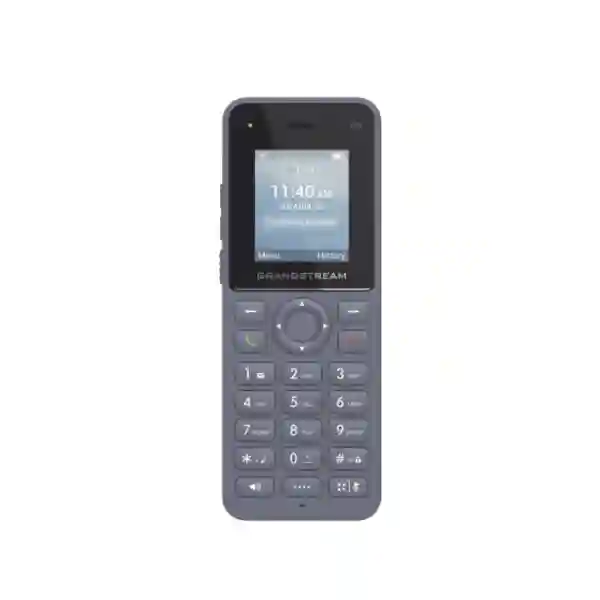
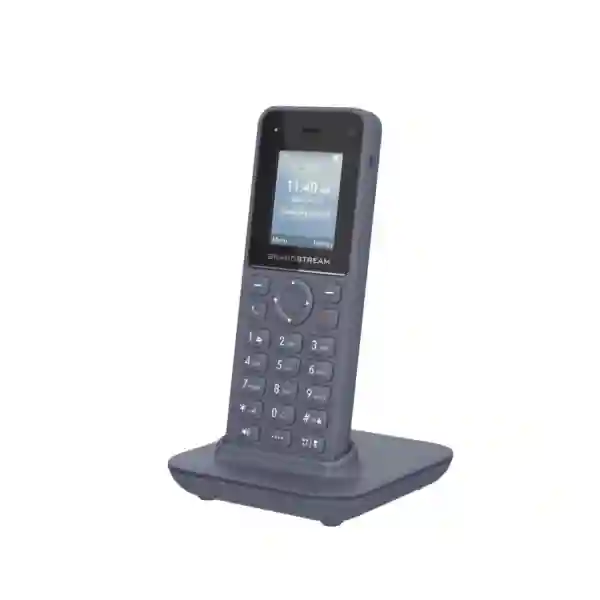
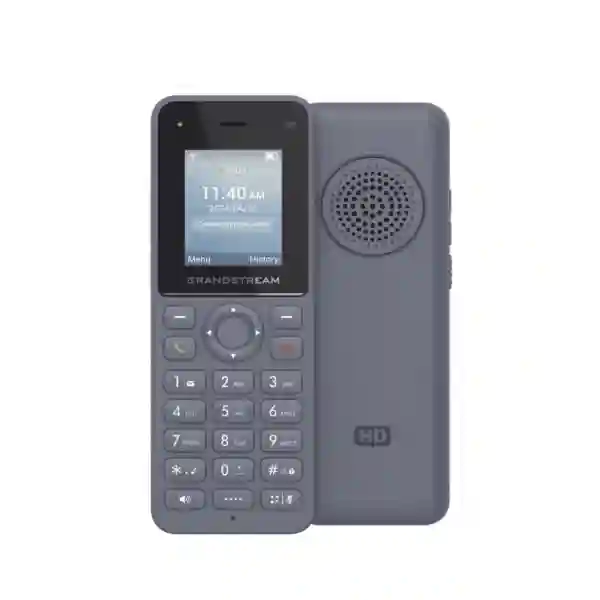
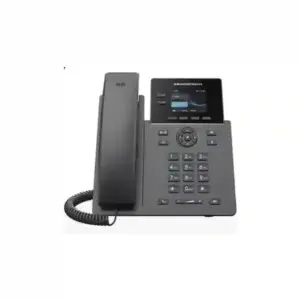
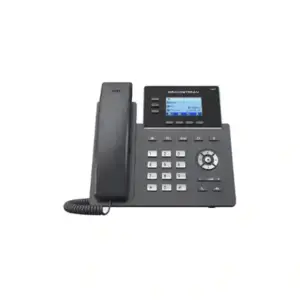
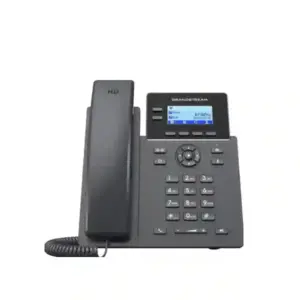
Grandstream GHP610 Hotel IP Phone for Dubai & UAE
The Grandstream GHP610 is a compact white wired hotel IP phone for guest rooms and other environments where users need an uncomplicated handset rather than a feature-heavy office desk phone. It supports two SIP accounts and two lines, provides three programmable keys and ten speed-dial keys, supports three-way audio conferencing and HD voice capabilities, and uses a 10/100 Mbps Ethernet interface with integrated Power over Ethernet. It can be placed on a desk or wall mounted. For hotels, serviced apartments, healthcare rooms, dormitories, residences and similar projects, the GHP610 works best as a controlled service interface: a guest or resident can quickly reach reception, housekeeping, room service, security, concierge or other internal services while administrators retain centralized provisioning and management through Grandstream Device Management System (GDMS).
Quick buying decision: when does the GHP610 make sense?
Choose the GHP610 when the project needs a simple wired SIP handset with PoE, programmable hotel-service access, compact styling, wall-mount flexibility and centralized administration. Its strength is deliberate simplicity. A hotel guest does not need to learn menus, applications or dozens of line keys simply to call reception. The IT team, however, still needs provisioning control, security, firmware governance and repeatable configuration for many rooms. The GHP610 separates those experiences effectively.
Choose a different GHP-series variant if the project specifically requires built-in Wi-Fi, a black finish, a different number of programmable keys, a display, USB charging or another form factor. The GHP610 is the white wired model. GHP610W is a related wireless-capable variant, and current Grandstream documentation notes hardware-revision differences in wireless and power behavior across W models. For project procurement, confirm the exact model and hardware revision being quoted.
Verified GHP610 capabilities and what they mean in practice
| Area | GHP610 capability | Deployment value |
|---|---|---|
| SIP telephony | 2 SIP accounts, 2 lines | Enough flexibility for straightforward room calling and selected internal service workflows. |
| Network | One auto-negotiating 10/100 Mbps Ethernet port | Fits conventional structured cabling in hospitality and institutional environments. |
| Power | Integrated PoE | A compatible PoE switch can provide network and power over the same cable. |
| Direct access | 3 programmable keys and 10 speed-dial keys | Allows fast access to services such as reception, housekeeping, concierge and security. |
| Audio | HD audio platform with full-band Opus support | Supports clearer calls when network and PBX conditions are appropriate. |
| Conferencing | 3-way audio conferencing | Provides a basic multi-party function for service and room communication. |
| Management | GDMS support | Useful for configuration, provisioning, monitoring and firmware control across many devices. |
| Placement | Desktop or wall mounted | Supports bedside, guest-room, apartment, clinic, dormitory and compact-space layouts. |
Built for the guest journey instead of the office desktop
A hotel room phone has a different job from an executive IP phone. A guest may use it only once during a stay, so the interface must communicate its purpose immediately. Pick up the handset, dial a number, or press a clearly labelled service key. That is often more valuable in a room than a large screen or a long list of enterprise functions. The GHP610’s compact trim-style design and programmable service access fit this requirement.
The three programmable keys and ten speed-dial keys are especially relevant because they let the property define the physical user experience around its services. A business hotel may prioritize reception, room service, housekeeping, concierge, transport and meeting support. A resort may emphasize dining, spa, activities, guest relations and buggy service. A serviced apartment operator may focus on property management, maintenance and security. In a healthcare or residential environment, the labels can be adapted to approved internal services.
Button labels should not be designed in isolation. The printed faceplate, PBX dial plan, extension routing and operational ownership need to match. A key labelled “Housekeeping” should reach the correct team at the right times, and the fallback route should be defined when that destination is unavailable. Hospitality telephony succeeds when the physical interface and operational process behave as one system.
PoE and room-network planning
Integrated PoE is one of the practical reasons to select the wired GHP610 in a property with structured Ethernet. A suitable PoE switch can carry both data and power over the room cable, reducing the number of individual phone power supplies that need to be installed and maintained. It can also simplify centralized power-resilience planning when access switches are protected by UPS systems.
A PoE design should still be engineered rather than assumed. Confirm the number of powered endpoints on each floor, switch power budget, port density, uplink requirements, UPS runtime, spare capacity and the needs of other PoE devices such as access points, cameras and access-control equipment. A hotel room having an Ethernet outlet does not prove that the cable is certified, patched to the correct switch or connected to a powered port.
Check Ethernet availability, cable condition, placement, wall-mount requirements and room numbering.
Calculate ports, PoE budget, uplinks, UPS coverage, redundancy needs and future growth.
Coordinate VLANs, DHCP, DNS, NTP, QoS, SIP reachability, firewall rules and management access.
Validate power, registration, service keys, labels, wall mounting, audio and support workflow on representative rooms.
PBX and SIP deployment planning
The GHP610 is a SIP endpoint, so the room-phone design must be aligned with the PBX or hosted voice platform. Confirm registration method, authentication, extension numbering, inbound and outbound calling policy, emergency dialing, DTMF behavior, time configuration, voicemail requirements, transfer and hold behavior, codec preferences and the use of the programmable and speed-dial keys. When migrating from analog hotel phones, do not assume the old dialing structure should be copied unchanged. A SIP migration is an opportunity to simplify service numbers and establish a consistent extension plan.
The two SIP accounts can be used in different ways depending on the PBX and operational model. Some properties may use one primary account and reserve the second for a special service or future requirement. Others may standardize on one account across all room phones. There is no benefit in using complexity simply because a capability exists. The better design is the one that is easiest to operate, secure and support.
Before a large order, test a production-representative device against the actual PBX. Verify registration after reboot, inbound and outbound calling, redial, hold, message-waiting behavior when used, service keys, codec negotiation, failover, recovery after network interruption and any required paging or internal-services workflow. A single successful call proves basic connectivity, not full deployment readiness.
Voice quality and network resilience
Grandstream’s GHP platform includes HD audio features, full-band Opus support and an advanced jitter-resilience algorithm designed to tolerate substantial packet loss without immediately compromising call quality. These are useful endpoint capabilities, but they do not replace good network design. Voice still depends on latency, jitter, packet loss, switching, QoS, WAN performance, PBX behavior and correct codec negotiation.
For an on-premises PBX, internal room calls may remain within the property network, which can make traffic more predictable. For hosted or multi-site voice, WAN stability becomes more important. In converged networks carrying guest Internet, operations traffic, cameras and voice, logical segmentation and appropriate QoS help stop bursts of unrelated traffic from damaging call quality. Device-management access should also be separated from unrestricted guest access.
Three-way audio conferencing is available when a basic multi-party call is needed. This is useful for service coordination or a guest who needs another party on the call, but it is not a substitute for a dedicated meeting-room audio or video collaboration system.
GDMS for centralized hotel-phone administration
Grandstream Device Management System is important when the project grows beyond a handful of endpoints. A single GHP610 can be configured manually, but a property with many rooms needs repeatable templates, controlled firmware and fast replacement. GDMS supports centralized provisioning, configuration, monitoring, troubleshooting and firmware management for supported Grandstream devices.
A disciplined deployment can keep common SIP, time, audio and security settings in standard templates while allowing room-specific or property-specific values to vary. This reduces manual configuration errors and supports faster replacement. If a room phone fails, the objective should be to install a spare, apply the approved configuration and restore service without rebuilding every setting from memory.
Central management is also part of the security model. Use strong administrator authentication, limit who can change templates or firmware, protect provisioning credentials, maintain an inventory, and define change-control procedures. A simple room handset is still a managed network device.
Example service-key strategies
The following labels are practical examples, not fixed factory assignments. Each key must be mapped by the administrator to a real extension, service code or approved destination.
| Environment | Possible direct-access services | Design priority |
|---|---|---|
| Business hotel | Reception, housekeeping, room service, concierge, transport, meetings | Keep labels obvious and consistent with in-room information. |
| Resort | Front desk, dining, spa, activities, buggy, guest relations, security | Map the physical labels to the actual guest-service operating model. |
| Serviced apartments | Reception, maintenance, security, housekeeping, property management | Support recurring resident needs without adding office-phone complexity. |
| Healthcare room | Reception, approved service desk, nurse station, security, internal support | Do not treat a SIP handset as a replacement for a regulated nurse-call or life-safety system. |
| Dormitory / residence | Reception, warden, maintenance, security, emergency desk | Prioritize essential destinations and simple support. |
Beyond hospitality: other suitable environments
Grandstream also positions the GHP series for hospitals, apartments, dormitories, retail and similar settings. The common requirement is a compact room or service phone with predictable calling and a small set of clearly defined destinations. In serviced residences, the GHP610 can provide access to reception, maintenance and security. In student housing, it can connect residents to administration or support. In selected healthcare settings, it can provide straightforward voice communication while remaining separate from clinical alerting systems.
The right endpoint should be chosen by user behavior. If users need a large directory, display-driven menus, many line appearances, advanced applications, Bluetooth, video or executive features, a different Grandstream model is more appropriate. If the user mainly needs to answer, dial and reach a few defined services, simplicity is a strength.
GHP610, GHP610W and GHP611: avoid model confusion
| Model | Published positioning | Typical selection logic |
|---|---|---|
| GHP610 | White, wired Ethernet, integrated PoE | Use when structured Ethernet and PoE are available at the phone location. |
| GHP610W | White Wi-Fi-capable variant; behavior varies by hardware revision | Consider when wireless connectivity is required; verify the exact hardware revision, Wi-Fi standard and powering method. |
| GHP611 | Black wired family variant | Consider when the compact wired concept is required with a black finish. |
Procurement documents should identify the exact model rather than using “GHP610 series” loosely. Grandstream’s current product information also notes Wi-Fi 6 on certain newer hardware revisions of the W variants, which is another reason to verify the hardware version at quotation time.
Security and lifecycle controls
Grandstream lists enterprise-level protection features for the GHP610 family, including secure boot. Endpoint security, however, is always layered. Protect provisioning credentials, restrict management access, segment voice devices appropriately, use approved firmware, apply firewall and PBX policies, and maintain accurate asset records. Because room phones can be physically accessible to guests or residents, administrative interfaces should not be exposed to unrestricted guest networks.
Firmware updates should be staged. Test new firmware on a small representative device group, verify registration, audio, service keys and management behavior, then roll out according to an approved change plan. Document the target version, rollback process and affected groups. Avoid updating an entire property during peak operational hours without a validated recovery plan.
Dial-plan security is equally important. Restrict destinations according to the property’s policy and confirm how restrictions behave during transfer, forwarding and failover. A room endpoint should provide the calls guests need without becoming an uncontrolled route to inappropriate destinations.
Recommended rollout sequence
Count rooms, identify existing voice platforms, audit cabling and PoE, collect service-key requirements and document property constraints.
Create the dial plan, VLAN and QoS policy, provisioning template, naming convention, security controls and faceplate mapping.
Install a small batch in real rooms and validate calling, labels, mounting, PoE, GDMS, PBX behavior and support workflow.
Stage by building or floor, apply approved templates, verify every room and record device identity and location.
Monitor registrations, manage firmware, maintain spares, keep documentation current and define a replacement procedure.
What to include in a GHP610 quotation request
- Required quantity and whether the request is for a new build, expansion, replacement or refurbishment.
- Deployment country, city and property or project context where appropriate.
- PBX or hosted SIP platform and current extension/dial-plan approach.
- Availability of Ethernet and PoE at each intended phone position.
- Preferred desktop or wall-mount placement.
- Required service keys, speed-dial destinations and faceplate/label expectations.
- Network VLAN, QoS, firewall and provisioning policy.
- Staging, configuration, installation and post-deployment support requirements.
- Whether the wired white GHP610 is mandatory or whether GHP610W, GHP611 or another GHP model should be compared.
Dubai and UAE deployment context
Dubai and the wider UAE include city hotels, resorts, serviced apartments, staff accommodation, healthcare facilities and mixed-use developments where a compact room phone can form part of a larger IP communications design. In a property with structured cabling and PoE switching, the GHP610 is a logical candidate because it avoids a separate room-side power supply and keeps the guest interface simple. The phone should still be planned together with switching, PBX or hosted voice, firewall policy, structured cabling, UPS capacity and endpoint management.
For new projects, coordinating the phone with the wider network early can prevent common deployment problems such as insufficient PoE budget, missing room ports, incorrect voice VLANs, inconsistent extension ranges or service labels that do not match PBX routing. For refurbishment projects, an audit of legacy analog cabling and existing room-phone workflows helps determine whether the rollout should be staged by floor or building.
Fourteck can be approached through IP Phone Fourteck for IP-phone project discussion and through Fourteck UAE for broader infrastructure requirements. Availability, project quantity, delivery and commercial terms should always be confirmed at quotation time.
Sharjah, Abu Dhabi and multi-site UAE projects
In Sharjah or Ajman, room-phone modernization may be part of a wider network and PBX refresh. The key project task is to audit cabling, map legacy extensions, verify PoE access switching and migrate service destinations in a controlled way. If the property is operating during the upgrade, floor-by-floor staging may reduce disruption.
Abu Dhabi projects can include large hotels, compounds, healthcare environments and multi-building sites. Centralized provisioning, endpoint grouping and consistent firmware policy become more important as device count grows. Standard naming, spare-unit policy and replacement workflow can have more operational value than adding extra features that guests never use.
For hotel groups operating across several emirates, standardizing one room-phone family can simplify configuration and spares, but only after a pilot has confirmed each site’s cabling and PBX conditions. When a property lacks wired Ethernet at the intended phone position, compare an appropriate wireless-capable variant instead of forcing a wired design into unsuitable infrastructure.
Regional project notes: Uganda, Kenya, Tanzania, Ghana, Nigeria and Kuwait
The same core design logic applies across regional hospitality and institutional projects: stable SIP registration, predictable room connectivity, adequate power, simple user operation and manageable provisioning. In locations where WAN quality or power stability varies, protect switching with appropriate UPS design and decide whether internal calling should depend on an external hosted platform. The right choice depends on the property architecture rather than the country name alone.
Hotel groups in East and West Africa can benefit from standardized configuration templates while keeping site-specific extension ranges and service destinations. Keep replacement units, accurate device inventory and a process for quickly reprovisioning a failed room phone. Fourteck regional information is available through Uganda, Kenya, Tanzania, Ghana and Nigeria.
For Kuwait projects, centralized management, PoE switching, PBX integration and guest-service mapping remain the main considerations. Regional pages and contact routes are useful for consultation, but they should not be interpreted as guaranteed stock, pricing, authorization or delivery timing.
Common specification mistakes to avoid
Confusing GHP610 and GHP610W: specify the exact model suffix and verify the hardware revision.
Assuming any Ethernet port provides PoE: confirm the switch, powered-port count, power budget and cabling.
Printing service labels before the dial plan is approved: the label, key assignment and PBX route must agree.
Putting phone management on unrestricted guest networks: treat room phones as managed infrastructure endpoints.
Skipping a pilot: operations, IT and guest-experience teams should validate real room behavior before mass deployment.
Assuming stock, price or delivery: confirm commercial conditions during quotation because they can change.
Frequently asked questions
Is the Grandstream GHP610 a Wi-Fi phone?
No. The GHP610 is the wired white model. It uses a 10/100 Mbps Ethernet connection and supports integrated PoE. Buyers who require built-in wireless connectivity should evaluate the GHP610W variant and confirm the exact hardware revision and powering method before ordering.
How many SIP accounts and lines does the GHP610 support?
The GHP610 supports 2 SIP accounts and 2 lines, making it suitable for room-based deployments that need straightforward guest calling plus hotel, residential, healthcare, dormitory, or service communication.
Does the GHP610 support Power over Ethernet?
Yes. Grandstream lists the GHP610 with one auto-negotiating 10/100 Mbps Ethernet port and integrated PoE. The project should still confirm PoE switch capacity, cabling, VLAN design, and the specific hardware revision being supplied.
How many programmable and speed-dial keys are available?
The GHP610 provides 3 programmable keys and 10 speed-dial keys. A property can configure these for reception, housekeeping, concierge, room service, security, maintenance, nursing station, or other approved internal destinations.
Can the GHP610 be wall mounted?
Yes. Grandstream positions the GHP610 for desktop or wall-mounted use, which is practical for hotel guest rooms, apartments, dormitories, healthcare rooms, corridors, and compact spaces.
Can a large GHP610 deployment be centrally managed?
Yes. The GHP series is supported by Grandstream Device Management System (GDMS) for centralized provisioning, configuration, monitoring, firmware management, and troubleshooting of supported endpoints.
Is the GHP610 suitable only for hotels?
No. Grandstream also identifies hospitals, apartments, dormitories, retail, and similar environments as suitable use cases for the compact GHP series.
What should be confirmed before requesting a GHP610 quotation?
Confirm quantity, PBX or hosted SIP platform, Ethernet and PoE availability, room layout, desired service-key mapping, faceplate requirements, network VLAN and QoS policy, provisioning method, deployment country, and whether the wired GHP610 or another GHP-series variant is the better fit.
Discuss a Grandstream GHP610 project with Fourteck
For a GHP610 deployment in Dubai, the UAE or a supported regional market, share the quantity, project location, PBX platform, room-network design, PoE status and desired service-key mapping. Fourteck can then review the requirement in the context of the real hospitality or room-communication environment instead of treating the handset as an isolated product line.
Recommended next step: request a quotation and compatibility review before finalizing the bill of materials.
Technical note: specifications can vary by hardware revision and firmware. Confirm the current Grandstream documentation and the exact hardware being supplied. Pricing, stock, delivery, warranty route, accessories and support scope are not assumed on this page and should be confirmed during quotation.
Reviews
There are no reviews yet.