
Grandstream HT814 v2 Four-Port FXS VoIP Gateway for UAE Deployments
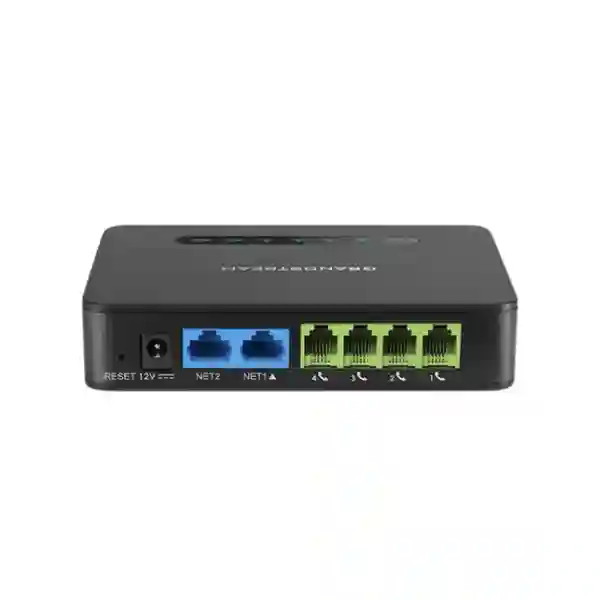
The Grandstream HT814 v2 is a practical bridge between established analog telephone equipment and a modern SIP voice environment. It combines four RJ11 FXS ports, two SIP profiles, dual Gigabit Ethernet interfaces and integrated NAT routing in one compact gateway. For offices, branches, service counters, small hospitality environments, legacy-device migrations and fax-dependent workflows, the value of the HT814 v2 is not simply that it converts analog voice to IP. Its real value is that it lets a project team migrate selected endpoints to SIP without automatically replacing every analog handset or compatible fax device at the same time.
For UAE buyers, the most important decision is whether the required job is an FXS job. The HT814 v2 supplies analog station interfaces for phones and fax equipment. It does not provide an FXO interface for accepting a traditional PSTN line. That distinction determines whether this model fits the requirement. Fourteck therefore recommends beginning with endpoint and call-flow mapping: identify each analog device, decide which SIP extension or service it needs, confirm fax behavior, validate the PBX or hosted platform, then choose the ATA size and deployment design.
Start with the requirement: what should the HT814 v2 actually connect?
A four-port ATA is most useful when a business already has analog endpoints that remain operationally valuable. These may include desk telephones in a small office, lobby or reception phones, simple room phones, a fax machine, an analog paging interface that is confirmed compatible, or legacy devices that still expect a standard analog station connection. The HT814 v2 provides the FXS side of that connection. Each port behaves as an analog subscriber interface and lets the connected endpoint participate in a SIP-based system once the ATA is registered and configured.
The right procurement question is therefore not just “Do we need four ports?” It is “What are the four endpoints, what does each one need to do, and how should calls reach them?” A project may need four ordinary extensions, one fax plus three voice ports, a pair of public-area phones and two back-office phones, or only two active endpoints today with planned expansion later. Those scenarios create different dial-plan, codec, registration, caller-ID and failover requirements even though the hardware count looks similar.
This requirement-first approach is especially important when replacing an older analog PBX or gateway. Existing labels on wall sockets do not prove how a circuit is wired, and an analog extension port is different from an incoming PSTN line. Before reusing building cabling, the team should trace the circuit, confirm the endpoint type, identify any intermediate distribution frame, inspect connector condition and determine whether the device expects ordinary two-wire FXS signaling. If the project includes a true outside analog line, an FXO-capable device must be considered for that part of the design.
Choose the HT814 v2 when the project needs up to four FXS interfaces for analog endpoints on a SIP platform and benefits from dual Gigabit networking and integrated routing. Do not choose it solely because four RJ11 sockets look suitable; confirm that the sockets must provide FXS station service rather than receive FXO/PSTN lines.
Verified product facts that matter during design
| Design area | HT814 v2 capability | Why it matters |
|---|---|---|
| Analog interfaces | Four RJ11 FXS ports | Connects up to four compatible analog endpoints directly. |
| SIP profiles | Two SIP profiles | Port-to-service mapping should be planned before rollout. |
| Ethernet | Two 10/100/1000 Mbps RJ45 ports | Supports Gigabit physical network connectivity and flexible placement. |
| Routing | Integrated NAT routing | Useful for compact deployments, while enterprise routing should remain deliberately designed. |
| Voice | Includes G.722 and OPUS among supported codecs | Enables wideband-capable media paths when the rest of the call supports them. |
| Fax | T.38 relay up to 14.4 kbps with G.711 pass-through fallback | Supports planned migration of compatible analog fax workflows. |
| Security | SRTP, TLS/SIPS, HTTPS, certificates and encrypted provisioning options | Provides mechanisms for protected signaling, media and management when configured correctly. |
| Provisioning | TR-069 and XML configuration options; UCM zero configuration support | Reduces repetitive setup effort in managed deployments. |
These facts are more useful when translated into deployment decisions. Four FXS ports do not automatically equal four unrelated services, because the unit supports two SIP profiles and the final behavior depends on port settings and the selected call platform. Dual Gigabit interfaces do not mean every environment should place the ATA directly at the network edge. T.38 support does not guarantee fax success through a provider that does not support or correctly pass T.38. Security features do not secure a deployment by themselves unless credentials, firmware, management exposure and PBX policies are handled properly.
For that reason, Fourteck treats the HT814 v2 as part of a voice solution rather than an isolated accessory. A useful design record should identify the connected endpoint on each FXS port, its directory number, the corresponding PBX extension or hosted account, the preferred and fallback codecs, DTMF method, caller-ID requirement, voicemail expectation, outbound dialing rights, emergency-number policy, fax mode where applicable, and the switch/VLAN location of the ATA. That information shortens troubleshooting and makes future changes easier to manage.
Four FXS ports: retaining analog endpoints without freezing the network in the past
Many organizations still have analog equipment for sensible operational reasons. A basic analog telephone may be inexpensive, familiar to staff, easy to replace and sufficient for a low-feature location. A fax device may remain in use because a customer, authority, supplier or workflow still depends on it. A facility may have older structured cabling that can continue to carry an analog station circuit even while the core telephony platform has moved to SIP. The HT814 v2 creates a migration boundary: the analog endpoint stays on one side, while the network and call-control environment can be IP-based on the other.
This can reduce unnecessary disruption, but it should not be mistaken for a reason to preserve every legacy device indefinitely. When an endpoint requires presence, directory search, multiple line keys, video, Bluetooth, modern encryption at the handset, application integration or rich unified communications features, a native IP phone may be the better endpoint. The ATA is strongest where the requirement is genuinely analog and simple. It is less compelling when a project is trying to force a feature-rich user workflow through a basic two-wire station interface.
For migration projects in Dubai, Abu Dhabi, Sharjah and other UAE locations, a mixed estate is common. A business may modernize executive and call-centre users with IP endpoints while keeping analog devices in stores, reception backup positions, utility rooms, workshop areas or low-interaction spaces. A four-port gateway can be used as a local consolidation point for those endpoints. The design should consider where the existing copper terminates, whether the analog runs remain in acceptable condition, and whether centralizing the ATA or placing it closer to the endpoints produces a cleaner operational result.
Two SIP profiles across four ports: plan the account model before configuration
The HT814 v2 supports two SIP profiles, an important detail that should shape the solution design early. A SIP profile is not simply a marketing count; it represents a group of common SIP-related parameters such as server settings and transport behavior. The four FXS ports can then be arranged within the device configuration according to the intended service model. This is efficient when several analog extensions belong to the same PBX or SIP service, but it also means the project should not assume four completely unrelated provider environments can be treated as four independent profiles.
A small branch, for example, may use one corporate SIP/PBX environment for all four analog ports. Another deployment may need a primary corporate profile and a second profile for a separate service. The configuration team should document primary SIP server details, optional failover server, outbound proxy requirements, authentication parameters, transport and media security, DTMF method, registration intervals and any provider-specific NAT settings. Where multiple locations are involved, standardizing these parameters reduces configuration drift.
Failover behavior deserves particular attention. Grandstream lists failover SIP-server support that can switch to a secondary server when the primary becomes unavailable. That capability can improve resilience when the upstream platform is designed for it, but it does not create full business continuity by itself. Internet connectivity, DNS, routing, firewall policies, power availability and PBX redundancy all influence whether calls continue during a failure. A reliable design therefore considers the whole path from analog handset to remote call destination instead of viewing registration failover as a complete continuity solution.
Voice quality: codec support is only one part of an end-to-end audio path
Grandstream documents a broad codec set for the HT8xx v2 family, including G.711, G.722, G.723.1, G.729A/B, G.726-32, iLBC and OPUS, along with dynamic jitter buffering and echo-cancellation capabilities. For buyers, the practical message is that the HT814 v2 can participate in both conventional narrowband and wideband-capable SIP environments. The negotiated result, however, depends on the PBX, service provider, remote endpoint and any transcoding resources in the path.
An analog handset connected to an ATA also places a physical limit on what the user ultimately hears. A wideband codec may be negotiated on part of the IP path, but the quality perceived by the caller still depends on the analog telephone, handset transducer, local wiring, line conditions and acoustic environment. For this reason, voice-quality troubleshooting should not start and end with codec selection. It should examine packet loss, jitter, latency, switch congestion, duplex issues, QoS markings, WAN behavior, PBX media handling and the analog endpoint itself.
In business networks, a dedicated voice VLAN and appropriate QoS policies can make ATA deployments easier to operate, especially when the same access switch carries data, wireless and other traffic. The ATA should be placed on a network segment consistent with the organization’s security and voice policies. If the project uses an enterprise firewall, SIP ALG behavior should be reviewed rather than blindly enabled or disabled. Different PBXs and carriers handle NAT traversal differently, so the correct setting should be based on the actual SIP architecture.
Fax migration: use T.38 deliberately, not as an assumption
Fax is one of the most common reasons organizations continue to need analog interfaces. The HT814 v2 supports T.38 Group 3 fax relay up to 14.4 kbps and can automatically fall back to G.711 fax pass-through. That gives the project two common ways to carry fax traffic through a VoIP environment. The best mode depends on the fax machine, PBX, SIP trunk or hosted provider, and the quality of the IP path.
A successful fax project should therefore be tested as an application, not merely checked against a feature list. Confirm whether the service provider supports T.38 end to end, whether the PBX negotiates it correctly, whether re-INVITEs are permitted through the firewall, and whether the far-end destination behaves consistently. When G.711 pass-through is used, packet loss and jitter can have a more visible effect on reliability because the modem tones are being carried as audio rather than converted to a fax-relay protocol.
Operational expectations should also be documented. Some businesses send only a few pages occasionally, while others depend on multi-page documents or repeated transmissions to external organizations. A low-volume workflow may tolerate occasional manual retry; a business-critical workflow may justify deeper testing or a different digital document-exchange strategy. Fourteck can help scope ATA-based fax integration, but the customer should confirm the required destinations, expected page volumes, existing fax hardware and service-provider behavior before treating any VoIP fax design as production-ready.
Dual Gigabit Ethernet and integrated NAT: useful flexibility with clear boundaries
The HT814 v2 includes two 10/100/1000 Mbps Ethernet interfaces. Grandstream’s HT8xx v2 documentation identifies the ports as NET1 and NET2. In the default arrangement, NET1 operates as the WAN-side DHCP client and NET2 as the LAN-side DHCP server. Their roles can be swapped through the web interface. This gives installers useful options when placing the ATA in a compact office or when direct local access is needed during commissioning.
Integrated NAT routing can be convenient, but an ATA should not automatically become the primary router for a business site simply because routing is present. Organizations that require next-generation firewall policies, multiple WAN links, VPNs, advanced traffic inspection, centralized logging, segmentation, SD-WAN or high-availability edge routing normally need a dedicated security and routing platform. In that architecture, the HT814 v2 is typically treated as a voice endpoint or gateway inside the protected network.
The physical Gigabit interfaces also do not remove the need to check the full access path. Switch port speed and duplex, VLAN tagging, DHCP scope, DNS reachability, NTP, gateway configuration and firewall rules should all be confirmed. If NET2 is used to attach a local device, document why it is being used and what addressing behavior is expected. In managed environments, clarity is more valuable than cleverness: a simple, standardized network placement is easier for support teams to troubleshoot than a collection of one-off local routing arrangements.
Security should cover signaling, media, management and provisioning
The HT814 v2 includes mechanisms that support a stronger VoIP security posture, including SRTP for encrypted media, TLS or SIPS options for SIP signaling, HTTPS for management, device certificates and encrypted provisioning capabilities. Grandstream also documents TR-069 management support. These features make the product suitable for centrally managed deployments, but only when they are integrated with the organization’s broader security standards.
A secure commissioning process should begin with credentials. Default or temporary administrative credentials should be changed, management access should be limited to trusted networks, and unnecessary remote access should remain disabled. SIP authentication passwords should be unique and protected. If a provisioning server is used, transport security and file access controls should be reviewed. Firmware should be maintained according to the vendor’s supported process, and configuration backups should be handled as sensitive information because they may contain account and network details.
Network segmentation is equally important. Voice devices can be placed in a dedicated VLAN with only the services they need, such as DNS, NTP, provisioning, PBX registration and management from authorized systems. Firewall policies can then reduce exposure between voice devices and unrelated user networks. For internet-hosted SIP platforms, the exact ports, transports and destination ranges should come from the provider rather than being opened broadly. Where SRTP and TLS are required, confirm that the upstream platform supports compatible cipher and certificate behavior before rollout.
Provisioning and lifecycle management for more than one device
A single ATA can be configured manually, but repeated manual configuration becomes inefficient and error-prone as the deployment grows. The HT814 v2 supports automated provisioning approaches including TR-069 and XML configuration files. Grandstream also lists zero-configuration integration with UCM-series IP PBXs. These mechanisms can help standardize settings, accelerate replacement and reduce configuration drift across branches or customer sites.
A good provisioning template separates global settings from site- or device-specific values. Global values may include time zone, NTP sources, security policy, codec order, logging destinations and management restrictions. Site-specific values may include VLAN details, local dial-plan behavior or network addressing. Device-specific values include SIP identities, authentication details and port assignments. Keeping those layers distinct makes troubleshooting and change control much easier.
Provisioning should also include a recovery plan. Teams should know how to discover the unit’s IP address, access the local web interface when permitted, factory-reset the device when authorized, and restore a known configuration. Grandstream documents an IVR for device information and configuration, including the ability to announce the current IP address. A reset button is also available. In provider-managed environments, factory-reset behavior may be restricted, so ownership and management responsibility should be confirmed before any reset is attempted.
Grandstream UCM integration: where the HT814 v2 becomes especially straightforward
For organizations already using a Grandstream UCM IP PBX, the HT814 v2 has a natural role as an analog-extension gateway. Grandstream specifically lists UCM zero-configuration provisioning support, allowing compatible UCM systems to discover and provision supported devices with less manual entry. This can be useful when a business wants to keep a few analog endpoints while standardizing call control, numbering and management on a UCM platform.
The project should still begin with call-flow design. Define the extension number for each analog port, outbound route permissions, inbound destinations, voicemail behavior, ring groups, hunt groups and any restrictions that apply to shared or public-area phones. If a fax machine is connected, separate its media settings from ordinary voice assumptions where necessary. If the ATA is deployed at a remote branch, confirm how the UCM is reached and whether VPN, RemoteConnect, static routing or another secure architecture is being used.
Fourteck also recommends documenting replacement behavior. If the ATA fails, support staff should be able to identify which four endpoints are affected, locate the latest approved configuration, replace the unit, restore port mapping and test inbound and outbound calls. Zero configuration can simplify onboarding, but operational documentation remains important. A four-port device creates a small concentration point: one hardware failure can affect several analog users, so the business impact should be understood when deciding where and how many units to deploy.
Using the HT814 v2 with third-party PBXs and hosted SIP services
Because the HT814 v2 is a SIP ATA, it can be evaluated for use with standards-based third-party PBXs and hosted VoIP platforms. Compatibility, however, should be proven through the settings that matter to the selected service. Registration may require a domain, proxy or outbound proxy. Authentication usernames may differ from extension numbers. Providers may specify UDP, TCP or TLS transport, particular DTMF modes, supported codecs, NAT keepalive behavior, session timers or special caller-ID rules.
Hosted platforms can also impose restrictions on analog features. A star code generated by the analog handset may be interpreted locally by the ATA, passed to the PBX, or conflict with a provider feature code. Message-waiting indication may depend on SIP NOTIFY behavior. Caller-ID presentation to an analog phone can vary with regional signaling format. Three-way calling may be handled locally or by the PBX depending on configuration. These details are why a simple test plan is valuable before multiple units are rolled out.
A practical acceptance test should cover registration after reboot, inbound calls, outbound local and international dialing as applicable, caller ID in both directions, hold, transfer, DTMF through IVRs, voicemail access, message-waiting indication, failover registration if used, fax transmission where required, and recovery after WAN interruption. The results should be recorded against the exact PBX or provider configuration. This turns interoperability from an assumption into a repeatable deployment standard.
Common UAE deployment scenarios
Small office retaining four familiar analog phones
A small office may be ready to move its trunking and PBX functions to SIP while staff still use simple analog handsets. The HT814 v2 can provide four station interfaces from one device. In this scenario, the key design questions are extension mapping, outbound calling permissions, caller ID and how the unit connects to the office switch. If users later require richer features, individual ports can be retired as native IP phones are introduced.
Fax plus three voice endpoints
A business may need one port for a fax machine and three for analog telephones. This is a sensible use of a four-port ATA, but the fax port should be treated as a distinct application. Test T.38 and G.711 behavior with the actual SIP service, document the preferred fax mode and keep voice codec choices aligned with the remaining ports. Do not assume the setting that works best for voice automatically produces reliable fax transmission.
Branch or retail location
A branch, shop or service counter may have a small number of analog endpoints but depend on a centralized PBX. The HT814 v2 can consolidate those devices while the central platform controls numbering and routes. Network resiliency is especially important at remote sites: if the WAN fails, SIP service may be unavailable unless the broader architecture provides a fallback. Power protection for the ATA, switch and router should be considered if voice availability is operationally important.
Legacy-cabling reuse during staged migration
In older offices or renovated premises, analog cabling may already reach locations that are expensive or disruptive to recable immediately. Where those circuits are suitable and verified, an ATA can help extend the useful life of that infrastructure while the organization plans a later endpoint refresh. The cable plant should be traced and tested, and the design should avoid connecting the FXS port to circuits that carry external voltage or an incoming PSTN service.
HT812 v2, HT814 v2 or HT818 v2? Size the gateway to the real endpoint count
| Model | FXS ports | Ethernet | Best planning fit |
|---|---|---|---|
| HT812 v2 | 2 | Dual Gigabit | Two analog endpoints where HT81x routing/network features are desired. |
| HT814 v2 | 4 | Dual Gigabit | Up to four analog endpoints with a balanced port count for small sites. |
| HT818 v2 | 8 | Dual Gigabit | Higher-density analog endpoint requirements at one location. |
Choosing a larger model purely for spare capacity is not always wrong, but it should be justified. An eight-port unit may reduce hardware count at a site with six or seven analog endpoints, while two four-port units may provide better physical distribution or reduce the number of endpoints affected by one hardware failure. Similarly, an HT814 v2 may be more sensible than an HT812 v2 when a site has two active endpoints today but two clearly planned additions. The decision should consider endpoint count, cabling location, resilience, rack or desk placement, power, support spares and future growth.
Also distinguish FXS density from FXO requirements. If a project must connect traditional PSTN lines to a SIP PBX, the relevant product family is different. The HT814 v2 is designed to present analog station interfaces to endpoints; it is not a four-line PSTN gateway. This single design check prevents one of the most common analog-gateway procurement mistakes.
Installation planning before the device arrives
A clean installation starts with information rather than cables. Record the PBX or hosted SIP platform, server addresses, required SIP transport, extension numbers, authentication identities, codec policy, DTMF settings, fax requirements, VLAN ID, IP addressing method, DNS and NTP sources. Determine who owns the firewall and switch configuration. If the device will be centrally provisioned, confirm the provisioning method and how the ATA will securely reach the management service.
Next, map the physical side. Label the four analog endpoints and the expected FXS port for each. Check whether the endpoint is a phone or fax machine and whether any building cabling lies between it and the gateway. If existing wall cabling is reused, make sure it is disconnected from old PBX or PSTN voltage sources before connecting it to an ATA. Document the patch-panel or distribution-frame path so future technicians can trace the circuit without guesswork.
Finally, define acceptance criteria. A deployment is not complete just because all LEDs are on. Each port should be tested for registration, dial tone, outbound calling, inbound calling, caller ID, DTMF, hold and transfer behavior where relevant. Fax ports should complete real send and receive tests. If a failover SIP server is configured, test the expected behavior in a controlled maintenance window. Save the final approved configuration and update the site diagram after commissioning.
A practical commissioning sequence
- Inspect and label. Confirm the correct model, power adapter, Ethernet connectivity and intended analog endpoints before connecting legacy wiring.
- Connect the network first. Place the ATA on the approved switch port or router segment and confirm it receives the expected IP configuration.
- Find and secure management access. Use the documented IVR or local network method to identify the address, then change administrative credentials and restrict management exposure.
- Apply network policy. Configure VLAN, DNS, NTP, gateway and any required QoS or firewall rules in accordance with the site design.
- Configure SIP profiles. Enter the primary server, failover server where used, transport, authentication and media settings supplied by the PBX or provider.
- Map the FXS ports. Assign extensions or service identities and confirm the dial plan, caller ID, voicemail and feature-code expectations for each analog endpoint.
- Configure fax separately where needed. Validate T.38 or G.711 pass-through behavior with the actual service instead of relying on default settings alone.
- Test the whole call path. Verify inbound, outbound, DTMF, hold, transfer, conference and recovery behavior relevant to the business.
- Document and back up. Record firmware, network placement, port mapping and approved configuration so replacement and support can be performed consistently.
Operational visibility: LEDs, IVR and basic troubleshooting
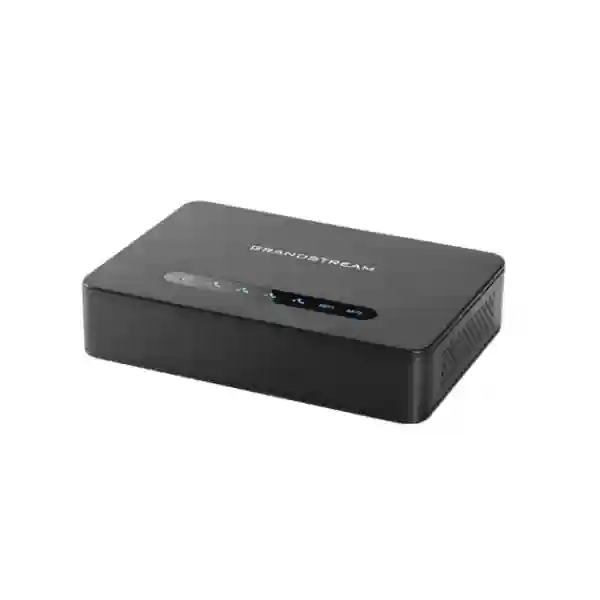
The HT814 v2 includes status indicators for power, NET1, NET2 and each of the four phone ports. Grandstream documentation describes phone-port LEDs that indicate registration, off-hook or busy state and voicemail notification behavior. These indicators are useful for first-line checks because they quickly distinguish a power or network issue from a registration or endpoint issue.
The built-in IVR provides another practical support path when a web session is not immediately available. Grandstream documents dialing three asterisks from a connected analog phone to enter the IVR, with option 02 announcing the current IP address. This can help a technician locate a device after DHCP changes or when the site documentation is outdated. Web access rules may differ depending on whether NET1 or NET2 is used, so the installer should follow the current vendor guide and the organization’s security policy.
Troubleshooting should proceed layer by layer. If there is no dial tone, verify the correct FXS port, cable, endpoint and physical state. If there is dial tone but no registration, check IP connectivity, DNS, time synchronization, server address and credentials. If calls connect but audio fails, examine NAT, firewall and RTP behavior. If DTMF fails, compare the ATA’s setting with the provider or PBX expectation. If fax fails, test T.38 negotiation and G.711 pass-through separately. A structured process avoids random setting changes that can make the final configuration harder to support.
What the HT814 v2 is not designed to replace
The HT814 v2 is not an IP PBX. It does not provide the full call-control, user-management, reporting, trunk-routing and collaboration functions of a PBX platform. It registers to or works with a SIP service that provides those capabilities. For organizations designing a complete communications environment, the ATA should therefore be specified alongside the PBX, SIP trunk or hosted service rather than treated as the system itself.
It is also not an FXO gateway for bringing four PSTN lines into a VoIP system. Its four RJ11 interfaces are FXS ports intended for analog endpoints. Projects that need PSTN line integration should evaluate the appropriate FXO gateway architecture. Likewise, it is not a substitute for an enterprise firewall simply because it includes NAT routing. A dedicated security platform remains appropriate when the site requires advanced policy, inspection, VPN or redundancy features.
Finally, an ATA is not always the best endpoint strategy. If users require programmable keys, multiple line appearances, corporate directories, presence, Bluetooth or Wi-Fi mobility, video, application integration or richer security at the endpoint, native IP phones can provide a better user experience. The HT814 v2 is most valuable when the endpoint requirement is genuinely analog and the business wants that endpoint to participate in a modern SIP environment.
Procurement questions that prevent avoidable project changes
Before requesting a quotation, identify the number of active analog devices and the expected growth at each site. A site with four endpoints maps naturally to one HT814 v2, but six endpoints may be better served by an eight-port device or by two smaller units depending on physical distribution and resilience. If the endpoint count varies across branches, standardizing on one model can simplify spares, but it may also create unused capacity. The total-cost decision should include support and operations, not only the hardware count.
Confirm the PBX or SIP provider and whether the service has already been used with Grandstream ATAs. Gather the required registration, codec and fax settings. If the project uses hosted SIP, ask whether TLS and SRTP are supported and whether fixed firewall rules are required. If the business requires emergency calling, confirm how the provider handles location and caller identification for analog extensions. These are service-design questions, not features the ATA can decide on its own.
Physical details also affect the quotation. State whether the unit will be desk-mounted, placed in a communications cabinet or located near an analog distribution frame. Identify whether new patching or cabling is needed. If remote branches are involved, include site locations and whether installation, remote configuration, on-site testing or migration assistance is required. Fourteck can then scope the requirement more accurately without implying unverified stock, price or lead time on the product page.
UAE project considerations: Dubai, Abu Dhabi, Sharjah and multi-site operations
In Dubai offices, a common requirement is staged migration: the company may already operate a SIP PBX or cloud calling service but still have a few analog devices in reception, back-office, warehouse or fax workflows. The HT814 v2 can concentrate four such endpoints without requiring a separate ATA for every device. For buildings with structured cabling and centralized communications rooms, the location of the existing analog pairs often determines whether one centrally placed gateway or several distributed units produce a cleaner design.
Abu Dhabi deployments may involve corporate offices, industrial facilities, service centers or geographically separated sites. In those environments, the WAN path and support model can matter more than the ATA itself. Remote-site voice depends on reliable connectivity to the PBX or hosted service. If business continuity is required, the project should consider redundant WAN design, UPS coverage, central monitoring and a support procedure for restoring or replacing the ATA.
Sharjah and Northern Emirates projects can face the same mix of modern IP systems and retained analog devices. A consistent configuration template across locations reduces support effort, especially when the same PBX, numbering plan and security policy are used. Multi-site customers should maintain a simple inventory that records device serial or asset identity, site, IP or DHCP reservation, connected analog endpoints, SIP extension mapping, firmware policy and configuration owner. This operational data is often more valuable during an outage than a long list of product specifications.
Regional expansion and Fourteck network resources
Organizations operating beyond the UAE can use the same requirement-driven approach when planning analog-to-SIP migration in other markets. Fourteck maintains regional technology resources for Kenya, Uganda, Tanzania and wider Africa. The exact voice-service provider, numbering regulations, power environment and connectivity design can differ by country, so a configuration proven in one market should not be copied blindly into another.
For UAE communications planning, buyers can also review Grandstream-focused UAE resources, IP PBX planning resources, the wider Fourteck UAE technology site and the IP Phone Fourteck catalog. These links are best used as supporting navigation; the specific HT814 v2 quotation should still be based on the live project requirement.
Why businesses choose a four-port ATA instead of four single-port adapters
Consolidating four analog endpoints into one gateway can simplify power, network patching, configuration and inventory. Instead of managing four separate Ethernet connections and four power adapters, a project can centralize the analog ports on one HT814 v2 where the physical cabling layout supports it. This can be especially useful near a patch panel or distribution frame where several analog pairs terminate in the same communications area.
Consolidation also has a trade-off: one device failure can affect multiple analog endpoints. A business should therefore consider the importance of the connected devices. If all four ports serve low-criticality phones, consolidation is usually straightforward. If one port supports a business-critical fax workflow and another supports an emergency or high-availability phone, distributing those functions across separate devices or providing an operational spare may reduce risk. The correct architecture depends on impact, not only port efficiency.
From a support perspective, fewer devices can mean fewer firmware objects and configuration backups. Automated provisioning further improves consistency when multiple HT814 v2 units are deployed. The support team can maintain a common baseline and apply site-specific values for extensions and networking. That model is easier to audit than manually configured one-off adapters, particularly across multiple branches.
Migration from an older analog gateway or PBX
A replacement project should begin with discovery. Export or record the existing extension list, identify which analog ports are active, note any fax devices, capture inbound and outbound call flows, and document feature codes staff actually use. Old systems often contain years of accumulated routing behavior that is not obvious from the physical ports. Moving the endpoints without recreating the necessary call logic can produce a technically successful installation that still disrupts users.
Next, separate features that belong to the endpoint from features that belong to the PBX. Call forwarding, hunt groups, voicemail, time conditions, caller-ID policy and outbound route permissions are often controlled by the PBX or service. The ATA provides the analog interface and local telephony behavior, but the wider user experience depends on both layers. A migration plan should therefore coordinate ATA settings with the new call-control platform.
Cutover is easier when the new configuration is staged and tested before the old service is disconnected. Where possible, validate one or two representative analog endpoints, then expand. Label both ends of reused cabling, update patching records and retain a rollback plan for business-critical services. After migration, monitor for intermittent issues such as one-way audio, delayed DTMF, fax inconsistency or registration loss that may not appear during a short initial test.
Support and maintenance checklist after go-live
- Maintain a record of the approved firmware policy and review vendor release notes before upgrades.
- Back up the configuration after successful commissioning and after material changes.
- Keep management access restricted to authorized networks or administrators.
- Use strong unique administrative and SIP credentials and rotate them according to policy.
- Monitor registration status and investigate repeated loss of registration rather than masking it with aggressive retry values.
- Document which analog endpoint is connected to each FXS port and keep cable labels current.
- For fax ports, retain a known test destination and document the working T.38 or G.711 behavior.
- Review switch-port errors, VLAN configuration and QoS if users report intermittent audio quality.
- Keep a tested replacement procedure for sites where multiple users depend on one ATA.
- Revalidate provider or PBX interoperability after major platform changes instead of assuming old settings remain optimal.
Buying decision: when the HT814 v2 is a strong fit
The HT814 v2 is a strong candidate when a project has up to four analog endpoints, wants to connect them to a SIP-based PBX or hosted voice service, values dual Gigabit Ethernet and requires business-oriented provisioning and security options. It is particularly attractive when several analog circuits terminate in the same location and can be managed as one small gateway.
It is also a sensible migration tool for businesses that want to modernize call control without forcing an immediate endpoint replacement everywhere. A staged approach can protect investments in simple analog devices while new IP phones are introduced where richer features are justified. Because the ATA supports common voice codecs, fax modes, secure signaling and centralized provisioning, it can fit both small standalone deployments and larger managed estates.
Choose another architecture when the requirement is fundamentally different: an FXO gateway for incoming PSTN lines, an eight-port FXS gateway for higher density, a native IP phone for feature-rich users, or a full PBX for call control. Product selection becomes much easier once the requirement is expressed in terms of endpoint type, port count, call platform, network design and operational importance.
Questions to answer before requesting an HT814 v2 quotation
Endpoint inventory: How many analog phones and fax machines are active today, and how many are expected during the next expansion phase?
Call platform: Which PBX, UCM, hosted SIP service or SIP trunk environment will provide registration and call control?
Network: Which VLAN, IP addressing method, firewall path and QoS policy will the ATA use?
Fax: Which ports require fax, and has T.38 behavior been confirmed with the provider or PBX?
Sites: Is the project for one UAE office or multiple branches in Dubai, Abu Dhabi, Sharjah or other locations?
Services: Is supply only required, or should the scope include configuration, migration, testing or deployment assistance?
Grandstream HT814 v2 FAQ
What is the Grandstream HT814 v2?
The Grandstream HT814 v2 is a four-port analog telephone adapter and VoIP gateway. It provides four RJ11 FXS ports for connecting compatible analog telephones or fax devices to SIP-based voice services, plus two Gigabit Ethernet interfaces and integrated NAT routing. It is intended for organizations that want to retain useful analog endpoints while moving voice services onto an IP network.
How many analog devices can the HT814 v2 connect?
The HT814 v2 provides four FXS ports, so up to four compatible analog endpoints can be connected directly, one per port. The actual service design also depends on how SIP accounts, port assignments, dial plans, fax requirements and the PBX or hosted SIP platform are configured.
Does the HT814 v2 have FXO ports for PSTN lines?
No. The HT814 v2 is an FXS-based adapter and does not provide an FXO port for connecting an incoming analog PSTN line. If the requirement is to bridge a traditional telephone line into a SIP environment, an FXO-capable gateway should be evaluated instead of assuming the HT814 v2 can perform that role.
Does the HT814 v2 support fax over IP?
Yes. Grandstream documents T.38 Group 3 fax relay support up to 14.4 kbps with automatic fallback to G.711 fax pass-through when required. Successful faxing still depends on the SIP provider, PBX, codec path, network quality and the configuration of the connected fax machine.
Can the HT814 v2 be used with a Grandstream UCM IP PBX?
Yes. Grandstream specifically lists UCM-series zero-configuration provisioning support for the HT814 v2. In a planned UCM deployment, this can simplify device onboarding and configuration consistency. The final configuration should still be validated against the UCM model, firmware, network design and required extension behavior.
Can the HT814 v2 work with a non-Grandstream SIP PBX or hosted VoIP service?
The device uses SIP and is designed for standards-based VoIP environments, so it can be considered for compatible third-party SIP PBXs and hosted voice services. Interoperability should be confirmed for registration, authentication, codecs, DTMF, fax, caller ID, emergency dialing, NAT traversal and provider-specific provisioning before a production rollout.
How many SIP profiles does the HT814 v2 support?
Grandstream specifies two SIP profiles across the four FXS ports. This means a deployment should be designed around how the required extensions and services are distributed across the available profiles rather than assuming every port needs an entirely independent profile. Port-level behavior should be mapped before ordering.
Does the HT814 v2 support HD voice?
Yes. Grandstream lists wideband codecs including G.722 and OPUS for the HT8xx v2 family. Whether an end-to-end call is actually wideband depends on the analog handset, SIP platform, remote endpoint, codec negotiation and the rest of the media path.
What network ports are available on the HT814 v2?
The HT814 v2 provides two 10/100/1000 Mbps Ethernet ports. Grandstream documentation identifies them as NET1 and NET2. By default NET1 operates as a WAN-side DHCP client and NET2 as a LAN-side DHCP server, and their roles can be changed in the web interface when the deployment requires a different arrangement.
Does the HT814 v2 include a router?
Yes. The HT814 v2 includes integrated NAT routing functionality. For business deployments, the ATA should still be placed within a deliberate LAN, VLAN, firewall and QoS design rather than used as a substitute for an enterprise edge router when advanced security, redundancy, VPN or policy features are required.
What security features are available?
Grandstream documents SRTP for media encryption, TLS or SIPS and HTTPS for protected signaling and management, unique device security certificates, AES-encrypted provisioning files and secure management options such as TR-069. The effective security posture also depends on PBX settings, strong credentials, firmware maintenance and network access controls.
Can analog phones with four-wire cords be connected?
Grandstream states that HT-series devices can work with four-wire analog telephone cords, but the ATA uses the standard center TIP and RING pair for operation. Cabling, connectors and any building distribution frames should be checked before deployment, especially when reusing older analog wiring.
How do I find the HT814 v2 IP address?
Grandstream documents an IVR method for the HT8xx v2 family: connect an analog phone to an FXS port, dial three asterisks to enter the IVR, then use option 02 to hear the current IP address. Administrative access should be protected and changed from default credentials during commissioning.
Is the HT814 v2 a good choice for four independent analog extensions?
It can be a strong fit when the requirement is to connect up to four analog endpoints to a SIP environment, but the two-profile design, extension mapping, caller ID, voicemail, hunt behavior and fax requirements should be reviewed first. Where eight analog endpoints are needed, an HT818 v2 may be more appropriate; where only two are needed, an HT812 v2 may be sufficient.
Can Fourteck help with HT814 v2 deployment planning in the UAE?
Fourteck can assist with requirement review, PBX and SIP compatibility checks, analog endpoint mapping, network readiness, migration planning and configuration scope for UAE projects. Availability, commercial terms, lead time and exact project deliverables should be confirmed through a current quotation rather than assumed from the product page.
What information should I provide when requesting a quotation?
Useful quotation inputs include the number and type of analog devices, required quantity of HT814 v2 units, PBX or hosted SIP platform, number of SIP accounts, fax requirements, site locations, existing analog cabling, VLAN and network details, provisioning expectations, installation scope and whether migration or testing assistance is required.
Plan the gateway around the call flow, not only the port count
The Grandstream HT814 v2 is easy to describe as a four-port ATA, but successful deployments depend on decisions that sit around the device: which analog endpoints remain, which SIP platform controls calls, how the four ports are mapped, whether fax is required, how the network handles voice traffic, and how the configuration will be secured and maintained. When those decisions are made first, the hardware becomes a predictable component rather than a troubleshooting experiment.
For a UAE project, Fourteck can help turn an endpoint list into a practical scope covering analog port mapping, SIP or PBX compatibility, network readiness, provisioning, migration and acceptance testing. Commercial availability, exact pricing, lead time and project deliverables should be confirmed in a current quotation because these factors can change and are not assumed on this page.
Share the number of analog phones or fax devices, PBX or SIP provider, site locations and required deployment scope. Fourteck can use that information to confirm whether the HT814 v2 is the right four-port gateway or whether another ATA or gateway size better matches the project.
Technical product facts were validated against current Grandstream product and HT8xx v2 documentation. For firmware-specific behavior and the latest vendor documentation, refer to the official Grandstream HT814 v2 product resource.



Reviews
There are no reviews yet.