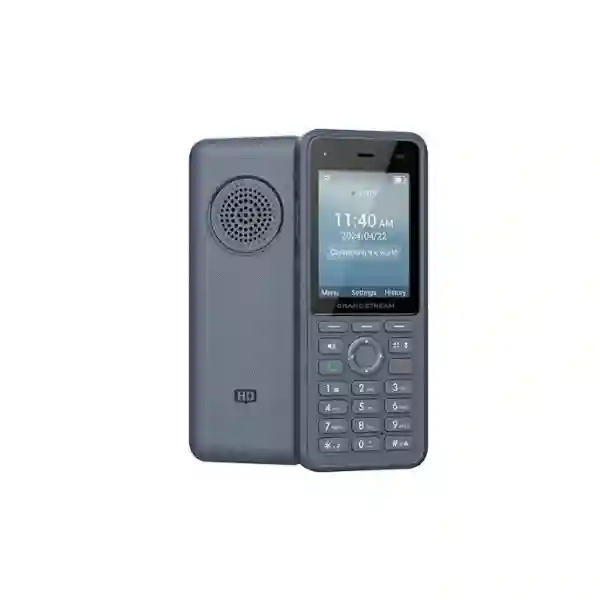
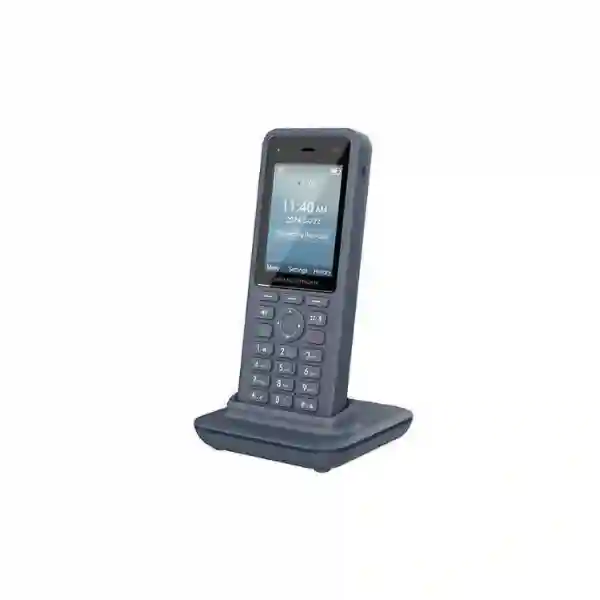
Grandstream WP836 Dubai: Rugged Wi-Fi 6 Cordless IP Phone for Mobile Teams
The Grandstream WP836 is a rugged cordless Wi-Fi IP phone built for organizations that need staff to move between work areas without giving up SIP calling, voice quality, managed provisioning, or workplace alert features. It combines dual-band Wi-Fi 6, 802.11k/r/v roaming support, three SIP accounts and three lines, HD voice with dual microphones, AI-based noise reduction, Bluetooth 5.4, push-to-talk, configurable alarm functions, and a 3000mAh battery. Grandstream’s current WP836 datasheet also lists IP67 and IP69K protection, resistance to water, dust and cleaning chemicals, an antibacterial casing, and drop protection up to 2 metres. For Dubai organizations evaluating mobility for logistics, healthcare, retail, hospitality, facilities, security, warehouses, campuses, workshops, and distributed office environments, the WP836 is best treated as part of a complete Wi-Fi and SIP design rather than as a simple cordless handset replacement.
IP67 & IP69K
3 SIP accounts / 3 lines
AI noise reduction
10-hour talk time*
*Battery figures are Grandstream laboratory data and real-world results depend on signal conditions, usage and configuration.
Rugged voice mobility
A strong fit where users walk between access points, work around dust or moisture, carry the handset through operational areas, or need push-to-talk and safety-alert functions alongside SIP calling.
Design Wi-Fi for voice
The handset supports Wi-Fi 6 and 802.11k/r/v, but roaming quality still depends on access-point placement, RF overlap, channel design, QoS, authentication and the quality of the wired network behind the WLAN.
Confirm the complete solution
Validate PBX compatibility, SIP registration requirements, SSID/security policy, headset needs, charger locations, expected duty cycle, alarm workflows, firmware baseline and roaming behaviour before purchasing at scale.
Provision for many users
Grandstream documents GDMS, TR-069 and encrypted XML provisioning options, making the WP836 suitable for structured rollouts where consistent settings, firmware and account configuration matter.
Why the WP836 is different from a normal office cordless phone
The WP836 is not a DECT handset and it is not a desk phone with a wireless adapter. It registers SIP accounts and uses the organization’s Wi-Fi network for voice connectivity. That changes both the opportunity and the design responsibility. A company can use a common wireless network across offices, warehouse aisles, clinics, hotel operational zones, retail floors and campus spaces, while the user carries one business handset. At the same time, a voice device is more sensitive to packet delay, interference and roaming transitions than ordinary browsing traffic. The practical value therefore comes from combining the handset with a well-engineered WLAN and a properly configured PBX or SIP platform.
Grandstream positions the WP836 for enterprise and vertical markets such as offices, retail, logistics, healthcare and security. The rugged design extends that idea. IP67 and IP69K protection, a cleaning-chemical-resistant antibacterial casing and 2-metre drop protection make the handset relevant in environments where shared devices may be cleaned regularly, carried by shift workers, exposed to operational dirt, or dropped during active work. These ratings do not mean every environment is automatically safe for the handset; organizations should still follow the operating limits, charging requirements, cleaning guidance and local safety rules for the application.
Another differentiator is the combination of operational communication features. A configurable push-to-talk button can support fast team communication. Alarm functions include push-button, man-down, no-movement, running and ambient-sound scenarios. The built-in accelerometer supports parts of that safety-oriented feature set. These functions should be treated as communications aids and workflow features, not as substitutes for certified life-safety systems, emergency infrastructure or industry-mandated protective equipment.
WP836 verified technical facts
| Area | WP836 specification / capability | Buyer meaning |
|---|---|---|
| Wireless | Integrated dual-band Wi-Fi 6, 802.11 a/b/g/n/ac/ax, 2.4 GHz and 5 GHz, 2T2R, 802.11k/r/v | Designed for managed enterprise WLANs and roaming between compatible APs. |
| SIP | 3 SIP accounts, 3 lines; current datasheet lists 5-way audio conferencing | Useful for users who need multiple identities, departments or call handling paths. |
| Display | 2.8-inch 240 × 320 color LCD with dual-color MWI | Larger display than the WP826 while keeping a keypad handset form factor. |
| Voice | HD audio, dual microphones, AEC, Noise Shield, AI noise reduction, Opus plus standard SIP codecs | Targets intelligible calling in active work environments when the network is engineered correctly. |
| Bluetooth | Integrated Bluetooth 5.4 | Allows compatible wireless headset use; validate the preferred headset before a bulk purchase. |
| Battery | 3000mAh Li-ion; up to 10 hours talk time and 240 hours standby in laboratory data | Suitable for many shift patterns, but charging strategy should match real use and RF conditions. |
| Ruggedization | IP67 and IP69K; waterproof, dustproof, cleaning-chemical resistant, antibacterial casing; 2m drop safe | Strong option for demanding operational environments compared with ordinary office handsets. |
| Safety / team features | Configurable push-to-talk; push-button, man-down, no-movement, running and ambient-sound alarms | Can support operational alerting and team workflows when correctly configured. |
| Security | WPA/WPA2/WPA3, enterprise and personal modes, OWE, TLS/SRTP, 802.1X, SCEP; OpenVPN and WireGuard support | Provides options for integration into controlled enterprise access and encrypted voice designs. |
| Provisioning | GDMS, TR-069, encrypted XML and multiple firmware transport options | Helps IT teams standardize configuration across fleets of handsets. |
| Operating environment | 0°C to 45°C operating temperature; 10–90% RH non-condensing | Outdoor or industrial projects should be checked against actual local conditions and charging locations. |
Specification note: Grandstream has published different revisions of WP836 web documentation. This page follows the current WP836 Datasheet v7 dated 10.2025 for detailed hardware and feature values, while deployment teams should still confirm the active firmware and current manufacturer documentation before rollout.
Wi-Fi 6 roaming: where a good WP836 project is won or lost
A cordless Wi-Fi phone can only perform as well as the wireless design carrying the voice packets. The WP836 supports both 2.4 GHz and 5 GHz Wi-Fi 6 and fast-roaming related standards 802.11k, 802.11r and 802.11v. Those capabilities help a compatible handset discover neighbouring access points, move authentication efficiently and make better roaming decisions. They do not correct poor RF design, overloaded access points, excessive co-channel interference, weak coverage at aisle ends, congested uplinks or a PBX path with high latency.
For Dubai offices, warehouses and mixed commercial spaces, Fourteck recommends evaluating voice coverage separately from ordinary data coverage. A laptop may tolerate a weak area while loading a webpage, but a live call can expose packet loss immediately. Site surveys should consider walking routes, staircases, lifts, loading areas, storerooms, corridors, treatment rooms, service entrances, staff-only zones and any place where a user is expected to remain on a call while moving. Access-point placement should minimize abrupt signal changes and avoid large dead zones between cells.
Network design should also consider SSID strategy, VLAN separation, QoS marking, DHCP scope capacity, DNS reliability, PBX reachability, firewall policies, WAN failover and whether the SIP platform is on-premises, hosted or delivered by a service provider. 802.1X and WPA enterprise options may be relevant for organizations that do not want shared Wi-Fi credentials. WPA3 and OWE can support more modern security designs where the rest of the infrastructure is compatible. These choices should be tested because authentication behaviour directly affects how a mobile voice endpoint joins and roams across the network.
A practical pilot is often more valuable than a specification-only decision. Configure several WP836 units with the intended firmware and PBX settings, then walk realistic routes while running active calls and push-to-talk workflows. Check call continuity, one-way audio, delay, re-registration, headset behaviour, alarm actions and battery consumption. This turns the Wi-Fi voice deployment into an engineered service rather than a box purchase.
Rugged design and workplace alert functions
The rugged construction is one of the main reasons to select the WP836 instead of a lighter general-purpose Wi-Fi handset. The current manufacturer datasheet lists both IP67 and IP69K protection. IP ratings describe resistance under defined test conditions; they should not be interpreted as permission to expose the phone to any liquid, chemical, temperature or pressure without considering the manufacturer’s guidance. The cleaning-chemical-resistant and antibacterial-casing claims are particularly relevant for healthcare, hospitality operations, shared facilities, security teams and other environments where devices may be cleaned frequently between users.
The manufacturer also lists 2-metre drop safety. That can reduce risk in active workplaces where a handset is clipped to clothing, carried while walking, or used by staff handling stock or equipment. A belt clip is included in the package. Procurement teams should still evaluate accessories, charging-cradle placement and user handling procedures. Rugged equipment lasts longer when the operational workflow is designed around it instead of assuming ratings remove all responsibility for care.
Alarm features broaden the WP836 use case beyond ordinary calling. A push-button action can provide a deliberate alert trigger. Man-down, no-movement and running functions can support defined staff-safety workflows, while ambient-sound related alerting may be relevant in particular operational scenarios. The exact business outcome depends on configuration, receiving systems, notification paths and staff procedures. These features should be validated during commissioning and periodically tested after firmware or infrastructure changes.
WP836 alarms can enhance operational communications, but Fourteck does not position the handset as a replacement for legally required emergency, medical, fire, lone-worker or life-safety systems. Where compliance is involved, use the appropriate certified system and treat the phone as a communications endpoint within the approved workflow.
Voice quality for noisy and mobile work environments
Grandstream combines several audio technologies in the WP836: broadband HD audio, dual microphones, acoustic echo cancellation, Noise Shield technology, AI noise reduction and the Opus codec. In practical terms, these features are intended to improve speech clarity and reduce distracting environmental noise. They are useful in places such as warehouses, busy retail floors, hotel service corridors, loading areas, maintenance spaces and healthcare environments where staff may need to speak while background activity continues.
Codec selection should be coordinated with the PBX, SIP trunk and network capacity. Opus can provide high-quality audio and flexibility, while G.722 and other supported codecs may be used depending on the system. The phone also supports familiar call capabilities such as hold, transfer, forward, call park, call waiting, auto answer, flexible dial plans and downloadable phonebooks. The current datasheet lists up to 1,000 XML phonebook entries and call logs up to 500 records. These details matter in shared operational roles because staff need quick access to departments, extensions and escalation contacts.
Bluetooth 5.4 provides another option for users who prefer a compatible wireless headset. A headset may be useful for supervisors, warehouse staff, hospitality operations or users who need hands-free calling. Bluetooth range and headset features vary by model, so a pilot should test the intended headset for pairing, call control, comfort, audio quality, charging and use with any push-to-talk workflow. Do not assume every Bluetooth accessory exposes every feature in the same way.
Voice quality is also a network matter. QoS, packet loss, jitter, WAN stability and Wi-Fi contention influence the actual experience. A WP836 with premium audio features cannot compensate for a poor network path. Fourteck therefore treats handset selection, WLAN design and PBX engineering as one communication system when customers request a deployment consultation.
SIP, PBX and security integration
The WP836 follows SIP RFC3261 and supports three SIP accounts. That makes it suitable for standard SIP-based business telephony designs, but compatibility should be confirmed with the PBX, hosted platform or service provider in use. Registration method, authentication requirements, codecs, DTMF mode, NAT traversal, TLS certificates, provisioning rules and feature codes can differ. For multi-site organizations, server redundancy and failover support can help design a more resilient voice environment when the upstream platform supports it.
The current datasheet lists several security mechanisms including WPA/WPA2/WPA3, personal and enterprise modes, OWE, 802.1X, TLS call encryption, SRTP options, SCEP and modern SIP authentication algorithms. It also lists OpenVPN and WireGuard support. These technologies give security teams options for aligning the handset with enterprise network policy. The correct design depends on whether the phone operates only on an internal voice VLAN, must reach a cloud PBX over the public internet, uses certificates for access, or needs a secure path across branch networks.
Security planning should go beyond enabling encryption. Create separate administrative credentials, restrict management access, maintain a controlled firmware baseline, use authenticated provisioning, segment voice devices where appropriate, monitor registration anomalies and document recovery procedures. Avoid leaving default Wi-Fi or administrative settings in production. Before a large rollout, confirm which services are enabled on the device and whether they are needed for the organization.
Grandstream’s provisioning options can reduce repetitive setup. GDMS can provide centralized management for Grandstream endpoints, while TR-069 and encrypted XML configuration files are also documented. Larger deployments can standardize SIP accounts, dial plans, Wi-Fi settings, firmware, language, programmable functions and security parameters. Central management is especially useful when devices are spread across several floors, branches or operating sites and support teams need a consistent baseline.
Where the WP836 fits by customer requirement
| Customer requirement | Relevant WP836 capability | Practical value | What to validate |
|---|---|---|---|
| Warehouse supervisors walking between aisles | Wi-Fi 6, roaming support, PTT, rugged housing | One handset for voice while moving through operational zones | RF coverage at aisle ends, loading bays, steel-rack shadowing and handoff behaviour |
| Healthcare or care teams | Rugged casing, cleaning-chemical resistance, Wi-Fi roaming, alarm functions | Mobile internal communication with features suited to shared operational use | Cleaning policy, WLAN security, coverage, notification workflow and local compliance needs |
| Retail floor managers | Compact mobile SIP device, Bluetooth, PTT, noise reduction | Faster access to colleagues without returning to a fixed desk phone | Guest Wi-Fi separation, headset comfort, call queues and paging process |
| Hotel operations and facilities teams | Wi-Fi mobility, SIP, PTT, alarms, 10-hour talk-time rating | Portable communications across back-of-house areas and service routes | Basement, lift, stairwell, plant-room and outdoor-service-zone coverage |
| Security teams | PTT, alarm functions, ruggedization, Bluetooth | Combines SIP calling with fast team communication in one device | Emergency process, battery rotation, RF coverage and separation from certified safety systems |
| Enterprise branch staff | 3 SIP accounts, centralized provisioning, security options | Standardizes a mobile voice endpoint across branches | PBX template, certificates, firmware control, WAN failover and support model |
A practical WP836 deployment architecture
A typical deployment starts with the handset connecting to a dedicated or business Wi-Fi SSID across multiple access points. The SSID may map to a voice VLAN or another controlled segment. DHCP provides addressing, DNS resolves services, and the handset reaches the PBX locally or across a routed/WAN path. QoS policies prioritize signaling and media where appropriate. The PBX then connects to internal extensions, SIP trunks, call queues, IVRs and other communication services according to the organization’s design.
For a multi-site business, the same WP836 configuration can be standardized while each branch has local Wi-Fi. Central provisioning can apply common firmware and account templates. A hosted PBX may simplify branch connectivity, while an on-premises PBX can provide tighter local integration. There is no universal architecture: internet quality, compliance, redundancy, number of handsets, branch autonomy and existing infrastructure determine the right design.
WP826 vs WP836 vs WP856: which Grandstream Wi-Fi phone should you choose?
| Decision area | WP826 | WP836 | WP856 |
|---|---|---|---|
| Primary profile | General Wi-Fi 6 cordless SIP phone | Rugged Wi-Fi 6 cordless SIP phone | Android Wi-Fi 6 smart device with scanner |
| SIP accounts / lines | 3 / 3 | 3 / 3 | Up to 6 / 6 |
| Display | 2.4-inch color LCD | 2.8-inch color LCD | 5.5-inch HD touch screen |
| Battery rating | 3000mAh, 12h talk, 240h standby | 3000mAh, 10h talk, 240h standby | 5000mAh, up to 20h talk, 200h standby |
| Rugged use | General-purpose | Strong rugged option with IP67/IP69K datasheet ratings | Rugged Android-class mobility device; Grandstream lists IP65 |
| Choose when | You need Wi-Fi 6 voice mobility without the WP836 rugged profile | You need ruggedness, alarms, larger keypad-phone display and operational voice mobility | You need Android apps, barcode scanning, larger touch interface or more SIP accounts |
The WP826 can be a sensible choice for office-style mobility where ruggedization is not a priority and slightly longer manufacturer-rated talk time is useful. The WP836 is the stronger fit when durability, alert functions and demanding operating areas are central to the requirement. The WP856 targets a different class of workflow: its larger Android interface, scanner and higher-capacity battery can suit logistics and application-led processes, but it is physically and operationally more like a smart enterprise device than a traditional keypad cordless phone.
Grandstream WP836 Dubai deployment considerations
For a Grandstream WP836 Dubai project, the first design question should be where staff actually move while speaking. Dubai sites often combine air-conditioned office space with loading zones, storage areas, service corridors, parking levels, outdoor transitions, workshops or high-ceiling warehouse spaces. These mixed environments can create very different RF conditions within one property. A conventional office access-point layout may not provide reliable voice coverage across metal racks, plant rooms or external service areas.
The second question is how the WP836 will connect to the business phone system. Existing Grandstream UCM deployments, standards-based IP PBXs, hosted SIP systems and other SIP environments may all be candidates, but feature behaviour should be validated before a fleet rollout. Confirm extension provisioning, call transfer, voicemail access, directory integration, call queues, emergency dial rules, caller ID, codecs and failover expectations. If the organization already uses VLANs and enterprise Wi-Fi authentication, plan certificate and credential handling as part of onboarding.
The third question is operational ownership. Decide who charges the handsets, who replaces damaged accessories, how spare units are stored, whether devices are assigned to individuals or shifts, how lost devices are disabled, and how firmware is controlled. For security or facilities teams working around the clock, charging cradle locations and battery discipline can be as important as the handset specification. For healthcare or hospitality, cleaning and handover procedures also matter.
Fourteck can help customers assess the handset together with the network and PBX requirement. The goal is not simply to quote a model number but to determine whether the WP836 is the correct endpoint for the walking routes, environmental exposure, voice workload, alarm needs, security standards and management process of the site.
Use cases across Dubai, Abu Dhabi, Sharjah and regional operations
Dubai logistics and warehousing: Wi-Fi voice can reduce dependence on fixed phones when supervisors, pickers, team leaders or security staff move across large floors. The WP836’s roaming support, rugged ratings, push-to-talk and alert functions align well with this pattern. The deployment should address RF shadows from racks, loading-dock transitions, high ceilings and external yard edges. Where barcode scanning is central to the workflow, compare the WP856 rather than assuming the WP836 replaces a dedicated scanner.
Abu Dhabi enterprise and institutional sites: Campuses, facilities teams, educational environments and large office complexes may benefit from a standardized cordless SIP endpoint. The important design questions include Wi-Fi authentication, certificate policy, extension numbering, cross-building roaming expectations, WAN resilience and whether staff need alarm functions. For sites with strict security policy, evaluate 802.1X, WPA enterprise, SCEP and encrypted voice options with the network team.
Sharjah industrial and commercial environments: Workshops, storage facilities and mixed industrial offices can expose handsets to dust, drops and cleaning requirements that make rugged construction more useful than a general-purpose office handset. Check the manufacturer’s operating temperature range and actual site conditions. Rugged ratings do not remove the need to protect charging equipment, power supplies and indoor infrastructure from unsuitable environments.
Hospitality and multi-site operations: Hotels, service apartments, managed facilities and distributed branches can use Wi-Fi handsets for staff mobility where reliable WLAN coverage already exists. A common provisioning template helps keep extensions, speed dials, Wi-Fi settings and firmware consistent. Service areas, stairwells, basements and engineering spaces should be included in testing because these are often the exact places where operational staff need communication.
Uganda, Kenya, Tanzania, Nigeria, Ghana and Kuwait projects: The same product logic applies, but connectivity, power design, support coverage, import lead times, environmental conditions and existing PBX/WLAN infrastructure differ by project. Fourteck’s regional technology network can support solution discussions through Fourteck Uganda, Fourteck Kenya, Fourteck Tanzania, Fourteck Nigeria, Fourteck Ghana and Fourteck Kuwait. Product availability and project scope should be confirmed for each market rather than assumed.
Procurement checklist before requesting a WP836 quotation
A useful quotation starts with requirements, not just quantity. Sharing the information below helps Fourteck recommend the handset, accessories and implementation scope more accurately. It can also reveal when a WP826, WP856, DECT solution or fixed IP phone would be a better fit.
- Quantity and user roles: number of handsets, departments, shared-shift devices versus named users, and expected expansion.
- Site type: office, warehouse, retail, healthcare, hotel, school, industrial site, security operation or mixed environment.
- Existing PBX: vendor/model, hosted or on-premises, SIP registration details, extension count and any high-availability design.
- Wi-Fi infrastructure: access-point vendor/models, controller, Wi-Fi generation, current coverage, enterprise authentication, VLANs and known weak areas.
- Mobility path: where calls must remain active while users walk and whether coverage is required outdoors, in stairwells, basements or loading zones.
- Audio needs: handset-only use, speakerphone, Bluetooth headset, noisy spaces and push-to-talk expectations.
- Safety workflow: whether alarm functions are needed, who receives them and how they fit alongside required emergency systems.
- Charging plan: number and location of charging points, shift duration, spare handset strategy and after-hours charging responsibility.
- Security policy: WPA/WPA2/WPA3, 802.1X, certificates, voice encryption, device-management access and firmware control.
- Services required: supply only, Wi-Fi survey, configuration, PBX integration, provisioning, installation assistance, testing, documentation and post-deployment support.
Recommended deployment workflow
Identify who needs mobility, where users move, the number of concurrent calls, expected talk time, safety functions and any headset requirement.
Review access points, RF coverage, roaming settings, SSIDs, security, VLANs, switches, QoS, WAN links and known dead zones.
Test SIP registration, codecs, dial plan, transfer, queues, voicemail, TLS/SRTP and failover behaviour with the actual phone system.
Deploy a small number of units, use the intended firmware and walk real routes while monitoring call continuity, roaming and battery behaviour.
Create approved templates for accounts, Wi-Fi, security, buttons, alarms, directories, language, firmware and device-management access.
Stage the handsets, label ownership, record configuration, train users, document escalation paths and keep a process for updates and replacements.
When the WP836 may not be the right choice
A good product page should also explain when not to buy. The WP836 may be unnecessary for a user who sits at a desk most of the day and needs a large display, many programmable keys, sidecar modules or a wired Ethernet connection; a desktop IP phone may be more appropriate. If the building has weak or unmanaged Wi-Fi and the organization does not intend to improve it, a Wi-Fi handset can expose those network weaknesses rather than solve them. In some sites a dedicated DECT system may provide a more predictable cordless design, depending on coverage, capacity and the existing telephony platform.
The WP836 is also not the highest-capacity choice in Grandstream’s current Wi-Fi cordless range. Users who need Android applications, integrated barcode scanning, a large touch display, more SIP accounts or longer talk-time specifications should compare the WP856. Conversely, users who do not require the WP836 rugged profile may find the WP826 sufficient. Selecting the higher model without a requirement can increase procurement cost without adding operational value.
Finally, rugged and alarm features should not be confused with universal industrial certification or certified life-safety functionality. Confirm the exact environmental, hazardous-area and regulatory requirements of the site. If a project needs intrinsically safe equipment, specialized emergency systems or certified lone-worker technology, choose equipment specifically approved for that purpose.
Frequently asked questions about the Grandstream WP836
Is the Grandstream WP836 a Wi-Fi 6 phone?
Yes. Grandstream lists integrated dual-band Wi-Fi 6 using 802.11a/b/g/n/ac/ax on 2.4 GHz and 5 GHz. The WP836 also supports 802.11k/r/v for roaming-related functions. Actual call mobility still depends on the WLAN design, access-point configuration and RF conditions.
How many SIP accounts and lines does the WP836 support?
The current Grandstream WP836 datasheet lists three SIP accounts and three lines. This can suit users who require more than one SIP identity or line appearance, subject to the behaviour of the connected PBX or hosted SIP service.
Is the WP836 waterproof and dustproof?
Grandstream’s current WP836 Datasheet v7 lists IP67 and IP69K ratings together with resistance to water, dust and cleaning chemicals. It also lists an antibacterial casing and 2-metre drop safety. Buyers should follow the manufacturer’s environmental and care guidance rather than treating the ratings as unlimited protection.
What is the WP836 battery life?
The handset uses a 3000mAh lithium-ion battery. Grandstream lists up to 10 hours of talk time and 240 hours of standby time as laboratory data. Real results vary with Wi-Fi signal strength, roaming, screen use, Bluetooth, call patterns and configuration.
Does the WP836 support Bluetooth headsets?
Yes. The current datasheet lists integrated Bluetooth 5.4. Because headset controls and feature support can vary, Fourteck recommends testing the intended Bluetooth headset before a large deployment, especially where push-to-talk or specialized call-control behaviour is required.
Can the WP836 roam between Wi-Fi access points during a call?
The WP836 supports 802.11k/r/v, which are designed to improve roaming in compatible WLANs. Successful call roaming depends on access-point placement, RF overlap, security method, controller design, firmware and network tuning. A walking call test should be part of commissioning.
Does the WP836 support push-to-talk and staff alarm functions?
Yes. Grandstream lists a configurable push-to-talk button and alarm functions including push-button, man-down, no-movement, running and ambient-sound scenarios. The organization should define where alarms go, who responds and how the feature fits into the wider safety process.
Can the WP836 be centrally provisioned?
Yes. Grandstream documents GDMS, TR-069 and AES-encrypted XML configuration methods, along with multiple firmware delivery protocols. Central provisioning can help IT teams keep account, security, Wi-Fi and firmware settings consistent across many handsets.
What is the difference between WP826 and WP836?
Both are Wi-Fi 6 SIP handsets with three accounts and three lines. The WP836 is the rugged option with a larger 2.8-inch display and the stronger environmental and alarm-focused profile. The WP826 has a 2.4-inch display and Grandstream lists up to 12 hours of talk time versus 10 hours for the WP836. Choose based on the work environment rather than model number alone.
Where can I request a Grandstream WP836 Dubai quotation and deployment consultation?
Fourteck can review the required quantity, PBX environment, Wi-Fi coverage, roaming areas, security policy, headset needs, rugged-use conditions and services required before preparing a project quotation. Product availability, lead time and commercial terms should be confirmed at the time of inquiry rather than assumed from a web page.
Discuss your WP836 requirement with Fourteck
If your team needs a rugged cordless SIP handset for a warehouse, healthcare facility, retail operation, hotel, enterprise campus, facilities department or security environment, Fourteck can help assess the endpoint together with Wi-Fi and PBX readiness. Share the user count, site type, existing access points, PBX platform, mobility routes and any push-to-talk or alarm requirement. We can then help determine whether the WP836, WP826, WP856 or another communication architecture is the better technical fit.
Technical reference: Content is based primarily on Grandstream’s current WP836 Datasheet v7 (10.2025), current product information and current WP8x6 documentation available at the time of preparation. Firmware evolves; Grandstream currently lists WP816/WP826/WP836 production firmware separately from beta releases. Verify the latest approved firmware, compatibility and specification revision before final deployment. Product availability, price, delivery, warranty scope and project services are subject to confirmation.
Reviews
There are no reviews yet.