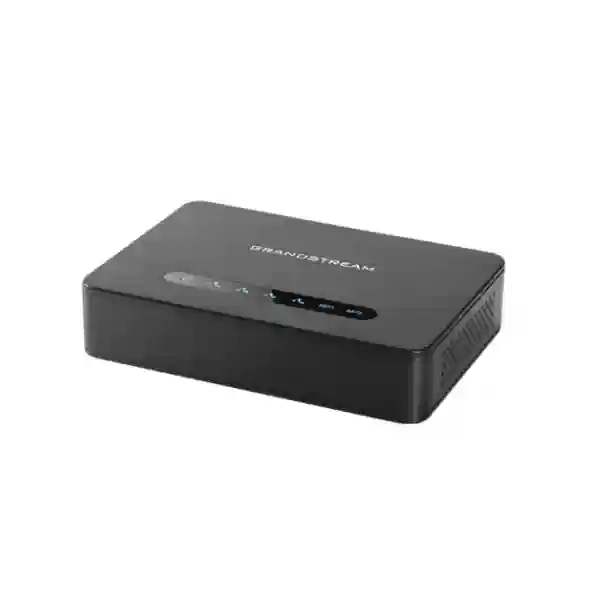

Grandstream HT814 v2 Dubai – 4-Port FXS VoIP Gateway for Analog Phone and Fax Migration
The Grandstream HT814 v2 is designed for organizations that still need reliable analog endpoints but want those devices to operate on a modern SIP-based voice network. It provides four RJ11 FXS ports for analog telephones, fax machines, cordless bases, service phones, and similar two-wire analog devices, while two Gigabit Ethernet interfaces and an integrated NAT router provide flexible network placement. For Dubai and UAE projects, the practical value is straightforward: instead of replacing every analog endpoint immediately, a business can preserve selected devices, connect them to a SIP platform, and modernize the wider voice environment in controlled stages.
The key decision is not simply whether the HT814 v2 has four ports. Buyers should also check how many analog endpoints must remain in service, whether fax is required, what PBX or SIP service will register the lines, which security and codec settings are expected, and whether centralized provisioning is needed across multiple locations. Fourteck can map those requirements before quotation so the ATA, PBX, network, and endpoint plan work as one system.
Who should consider the HT814 v2?
The HT814 v2 fits deployments that have more than two analog endpoints but do not require the eight FXS ports of the HT818 v2. Examples include a small office retaining several analog handsets, a clinic keeping fax and analog extensions, a branch office migrating from legacy telephony, a warehouse using durable analog phones in operational areas, or a hospitality site keeping selected service phones while the main voice platform moves to SIP. Its four-port format is a useful middle ground when a two-port ATA would be too small and an eight-port gateway would be unnecessarily large.
The device should not be treated as a complete PBX. It is an analog telephone adapter and VoIP gateway that connects analog endpoints to a SIP environment. Extension logic, trunks, IVR, queues, voicemail, recording, call routing, and business policies normally come from a connected IP PBX, hosted PBX, SIP platform, or service provider. Before purchase, confirm the number and type of analog devices, the SIP platform, the network design, codec policy, fax expectations, secure signaling/media requirements, and whether the ATA will sit behind an existing firewall/router or use its own integrated routing functions.
Customer requirement → practical HT814 v2 value
| Requirement | Capability | Benefit | Consideration |
|---|---|---|---|
| Keep up to four analog devices | 4 RJ11 FXS ports | Preserves selected analog phones, fax machines, or cordless bases during SIP migration. | Confirm each endpoint is compatible with a standard two-wire FXS interface. |
| Use wideband codec options | G.722 and Opus among supported codecs | Supports HD-capable SIP call paths where the rest of the system is compatible. | Final audio quality also depends on the analog handset, PBX, WAN and remote endpoint. |
| Retain fax | T.38 Group 3 fax relay with G.711 fallback | Allows a traditional fax device to operate through a suitable VoIP environment. | PBX, SIP provider and network quality must support reliable fax operation. |
| Secure SIP signaling and media | TLS/SIPS/HTTPS and SRTP support | Supports protected signaling/control and encrypted media where configured end to end. | Encryption must also be supported by the PBX or service provider. |
| Repeatable multi-site rollouts | TR-069, HTTP/HTTPS, TFTP, AES-secured provisioning and remote management | Reduces manual configuration and configuration drift. | Templates should be validated before mass deployment. |
Verified Grandstream HT814 v2 specifications
Grandstream describes the HT814 v2 as a four-port FXS gateway with an integrated Gigabit NAT router. The official datasheet lists four RJ11 FXS ports, two 10/100/1000 Mbps Ethernet ports, a reset button, multiple voice codecs, fax relay, SIP and networking protocols, QoS, encrypted media/control options, remote management, and a 12V power supply. The table below is intended for project planning and procurement; firmware-specific behavior should always be checked against the latest Grandstream documentation before rollout.
| Analog interfaces | Four RJ11 FXS ports |
|---|---|
| SIP profiles | Two SIP profiles across four FXS ports |
| Ethernet | Two 10/100/1000 Mbps RJ45 ports, NET1 and NET2 |
| Voice codecs | G.711, G.722, G.723.1, G.729A/B, G.726-32, iLBC and Opus, with dynamic jitter buffer and advanced line echo cancellation |
| Telephony | Caller ID display/block, call waiting, flash, blind or attended transfer, forwarding, hold, DND and 3-way conference |
| Fax | T.38 Group 3 fax relay up to 14.4 kbps with automatic G.711 fax pass-through fallback |
| Caller ID formats | Bellcore Type 1 & 2, ETSI, BT, NTT and DTMF-based caller ID |
| QoS | 802.1Q VLAN, SIP/RTP 802.1p and Layer 3 ToS, DiffServ, MPLS, plus traffic shaping |
| Security | SRTP media, TLS/SIPS/HTTPS control options, AES-secured provisioning and device certificate features |
| Provisioning / management | HTTP, HTTPS, SSH, TFTP, TR-069, syslog and web-based remote management |
| Ring load | 2 REN, up to 1 km on 24 AWG line |
| Power | 100–240 VAC input; 12V/1.0A output |
| Environment | 0°C to 50°C operating; 10–90% non-condensing humidity |
| Dimensions / weight | 28.5 × 130 × 90 mm; 0.29 kg |
Network design: NET1, NET2, NAT and QoS
Grandstream’s current HT8xx v2 documentation describes the HT812, HT814 and HT818 v2 as dual-Gigabit devices with NET1 and NET2 interfaces. By default, NET1 operates as the WAN-side DHCP client and NET2 as the LAN-side DHCP server, and their roles can be changed through the web interface. That flexibility is useful when fitting the ATA into different network layouts, but it does not mean the device should always become the site router. Where a business already has a firewall that handles WAN failover, VPNs, VLANs, security inspection and QoS, the cleaner design may be to place the ATA behind that network edge and use it primarily for analog-to-SIP conversion.
For Dubai offices, the network plan should decide whether the ATA belongs in a voice VLAN, how DHCP and DNS will be provided, whether SIP signaling traverses NAT, whether an SBC or PBX handles NAT traversal, and how RTP traffic will be prioritized. The HT814 v2 supports Layer 2 802.1Q/802.1p and Layer 3 QoS mechanisms listed by Grandstream, but those features deliver real value only when the switches, routers, PBX and SIP service follow the same traffic policy.
Avoid exposing the ATA management interface directly to the public internet without a deliberate secured design. Use strong credentials, prefer encrypted management and SIP options where supported end to end, restrict administrative access, keep firmware aligned with Grandstream guidance, and protect provisioning systems.
Voice quality and codec planning
The HT814 v2 supports G.711, G.722, G.723.1, G.729A/B, G.726-32, iLBC and Opus. This gives installers flexibility to balance compatibility, bandwidth and voice quality. G.722 and Opus can support wideband audio on compatible SIP paths, while G.711 is frequently chosen where interoperability and simple media handling are priorities. Compressed codecs can reduce bandwidth, but codec selection should follow the PBX, SIP trunk, remote endpoint and WAN design rather than being chosen in isolation at the ATA.
Because the final endpoint on the FXS side is still analog, user experience is influenced by handset quality, analog cabling, ring load, line distance, electrical conditions and the endpoint’s own acoustics. Grandstream lists dynamic jitter buffering and advanced line echo cancellation, but poor WAN performance can still cause call problems. Packet loss, jitter, overloaded uplinks, incorrect QoS, SIP ALG interference or unsuitable NAT handling should be corrected in the network rather than masked with random codec changes.
Fax over IP with the HT814 v2
Fax is one of the strongest reasons businesses retain analog ports. The HT814 v2 supports T.38 compliant Group 3 fax relay up to 14.4 kbps and can automatically fall back to G.711 fax pass-through. This can allow an existing fax machine to remain in service while the surrounding voice platform moves to IP. Reliable faxing, however, depends on the full call path. The PBX or SIP provider must support the chosen fax method, NAT handling must be correct, packet loss and jitter must stay controlled, and codec or media negotiation must remain predictable.
For UAE organizations that still exchange forms, signed documents, logistics paperwork or legacy vendor communications by fax, Fourteck can include fax validation in the implementation plan. That can include checking T.38 support, assigning a dedicated FXS port, testing inbound and outbound multi-page transmissions and documenting fallback behavior before a legacy service is retired.
Security capabilities for business SIP environments
Grandstream lists SRTP for media and TLS/SIPS/HTTPS-related control options for the HT814 v2, together with AES-secured automated provisioning and device certificate features. These capabilities are most useful when security is designed end to end. Enabling SRTP on the ATA alone does not guarantee a fully encrypted call if the PBX, trunk or remote endpoint terminates media security differently.
A practical deployment policy should include changing administrative credentials, restricting management access to trusted networks, disabling unnecessary services, using encrypted signaling and media where supported, keeping firmware current, securing configuration files and provisioning servers, monitoring failed registrations, and controlling outbound calling permissions on the PBX. Multi-site configuration templates should also avoid accidental reuse of shared passwords or insecure remote-management settings.
Provisioning and multi-site management
Manual setup is acceptable for a single ATA, but it becomes inefficient when a business operates many branches. Grandstream documents TR-069, HTTP/HTTPS, TFTP, SSH, syslog, AES-secured provisioning and remote web management for this device family. A structured rollout should define a baseline profile for SIP servers, transport and security, codec priorities, dial plans, FXS assignments, time/NTP, VLAN/QoS, firmware policy, remote access and logging.
Once the baseline is validated, each unit should receive only the site-specific or extension-specific values that need to differ. This reduces configuration drift and helps support teams diagnose problems consistently. The same approach is useful for organizations operating across Dubai, Abu Dhabi, Sharjah, Ajman and other UAE locations, as well as regional branches in GCC and African markets.
HT812 v2 vs HT814 v2 vs HT818 v2
Within Grandstream’s HT81x v2 family, port count is the fastest way to narrow the choice. Grandstream’s current FAQ identifies the HT812 v2 with two FXS ports, the HT814 v2 with four, and the HT818 v2 with eight. These models also include dual Gigabit interfaces and NAT routing functionality. Buyers should size for current analog devices and sensible near-term growth, then consider physical layout, management, fax, and the operational impact of concentrating more endpoints behind one gateway.
| Model | FXS | Typical fit | Decision point |
|---|---|---|---|
| HT812 v2 | 2 | Small office, phone + fax, two retained analog extensions | Will two ports remain enough after migration? |
| HT814 v2 | 4 | Branch, clinic, hospitality service area or SMB with several analog devices | Do four ports cover the real requirement plus reasonable spare capacity? |
| HT818 v2 | 8 | Higher-density analog cluster | Would one eight-port gateway simplify the site or increase the impact of a single-device failure? |
HT814 v2 deployment examples in Dubai and UAE
Small and medium offices
A common office design may retain reception overflow, an existing cordless base, a meeting-room analog handset and a fax machine while the majority of staff use IP phones. The HT814 v2 can consolidate those endpoints on one ATA. Extension permissions, outbound caller ID, emergency dialing, voicemail behavior and QoS should remain consistent across both analog and IP endpoints.
Hotels and serviced properties
Hospitality environments often contain mixed generations of telephony. Back-of-house analog devices may remain even after front-desk or room systems move to IP. A four-port ATA can serve a small analog cluster, but specialized hotel, emergency or service devices should be checked for signaling, ringing, DTMF, supervision and power-failure requirements before migration.
Clinics and professional offices
Clinics, legal practices, accounting firms and similar organizations may continue using fax and a few analog handsets. The HT814 v2 can support that transition, but security policy should cover SIP credentials, provisioning, administrative access and the surrounding network because the ATA becomes part of the IP infrastructure.
Warehouses and operational sites
Warehouses may retain analog phones or cordless bases in operational zones because the devices are simple and familiar. The ATA can connect them to a centralized SIP platform, while the deployment plan accounts for line length, cable condition, switch topology, VLANs, UPS coverage and remote troubleshooting.
Regional planning for GCC and Africa
Abu Dhabi: Enterprise and institutional environments may require stricter network segmentation, security documentation, change control and standardized device management. Plan the HT814 v2 as a managed part of the voice architecture rather than as an isolated accessory.
Sharjah and Ajman: SMEs, schools, clinics and warehouses may prefer staged modernization that preserves usable analog devices. The four-port capacity can provide a practical balance between cost, port density and manageability.
Kuwait and GCC: Similar use cases apply to branches, hospitality, clinics and SMEs, but SIP trunk rules, carrier requirements and equipment policies vary by country. Confirm local requirements before deployment.
Uganda, Kenya, Tanzania, Ghana and Nigeria: Analog-to-SIP migration can be useful where organizations are centralizing communications but still have working analog endpoints. WAN stability, UPS coverage, remote management, spare-unit planning and consistent provisioning can be particularly important for distributed sites.
Recommended installation workflow
- Document endpoints: map FXS1–FXS4 to the intended phones, fax machines or other approved analog devices.
- Confirm SIP compatibility: collect SIP server, user ID, authentication ID, password, transport, codec policy, failover and outbound proxy details where applicable.
- Choose network placement: decide whether the ATA sits behind the main firewall/router or whether NET1/NET2 routing functions are required.
- Identify the IP address: Grandstream documentation allows users to dial *** and then 02 from an attached analog phone to hear the current IP address.
- Configure profiles and ports: apply the SIP profile, map each FXS port to the proper credentials and verify registration.
- Apply security: change administrative credentials, restrict access and enable HTTPS/TLS/SRTP where supported by the full environment.
- Test calls: validate inbound/outbound calls, DTMF, caller ID, transfer, forwarding, conference and failover requirements.
- Test fax separately: if T.38 or G.711 pass-through is required, test multi-page inbound and outbound faxes over the real SIP trunk.
- Document the approved baseline: record firmware, network values, SIP mapping and troubleshooting notes for support.
Procurement checklist
- How many analog endpoints are required now and in the near future?
- Are the endpoints ordinary analog phones/fax devices or specialized equipment requiring separate compatibility confirmation?
- Which PBX, hosted PBX, UCM platform, SIP trunk or service provider will register the lines?
- Are TLS, SRTP, SBC, VPN, VLAN or specific firewall policies required?
- Is fax business critical, and does the service path support T.38?
- Will the ATA be individually managed or centrally provisioned?
- Would two, four or eight FXS ports provide the best balance of capacity and resilience?
- Do you need hardware only, or also PBX registration, network configuration, fax testing and support?
Common troubleshooting areas
FXS port does not register
Check the SIP server, SIP user ID, authentication ID, password, assigned profile, DNS, transport, outbound proxy and firewall policy. Verify status per port in the web interface and isolate one setting at a time.
One-way audio
Review NAT, RTP ranges, SBC behavior, firewall rules, SIP ALG, VPN routing and advertised media addresses. One-way audio is usually a media-path problem rather than an analog-port failure.
Fax is inconsistent
Confirm real T.38 support from the SIP provider or PBX, inspect negotiated fax mode, check packet loss/jitter, and test longer multi-page faxes rather than relying on one short test.
DTMF menus do not respond
The HT814 v2 supports in-audio, RFC2833 and SIP INFO methods. Match the configured DTMF method to the PBX or service-provider requirement.
When another model may be better
If only one or two analog endpoints are required, a smaller HT801 v2, HT802 v2 or HT812 v2 may better match the site. If substantially more than four analog extensions are needed, the HT818 v2 or a higher-density FXS gateway may reduce device count. Where all endpoints can be replaced with native SIP phones, moving directly to IP endpoints may reduce analog dependencies and provide a richer feature set.
Specialized analog devices deserve extra caution. Alarm panels, lift phones, modems, POS terminals, access-control equipment, paging systems and emergency phones can have signaling or regulatory requirements that differ from standard telephones. An RJ11 connector alone is not proof of compatibility. Confirm requirements with the device manufacturer, SIP provider and project consultant before removing a legacy circuit.
Why choose Fourteck for an HT814 v2 project?
Fourteck treats ATA deployments as part of the complete voice and network environment. The project discussion can therefore include analog endpoint count, PBX/SIP design, extension mapping, VLAN and QoS, firewall/NAT behavior, secure signaling/media, fax requirements, provisioning, regional rollout and support. This avoids purchasing an ATA first and discovering network or compatibility issues only during installation.
For Dubai and UAE requirements, Fourteck can help determine whether the HT814 v2 is the correct four-port choice or whether a smaller or larger Grandstream ATA better fits the requirement. Hardware availability, pricing, lead time and commercial scope should be confirmed at quotation stage rather than assumed online.
Explore related resources through Fourteck UAE, Fourteck IP Phone, Grandstream UAE, Fourteck Kuwait, Fourteck Uganda, Fourteck Kenya, Fourteck Tanzania, Fourteck Ghana, and Fourteck Nigeria.
Frequently asked questions
How many analog phones can the HT814 v2 connect?
The HT814 v2 provides four RJ11 FXS ports, so it can connect up to four standard analog endpoints, subject to device compatibility and ring-load requirements.
Does the HT814 v2 support fax?
Yes. Grandstream specifies T.38 Group 3 fax relay up to 14.4 kbps and automatic G.711 fax pass-through fallback. Actual reliability also depends on the PBX, SIP provider and network path.
Does it have Gigabit Ethernet?
Yes. It includes two 10/100/1000 Mbps RJ45 network ports labeled NET1 and NET2 in Grandstream’s v2 documentation.
Can NET1 and NET2 swap LAN/WAN roles?
Grandstream’s HT8xx v2 documentation states that the HT812, HT814 and HT818 v2 models allow the NET1 and NET2 roles to be switched in the web interface. By default, NET1 is a DHCP client and NET2 is a DHCP server.
Does the HT814 v2 support encrypted SIP?
The device supports TLS/SIPS/HTTPS control options and SRTP media. End-to-end encryption depends on compatible configuration across the ATA, PBX, SIP service and remote endpoint.
Can it be centrally provisioned?
Yes. Grandstream documents TR-069, HTTP/HTTPS, TFTP and AES-secured provisioning workflows that are useful for repeatable deployments.
How do I find its IP address?
Connect an analog phone to an FXS port, dial *** to enter the IVR menu, and then dial 02. The ATA will announce its current IP address.
HT812 v2, HT814 v2 or HT818 v2?
Start with analog port count: HT812 v2 has two FXS ports, HT814 v2 has four, and HT818 v2 has eight. Then consider spare capacity, site layout, management, fax needs and resilience.
Is the HT814 v2 a PBX?
No. It is an analog telephone adapter/gateway. Business call control normally comes from the connected SIP PBX, hosted PBX or service provider.
Can Fourteck supply and configure the HT814 v2 in Dubai?
Fourteck can assess the requirement and prepare a quotation covering suitable hardware, SIP/PBX compatibility, installation or configuration scope, and related network considerations. Current stock, pricing and lead time should be confirmed when requesting the quotation.
Request an HT814 v2 quotation or compatibility check
Share the number of analog devices, PBX or SIP provider, location, fax requirement, network design, and whether you need supply only or configuration support. Fourteck can then confirm whether the Grandstream HT814 v2 is the right four-port ATA or whether another model fits the project better.
Technical details are based on Grandstream HT814 v2 product, datasheet, installation and HT8xx v2 documentation available at the time of writing. Firmware and configuration behavior can change; confirm the latest Grandstream documentation and project-specific compatibility before deployment.




Reviews
There are no reviews yet.