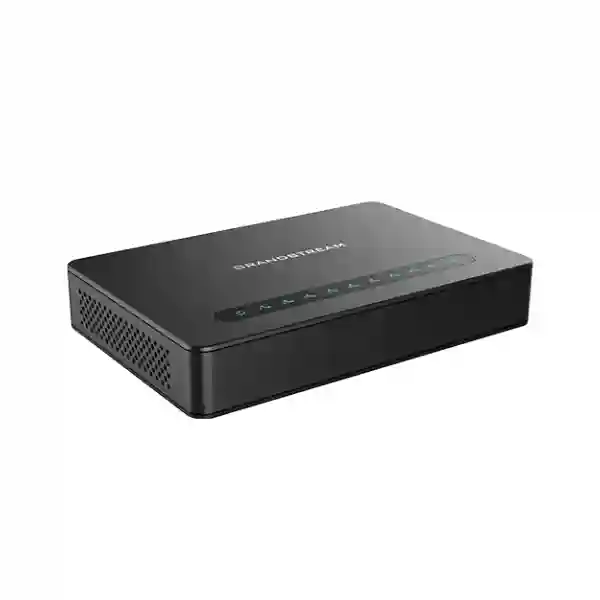
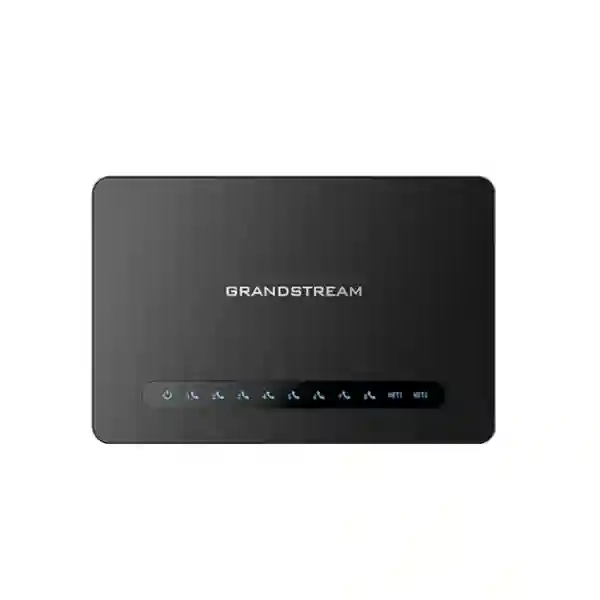
Grandstream HT818 v2: 8-Port FXS VoIP Gateway for Analog Migration
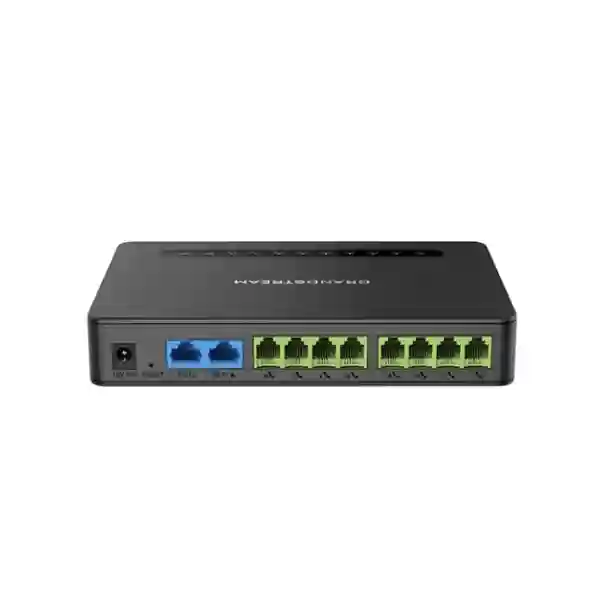
The Grandstream HT818 v2 is a powerful eight-port analog telephone adapter and VoIP gateway for businesses that need to retain compatible analog devices while moving the voice core to SIP. Grandstream specifies eight RJ11 FXS ports, two SIP profiles, dual 10/100/1000 Mbps network interfaces, an integrated Gigabit NAT router, wideband codec support, T.38 fax, secure provisioning, and three-way conferencing per port.
For Dubai and UAE projects, its strongest role is as a controlled migration bridge. Instead of replacing every working analog phone or fax device immediately, an organization can move the PBX or voice service to IP while keeping selected endpoints. The correct deployment still depends on interface type, SIP design, network quality, fax requirements, security, port mapping, and testing.
Verified HT818 v2 specifications
| Specification | HT818 v2 | Deployment relevance |
|---|---|---|
| Telephone interfaces | 8 × RJ11 FXS | Connects compatible analog station devices. |
| SIP profiles | 2 | Registration architecture must be planned across eight ports. |
| Network | 2 × 10/100/1000 Mbps RJ45 | Gigabit attachment with flexible WAN/LAN roles. |
| Voice codecs | G.711, G.722, G.723.1, G.729A/B, G.726-32, iLBC, Opus | Supports varied PBX, bandwidth, and voice-quality requirements. |
| Fax | T.38 Group 3 up to 14.4 kbps; G.711 pass-through | Supports legacy fax migration when the full call path is compatible. |
| Security | SRTP, TLS/SIPS/HTTPS, AES-protected provisioning, unique certificate | Supports secure signaling, media, management, and provisioning design. |
| QoS | 802.1Q, 802.1p, ToS, DiffServ, MPLS, traffic shaping | Useful for managed voice-network integration. |
| Power | 100–240VAC input; 12V/1.5A output adapter | Include correct power and UPS planning where needed. |
| Physical | 180 × 120 × 36 mm; 356 g | Compact placement with proper cable management and ventilation. |
| Environment | 0–50°C operation; -10–60°C storage; 10–90% RH non-condensing | Check communications-room conditions before deployment. |
Where the HT818 v2 fits in an analog-to-IP migration
The Grandstream HT818 v2 is most useful when an organization wants to modernize the voice platform without replacing every analog endpoint at once. It provides eight RJ11 FXS ports for station-side analog devices, allowing conventional phones, supported fax machines, and other compatible analog endpoints to participate in a SIP-based communication environment. In practical terms, the gateway can become a bridge between existing copper-connected devices and a newer IP PBX, hosted SIP service, or service-provider platform. This is valuable for offices, branches, warehouses, clinics, schools, hospitality environments, service counters, and other sites where several analog endpoints still have operational value.
The buying decision should begin with the customer requirement, not the model number. Count how many analog endpoints will remain, identify what each endpoint actually does, confirm whether the interface required is FXS or FXO, understand the SIP registration model, and decide how the gateway will join the LAN. If the business needs up to eight station-side analog connections and two SIP profiles fit the voice architecture, the HT818 v2 can be a compact way to consolidate migration. If the requirement is for analog PSTN trunk interfaces, much higher port density, more independent SIP profiles, or specialized life-safety integrations, a different gateway class may be more appropriate.
Eight FXS ports: what buyers should understand
FXS means Foreign Exchange Station. An FXS port presents the analog station interface expected by a conventional telephone or compatible fax device. The HT818 v2 includes eight RJ11 FXS ports, so one appliance can concentrate several analog endpoints instead of requiring multiple one-port or two-port ATAs. This can simplify power, administration, labeling, and physical installation where the devices are located in the same office or communications area.
The connector alone does not guarantee compatibility with every legacy device. Grandstream specifies a 2 REN ring load and support up to 1 km on 24 AWG line. Projects involving very long copper runs, unusual ringing requirements, old bell equipment, bridged analog devices, intercoms, lift interfaces, alarm panels, or specialized equipment should be validated rather than assumed compatible. For standard telephones and fax devices, the product is designed specifically for analog-to-VoIP migration, but unusual equipment should be tested in the intended configuration.
Caller-ID and analog signaling settings also matter. Grandstream documents Bellcore Type 1 and 2, ETSI, BT, NTT, and DTMF-based caller ID, as well as DTMF and pulse dialing support and multiple disconnect methods. During staging, validate caller ID, hook flash, transfer, call waiting, DTMF, disconnect supervision, ringing, and any application-specific behavior on the actual devices that will remain in service.
Two SIP profiles across eight analog ports
A common procurement mistake is to assume that eight FXS ports automatically mean eight completely independent SIP profiles. Grandstream specifies two SIP profiles for the HT818 v2. That architecture can work well, but the deployment team should decide how the analog ports will be grouped and registered before the gateway is installed. Extension numbering, authentication model, hunt groups, trunk routing, outbound proxy requirements, dial plans, and provider behavior all influence the final configuration.
In an on-premises IP PBX deployment, the gateway may register extensions or profiles toward the local voice server. In a hosted environment, the service provider may define registration and NAT requirements. For a managed multi-site deployment, standardized configuration templates may be appropriate. In every case, collect the registrar or proxy address, transport requirements, credentials, DTMF method, preferred codecs, NAT settings, registration timers, and failover behavior before cutover.
This distinction also affects sizing. A customer with six analog phones may fit comfortably in the eight-port hardware, yet still have a registration model that does not suit two SIP profiles. Conversely, a branch with eight analog endpoints under a shared or structured SIP design may be an excellent match. Port capacity and SIP-profile capacity answer different design questions.
Voice quality and codec planning
Grandstream lists G.711 with packet-loss concealment and voice-activity features, G.722, G.723.1, G.729A/B, G.726-32, iLBC, and Opus for the HT818 v2. It also documents dynamic jitter buffering and advanced line echo cancellation. This gives administrators several options for matching voice quality and bandwidth requirements to a PBX or SIP service.
Codec support alone does not guarantee good calls. Voice quality depends heavily on the LAN and WAN. Packet loss, jitter, congestion, incorrect duplex settings, cabling faults, overloaded WAN links, misconfigured Wi-Fi bridges, or poor QoS can degrade calls even when the ATA is configured correctly. The product supports Layer 2 controls such as 802.1Q VLAN and 802.1p and Layer 3 functions including ToS and DiffServ. These capabilities are most useful when they are aligned with switch, router, firewall, and provider policies.
A production acceptance test should include inbound and outbound calls, long-duration calls, concurrent calls across several FXS ports, DTMF to IVRs, hold, transfer, forwarding, caller ID, and testing while the network carries realistic business traffic. This validates the system rather than just confirming that one test phone can register.
Fax over IP with T.38: useful, but test end to end
The HT818 v2 supports T.38-compliant Group 3 fax relay up to 14.4 kbps and automatic switching to G.711 for fax pass-through. That makes it relevant to organizations that still depend on physical fax machines but are moving away from traditional analog voice infrastructure. However, fax over IP is an end-to-end workflow. The ATA may support T.38 while the PBX, hosted platform, SIP trunk, session border controller, firewall, carrier, or remote fax endpoint introduces limitations.
Before putting fax into production, confirm the provider’s T.38 policy, codec recommendations, re-INVITE behavior, firewall handling, and any required settings. Test real multi-page documents in both directions and under normal WAN conditions. A one-page test between nearby devices is not enough for a business-critical fax workflow.
The migration project can also be used to reassess how many physical fax endpoints must remain. Some organizations may keep one or two devices for specific processes while moving other document flows to secure digital alternatives. The HT818 v2 supports phased migration, but the broader communication process should be designed around the real business requirement.
Dual Gigabit Ethernet and integrated NAT routing
Grandstream specifies two 10/100/1000 Mbps RJ45 interfaces on the HT818 v2. Current v2 documentation identifies these interfaces as NET1 and NET2. By default NET1 operates as WAN with DHCP-client behavior and NET2 as LAN with DHCP-server behavior, and Grandstream documents that the roles can be switched through the web interface. This makes the gateway flexible for small deployments where local routing functions are useful.
In a managed enterprise environment, the existing firewall or router may already control NAT, DHCP, VLAN routing, WAN failover, policy enforcement, and security inspection. In that case, the integrated router should not be enabled blindly. Decide whether the ATA will route, sit behind the existing network edge, or use a dedicated voice VLAN. Define IP addressing, DNS, NTP, default gateway, DHCP strategy, management access, and firewall rules in advance.
Dual Gigabit interfaces are therefore a design option rather than a reason to create a second unmanaged routing domain. A simple network diagram that shows the PBX, SIP provider, firewall, switches, voice VLAN, gateway, and analog endpoints can prevent hours of troubleshooting later.
Security: signaling, media, management, and provisioning
Grandstream documents SIP over TLS, SRTP media protection, HTTPS management, strong AES-based provisioning protection, and a unique security certificate per unit. These capabilities support a stronger security posture when the surrounding PBX, provider, management platform, and network are configured to use them. A checkbox for TLS on one device does not make the full call path secure if another leg remains unencrypted.
Treat the HT818 v2 as a managed network appliance. Change administrative credentials, restrict management access to trusted networks or VPNs, use HTTPS rather than unencrypted management where supported, keep firmware under controlled change management, disable unnecessary services, and avoid exposing administration directly to the public internet. If remote provisioning is required, use authenticated and encrypted methods within the chosen management architecture.
Document where encryption begins and ends, who can modify configuration, how certificates are handled, and how a replacement device would be introduced. In multi-site deployments, standardized credentials policy, configuration templates, logging, and firmware governance are just as important as the protocols printed on the datasheet.
Provisioning and lifecycle management
The HT818 v2 supports multiple provisioning and administration methods, including HTTP/HTTPS, SSH, TFTP, TR-069, syslog, and web-based management. Grandstream also positions its centralized device-management ecosystem for provisioning, monitoring, firmware, alarms, and operational workflows. This becomes increasingly valuable when an organization manages more than one gateway.
For a single branch, a documented local configuration with a backup may be sufficient. For a hotel group, clinic network, school system, retail chain, or distributed enterprise, configuration standards reduce manual errors. Separate global settings from site-specific items such as IP addressing, extensions, SIP credentials, dial plans, local emergency routes, VLANs, NTP, and provider information.
Management planning should include the full lifecycle. Decide how firmware is tested before deployment, how backups are stored, how ports are labeled, which team receives alerts, and how a failed unit would be replaced. Each FXS port should have a clear business owner or endpoint description so support teams can identify its function without tracing cables during an outage.
Business deployment scenarios
An office PBX migration is one of the most natural uses for the HT818 v2. A company can move the voice core to SIP while keeping a group of analog phones or fax devices temporarily or permanently. This reduces the number of endpoints that must be replaced on day one and allows a controlled transition.
Hospitality and serviced-office environments may have clusters of analog room, reception, back-office, or service phones. Warehouses and industrial offices may have fixed analog handsets in locations where the existing endpoint remains adequate. Clinics, schools, and professional offices may retain fax or legacy devices while modernizing the core telephony system.
The model can also function as a migration bridge. An organization may deploy the gateway during the first phase, then gradually replace analog devices with native IP phones. The value is operational flexibility: modernization can happen according to business priorities rather than forcing every endpoint change into one cutover window.
HT818 v2 versus HT814 v2
The most obvious difference between HT818 v2 and HT814 v2 is analog capacity. The HT818 v2 provides eight FXS ports; the HT814 v2 provides four. Both models are intended for analog-to-VoIP migration and provide dual Gigabit networking. A branch with three analog devices and no realistic growth may not need eight ports, while a site with six devices or clear expansion requirements may benefit from the HT818 v2.
Port count is not the only consideration. More analog endpoints on one gateway simplify administration and power, but they also increase the number of devices affected if that gateway fails. Some organizations prefer consolidation; others prefer smaller failure domains. The right decision depends on endpoint criticality, spare strategy, support standardization, physical location, and expansion plans.
If the requirement is for analog PSTN trunk lines rather than station devices, neither a simple four-versus-eight FXS comparison nor the model name is enough. Verify whether the project needs FXS or FXO before ordering.
Dubai and UAE deployment considerations
For a Grandstream HT818 v2 Dubai project, the gateway is often relevant during office relocations, PBX upgrades, SIP migration, branch standardization, or retirement of older analog voice infrastructure. Dubai businesses frequently operate mixed environments where IP phones coexist with fax devices, reception phones, warehouse handsets, or selected analog equipment. Standard phones and fax machines are within the intended use case, while specialized equipment should be confirmed separately.
In Deira, Bur Dubai, JLT, and other commercial areas, the LAN may already support cloud applications, managed Wi-Fi, CCTV, access control, and firewalls. Voice should be integrated into that architecture with deliberate VLAN, QoS, routing, and security policy. If an enterprise firewall already owns NAT and DHCP, decide whether the gateway’s routing function is needed.
Abu Dhabi enterprise projects may place greater emphasis on documentation, change control, security review, and centralized management. Sharjah and Ajman deployments may include SMEs, schools, clinics, warehouses, and industrial offices where analog endpoints remain serviceable. The product can fit all of these environments, but the configuration, test plan, and handover should be specific to the site rather than copied from a generic template.
Regional planning beyond the UAE
Analog-to-SIP migration requirements also appear in Uganda, Kenya, Kuwait, Tanzania, Nigeria, Ghana, and other markets served by Fourteck’s regional network. The core product capabilities remain the same, but network conditions, provider requirements, power protection, spare strategy, support logistics, and deployment practices can differ by location.
For Uganda requirements, organizations can review regional information at Fourteck Uganda. Kenya coverage is available through Fourteck Kenya, Kuwait through Fourteck Kuwait, Tanzania through Fourteck Tanzania, Nigeria through Fourteck Nigeria, and Ghana through Fourteck Ghana.
Regional content should support product validation rather than replace it. Match the gateway to the actual PBX, SIP provider, network, analog-device environment, and support model at the installation site.
Installation and cutover checklist
Start with an endpoint inventory. Record each analog device, its location, extension or line number, cable route, caller-ID requirement, fax usage, operational owner, and business criticality. Confirm that the requirement is for FXS station-side connectivity rather than FXO trunk-side connectivity. Then map the eight physical ports into the two supported SIP profiles and define registration, authentication, outbound and inbound call routing, and any hunt-group behavior.
Prepare the network before the gateway arrives. Decide IP addressing, VLAN, QoS, DNS, NTP, default gateway, firewall rules, and whether the HT818 v2 will use its NAT-routing capability. Define security settings, management access, credential policy, TLS/SRTP use, firmware baseline, and backup process. Stage the gateway before live cutover and label every port.
Acceptance testing should cover inbound and outbound calls, caller ID, DTMF to IVRs, hold, transfer, forwarding, three-way conferencing, concurrent calls, and realistic network load. Test fax independently if it is required. Include the gateway, PBX, switch, router, and any SIP edge device in the power-resilience plan where continued service during short outages matters. Finish with a documented handover containing port maps, configuration backup, provider details, firmware level, support contacts, and change notes.
What to include in a quotation request
A useful request for quotation should describe the deployment rather than simply ask for HT818 v2 price. Include the number of gateways, the number and type of analog endpoints, site location, PBX or hosted-voice platform, SIP provider if known, installation or configuration requirements, fax usage, desired migration timing, and the existing LAN or firewall environment. If the project replaces an older gateway, include the current model and how it is used.
This information helps determine whether the HT818 v2 is the right capacity, whether a smaller or higher-density gateway would be more appropriate, and whether network or configuration services should be included. Fourteck’s broader UAE technology portfolio is available at Fourteck UAE, while IP telephony information is available through IP Phone Fourteck.
Availability, delivery timing, pricing, and commercial terms should be confirmed at quotation stage. They can change and should not be inferred from static technical content.
Common mistakes to avoid
Do not buy an FXS gateway when the project needs FXO. Do not assume eight physical ports mean eight unrelated SIP profiles. Do not assume T.38 support guarantees every fax workflow. Do not enable the integrated router without understanding the existing firewall and NAT design. Do not expose management directly to the internet. Do not skip VLAN and QoS planning where voice shares a busy network.
Also avoid treating a successful registration as the end of testing. Real users depend on caller ID, DTMF, transfers, hunt groups, voicemail access, fax, concurrent calls, and stable audio under load. Those requirements should be part of acceptance. Finally, do not leave port ownership undocumented. A clearly labeled gateway with a current configuration backup is far easier to support than an identical device whose eight cables and extensions must be rediscovered during an incident.
Why involve Fourteck at the design stage?
The physical installation of an ATA is simple compared with the design decisions around it. A reliable migration requires endpoint discovery, FXS/FXO validation, SIP and PBX integration, LAN readiness, QoS, security, fax testing, cutover sequencing, and operational documentation. These are the areas where project planning adds value.
Fourteck can help organizations translate the requirement into a structured deployment scope: how many analog endpoints must remain, whether the two-SIP-profile model fits, how the gateway should join the network, which call features must be tested, what information is needed from the provider, and how the migration should be staged. If another gateway type or port count is more appropriate, the design should reflect that rather than forcing the HT818 v2 into the project.
The objective is a supportable voice architecture, not simply the installation of an appliance. A well-planned gateway can extend the useful life of selected analog endpoints while allowing the wider communication system to modernize.
Customer requirement to capability matrix
| Requirement | Relevant HT818 v2 capability | Buying consideration |
|---|---|---|
| Retain 5–8 analog endpoints | 8 FXS ports | Confirm endpoint type, REN, distance, and port mapping. |
| Move to SIP without immediate handset replacement | Analog-to-SIP gateway function | Validate two-SIP-profile architecture and PBX compatibility. |
| Retain fax | T.38 plus G.711 pass-through | Test provider, firewall, PBX, and remote fax behavior. |
| Secure business voice | TLS, SRTP, HTTPS, certificate and AES provisioning features | Security must be configured end to end. |
| Segment voice traffic | 802.1Q VLAN and QoS functions | Align switch, firewall, DHCP, and QoS policy. |
| Standardize multiple branches | TR-069 and automated provisioning options | Define templates, firmware governance, backups, and credentials. |
Procurement checklist before ordering
- Count all analog endpoints and identify their exact function.
- Confirm the project requires FXS station interfaces rather than FXO analog-line interfaces.
- Map the eight ports into the two supported SIP profiles and confirm the PBX or hosted service model.
- Verify caller-ID format, DTMF method, fax requirements, dial plan, emergency calling, and transfer behavior.
- Decide the IP addressing, VLAN, QoS, DNS, NTP, firewall, and NAT design.
- Determine whether the integrated NAT router will be used or whether the unit will sit behind an existing enterprise firewall.
- Define administrative access, HTTPS/TLS/SRTP usage, credential policy, provisioning method, and firmware process.
- Confirm power, UPS requirements, rack or desk placement, ventilation, and cable labeling.
- Stage and test the gateway before the production cutover.
- Document port ownership, configuration backup, firmware baseline, provider details, and support handover.
Grandstream HT818 v2 FAQ
What is the Grandstream HT818 v2 used for?
The Grandstream HT818 v2 is an eight-port analog telephone adapter and VoIP gateway used to connect compatible analog phones, fax machines, and other supported analog endpoints to SIP-based voice services. It combines eight FXS ports with dual Gigabit Ethernet and an integrated NAT router.
How many FXS ports does the HT818 v2 have?
It has eight RJ11 FXS ports. These are station-side analog interfaces intended for compatible analog telephones, fax devices, and other supported analog endpoints.
How many SIP profiles does the HT818 v2 support?
Grandstream specifies two SIP profiles. Because the unit has eight FXS ports, the deployment should map those ports into the required SIP registration and PBX architecture before installation.
Does the HT818 v2 support Gigabit Ethernet?
Yes. Grandstream specifies two 10/100/1000 Mbps RJ45 interfaces. On the v2 model they are identified as NET1 and NET2, and their WAN/LAN roles can be changed through the web interface.
Does the HT818 v2 include NAT routing?
Yes. It includes an integrated high-performance NAT router. In a managed business network, the design should decide whether the ATA will actually route traffic or integrate behind an existing firewall or router.
Can the HT818 v2 handle fax over IP?
Yes. Grandstream specifies T.38 Group 3 fax relay up to 14.4 kbps with automatic fallback to G.711 fax pass-through. Real-world reliability still depends on the PBX, SIP provider, firewall, network quality, and remote fax endpoint.
Which voice codecs are supported?
Grandstream lists G.711, G.722, G.723.1, G.729A/B, G.726-32, iLBC, and Opus, together with dynamic jitter-buffer and advanced line echo-cancellation functions.
Does the HT818 v2 support secure SIP and media?
Grandstream documents SIP over TLS, SRTP, HTTPS management, AES-protected provisioning, and a unique security certificate per unit. End-to-end security depends on compatible configuration across the ATA, PBX, provider, and network.
Can the HT818 v2 be centrally provisioned?
Yes. Grandstream documents TR-069 and additional secure provisioning methods, making the model suitable for standardized or multi-site deployment when an organization has appropriate management processes.
Can NET1 and NET2 swap WAN and LAN roles?
Yes. Grandstream’s HT8xx v2 documentation states that the HT812, HT814, and HT818 v2 can switch the network-port roles from the web interface. By default NET1 acts as WAN and NET2 as LAN.
Does each FXS port support three-way conferencing?
Yes. Grandstream specifies three-way voice conferencing per port, subject to the call configuration and SIP environment.
Is the HT818 v2 suitable for a Dubai office migration?
It can be a strong fit when a Dubai office needs to keep several analog endpoints while moving the voice core to SIP or an IP PBX. The final design should confirm FXS requirements, SIP profiles, dial plan, emergency calling, fax, cabling, network segmentation, and provider compatibility.
What should be checked before replacing an older analog gateway?
Check the number and type of analog devices, FXS versus FXO requirements, REN and distance, SIP registration design, PBX compatibility, caller-ID format, DTMF, fax, IP addressing, VLAN and QoS, security, power, cabling, and cutover procedures.
How does HT818 v2 compare with HT814 v2?
The clearest capacity difference is port count: HT818 v2 provides eight FXS ports while HT814 v2 provides four. Both target analog-to-VoIP migration with dual Gigabit networking, so endpoint count and expansion needs are important selection factors.
Can Fourteck help with an HT818 v2 project?
Fourteck can help assess analog endpoint requirements, SIP and PBX integration, LAN readiness, VLAN and QoS, migration sequencing, configuration scope, and the information required for a suitable project quotation. Availability and final compatibility should be confirmed for each project.
Plan the HT818 v2 deployment around your real analog requirement
Share the number of analog devices, site location, PBX or hosted voice platform, SIP provider, fax requirements, network environment, and migration objective. Fourteck can use that information to help confirm whether the Grandstream HT818 v2 is the right eight-port gateway and what configuration, network, testing, or rollout considerations should be included.
Technical specifications are based on current Grandstream HT818 v2 product documentation reviewed for this page. Firmware, provider behavior, and deployment compatibility can vary by configuration. Confirm current compatibility and commercial details before ordering or cutover.

Reviews
There are no reviews yet.