Grandstream HT881 Dubai – 8-Port FXO Gateway for PSTN and VoIP Integration
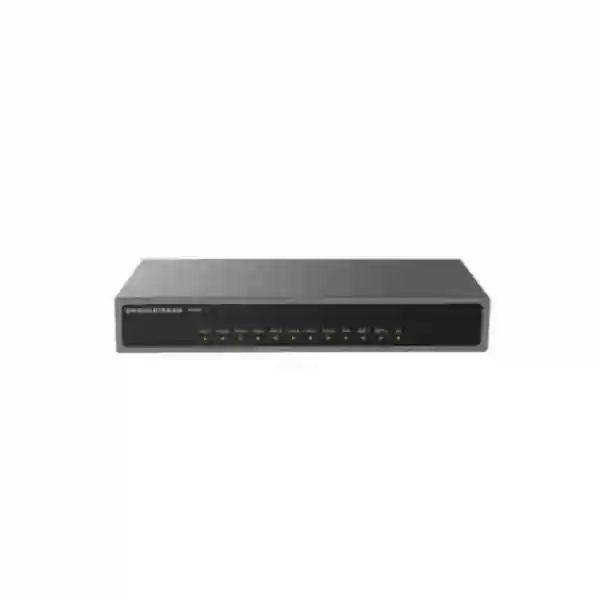
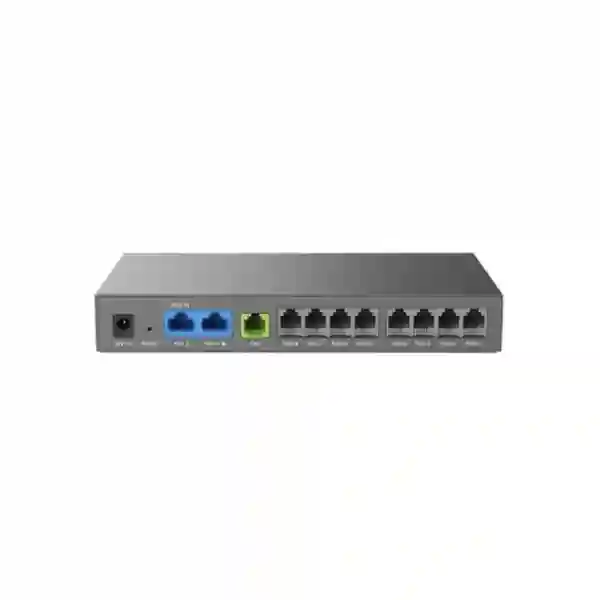
Grandstream HT881 Dubai is an eight-port analog FXO gateway designed for organizations that need to connect conventional PSTN telephone lines to a SIP-based IP PBX, hosted PBX, softswitch, or multi-site VoIP environment. Instead of replacing every analog carrier line at once, the HT881 creates a controlled bridge between the traditional telephone network and an IP communications platform. Grandstream specifies eight RJ11 FXO ports for PSTN connectivity, one RJ11 FXS port, three SIP profiles, dual 10/100/1000 Mbps Ethernet interfaces with one 802.3af PoE-PD capable port, T.38 fax support, secure provisioning, SIP failover, and lifeline operation. Those capabilities make the model especially relevant when a business is modernizing telephony but still depends on copper lines for inbound numbers, fallback calling, legacy services, phased migration, or location-specific connectivity.
The most important buying question is not simply whether a company needs eight ports. The correct question is how many real PSTN circuits must be presented to the IP PBX, how incoming calls should be routed, which lines are reserved for outbound traffic, whether fax or modem-like traffic remains in use, how power and network resilience are designed, and what happens when the primary SIP server or building power fails. The HT881 can be a strong fit when those requirements are understood before configuration. It can be a poor fit when the actual requirement is to connect eight analog telephones, because that is an FXS-gateway problem rather than an FXO-gateway problem.
Fourteck treats the HT881 as an integration component rather than a standalone box. A successful deployment normally includes line inventory, PBX routing design, SIP security, VLAN and QoS planning, PSTN disconnect detection, caller-ID validation, failover testing, fax testing where needed, and clear documentation of which physical FXO port maps to which carrier line or business number. This page explains those decisions in practical detail for IT teams, system integrators, offices, hotels, schools, clinics, warehouses, service businesses, branches, and multi-site organizations in Dubai, Abu Dhabi, Sharjah, Ajman and the wider UAE.
HT881 decision snapshot: where this gateway fits
Use the eight RJ11 FXO interfaces to bring up to eight analog PSTN lines into a SIP environment, subject to the line service and configuration.
The single FXS interface is not an eight-extension bank. It is an analog endpoint interface and participates in the model’s lifeline design.
Grandstream’s current datasheet specifies two 10/100/1000 Mbps RJ45 ports, with Gigabit operation in bridge mode and up to 100 Mbps in NAT mode.
One network port can accept PoE input, allowing the gateway to participate in a centrally powered design when the switch and power budget are suitable.
What the Grandstream HT881 actually does
An FXO gateway sits at the boundary between analog telephone lines and an IP communications system. The carrier or legacy PBX presents an analog line to an FXO port. The gateway then translates signaling and media between that analog circuit and SIP/RTP on the IP side. In a common office design, incoming calls arrive on one or more PSTN lines, the HT881 detects the ringing and caller information according to the configured regional settings, then sends the call toward the IP PBX. The PBX can apply business logic such as an IVR, ring group, queue, receptionist extension, hunt group, time condition, call recording policy, or branch routing. For outbound calls, the IP PBX can send selected calls to the HT881, which then seizes an available FXO line and places the call onto the PSTN.
This role is useful during migration because the organization can keep numbers or circuits that have not yet moved to SIP trunks. It can also preserve a local analog route for specific call types or provide an alternative path when the main IP service is unavailable. The gateway therefore becomes part of the call-routing architecture. It is not merely a passive adapter. Correct operation depends on SIP settings, PSTN line characteristics, dial plans, ring detection, busy-tone or disconnect detection, caller-ID format, impedance or country profile, network timing, codec selection, NAT behavior, and the routing logic on the PBX.
The HT881 also supports a single FXS port. FXS and FXO are often confused because both use analog telephone-style connectors. The direction of service is different. An FXS interface provides battery and ringing to an analog endpoint such as a telephone or fax device. An FXO interface behaves like the customer-side analog interface that receives service from a carrier line or PBX analog extension. This distinction matters before purchasing: a company that has eight analog phones to retain generally needs multiple FXS ports, while a company that has eight PSTN lines to present to an IP PBX needs multiple FXO ports. The HT881 is built for the second requirement.
For organizations comparing analog gateway options, the HT881’s value comes from the combination of eight FXO channels, SIP integration, security features, automated provisioning, fax support, PoE input, and failover functions in a compact gateway. The practical result is flexibility: an organization can modernize the PBX layer without forcing every carrier-side analog dependency to disappear on day one.
FXO versus FXS: the buying distinction that prevents the wrong gateway order
Before choosing the HT881, inventory the direction of every analog connection. A physical RJ11 socket alone does not tell you whether the requirement is FXO or FXS. If the cable comes from a telecom provider’s analog line, or from an analog station/trunk presentation that behaves like a telephone line, the gateway normally needs an FXO interface to receive that service. If the objective is to plug in an analog telephone, cordless base, fax machine, lobby phone, lift/intercom interface, or other endpoint that expects line voltage and ringing from the network, the gateway normally needs an FXS interface. Mixing these roles can result in a project that cannot be made functional through software configuration alone.
| Requirement | Interface usually needed | HT881 fit | Planning note |
|---|---|---|---|
| Connect eight carrier PSTN lines to an IP PBX | 8 × FXO | Strong fit | Map each line, caller ID behavior, inbound destination and outbound selection. |
| Connect eight analog desk phones to VoIP | 8 × FXS | Not the intended fit | Select an FXS gateway sized for the endpoint count. |
| Retain one analog phone for local/lifeline use | 1 × FXS | Supported role | The HT881 includes one FXS port and lifeline behavior. |
| Move all calling to a native SIP trunk with no analog lines | No FXO gateway may be required | Requirement dependent | Confirm whether any PSTN fallback, fax, alarm, legacy or regulatory line still needs analog access. |
A useful procurement habit is to label every analog cable by source and function before ordering hardware. Record the provider, telephone number, line type, current device or PBX port, inbound purpose, outbound purpose, caller-ID behavior, and whether the line has any special service attached. That simple exercise usually reveals whether eight FXO ports are genuinely required and helps the integrator plan the new call routes without trial-and-error wiring.
Verified HT881 technical specifications
The following specifications are based on Grandstream’s current HT841/HT881 product information and datasheet. They are presented with deployment context so buyers can understand the operational meaning rather than treating the gateway as a list of isolated features.
| Area | HT881 detail | Deployment meaning |
|---|---|---|
| Analog telephony | 8 RJ11 FXO ports and 1 RJ11 FXS port | Eight analog PSTN-facing channels plus one analog endpoint/lifeline interface. |
| SIP profiles | Supports 3 SIP profiles | Allows flexible connection and profile organization, with design dependent on PBX and channel configuration. |
| Network | Two 10/100/1000 Mbps RJ45 ports; one supports 802.3af PoE-PD | Supports bridge/router deployment; current datasheet notes up to 1 Gbps in bridge mode and up to 100 Mbps in NAT mode. |
| Power | PoE input 48 V / 0.5 A; DC input 12 V / 1 A | Choose an appropriate power strategy and verify PoE switch capacity where PoE is used. |
| Voice codecs | G.711, G.723.1, G.729, G.726-32, iLBC and Opus, with jitter-buffer and echo-cancellation functions | Codec selection should match PBX, bandwidth, transcoding policy and voice-quality requirements. |
| Fax | T.38 Group 3 fax relay up to 14.4 kbps with G.711 pass-through fallback | Fax success depends on end-to-end configuration and provider/PBX support, so real documents should be tested. |
| Caller ID | Bellcore Type 1 & 2, ETSI, BT, NTT and DTMF-based caller ID | Regional carrier behavior must be matched correctly for consistent inbound caller identification. |
| Disconnect detection | Busy tone, polarity reversal/wink and loop current methods | Correct settings help prevent stuck FXO channels and delayed release after the far end hangs up. |
| QoS | 802.1Q VLAN, 802.1p, ToS, DiffServ, MPLS and traffic shaping support | Useful for voice-segment design and prioritization when the surrounding network is configured accordingly. |
| Security | SRTP media, TLS/SIPS/HTTPS control, secure provisioning and per-unit security certificate | Enables a stronger security posture when certificates, credentials, firewall rules and management access are properly administered. |
| Provisioning | HTTP/HTTPS, TFTP, SSH, TR-069, encrypted automated provisioning and syslog | Supports repeatable deployments and centralized operational workflows. |
| Physical | 190 × 100 × 28 mm; 0.46 kg | Compact form factor; provide suitable shelf, cabinet or protected installation space. |
| Environment | 0–40°C operation; 10–90% non-condensing humidity | Install within the specified environment and avoid unconditioned locations that exceed limits. |
PSTN-to-SIP architecture: how the HT881 fits into the call path
In an inbound design, each analog line should have a defined business purpose. One line may represent the main office number, another a service department, another a legacy fax route, and others may be retained as direct numbers or fallback trunks. The gateway must know how to translate an incoming ring event into a SIP call. The IP PBX then needs an inbound route that understands what to do with that call. Depending on the configuration, calls may be directed to a fixed SIP destination, registered account, extension, IVR, queue, or other PBX object. The exact method should follow the PBX platform and the gateway’s supported configuration model rather than relying on assumptions carried over from an FXS ATA.
Outbound design is equally important. If the organization has eight PSTN circuits but only certain departments should use them, the PBX should enforce route permissions. If one line has a special tariff or is reserved for emergency fallback, it should not simply be placed into a general outbound pool. Line-selection logic, dial prefixes, least-cost routing, caller-ID presentation, emergency-call rules and overflow behavior should be documented. The gateway can provide the analog route, but the PBX normally remains the policy engine.
Multi-site projects require another layer of thought. A branch could keep local PSTN lines on an HT881 while the IP PBX resides at headquarters or in a hosted environment. This can give the branch local carrier access while maintaining centralized extensions and call control. In that design, WAN resilience, firewall policy, SIP traversal, latency, DNS, VPN requirements and failover behavior become part of the solution. If the WAN path fails, planners should know which local calls can still function and whether the lifeline path covers only a limited analog scenario or meets the organization’s broader continuity expectations.
The best architecture is therefore drawn before configuration. A simple diagram showing every PSTN number, FXO port, SIP profile, PBX route and final destination often saves hours during commissioning. It also becomes a support document for future technicians who need to understand why a particular line is connected to FXO3 rather than FXO7 or why one route bypasses the normal SIP trunk.
Who should choose the HT881 — and when another approach is better
The HT881 is a strong candidate for an organization with several analog carrier lines that must remain active while the internal communications platform moves to SIP. This is common in offices that have longstanding numbers on copper circuits, branches that still receive local PSTN service, hospitality or healthcare sites with mixed-generation infrastructure, schools and institutions that want a staged migration, or businesses that need a fallback route separate from their primary SIP trunk. The eight-port density is useful when four ports would be insufficient but a much larger chassis would be unnecessary.
It can also suit integrators working with a customer whose legacy PBX still exposes analog trunk connectivity while new extensions and applications are moving to an IP PBX. Rather than force a full cutover, the project can preserve existing lines and transition call flows gradually. During the migration window, the gateway can help bridge old and new systems while the organization validates call routing, number porting, user training, IVR changes and service-provider readiness.
Another approach may be better when the business has already migrated every number to a native SIP trunk and does not need any analog carrier path. In that case, adding an FXO gateway creates unnecessary analog conversion and another device to manage. Likewise, if the actual goal is to connect many analog telephones or fax endpoints, an FXS gateway should be evaluated instead. If the requirement involves GSM/LTE channels, BRI, PRI, E1/T1 or other trunk types, the HT881 is not a substitute for the appropriate gateway technology.
The HT881 also should not be selected solely because eight ports sound future-proof. Unused FXO capacity has little value if the organization will retire all analog lines within a short period. A four-port HT841 may be more proportionate when the current and planned PSTN requirement is small. Conversely, if a business already has eight lines and expects further growth, planners should consider whether eight is a temporary ceiling. Capacity planning should look at the next migration phase, not just today’s cabling.
Fourteck can help frame this decision around the customer requirement: number of lines, PBX platform, call volume, business continuity, fax dependency, branch topology, carrier migration plan, network design and support expectations. That approach avoids buying a gateway first and trying to invent a reason for it afterward.
Using HT881 in a phased legacy-PBX migration
A phased migration is one of the most practical reasons to deploy an FXO gateway. Many organizations cannot move from a traditional telephone system to a fully IP-based environment in a single maintenance window. Numbers may still be tied to analog services, departments may have different operational calendars, the carrier may schedule porting on a later date, and critical inbound routes may require parallel testing before cutover. The HT881 allows the IP PBX to participate while the existing PSTN circuits remain available.
The first stage should be discovery. Document every analog line, telephone number, carrier, monthly purpose, destination, busy-hour usage, caller-ID behavior and dependency. Ask whether each line must survive the migration, can be ported to SIP, is used by fax, belongs to an alarm or third-party service, or is simply an old line that nobody has reviewed. This exercise can reduce unnecessary gateway capacity and prevent a critical circuit from being disconnected accidentally.
The second stage is target call-flow design. Decide how an inbound PSTN call should be presented to the new PBX and which users should be allowed to place outbound calls through the analog network. Define whether the PBX uses the gateway as a registered SIP peer, a set of accounts, or an IP-based route according to the supported integration model. Decide how calls will fail over when one PSTN line is busy or unavailable. If multiple FXO channels share the same outbound purpose, define the selection order and whether the gateway or PBX is responsible for channel choice.
The third stage is controlled commissioning. Connect a limited number of lines, validate ringing, caller ID, answer supervision, audio in both directions, hang-up detection, DTMF, outbound dialing and any fax requirement. Make test calls from multiple carriers and destinations because analog behavior can vary. Confirm that the PBX releases the route after each call and that the FXO channel does not remain seized. Only after those tests pass should the remaining lines be migrated.
The fourth stage is resilience testing. Simulate a primary SIP server outage, network interruption and power scenario in a controlled maintenance period. Verify what the HT881 does, what the PBX does and what users experience. Grandstream provides failover SIP server functionality and lifeline support, but those features are components of a continuity plan rather than proof that every business service remains available. An organization should test the exact routes it considers critical.
Finally, the migration should have an exit plan. If the long-term objective is to eliminate analog trunks, document which HT881 ports will be retired as numbers move to SIP. This avoids leaving unused circuits active indefinitely and helps the customer understand whether the gateway is a permanent hybrid component or a transition device that may later be repurposed.
Inbound PSTN routing with eight FXO ports
Inbound PSTN calls look simple from the caller’s perspective, but the gateway must interpret several analog events correctly before the PBX can make a routing decision. The line rings, caller-ID information may arrive according to a regional standard, the gateway waits or answers according to its settings, and a SIP call is then created toward the configured destination. If ring timing, caller-ID detection, country settings or destination logic are wrong, the organization can experience missing caller ID, delayed answering, calls reaching the wrong extension, or calls that never reach the PBX at all.
For each FXO channel, decide the inbound destination before installation. FXO1 may feed the main auto attendant, FXO2 a service queue, FXO3 a direct reception route, and FXO4 a fallback number. The remaining channels may serve departments or share a common route. If the PBX needs to distinguish lines, the integration must preserve enough identity for the PBX to apply the correct inbound rule. If every channel is simply sent to the same destination, administration becomes easier but the organization may lose line-specific behavior.
Caller ID deserves separate testing. Grandstream lists support for Bellcore Type 1 and 2, ETSI, BT, NTT and DTMF-based caller-ID formats. The correct format depends on the local service. In the UAE or another region, the installer should not assume a default profile will match every carrier or analog presentation. Use live test calls and confirm that the number arrives at the PBX in the format expected by the inbound route. If the PBX normalizes numbers to E.164 or another internal format, apply that logic consistently.
Answer supervision and disconnect detection are also essential. The gateway supports busy-tone, polarity reversal/wink and loop-current methods. The correct choice depends on what the analog network presents. Incorrect disconnect settings can leave a port tied up after the remote caller hangs up, which reduces available line capacity and may cause repeated routing problems. A proper acceptance test therefore includes not only successful calls but also deliberate hang-ups from both sides and observation of how quickly the channel returns to idle.
Outbound call design: line selection, permissions and fallback
Outbound calling should be designed from the PBX policy outward. Decide which dialed numbers are eligible to use the HT881, which users or departments may access the analog lines, and whether the PSTN route is primary, secondary or restricted to specific destinations. For example, a company may use a SIP trunk for ordinary calls while retaining analog lines as a backup path. Another organization may use one PSTN circuit for a specific local service while the remaining channels support general outbound traffic. These rules should be explicit so users do not consume limited analog capacity unintentionally.
Channel selection can be fixed or pooled depending on the integration. A fixed design maps a particular call class to a specific FXO port. A pooled design lets eligible calls use the next available line. Fixed mapping can simplify accounting or preserve a line for a special purpose, while pooled routing can improve utilization. The trade-off should be considered along with caller-ID presentation, line ownership, emergency-calling behavior and the carrier’s restrictions.
Digit handling matters because the PBX and PSTN may expect different formats. A user might dial a short local pattern while the carrier requires a full national number. The PBX can normalize or transform the digits before sending the call to the gateway. Avoid scattering overlapping digit-manipulation rules across both systems unless there is a clear reason. A single documented point of dial-plan control reduces troubleshooting complexity.
Fallback routing should also be intentional. If the primary SIP trunk fails, the PBX may send selected outbound calls to the HT881. The gateway’s own failover SIP server functionality addresses loss of its primary SIP server connection, while PBX route failover determines whether users are redirected to analog lines when another trunk fails. These are different layers. Testing should verify the complete user experience from extension to PSTN during failure, not just confirm that a configuration field exists.
Finally, consider call concurrency. Eight physical FXO lines do not mean every user can make unlimited simultaneous analog calls. Each active PSTN line represents a finite channel. Busy-hour measurements can reveal whether eight lines are sufficient, excessive or likely to become a bottleneck when used as a backup for a larger SIP environment. Capacity should be based on expected simultaneous analog calls, not total employee count alone.
Network and PoE planning for the HT881
Grandstream’s current datasheet specifies two 10/100/1000 Mbps RJ45 interfaces and notes that one port supports 802.3af PoE-PD. It also notes up to 1000 Mbps operation in bridge mode and up to 100 Mbps in NAT mode. This distinction is worth recording because buyers sometimes see “dual Gigabit” in a product description and assume every operating mode forwards at Gigabit speed. The gateway’s voice traffic itself is modest compared with modern LAN capacity, but architecture and performance expectations still should match the chosen device mode.
A typical enterprise deployment places the gateway on a controlled voice or communications VLAN with access only to the PBX, DNS, NTP, provisioning, management and other services it genuinely needs. The HT881 supports 802.1Q VLAN and Layer 2/Layer 3 QoS mechanisms. Those features help only when the switches, routers, firewalls and PBX follow a consistent design. Marking packets at the gateway without honoring those markings elsewhere does not create end-to-end quality of service.
PoE can simplify cabling and centralize power. If the gateway is powered from a PoE switch that is connected to a UPS, the organization can reduce dependence on a local wall adapter during a short power disturbance. However, this is only one part of resilience. The PBX, switch, router, firewall, WAN equipment and any analog carrier-side devices must also have appropriate backup power. The current Grandstream datasheet lists PoE input at 48 V / 0.5 A and DC input at 12 V / 1 A. Procurement should confirm what is included in the package and choose approved power accessories when DC power is used.
Network security starts with placement. Do not expose the management interface broadly to the internet merely because remote administration is convenient. Use firewall rules, VPN access or other controlled methods appropriate to the organization. Restrict management to trusted subnets, change default or initial credentials, maintain firmware according to the support policy, use secure management protocols, and log significant events. If SIP is traversing between sites, decide whether the design uses private routing, VPN, session border functions or firewall/NAT rules and validate the actual traffic flow.
Time synchronization and DNS are easy to overlook. Accurate time supports logs and troubleshooting, while reliable name resolution is necessary when SIP servers or provisioning systems are configured by hostname. Document NTP and DNS sources, then verify them during commissioning rather than discovering a resolution problem only after a failover event.
Voice quality, codecs and echo control
The HT881 supports common voice codecs including G.711, G.723.1, G.729, G.726-32, iLBC and Opus, together with dynamic jitter-buffer and advanced line-echo-cancellation functions. Codec choice should match the PBX and network design. G.711 is often attractive when bandwidth is readily available because it avoids additional compression and is commonly used for fax pass-through scenarios. Compressed codecs can reduce bandwidth but may add processing considerations and are not automatically preferable on a well-provisioned LAN or WAN.
Analog-to-IP conversion adds another source of variables compared with an all-digital SIP trunk. Line impedance, analog gain, echo, noise, cable quality and carrier-side conditions can influence the perceived result. A deployment should therefore test actual calls through each PSTN circuit rather than assume one successful port proves all eight lines are identical. If users report echo or volume imbalance, troubleshooting should isolate whether the source is the analog line, gateway settings, codec path, PBX, endpoint or remote network.
DTMF is another practical requirement. The HT881 supports in-audio, RFC2833 and SIP INFO methods. Interactive voice response systems, banking menus, carrier services and remote applications may respond differently depending on how tones are transported. If DTMF fails only after a call crosses the gateway, compare the configured method on the PBX and gateway, inspect whether transcoding occurs, and test with real IVRs rather than relying solely on local tone generation.
Quality assurance should include short calls, long calls, simultaneous calls on multiple channels, inbound and outbound directions, calls to mobile and fixed networks, DTMF navigation, transfers, conference scenarios where relevant, and deliberate network stress within safe test conditions. The goal is not merely to hear audio once; it is to demonstrate that the analog-to-SIP path remains usable under the business’s expected call patterns.
T.38 fax and legacy document workflows
Grandstream specifies T.38 Group 3 fax relay up to 14.4 kbps and automatic switching to G.711 for fax pass-through. That gives the HT881 a useful role where a business still receives or sends fax traffic through an analog PSTN line while the PBX environment becomes IP based. However, fax over IP is an end-to-end workflow, not a single-device feature. Successful transmission depends on the fax endpoint, gateway, PBX, network, SIP provider or PSTN path, codec negotiation, jitter, packet loss and the remote fax machine.
Before committing a critical fax workflow to the migration, test representative documents in both directions. Use a one-page text document, a multi-page document and a page with graphics. Confirm completion reports, not just the sound of fax negotiation. Repeat the test at different times if the WAN or provider path varies under load. If a business handles contracts, healthcare records, legal documents or other time-sensitive fax traffic, document the supported path and the recovery procedure when transmission fails.
Avoid assuming that a fax machine must share the HT881’s single FXS port simply because it is an analog device. The architecture depends on whether the fax is an endpoint connected on the FXS side, a PSTN service arriving through an FXO line, or a PBX-based fax application. The signal direction determines the correct connection. For a large fax estate, a dedicated FXS gateway or an alternative digital fax strategy may be more appropriate.
A migration is also a good opportunity to ask whether fax is still operationally necessary. If only a small number of external partners require it, the customer may choose to maintain one tested fax route while moving other communication to digital workflows. The HT881 can support the analog bridge where needed without forcing the whole communications platform to remain tied to legacy technology.
Security, provisioning and centralized operations
The HT881 supports SRTP for media, TLS/SIPS/HTTPS for protected control and management paths, secure automated provisioning with AES encryption, a per-unit security certificate, syslog and management options including SSH and web administration. These capabilities give IT teams the building blocks for a controlled deployment, but the final security posture depends on configuration. A device with encryption support can still be exposed by weak passwords, unnecessary internet access, unrestricted management networks or outdated firmware.
Start by defining an ownership model. Identify who can administer the gateway, where credentials are stored, which management networks are allowed, who approves firmware changes, and how configuration backups or templates are controlled. Separate day-to-day monitoring from high-privilege changes where practical. If an external integrator supports the system, agree how remote access is granted and revoked rather than leaving permanent broad exposure.
Provisioning becomes more valuable as the number of gateways grows. Grandstream supports TR-069 and automated encrypted configuration options, and the product page also positions the HT841/HT881 within Grandstream Device Management System workflows. A multi-site organization can benefit from repeatable settings, centralized visibility and controlled updates instead of manually configuring every device from scratch. Even with one gateway, a documented template reduces inconsistency when hardware is replaced or reset.
Logging should be treated as part of support. Configure time correctly, send syslog to an appropriate collector if the organization uses one, and record the mapping between physical FXO ports and business lines. During an incident, a technician should be able to answer whether the gateway received a ring, generated a SIP request, reached the PBX, received a response and released the analog channel. Without logs and documentation, troubleshooting can become a sequence of guesses.
Security also includes the analog side. A PSTN line may bypass some policies that exist on the primary SIP trunk. If the HT881 is used for fallback outbound calls, ensure the PBX still enforces user permissions and destination restrictions. Avoid creating a route that becomes an uncontrolled escape path simply because it exists for resilience.
Business continuity: lifeline support and SIP server failover
Grandstream lists two continuity-related features that should be understood separately. The first is lifeline support: the FXS port can be hard-relayed to an FXO port during a power outage. The second is SIP server failover: the gateway can switch to a secondary SIP server if the primary becomes unavailable. Both are useful, but neither is a complete disaster-recovery strategy by itself.
Lifeline functionality provides a direct analog path in a specific failure condition. It can help preserve basic calling through the associated PSTN circuit when the gateway loses power. The organization should verify exactly which physical port participates in the lifeline design for the installed model and firmware, then label the cabling and test it. Users who may rely on the lifeline phone should know its limitations, such as whether normal PBX features, extension dialing, recording or central policy remain available during that condition.
SIP server failover addresses a different problem. If the gateway is configured with a primary and secondary SIP server, it can use the failover server when the main server loses connection. The secondary server must be genuinely prepared to handle the call routes, accounts and security context. Simply entering a second IP address does not guarantee business continuity if that server lacks synchronized configuration or if DNS, firewall and network paths still depend on the same failed component.
A resilient design evaluates failure domains. What happens if the PoE switch fails? What if the WAN fails but the local LAN remains healthy? What if the hosted PBX is unreachable but PSTN lines still work? What if the carrier analog lines fail but the SIP trunk is healthy? What if building power fails? Each scenario may need a different response. The HT881 can contribute useful options, especially local analog access, but continuity comes from architecture, backup power, route logic, user procedures and testing.
For critical deployments, schedule a controlled failover exercise after installation and periodically after major changes. Record the expected behavior, actual result and recovery steps. This converts resilience from a product feature into an operational capability.
HT841 vs HT881: when four FXO ports are enough and when eight are justified
Grandstream positions the HT841 and HT881 in the same analog FXO gateway family. The clearest difference is capacity: the HT841 provides four RJ11 FXO ports while the HT881 provides eight. Both include one RJ11 FXS interface and share the family’s core SIP, networking, fax, security, provisioning and lifeline concepts. That makes the choice primarily a capacity and growth decision rather than a search for a completely different feature set.
| Decision factor | HT841 | HT881 |
|---|---|---|
| FXO capacity | 4 PSTN-facing ports | 8 PSTN-facing ports |
| FXS interface | 1 | 1 |
| Best fit | Smaller PSTN retention requirement, up to four analog lines | Higher-density branch or office requirement, five to eight analog lines |
| Growth consideration | Choose when four ports cover planned needs with reasonable margin | Choose when current or planned PSTN count would exceed four ports |
If a customer has three active analog lines and expects to retire one soon, selecting the eight-port HT881 only for “future-proofing” may not be necessary. If the customer has four active lines and may add another branch number, fax route or fallback circuit, moving directly to the HT881 can avoid an early replacement. If the customer already uses six to eight circuits, the choice is straightforward unless a larger gateway architecture is expected soon.
Capacity planning should also consider spare ports for fault isolation. A spare port can be useful during troubleshooting, but unused capacity should not replace a real roadmap. The objective is to choose the smallest architecture that meets operational needs, growth, resilience and supportability without creating unnecessary complexity.
HT881 versus an FXS ATA, native SIP trunk or larger gateway
The HT881 solves a specific boundary problem, so it should be compared with alternative architectures rather than only with other eight-port devices. An FXS ATA or FXS gateway is appropriate when analog endpoints need service from a SIP platform. A native SIP trunk is appropriate when the carrier can deliver numbers directly over IP and no analog trunk needs to remain. A larger gateway is appropriate when analog line density exceeds eight or when the project includes other interfaces. The correct technology follows the required direction of conversion.
| Option | Best for | Main advantage | Main consideration |
|---|---|---|---|
| HT881 FXO gateway | Retaining up to eight analog PSTN lines with a SIP PBX | Bridges existing analog trunks into modern IP call control | Requires analog-line tuning, routing and ongoing gateway management |
| FXS ATA/gateway | Keeping analog phones, fax endpoints or devices on a SIP platform | Provides analog station service from an IP system | Does not replace an FXO interface for carrier PSTN lines |
| Native SIP trunk | All-IP carrier connectivity | Avoids analog conversion and scales digitally | Depends on provider availability, number migration, WAN design and regulatory/service requirements |
| Larger/mixed-interface gateway | More than eight lines or mixed analog/digital/mobile interfaces | Higher density or broader interface options | May add cost, rack space, licensing or configuration complexity |
For many Dubai businesses, the choice between the HT881 and a native SIP trunk is not either/or. A hybrid design can use SIP as the primary route while selected analog lines remain for continuity, fax, legacy numbers or phased migration. Over time, the PSTN dependency may shrink. The gateway can then serve fewer lines or move to another branch. A well-designed deployment therefore considers lifecycle as well as day-one connectivity.
When comparing costs, include more than hardware. Consider carrier line rental, SIP trunk charges, installation, PBX licensing where applicable, network upgrades, PoE capacity, support, monitoring, remote management and future migration work. An apparently inexpensive gateway can become costly if it prolongs unnecessary analog services, while an all-IP migration can be risky if it ignores critical legacy dependencies. The decision should be based on operational value.
PBX interoperability and integration planning
Grandstream describes the HT841/HT881 family as designed for interoperability with leading IP PBXs, softswitches and SIP-based environments. Standard SIP support provides a broad foundation, but a production deployment should still confirm the exact integration method for the chosen PBX. “Supports SIP” does not automatically mean every PBX will expose a one-click HT881 template or that every vendor has certified every firmware combination.
With a Grandstream UCM environment, Grandstream documentation highlights the ability to use its ecosystem and provisioning features. In mixed-vendor deployments, review the PBX gateway documentation and decide whether the HT881 registers channels as SIP accounts, uses IP-based trunking, or follows another supported pattern. Configure authentication, source IP restrictions, transport, codec preferences and DTMF consistently. If TLS and SRTP are used, confirm certificate and cipher requirements rather than enabling security settings independently on each side.
For hosted PBX environments, ask the provider whether an on-premise FXO gateway is supported and how it should reach the cloud platform. Some services expect registration over the public internet, while others recommend a session border controller, VPN or managed edge device. NAT and firewall behavior can affect SIP signaling and RTP media. Avoid opening broad port ranges without understanding the provider’s documented requirements.
A useful proof-of-concept connects one PSTN line and one inbound/outbound route before all eight channels are configured. Validate registration or peering, audio, caller ID, DTMF, hang-up detection, transfer, route permissions and failover. Once the baseline is proven, replicate the design carefully across additional ports while preserving line-specific differences.
If the organization uses 3CX, Yeastar, Asterisk-based systems, hosted platforms or another SIP PBX, verify current vendor guidance and support status for the exact deployment rather than relying on old forum examples. Community posts can be useful for symptoms and troubleshooting ideas, but the final configuration should be anchored in current vendor documentation and the live system requirements.
Pre-deployment checklist for an HT881 project
A short discovery session before installation can prevent most avoidable problems. Use the following checklist as a project input document rather than waiting until the gateway is powered on.
1. Analog line inventory
Record each telephone number, carrier, physical cable, current device, inbound purpose, outbound purpose, caller-ID behavior, service owner, billing owner and whether the line will remain after migration.
2. PBX integration method
Confirm whether the PBX expects registration, IP-based trunking or another method. Define authentication, transport, codecs, DTMF, inbound destinations and outbound route permissions.
3. Network readiness
Assign VLAN, IP addressing, DNS, NTP, default gateway, firewall policy, QoS handling, management subnet and remote-access method. Confirm PoE budget if PoE will power the gateway.
4. Business continuity
Define which calls must continue during SIP server failure, WAN failure and building power loss. Test the secondary SIP server and lifeline behavior rather than assuming they meet every recovery requirement.
5. Fax and special services
Identify fax, alarm, intercom, modem-like, lift, payment or other services attached to analog lines. Confirm whether they are technically appropriate for the intended VoIP path before migration.
6. Acceptance criteria
Write the tests that define success: inbound/outbound calls, caller ID, hang-up release, DTMF, simultaneous channels, failover, fax, security, logging and documented port mapping.
A practical HT881 deployment workflow
Step 1 — survey and label. Trace every PSTN cable and label both ends. If the existing PBX or distribution frame is complex, photograph and document the current state before moving anything. Confirm which lines are live with controlled test calls. A cable that appears unused may carry a number that only rings outside business hours.
Step 2 — prepare the IP network. Create the IP address reservation or static address plan, voice VLAN if used, firewall rules, DNS, NTP and management access. If PoE will be used, verify the switch standard and power budget. Keep the gateway on a protected network and avoid broad public management exposure.
Step 3 — baseline the gateway. Record the hardware identity and firmware version, change administrative credentials, configure time, apply the intended network mode and back up the initial configuration where operational practice permits. Do not make dozens of undocumented changes at once; controlled changes are easier to troubleshoot.
Step 4 — configure SIP and one FXO channel. Build the SIP profile and PBX peer or registration according to the integration method. Connect one known-good PSTN line. Configure country/impedance and caller-ID behavior according to the service. Establish one inbound and one outbound route.
Step 5 — perform functional testing. Test inbound calling, outbound calling, caller ID, DTMF, audio, hold/transfer behavior where applicable, remote hang-up, local hang-up and repeated calls. Observe logs to confirm that each call returns the channel to idle.
Step 6 — expand to the remaining lines. Add channels one at a time or in a controlled group. Preserve line-specific settings when the carrier service differs. Use a port map so the PBX route, physical jack and telephone number remain traceable.
Step 7 — test concurrency and failures. Place multiple simultaneous calls, verify channel selection and confirm that the PBX handles busy conditions as designed. During a maintenance window, test SIP server failover and the intended power/lifeline scenario.
Step 8 — hand over documentation. Provide the customer with the network details, port map, route summary, support contacts, recovery steps, firmware/change policy and list of remaining analog dependencies. Good documentation turns the gateway from a mysterious black box into a maintainable part of the communications platform.
Common HT881 deployment problems and what to check first
Incoming PSTN call never reaches the PBX: confirm the analog line itself rings, the correct FXO port detects the ring, the port is mapped to the intended SIP profile or destination, the PBX accepts the incoming SIP call, and firewall/NAT rules are not blocking signaling or media. Review whether the gateway is configured to route the call to the FXS/lifeline behavior instead of the PBX in the current mode.
Outbound call reaches the gateway but does not dial: check the PBX route, digit transformation, FXO channel availability, stage/dialing method where applicable, DTMF or pulse expectations, and whether the analog carrier line can make the destination directly. Test the carrier line with a conventional analog phone to separate PSTN issues from SIP issues.
Caller ID is missing or delayed: verify the carrier actually provides caller ID, select the correct regional format, review ring-before-answer timing, and compare the raw value seen by the gateway with the number presented to the PBX. Avoid correcting the symptom only with PBX normalization if the gateway is not decoding the analog caller ID reliably.
Calls remain connected after the remote party hangs up: focus on disconnect supervision. Test busy-tone detection, polarity reversal/wink and loop-current behavior as appropriate to the carrier line. A stuck channel can consume one of the eight FXO ports and cause later calls to fail or hunt incorrectly.
One-way audio: inspect SIP and RTP addressing, NAT, firewall rules, PBX media handling and the selected network mode. One-way audio is usually an IP path problem rather than an FXO-capacity problem. Packet capture and PBX/gateway logs can show where media is being sent.
DTMF does not work in external IVRs: align DTMF transport between the PBX and gateway, test RFC2833, SIP INFO or in-audio according to the design, and ensure codec/transcoding behavior is compatible. Use a real external IVR to validate the result.
Fax is inconsistent: verify T.38 support and settings on every relevant element, test G.711 pass-through where appropriate, reduce packet loss and jitter, and use representative multi-page documents. If the path crosses a provider that does not preserve fax reliably, the gateway alone cannot correct the remote network.
Gateway registers but calls do not route: registration proves only that one signaling relationship exists. Check inbound and outbound dial plans, port/channel mapping, authentication direction, source IP restrictions and how the PBX identifies the trunk. Do not assume an FXS ATA configuration guide applies directly to an FXO gateway.
Intermittent behavior after network changes: re-check VLAN assignment, DHCP or static addressing, DNS, NTP, switch-port configuration, firewall policy and PoE. Communications gateways are sensitive to infrastructure changes even when their own configuration has not been edited.
Industry scenarios where eight FXO lines can still matter
Hotels and serviced apartments: a property may modernize its internal PBX while retaining local analog trunks, direct departmental numbers or legacy carrier services during a phased cutover. The HT881 can bring those lines into the IP call-control layer while front desk, reservations, back office and guest-service workflows migrate at different speeds. The project should still distinguish PSTN trunks from analog guest-room endpoints, which may require FXS capacity elsewhere.
Schools and educational institutions: campuses often have a mixture of old and new communications infrastructure. An HT881 can preserve several incoming analog lines while administration, reception, security and departments move onto a centralized IP PBX. Continuity planning should include what happens during internet outages and which analog route remains available for urgent calling.
Clinics and healthcare administration: some facilities retain legacy numbers, fax workflows or local PSTN circuits even as staff extensions move to IP. The gateway can support the transition, but medical or emergency workflows require stricter testing, documentation and backup design. No critical service should be assumed compatible merely because it uses an RJ11 connector.
Retail and multi-branch businesses: a branch may keep local analog numbers while connecting to a central PBX over IP. This gives the branch local inbound presence and potentially a local outbound fallback path. WAN failure behavior should be documented so staff know which services remain available locally and which require the central PBX.
Warehouses and industrial offices: existing analog lines may terminate near a gatehouse, dispatch area or administration office. The HT881 can integrate these lines into SIP routing while the rest of the site adopts IP phones. Environmental limits matter; the gateway should be installed in a suitable conditioned communications area rather than an exposed industrial space outside its rated temperature or humidity range.
Professional services and SMEs: law firms, accounting practices, consultancies and other businesses may have longstanding published telephone numbers that they are not ready to port. Using the HT881, those numbers can feed a modern PBX with auto attendants, queues and extension mobility while the carrier migration is planned separately.
Government and institutional projects: some environments maintain POTS or analog handoffs for policy, availability or legacy reasons. An FXO gateway can bridge those lines into a controlled IP environment, but integration should follow the organization’s security, procurement and support requirements and be validated against the selected PBX rather than assumed from generic SIP compatibility.
Grandstream HT881 Dubai and UAE deployment planning
For a Grandstream HT881 Dubai deployment, the local requirement is usually less about the city name and more about the telecom environment inside the building. Business districts may contain offices with modern structured cabling but still have analog carrier lines delivered through an older distribution frame. Deira and Bur Dubai can include mixed-age premises where telephone cabling has changed over many years. Newer offices in other parts of Dubai may have full IP networks but retain a small number of PSTN lines for continuity or legacy services. A site survey should establish the real line handoff and network path before equipment is selected.
In Abu Dhabi, enterprise, education, healthcare and government-related deployments often place greater emphasis on change control, documentation and resilience. An HT881 can be part of a hybrid architecture, but the gateway should be integrated into the organization’s VLAN, security, logging and support standards. Where a secondary SIP server or analog fallback is expected to support business continuity, the acceptance plan should prove the route under controlled failure conditions.
Sharjah and Ajman businesses may use the HT881 in branch offices, warehouses, trading companies, schools and service organizations that want to keep existing analog lines while moving internal users to an IP PBX. The project should check the condition of older analog cabling, identify any undocumented splitters or extensions, and confirm which lines genuinely belong to the business. Physical cleanup is often as important as gateway configuration.
For multi-emirate companies, consistent configuration matters. If each branch has an HT881 or similar gateway, use a common naming scheme for ports, SIP profiles, VLANs, logs and backup procedures. At the same time, do not force identical analog settings when carriers or line characteristics differ. A standardized template should allow documented regional exceptions.
Pricing and availability should be confirmed at quotation time. Fourteck does not need to guess a static online price because project cost depends on quantity, current supply, required accessories, installation, configuration, PBX integration, network changes and support scope. An accurate quotation should state what is included and what customer information is still required.
Customers comparing local options can also review Fourteck’s UAE listing for the Grandstream HT881 in Dubai. For a project deployment, the better next step is to provide the number of PSTN lines, PBX model, branch count and intended fallback behavior so the gateway can be evaluated as part of the full communications design.
Regional deployments across GCC and Africa
The same hybrid-telephony problem appears outside the UAE. In Kuwait, a business may want to modernize the PBX while retaining a limited number of analog lines for local numbers or fallback. In Kenya, Uganda, Tanzania, Ghana or Nigeria, branch connectivity can vary by location, and organizations may combine IP communications with local carrier handoffs during a staged modernization. The HT881 can provide the FXO-to-SIP bridge where the local analog service and PBX design are compatible.
Regional projects should not copy one configuration blindly. Caller-ID formats, impedance expectations, PSTN supervision, carrier behavior, numbering plans, WAN quality, power stability and local support arrangements can differ. Treat the Grandstream specifications as the common hardware foundation, then validate the actual line behavior at each site. A successful Dubai configuration is a useful reference but not proof that a branch in another country should use identical analog parameters.
Multi-country organizations benefit from consistent documentation. Use the same asset-naming convention, configuration ownership, firmware policy, monitoring method and port-mapping format across sites. Record local exceptions clearly. Where centralized PBX services are used, evaluate latency, VPN or private connectivity, firewall policy, DNS and failover routes from each country independently.
Fourteck’s broader regional network can support planning conversations for businesses operating across multiple markets, but product availability, installation scope and local carrier compatibility should always be confirmed for the target country and project rather than inferred from another region.
What to include in an HT881 RFQ or quotation request
A useful RFQ should describe the communication requirement, not only ask for “HT881 price.” Start with the quantity of gateways and the number of active PSTN lines at each site. Include the IP PBX or hosted PBX vendor and version if known, the number of branches, whether the gateway will be locally or centrally managed, and whether PoE is available. Identify any fax requirement and any analog line that is reserved for emergency or continuity use.
State whether the requirement is hardware supply only, remote configuration, on-site installation, migration, PBX route setup, testing, documentation or ongoing support. If the site already has analog lines, provide a simple line schedule with telephone numbers redacted where necessary for early discussion. The integrator needs to know how many unique inbound routes exist and whether lines are pooled for outbound calls.
For security-conscious projects, include requirements for VLAN, TLS/SRTP, remote-access control, logging, credential handover and firmware management. For business-continuity projects, define the failure scenarios that must be tested. For multi-site projects, state whether one standardized template is expected and whether a central management platform will be used.
A complete quotation can then separate hardware, optional accessories, installation, configuration, PBX integration, network work and support. This gives the customer a clearer basis for comparison than a single hardware price that hides the services required to make eight analog lines operate reliably in a VoIP environment.
Frequently asked questions about the Grandstream HT881
What is the Grandstream HT881?
The Grandstream HT881 is an analog FXO gateway that connects up to eight PSTN-facing analog lines to a SIP-based communications environment. It includes eight RJ11 FXO ports, one RJ11 FXS port, SIP support, network interfaces, security and provisioning features, fax support, lifeline behavior and SIP server failover functions.
Does the HT881 have eight FXS ports for analog telephones?
No. The HT881 has eight FXO ports and one FXS port. The eight FXO ports are intended for analog PSTN line integration. If the requirement is to connect eight analog telephones or fax endpoints to a SIP PBX, an FXS gateway should be evaluated instead.
How is the HT881 different from the HT841?
The main capacity difference is the number of FXO ports. The HT841 provides four FXO ports, while the HT881 provides eight. Both are in the same Grandstream analog FXO gateway family and include one FXS interface with related SIP, networking, provisioning, fax and continuity features.
Can the HT881 connect analog PSTN lines to an IP PBX?
Yes. That is the core use case. The gateway converts between analog PSTN signaling/media and SIP/RTP so an IP PBX can route calls to extensions, IVRs, queues or other destinations. The exact trunk or registration method depends on the PBX and chosen configuration.
Does the HT881 support Power over Ethernet?
Yes. Grandstream’s current datasheet specifies one 802.3af PoE-PD capable network port and lists a 48 V / 0.5 A PoE input. Confirm the PoE switch standard and available power budget as part of the network design.
Are the HT881 Ethernet ports Gigabit?
Grandstream’s current datasheet specifies two 10/100/1000 Mbps RJ45 interfaces and notes up to 1000 Mbps in bridge mode and up to 100 Mbps in NAT mode. This operating-mode distinction should be considered when documenting the network design.
Does the HT881 support fax?
Yes. It supports T.38 Group 3 fax relay up to 14.4 kbps and can switch to G.711 fax pass-through. End-to-end fax reliability still depends on the PBX, network, provider path, fax endpoint and configuration, so real document tests are recommended.
What happens during a power outage?
The HT881 family includes lifeline support in which the FXS port can be hard-relayed to an FXO port during a power outage. Treat this as a specific analog fallback path, not as a guarantee that the full PBX environment remains operational. The deployed cabling and expected user procedure should be tested.
Does the HT881 support a backup SIP server?
Yes. Grandstream specifies failover SIP server behavior that can switch to a secondary server if the primary loses connection. The secondary server must be correctly configured and reachable, and the complete failover call flow should be tested.
Can the HT881 work with hosted or on-premise PBX systems?
Grandstream positions the gateway for hosted and on-premise IP PBX environments. Because platforms differ, confirm the current integration method, security requirements, registration or peering model, NAT behavior and provider support for the exact PBX before production deployment.
Which voice codecs does the HT881 support?
Grandstream lists G.711, G.723.1, G.729, G.726-32, iLBC and Opus, together with dynamic jitter buffering and line echo cancellation. The preferred codec should match the PBX, network and call-path requirements.
What security features are available?
The gateway supports SRTP media protection, TLS/SIPS/HTTPS control and management options, encrypted automated provisioning and a security certificate per unit. Secure deployment still requires strong credentials, controlled management access, firewall policy and appropriate firmware/change management.
Why can an FXO channel stay busy after a call ends?
Analog lines rely on disconnect supervision. The HT881 supports busy-tone detection, polarity reversal/wink and loop-current methods. If the selected method does not match the carrier line, the gateway may not recognize that the remote party has disconnected. Testing and regional line tuning are therefore important.
Can the HT881 be used only as a temporary migration device?
Yes. Some organizations use an FXO gateway during a staged move from analog trunks to SIP. Others keep it permanently for local PSTN access or fallback. The project should define whether the gateway is transitional or part of the long-term hybrid architecture.
How should I request an HT881 quotation in Dubai?
Provide the required quantity, number of PSTN lines, PBX platform, site locations, PoE availability, fax requirement, migration scope, installation needs and desired support level. Fourteck can then confirm current product availability and prepare a project-specific quotation rather than relying on an outdated static price.
Plan the HT881 around your real PSTN requirement
The Grandstream HT881 is most valuable when it is selected for a clearly defined hybrid-telephony requirement: up to eight analog PSTN lines need to participate in a SIP-based communications environment, and the organization wants controlled routing, secure provisioning, fax support, failover options and a migration path without discarding every analog dependency immediately. The hardware is only one layer. Reliable operation comes from correct line mapping, PBX route design, network security, disconnect supervision, testing and documentation.
To evaluate an HT881 deployment, share the number of analog lines, current PBX or hosted platform, branch locations, inbound call destinations, outbound fallback requirements, fax usage and network/PoE details. Fourteck can use that information to compare the HT881 with the HT841 or another gateway approach, confirm compatibility considerations and define the installation or configuration scope.
Technical reference note: Core specifications on this page are based on Grandstream’s current HT841/HT881 product page, datasheet and documentation available at the time of preparation. Firmware, regional settings and integration behavior can change. Confirm the current Grandstream documentation and PBX/provider requirements before deployment. Product price, stock, delivery time, warranty handling and project scope are intentionally not assumed and should be confirmed at quotation time.


Reviews
There are no reviews yet.