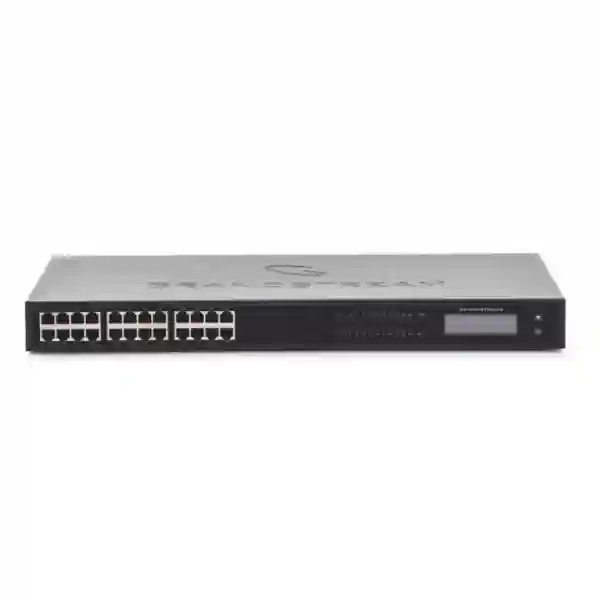
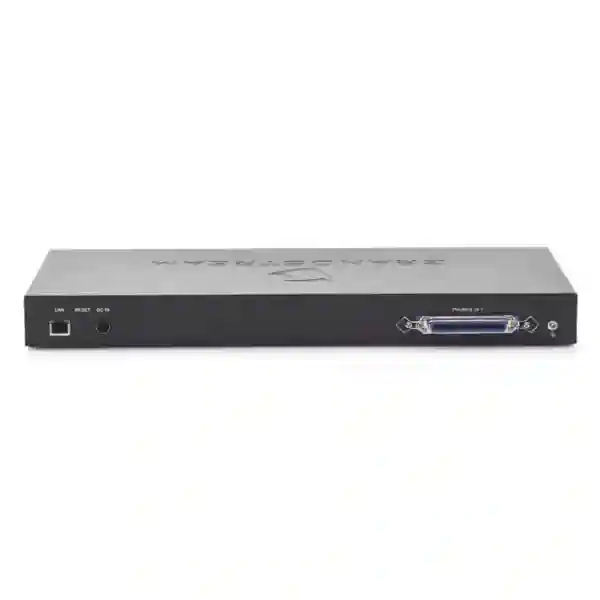
Grandstream GXW4224 V2 Dubai – 24-Port FXS VoIP Gateway
The Grandstream GXW4224 V2 is a high-density 24-port FXS VoIP gateway designed for organizations that need to connect existing analog telephones, fax endpoints, legacy PBX extensions, or other supported analog devices to a SIP-based communications environment. For a Dubai office, hotel, clinic, school, warehouse, branch network, government facility, or multi-site business, the practical value of the GXW4224 V2 is not simply the number of ports. Its real purpose is to provide a structured migration path between established analog infrastructure and modern IP telephony without forcing every endpoint to be replaced at the same time.
Fourteck positions the GXW4224 V2 as a project component that should be selected after checking endpoint count, analog wiring, fax requirements, SIP platform compatibility, VLAN and QoS design, rack space, provisioning method, security policy, failover expectations, and future expansion. The gateway provides 24 FXS ports, a Gigabit Ethernet interface, four SIP server profiles, an independent SIP account per telephone port, wideband codec support including G.722 and Opus, T.38 fax capability, advanced security features, and centralized provisioning options. These capabilities make it suitable for phased VoIP migration and mixed analog/IP deployments where continuity matters as much as modernization.
Designed for analog endpoint-side connectivity rather than PSTN line-side FXO integration.
A single auto-sensing 10/100/1000 Mbps RJ45 network interface connects the gateway to the IP network.
Supports distinct SIP server profiles with an independent SIP account mapped to each telephone port.
V2 adds modern security and provisioning capabilities, including secure boot, device certificates, randomized credentials, dual firmware images, and GDMS support.
Where the GXW4224 V2 fits in a real telephony project
A common migration problem is that the IP PBX or SIP trunk is ready, but a building still has many analog endpoints. Some may be ordinary desk phones, while others may be fax machines, lift or lobby phones, reception handsets, warehouse phones, emergency points, hotel back-office devices, intercom-related extensions, or legacy PBX-side analog extensions. Replacing all of them may be unnecessary, disruptive, or simply outside the current project budget. A 24-port FXS gateway lets the organization preserve suitable analog endpoints while changing the call-control layer behind them.
This makes the Grandstream GXW4224 V2 particularly relevant when the requirement falls between a small ATA deployment and a much higher-density gateway. A few analog endpoints can often be handled with smaller adapters. Once the requirement grows into the teens or twenties, however, using many separate ATAs can increase power supplies, switch ports, cable clutter, configuration overhead, and troubleshooting points. The GXW4224 V2 consolidates 24 analog ports into a rack-mountable or desktop gateway with centralized administration.
The gateway does not by itself replace a PBX, SIP service, switching infrastructure, VLAN design, or structured cabling. Instead, it acts as the analog-to-SIP bridge. Fourteck therefore recommends viewing it as one part of an overall voice architecture rather than as a standalone communications system.
GXW4224 V2 or FXO gateway? Start with the direction of the analog connection
The most important buying check is whether the project needs FXS or FXO. The GXW4224 V2 is an FXS gateway. In practical terms, its ports are intended to serve analog endpoint-side devices such as supported analog telephones and fax machines. It is not the correct category when the requirement is to bring analog PSTN lines into an IP PBX. That line-side role normally requires FXO interfaces instead.
| Requirement | Interface direction | GXW4224 V2 fit |
|---|---|---|
| Connect analog telephones to SIP/IP PBX | FXS | Strong fit |
| Retain analog fax endpoints during VoIP migration | FXS with fax planning | Relevant; confirm fax path and codec settings |
| Bring analog PSTN trunks into IP PBX | FXO | Not the correct interface category |
| Replace many small ATAs with one managed chassis | High-density FXS | Good project use case |
This distinction prevents one of the most expensive analog-gateway procurement mistakes: buying the right port count with the wrong electrical interface. Before quotation, Fourteck can help map the existing analog side, the SIP side, and the desired call flows so the gateway category is clear.
Verified GXW4224 V2 technical profile
| Analog interfaces | 24 FXS ports; GXW4224 family format includes 24 RJ11 connections and one 50-pin Telco connector |
|---|---|
| Network interface | 1 × 10/100/1000 Mbps auto-sensing RJ45 Ethernet port |
| SIP structure | 4 distinct SIP server profiles; independent SIP account per telephone port |
| Voice codecs | G.711, G.723.1, G.726-32, G.729, G.722 wideband, iLBC, and Opus |
| Wideband audio | Supports 16 kHz wideband voice sampling and wideband codecs including G.722 and Opus |
| Fax | T.38 Group 3 fax relay with G.711 fax pass-through support; deployment should be validated against the carrier/PBX path |
| Telephony functions | Caller ID, call waiting, blind/attended transfer, call forwarding, do not disturb, 3-way conference, last call return, paging, message waiting indication and related features, subject to platform configuration |
| QoS and VLAN | DiffServ, TOS, and 802.1P/Q VLAN tagging |
| SIP transport | SIP RFC 3261 over UDP, TCP, or TLS |
| Provisioning | TFTP, HTTP, HTTPS, FTP, FTPS, TR-069; Grandstream also lists GDMS management/provisioning support for the V2 series |
| Security | SRTP, TLS/SIPS, HTTPS, secure boot, randomized admin credentials, unique device certificates, and dual firmware images |
| Power | 12 VDC, 5 A output, maximum 60 W; universal AC input 100–240 VAC, 50–60 Hz |
| Form factor | Approx. 440 × 185 × 44 mm, 1U; desktop or rack mounting with front brackets |
| Line reach reference | 2 REN, up to 6000 ft on 24 AWG wire under the manufacturer’s specified conditions |
What changed with V2 and why buyers should care
The V2 generation is more than a model-name suffix. Grandstream documents V2 improvements around security, voice quality, provisioning, and platform longevity. The V2 family supports 16 kHz wideband sampling and wideband codecs such as G.722 and Opus. It also adds carrier-grade security elements such as secure boot, a unique device certificate, a randomized default/admin password, and dual firmware images. For larger deployments, secure cloud management through Grandstream Device Management System can simplify inventory, provisioning, and remote administration when it is part of the chosen operational model.
The correct way to identify a V2 unit is by the physical product label. Grandstream notes that the model label explicitly includes “V2,” and V2 hardware includes a device password on the label. This matters because V1 and V2 firmware handling differs. A purchasing team replacing an older GXW42xx gateway should therefore avoid assuming that every device carrying the same base model number is identical.
For Fourteck projects, model generation is checked before firmware planning, configuration reuse, or replacement recommendations. This reduces the risk of applying the wrong firmware assumptions or importing legacy settings without validating the target hardware.
Twenty-four FXS ports: the density question behind the model choice
Port count should follow the endpoint plan rather than simply matching today’s active extension count. If a site currently has 18 analog devices, a 24-port gateway may provide a practical margin for spare ports, temporary migration needs, or small future additions. Conversely, if the requirement is already close to 24 ports and the project is likely to expand materially, the next density level may be more appropriate. Fourteck normally reviews the current endpoint inventory, inactive-but-required lines, fax devices, future rooms or desks, contingency ports, and whether multiple buildings or floors are better served by one centralized gateway or several distributed units.
A centralized 24-port device can simplify management but may lengthen analog cable runs. A distributed design can shorten analog wiring but introduces additional network, power, and device-management points. The better choice depends on rack location, copper topology, switch availability, UPS coverage, and fault-domain planning. In hotels, schools, warehouses, and multi-floor offices, this physical topology can be more important than the raw gateway specification.
The GXW4224 V2 therefore suits environments where the analog requirement is substantial enough to justify a high-density gateway yet still fits comfortably within a 24-port architecture.
Analog phone migration without replacing every handset
One of the strongest business cases for the GXW4224 V2 is phased migration. An organization may be moving from an older PBX to a SIP-based communications platform while still having reliable analog phones in locations where advanced IP-phone features are unnecessary. Rather than change every endpoint on the same weekend, the project can preserve selected analog handsets and move call control to the new IP environment. This approach can reduce endpoint disruption, spread replacement cost over time, and let the IT team prioritize new IP phones for users who actually need displays, programmable keys, presence, directory access, video, Wi-Fi, Bluetooth, or other modern endpoint capabilities.
The migration still requires careful extension mapping. Each analog port should be associated with the intended SIP identity, dial plan, class of service, emergency-calling policy, caller-ID behavior, and voicemail or feature expectations. Users accustomed to legacy PBX feature codes may need revised instructions because feature behavior can depend on the new SIP platform.
Fourteck can help create a port-to-extension mapping sheet before cutover so configuration, labels, patching, and testing follow the same plan.
Fax over IP: supported, but the end-to-end path still matters
Grandstream lists T.38 fax relay and G.711 fax pass-through support for the GXW4200 V2 series. That makes the GXW4224 V2 relevant when a business still depends on analog fax machines or fax-capable multifunction devices. However, the presence of T.38 on the gateway does not guarantee that every upstream SIP carrier, SBC, IP PBX, or remote destination will handle fax identically. Fax is an end-to-end service, so reliability depends on the complete route.
For a Dubai or UAE deployment, Fourteck recommends confirming whether fax traffic will remain internal, traverse a SIP trunk, pass through an SBC, or connect to a provider with specific codec and T.38 policies. Network packet loss and jitter also matter because fax is less forgiving than ordinary voice. The configuration may require testing both T.38 and G.711 pass-through behavior against the actual service path.
If fax is business-critical, it should be treated as a separate acceptance-test item rather than assumed to work simply because the gateway supports the relevant protocol.
Voice quality: codecs are only one part of the result
The GXW4224 V2 supports familiar narrowband codecs as well as wideband G.722 and Opus, and Grandstream identifies 16 kHz wideband voice sampling as a V2 capability. That gives the gateway a strong technical basis for modern voice integration, but the audio experience at an analog handset is still influenced by the handset itself, the local copper pair, PBX codec policy, SIP trunk transcoding, network quality, and the remote endpoint.
For business deployment, the goal is not to enable the maximum number of codecs. It is to choose a codec policy that matches the SIP platform and carrier, avoids unnecessary transcoding, preserves quality, and respects bandwidth constraints. Echo cancellation, jitter management, packet-loss concealment, and correct analog gain settings also contribute to user experience.
Fourteck can align gateway codec priorities with the wider voice design so the configuration reflects the actual network rather than a generic factory-default policy.
SIP profiles and account mapping for multi-environment deployments
The GXW4224 V2 supports four distinct SIP server profiles and an independent SIP account per telephone port. This architecture is useful where groups of analog ports need different registration parameters, servers, transport settings, or dial-plan behavior. It can also support migration scenarios where one set of ports is being moved to a new platform while another set remains associated with an existing SIP environment, subject to the design and platform requirements.
A strong configuration starts with a clear mapping table: physical port, room or desk, extension, SIP account, profile, outbound identity, inbound destination, voicemail policy, feature access, and test result. Without that documentation, troubleshooting twenty-four analog endpoints can become unnecessarily slow because a technician must infer configuration from the device instead of comparing it against an agreed plan.
For multi-branch organizations, the same principle should be applied consistently across sites so numbering plans and provisioning conventions remain understandable to both local and central IT teams.
Network design: VLAN, QoS, switching and resilience
Because twenty-four analog endpoints can depend on one gateway, the network path to that gateway deserves deliberate design. Grandstream supports 802.1P/Q VLAN tagging, DiffServ/TOS, and standard IP networking protocols. In practice, Fourteck recommends placing voice components in an appropriate network segment, coordinating VLAN tagging with the switch configuration, and applying QoS consistently across the LAN and WAN path when congestion is possible.
The gateway itself has one Gigabit Ethernet interface. That means link availability, switch-port configuration, cable quality, and upstream switching resilience affect all connected analog endpoints. Where telephony is operationally important, the gateway and its network switch should be considered in the UPS and power-resilience plan. A high-density gateway that remains powered during an outage is still unusable if the switch, router, SBC, or IP PBX loses power.
For branch connectivity, the WAN design should account for latency, packet loss, jitter, VPN overhead if used, and failover behavior. If the deployment spans Dubai and remote UAE branches, or UAE headquarters with offices in Africa or GCC markets, the voice path may cross different service providers and network conditions. Testing should therefore include normal and failover routes when those routes are part of the production design.
A successful GXW4224 V2 deployment is consequently a combined voice-and-network task. Treating it only as an analog adapter misses the infrastructure dependencies that determine reliability.
Security features and practical hardening
The V2 platform includes SRTP, TLS/SIPS, HTTPS, secure boot, randomized device credentials, unique certificates, and dual firmware images. These are valuable controls, but a secure deployment still depends on how the gateway is configured and where it is placed. Management access should be restricted to trusted administrative networks, default credentials should be handled according to policy, unused management exposure should be avoided, and firmware should be managed deliberately.
If SIP over TLS and SRTP are required, the PBX, SBC, certificate model, and service provider must support the same security approach. Encryption should not be enabled in isolation without confirming interoperability and troubleshooting procedures. The same applies to remote management: cloud provisioning can reduce operational effort, but access control, account security, role assignment, and change management still matter.
Fourteck can incorporate the gateway into a broader hardening checklist covering management access, SIP credentials, transport security, network segmentation, logging, firmware policy, backup configuration, and recovery documentation.
Provisioning and remote administration at scale
The GXW4200 V2 series supports multiple provisioning methods, including TFTP, HTTP, HTTPS, FTP, FTPS, TR-069, and Grandstream’s GDMS environment. The right choice depends on the organization’s management model. A single gateway in one office can be administered manually, but a larger rollout benefits from standard templates, controlled configuration changes, inventory records, firmware policy, and centralized monitoring.
For a 24-port unit, template discipline is especially useful because many settings are repeated across ports while some values must remain unique. Extension numbers, authentication details, display or caller-ID settings, dial-plan exceptions, and profile assignments should be generated or reviewed systematically. Configuration backups should be kept under change control, particularly before firmware upgrades or major SIP-server changes.
In managed multi-site deployments, centralized administration can shorten troubleshooting time because IT can compare devices, verify firmware levels, and review configuration without requiring physical access to each branch. Whether GDMS or another supported workflow is used, the operational process should be documented before rollout.
Rack, cabling and physical deployment planning
The GXW4224 V2 is approximately 440 mm wide, 185 mm deep, and 44 mm high, corresponding to a 1U form factor, and it can be used on a desktop or mounted in a rack with front brackets. The physical design makes it suitable for telecom rooms and server racks, but the gateway should be installed with attention to airflow, cable bend radius, power access, labeling, and serviceability.
For twenty-four analog ports, cabling organization matters. If RJ11 connections are used directly, every lead should be labeled to match the extension plan. If the project uses the 50-pin Telco interface with appropriate breakout infrastructure, the patching scheme should be documented so future technicians can trace a room or endpoint without trial and error. Cable-management space around the device should be considered before the rack elevation is finalized.
Fourteck recommends keeping the gateway, analog distribution, switch, UPS, and PBX/SBC documentation together as part of the handover pack. Good physical documentation turns future support from a tracing exercise into a controlled maintenance task.
Long analog cable runs and REN considerations
Grandstream specifies a short/long-haul reference of 2 REN and up to 6000 feet on 24 AWG wire under the manufacturer’s stated conditions. This is useful for campuses, warehouses, large villas, schools, or hospitality environments where an analog endpoint may be far from the telecom rack. However, real cabling quality, joints, patch panels, surge exposure, handset characteristics, and local installation conditions can affect performance.
Long copper runs should therefore be tested rather than accepted from a theoretical distance alone. Ringing, caller ID, off-hook detection, audio level, and fax behavior are all relevant. Buildings with old copper infrastructure may have undocumented splices or mixed cable types that change line behavior.
Where the analog path is unreliable or unusually long, the better solution may be to move the gateway closer to the endpoints and extend IP connectivity instead of extending analog copper. That decision should be based on the site layout, network access, rack availability, and power resilience.
Who should consider the Grandstream GXW4224 V2?
Hotels and hospitality
Useful where selected room, service, back-office, lift, or operational analog endpoints need to remain active while the core telephony platform moves to SIP. Endpoint roles and emergency policies must be mapped carefully.
Warehouses and logistics
Can preserve rugged or strategically placed analog phones across loading, security, dispatch, and operations areas while central call control is modernized.
Schools and campuses
Suitable for analog extensions spread across admin offices, staff areas, security points, and older buildings, subject to copper quality and extension planning.
Clinics and healthcare administration
Can support phased migration for non-clinical analog telephony and fax workflows, while business-critical fax and emergency use cases are validated separately.
Government and institutions
Relevant when existing analog endpoints must be retained during a controlled modernization project with documentation, segmentation, security, and acceptance testing.
Multi-branch businesses
Useful for standardizing analog-to-SIP migration across branches while keeping centralized configuration and numbering conventions.
When the GXW4224 V2 may not be the right choice
A good product page should also explain when not to buy the product. The GXW4224 V2 is not the correct choice when the requirement is primarily for analog PSTN line input, because that is an FXO use case. It may also be unnecessarily large when only one or two analog endpoints remain. In that situation, a smaller ATA can reduce cost and simplify installation. At the other extreme, if the organization already requires more than 24 ports at one location and expansion is likely, a higher-density GXW42xx model or multiple-gateway design may be more appropriate.
The gateway is also not a substitute for an IP PBX. If the project lacks call control, SIP accounts, routing, voicemail, hunt groups, IVR, reporting, or trunk services, those components must be designed separately. Similarly, the presence of T.38 support does not mean every fax route will be reliable without provider and network validation.
Finally, if the project objective is to remove analog infrastructure completely and every user requires modern endpoint features, it may be more efficient to move directly to IP phones rather than preserve analog handsets through a gateway.
GXW4216 V2 vs GXW4224 V2 vs GXW4232 V2 vs GXW4248 V2
The core GXW4200 V2 family shares the same general high-density FXS gateway concept. The main procurement difference is port density and physical analog connectivity. Choosing the correct model is therefore primarily a capacity and cabling decision, with allowance for future growth.
| Model | FXS capacity | Typical fit | Planning note |
|---|---|---|---|
| GXW4216 V2 | 16 ports | Smaller analog estates | Good when 16 ports provide sufficient headroom |
| GXW4224 V2 | 24 ports | Medium/high-density analog migration | Balanced option for sites in the high teens or low twenties |
| GXW4232 V2 | 32 ports | Larger single-site analog estates | Consider when 24 ports leave too little expansion room |
| GXW4248 V2 | 48 ports | Very high-density deployments | Uses Telco connectors rather than the same front-panel RJ11 layout |
Fourteck can compare the models against the actual endpoint inventory instead of simply recommending the largest device. Excess capacity can be useful, but unnecessary density can increase project cost without improving functionality.
Compatibility with IP PBX, SIP platforms and Grandstream UCM
Grandstream describes the GXW4200 series as interoperable with leading IP PBXs, softswitches, SIP-based environments, analog PBXs, and analog phones. The manufacturer also highlights integration with its UCM series and Zero Configuration provisioning. This broad SIP orientation is useful, but interoperability should still be confirmed against the exact PBX version, firmware, authentication method, SIP transport, codec set, dial plan, and feature expectations used in the project.
Basic registration and calling are only the starting point. A production acceptance test should verify inbound calls, outbound calls, caller ID, DTMF, transfer, call waiting, voicemail access, hunt-group behavior where relevant, emergency dialing policy, fax if required, failover, and any special feature codes used by analog users. If an SBC or SIP trunk sits between the gateway and call-control platform, it should be part of the test path.
Fourteck can help define a compatibility checklist before deployment so acceptance is based on business functions rather than a single successful test call.
Failover and continuity planning
Grandstream lists failover SIP server capability for the GXW4200 V2 series, allowing the device to switch to a secondary server when the primary server is unavailable. This can contribute to resilience, but effective continuity depends on the entire environment. The secondary server must be reachable, have appropriate account or registration configuration, support the same numbering and routing expectations, and be included in operational testing.
Network resilience should also be considered. If the gateway has only one Ethernet path to one access switch and that switch fails, SIP server redundancy alone will not keep the analog phones working. The same is true for power, WAN connectivity, DNS, SBCs, and hosted PBX access. Resilience therefore needs to be designed end to end.
For sites where analog phones support critical operations, Fourteck recommends documenting the expected behavior during PBX failure, WAN failure, switch failure, and power failure. That documentation should state what remains functional, what does not, and who is responsible for recovery.
Dubai deployment scenarios
Dubai has a wide mix of office towers, warehouses, hotels, retail sites, schools, clinics, villas, and industrial facilities. Many organizations operate modern IP networks while still carrying pockets of analog telephony that are expensive or inconvenient to replace immediately. In a Business Bay office, the GXW4224 V2 may support a phased PBX migration where reception, meeting areas, stores, or service rooms retain analog phones. In Deira or Bur Dubai, an established trading company may have working analog extension wiring across multiple rooms and want to modernize call control without rewiring every desk on the first phase.
In JAFZA, Dubai Investments Park, or industrial environments, the requirement may be operational phones distributed across a warehouse or logistics facility. Here the design focus shifts toward cable distance, labeling, rack location, power backup, and network resilience. Hospitality projects can introduce another set of requirements, including large extension maps, room numbering, back-office lines, and operational phones that must be tested against the new PBX workflow.
Fourteck can scope GXW4224 V2 projects in Dubai around the existing telephony estate rather than assuming every site uses the same architecture. The quotation can be aligned to device supply, configuration, PBX integration, cabling, rack work, testing, or a combined migration scope depending on the actual requirement.
Abu Dhabi, Sharjah, Ajman and wider UAE projects
Outside Dubai, the GXW4224 V2 can fit the same underlying migration challenge: retain selected analog endpoints while moving the communications core to SIP. An Abu Dhabi organization may have larger campus-style facilities where long copper runs and centralized telecom rooms influence gateway placement. Sharjah industrial and educational sites may need a practical way to preserve distributed analog phones while upgrading PBX infrastructure. Ajman businesses may prefer a single 24-port chassis over a collection of small ATAs when the analog estate has grown over time.
For UAE-wide organizations, standardization becomes important. Using the same gateway family, firmware policy, extension mapping format, configuration naming, and acceptance checklist across branches can simplify central support. At the same time, each location may need a different port density. A 16-port model may suit one branch, the GXW4224 V2 another, and a 32- or 48-port model a larger site.
Fourteck can help standardize the design while selecting the correct capacity per branch, avoiding both under-sizing and unnecessary over-sizing.
GCC and Africa deployment considerations
The same analog-to-SIP migration pattern appears across GCC and African markets, although the surrounding infrastructure can differ. In Kuwait, organizations may be consolidating branch telephony into centralized or hosted SIP platforms while retaining analog devices at selected locations. In Uganda, Kenya, Tanzania, Ghana, and Nigeria, the business requirement may combine existing analog extensions with new IP PBX deployments, branch connectivity, varied WAN quality, and a need for remote administration.
In these projects, procurement should not focus only on the gateway chassis. Power quality, UPS sizing, rack conditions, structured cabling, switch availability, WAN resilience, remote access policy, spare strategy, and local technical support can have a greater effect on service continuity. The GXW4224 V2’s centralized management options can help, but remote support works best when the network is documented and management access is designed securely.
Fourteck’s broader regional presence can support requirement discussions for UAE, GCC, and African deployments. Regional suitability, supply, lead time, licensing, installation scope, and support should be confirmed at quotation stage rather than assumed from a product page.
A practical design sequence for a 24-port analog-to-SIP migration
- Inventory every analog endpoint. Record location, current extension, device type, business owner, line purpose, whether it is still required, and whether fax or special signaling is involved.
- Separate FXS requirements from FXO requirements. Confirm that the endpoint side really needs FXS and identify any analog PSTN trunks that require a different gateway category.
- Confirm the target SIP platform. Document the IP PBX, hosted service, SBC, SIP trunk, authentication model, codec policy, security requirements, and provisioning approach.
- Plan capacity. Decide whether 24 ports provide enough current capacity and future headroom. Compare GXW4216 V2, GXW4224 V2, GXW4232 V2, or GXW4248 V2 if the count is close to a model boundary.
- Design the network. Confirm VLAN, QoS, IP addressing, switch port, firewall rules where relevant, DNS/NTP, WAN path, UPS coverage, and failover expectations.
- Plan analog cabling. Decide between direct RJ11 patching and the available Telco-connector approach, then label every connection against the extension plan.
- Build and validate the configuration. Configure SIP profiles, accounts, dial plans, codec priorities, DTMF, caller ID, fax parameters, security, provisioning, logging, and management access.
- Test business functions. Verify inbound/outbound calls, transfers, DTMF, voicemail, hunt groups, fax, failover, caller ID, and any role-specific workflows.
- Document and hand over. Capture port mapping, IP details, firmware version, backup configuration, rack location, cable labels, support contacts, and change-control procedure.
Procurement checklist before requesting a GXW4224 V2 quote
A useful quotation contains more than a product name. Sharing the following information helps Fourteck determine whether the GXW4224 V2 is the right model and whether accessories, configuration, installation, or migration services should be included.
- Number of analog telephones and fax devices to be retained.
- Current PBX or telephony platform and target PBX/SIP platform.
- Whether the project requires only FXS endpoints or also has analog PSTN/FXO requirements.
- Site location, number of branches, and whether the gateway will be centrally or locally installed.
- Rack availability and preferred analog termination method.
- Fax requirements and whether fax traffic traverses a SIP trunk.
- VLAN, QoS, security, TLS/SRTP, remote management, and provisioning requirements.
- Need for installation, configuration, PBX integration, cabling, testing, documentation, or support.
- Expected future analog-port growth so capacity can be selected sensibly.
Common configuration mistakes to avoid
Buying FXS for an FXO requirement: this is the most fundamental mismatch. Confirm whether the analog side is an endpoint or a provider/PSTN line.
Using a flat network with unrestricted management access: the gateway supports modern security features, but they should be paired with sensible network segmentation and access control.
Ignoring the analog wiring plan: twenty-four ports without labels and extension documentation can turn a simple fault into a long tracing exercise.
Assuming fax is automatic: test the full fax path against the actual carrier or PBX. T.38 capability on one device is not an end-to-end guarantee.
Upgrading firmware without verifying V1/V2 generation: Grandstream distinguishes V2 hardware and firmware handling. Confirm the label and follow the correct release guidance.
Testing only one phone: acceptance should cover representative endpoint types and all critical workflows, not just a successful outbound voice call.
Firmware and lifecycle discipline
Grandstream actively publishes firmware and documentation for the GXW42xx V2 family. Because firmware can change features, behavior, security, and upgrade requirements, a production gateway should not be treated as a “configure once and forget” appliance. The organization should record the deployed firmware version, review release notes before upgrades, maintain backups, and schedule changes under a controlled maintenance process.
The manufacturer also documents important differences between V1 and V2 firmware paths. This is another reason to verify the physical model label rather than rely on an old inventory entry. If multiple generations exist in the same environment, they should be tracked separately.
Fourteck can assist with firmware review and configuration planning as part of a support scope. Firmware should be selected based on vendor guidance and project needs, not upgraded blindly solely because a newer number exists.
Troubleshooting approach for GXW4224 V2 deployments
When an analog endpoint cannot make or receive calls, troubleshooting should move through the layers systematically. First verify the physical port, phone, cable, and off-hook behavior. Then check whether the corresponding SIP account is registered and mapped to the correct profile. Review IP connectivity, DNS and NTP where relevant, VLAN tagging, firewall/SBC behavior, and SIP transport. After registration is confirmed, examine the dial plan, DTMF method, caller-ID settings, codec negotiation, and PBX routing.
Audio issues should be separated into one-way audio, no audio, echo, low level, distortion, clipping, packet loss, or delay because each points to a different set of causes. Fax should be tested independently from voice. Intermittent problems require timestamps, call examples, network captures or logs where appropriate, and correlation with PBX/SBC records.
A documented port map and standardized configuration dramatically reduce troubleshooting time. The technician can compare the failing port with a known-good port rather than re-discover the deployment from scratch.
Why engage Fourteck for GXW4224 V2 planning?
A high-density analog gateway is easy to describe as “24 ports,” but the project behind those ports can be more complex. Fourteck approaches the requirement from both the telephony and network sides: analog endpoint inventory, FXS/FXO distinction, SIP/PBX compatibility, codec and fax behavior, VLAN and QoS, rack and cabling layout, provisioning, firmware, security, testing, and handover documentation.
For organizations already operating Grandstream UCM, the discussion can include how the GXW4224 V2 fits into the existing Grandstream environment and provisioning model. For third-party PBX or hosted SIP deployments, the focus shifts to standards-based interoperability and the exact features required by the business. For multi-site projects, Fourteck can help standardize naming, port mapping, configuration, and acceptance procedures across branches.
Supply, stock, lead time, project pricing, installation availability, and support scope can vary by country and project, so Fourteck confirms these at quotation stage rather than making static promises on a product page.
Related Fourteck regional resources
For UAE technology procurement and infrastructure requirements, visit Fourteck UAE. For broader company and solution information, visit Fourteck. Regional project discussions are also supported through Fourteck Uganda, Fourteck Kenya, Fourteck Tanzania, Fourteck Ghana, Fourteck Nigeria, and Fourteck Kuwait.
These links are intended to support a regional buyer journey. Product availability, deployment scope, and commercial terms should be confirmed for the destination market and project at the time of inquiry.
Frequently asked questions about the Grandstream GXW4224 V2
Is the GXW4224 V2 an FXS or FXO gateway?
The GXW4224 V2 is an FXS gateway. It is designed to connect analog endpoint-side devices such as supported analog telephones and fax machines to a SIP-based environment. If the requirement is to connect analog PSTN lines into an IP PBX, an FXO gateway category is normally required instead.
How many analog ports does the GXW4224 V2 provide?
It provides 24 FXS ports. The GXW4224 family format includes 24 RJ11 connections and one 50-pin Telco connector, giving project teams flexibility in how the analog side is patched and distributed.
Can the GXW4224 V2 be used with a Grandstream UCM IP PBX?
Yes. Grandstream specifically highlights use with its UCM series and Zero Configuration provisioning. As with any production project, the exact UCM version, firmware, account mapping, dial plan, codec policy, and feature requirements should still be validated.
Can it work with third-party SIP platforms?
Grandstream states that the GXW4200 series is designed for interoperability with leading IP PBXs, softswitches, and SIP-based environments. Compatibility should be confirmed against the specific platform and required feature set before a large deployment.
Does the GXW4224 V2 support fax?
Yes. The manufacturer lists T.38 Group 3 fax relay and G.711 fax pass-through support. Fax reliability depends on the complete path, including PBX, SBC, SIP provider, network quality, and remote destination, so business-critical fax should be tested end to end.
Does it support secure SIP and encrypted media?
The V2 series supports TLS/SIPS, SRTP, and HTTPS, along with secure boot, unique certificates, randomized credentials, and dual firmware images. The PBX and surrounding infrastructure must support the chosen security design as well.
What is the network interface speed?
The gateway has one auto-sensing 10/100/1000 Mbps RJ45 Ethernet interface. Network availability and switch configuration are important because all 24 analog endpoints depend on this IP connection.
Does it support VLAN and QoS?
Yes. Grandstream lists DiffServ, TOS, and 802.1P/Q VLAN tagging. Fourteck recommends aligning these settings with the actual switch, router, and WAN QoS design rather than enabling them in isolation.
Can the GXW4224 V2 be rack mounted?
Yes. The manufacturer lists desktop and rack mounting with front brackets. The chassis is approximately 1U high, which makes it suitable for telecom and server-rack environments.
How do I know whether a device is V1 or V2?
Grandstream advises checking the physical label. A V2 unit explicitly includes “V2” in the model name and includes a device password on the label. This check is important before selecting firmware or applying generation-specific upgrade guidance.
Should I choose GXW4216 V2, GXW4224 V2, GXW4232 V2, or GXW4248 V2?
Choose according to the required FXS capacity, physical cabling plan, and expected growth. The family provides 16, 24, 32, and 48-port options. A model should leave sensible headroom without creating unnecessary cost or unused capacity.
Can Fourteck supply and configure the GXW4224 V2 in Dubai?
Fourteck can evaluate GXW4224 V2 requirements for Dubai and UAE projects, including product selection, SIP/PBX compatibility, configuration, network planning, cabling considerations, migration, and testing. Current stock, lead time, project pricing, installation scope, and support terms should be confirmed at quotation stage.
Request a GXW4224 V2 sizing and compatibility review
If your project needs to retain analog phones or fax endpoints while moving to SIP, share the number of analog devices, current PBX, target SIP platform, site location, fax requirements, and whether configuration or installation is required. Fourteck can help determine whether the Grandstream GXW4224 V2 is the right 24-port option or whether another gateway density is a better fit.
Next step: request a quotation with your endpoint count and telephony platform details so the proposed solution can be checked for FXS capacity, SIP compatibility, network requirements, and deployment scope before ordering.

Reviews
There are no reviews yet.