Grandstream GCC6021: High-Capacity UC, Security, Routing and Multi-Gig Switching in One Platform
Grandstream GCC6021 is the larger-capacity model in the GCC6020 Series, created for organisations that want to consolidate several core infrastructure functions into one centrally managed platform. It combines a multi-WAN VPN router, next-generation firewall, managed Ethernet switch and IP PBX while also supporting central management of compatible Grandstream networking and communication endpoints. The value is not simply that four functions occupy one chassis. The important question is whether convergence can simplify operations, reduce the number of independent appliances and still provide the routing, security, PoE, switching, telephony and resilience capacity required by the site.
The model is particularly relevant when a project needs multi-gigabit access, multiple 10GbE uplinks, high PoE density, resilient WAN design, integrated business telephony and a consistent management approach across networking and communication services. Fourteck can evaluate GCC6021 as part of a full deployment that includes WAN services, VLANs, access points, IP phones, SIP trunks, QoS, security policy, rack design, UPS capacity, redundancy and future growth.
High-speed edge routing for demanding business networks and multi-WAN connectivity.
Published DPI and IPS next-generation firewall throughput for integrated security.
Eight 2.5GbE and sixteen Gigabit copper access ports with up to 370W PoE budget.
Standard package supports up to 50 users or extensions and 16 concurrent calls.
Why GCC6021 is more than a router or IP PBX
Business infrastructure is often assembled in layers. A router is installed for internet access, a firewall is added for inspection and segmentation, PoE switches are deployed for phones and access points, and a separate PBX handles voice. This modular approach remains valid where best-of-breed separation is required, but it can also create multiple management interfaces, duplicated configuration, several firmware cycles, separate support paths and more integration points between services.
GCC6021 follows a convergence-first model. It can serve as secure network edge, internal switching platform, communication server and management point for supported Grandstream infrastructure. This makes it relevant to branch offices, headquarters, hotels, schools, healthcare environments, professional offices, warehouses, retail sites and distributed organisations that want fewer independent systems without ignoring segmentation, capacity planning, change control or resilience.
Convergence does not remove the need for engineering. It increases the importance of sizing because one appliance may carry several critical services. Before selection, an organisation should quantify internet bandwidth, number of WAN circuits, wired clients, access points, PoE load, VLANs, expected session volume, firewall inspection, extensions, peak concurrent calls, SIP trunk channels, VPN users, recording requirements and recovery expectations. Fourteck treats GCC6021 as an infrastructure architecture decision rather than simply a box to add to a bill of materials.
Verified GCC6021 platform specifications
| Capability | GCC6021 | Deployment meaning |
|---|---|---|
| Processor | Quad-core Cortex-A73, 1.8GHz | Runs the converged network and communication workload. |
| 10GbE | 4 × 10 Gigabit SFP+ | High-speed uplinks, aggregation and selected WAN/LAN roles. |
| 2.5GbE | 8 × 2.5 Gigabit Ethernet | Useful for modern APs, workstations and multi-gig endpoints. |
| Gigabit access | 16 × Gigabit Ethernet | Provides dense wired access for phones, PCs and edge devices. |
| WAN | Maximum 5 WAN interfaces | Supports resilient multi-carrier and load-balancing designs. |
| Routing | 10Gbps | Headroom for high-bandwidth edge and inter-network traffic. |
| IPsec VPN | 1.3Gbps | Capacity reference for encrypted branch and remote connectivity. |
| NGFW | 9Gbps DPI + IPS | Security inspection capability for higher traffic environments. |
| PoE | 24 PoE-out ports; 370W maximum | Can power a substantial mix of phones, APs and compatible devices. |
| PBX | 50 users / 16 calls by default | Integrated telephony for standard package deployments. |
| GWN management | Up to 300 APs / 1,000 clients | Supports sizeable Grandstream wireless environments. |
| Form factor | 440 × 301.5 × 44mm; 4.2kg; rack-mountable | Designed for structured rack deployment. |
Specifications should be checked against current Grandstream documentation and firmware notes at procurement time because firmware behaviour, licensing options and service plans may evolve.
Multi-gig switching and 10GbE uplinks
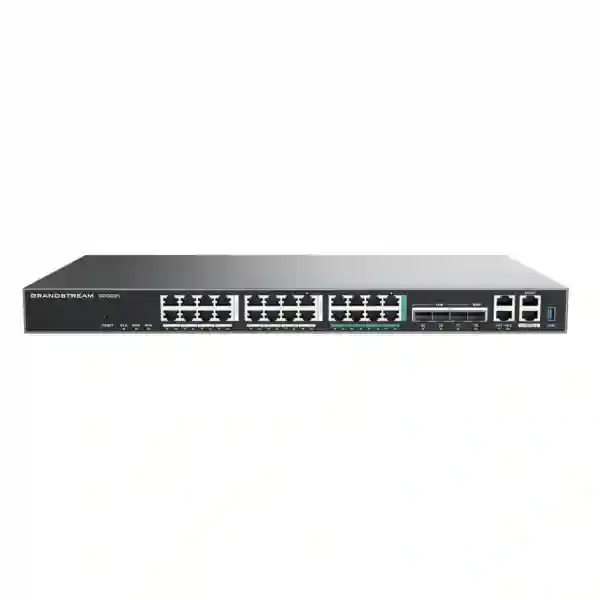
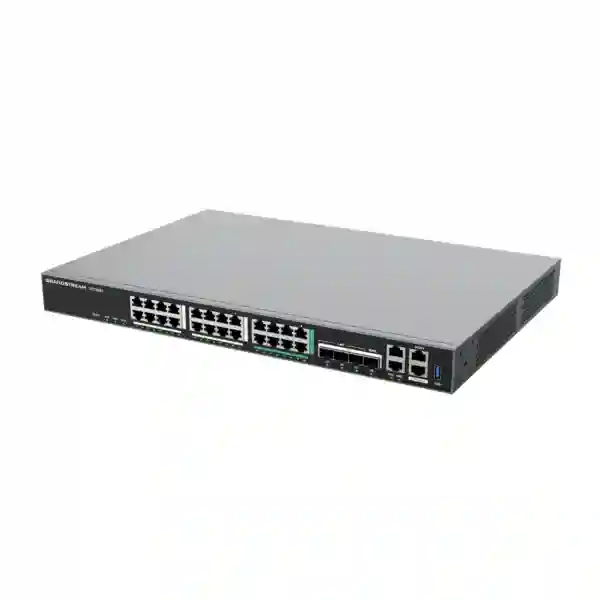
The physical port layout is one of the clearest reasons to select GCC6021 instead of a smaller convergence appliance. Sixteen Gigabit Ethernet ports support conventional access devices, eight 2.5GbE ports provide higher-speed copper access, and four 10GbE SFP+ interfaces provide fast uplink and aggregation options. This allows one platform to serve ordinary office endpoints while also accommodating access points, workstations, servers or uplinks that need more than one Gigabit of path capacity.
The eight 2.5GbE ports are particularly useful for modern wireless access points. Wi-Fi 6 and later access points can aggregate traffic from many clients, and a 1GbE wired uplink can become the limiting factor before the radio layer reaches its potential. Multi-gig Ethernet creates extra headroom while still using copper cabling where the cabling plant supports the required link speed. The same ports can serve selected power users, local storage appliances or other systems with 2.5GbE interfaces.
The four 10GbE SFP+ interfaces can connect GCC6021 to core or distribution switching, high-speed servers, storage infrastructure, or selected carrier handoffs where the design permits. Port assignment should be documented carefully because Grandstream supports configurable WAN/LAN roles and up to five WAN interfaces. A deployment should clearly identify edge-facing ports, internal trunks, tagged VLAN links and any fixed management or HA connectivity.
A good switching design also includes VLAN strategy. Voice, corporate data, guest access, surveillance, IoT, management and server networks often need logical separation. The objective is not to create VLANs merely for complexity, but to establish useful security boundaries, broadcast control and operational clarity. Fourteck can build port profiles and VLAN policies that match actual departments, services and endpoint types.
PoE design: calculate watts, not just port count
GCC6021 provides PoE output across twenty-four copper access ports. Eight 2.5GbE ports support IEEE 802.3af/at/bt, while sixteen Gigabit ports support IEEE 802.3af/at. Grandstream specifies a maximum PoE budget of 370W. This makes the appliance capable of powering many IP phones, wireless access points, cameras and other compatible endpoints, but successful deployment requires a power budget rather than a simple device count.
An office phone may draw modest power while a multi-radio access point, PTZ camera or specialised edge device can consume substantially more. The eight bt-capable ports should be allocated deliberately to devices that require the higher power class. A project worksheet should record each endpoint model, expected draw, maximum draw, target port and the total budget with practical headroom for expansion and transient demand.
Power design also affects resilience. When phones and APs receive power directly from the GCC6021, the appliance becomes an important part of the site’s power distribution. UPS capacity, redundant power input, generator availability and rack power should be considered together. A resilient network is not achieved by having two internet circuits if the entire edge loses power during a short outage.
Different environments create different PoE profiles. A hotel may power front-desk phones, staff phones and APs. A school may prioritise ceiling APs and office phones. A warehouse may combine access points, industrial edge devices and voice endpoints. The same GCC6021 hardware can support these use cases, but only after the endpoint mix is translated into a verified PoE plan.
Integrated IP PBX and call-capacity planning
GCC6021 includes the GCC PBX software module. The standard GCC602x package supports up to 50 users or extensions and 16 concurrent calls. Grandstream also documents a UC-200 SMB one-time upgrade for GCC602x models that increases capacity to 200 users or extensions and 48 concurrent calls. Projects requiring larger capacity should confirm the current upgrade path and licensing options before ordering.
Extension count alone is not enough to size a phone system. A 50-person professional office may rarely exceed ten simultaneous external calls, while a smaller support or sales team may have far higher concurrency during busy periods. SIP trunk channels, queues, conferences, call recording, remote extensions and call routing behaviour all influence the real requirement. Fourteck therefore sizes the PBX around peak call activity as well as user count.
Grandstream documents common UCM-style functions including extensions, SIP trunks, inbound and outbound routing, queues, conferencing and remote communication features. The GCC platform also supports PBX Direct Line VLAN configuration for SIP trunks delivered over dedicated VLANs or private carrier networks. This can help where a service provider presents voice separately from ordinary internet access and the PBX must bind trunks to the correct interface.
A practical telephony deployment should define extension ranges, departments, IVRs, ring groups, call queues, office hours, failover destinations, SIP provider details, emergency calling rules, recording policy and endpoint provisioning. The goal is a call flow that matches the organisation rather than a generic PBX installation.
Next-generation firewall and security service lifecycle
Grandstream publishes 9Gbps next-generation firewall throughput for GCC6021 with DPI and IPS. Supported security functions include traffic rules, NAT, anti-virus, IDS/IPS, SSL proxy, DNS filtering, web filtering, application identification and control, email security and Geo-IP filtering. These capabilities allow the appliance to act as a security platform rather than only a basic NAT router.
Real-world security throughput depends on enabled inspection functions, encrypted traffic, session mix, firmware, policy complexity and network design. A published figure should be treated as a capacity reference, not a guarantee that every combination of services will produce identical application throughput. Testing and sensible policy design remain important.
Grandstream documents an important licensing detail for the firewall service. When first activated, it includes a free one-year trial. If the service is not renewed after the trial, the firewall continues to run with its current configuration and the last installed security engines or signatures, but it no longer receives new security signature updates. Organisations should include renewal planning in their security operations because current signatures are part of maintaining an active threat-prevention platform.
Fourteck recommends defining trusted, untrusted and restricted zones, minimising broad inbound rules, separating management access, reviewing port forwarding, controlling remote VPN users, maintaining current firmware, monitoring security events and periodically reviewing policy. Hardware capability is only one part of effective network security.
Multi-WAN, VPN and connectivity resilience
GCC6021 supports up to five WAN interfaces and can be used for load balancing and failover. This is useful when internet availability directly affects cloud applications, voice, remote branches, payment systems, guest services or customer-facing operations. A primary fibre connection can be paired with another fixed broadband service, wireless connection or other carrier path depending on the site.
Failover should be validated during commissioning. Testing should confirm what happens when the primary WAN fails, how quickly traffic moves, whether VPN tunnels re-establish, whether SIP trunks remain reachable and whether inbound services depend on a public address tied to the failed circuit. DNS, static routes, carrier CPE and provider-specific settings can also affect recovery.
Grandstream lists IPsec, OpenVPN and WireGuard among supported VPN technologies, and the published IPsec throughput figure is 1.3Gbps. Site-to-site VPN can connect branches, while remote-access VPN can support authorised administrators and users. Access should follow least-privilege principles so remote users can reach only the networks and services they need.
Multi-site organisations benefit from consistent addressing and VLAN conventions. For example, branches can use a predictable voice VLAN, corporate VLAN, guest VLAN and management VLAN while keeping IP ranges unique at each site. This reduces troubleshooting effort and makes VPN policy easier to understand. Templates should be standardised, but each site still requires validation for local WAN and operational conditions.
High availability and failure-domain planning
The GCC6020 Series supports hot-standby high availability, and GCC6021 includes two dedicated HA interfaces. This matters because a converged appliance can carry routing, firewall, switching and PBX services simultaneously. If those functions are critical, the operational impact of a single device outage may be larger than in a fully separated architecture.
A true HA design extends beyond two appliances. It should consider redundant WAN circuits, independent carrier paths where possible, resilient power, UPS runtime, redundant uplinks, SIP trunk behaviour and configuration synchronisation. Two devices connected to one unprotected power feed or one ISP handoff still leave the environment exposed to a major single point of failure.
Fourteck can help determine whether one GCC6021 is sufficient or whether a hot-standby pair is justified. The decision should reflect business hours, number of users, dependence on voice and internet access, recovery objectives, availability of temporary workarounds and the financial impact of downtime.
Centralised management and Grandstream ecosystem operations
Grandstream documents management through GDMS, GWN App, local web GUI, SSH, SNMP and CLI. The platform can also centrally manage supported Grandstream endpoints. This can simplify standardisation when an organisation uses Grandstream access points, switches and communication devices across one or many locations.
Central management is most useful when paired with configuration discipline. IT teams can standardise device naming, VLANs, SSIDs, firmware policy, access rules and monitoring expectations. Topology visibility can also reduce the time needed to identify where a device is connected or which part of the infrastructure is affected by an issue.
Administrative access should be controlled. Roles should be assigned according to responsibility, management access should be restricted to trusted networks, credentials should be protected, secure protocols should be preferred and configuration changes should be documented. As one interface gains authority over more devices, governance becomes more important rather than less.
GCC6021 is specified to manage up to 300 GWN access points and 1,000 clients. These are platform limits, not substitutes for wireless engineering. AP quantity and placement must still be based on coverage, capacity, RF interference, building materials, user density, roaming and application demand.
GCC6021 versus GCC6020
GCC6020 and GCC6021 share the same convergence concept, but the physical and performance scale differs significantly. GCC6020 provides one 10GbE SFP+ port, one 2.5GbE port and four Gigabit Ethernet ports, while GCC6021 expands to four 10GbE SFP+ ports, eight 2.5GbE ports and sixteen Gigabit Ethernet ports. GCC6021 also raises routing performance to 10Gbps, increases NGFW DPI and IPS throughput to 9Gbps, expands PoE budget to 370W and supports more managed clients.
| Decision point | GCC6020 | GCC6021 |
|---|---|---|
| 10GbE SFP+ | 1 | 4 |
| 2.5GbE | 1 | 8 |
| Gigabit ports | 4 | 16 |
| PoE budget | 120W | 370W |
| Routing | 6.5Gbps | 10Gbps |
| NGFW DPI + IPS | 6Gbps | 9Gbps |
GCC6020 is appropriate when the convergence architecture is attractive but the site has modest port density and uplink requirements. GCC6021 is the stronger choice when the project needs more copper access, multiple multi-gigabit ports, several 10GbE links, a larger PoE budget or greater client scale. Port count and PoE demand often make the decision clearer than headline processor specifications.
Business environments where GCC6021 can fit well
Professional offices
Separate finance, sales, management, guest and voice traffic while using multi-WAN resilience, integrated telephony and PoE for phones and APs. Multi-gig ports can be reserved for high-performance wireless or power users.
Hospitality
Support staff communications, guest Wi-Fi, administrative systems and selected PoE endpoints while keeping guest and operational traffic logically separated. The integrated PBX can serve front-office and back-office call flows.
Education
Use multi-gig ports for dense APs and segment administration, teaching, student, guest and IoT networks. Central management can simplify operations where many Grandstream APs are deployed.
Warehouse and logistics
Combine resilient WAN, wireless coverage, voice and secure segmentation for scanners, operational systems and office users. RF planning remains essential because racks and inventory can alter wireless propagation.
Retail branches
Standardise POS isolation, corporate access, guest services, voice and dual-internet design across multiple branches while keeping site addressing and policies consistent.
Regional headquarters
Use GCC6021 as edge, security and communications platform while linking to additional access or core switches through 10GbE when physical port density exceeds the built-in switch.
Engineering notes for a production GCC6021 deployment
WAN design
Document every carrier handoff, bandwidth, public addressing method, VLAN tagging, CPE dependency and failover expectation. If inbound services rely on a public IP that exists only on one circuit, internet failover may restore outbound traffic but not every inbound service. Voice trunks should be tested separately because some providers bind service to a specific circuit or source address.
VLAN strategy
Use segmentation to create meaningful trust boundaries rather than an excessive number of networks. Voice, management, guest, CCTV, IoT and corporate data often need different policy. Document which VLANs can reach the internet, servers, PBX and management interfaces, and keep inter-VLAN rules explicit so troubleshooting does not depend on memory.
QoS and voice
Prioritise real-time voice traffic where congestion can occur, but remember that QoS cannot create bandwidth that does not exist. Measure the actual WAN bottleneck, classify traffic consistently and avoid marking every application as high priority. Voice quality also depends on latency, jitter, packet loss, SIP trunk quality and endpoint configuration.
SIP trunk planning
Confirm registration method, authentication, DID ranges, outbound CLI rules, codec support, emergency-call requirements and the provider’s preferred network path. Where the carrier uses a private VLAN, PBX Direct Line VLAN functionality can help bind voice to the correct interface without mixing it with ordinary internet routing.
PoE reserve
Do not consume the entire 370W budget under normal conditions. Maintain reasonable reserve for endpoint peaks, replacements and expansion. Record which ports are allocated to higher-power 802.3bt devices so a later move does not place a demanding endpoint on a port that supports only lower power classes.
Rack and thermal planning
GCC6021 is a rack-oriented platform. Provide suitable rack depth, airflow, grounding, cable management and service access. Avoid blocking ventilation with dense patching or unsupported stacking. If the appliance is a critical convergence point, rack power and environmental monitoring deserve the same attention as network configuration.
UPS sizing
Calculate UPS runtime using the appliance plus the PoE devices it powers. A UPS sized only for the GCC6021 chassis may provide far less runtime when phones, APs and other endpoints draw power through the switch. Include any redundant power supply or second HA appliance in the total load calculation.
High-availability acceptance
An HA project should include a failure test plan. Validate device switchover, WAN reachability, internal routing, security policy, PBX registration, SIP calls, VPN recovery and management access. Record expected recovery behaviour so operations staff know whether a brief call or session interruption is normal during failover.
Firmware management
Follow current Grandstream firmware guidance and release notes. Back up configuration before significant upgrades, schedule changes during a maintenance window and validate critical services afterward. Firmware should not be treated as an occasional afterthought on a platform that performs routing, security, switching and telephony.
Firewall update service
Track the firewall service renewal date and assign ownership. The appliance keeps running if the update service expires, but new threat signatures stop arriving. Security teams should treat signature currency, firmware and policy review as separate maintenance responsibilities and not assume one automatically covers the others.
Wireless capacity
The ability to manage up to 300 GWN APs does not mean every project should approach that number. AP count comes from RF design, client density, channel reuse, roaming and application requirements. Use multi-gig ports where AP traffic justifies them and avoid deploying more radios than the spectrum can support efficiently.
Documentation and handover
Provide logical and physical diagrams, WAN details, VLAN IDs, IP ranges, port assignments, PoE notes, SIP configuration summary, backup procedure, firmware baseline, support contacts and administrator ownership. A well-documented converged platform is easier to operate than several undocumented standalone appliances.
Dubai and UAE deployment considerations
In Dubai, Abu Dhabi, Sharjah, Ajman and other UAE business locations, GCC6021 can fit organisations that want to consolidate branch networking and unified communications while retaining multi-carrier resilience. The final architecture depends on the internet and voice services available at the premises. Fibre handoff type, static IP allocation, SIP trunk presentation, provider VLANs and carrier CPE should be confirmed before configuration is finalised.
For multi-floor offices, GCC6021 can sit in a central rack and connect to distribution or access switching over 10GbE where required. Where the built-in port count is sufficient, it can reduce the number of separate access switches. In larger offices it can still act as edge and communications platform while dedicated switches extend the access layer.
UAE sites frequently combine corporate Wi-Fi, guest access, IP telephony, CCTV, meeting-room devices and contractor access. These services should not be placed on one flat network. VLANs and policy can separate them while preserving required application flows. A converged appliance makes it possible to coordinate these policies from one architecture, but the configuration should remain easy to audit.
Fourteck can assist with requirement analysis, sizing, WAN and VLAN design, Grandstream endpoint integration, SIP/PBX configuration, PoE engineering, firmware setup, deployment, testing and handover. Stock, lead time and quotation are confirmed at enquiry time rather than assumed on the product page.
Regional deployment beyond the UAE
The same platform can support projects in Uganda, Kenya, Tanzania, Ghana, Nigeria, Kuwait and other markets, but priorities vary by site. One branch may focus on centralised management while another values multi-WAN resilience because it combines fibre and wireless backup. A campus with limited local IT staff may prioritise remote monitoring, standard templates and clear handover documentation.
Multi-site projects benefit from shared naming conventions, predictable VLAN numbers, standard security policy and common voice design, but each location should be checked for local ISP, power, rack, cabling and SIP conditions. Copying a configuration without validating the site can create hidden routing conflicts or unsupported assumptions.
Related Fourteck resources include Fourteck UAE, Fourteck global solutions, Fourteck Uganda, Fourteck Kenya, Fourteck Kuwait, Fourteck Tanzania, Fourteck Ghana and Fourteck Nigeria. For broader voice and PBX planning, see Fourteck IP Phone and IP PBX Dubai.
Procurement checklist before ordering
- WAN services: provider, bandwidth, handoff, addressing, VLAN, failover and public IP requirements.
- Physical ports: count Gigabit, 2.5GbE and 10GbE requirements separately and leave capacity for growth.
- PoE: list every powered endpoint and calculate the maximum load with headroom.
- PBX: record extension count, peak concurrent calls, SIP trunks, queues, recording and remote-user requirements.
- Security: identify VPN users, inbound services, application control, filtering and segmentation policy.
- High availability: decide whether device redundancy, dual WAN, redundant power and resilient uplinks are needed.
- Optics and cabling: confirm SFP+ modules, DACs, fibre type, patch leads and rack patching.
- Operations: define who owns firmware, backups, firewall updates, PBX changes, monitoring and vendor support.
An advertised hardware price does not represent the complete project cost. Depending on the site, a production deployment may also require transceivers, cables, UPS capacity, IP phones, APs, additional switches, PBX capacity upgrades, firewall update plans, rack accessories, installation, configuration or site survey services. A requirements-based bill of materials is more reliable than purchasing the appliance alone.
Frequently asked questions
What is the Grandstream GCC6021?
GCC6021 is a UC and networking convergence appliance in Grandstream’s GCC6020 Series. It combines VPN routing, next-generation firewall, managed switching and IP PBX functions in one platform, with management capabilities for compatible Grandstream endpoints.
How many network ports does GCC6021 provide?
It provides sixteen Gigabit Ethernet ports, eight 2.5 Gigabit Ethernet ports and four 10 Gigabit SFP+ ports. Grandstream supports WAN/LAN configurability with a maximum of five WAN interfaces.
What is the maximum PoE budget?
Grandstream specifies up to 370W of PoE output. Eight 2.5GbE ports support IEEE 802.3af/at/bt, while sixteen Gigabit ports support IEEE 802.3af/at.
How many PBX users and concurrent calls are included by default?
The current standard GCC602x PBX package supports up to 50 users or extensions and 16 concurrent calls. Grandstream documents an optional UC-200 SMB one-time upgrade to 200 users and 48 concurrent calls.
Does GCC6021 support high availability?
Yes. The GCC6020 Series supports hot-standby high availability and GCC6021 includes two dedicated HA interfaces. A complete resilient design should also address WAN, power, uplinks and SIP services.
How many GWN access points can GCC6021 manage?
Grandstream specifies management of up to 300 GWN access points and up to 1,000 clients on GCC6021. Wireless deployment still requires proper RF and capacity design.
What firewall performance is published?
Grandstream publishes 9Gbps next-generation firewall throughput with DPI and IPS enabled. Real-world throughput depends on traffic conditions and enabled services.
Does the firewall update service expire?
Grandstream states that the firewall service includes a free one-year trial when first activated. After expiry the firewall continues using the last installed engines and signatures, but new security signature updates require renewal through an update plan.
Can GCC6021 be used with third-party endpoints?
Standard Ethernet, IP and SIP technologies allow GCC6021 to coexist with many third-party devices. Grandstream-specific central management capabilities apply to supported Grandstream products, and specialised integrations should be verified before deployment.
Is GCC6021 suitable for a small office?
It can be used in a small office, but its port density, PoE budget and uplink capacity may exceed the requirement. A smaller GCC model can be more economical when the network is modest. GCC6021 is most compelling when its higher capacity is genuinely useful.
Can Fourteck configure and deploy GCC6021?
Fourteck can assist with sizing, architecture, WAN and VLAN planning, PoE design, Grandstream endpoint integration, PBX and SIP configuration, security policy, installation planning, testing, documentation and handover. The final scope depends on the project.
Plan GCC6021 around your real network and communication requirements
GCC6021 is most valuable when its capacity is matched to a well-defined design. Share the number of users, access points, IP phones, WAN circuits, SIP trunks, VLANs, PoE endpoints, sites and redundancy requirements with Fourteck. We can help determine whether GCC6021 is the right convergence platform, whether GCC6020 is sufficient, or whether the project should combine GCC6021 with additional switching, security or communication infrastructure.
Recommended next step: request a compatibility and deployment review before finalising the bill of materials. This avoids buying by headline specifications alone and creates a clear plan for installation, migration, testing and support.

Reviews
There are no reviews yet.