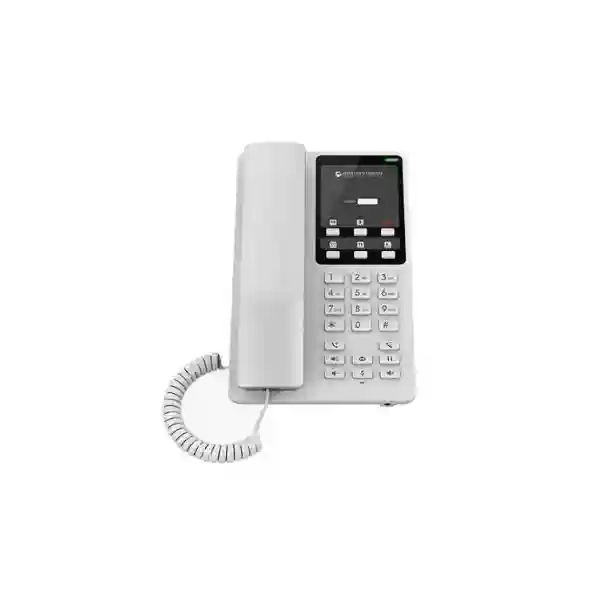
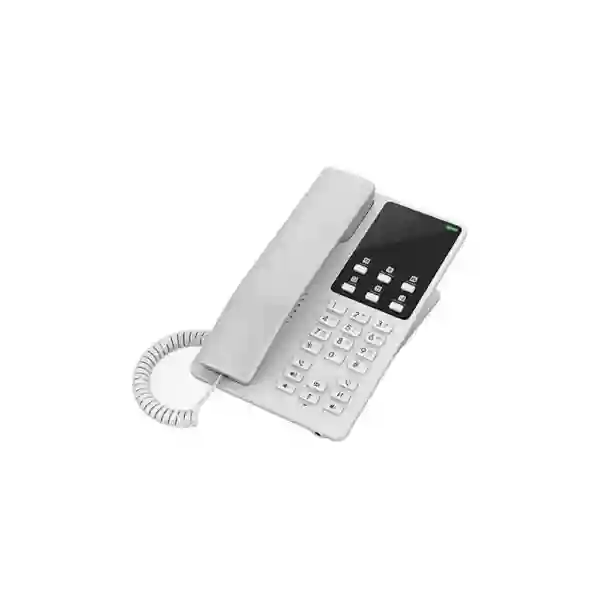
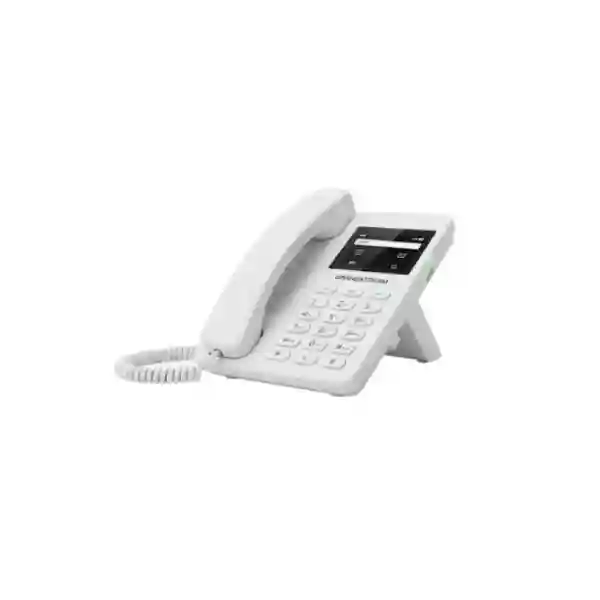
Grandstream GHP620 Dubai – Compact PoE Hotel IP Phone for Guest Rooms
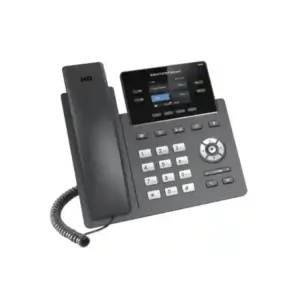
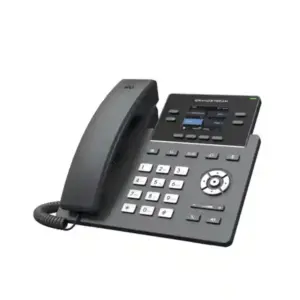
The Grandstream GHP620 Dubai is a compact wired SIP hotel phone designed for guest rooms and other spaces where calling must stay simple for the user while remaining manageable for the IT team. It supports two SIP accounts and two lines, HD handset audio, ten speed-dial functions, programmable keys, three-way audio conferencing, centralized Grandstream Device Management System (GDMS) provisioning, one 10/100 Mbps Ethernet interface with integrated PoE, a swappable faceplate, hearing-aid compatibility, USB Type-C charging for external devices, wall mounting, and enterprise-oriented security functions. For hotels, serviced apartments, hospitals, dormitories, staff accommodation and similar UAE environments, its strongest use case is a repeatable room-by-room deployment in which Ethernet and PoE are available and the property wants a clean, screen-free endpoint that guests can understand quickly.
Fourteck approaches the GHP620 as part of a complete hospitality communication design rather than as an isolated handset. A successful project considers the IP PBX, SIP extension plan, reception and service routing, VLAN and QoS policy, PoE switch capacity, room numbering, faceplate labels, emergency calling policy, remote provisioning, handover documentation and future expansion. This page explains where the GHP620 fits, what its verified capabilities mean in practice, how it differs from nearby GHP models, what Dubai and UAE buyers should confirm before ordering, and how to plan deployment without creating unnecessary complexity.
Is the Grandstream GHP620 the Right Hotel Phone for Your Requirement?
The quickest way to decide is to look at the environment rather than the model number. The GHP620 is especially well suited when the property already has, or plans to deploy, structured Ethernet cabling and PoE switching to rooms. In that design, the phone can use the data cable for both network connectivity and power, reducing the need for a separate local power adapter. This is attractive in guest rooms because visible adapters, extra sockets and loose cabling can complicate housekeeping, interior presentation and maintenance. The model is also a good match when the user experience should be intentionally simple: guests should be able to lift the handset, dial an extension, call reception or use a labelled service shortcut without learning a business-phone interface.
Choose the GHP620 when centralized endpoint management matters. GDMS support allows IT administrators and service teams to standardize configuration, monitor devices and manage larger quantities more efficiently than treating every handset as an independent device. It is also a strong choice when the property wants a white handset, a compact footprint, customizable faceplate information and a wired connection. By contrast, a site with no Ethernet at the bedside or wall position should compare the Wi-Fi-capable GHP620W rather than assuming the standard GHP620 provides wireless connectivity. Likewise, buyers wanting an LCD-based room phone should evaluate higher GHP models such as the GHP630 series. Fourteck can help translate room design, cabling, PBX, service-button and management requirements into the correct model decision.
Verified GHP620 Technical Facts That Matter in Real Deployments
| Area | Grandstream GHP620 Details | Why It Matters |
|---|---|---|
| SIP | 2 SIP accounts, 2 lines | Supports practical extension and line mapping for rooms and service workflows. |
| Network | One auto-negotiation 10/100 Mbps Ethernet port with integrated PoE | Enables clean wired deployment when compatible PoE infrastructure is available. |
| Wireless | No Wi-Fi on standard GHP620 | Use GHP620W when the project specifically requires Wi-Fi connectivity. |
| Audio | HD handset audio, wideband codec support including G.722 and full-band Opus | Helps deliver intelligible room-to-reception and internal calls when the network is designed properly. |
| Keys | GHP62x family provides six programmable keys and ten speed-dial functions in current Grandstream documentation | Allows hotels to expose only the services guests need. |
| Conference | Up to 3-way audio conferencing | Useful for simple multi-party coordination without requiring a premium desk phone. |
| Management | GDMS centralized management and provisioning | Reduces repetitive manual work in multi-room or multi-site fleets. |
| Installation | Desktop or wall-mount use | Gives designers flexibility around bedside tables, wall panels and compact furniture. |
| Customization | Swappable faceplate | Supports property-specific service labels and visual consistency. |
| Accessibility | Hearing Aid Compatibility (HAC) | Important when evaluating inclusive guest-room communication. |
| USB | USB Type-C port for charging external devices | Adds a convenient room-side charging function while keeping the device compact. |
| Security | Secure boot plus encrypted configuration and secure voice/network mechanisms supported by the platform | Supports a more controlled endpoint deployment when paired with sound network policy. |
Specifications should always be checked against the exact hardware revision and current Grandstream documentation before a large procurement, particularly where a project depends on revision-specific wireless capabilities, firmware functions or compliance requirements. The standard GHP620 discussed here is the wired white model; do not confuse it with the GHP620W Wi-Fi variant or the black-finish GHP621 family.
Why Hotels Prefer a Purpose-Built Room Phone Instead of a Full Business Desk Phone
Hotel-room communication has a different design objective from an office desk. An office user may want a display, directory browsing, many line appearances, BLF keys, headset support, application integration and daily access to dozens of telephony functions. A guest usually wants something much simpler: call reception, request housekeeping, contact room service, reach another permitted room or extension, or place an outside call according to property policy. More features can actually reduce usability when the guest is unfamiliar with the device. A compact hospitality phone therefore succeeds when it makes the common actions obvious and hides unnecessary administrative complexity.
The GHP620 follows this room-first approach. Its speed-dial and programmable key capabilities can be mapped to clearly defined hotel services, while the customizable faceplate can communicate those functions in the property’s own visual language. The handset form factor remains familiar across age groups and nationalities, which can matter in hotels serving international guests. For operations teams, the value is repeatability. If hundreds of rooms use the same endpoint profile, extension naming convention and service-key map, troubleshooting becomes easier and staff can follow a consistent support process. The phone can also fit non-hotel spaces where the same logic applies, including hospital rooms, dormitory rooms, staff accommodation, serviced residences, assisted-living environments and reception-adjacent guest areas. Fourteck can help decide whether the GHP620’s intentionally limited user interface is an advantage for the target room or whether a more feature-rich endpoint is required.
PoE Planning: One of the Strongest Reasons to Choose the GHP620
For a wired hotel deployment, Power over Ethernet is more than a specification line. It affects room appearance, electrical planning, maintenance, switch sizing and outage strategy. With the standard GHP620, a compatible PoE switch can deliver both Ethernet connectivity and power over the network cable. This can eliminate a separate phone power adapter at the room position, making the installation cleaner and reducing the number of small power supplies that facilities teams need to inventory. It also allows the hotel to centralize power protection more effectively when access switches are backed by UPS systems. In a carefully designed network, this means room phones can remain operational during short utility interruptions without relying on an individual UPS in every room.
PoE still requires engineering. The switch must support the correct PoE standard and have enough total budget for the number of connected endpoints. Cable quality, patch-panel labeling, rack power, UPS runtime and switch redundancy should be reviewed before rollout. A 150-room property does not simply need 150 available ports; it needs a topology that considers floor distribution, uplinks, VLANs, fault domains, maintenance windows and spare capacity. For renovation projects, cable testing is particularly important because legacy runs may not perform consistently. Fourteck can help buyers treat GHP620 procurement as part of the complete network design so the phone is not blamed for power or connectivity problems caused elsewhere in the infrastructure.
SIP and IP PBX Integration for Guest-Room Communication
The GHP620 is a SIP endpoint, so the project should start by defining how room extensions interact with the property’s IP PBX or hosted voice platform. Two SIP accounts and two lines provide flexibility, but most hotel rooms do not need complicated account structures. The more important questions are operational: What extension number maps to each room? Can guests dial between rooms? Which prefixes are used for reception, operator, emergency, room service and external calls? Are outbound international calls restricted? Does the PBX need to apply class-of-service rules based on occupancy status? How are wake-up calls handled? What happens when a room is out of service or changes category?
A good design links the handset, PBX dial plan and property workflow. For example, a labelled reception key should call the right hunt group at all times, including overnight. A housekeeping key may route differently during staffing changes. Emergency calling must follow applicable regulations and the property’s approved procedure rather than being treated like an ordinary shortcut. The room number should be reflected consistently in extension naming, PBX records, network documentation and GDMS device labels. If the hotel uses a property-management system with PBX integration, the overall compatibility should be checked at the system level rather than assumed from the fact that the phone supports SIP. Fourteck can assist with endpoint configuration planning, extension mapping and practical integration discussions, while final PMS/PBX interoperability depends on the selected platforms, supported interfaces and project design.
GDMS: Managing a Few Phones Is Easy; Managing Hundreds Requires a System
Large hospitality deployments become operationally expensive when every phone must be configured by hand. Grandstream’s GDMS platform is designed to centralize provisioning, configuration, monitoring and lifecycle administration for supported Grandstream devices. For a GHP620 project, that creates a path to repeatable deployment. A base profile can be prepared for the property, with room-specific values applied in a controlled way. Firmware policy, account settings and supported configuration parameters can be standardized instead of relying on technicians to reproduce the same settings manually across floors.
The practical benefit is consistency. When a user reports that the reception key does not work in one room, the support team can compare that endpoint with the approved profile rather than starting from zero. When a SIP server address changes, the administrator can plan a managed update instead of walking room to room. In a multi-property group, devices can be organized according to site, floor, building or operational grouping. Remote management does not remove the need for change control: hotels should still test firmware and configuration changes on a small set of devices before broad rollout, schedule disruptive work appropriately, preserve rollback information and ensure that administrative access is protected. Fourteck can help establish a practical provisioning approach so GDMS becomes part of an operational process rather than simply another portal.
Service Keys, Speed Dial and Faceplate Design
A hotel phone is also a user-interface project. The guest should not need to know extension numbers for the most common services. The GHP620’s programmable and speed-dial functions can be used to reduce that friction. Typical labels might include Reception, Concierge, Housekeeping, Room Service, Operator or an approved emergency contact function. The exact assignments should come from the hotel’s operating model, not from a generic template. A business hotel may prioritize front desk, reservations and transport assistance. A resort may emphasize concierge, spa, dining and guest services. A hospital room may require nurse station, reception and approved patient-service contacts. A serviced apartment may need security, maintenance and property management.
The swappable faceplate is valuable because these functions can be presented clearly and consistently. Before printing or ordering customized faceplates, the project team should finalize the dial plan and validate the labels with operations. Changes after a full rollout can be costly if hundreds of inserts or faceplates must be reworked. Consider language requirements as well: Dubai hotels may serve Arabic, English, Russian, Chinese, Hindi, French and other language groups. A faceplate has limited physical space, so icons, bilingual labels or carefully chosen terminology may be more effective than dense text. The most successful design makes the top guest actions obvious while avoiding a visually crowded panel.
HD Audio, Codecs and Call Quality: The Network Still Matters
Grandstream positions the GHP620 with HD handset audio and broad codec support, including wideband options such as G.722 and full-band Opus alongside established narrowband codecs. The device also supports mechanisms intended to improve resilience under imperfect packet conditions. These capabilities are useful, but they cannot compensate for a poorly designed voice network. Hotels should treat voice quality as an end-to-end outcome involving the handset, Ethernet cabling, access switch, VLAN design, QoS policy, uplink utilization, PBX, SIP trunk, WAN service and remote carrier path.
For internal room-to-reception calls, the local network should deliver low latency, minimal packet loss and predictable switching. Voice VLANs can separate logical traffic and help simplify policy, while Layer 2 and Layer 3 QoS can prioritize real-time voice where properly configured end to end. For external calls, the ISP and SIP trunk provider become part of the experience. Troubleshooting should therefore be structured. If multiple rooms on one floor have poor audio, inspect the floor switch and uplink before replacing phones. If only one extension has an issue, compare its cable test, switch port, SIP registration and configuration profile with a known-good endpoint. Fourteck can assist customers with this system-level approach so the GHP620 is deployed inside a voice-ready network rather than expected to solve infrastructure problems by itself.
Security Considerations for a Hotel IP Phone
An IP phone is a network endpoint, so hospitality projects should include it in cybersecurity and access-control planning. Grandstream documents enterprise-oriented protections across the GHP platform, including secure boot and support for encrypted configuration and secure signaling/media mechanisms. The network can also use technologies such as 802.1X where the surrounding infrastructure and deployment design support them. These features create useful controls, but security depends on implementation. Default administrative credentials should never be left unmanaged, configuration interfaces should be restricted appropriately, management traffic should be protected, firmware should be kept within an approved maintenance policy and unused services should be reviewed.
Segmentation is particularly relevant in hotels because guest networks, staff systems, building systems, cameras, access control, payment environments and voice devices may coexist on shared physical infrastructure. The room phone should not automatically share the same unrestricted network path as guest Wi-Fi. A dedicated voice VLAN and controlled routing policy can reduce unnecessary exposure and improve troubleshooting. Remote provisioning platforms should use strong administrator security and access governance. If third-party support teams are involved, define who may change PBX, GDMS and switch settings. Logs and configuration backups should be maintained according to operational policy. Fourteck can help customers incorporate the GHP620 into a wider telecom and network-security plan rather than viewing endpoint security as a checkbox on the product sheet.
Wall Mount or Bedside Table? Room Design Changes the Installation
The GHP620 can be used on a desktop surface or wall mounted, giving hotel designers flexibility. Bedside placement keeps the phone close to the guest, but it must be coordinated with lamps, charging sockets, bedside controls, room tablets and furniture. Wall mounting can free table space and reduce accidental movement, particularly in compact rooms, corridors, service areas or healthcare environments. The choice should be made early because cable outlet position, mounting height, furniture layout and faceplate readability all depend on it.
For wall installations, the project team should verify the mounting surface, cable exit, strain relief, handset retention and access for future replacement. For desk installations, cable routing should avoid creating visible loops or snag points. The white finish of the GHP620 may complement many hospitality interiors, while projects wanting a black finish can review the GHP621 family. Because the phone is relatively compact, it can be integrated into modern room concepts where a full office desk phone would appear visually heavy. However, aesthetics should not override serviceability. Technicians need to be able to disconnect and replace the device without damaging joinery or wall finishes. Fourteck can help coordinate device selection with the practical realities of room renovation and telecom access.
USB Type-C Charging: A Small Feature With Useful Hospitality Value
Grandstream includes a USB Type-C charging connection for external devices on the GHP620 family. In a hotel room, this can be a useful convenience because guests increasingly travel with USB-C phones and accessories. It should be treated as a supplementary charging point rather than as a replacement for the room’s full electrical and USB charging design. Charging capacity, cable compatibility and the guest’s device requirements vary, so the property should avoid promising laptop-class charging or other performance that the phone is not designed to provide.
From an interior-planning perspective, the additional port can reduce pressure on bedside sockets for light-duty charging, particularly in older properties being modernized incrementally. It may also help in hospital rooms, dormitories and staff accommodation where users appreciate a convenient low-power charging connection. The port’s value is therefore operational rather than transformational: it adds utility without changing the GHP620’s primary role as a SIP hospitality endpoint. Procurement teams should focus first on call workflow, PoE, PBX compatibility and management, then view USB-C as an added convenience.
GHP620 vs GHP610, GHP620W, GHP621 and GHP630: Which One Fits?
| Model | Best Fit | Key Decision Point | Buyer Note |
|---|---|---|---|
| GHP610 | Simple wired hotel-room calling | More basic GHP61x key layout | Consider when fewer programmable controls are needed. |
| GHP620 | Wired PoE rooms needing more programmable service access | White finish, wired Ethernet, PoE, GHP62x key layout | Strong balanced choice for standardized wired hospitality deployments. |
| GHP620W | Rooms where Wi-Fi connectivity is specifically required | Wireless variant; current hardware revisions support Wi-Fi 6 according to Grandstream documentation | Confirm hardware revision and power method before ordering. |
| GHP621 | Projects wanting the GHP62x capability set in black | Finish and variant selection | Useful when room design calls for a darker handset. |
| GHP630 family | Rooms needing a visual LCD interface and newer hospitality presentation | Different user-interface requirement | Compare when screen-based interaction is important. |
The right comparison is based on cabling, power, room aesthetics, required buttons and user-interface complexity—not on model number alone. Fourteck can help customers compare the current Grandstream hospitality range against the actual room standard before committing to a large quantity.
Dubai Hotel Deployment Scenarios
Business Hotels in Deira, Bur Dubai and Sheikh Zayed Road Corridors
Business hotels often prioritize dependable room-to-reception calling, simple service shortcuts and rapid IT support. The GHP620 fits well when the property has structured cabling and centralized PoE switching. A typical design might map a primary service key to the operator or front desk, another to housekeeping and another to a business-services or concierge function. The underlying PBX can control which external destinations are available while the handset remains easy for the guest. In older buildings, the most important pre-deployment task may be cable validation rather than phone configuration.
Luxury and Lifestyle Hotels in Downtown Dubai, Jumeirah and Dubai Marina
Higher-end properties may care as much about room presentation as telephony. The compact white chassis and customizable faceplate can support a clean bedside design, but the key layout, printed information and cable visibility should be reviewed with the interior and brand teams. Luxury guests may interact primarily through a mobile app or room tablet, yet a physical phone remains valuable for immediate voice access, emergencies and users who prefer a familiar handset. The GHP620 can serve as the simple voice layer while digital guest-service platforms handle richer interactions.
Serviced Apartments, Holiday Homes and Staff Accommodation
Long-stay properties often need fewer hotel-specific features but still benefit from extension calling, reception access and centralized management. The GHP620 can provide a standardized endpoint across many units without exposing a complex office-phone interface. For staff accommodation, the same model can connect rooms to security, facilities or administration. The project should decide whether every unit receives external calling privileges or only internal access, and the PBX dial plan should enforce that policy consistently.
Abu Dhabi, Sharjah, Ajman and Wider UAE Requirements
In Abu Dhabi, hotel and serviced-residence projects often span larger campuses, mixed-use developments or geographically separated buildings. The endpoint decision therefore connects closely with the switching and uplink architecture. A GHP620 fleet can be grouped by building or floor and managed centrally, while the PBX provides a consistent extension plan across the property. In resort or island environments, network resilience and remote support may be more important than squeezing the lowest possible cost from each handset because on-site intervention can be disruptive.
Sharjah and Ajman properties frequently include mid-market hotels, furnished apartments, clinics, educational accommodation and staff housing. Here the GHP620’s simple interface can be particularly practical because users change often and training is not realistic. The wired PoE design is attractive where the building already uses managed switches and structured cabling. For new projects, Fourteck recommends planning voice outlets, PoE port allocation and room-number documentation at the same time as the rest of the low-voltage design. In Ras Al Khaimah and Fujairah resorts, deployment teams should also consider distributed buildings and longer support routes. The overall principle across the UAE is the same: the phone works best when network, PBX and operational design are standardized before installation begins.
Use Beyond Hotels: Hospitals, Dormitories, Clinics and Managed Residences
Grandstream positions the GHP range for more than traditional hotels, and the GHP620’s strengths translate naturally to other room-based environments. In hospitals, a simple handset can give patients or visitors a familiar way to contact approved destinations without exposing unnecessary office telephony functions. In dormitories and student residences, the device can support reception, security and internal calling. In clinics and recovery facilities, wall mounting and easy-to-understand service access may be more valuable than a screen. In managed residential or senior-living environments, a physical handset remains important for users who are less comfortable relying on mobile applications.
These projects may have stricter requirements around emergency calling, infection-control processes, accessibility, privacy or regulatory policy. The GHP620 should therefore be evaluated as one component within the institution’s approved communication system. Hearing-aid compatibility is a useful feature, but accessibility planning goes beyond a single specification. Likewise, network security and emergency routing must follow organizational policy. Fourteck can help technical teams compare the endpoint’s capabilities with the project brief, but final suitability for specialized healthcare or regulated environments should be confirmed through the organization’s engineering and compliance process.
How to Plan a 50-, 100- or 500-Room GHP620 Rollout
Scale changes the nature of deployment. Installing five phones can be handled manually; installing five hundred requires process design. Start with a room inventory that records building, floor, room number, network outlet, switch port, extension, device MAC address or serial reference, configuration profile, faceplate version and installation status. This becomes the control sheet for commissioning and later support. Next, validate network readiness. Confirm enough PoE ports and power budget, test cabling, verify voice VLAN reachability and confirm that the PBX has adequate extension capacity and licensing where applicable.
Build a pilot before mass rollout. Configure a small number of GHP620 phones exactly as they will be used in production, including service keys, dial plan, time settings, codecs, firmware, security policy and GDMS provisioning. Place them in representative rooms on different floors and ask operations staff to test real workflows. Verify reception, housekeeping, external calling policy, emergency procedures, hold and transfer behavior where relevant. Only after the pilot is accepted should the team clone the configuration at scale.
During rollout, treat labeling and documentation as production tasks, not administrative afterthoughts. A technician should be able to identify a room’s switch port and extension quickly. Spare devices should be pre-approved and easy to provision so replacement does not become a lengthy configuration exercise. After commissioning, provide the hotel with a concise support procedure: what front-office staff should check, what IT should check, and when to escalate to PBX, network or endpoint support. This structure minimizes room downtime and avoids unnecessary device swaps.
Network Design Checklist for GHP620 Projects
Each of these areas influences the guest experience. A phone can be correctly configured yet appear unreliable if DHCP is unstable, the switch reboots without UPS coverage, the SIP trunk is congested or a service key points to the wrong destination. Fourteck therefore recommends validating the full call path before treating endpoint installation as complete.
Common Procurement Mistakes to Avoid
Buying the wrong variant: The GHP620 and GHP620W are not interchangeable. The standard GHP620 is the wired PoE model. Projects that require wireless connectivity should review the Wi-Fi variant and confirm current hardware revision details. Ignoring switch capacity: A large quantity of PoE phones still requires sufficient powered ports and budget. Printing faceplates too early: Service labels should be finalized after PBX call flows are approved. Assuming any SIP PBX equals full hospitality integration: Basic SIP registration and advanced PMS/PBX hotel functions are different questions. Confirm system-level compatibility.
Skipping a pilot: A sample deployment often reveals room-position, cabling, labeling or call-flow issues that specifications cannot predict. Mixing uncontrolled firmware versions: Standardize and test before broad updates. Neglecting documentation: Room number, extension, switch port and device identity should be linked in a maintained record. Buying only the exact active quantity: Operational environments benefit from planned spare strategy, though the correct spare quantity depends on the property and support model. Relying on unsupported commercial assumptions: Price, stock, lead time and regional availability can change; request a current quotation rather than treating an old online listing as a commitment.
Installation and Commissioning Workflow
- Survey the room standard. Confirm whether the phone sits on a bedside table, desk or wall, and verify network outlet position.
- Validate the network path. Test cabling, switch port, PoE delivery, VLAN assignment, DHCP/DNS/NTP and reachability to required voice systems.
- Prepare the PBX extension. Apply the approved room numbering, authentication, class of service and call permissions.
- Provision the GHP620. Use the chosen management method, preferably a standardized centralized approach for larger deployments.
- Apply service-key mapping. Configure reception, housekeeping, concierge or other approved destinations according to the property workflow.
- Install the approved faceplate. Confirm labels match the actual routing before mass reproduction.
- Test calls. Verify inbound, outbound, internal, service-key and emergency procedures according to the project acceptance plan.
- Check audio and handset placement. Make sure the handset is secure, audible and easy to reach in the final room layout.
- Record asset mapping. Update the room/device/switch/extension inventory.
- Handover and monitor. Provide support instructions, maintain spares and review logs or configuration when recurring faults appear.
For phased hotel renovations, the same workflow can be repeated floor by floor while preserving one approved baseline. This keeps old and new areas manageable during transition and reduces configuration drift.
Troubleshooting GHP620 Issues Without Guessing
Phone Has No Power
For a standard GHP620 powered by PoE, check the Ethernet cable, wall outlet, patch panel, switch port status and PoE allocation. Move the phone to a known-good port or test the original port with a known-good device. If multiple rooms on one switch lose power simultaneously, investigate the switch, UPS or PoE budget before replacing handsets.
Phone Powers Up but Does Not Register
Verify VLAN placement, IP addressing, DNS, gateway reachability, SIP server address, credentials and PBX-side extension status. Compare the configuration with another working room. Centralized provisioning records can help identify drift. If registration fails only across a particular building or floor, inspect network policy and routing.
Reception or Service Key Calls the Wrong Place
Check both the endpoint key mapping and PBX dial plan. A speed-dial value can be correct while the PBX route has changed. Validate the service destination with hotel operations before updating many devices.
Poor or One-Way Audio
Do not immediately assume the handset is faulty. Review packet loss, VLAN/QoS behavior, NAT or firewall rules for remote voice paths, SIP/RTP settings and trunk performance. One-way audio frequently points to network or signaling/media path issues rather than a damaged speaker.
GCC Hospitality Projects: UAE, Kuwait, Oman, Saudi Arabia, Qatar and Bahrain
The GHP620’s deployment logic also fits many GCC hospitality environments where new hotels and serviced residences are built around managed IP infrastructure. In Kuwait, compact wired room phones can support business hotels and apartment properties that want centralized telecom administration. In Oman, resorts with distributed buildings should pay particular attention to network topology and remote support. In Saudi Arabia, large hospitality and staff-accommodation projects may require more formal asset management and staged commissioning because of scale. In Qatar and Bahrain, mixed-use towers can benefit from standardized voice endpoints that integrate with building-wide switching and PBX systems.
Regional procurement should still be based on the exact project and current commercial quotation. Power, compliance, availability, logistics, PBX environment and support scope can differ by country. The GHP620 itself is not a substitute for country-specific telecom planning. Fourteck’s wider network can support regional conversations, including Fourteck Kuwait and Fourteck international IT and telecom solutions, while the product decision should remain grounded in the site’s infrastructure and operational requirements.
Africa Deployment Context: Kenya, Uganda, Tanzania, Ghana and Nigeria
Hotels, lodges, hospitals, schools and managed accommodation projects in African markets often value endpoints that can be administered remotely because technical resources may be centralized in another city or country. GDMS-supported management can help reduce repetitive site visits for configuration tasks, while a wired PoE model such as the GHP620 can simplify room power where managed switching already exists. The infrastructure assessment is critical: cabling quality, stable switching, UPS coverage, internet reliability and PBX hosting architecture can vary widely between properties.
For Kenya and Uganda, multi-site hospitality groups may need consistent extension templates across different properties while allowing local reception and emergency routes. Tanzania resort projects can require distributed network designs where endpoint support depends on resilient uplinks. Ghana and Nigeria projects may combine hotels, staff housing and offices under one telecom architecture, making VLAN separation and documentation especially useful. Fourteck maintains regional information through Fourteck Kenya, Fourteck Uganda, Fourteck Tanzania, Fourteck Ghana and Fourteck Nigeria. These regional links provide broader project context; exact product availability and commercial terms should always be confirmed for the required location and date.
What Information Should You Send for a GHP620 Quotation?
A useful quotation starts with more than a model name. Share the required quantity, project location, room count, expected deployment date, whether the property already has Ethernet and PoE to each room, the IP PBX or hosted voice platform in use, whether installation and configuration are required, and whether customized faceplates or service-key planning are part of the scope. If the project is a renovation, indicate the existing phone system and whether analog room phones are being replaced. If the project is new construction, provide the expected handover stage so endpoint delivery can align with network readiness.
Commercial variables such as price, stock, delivery time and project support can change and should not be inferred from static web content. Fourteck can prepare current buying guidance after reviewing the requirement. For UAE customers, broader infrastructure planning is also available through Fourteck UAE. For IP PBX-focused projects, Fourteck IP PBX Dubai provides related context. The objective is to ensure the selected room phone, PBX and network design work together rather than quoting hardware in isolation.
Why Fourteck for Grandstream GHP620 Dubai Projects?
Fourteck’s role is to help businesses make a technically sensible buying decision and connect the endpoint to the wider communication environment. A hotel-phone project may involve Grandstream endpoints, IP PBX configuration, PoE switching, VLAN and QoS design, structured cabling, SIP trunks, remote management, service-key mapping and support procedures. Treating these as separate purchases increases the chance of gaps between teams. A consultant-led approach looks at the entire call path and the hotel’s operating workflow before deciding how the GHP620 should be configured.
For a small property, support may focus on model selection, PBX registration and service shortcuts. For a large hotel or group, the requirement can expand into deployment templates, floor-by-floor commissioning, GDMS organization, asset records, firmware control, spare-device procedure and multi-site standardization. Fourteck can support discussions across Dubai, Abu Dhabi, Sharjah and the wider UAE, and can coordinate regional requirements through its broader network where appropriate. No page can guarantee current stock, price or delivery for every project, so the recommended next step is to share the quantity and technical requirement for a current quotation and compatibility review.
Grandstream GHP620 Dubai FAQ
Does the Grandstream GHP620 support PoE?
Yes. The standard GHP620 includes a 10/100 Mbps Ethernet interface with integrated PoE, making it suitable for wired room deployments connected to compatible PoE switching.
Does the GHP620 have Wi-Fi?
No. The standard GHP620 is the wired model. If Wi-Fi is required, compare the GHP620W and confirm the current hardware revision and project power requirements before ordering.
How many SIP accounts and lines does the GHP620 support?
It supports two SIP accounts and two lines. This is sufficient for many hotel-room, serviced-apartment and institutional room communication designs.
Can the GHP620 be managed centrally?
Yes. Grandstream GDMS support allows centralized provisioning, configuration and management of supported endpoints, which is particularly useful for large room counts and multi-site deployments.
Can hotels customize the service labels?
Yes. The GHP620 supports a swappable faceplate, and its programmable and speed-dial functions can be aligned with services such as reception, housekeeping or concierge according to the approved hotel call flow.
Can the GHP620 be wall mounted?
Yes. It is suitable for desktop or wall-mounted installation. The project should confirm cable position, mounting surface, handset retention and service access before finalizing room design.
Is the GHP620 suitable only for hotels?
No. It can also fit hospitals, clinics, dormitories, staff accommodation, serviced residences and other room-based environments where a compact SIP phone with centralized management is appropriate.
Does the GHP620 support hearing aids?
Grandstream lists Hearing Aid Compatibility for the GHP620 family. Organizations with formal accessibility requirements should still evaluate the complete room communication design against their policy and applicable standards.
Can the GHP620 charge a guest device?
The phone includes a USB Type-C port for charging external devices. It should be viewed as a convenient supplementary charging connection rather than a replacement for high-power room charging infrastructure.
Will the GHP620 work with any IP PBX?
It is a standards-based SIP phone, but exact interoperability and advanced hotel functions depend on the selected PBX, firmware, configuration and any PMS integration. Compatibility should be confirmed for the actual system before a large rollout.
What should a Dubai hotel check before ordering GHP620 phones?
Confirm quantity, Ethernet and PoE readiness, PBX compatibility, room extension plan, service-key requirements, faceplate design, voice VLAN/QoS policy, GDMS management approach, installation position and the required support scope.
How do I get the current GHP620 price in Dubai or the UAE?
Request a current quotation from Fourteck with the required quantity, location and deployment scope. Pricing, stock and delivery can change, so they should be confirmed at the time of purchase rather than inferred from older listings.
Discuss Your Grandstream GHP620 Requirement With Fourteck
Choose the GHP620 when your project needs a compact white wired hotel IP phone with PoE, simple guest operation, centralized management and customizable service access. Before ordering, confirm the room network, PoE switch capacity, IP PBX, service-key design and installation standard. Fourteck can help Dubai and UAE customers compare the GHP620 with nearby Grandstream hotel-phone variants, plan deployment and prepare a requirement-based quotation.
Next step: share your room count, quantity, location, PBX platform and whether you need supply only or configuration/installation support.
Reviews
There are no reviews yet.