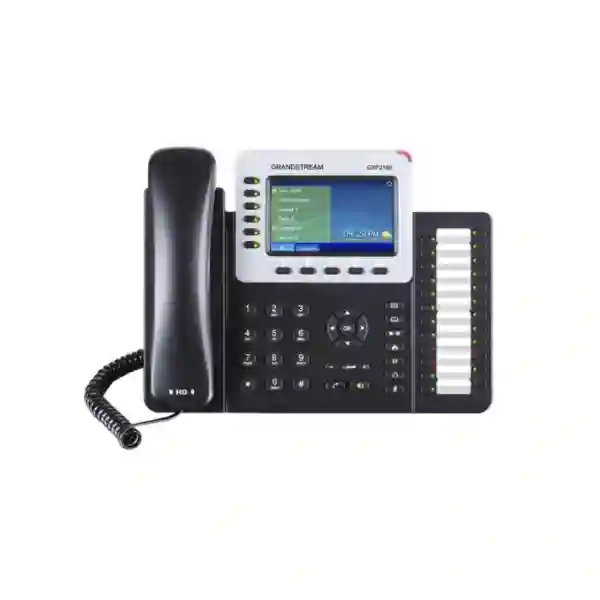
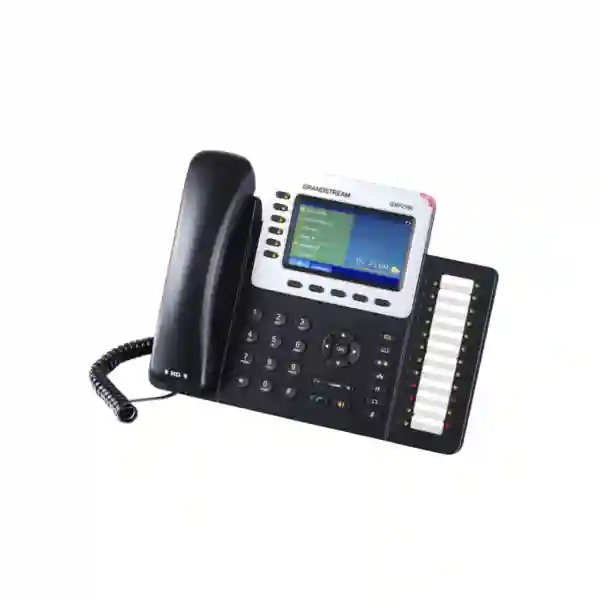
Grandstream GXP2160 Dubai – Enterprise IP Phone for High-Volume Call Handling
The Grandstream GXP2160 Dubai is a six-line enterprise SIP phone built for people who must see, route, transfer and manage many calls without losing speed at the desk. Its practical advantage is the combination of a 4.3-inch 480×272 color display, six line keys, up to six SIP accounts, 24 dual-color programmable BLF/speed-dial keys, dual Gigabit Ethernet, integrated PoE, HD audio, Bluetooth, USB, headset support and five-way audio conferencing. That makes the GXP2160 especially relevant for receptionists, office administrators, executive assistants, customer-service coordinators, operations desks and managers who regularly work across several extensions, departments or call queues.
Fourteck can help organizations evaluate where the GXP2160 fits in an IP telephony deployment, plan SIP/PBX integration, prepare PoE and VLAN requirements, map BLF keys to real users or departments, and confirm the practical accessories and configuration needed before ordering. Product availability, commercial terms and project scope should be confirmed at quotation stage rather than assumed from a web page.
Decision Snapshot: Is the GXP2160 the Right Desk Phone?
Useful when a desk handles multiple identities, departments, DID numbers or concurrent call appearances.
Lets users monitor extension status and reach common transfer targets with direct tactile access.
Fits managed business LANs while reducing the need for a separate power point when PoE is available.
Provides a clear visual workspace for call states, menus, directories and daily call-control tasks.
Best fit: choose the GXP2160 when the user needs many directly accessible BLF targets and several SIP identities, but does not necessarily need a separate expansion module. If the requirement is much lighter, a smaller GXP model may be more economical; if the desk must monitor substantially more destinations, a higher-capacity model such as the GXP2170 deserves comparison.
Why the 24 BLF Keys Matter in Real Offices
On a busy reception or administration desk, the costliest resource is often the time lost while a user searches for an extension, checks availability, places a caller on hold, navigates menus and then completes the transfer. The GXP2160 addresses that problem with 24 physical dual-color BLF/speed-dial keys beside the main display. In a properly configured PBX environment, those keys can give immediate visual feedback about monitored extensions and provide one-touch access to frequently used destinations.
This physical layout is useful where a receptionist supports several departments such as sales, accounts, logistics, service and management. A practical key map might reserve the upper keys for executives and duty managers, the middle group for high-volume departments, and the lower group for shared resources such as meeting rooms, security, dispatch or frequently used external contacts. The actual behavior depends on PBX support and provisioning, so the key plan should be designed around the organization’s call flow instead of simply programming every available key.
BLF is also valuable where staff move between meetings, customer areas and workstations. The receptionist does not need to ring every destination just to discover whether it is already engaged. Presence information can shorten the transfer decision, while pickup and transfer workflows can be standardized. In a customer-facing business, a few seconds saved on dozens or hundreds of calls can improve the front-desk experience more than adding features that employees rarely use.
| Customer requirement | GXP2160 capability | Practical benefit | Buying / design point |
|---|---|---|---|
| Reception handling many internal destinations | 24 BLF/speed-dial keys | Faster status checking and transfer access | PBX must support the intended BLF behavior |
| Manager with several business identities | Up to six SIP accounts | Separates lines, departments or call roles | Caller ID, voicemail and outbound rules must be planned |
| Desk with a connected PC | Dual Gigabit Ethernet | Avoids forcing a Fast Ethernet bottleneck at the desk | VLAN and security policy still need correct configuration |
| Cleaner installation | Integrated 802.3af PoE | Power and data can share Ethernet | Check total PoE budget and UPS capacity |
| Hands-free or headset-heavy role | HD audio, Bluetooth, RJ9/EHS support | More flexible desk workflow | Confirm exact headset compatibility before ordering |
A Call-Handling Workstation, Not Just a SIP Endpoint
Six line keys and up to six SIP accounts give the user room to separate inbound numbers, departments or service identities. Five programmable context-sensitive soft keys change function according to call state, while dedicated controls for transfer, conference, hold, headset, mute, redial and speakerphone keep frequent actions physically accessible. This helps reduce dependence on deep menus during active calls.
Five-way voice conferencing is useful for supervisors, coordinators and managers who occasionally need to bring several people into an operational discussion without moving immediately to a separate collaboration application. Larger formal meetings may still belong on a dedicated conferencing platform, but the phone’s built-in conference capability can be convenient for short escalations, customer issue resolution and internal coordination.
The 4.3-inch 480×272 TFT color display supports the high-volume role by making call states, directory items and menus easier to read than on compact entry-level screens. Grandstream also documents XML/LDAP directory support and substantial call-history capability in the GXP21xx family. In larger offices, a centrally managed directory is usually more maintainable than asking every user to manage private contact lists independently.
Audio, Headsets and Bluetooth for Daily Productivity
Grandstream specifies HD audio on both the handset and the full-duplex speakerphone. That matters because many business calls become inefficient when people repeat names, numbers and delivery details or struggle with poor intelligibility. Wideband-capable audio does not replace good network engineering, but it gives the endpoint a stronger base for clear conversations when the codec path, PBX and WAN support it.
Bluetooth expands the desk workflow for supported headsets and mobile-device functions. For a receptionist or office administrator who needs to move between a printer, filing area and nearby customer counter, a compatible wireless headset can reduce dependence on the handset. The GXP2160 also provides an RJ9 headset interface and supports Electronic Hook Switch functionality for compatible headset environments. Because headset ecosystems evolve, buyers should confirm the exact headset model, cable or EHS requirement against current compatibility information before purchase.
A USB interface adds another supported connection point for relevant data-related functions. Instead of choosing the phone because “USB is included,” buyers should identify the exact workflow they expect from USB and confirm that use against the current firmware and documentation. Requirement-first buying avoids designing around a capability that may not match how the business actually works.
Network Design: Gigabit, PoE, Voice VLAN and QoS
The GXP2160 includes dual switched auto-sensing 10/100/1000 Mbps Ethernet ports and integrated 802.3af PoE. This is relevant in offices where a workstation PC connects through the phone. A Fast Ethernet handset can become an avoidable bottleneck in a Gigabit desktop design; the GXP2160’s Gigabit ports are better aligned with modern managed access networks. The second port can also support a clean desk arrangement where the phone and PC share one wall outlet, subject to the organization’s network security policy.
PoE can reduce cabling clutter because the switch can provide power over the Ethernet connection. It can also help centralized resilience when access switches are protected by UPS infrastructure. However, PoE should be engineered rather than assumed. In a deployment of dozens or hundreds of phones, the switch’s total PoE budget, per-port capability, UPS runtime and future expansion margin are important. A switch may have enough physical ports yet still be unsuitable if its power budget cannot support the endpoint mix.
Grandstream documents Layer 2 and Layer 3 quality-of-service support, including 802.1Q/802.1p and IP-layer QoS mechanisms. In practice, the network team should define voice VLAN assignment, trust boundaries, DSCP/priority values, DHCP, DNS, NTP and whether the PC port is permitted to bridge to a separate data VLAN. LLDP-based voice VLAN discovery can simplify certain managed deployments, but its behavior must match the switch configuration.
Good voice quality depends on the full path, not only the phone. Before blaming an endpoint for choppy speech, administrators should check packet loss, latency, jitter, duplex issues, overloaded WAN links, QoS marking, SIP ALG behavior, firewall/NAT handling and PBX resource constraints. For branch deployments, WAN resilience and SBC or VPN design may also matter. The GXP2160 is a capable endpoint, but it must be part of a coherent network and telephony architecture.
SIP, PBX Interoperability and Provisioning Strategy
The GXP2160 is based on SIP and Grandstream describes the GXP21xx family as interoperable with third-party SIP devices and leading SIP/NGN/IMS platforms. That makes it relevant not only for Grandstream UCM systems but also for many standards-based IP PBX deployments. Compatibility should still be confirmed at a practical level because registration, BLF, shared-line behavior, voicemail indicators, transfer behavior, directory integration, provisioning and advanced features can vary between platforms and versions.
For a small office, manual configuration through the phone’s web interface may be acceptable. In a larger rollout, manual setup quickly becomes an operational problem. Grandstream documents automated provisioning through methods including TR-069 and encrypted XML configuration files, while zero-configuration workflows can be available in Grandstream UCM environments. A scalable deployment should define a standard template for accounts, NTP, time zone, codecs, dial plan, VLAN, QoS, BLF assignments, security, firmware policy and user-specific overrides.
Provisioning also helps lifecycle management. If a user changes desk, a department moves or a replacement phone is installed, a centrally managed configuration reduces the chance that critical settings exist only inside one handset. Administrators should document which settings are delivered by the PBX, which come from the provisioning server and which can be modified locally. This separation is especially useful when an organization has several branches or outsourced support teams.
Security Controls to Plan Before Installation
Grandstream lists TLS, SRTP, secure configuration mechanisms, user/administrator controls and 802.1X among the security-related capabilities of the GXP2160 family. These are useful features, but security is achieved through configuration and network policy rather than by the mere existence of a checkbox on a datasheet. The PBX, SBC, certificates, provisioning server, switch access controls and endpoint settings must all be aligned.
For business deployments, administrators should change default credentials, restrict management access, prefer HTTPS where supported, use strong SIP authentication, consider TLS/SRTP where the PBX and policy support them, protect provisioning URLs and keep firmware within an approved release policy. Internet-exposed phone administration should generally be avoided unless there is a deliberate secure architecture around it. Remote phones may require an SBC, VPN or vendor-supported remote-access design depending on the PBX platform.
802.1X can be relevant in enterprises that authenticate devices at the wired network edge. Smaller offices may not use it, but the feature gives larger organizations another route for integrating the handset into existing access-control policy. As with QoS and VLANs, the value comes from consistent end-to-end design instead of enabling isolated settings without understanding the network around them.
Deployment Blueprint for Reception and Administration Desks
List main numbers, queues, departments, overflow destinations, after-hours routing, pickup groups and escalation contacts before programming keys.
Decide which of the six available SIP accounts are needed and define outbound caller ID, voicemail and failover behavior for each role.
Arrange the 24 keys by importance and workflow. Use a consistent layout so users can transfer calls without searching.
Check PoE budget, switch ports, voice VLAN, DHCP, DNS, NTP, QoS, firewall policy and WAN quality before mass installation.
Use a controlled template for firmware, accounts, codecs, security and preferences so every handset starts from a known baseline.
Validate inbound calls, attended/blind transfers, busy targets, hold, park/pickup, conference, voicemail, headset and failover—not only registration.
A pilot desk is often the best starting point for a larger rollout. Receptionists and administrators discover workflow problems that may not appear in a technical checklist. Their feedback can improve key layout, transfer methods, ring behavior and directory design before the same template is copied across many phones.
GXP2160 vs GXP2140, GXP2170 and GXP2135
The useful comparison is not “which phone is best?” but “which phone matches the user’s call-control load?” Grandstream’s published GXP21xx information shows important differences in line capacity, SIP accounts, display and programmable-key density.
| Model | Line / SIP capacity | Display | BLF / programmable access | Good fit |
|---|---|---|---|---|
| GXP2140 | 4 line keys / 4 SIP accounts | 4.3-inch 480×272 | Expansion-module support | Executive or manager who may need expansion |
| GXP2160 | 6 line keys / up to 6 SIP accounts | 4.3-inch 480×272 | 24 physical dual-color BLF/speed-dial keys | Reception, administrator, coordinator or busy manager |
| GXP2170 | 12 line keys / 6 SIP accounts | 4.3-inch 480×272 | 48 on-screen BLF/speed-dial keys plus expansion modules | Very high call-control density |
| GXP2135 | 8 line keys / 4 SIP accounts | 2.8-inch 320×240 | 32 programmable BLF/speed-dial keys | Users prioritizing programmable key density with a smaller display |
The GXP2160 is attractive when six SIP accounts and 24 direct BLF positions are enough. A light user may not need this capacity, while a large attendant desk that monitors many more extensions should evaluate the GXP2170 or a dedicated attendant-console approach.
Who Should Choose the Grandstream GXP2160?
Receptionists and front-desk teams: this is the clearest fit. The physical BLF bank can represent executives, departments, meeting rooms, security, logistics or frequently used external numbers. The benefit is a faster decision path from incoming call to correct destination.
Executive assistants: an assistant supporting several managers may need multiple line appearances, quick status information, conference controls and headset mobility. The GXP2160 provides a useful combination of these functions without depending on an external sidecar for the core 24 BLF positions.
Sales and customer-service coordinators: users who regularly move calls between salespeople, service teams and supervisors can benefit from direct programmable access and multiple SIP accounts, especially where different business numbers or queues are involved.
Operations desks: logistics, facilities, hospitality and service organizations often have a known set of frequently contacted internal points. A well-designed key map can turn the handset into a compact call-routing console for the team.
Managers with multiple communication roles: a manager who represents several departments or business units may use separate SIP identities while retaining a familiar desk-phone experience. If the user rarely handles calls and needs only a simple extension, a smaller model may be more appropriate.
When the GXP2160 May Not Be the Best Choice
If a user needs only one or two SIP accounts, rarely transfers calls and does not use BLF, a simpler phone can reduce cost and administration. If the user requires Wi-Fi as the primary network connection, video calling, a touch-centric Android interface or modern collaboration applications, another Grandstream family may be more appropriate. If a receptionist must monitor far more than 24 destinations, the GXP2170 or a dedicated attendant-console strategy may fit better.
Organizations refreshing a large estate should also compare current-generation product families, management methods, expected lifecycle, security policy and interoperability requirements before standardizing on any one model. The fact that a model remains documented and supported does not automatically make it the best greenfield choice. Fourteck can help compare a direct replacement, a mixed-role deployment or a wider IP telephony refresh where that is more sensible.
Grandstream GXP2160 Dubai and UAE Deployment Considerations
For a Grandstream GXP2160 Dubai project, the purchasing decision is often linked to a wider office-communication requirement rather than a single handset. Businesses may be opening a branch, moving floors, replacing analog extensions, consolidating several numbers on an IP PBX or improving front-desk call handling. Endpoint selection should therefore be coordinated with switching, PoE, structured cabling, internet/WAN connectivity, PBX licensing, SIP trunks and support responsibilities.
Dubai offices: reception, sales and multi-department call flow
Dubai businesses often operate with customer-facing reception desks and several internal functions sharing one public number. The GXP2160 suits this scenario when the front desk needs fast access to departments and key individuals. A useful project scope includes the phone, BLF layout, transfer policy, pickup groups, after-hours routing, PoE readiness and short user training. In offices with managed switching, voice VLAN and QoS should be in place before phones are rolled out across the floor.
Deira and Bur Dubai: busy trading and service environments
Trading, distribution and service businesses may handle frequent calls about quotations, delivery status, accounts and technical support. A role-based BLF map is often more useful than a random list of employee names. Direct keys can prioritize sales counter, warehouse, accounts, delivery coordination, purchasing and management so the receptionist can route calls according to customer intent.
Abu Dhabi: structured enterprise and branch deployments
Abu Dhabi projects may involve larger offices or institutional environments where standardized provisioning matters more than one-off manual setup. Before procurement, the project team should confirm PBX compatibility, network access policy, VLANs, 802.1X requirements if used, headset standards, firmware management and support ownership. A consistent template makes replacement and branch expansion easier.
Sharjah and Ajman: practical SME modernization
For SMEs in Sharjah and Ajman, a common requirement is migrating from older analog or basic digital desk phones to SIP while retaining familiar physical controls. The GXP2160 can provide a professional reception or manager endpoint within a mixed deployment where other employees receive simpler phones. This role-based approach can be more cost-effective than assigning the highest-capacity handset to every user.
When requesting a UAE quotation, provide the quantity, PBX platform, number of SIP accounts, approximate BLF targets, headset requirement, PoE switch status and whether configuration or installation is required. Those details allow the quotation to reflect a usable solution rather than only a box price.
Regional Deployment Beyond the UAE
Organizations in other GCC and African markets can also evaluate the GXP2160 for high-traffic desks, but the practical constraints vary by location. The endpoint remains the same; the deployment problem does not. Buyers should consider freight, local power and UPS strategy, WAN quality, remote support, PBX location, SIP trunk availability, branch security and the ability to replace or re-provision handsets when staff move.
Uganda and Kenya
For Kampala, Nairobi and branch-office projects, WAN reliability and central PBX design deserve attention when phones register across sites. A business may use local PBX systems at each branch, a centralized PBX with secure connectivity or a hosted SIP platform. The GXP2160 can serve high-traffic desks in these designs, but BLF behavior, failover and remote provisioning should be tested under the intended topology. UPS protection for PoE switches can also improve continuity during power interruptions.
Tanzania, Ghana and Nigeria
Organizations with multiple offices in Dar es Salaam, Accra or Lagos can benefit from standardized endpoint templates. A consistent GXP2160 profile can define account numbering, time settings, codecs, BLF layout principles and security while allowing branch-specific extensions. This improves support because technicians troubleshoot a known baseline rather than a different manual configuration on every desk.
Kuwait and other GCC offices
GCC branch deployments may place more emphasis on structured cabling, managed switching, centralized IT control and integration with existing enterprise PBX platforms. Before ordering, confirm the SIP feature set required, whether the organization mandates encrypted signaling/media and whether handsets will be managed through an internal provisioning system.
Technical Specifications That Affect the Buying Decision
| SIP / lines | Six line keys with up to six SIP accounts |
|---|---|
| Display | 4.3-inch 480×272 TFT color LCD |
| BLF / speed dial | 24 dual-color programmable BLF/speed-dial keys |
| Ethernet | Dual switched auto-sensing 10/100/1000 Mbps Gigabit Ethernet ports |
| Power | Integrated IEEE 802.3af PoE; Grandstream also lists a universal power adapter in package contents |
| Audio | HD audio on handset and full-duplex speakerphone; codec support includes G.711, G.722, G.726, G.729 and additional codecs documented by Grandstream |
| Conference | Five-way audio conferencing |
| Bluetooth | Integrated Bluetooth; current Grandstream datasheet identifies Bluetooth V2.1 |
| Headset / auxiliary | RJ9 headset interface, EHS support for compatible headset workflows and USB |
| Security | TLS, SRTP, 802.1X and secure configuration features documented by Grandstream |
| Provisioning | Firmware upgrade and mass-provisioning methods including HTTP/HTTPS/TFTP, TR-069 and encrypted XML configuration files |
| QoS | Layer 2 and Layer 3 QoS support as documented by Grandstream |
Specifications should be checked against current Grandstream documentation when a feature is critical to PBX interoperability or accessory compatibility.
Procurement Checklist Before Requesting a Quote
- Quantity of GXP2160 handsets and whether a pilot unit is required.
- Existing or planned PBX platform and version where relevant.
- Number of SIP accounts required per phone and the extension-numbering plan.
- Approximate number of BLF destinations and the roles to be monitored.
- PoE switch availability, spare ports, PoE budget and UPS coverage.
- Voice VLAN, DHCP, DNS, NTP and QoS requirements.
- Headset model or whether wired/Bluetooth headset guidance is required.
- Need for provisioning, firmware standardization, configuration or on-site installation.
- Branch locations and whether remote phones register through WAN, VPN or SBC infrastructure.
- Support expectations after installation, including user, key and extension changes.
Fourteck can use this information to discuss the phone in the context of the full communication system rather than selecting an endpoint only because it has a long feature list.
Configuration and Acceptance Testing
Registration is only the first test. A proper handover should verify inbound and outbound calls, caller ID, voicemail indication, hold/resume, attended transfer, blind transfer, call pickup, park/retrieve if used, conference, BLF status, speed dial, headset operation, speakerphone, directory access and failover behavior. If a PC connects through the phone, confirm that the PC receives the intended VLAN and expected network performance.
For a reception desk, acceptance testing should use realistic calls. Ask one person to call the main number while several monitored extensions are busy, ringing or unavailable. Test how the receptionist identifies the correct target, whether BLF status is understandable, how quickly a transfer can be completed and what happens when the destination rejects or does not answer. This reveals workflow problems that a simple “registered successfully” test will not expose.
Document the final key layout. A printed or digital key map helps future support staff understand why each position exists. When employees change, update the centrally managed configuration rather than making undocumented local changes. This is especially important when the same phone role exists at several branches and the organization wants consistent behavior.
Firmware, Documentation and Long-Term Support
Grandstream continues to publish GXP21xx documentation and firmware information. Administrators should use an approved firmware process instead of upgrading production phones impulsively. Before a rollout, read release notes, test the selected firmware on a small group, confirm PBX interoperability and deploy according to the organization’s change-management process.
Keep copies of the approved configuration template, firmware version, PBX-side extension settings and BLF map. This makes replacement faster when a handset fails or a user changes location. It also reduces troubleshooting time because support teams can compare the affected phone against a known-good baseline instead of rebuilding the configuration from memory.
Official technical references are available from Grandstream’s GXP2160 product page and GXP21xx documentation. Buyers can also review IP Phone Fourteck, Fourteck IP PBX resources and Fourteck Grandstream UAE.
Frequently Asked Questions
How many SIP accounts does the Grandstream GXP2160 support?
The Grandstream GXP2160 supports up to six SIP accounts with six line keys. The PBX configuration determines how those accounts behave for inbound routing, outbound caller ID, voicemail and failover.
Does the GXP2160 have dedicated BLF keys?
Yes. Grandstream specifies 24 dual-color programmable BLF/speed-dial keys on the GXP2160. In a compatible PBX configuration, they can monitor extension status and provide rapid access to common transfer destinations or speed dials.
Is the GXP2160 suitable for a receptionist?
Yes. Reception and office-administration roles are strong use cases because the phone combines multiple SIP accounts with 24 physical BLF keys, a 4.3-inch color screen and dedicated call-control buttons. Suitability depends on how many extensions must be monitored and the features supported by the PBX.
Does the GXP2160 support PoE?
Yes. The GXP2160 supports integrated IEEE 802.3af Power over Ethernet. A compatible PoE switch can provide network connectivity and power through Ethernet. Larger deployments should verify the switch’s total PoE budget and UPS design.
Does the GXP2160 support Gigabit Ethernet?
Yes. Grandstream specifies dual switched auto-sensing 10/100/1000 Mbps Ethernet ports. This is useful when a workstation PC connects through the phone in a Gigabit LAN design.
Can I use a Bluetooth headset with the GXP2160?
The GXP2160 includes integrated Bluetooth and supports Bluetooth-related headset use cases. Exact compatibility should be confirmed for the intended headset model and firmware.
Does the GXP2160 support encrypted voice?
Grandstream documents TLS and SRTP support. Encrypted signaling and media require compatible configuration across the phone, PBX or SBC and related certificate/security infrastructure.
Can the GXP2160 work with a third-party SIP PBX?
The GXP21xx family is based on SIP interoperability. Buyers should confirm the exact PBX features required, especially BLF, shared-line behavior, provisioning, voicemail indication and advanced call control.
What is the difference between the GXP2160 and GXP2170?
The GXP2160 provides six line keys, up to six SIP accounts and 24 physical BLF/speed-dial keys. The GXP2170 provides greater line and programmable-key capacity and supports expansion modules. The GXP2160 is a strong fit where 24 direct BLF positions are sufficient.
What information should I send when requesting a GXP2160 quotation?
Send the quantity, project location, PBX platform, number of SIP accounts, BLF destinations, PoE status, headset requirement and whether provisioning, configuration, installation or support is needed.
Plan Your GXP2160 Deployment with Fourteck
The GXP2160 is most valuable when its six SIP accounts, 24 BLF keys, network interfaces, headset options and security settings are mapped to a real call-flow requirement. Fourteck can help review the user role, PBX, PoE network, BLF layout and regional deployment scope before a quotation is prepared.
Next step: share the quantity, office location, PBX platform and number of extensions the user needs to monitor. Fourteck can then help confirm whether the Grandstream GXP2160 Dubai is the right fit or whether another Grandstream model better matches the requirement.

Reviews
There are no reviews yet.