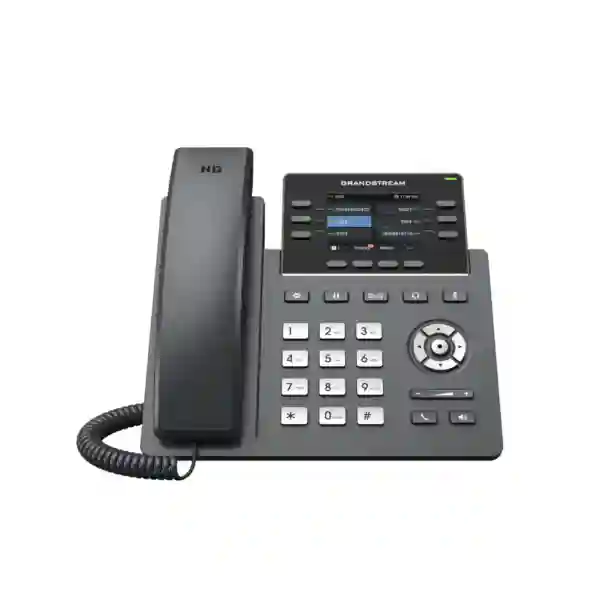
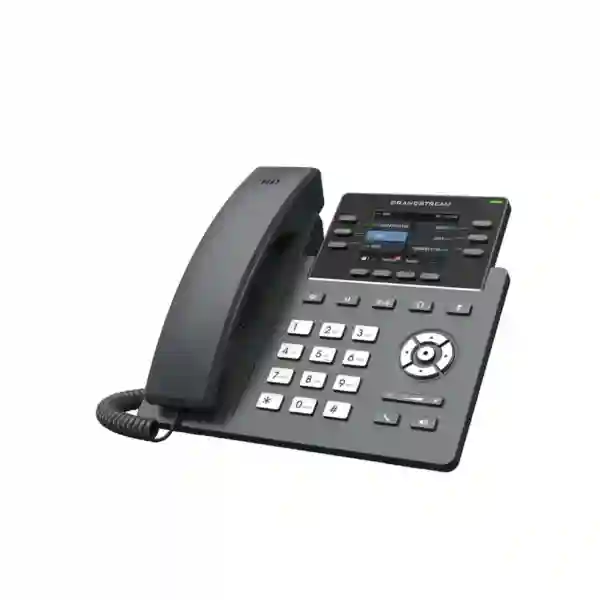
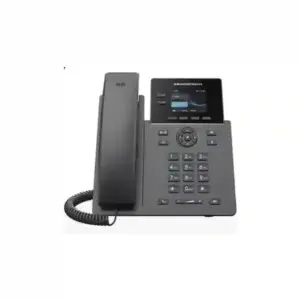
Grandstream GRP2613 IP Phone Dubai UAE
The Grandstream GRP2613 is a professional six-line SIP desk phone designed for organisations that want a wired, centrally manageable endpoint for office users, branch teams, reception support, supervisors and other employees who handle regular business calls. Grandstream positions the model for mass deployment and easy management. Key capabilities include a 2.8-inch colour display, six multipurpose line keys, dual Gigabit Ethernet ports, integrated PoE, up to 24 provisionable digital BLF or fast-dial functions, HD audio, noise-shield technology, enterprise-oriented security features and Grandstream Device Management System (GDMS) support.
For Dubai and UAE buyers, the useful question is not simply whether the phone has enough keys. The correct decision depends on SIP account requirements, wired network design, PoE switching, PBX or hosted-voice compatibility, headset workflow, security policy and the organisation’s provisioning strategy. This page explains those decisions, including the important distinction between the wired GRP2613 and the wireless-capable GRP2613W.
GRP2613 decision snapshot
Desk users who need a dependable wired SIP phone with Gigabit networking, PoE, HD audio, multiple line appearances and useful programmable BLF or speed-dial capacity.
Businesses standardising many phones, especially when IT teams want central configuration, consistent firmware and scalable provisioning through GDMS.
Confirm hardware revision, SIP account count, PBX platform, VLAN/QoS design, PoE budget, headset requirements and whether the user actually needs wireless connectivity.
The standard GRP2613 is the wired model. Integrated Wi-Fi 6 and Bluetooth are features of the GRP2613W variant, so the two names should not be treated as interchangeable.
Verified Grandstream GRP2613 specifications
| Phone class | Professional carrier-grade SIP IP phone designed for mass deployment and central management. |
|---|---|
| Lines | 6 multipurpose line keys. |
| SIP accounts | Current Grandstream documentation lists up to 4 SIP accounts; legacy hardware may support up to 3, so hardware revision should be confirmed where this matters. |
| Display | 2.8-inch 320 × 240 TFT colour LCD. |
| Programmable functions | Up to 24 digital BLF or fast-dial functions. |
| Network | Dual switched auto-sensing 10/100/1000 Mbps Gigabit Ethernet ports. |
| Power | Integrated IEEE 802.3af PoE. |
| Audio | HD handset and speakerphone, wideband codec support including G.722 and Opus, plus noise-shield technology. |
| Conference | 5-way audio conferencing. |
| Provisioning | GDMS, TR-069 and encrypted XML configuration workflows are supported in the platform. |
| Security | Grandstream documents secure boot, dual firmware images, encrypted data storage/configuration mechanisms, TLS, SRTP and 802.1X support. |
Why this model fits professional office deployments
A basic SIP phone can register to a PBX and make calls, but a larger deployment creates more demanding operational requirements. IT teams need predictable configuration, secure provisioning, firmware control, sufficient programmable keys and network behaviour that does not compromise the user’s workstation. The GRP2613 addresses these needs without moving into a larger touch-screen category. Its dual Gigabit interfaces are particularly useful where one structured network outlet serves both the phone and a connected PC. Integrated PoE simplifies desk cabling when a compatible switch is available, while the 2.8-inch colour display and six line keys provide a practical physical interface for regular business use.
The phone is also useful where a company wants a common model for several roles while still customising keys. Up to 24 provisionable BLF or fast-dial functions can support extension monitoring, one-touch calling, call handling and PBX feature access. The exact result depends on the PBX, SIP service and configuration, so administrators should map desired user actions to the call-control platform before mass deployment.
For procurement teams, this distinction matters. A phone may be capable of exposing a function, but the calling platform must support the relevant SIP behaviour. Endpoint and PBX selection should therefore be evaluated together rather than treating the handset as an isolated purchase.
GRP2613 vs GRP2613W: do not miss the connectivity difference
Grandstream now presents the GRP2613 and GRP2613W closely within the same product family. They share many deployment characteristics, but the connectivity distinction is important: the GRP2613W includes integrated dual-band Wi-Fi 6 and Bluetooth, while the standard GRP2613 should be treated as the wired model. If a project requires wireless placement or integrated Bluetooth accessories, confirm the GRP2613W instead of assuming the standard GRP2613 includes those features.
| Decision point | GRP2613 | GRP2613W |
|---|---|---|
| Desk connectivity | Wired Gigabit Ethernet | Wired Gigabit plus integrated Wi-Fi 6 |
| Bluetooth | Do not assume integrated Bluetooth | Integrated Bluetooth |
| Typical selection reason | Structured LAN and PoE are preferred | Wi-Fi desk placement or Bluetooth is required |
Customer requirement → relevant capability → practical benefit
Busy users need visible call control
Six line keys plus provisionable BLF and fast-dial functions can reduce menu navigation. This can benefit team leaders, office coordinators and reception-support roles.
IT wants fewer desk adapters
Integrated 802.3af PoE allows a compatible switch to deliver network and power over Ethernet. The switch’s total PoE capacity and UPS strategy should still be calculated.
A PC shares the same network point
Dual Gigabit ports are useful when the phone sits between the wall outlet and a workstation. Voice/data VLAN design and security policy must still be planned properly.
Many phones need consistent management
GDMS and supported provisioning methods help administrators standardise configurations, monitor devices and reduce repetitive manual setup as deployments grow.
Call clarity matters
HD audio, wideband codecs such as G.722 and Opus, and noise-shield capability can improve usability when the PBX, network and remote endpoint support a suitable audio path.
Security controls are required
Secure boot, dual firmware images, encrypted configuration/data mechanisms, TLS, SRTP and 802.1X support provide building blocks for a more controlled voice environment.
Audio, conferencing and everyday call handling
The GRP2613 supports HD audio through the handset and speakerphone and includes wideband codecs such as G.722 and Opus. Codec support alone does not guarantee excellent voice quality. Real-world results depend on PBX or hosted-SIP configuration, WAN stability, local switching, VLAN/QoS policy, firewall behaviour, headset choice and the far-end device. A Dubai office can install HD-capable phones and still negotiate narrower audio if the SIP trunk or platform policy does not permit the preferred codec.
Grandstream also specifies noise-shield technology for the GRP2613. This is relevant in open offices, shared administration spaces and customer-service environments where background conversation can reduce perceived call quality. Organisations with especially noisy environments should still pilot the phone in the real workspace.
The GRP platform supports common business telephony functions such as hold, transfer, call forwarding, call waiting, call park, call pickup, shared-call appearance or bridged-line appearance, hot desking and failover-related workflows. Feature behaviour depends on the PBX. A good deployment therefore defines the desired user action first and then programs keys and call flows to make it easy.
GDMS and mass deployment
The GRP family is designed around scalable deployment, and GDMS is a major part of that model. Administrators can use a central interface to configure, provision, manage and monitor supported Grandstream endpoints. This is useful for one large office, but its value increases for multi-site organisations with branches in Dubai, Abu Dhabi, Sharjah or other locations where technicians cannot visit every desk.
A well-designed project starts with templates rather than individual handsets. IT teams can define account settings, time and language preferences, VLAN values, programmable keys, firmware policy and security settings according to role. Reception support may receive more BLF assignments, while general office users receive a simpler layout. This creates consistency while allowing necessary exceptions.
Central management still needs governance. Administrators should control who can edit templates, document firmware changes, test updates before broad rollout, protect management credentials and minimise unnecessary device-interface exposure. The phone provides the management capability; operational discipline determines how reliable the estate becomes.
Security design for a business voice network
IP phones are network endpoints and should be included in the organisation’s security model. Grandstream lists enterprise-level protection for the GRP2613, including secure boot, dual firmware images and encrypted data storage. The broader platform also supports technologies such as TLS for signalling, SRTP for media protection and 802.1X for network access control. These are useful controls, but they require correct configuration.
A practical deployment should consider unique administrative credentials, restricted management access, encrypted provisioning where available, current firmware, voice VLAN segmentation, firewall policy, SIP authentication, certificate handling, logging and the disabling of unused services. Where 802.1X is used, test the phone and connected workstation together because authentication design can affect pass-through topologies.
For multi-site deployments, the same security baseline may be applied differently. A head office can use NAC, central firewalls and formal change control, while a small branch may depend on a managed switch and VPN. The endpoint settings must match the network rather than being copied blindly from another site.
Network planning: PoE, VLANs, QoS and Gigabit pass-through
The GRP2613’s dual Gigabit Ethernet ports and PoE support make it suitable for a modern structured network, but the deployment should still be designed carefully. If phones share cabling with PCs, the switch port may carry both voice and data VLANs. The phone can then receive VLAN information through the chosen network and provisioning method. QoS markings should be aligned with switches, routers and WAN policies so voice traffic receives predictable treatment during congestion.
PoE capacity and resilience
Integrated PoE reduces the need for local adapters, but the access switch must have enough total power capacity for all connected phones. If continuous voice service is important, consider the complete power chain: PoE switch, router, firewall, PBX or SBC and WAN equipment. A powered handset is not useful if the upstream voice path is offline.
Voice VLAN and QoS
Separating phones into a voice VLAN can simplify addressing, policy, QoS and troubleshooting. The GRP platform supports common Layer 2 and Layer 3 QoS mechanisms, but they should match the rest of the network. For branch sites using internet VPNs or SD-WAN, WAN policy matters because local switch priority cannot solve congestion after traffic leaves the site.
DHCP, DNS and NTP
Reliable DHCP, DNS and NTP are easy to overlook. SIP registration, provisioning, certificates and call logs can all be affected by incorrect network or time configuration. A deployment checklist should therefore include these basic services along with firewall rules for the selected PBX or cloud voice platform.
SIP accounts and the hardware-revision detail
Current Grandstream documentation lists the GRP2613 with up to four SIP accounts and six line keys, while also noting that legacy hardware may support up to three SIP accounts. This matters when an organisation is expanding an older estate or sourcing devices from mixed channels. If a user requirement depends on four independent registrations, confirm the hardware revision before purchase.
SIP accounts and line keys are not the same thing. A key can represent an account appearance, BLF target, speed dial or another configured function. A team leader may use one SIP identity but many BLF assignments. Another user may need multiple SIP registrations but only a small number of monitoring keys. The GRP2613 provides enough physical and provisionable key capacity to support several role designs.
A simple role matrix—SIP registrations, monitored extensions, headset need, wired/wireless requirement and call volume—often reveals quickly whether the GRP2613 is the correct model.
Best-fit user roles
| User type | Why GRP2613 may fit | What to confirm |
|---|---|---|
| General office staff | PoE, HD audio, Gigabit pass-through and manageable programmable keys. | Whether a simpler model would already satisfy the role. |
| Team leaders | BLF and speed-dial capacity can support team visibility and rapid calling. | Number of monitored users and PBX BLF behaviour. |
| Reception support | Six line keys and up to 24 provisionable functions can suit moderate call handling. | Whether a larger display or more dedicated keys are required. |
| Branch administrators | Central provisioning and Gigabit networking support standardised branches. | WAN resilience, VPN/SBC design and local PoE availability. |
| Customer-service users | HD audio, headset interface and programmable keys can improve daily workflows. | Headset/EHS compatibility and platform-specific call-centre functions. |
| Flexible desk | Can work where Ethernet is available and secure remote registration is supported. | If Wi-Fi is mandatory, evaluate GRP2613W instead. |
Deployment scenarios across Dubai and the UAE
Dubai businesses often combine head offices with sales offices, warehouses, showrooms, retail sites or remote branches. A standard endpoint such as the GRP2613 can reduce the number of phone models IT must support, but each site can still require a different network and key configuration. A corporate head office might use voice VLANs, 802.1X, central DHCP and resilient call control. A smaller branch may use a managed PoE switch with a VPN or cloud PBX. The same handset can participate in both designs when configuration is planned correctly.
Dubai corporate offices
In professional-services environments, the GRP2613 suits users who need a traditional desk phone with more programmable capability than a basic endpoint. Dual Gigabit ports help when cabling is shared with workstations. PoE capacity, VLAN design, PBX integration and the need for Wi-Fi or Bluetooth should be checked before hardware quantities are finalised.
Abu Dhabi enterprise and institutional users
Larger organisations may focus on central provisioning, endpoint security and controlled configuration changes. The GRP2613’s GDMS support and security capabilities fit this approach, but administrators should build approved templates, test firmware, define configuration ownership and document exceptions.
Sharjah and Ajman branches
For distributed offices, central management can reduce travel and local support effort. The branch network must still provide reliable addressing, DNS, NTP and connectivity to the telephony service. For VPN-connected branches, latency, jitter, packet loss and failover should be considered. For cloud PBX deployments, firewall and NAT behaviour should be tested against provider guidance.
Deira and Bur Dubai trading companies
Trading businesses often need straightforward phones that can handle multiple lines, supplier calls and internal coordination without complex desktop equipment. The GRP2613 can be a practical mid-range choice when a wired Gigabit network is available. If users need only a basic extension, a simpler phone may be enough; if reception needs a larger visible extension field, a higher model may be a better fit.
GRP2613 compared with nearby GRP choices
The right comparison is based on user workflow, not just model number. Exact specifications for alternative models should be reconfirmed against current Grandstream documentation when a quotation is prepared.
| Choice | Consider it when | Why GRP2613 may still fit better |
|---|---|---|
| GRP2612 family | Users have lighter call-control needs and fewer programmable-key requirements. | GRP2613 provides a larger display, six line keys, up to 24 digital BLF/fast-dial functions and Gigabit PoE. |
| GRP2613W | Wi-Fi 6 or integrated Bluetooth is required. | Standard GRP2613 is appropriate where structured wired Ethernet and PoE are preferred. |
| GRP2614 | Users need a different multi-key display experience, integrated wireless features or more account capacity. | GRP2613 can keep the user experience simpler when six line keys and 24 provisionable functions are enough. |
| Higher GRP professional models | Executives, operators or power users need larger displays, more lines or more programmable-key capacity. | GRP2613 avoids unnecessary higher-end capability for mainstream professional users. |
PBX and hosted-voice compatibility
The GRP2613 is a standards-based SIP phone, but “SIP compatible” should not be interpreted as a guarantee that every advanced feature behaves identically with every PBX or hosted provider. Basic registration and calling may be simple, while BLF, presence, shared lines, voicemail indicators, remote directories, provisioning, hot desking or call-recording controls can vary by platform.
Before a larger purchase, confirm the SIP registration method, authentication, transport, required codecs, DTMF method, BLF subscriptions, voicemail behaviour, directory integration, time settings, provisioning process, firmware policy, NAT traversal for remote sites and any SBC requirement. SIP ALG behaviour should also be reviewed because incorrect handling can contribute to registration or one-way-audio issues in some environments.
A representative pilot is usually more valuable than assuming a large rollout will behave exactly like one lab phone. Pilot users should include the busiest call handlers so transfer, hold, BLF, voicemail and headset workflows are tested early.
Headsets, EHS and ergonomics
The GRP2613 includes an RJ9 headset interface and supports electronic-hook-switch workflows in the GRP platform. Headset compatibility should be treated as a specific procurement item. Different brands and models may require EHS cables or adapters, and supported call-control behaviour can vary. For users who spend much of the day on calls, validate the complete phone-headset combination before standardising it.
Grandstream documents a two-position stand and wall-mount capability with the appropriate accessory. In compact counters, reception desks or shared workspaces, cable routing and handset accessibility can influence placement. For wall mounting, confirm the mount and ensure Ethernet/PoE reaches the location cleanly.
If integrated Bluetooth is a requirement, the standard GRP2613 is not the model to assume it on. The GRP2613W is the relevant variant.
A practical deployment workflow
Count SIP identities, BLF requirements, headset users, shared desks, reception positions and users who need Wi-Fi or Bluetooth.
Confirm registration, codecs, BLF, voicemail, directories, provisioning and remote-access requirements.
Validate PoE budget, Gigabit switching, VLANs, QoS, DHCP, DNS, NTP, firewall rules and UPS coverage.
Create approved provisioning profiles for departments or user roles instead of configuring every phone manually.
Test real calls, transfer, BLF, voicemail, headset behaviour, failover and remote support with representative users.
Deploy in controlled batches, monitor registration and user feedback, then refine templates before scaling further.
Dubai/UAE procurement checklist
- Quantity and whether the rollout covers one site or multiple UAE locations.
- PBX or hosted voice platform and relevant software/firmware version.
- Number of SIP accounts needed per user and whether legacy GRP2613 hardware exists.
- Number of BLF, speed-dial or monitored-extension functions required per role.
- Wired-only requirement or need for Wi-Fi/Bluetooth, which may point to GRP2613W.
- PoE switch availability, power budget and UPS requirements.
- Voice VLAN, QoS, 802.1X and other network-security controls.
- Headset model and EHS call-control requirement.
- Wall-mounting or custom faceplate requirements.
- Preferred provisioning method and whether GDMS will be used.
- Need for installation, configuration, migration, user training or support.
Installation and configuration considerations
Small deployments can be configured individually, but this becomes difficult to maintain as quantities grow. A repeatable provisioning method is preferable for business rollouts. Administrators should decide how phones receive account details, network settings, programmable keys, time zone, firmware policy and security values. GDMS and other provisioning methods can reduce manual work when templates are prepared carefully.
Installation should include user-facing testing. A technically correct phone can still generate support tickets if transfer behaviour, voicemail access, key labels or directory navigation do not match actual work patterns. Representative users should test answering a second call, transferring, hold, voicemail, speakerphone, headset use and frequent-extension access.
For migrations from older phones, map old key behaviour to the new endpoint before rollout. Users often rely on functions that are not obvious from configuration exports. Reception and customer-service users are especially valuable during pilot testing because they reveal call-flow issues quickly.
When the GRP2613 may not be the right choice
The GRP2613 can be more capable than necessary for a user who needs only a basic extension with minimal keys. A simpler GRP model may reduce cost and simplify the interface. At the other end, a receptionist or executive who needs many visible programmable keys, a larger display, more SIP accounts or integrated wireless capability may be better served by a higher model.
It is also not the correct assumption when Wi-Fi or Bluetooth is mandatory. The GRP2613W is the relevant variant for those integrated wireless features. Likewise, if a workplace is entirely softphone-based and does not require physical endpoints, a desk phone may not add value for every user.
Role-based standardisation is usually better than forcing one model across the entire organisation. A common design is to define a basic phone profile, a professional mid-range profile such as the GRP2613 and a higher-end profile for power users.
Regional planning beyond the UAE
The same design principles apply to organisations deploying endpoints across Kuwait, Kenya, Uganda, Nigeria, Tanzania, Ghana or other markets. The phone can remain standard while WAN quality, switching, power resilience and local support models change. Central provisioning is valuable in these environments because IT teams can maintain a consistent baseline without visiting every handset.
For cross-border projects, confirm local logistics, connectivity, PBX hosting, SIP-provider requirements and network conditions before standardising a bill of materials. A configuration that works in a Dubai head office should not automatically be copied to every branch without validation.
Related Fourteck resources include Fourteck UAE, Fourteck, Uganda, Kenya, Tanzania, Nigeria, Ghana and Kuwait.
Frequently asked questions about Grandstream GRP2613
Is the GRP2613 a 6-line IP phone?
Yes. Grandstream describes it as a six-line professional carrier-grade IP phone with six multipurpose line keys. Current documentation lists up to four SIP accounts, while legacy hardware may support fewer.
Does the GRP2613 support PoE?
Yes. It includes integrated IEEE 802.3af Power over Ethernet. Confirm the switch’s total PoE budget for larger rollouts.
Does the GRP2613 have Gigabit Ethernet?
Yes. It has dual switched auto-sensing 10/100/1000 Mbps Gigabit Ethernet ports.
Does the GRP2613 have Wi-Fi?
The standard GRP2613 should be treated as the wired model. Integrated Wi-Fi 6 is a feature of the GRP2613W variant.
Does the GRP2613 have Bluetooth?
Do not assume integrated Bluetooth on the standard GRP2613. Grandstream identifies Bluetooth on the GRP2613W variant.
How many BLF or fast-dial functions does it support?
Grandstream specifies up to 24 digital BLF or provisionable fast-dial functions, with behaviour depending on configuration and PBX support.
Can GRP2613 be managed through GDMS?
Yes. GDMS supports central configuration, provisioning, management and monitoring of supported Grandstream endpoints including the GRP2613.
Does it support HD audio?
Yes. Grandstream specifies HD audio and wideband codecs including G.722 and Opus. End-to-end quality still depends on the PBX, network and remote endpoint.
Can I use a headset?
Yes. The phone includes an RJ9 headset interface and supports EHS workflows. Confirm the exact headset and required cable or adapter.
Is GRP2613 suitable for reception?
It can fit moderate reception and team-coordination needs because it offers six line keys and up to 24 programmable functions. High-volume operators may prefer a model with more visible key capacity.
Will it work with any SIP PBX?
It is standards-based SIP, but advanced compatibility varies. BLF, shared lines, directories, provisioning, codecs and remote connectivity should be validated for the specific platform.
What information helps with a Dubai quotation?
Provide quantity, PBX/hosted voice platform, delivery location, SIP-account and BLF requirements, PoE availability, Wi-Fi/Bluetooth needs, headset requirements and whether configuration or deployment help is required.
Plan the GRP2613 around your users, PBX and network
The Grandstream GRP2613 is strongest when it is deployed as part of a planned voice environment: appropriate user roles, a compatible SIP platform, correct PoE and VLAN design, and a repeatable provisioning method. It offers a practical balance of professional call control, Gigabit connectivity, HD audio, security capabilities and central management.
Contact Fourteck with your quantity, location, PBX platform and user requirements to confirm compatibility, compare suitable GRP models and prepare a deployment-focused quotation. Availability, lead time and commercial terms should be confirmed at the time of enquiry.
Specification note: Product capabilities can vary by hardware revision and firmware. Grandstream’s current product resources and documentation should be used as the final technical reference. Fourteck does not state price, stock, delivery time, warranty terms or partner authorisation on this page; confirm commercial details before ordering.

Reviews
There are no reviews yet.