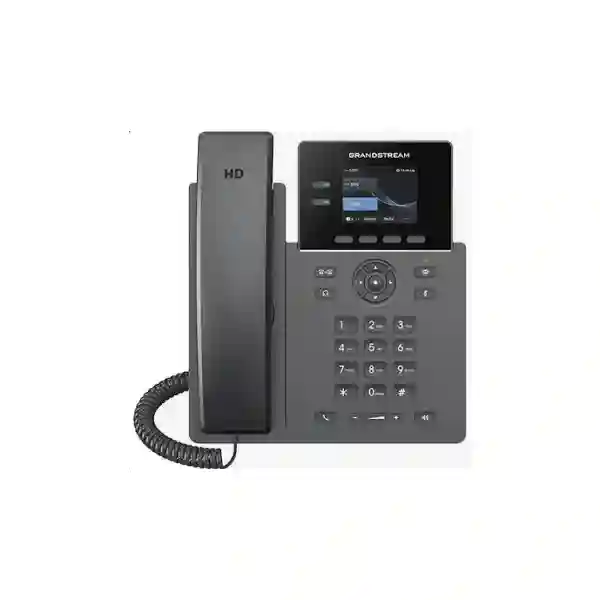
Grandstream GRP2610P Dubai – 2-Line PoE Carrier-Grade IP Phone
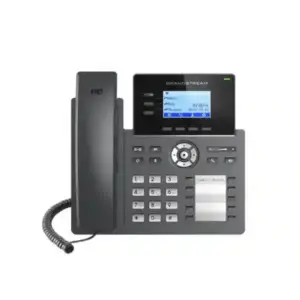
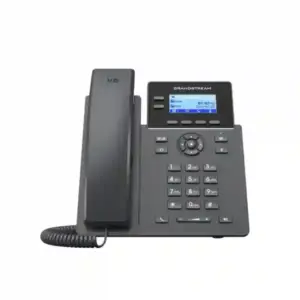
The Grandstream GRP2610P Dubai is a compact carrier-grade business IP phone built for organizations that want straightforward SIP calling, centralized provisioning and Power over Ethernet in a modern desktop endpoint. It supports two SIP accounts, two physical multi-purpose line keys, up to eight digital BLF or fast-dial keys, a 2.4-inch color display, HD audio, noise-shield technology and 5-way voice conferencing. The P variant is especially useful where a managed PoE switch can supply both network connectivity and electrical power through the same Ethernet cable.
For UAE businesses, the value is not only the handset specification. The larger decision includes PBX compatibility, extension design, PoE capacity, VLAN and QoS policies, headset requirements, provisioning, branch connectivity and future expansion. Fourteck can help customers compare the GRP2610P with related Grandstream GRP models and plan a deployment around the real communication requirement instead of selecting a phone only by feature count.
Integrated 802.3af PoE
2.4″ Color LCD
Up to 8 BLF Keys
GDMS Management
Quick answer: who is the GRP2610P best for?
The GRP2610P is a strong fit for a user who needs a professional wired SIP desk phone with two accounts, PoE, HD voice, basic BLF visibility and centralized management, but does not need built-in Wi-Fi, Bluetooth, a large number of physical line keys or Gigabit Ethernet. That makes it practical for standard office extensions, branch desks, reception support positions, billing counters, back-office teams, sales desks, administration staff and multi-site rollouts where consistent provisioning matters more than advanced executive features.
Choose it when
You have PoE switching, use SIP extensions, want simple color-screen operation and need a consistent device that can be provisioned centrally across multiple desks.
Consider a higher model when
Users require more SIP accounts, more keys, Gigabit pass-through, built-in wireless connectivity or greater executive and receptionist functionality.
Deployment advantage
Integrated PoE can remove a separate desk power adapter when the LAN provides compatible 802.3af power, simplifying workspace cabling and centralized power planning.
Management advantage
Grandstream GDMS support can help administrators configure, provision, manage and monitor supported Grandstream endpoints through a centralized interface.
GRP2610P versus GRP2610: the PoE difference matters
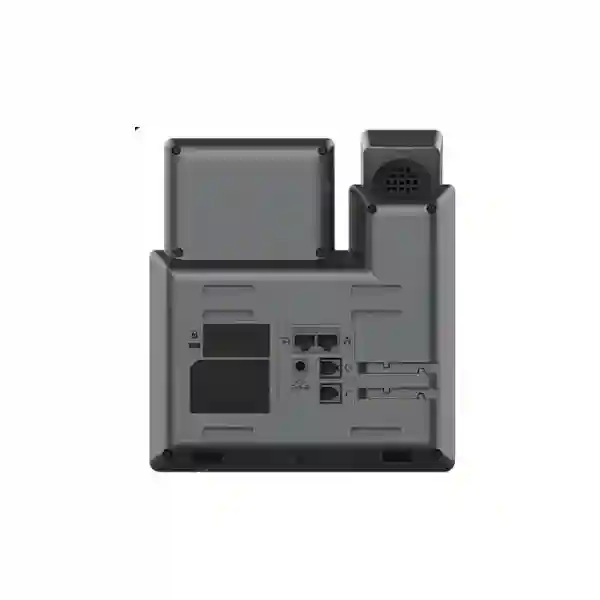
The GRP2610 and GRP2610P are closely related, but their power and network-port implementation affects deployment planning. Grandstream specifies dual switched auto-sensing 10/100 Mbps Ethernet ports for both models, while the GRP2610P adds integrated Power over Ethernet. The standard GRP2610 is supplied with a 5V power adapter; the GRP2610P is intended to receive power through a compatible PoE network connection. For a business standardizing on PoE switches, the P model can be operationally cleaner because power can be managed from the network side and fewer individual adapters are required at desks.
PoE should still be treated as part of a complete network design. A switch must provide adequate PoE budget for the number of connected phones, and UPS-backed PoE switching may be desirable where the organization expects desk phones to remain operational during short utility interruptions. The phone does not turn an unreliable network into a resilient voice system; voice availability still depends on switching, routing, PBX or hosted SIP service, Internet connectivity where applicable, and power continuity across the relevant infrastructure.
Verified GRP2610P technical specifications
The following specification summary is based on Grandstream’s official GRP2610/GRP2610P documentation. Exact deployment behavior can depend on firmware, provisioning policy, PBX configuration, network design and the features enabled by the SIP platform.
| Model | Grandstream GRP2610P |
|---|---|
| SIP / line capacity | 2 SIP accounts and 2 multi-purpose line keys |
| Digital keys | Up to 8 digital BLF / fast-dial keys through programmable virtual key functions |
| Display | 2.4-inch 320×240 TFT color LCD |
| Ethernet | Dual switched auto-sensing 10/100 Mbps Ethernet ports |
| Power | Integrated IEEE 802.3af Power over Ethernet; maximum stated PoE consumption 3.8W |
| Audio | HD handset and speakerphone; wideband support including G.722 and Opus; noise-shield technology |
| Conferencing | 5-way audio conference |
| Headset | RJ9 headset jack with Electronic Hook Switch support for compatible headset solutions |
| Management | Grandstream Device Management System (GDMS), TR-069 and encrypted XML provisioning options |
| Security | Secure boot, dual firmware images, encrypted data storage, TLS, SRTP, 802.1X and encrypted configuration capabilities |
| QoS | Layer 2 802.1Q / 802.1P and Layer 3 ToS / DiffServ / MPLS QoS support |
| Installation | Two-position desk stand; wall mounting supported with wall-mount accessory sold separately |
| Dimensions / weight | 203 mm × 186 mm × 28 mm; stated unit weight 0.4 kg |
Customer requirement → GRP2610P capability → practical result
Reduce desk cabling
Capability: Integrated 802.3af PoE. Practical result: one compatible Ethernet connection can carry both network traffic and power. Consideration: confirm PoE switch capacity and UPS strategy.
Manage many desks consistently
Capability: GDMS and provisioning support. Practical result: administrators can standardize settings and monitor supported devices. Consideration: design templates and credentials securely.
Improve everyday call clarity
Capability: HD audio, Opus/G.722 and noise-shield technology. Practical result: better intelligibility in suitable network and codec conditions. Consideration: end-to-end quality also depends on PBX, trunk and WAN performance.
Monitor colleagues or extensions
Capability: up to 8 digital BLF / fast-dial functions. Practical result: common contacts or extension states can be easier to access. Consideration: BLF behavior must be supported and configured by the SIP platform.
Join ad-hoc team calls
Capability: 5-way audio conferencing. Practical result: users can handle small voice conferences from the endpoint. Consideration: conferencing features and call capacity can also depend on the PBX and service configuration.
Use a business headset
Capability: RJ9 headset interface and EHS support. Practical result: suitable users can work hands-free with compatible headsets. Consideration: verify the exact headset and EHS combination before ordering.
Why PoE is useful for Dubai and UAE office deployments
In a new office, branch refresh or structured-cabling project, desk phones are often connected to managed access switches that already support Power over Ethernet. In that design, the GRP2610P can receive power from the switch and avoid a separate local adapter at each workstation. This can make desk areas cleaner and can simplify centralized backup power when the PoE switches are protected by a properly sized UPS.
For a larger Dubai deployment, Fourteck would normally look beyond the phone count. The network plan should consider PoE wattage per switch, access-port count, uplink capacity, voice VLAN configuration, DHCP behavior, DNS and NTP reachability, QoS markings, PBX or hosted SIP reachability and failover expectations. A branch that has forty phones requires a different switching and resilience plan from a small office with six extensions.
The GRP2610P itself is specified with dual 10/100 Mbps switched ports rather than Gigabit Ethernet. That is typically sufficient for voice traffic, but the pass-through network requirement for a user’s computer should be considered. If a workstation behind the phone needs higher wired throughput, a model with Gigabit Ethernet or a separate network path may be more appropriate.
GDMS and zero-touch provisioning for scalable phone management
A key reason to evaluate the GRP2610P for business rollouts is its support for Grandstream Device Management System. GDMS is designed to provide a centralized interface for configuring, provisioning, managing and monitoring supported Grandstream devices. For a single desk phone, centralized management may not be essential. For tens or hundreds of endpoints, consistent provisioning can become one of the most important operational requirements.
A practical deployment can use templates for SIP settings, network preferences, function keys and other approved configuration parameters. The objective is to reduce repeated manual entry, lower configuration variation and make replacement or rollout processes more predictable. Zero-touch concepts are especially useful for branch and multi-site deployments where every phone should follow a controlled standard.
Provisioning still requires governance. Credentials, configuration files and administrative access should be protected; firmware should be planned rather than changed arbitrarily; and a production rollout should be validated against the organization’s PBX, SIP trunking and network environment. Cloud management is an operational tool, not a replacement for secure network architecture.
Voice quality: HD audio, Opus, G.722 and noise-shield technology
The GRP2610P supports HD handset and speakerphone audio and major voice codecs, including the wideband G.722 and Opus codecs. Wideband audio can improve speech clarity when the PBX, calling path and opposite endpoint support a compatible codec. Grandstream also lists noise-shield technology, intended to minimize distracting background noise around the speaker.
This matters in real offices because voice quality is rarely determined by the handset alone. A high-quality phone can still sound poor if a site has packet loss, jitter, congestion, unsuitable WAN routing or incorrect QoS policies. Conversely, a well-designed voice network can help relatively simple endpoints deliver consistent day-to-day call quality. Fourteck can help customers separate endpoint requirements from network and PBX issues so that a phone replacement is not used as a substitute for troubleshooting the actual cause.
For open offices, customer-service areas and busy counters, headset selection can also influence the user experience. The GRP2610P provides an RJ9 headset connection and supports Electronic Hook Switch operation with compatible headset solutions. Exact compatibility should be confirmed against the selected headset brand and accessory combination before procurement.
Two SIP accounts: what that means in daily use
The phone supports two SIP accounts. In a typical office, one account may represent the user’s main extension while a second can be used for another identity, department, service or failover design supported by the PBX. This capacity is appropriate for many standard desk users, but it should be compared with the number of identities the role actually requires.
A receptionist handling many monitored extensions, an executive with multiple identities or a user working across several business units may need more accounts and more keys. In those cases, a higher GRP model can be a better investment. The goal is not to buy the phone with the longest feature list; it is to match the endpoint to the role so staff have enough functions without unnecessary complexity.
The two physical line keys can be digitally programmed to expose additional virtual functions, with Grandstream listing up to eight digital BLF or fast-dial keys. BLF operation is PBX dependent. A SIP platform must support and be configured for the presence or dialog subscription behavior required by the deployment.
PBX, SIP and network compatibility planning
Grandstream positions the GRP2610/GRP2610P as SIP endpoints with broad interoperability across SIP-based systems. The phone supports SIP RFC3261 and common IP networking and security protocols. In a real project, however, “SIP compatible” should not be interpreted as “every feature works automatically with every PBX.” Registration, basic calling and DTMF may be straightforward, while BLF, shared call appearance, directory services, call parking, provisioning, remote access and advanced feature codes can require platform-specific settings.
Before a larger order, it is sensible to validate one or more phones against the target PBX or hosted service. Check registration, inbound and outbound calling, transfer, hold, voicemail access, caller ID, DTMF, conferencing, BLF if required, headset behavior and codec negotiation. Where the phones are remote from the PBX, review NAT traversal, VPN or SBC strategy, firewall rules and security policies rather than exposing management interfaces unnecessarily.
For business customers evaluating a complete voice platform, Fourteck can also discuss related IP PBX solutions in Dubai and broader IP phone deployment options. The endpoint, PBX, switching and WAN design should be treated as one communications system rather than isolated purchases.
Security capabilities and configuration discipline
Grandstream lists carrier-grade security features for the GRP series, including secure boot, dual firmware images and encrypted data storage. The GRP2610P also supports security mechanisms such as TLS, SRTP, 802.1X and encrypted configuration files. These capabilities can contribute to a stronger endpoint posture when they are supported and correctly configured throughout the voice environment.
Security is still a system-level responsibility. A phone should not use weak administrative passwords, unprotected provisioning, unnecessary Internet exposure or untrusted firmware. Network segmentation, firewall policy, least-privilege management, secure SIP transport where supported, controlled firmware lifecycle and PBX hardening all remain relevant. The selected security settings must also be compatible with the organization’s SIP platform and operational processes.
For managed offices, 802.1X can be relevant where access ports require authenticated devices. VLAN and QoS support can help separate and prioritize voice traffic according to the switch configuration. These mechanisms should be designed centrally rather than configured differently on each desk phone without documentation.
A buyer should notice the 10/100 Mbps Ethernet limitation
The GRP2610P uses 10/100 Mbps Ethernet ports. For voice, that bandwidth is more than sufficient. The consideration arises when a desktop computer is connected through the phone’s switched PC port. A modern workstation on a fast LAN may be capable of substantially more than 100 Mbps, and the phone would then become a throughput constraint for that wired path.
This is why endpoint selection should consider the desk layout. If the user’s PC has its own Gigabit network connection, the phone’s 100 Mbps ports may not matter. If the design expects the PC to pass through the phone, a Gigabit-capable GRP model could be more appropriate for users who need faster wired data transfer. Fourteck can map the phone model to the switching and cabling design before quantity pricing is finalized.
Where the GRP2610P fits in a business
General office desks
A practical choice for staff who mainly need one primary extension, an optional second SIP identity, transfer, hold, voicemail, conference and a few monitored or frequently dialed contacts.
Sales and customer support
HD audio, headset support and programmable keys suit roles that spend significant time on calls without needing a large executive phone or expansion console.
Retail and service counters
PoE simplifies power at counters, while a color display and physical navigation controls make the phone practical for shared service positions where users need straightforward operation.
Branches and remote offices
Central provisioning through GDMS can help standardize devices across multiple sites, subject to suitable Internet or WAN connectivity and secure PBX reachability.
Hotels, clinics and education offices
Administrative desks can use the phone for routine internal and external calling where two accounts and a modest number of BLF keys satisfy the workflow.
Managed service deployments
Service providers and IT teams can benefit from repeatable provisioning and the ability to manage supported endpoints centrally instead of configuring every unit manually.
When the GRP2610P may not be the right phone
A good product page should also explain when a model is not the best fit. The GRP2610P may be too limited for users who need many SIP identities, a larger number of physical line keys, integrated Wi-Fi, Bluetooth, Gigabit Ethernet, a larger screen or richer executive functions. It may also be unnecessary in a location without PoE if the customer specifically wants an adapter-powered handset and has no plan to introduce PoE switching.
For a role with three SIP accounts and a requirement for Gigabit Ethernet, the GRP2611G is a model to evaluate. For four SIP accounts, related GRP2612 variants may be more suitable depending on the exact network and wireless requirement. The correct choice should be based on role, port speed, connectivity, account count, key count and management policy.
For advice across the Grandstream portfolio, customers can also review Fourteck’s Grandstream UAE solutions and discuss model selection with a consultant before ordering large quantities.
GRP2610P, GRP2610, GRP2611G and GRP2612P: requirement-led comparison
| Requirement | GRP2610 | GRP2610P | GRP2611G | GRP2612P |
|---|---|---|---|---|
| SIP accounts | 2 | 2 | 3 | 4 |
| Integrated PoE | No | Yes | Yes | Yes |
| Ethernet | 10/100 Mbps | 10/100 Mbps | Gigabit | 10/100 Mbps |
| Best-fit logic | Simple 2-account desk without PoE requirement | Simple 2-account desk with PoE | More accounts plus Gigabit | Four-account desk with PoE |
This table is intentionally requirement-led rather than price-led. Pricing, availability and bundle contents can vary by supplier, region, quantity and project scope, so those commercial details should be confirmed at quotation stage instead of assumed from a generic product page.
A practical deployment checklist before ordering
- Confirm the user profile. Count SIP accounts, monitored extensions, speed dials and conference requirements instead of assuming every desk has the same needs.
- Check the network port requirement. Decide whether a PC will connect through the phone and whether 100 Mbps pass-through is acceptable.
- Validate PoE. Confirm the access switch supports compatible 802.3af power and has enough overall PoE budget.
- Plan VLAN and QoS. Define voice VLAN tagging, DHCP, DNS, NTP and QoS policies consistently with the switching environment.
- Validate PBX compatibility. Test registration, transfer, voicemail, DTMF, caller ID, BLF and conferencing on the target SIP platform.
- Confirm headset requirements. If staff need EHS or a specific professional headset, verify the exact compatible combination.
- Define provisioning. Decide whether devices will use GDMS, PBX provisioning, TR-069 or another supported controlled process.
- Plan firmware governance. Standardize approved versions and test updates before widespread rollout.
- Review resilience. Consider UPS-backed PoE, PBX redundancy, Internet failover and SIP provider continuity where the business needs it.
- Request a quantity-specific quotation. Include phone count, delivery location, installation, configuration, PBX integration and support scope so the quote reflects the real project.
Dubai deployment scenarios
Small professional office
A Dubai consultancy, trading office or professional-services firm may have ten to thirty employees, a managed PoE switch and a SIP PBX or hosted voice platform. Most users need one extension, perhaps a secondary identity, voicemail, transfer and a few fast-dial or BLF keys. In this case the GRP2610P can be a sensible standard endpoint, while executives or reception may receive higher models based on their specific call-handling roles.
Multi-branch business
A company with locations in Dubai, Sharjah and Abu Dhabi may prioritize standardized provisioning and simpler support. GDMS can help centralize management of supported Grandstream endpoints, while the PBX architecture handles extension routing between branches. The project should also review WAN quality, firewall design, VPN or SBC use, voice VLANs and emergency/failover procedures according to the organization’s policies.
Retail or service counter
A retail counter or customer-service point may benefit from PoE because only one data cable needs to reach the phone position. The user may require a small set of speed dials to stock, supervisor, security or administration contacts. The compact function set can be easier to operate than a feature-heavy executive model, provided the role does not require more accounts or extensive key coverage.
Back-office and warehouse administration
Administrative desks in warehouses, logistics sites and industrial offices often need reliable calling but not advanced executive features. A managed switch can power the GRP2610P, while IT can keep configuration consistent with the rest of the organization. If the environment is physically harsh or phones are exposed to dust, heat or moisture beyond normal office limits, a different endpoint or placement strategy should be assessed because the GRP2610P is a standard indoor desk phone.
Regional procurement beyond Dubai
Fourteck supports technology requirements across the UAE and through regional Fourteck properties. Customers planning deployments in Abu Dhabi, Sharjah, Ajman or other Emirates can use the same requirement-led approach: verify the PBX, PoE switching, network design, user roles, quantities and support scope before finalizing the model. Multi-country organizations should also account for local supply, service arrangements, SIP provider differences and site-specific network conditions.
For broader technology projects, buyers can explore Fourteck UAE and Fourteck IT services. Regional availability, lead time, warranty handling and commercial terms should always be confirmed for the specific quotation rather than assumed from a general web page.
Installation and configuration workflow
A basic GRP2610P installation starts by connecting the handset, placing the phone on its stand or suitable wall-mount arrangement, and connecting the LAN port to a network switch. With compatible PoE available, the phone can receive power through Ethernet. Grandstream’s installation guide indicates that a separate 5V power step can be skipped for the GRP2610P when PoE is used.
After startup, the phone receives or is assigned an IP address and can be configured through supported provisioning mechanisms, its web interface or the keypad menu depending on the deployment method. In a business rollout, administrators should avoid configuring every phone differently. Use an approved standard for SIP server addresses, extension identities, codecs, time settings, VLANs, security, function keys and firmware.
The official quick installation guidance notes that the device can use DHCP or static addressing and that the embedded web interface can be reached using the phone’s IP address. Production credentials should be controlled, and deployment teams should not rely on shared weak passwords. Where the PBX or management platform supports device templates, those templates should be tested on a small group before mass rollout.
For larger UAE projects, Fourteck can scope staging, PBX registration, network readiness, VLAN/QoS validation, basic user handover and support requirements as separate project components. The exact service scope should be defined in the quotation so the customer knows whether the requirement is supply-only, pre-configuration, onsite installation or a complete communications deployment.
What information helps Fourteck quote accurately?
A useful quotation request provides more than the product model. The customer should share the required quantity, delivery location, target PBX or hosted SIP platform, whether PoE switching already exists, whether users need headsets, whether the phones require configuration, and whether installation or remote support is part of the scope. For a new site, include the expected number of total extensions and simultaneous calls so the wider communications design can be reviewed.
If the project is a replacement of an older IP phone estate, provide the current handset models and explain what problem the refresh needs to solve. It may be better audio, easier provisioning, PoE standardization, security modernization, a new PBX or a need to simplify support. Those details can change the recommended model and migration plan.
Fourteck does not need to force every customer onto the same model. A mixed deployment can be more appropriate: GRP2610P for ordinary desks, a higher model for reception and management, wireless endpoints for mobile roles, and conference equipment for meeting spaces. Standardization should reduce support complexity without ignoring genuine role differences.
Frequently asked questions about Grandstream GRP2610P
Does the GRP2610P support Power over Ethernet?
Yes. The GRP2610P includes integrated IEEE 802.3af PoE on its dual 10/100 Mbps Ethernet ports. A compatible PoE switch can therefore provide network connectivity and power through the Ethernet connection.
What is the main difference between GRP2610 and GRP2610P?
The key deployment difference is PoE. The GRP2610P includes integrated PoE, while the GRP2610 is the non-PoE version and is supplied with a 5V power adapter according to Grandstream documentation.
How many SIP accounts does the GRP2610P support?
It supports two SIP accounts and two multi-purpose line keys. This is usually appropriate for standard office users who do not require many separate SIP identities.
Does the GRP2610P have Gigabit Ethernet?
No. Grandstream specifies dual switched auto-sensing 10/100 Mbps Ethernet ports for the GRP2610P. Buyers who need Gigabit pass-through for a workstation should consider a suitable Gigabit-capable model.
Does the GRP2610P support Wi-Fi or Bluetooth?
The GRP2610P is designed as a wired Ethernet desk phone and does not list integrated Wi-Fi or Bluetooth. If built-in wireless connectivity is required, compare other GRP variants designed for that purpose.
Can I use BLF keys on the GRP2610P?
Yes. Grandstream lists up to eight digital BLF or fast-dial keys. Actual BLF operation depends on the SIP PBX or service supporting and being configured for the required presence functionality.
Can the GRP2610P be centrally managed?
Yes. It is supported by Grandstream Device Management System, which provides a centralized interface to configure, provision, manage and monitor supported Grandstream endpoints.
Does it support HD voice?
Yes. The GRP2610P supports HD audio on the handset and speakerphone and includes wideband codecs such as G.722 and Opus. End-to-end HD quality also depends on the PBX, network and remote endpoint.
Can the GRP2610P be wall mounted?
Yes. Grandstream documentation lists wall mounting support, with the wall-mount accessory sold separately. Confirm the required accessory and installation location when ordering.
Does the GRP2610P work with third-party SIP PBX systems?
It is a standards-based SIP phone intended for broad interoperability, but individual PBX features can require platform-specific configuration. Validate registration, calling, transfer, voicemail, DTMF and any BLF or advanced features on the target system.
Is the GRP2610P suitable for reception?
It can suit a small reception or support position with modest call handling and up to eight digital BLF functions. A busy receptionist managing many lines or extensions may benefit from a higher-capacity model.
How can I request a GRP2610P quotation in Dubai?
Send Fourteck the required quantity, delivery location, PBX platform, PoE availability and any installation, configuration or headset requirements. This allows the quotation to reflect the actual project scope rather than an assumed one-size-fits-all bundle.
Discuss your GRP2610P requirement with Fourteck
If you are planning a Grandstream GRP2610P Dubai deployment, Fourteck can help assess whether this model matches the user role, network speed, PoE design, PBX platform and management requirement. Share your phone quantity, site locations, existing switch environment and current PBX or hosted voice service. For a new office, include the expected extension count and any reception, conference, headset or remote-worker requirements.
The objective is to select the right endpoint for each role and build a voice environment that is manageable after installation. Request a quote, confirm compatibility or compare suitable Grandstream models before placing a volume order.
Reviews
There are no reviews yet.