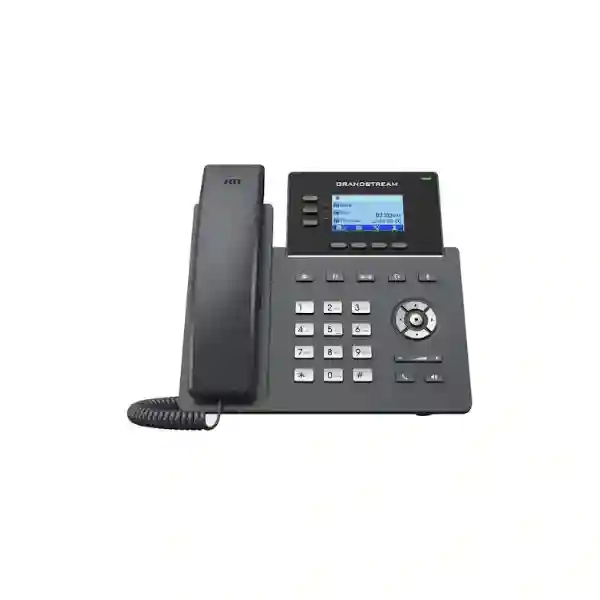
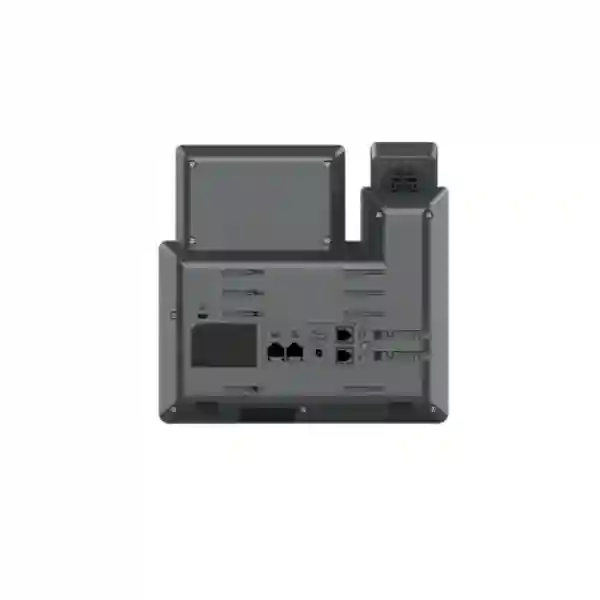
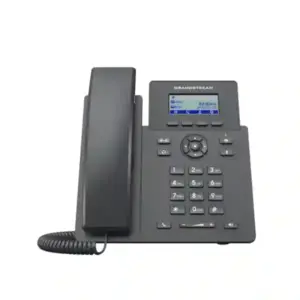
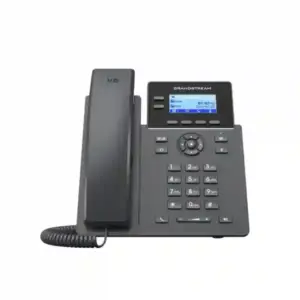
Grandstream GRP2603P IP Phone
The Grandstream GRP2603P is a 3-line carrier-grade IP phone built for organizations that want Gigabit Ethernet, integrated Power over Ethernet, six SIP accounts, centralized GDMS management, HD audio, secure provisioning and straightforward desk-phone deployment. It is particularly relevant when a business needs a practical wired SIP endpoint on a PoE-enabled network without adding a separate power adapter at every desk. The phone belongs to Grandstream’s GRP essential family and is designed around high-volume rollout, zero-touch provisioning, simplified administration and a consistent user experience.
For offices in Dubai, Abu Dhabi, Sharjah and the wider UAE, the GRP2603P can fit reception desks, administration teams, branch users, customer-service staff, finance desks, operations teams and other employees who need a reliable voice endpoint without moving to a touchscreen or application-heavy executive phone. It also suits multi-site projects where IT teams want to standardize provisioning and ongoing management through Grandstream Device Management System (GDMS). Fourteck can help buyers evaluate the model, confirm PBX and network requirements, plan PoE switching, compare suitable alternatives and prepare a project quotation based on the actual deployment.
6 SIP accounts
Integrated PoE
Dual Gigabit Ethernet
GDMS management
5-way audio conferencing
Quick answer: who should choose the GRP2603P?
Choose the GRP2603P when the user needs a conventional wired business IP phone with more account capacity than a basic desk endpoint, wants Gigabit network passthrough for a connected workstation, and already has or plans to use PoE switching. Its strongest deployment value comes from the combination of six SIP accounts, three lines, PoE, Gigabit Ethernet, Grandstream GDMS provisioning, HD audio, security controls, headset support and a familiar physical-key interface.
It is not automatically the best phone for every user. A worker who needs Wi-Fi, Bluetooth, a color touchscreen, Android applications, many visible programmable keys or advanced video capabilities may be better served by another model. A buyer should therefore match the endpoint to role, network design, PBX platform, headset requirements, number of SIP registrations, call volume, expansion plans and management method rather than selecting only by price.
Best fit
Business users who need a dependable SIP desk phone, Gigabit Ethernet, PoE, multiple SIP registrations and centralized fleet management.
Deployment strength
Mass rollout through zero-touch provisioning and GDMS, particularly useful for branches, managed deployments and standardized endpoint estates.
Network advantage
Two auto-sensing 10/100/1000 Mbps Ethernet ports with integrated PoE on the GRP2603P variant.
Management advantage
Central provisioning, configuration, monitoring and lifecycle operations through Grandstream Device Management System.
Verified GRP2603P capabilities that matter in real deployments
| Capability | GRP2603P detail | Why a buyer cares |
|---|---|---|
| Lines and accounts | 3 lines, 6 SIP accounts, up to 3 call appearances | Supports multiple identities, extensions or service registrations without requiring a more complex executive endpoint. |
| Network | Dual switched auto-sensing Gigabit Ethernet ports | Useful when the desk phone shares the wired connection path with a PC and the organization wants to avoid a 100 Mbps bottleneck. |
| Power | Integrated PoE on the GRP2603P | Reduces desk-side cabling and allows centralized power design when connected to a suitable PoE switch. |
| Display | 132 × 64 backlit graphical LCD | Provides a clear conventional interface for line status, call information, menus and configuration tasks. |
| Audio | HD audio, full-duplex speakerphone, noise-reduction functions | Supports clearer desk conversations and speakerphone use in normal office environments. |
| Conferencing | 5-way audio conferencing | Enables small ad-hoc audio conferences from the endpoint. |
| Headset | RJ9 headset interface and EHS support for selected headset ecosystems | Helps organizations equip frequent-call users with compatible professional headsets; exact headset/EHS compatibility should be confirmed before purchase. |
| Provisioning | GDMS, TR-069 and encrypted XML provisioning options | Reduces repetitive manual configuration across larger or geographically distributed phone fleets. |
| Security | Secure boot, dual firmware images, encrypted data storage and standards-based voice/network security options | Supports more controlled enterprise deployment and safer provisioning practices. |
GRP2603P vs GRP2603: the key buying difference
The two names are closely related because they share the same core GRP2603 platform. The practical distinction is power delivery: the GRP2603P includes integrated PoE. For a business with PoE-enabled access switching, the GRP2603P is usually the cleaner deployment choice because power and network connectivity can travel over the Ethernet infrastructure. This can simplify desk cabling, centralize the power strategy and make large rollouts easier to standardize.
The decision should still consider switch PoE budget, UPS design, VLAN architecture and physical cabling. If many phones share one access switch, confirm that the switch offers enough powered ports and suitable total PoE capacity for the planned endpoint count while leaving reasonable headroom for growth and other powered devices.
Why Gigabit Ethernet matters on a desk phone
Many office desks use the phone as part of the wired path between the wall outlet and a desktop computer. In that layout, a phone with only Fast Ethernet can become the slowest link for a workstation that would otherwise connect to a Gigabit access network. The GRP2603P’s dual Gigabit Ethernet interfaces make it better suited to current business LANs where the attached PC may transfer cloud files, use web applications, access on-premises resources or move large documents across the network.
Gigabit capability should not be confused with voice quality by itself. A VoIP call does not require anything close to Gigabit throughput. The main benefit is preserving network performance for the downstream workstation. Voice performance still depends on LAN design, WAN quality, QoS policy, PBX configuration, codec choices, packet loss, jitter, latency, DNS, routing and firewall behavior.
For deployments with separate voice and data VLANs, the network team should plan VLAN tagging, LLDP or equivalent policies, switch-port configuration and quality-of-service settings as part of the rollout. The handset supports common enterprise networking and QoS mechanisms, but the surrounding infrastructure must be configured coherently for those mechanisms to deliver practical benefit.
Six SIP accounts: where that capacity helps
Six SIP accounts can be useful when one desk phone needs several registrations or identities. Examples include an employee with a personal extension plus a departmental identity, a front-desk user who handles different business units, a branch employee who registers to more than one service, or a managed deployment in which multiple SIP profiles are provisioned centrally.
The value depends on PBX design. Six SIP accounts do not mean six physical line keys or six concurrent call appearances. The phone provides three lines and up to three call appearances, so map the extension architecture to the real interface before ordering.
GDMS: a major reason to standardize on GRP
Grandstream Device Management System is designed to centralize provisioning, configuration, monitoring and management of supported Grandstream endpoints. For organizations deploying many phones, that operational capability can matter more than a long list of desk features. Standard templates reduce repetitive setup while centralized administration can simplify moves, additions, configuration updates and firmware operations.
A strong rollout process should still define device ownership, administrator access, firmware policy, provisioning credentials, configuration standards and change control. Central management works best as part of an operating standard rather than only as a first-day setup tool.
Audio experience: HD voice, speakerphone and office noise control
The GRP2603P supports HD audio on the handset and speakerphone, full-duplex speakerphone operation and Grandstream noise-reduction capabilities. In practice, the goal is to make everyday business calls easier to understand and reduce distraction from normal background noise. This can be valuable for open offices, shared administration areas, reception counters and branch environments where a user is not always working in a perfectly quiet room.
Audio quality remains end-to-end. The phone cannot compensate for every weak point elsewhere in the voice path. SIP trunk quality, PBX resources, codec negotiation, WAN quality, firewall handling, headset quality and the remote party can all affect what users hear. For critical voice deployments, test internal calls, inbound and outbound PSTN calls, transfers, conferences, queue traffic, remote branches and failover paths before a large rollout.
The phone supports widely used codecs and business telephony functions. Exact codec selection and advanced feature behavior can depend on the PBX, service provider and firmware, so project configuration should be based on the intended platform rather than a generic settings copy.
Role-based deployment guide
Reception and front desk
A good fit where the receptionist needs several SIP identities and routine transfer, hold, pickup and conference functions, but not a large attendant console. Very busy reception roles may require more visible programmable keys.
Administration and finance
Suitable for employees who need dependable desk calling, multiple SIP identities, headset support and Gigabit workstation connectivity while keeping the interface simple.
Customer service
Useful for moderate call-handling roles where EHS-compatible headsets, call transfer, call waiting and centralized phone administration are more important than application-rich screens.
Branch office users
Strong for standardizing phones across multiple offices because the GRP platform is designed for easy mass deployment and remote management through GDMS.
Hotels, schools and clinics
Can suit back-office, administration and staff areas that need managed SIP endpoints. Specialized hospitality, classroom or clinical communication requirements may call for different device classes.
Managed service deployments
Relevant to providers and integrators that value repeatable provisioning, fleet visibility and configuration consistency across a larger installed base.
PBX and SIP compatibility: what to confirm before purchase
The GRP2603P is a standards-based SIP endpoint and can be used in many IP-PBX and hosted-voice environments. However, “SIP compatible” does not mean every platform exposes every feature in exactly the same way. Basic registration and calling may work while advanced BLF, directory, voicemail, provisioning, hot desking, transfer behavior or security settings require platform-specific templates or testing.
Before a project quotation is finalized, confirm the following:
- PBX or hosted-voice platform and software version.
- Number of SIP registrations required per user and whether shared or departmental identities are involved.
- Required features such as BLF, pickup, transfer, park, voicemail, paging, hot desking or shared-call appearance.
- Provisioning method, including GDMS, local provisioning, TR-069 or platform-specific configuration.
- Voice VLAN, QoS, DHCP, DNS, NTP and firewall requirements.
- SIP transport and media-security expectations, including TLS and SRTP where required.
- Exact headset model and whether EHS control is needed.
- PoE switch compatibility and available power budget.
- Firmware policy and any known version dependencies for the PBX integration.
A short pilot using the same PBX, switching and WAN conditions as production is often more valuable than relying only on a compatibility statement. It reveals how real call flows behave and lets users validate ergonomics before a larger purchase.
Headsets and EHS: useful, but verify the exact combination
The GRP2603P includes an RJ9 headset interface and supports Electronic Hook Switch integrations for selected headset brands and models. EHS can allow users to answer or end calls from a compatible wireless headset without physically pressing the phone’s headset key. This is valuable for receptionists, customer-service users, warehouse administration staff and employees who need to move around the immediate work area during calls.
Headset support should be confirmed at model level, not brand level alone. A brand may offer several connection standards and EHS cable options. Identify the exact headset SKU, whether it is wired or wireless, the required EHS adapter, audio connector, firmware dependency and preferred call-control behavior before ordering.
Security and lifecycle considerations
Grandstream positions the GRP family for carrier-grade deployment and includes security mechanisms such as secure boot, dual firmware images and encrypted data storage. The platform also supports common network and voice-security technologies such as TLS, SRTP and 802.1X depending on the deployment. These capabilities are useful, but secure operation depends on configuration discipline.
Avoid leaving endpoint administration with weak shared credentials, unmanaged firmware and unrestricted network access. Recommended practices include changing administrative credentials, placing phones in a suitable voice VLAN, restricting management access, using secure provisioning, keeping NTP and DNS trustworthy, maintaining approved firmware baselines, monitoring failed registrations and defining a controlled procedure for reset, replacement and decommissioning.
Firmware planning is particularly important in larger fleets. New releases can add security fixes, features or behavioral changes. Maintain a pilot group, validate critical call flows and roll out firmware in stages rather than changing every phone at once.
A practical deployment workflow for GRP2603P projects
Define user profiles
Separate reception, management, administration, customer service, warehouse and branch-office needs. Not every employee needs the same phone.
Confirm PBX and SIP design
Document extensions, SIP trunks, registration method, call routing, dial plans, voicemail, pickup groups, queues and any shared-line behavior.
Audit the LAN and PoE budget
Count powered ports, switch uplinks, VLAN capacity, QoS settings and available PoE headroom. Decide how the phone and PC will connect at each desk.
Build the provisioning standard
Create templates for account settings, NTP, display preferences, dial plan, codec order, VLAN behavior, security, firmware and function keys.
Pilot with real users
Test inbound and outbound calls, transfer, hold, conference, voicemail, headset use, queue calls, directory behavior and support procedures.
Roll out in controlled batches
Deploy by floor, branch, team or project phase so a template issue is found before it affects the entire organization.
Operate the fleet
Keep an asset list, map phones to users and locations, maintain firmware standards, review failed registrations and document replacement procedures.
Customer requirement → GRP2603P capability → buying consideration
| Customer requirement | Relevant capability | Practical benefit | Check before ordering |
|---|---|---|---|
| Reduce desk power adapters | Integrated PoE | Power and data can use the Ethernet connection. | PoE switch standard, port count and power budget. |
| Maintain workstation network speed | Dual Gigabit Ethernet | Phone passthrough preserves a Gigabit-capable desk path. | Structured cabling, switch uplinks and endpoint NIC configuration. |
| Manage multiple identities | Six SIP accounts | More flexible registration design for users or departments. | PBX provisioning and actual line-key workflow. |
| Deploy phones across branches | GDMS and zero-touch provisioning model | Less repetitive desk-side configuration and better standardization. | Internet access, provisioning security and administrative process. |
| Support frequent-call users | Headset port and EHS support | Hands-free call handling with suitable accessories. | Exact headset and EHS accessory compatibility. |
| Improve ad-hoc collaboration | 5-way audio conferencing | Small conference calls can be created from the desk phone. | PBX, trunk and policy limitations for external participants. |
Dubai and UAE deployment context
In Dubai, businesses often combine voice endpoints with the same switching infrastructure that serves desktop PCs, wireless access points, cameras and other IP devices. The GRP2603P is attractive in that environment because it uses PoE and provides Gigabit Ethernet passthrough, allowing a clean phone deployment while preserving a high-speed connection for the workstation. Offices in Business Bay, JLT, Deira, Bur Dubai, Dubai Internet City, Dubai South and industrial zones can have very different cabling and switch conditions, so the network should be audited instead of assuming every desk is ready for PoE.
For Abu Dhabi organizations, professional offices and multi-site companies, centralized provisioning can be especially useful when the phone estate spans more than one building or branch. Sharjah businesses, education organizations and industrial companies can value the same management model when IT staff need to support many endpoints with a small technical team. The phone itself is only one part of the voice solution; successful deployment also depends on the IP-PBX or hosted service, SIP connectivity, WAN design, firewall configuration, PoE switching and support process.
Fourteck can assist with requirement mapping, model selection, PBX and SIP planning, switching and PoE considerations, headset selection and deployment design. Quotations should be based on quantity, required accessories, project services and current commercial conditions. Price and availability can change, so this page intentionally does not present an unverified fixed selling price or stock claim.
GCC procurement: Kuwait and regional projects
For Kuwait and wider GCC projects, procurement planning often needs attention to shipment quantities, site staging, PBX standardization, language preferences, accessories and support handover. A branch rollout may involve phones delivered to one staging location, while a regional project can require separate batches for different offices. Centralized configuration templates can reduce variation between sites.
Buyers should confirm regional power, cabling and network standards, logistics requirements and commercial scope before ordering. The GRP2603P’s PoE design can simplify endpoint power when the switching estate is ready, but a project that still uses non-PoE access switches may need a network upgrade or a different endpoint-power plan.
Uganda, Kenya and Tanzania deployment considerations
In East African business networks, the GRP2603P can be useful for organizations standardizing IP telephony across headquarters, branches, schools, healthcare administration, hotels, professional offices and distributed teams. Integrated PoE can reduce dependence on individual desk adapters when a site already uses managed PoE switches. Where business continuity matters, the switch and upstream network should be protected by appropriate UPS capacity because the phones rely on the powered network.
For Uganda deployments in Kampala and surrounding business areas, the network assessment should examine internet stability, SIP-provider design, PBX location and branch connectivity. For Kenya and Tanzania, multi-branch organizations can benefit from consistent templates, but the project should account for different ISP links and firewall policies at each site rather than assuming one configuration fits every branch.
Where remote offices have constrained WAN links, voice traffic usually consumes modest bandwidth, but jitter, packet loss and latency can still affect quality. QoS planning and sensible codec policy are often more important than raw bandwidth. A pilot can demonstrate real performance before a larger rollout.
Nigeria and Ghana project considerations
For Nigeria and Ghana, businesses evaluating the GRP2603P should consider how endpoint management fits their support model. A central IT team may support multiple cities or branch offices, making remote provisioning and monitoring attractive. At the same time, local power continuity, ISP diversity, branch firewall configuration and secure remote administration can be as important as the phone hardware.
A standardized endpoint can reduce training and support complexity, but it should follow a user-role study. Receptionists, executives and call-center agents have different requirements. The GRP2603P is strongest as a capable essential desk phone. If a user needs many programmable keys, integrated wireless features, video or a richer application interface, another model may be more suitable.
Procurement checklist for the GRP2603P
Before requesting a quote, collect the following information. Better inputs produce a more accurate bill of materials and reduce the chance of missing accessories or network dependencies.
- Quantity: initial phone count and expected expansion.
- Location: delivery country, city and whether one or multiple sites are involved.
- PBX platform: on-premises IP-PBX, cloud PBX, hosted SIP service or provider-managed environment.
- SIP design: extension count, shared lines, queues, departments and required registrations.
- PoE infrastructure: switch models, available ports and power budget.
- LAN design: voice VLAN, QoS, DHCP, DNS, NTP and uplink capacity.
- Headsets: exact models and whether EHS is required.
- Provisioning: GDMS, PBX provisioning or another approved method.
- Security: TLS/SRTP expectations, certificate requirements and endpoint management policy.
- Accessories: wall-mount requirements, cabling and role-specific add-ons.
- Services: configuration, staging, installation, migration, testing, training or ongoing support.
- Timeline: required deployment window, phases and any site-access constraints.
Common selection mistakes to avoid
Choosing only by SIP-account count
Six SIP accounts are useful, but the user experience is also shaped by line keys, call appearances, PBX features and daily call volume. A receptionist can need more visible control than a typical administrative user even if both fit within the SIP-account limit.
Assuming PoE means “plug into any switch”
The access switch must support appropriate PoE and have enough total power capacity. Count all powered endpoints on the switch, not only the phones being added today.
Skipping PBX feature validation
SIP registration is only the first test. Validate transfers, voicemail, BLF, queue login, call pickup, directory, conference, failover and any business-critical workflow.
Copying an old phone configuration blindly
Endpoint families, firmware and PBX versions evolve. Use a reviewed template for the GRP2603P rather than importing years-old settings without checking security and feature behavior.
Buying headsets without checking EHS details
Headset compatibility can involve specific cables, adapters and firmware. Confirm the complete combination before large purchases.
When the GRP2603P may not be the right phone
The GRP2603P is a wired essential business IP phone. It does not target users who need an Android application platform, integrated video, a large color touchscreen or built-in Wi-Fi. If the desk lacks Ethernet, a wireless-capable model may be more appropriate. If the user needs many visible programmable keys for heavy attendant-console work, a higher-level endpoint can provide a better experience.
Likewise, a very basic single-role user may not need six SIP accounts or Gigabit passthrough, so a simpler model could meet the requirement. The right comparison is not “which phone has the longest feature list?” but “which endpoint satisfies the user requirement with the least operational complexity?”
Why organizations consider the GRP2603P for standardized fleets
Standardization reduces variation. When an organization uses the same phone family across many ordinary desk roles, IT teams can create one tested provisioning baseline, one user guide, one support playbook and one firmware process. Replacement becomes easier because a spare phone can be provisioned from the same template. Training is simpler because buttons and menus remain familiar.
The GRP2603P fits that strategy because its hardware is intentionally business-focused rather than application-heavy. Gigabit Ethernet and PoE address common infrastructure needs, while GDMS addresses operational scale. Security capabilities support a more controlled endpoint estate, and six SIP accounts provide flexibility for many business roles.
A strong fleet design can still use multiple endpoint tiers. A business might standardize the GRP2603P for most employees while choosing a richer model for executives, reception consoles or specialty users. This preserves management consistency without forcing every role into the same device.
GRP2603P quotation and project planning with Fourteck
A meaningful quotation should reflect the entire requirement. For a small office, that may simply mean a defined quantity of phones and confirmation of PoE availability. For a larger deployment, the scope can include IP-PBX integration, SIP trunk considerations, PoE switches, VLAN configuration, firewall rules, GDMS onboarding, extension templates, headsets, installation, user migration, acceptance testing and post-deployment support.
Fourteck can work with the customer to identify user groups, compare endpoint choices and prepare a deployment bill of materials. Where the project covers multiple countries, the design can separate the common phone standard from site-specific network and service-provider differences.
For current pricing, project quantity, accessories and availability, request a quotation with the deployment details. No fixed price or stock status is stated here because those items are commercial and time-sensitive. Confirm them at the time of purchase.
Frequently asked questions about the Grandstream GRP2603P
Is the Grandstream GRP2603P a PoE phone?
Yes. The GRP2603P is the PoE variant of the GRP2603 family and includes integrated Power over Ethernet. A suitable PoE switch can provide both network connectivity and power through the Ethernet connection.
How many SIP accounts does the GRP2603P support?
It supports six SIP accounts with three lines and up to three call appearances. The way those accounts are presented depends on configuration and PBX design.
Does the GRP2603P have Gigabit Ethernet?
Yes. It has dual switched auto-sensing 10/100/1000 Mbps Ethernet ports, useful when the phone and a workstation share the same desk connection.
Does the GRP2603P support Wi-Fi?
No. The GRP2603P is primarily a wired Ethernet IP phone. If integrated Wi-Fi is required, compare another Grandstream model that specifically includes wireless connectivity.
Can the GRP2603P be managed through GDMS?
Yes. Grandstream Device Management System supports centralized provisioning, configuration, management and monitoring for the GRP2603P and other supported Grandstream endpoints.
Does the GRP2603P support conference calls?
Yes. Current Grandstream product documentation specifies 5-way audio conferencing. PBX, trunk and call-policy conditions can still affect how external participants are handled.
Can I use a headset with the GRP2603P?
Yes. The phone includes an RJ9 headset interface and supports EHS with selected headset solutions. Confirm the exact headset model and required adapter or EHS cable before purchase.
What is the difference between GRP2603 and GRP2603P?
The primary buying difference is integrated PoE on the GRP2603P. Both belong to the same GRP2603 platform, while the P variant is intended for direct power from a compatible PoE network.
Is the GRP2603P suitable for reception?
It can be a good fit for moderate reception workloads that need multiple SIP identities, transfer, hold, conferencing and headset support. Very busy attendant roles may benefit from a phone with more visible programmable keys.
Can the GRP2603P work with a third-party IP-PBX?
The phone uses standard SIP technologies and can be deployed with many IP-PBX and hosted-voice platforms. Confirm the specific platform and required features because advanced functions and provisioning behavior can vary.
What should I check before buying the GRP2603P in Dubai or the UAE?
Confirm quantity, PBX platform, SIP-account requirements, PoE switch capacity, voice VLAN and QoS design, headset compatibility, provisioning method, services and delivery location. Request current pricing and availability at the time of purchase.
Can Fourteck help with GRP2603P configuration and deployment?
Fourteck can assist with requirement assessment, model selection, PBX and SIP planning, network and PoE considerations, provisioning strategy, headset selection and deployment support according to the agreed project scope.
Plan a GRP2603P deployment around the real user requirement
The Grandstream GRP2603P is strongest when a business needs a manageable, PoE-powered, Gigabit wired SIP phone with enough account capacity for flexible desk roles. Confirm who will use the phones, how the PBX is configured, which switches will power them, whether headsets are required and how the devices will be provisioned and supported.
Discuss your requirement with Fourteck for a current quotation, deployment review and compatibility check covering the GRP2603P, PBX environment, PoE network and required accessories.
Technical characteristics can vary by firmware revision and deployment environment. Confirm current Grandstream documentation and project-specific compatibility before final procurement.
Reviews
There are no reviews yet.