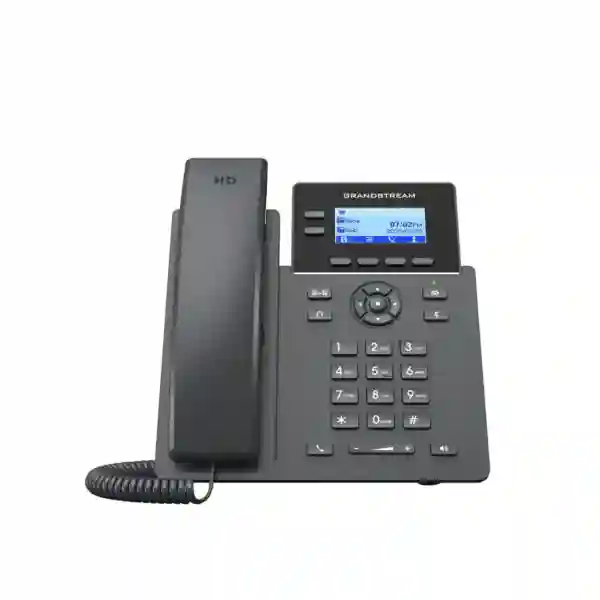
Grandstream GRP2602P Dubai – 2-Line PoE IP Phone for Business Deployments
The Grandstream GRP2602P is a 2-line essential business IP phone designed for organizations that want straightforward SIP calling, centralized administration and Power over Ethernet in a compact desktop endpoint. It supports four SIP accounts, 5-way audio conferencing, HD audio on the handset and speakerphone, Grandstream Device Management System (GDMS), a 132 × 48 backlit graphical display, EHS-capable headset connectivity and carrier-grade security features. The “P” in GRP2602P is important: this model has integrated PoE and dual 10/100 Mbps Ethernet ports. It is not the Wi-Fi model and it is not the gigabit model, so buyers should match the variant to the network design rather than ordering by name alone.
For Dubai, Abu Dhabi, Sharjah and wider UAE rollouts, the GRP2602P is especially relevant where a managed PoE switching environment is already available and the project needs consistent desk-phone behavior across many users. Fourteck can help businesses assess PBX compatibility, PoE capacity, VLAN and QoS requirements, headset needs, user roles and deployment quantities before quotation. Stock, price, warranty terms and delivery time should always be confirmed at the time of order.
Is the GRP2602P the right Grandstream phone for your requirement?
Choose the GRP2602P when your priority is a wired PoE desk phone for everyday business calling and you do not require gigabit pass-through or built-in Wi-Fi. It suits organizations that value predictable wired connectivity, centralized endpoint administration and a simple user interface more than a large color display, Bluetooth or extensive programmable-key capacity. Typical placements include general office desks, back-office teams, customer-service positions with moderate call handling, hotel administration, school and campus offices, clinics, branch offices, reception support desks, warehouse administration points and multi-site businesses using standardized SIP endpoints.
It is less appropriate where the workstation must pass gigabit Ethernet to a PC, where the phone location has no network cable and depends on Wi-Fi, or where a user needs a much larger screen, many visible BLF keys or advanced executive features. In those cases, another GRP variant or a higher-positioned Grandstream model can be a better fit. Selecting by user profile prevents overbuying features for basic users and prevents under-specifying phones for power users.
Verified GRP2602P technical specifications
The following specification summary focuses on the GRP2602P variant. Grandstream also sells GRP2602, GRP2602W and GRP2602G versions, and some specifications differ between those models. That distinction matters during procurement because PoE, Wi-Fi and Ethernet speed are variant dependent.
| Model | Grandstream GRP2602P |
|---|---|
| Lines / SIP accounts | 2 lines and support for 4 SIP accounts |
| Display | 132 × 48, approximately 2.41-inch backlit graphical LCD |
| Ethernet | Dual switched auto-negotiation 10/100 Mbps Ethernet ports |
| Power over Ethernet | Integrated PoE; IEEE 802.3af Class 1, 3.84 W |
| Wi-Fi | Not built into GRP2602P; Wi-Fi is a GRP2602W feature |
| Audio conference | Up to 5-way audio conferencing |
| Audio | HD handset and full-duplex HD speakerphone; wideband codec support including G.722 and Opus |
| Headset | RJ9 headset port with EHS compatibility for supported headsets |
| Provisioning / management | GDMS, TR-069 and encrypted XML configuration options |
| Security | Secure boot, dual firmware images, encrypted data storage, TLS/SRTP capabilities and 802.1X support |
| Mounting | Desktop stand; wall mounting is supported with a separately sold wall-mount bracket |
| Dimensions | 208 × 180 × 63.4 mm with handset |
| Unit weight | Approximately 670 g |
Package planning note: Grandstream’s current datasheet lists the universal power supply as not included with the GRP2602P. The normal design assumption is therefore PoE power from a compatible switch or injector. Confirm current regional package contents and accessory requirements before ordering, especially when phones will be installed outside the managed PoE LAN.
What “2 lines and 4 SIP accounts” means in daily use
A common buying question is why the GRP2602P is described as a 2-line phone while also supporting four SIP accounts. The phone has two physical line keys, but its SIP stack can register up to four accounts. This lets an administrator assign more than one SIP identity to the endpoint even though only two dedicated line keys are presented on the front panel. A user might, for example, have a personal extension plus a departmental identity, or an organization might register services from different PBX contexts depending on the deployment design.
The practical value is flexibility without making the handset physically complicated. For a normal employee who mainly places, receives, transfers and holds calls, two visible line keys can be easier to understand than a large field of programmable keys. The four-account capability still gives the IT team room to support multiple identities or service profiles. However, if the role depends on watching many extensions, handling a large queue or using numerous one-touch keys, a higher-tier phone with more programmable-key capacity should be considered.
When mapping SIP accounts, verify PBX licensing, extension policy, failover design and number presentation. Four SIP registrations do not automatically mean four simultaneous independent calls or four physical line buttons in every workflow. The user experience depends on the PBX, call-state handling and feature configuration.
Why PoE makes the GRP2602P attractive for managed office networks
Power over Ethernet is the main hardware reason to choose the “P” variant. A compatible PoE switch can provide both network connectivity and electrical power through the phone’s Ethernet cable. In a structured office deployment, that can reduce adapter clutter, simplify desk cabling and make large installations easier to standardize. More importantly, it lets the voice endpoint participate in a centrally powered network design. If the PoE switches and the PBX or SIP platform are protected by suitable UPS capacity, phones can remain powered through short utility interruptions even when individual desks have no local UPS.
PoE does not remove the need for capacity planning. An IT team should calculate the total switch PoE budget, not just the number of PoE ports. The GRP2602P is listed as IEEE 802.3af Class 1 with a 3.84 W figure, but the switch design should still include headroom, additional PoE devices, redundancy targets and growth. Branch deployments should also consider uplink resilience, VLAN design and whether the voice network must survive failure of a single switch.
The GRP2602P uses 10/100 Mbps Ethernet, which is more than adequate for the phone’s own voice traffic. The issue is the device connected through the phone’s PC port. If a workstation requires gigabit LAN performance, the GRP2602G is the more appropriate member of the family because Grandstream specifies gigabit Ethernet on that variant. Alternatively, the PC can use a separate gigabit network connection. This one detail is worth checking before a mass order because changing hundreds of endpoints after users report reduced wired PC speed is far more disruptive than selecting the right variant at design stage.
GDMS and zero-touch deployment for multi-phone projects
Grandstream positions the GRP2602 family for mass deployment, and GDMS is central to that approach. Grandstream Device Management System provides a centralized environment for provisioning, configuration, monitoring and management of supported endpoints. For an IT administrator, the advantage is consistency. Instead of manually logging into each phone and changing settings one by one, a project can use templates and centralized policies to reduce configuration drift across branches, floors or customer sites.
A disciplined deployment starts with a configuration baseline. That baseline may include SIP server addresses, extension credentials, regional settings, time zone, NTP, codec order, dial plan, VLAN policy, QoS values, display behavior, firmware policy, phonebook sources, security settings and user-facing functions. The exact profile depends on the PBX and network. Once validated on a pilot group, the configuration can be replicated more confidently to larger batches.
Zero-touch should not be interpreted as “no planning.” It reduces hands-on endpoint work after the provisioning workflow has been designed correctly. Administrators still need device inventory, ownership mapping, extension assignments, network readiness, authentication policy and a rollback path. Firmware should be tested with the intended PBX and required features before broad rollout. Grandstream’s current user documentation also includes hardware-version-specific firmware downgrade restrictions for some GRP2602(P) hardware, reinforcing the value of controlled firmware change management rather than casual bulk upgrading.
For organizations with many locations, centralized management is often more valuable than a visually advanced phone. A predictable essential handset combined with a controlled provisioning platform can reduce support effort because common settings and troubleshooting information are easier to manage centrally.
Audio quality, speakerphone use and noise management
Voice quality depends on the complete path between endpoints, but the GRP2602P provides a useful foundation with HD audio on the handset and full-duplex speakerphone plus support for wideband codecs. Grandstream also lists noise shield technology and AI noise reduction for the current GRP2602 family. In practical terms, those capabilities are designed to make normal office conversations easier to follow and to reduce the impact of background noise.
For best results, pair endpoint capability with a well-designed network and SIP platform. Wideband audio requires compatible codec negotiation across the call path. Internet trunks, SBCs, PBXs, carrier routes and remote endpoints can all affect the final codec and perceived quality. A phone that supports G.722 or Opus cannot force wideband quality if another part of the path restricts the call to a narrowband codec.
Speakerphone quality also depends on room acoustics. Small offices, private workspaces and short collaboration calls are natural use cases. In open areas with substantial ambient noise, a professional headset is often a better choice. The GRP2602P includes an RJ9 headset interface and EHS support for compatible headset families, allowing suitable deployments to support remote call answer/end behavior. Headset compatibility should still be checked by exact headset model and any required EHS cable or adapter because “brand compatible” does not mean every model connects in the same way.
Security features for business voice endpoints
IP phones are network devices and should be treated as part of the security architecture rather than as simple desk appliances. Grandstream lists carrier-grade security features on the GRP series including secure boot, dual firmware images and encrypted data storage. The current GRP2602 datasheet also lists TLS 1.3 support, HTTPS management access, SIP over TLS options, SRTP-related media protection and 802.1X network access-control capability.
Those features are valuable only when they are configured as part of a coherent design. A secure deployment can include a dedicated voice VLAN, restricted management access, unique administrator credentials, certificate validation where supported, encrypted signaling and media when the PBX and network architecture support it, disabled unnecessary services, current firmware, controlled provisioning and firewall rules that limit the phone to required destinations. Where 802.1X is used, test certificate or credential workflows carefully so the phone can still obtain the required network access during provisioning and after reboot.
For branch sites and remote offices, avoid exposing device-management interfaces directly to the public internet. Use a secure, supported management and provisioning design. If the business uses an SBC, VPN or hosted PBX, confirm the endpoint’s required ports and trust model with the voice-platform administrator. Security is strongest when network, PBX, endpoint and identity controls are planned together rather than configured independently.
Network, VLAN and QoS planning for GRP2602P deployments
Voice traffic consumes modest bandwidth, but call quality is sensitive to delay, jitter and packet loss. A well-run GRP2602P deployment therefore needs more than an available Ethernet port. On a managed office LAN, the phone can be placed in a voice VLAN, while the connected PC uses the appropriate data VLAN according to the switch and endpoint design. Grandstream lists LLDP-MED and Layer 2 and Layer 3 QoS capabilities, giving network teams options for voice classification and prioritization.
The first design question is whether the organization already has a voice VLAN standard. If yes, verify that access switches advertise or assign the correct VLAN and that DHCP, DNS, NTP, PBX and provisioning services are reachable. If no, decide whether separating voice from data improves policy control, troubleshooting and security enough to justify the configuration. A small office can operate successfully without a separate voice VLAN, but larger environments usually benefit from logical segmentation.
QoS is most useful when congestion exists somewhere along the path. Marking packets at the phone is only one step; switches, routers, firewalls, SD-WAN devices and WAN providers must preserve or intentionally remap the policy. For internet-hosted PBX services, local QoS cannot control the public internet, but it can still protect voice on the organization’s own LAN and managed WAN. Capacity planning should account for the number of concurrent calls, codec selection, signaling, remote branches, backup links and other latency-sensitive applications.
Before rollout, test calls under realistic network load. Listen for clipping, delay or one-way audio, and use PBX or network telemetry when available. A five-minute clean test on an empty LAN is not enough evidence for a call center, busy branch or multi-site deployment.
SIP, PBX and hosted voice compatibility considerations
The GRP2602P is a SIP endpoint and supports a broad set of standard VoIP functions, but successful interoperability depends on the target platform and configuration. Before ordering a large quantity, confirm that the PBX or hosted service supports the required registration method, authentication, codec set, DTMF method, transfer behavior, voicemail indication, presence or BLF behavior if used, phonebook integration and any vendor-specific provisioning requirements.
Common business environments include on-premise IP PBX systems, hosted PBX services, SIP trunk-connected communication systems and multi-site deployments where phones register to a central platform. The phone may also be used in a branch that reaches the PBX through VPN, SD-WAN or a secured routed network. Each architecture creates different dependencies. A hosted service may require public DNS and specific outbound ports; an on-premise PBX may depend on local DHCP options or provisioning servers; a branch design may depend on failover routes and survivability.
Fourteck can help map the endpoint requirement against the existing voice platform rather than treating the handset as an isolated purchase. For a replacement project, capture the current extension count, call features, PBX brand/version, headset use, network switch model, PoE budget, VLAN policy, user roles and any receptionist or queue workflows. For a new deployment, begin with user and call-flow requirements, then select phone models that match each role. Not every employee needs the same endpoint.
GRP2602P user roles: where this model fits best
General office staff
Employees who mainly make and receive business calls usually need reliability, clear audio, transfer, hold, voicemail access and a manageable interface. The GRP2602P covers those essentials without pushing every user into a higher-cost feature set.
Branch and remote-site desks
For a branch with structured Ethernet and PoE switching, centralized GDMS administration can simplify repeated provisioning and make the same endpoint profile easier to support across locations.
Hotels, schools and clinics
Administration desks, staff offices and non-specialist positions can benefit from a standardized SIP phone with PoE and straightforward calling features, provided the network and PBX are designed for the environment.
Customer-service teams
The model can suit moderate inbound or outbound roles when the required headset is compatible and users do not need a large number of visible queue, BLF or programmable keys.
Receptionists, executives and high-intensity contact-center agents often need different capabilities. A receptionist may benefit from more programmable keys and a larger display; an executive may want Bluetooth, a color interface or more advanced presence functions; a contact-center user may prioritize certified headset workflows and softphone integration. A mixed-model deployment is often more efficient than forcing one phone model across every role.
GRP2602P vs GRP2602, GRP2602W and GRP2602G
The family names are similar, so procurement teams should check the suffix carefully. The comparison below focuses on the network and power differences that most often change the buying decision.
| Variant | Ethernet | PoE | Wi-Fi | Best fit |
|---|---|---|---|---|
| GRP2602 | 10/100 Mbps | No integrated PoE | No | Basic wired desk where local power is acceptable |
| GRP2602P | 10/100 Mbps | Yes | No | Managed PoE office networks |
| GRP2602W | 10/100 Mbps | Variant focus is Wi-Fi rather than PoE | Yes; current hardware documentation lists dual-band Wi-Fi 6 on supported hardware versions | Locations needing wireless network connectivity |
| GRP2602G | 10/100/1000 Mbps | Yes | No | PoE plus gigabit pass-through requirement |
All four are members of the same essential GRP2602 family, so core calling features overlap substantially. The buying decision is usually driven by infrastructure: power method, wireless requirement and whether a connected workstation needs gigabit Ethernet. Treat those as design inputs rather than small specification details.
GRP2602P vs GRP2601P: when four SIP accounts matter
Businesses comparing essential Grandstream models often look at the GRP2601P and GRP2602P together. Both target straightforward desk-phone use and can participate in managed mass deployments, but the GRP2602P gives the user and administrator more account flexibility. If a role needs multiple SIP identities, departmental registrations or a configuration that benefits from additional account capacity, the GRP2602P is the stronger fit. If the user truly needs only a very basic extension profile, a lower-positioned model may be sufficient.
The right comparison should not be reduced to “which one has more features.” Consider the total endpoint population. A 200-user office might have 140 standard desks, 20 supervisors, 10 reception or executive users and 30 shared or common-area phones. Assigning the most appropriate model to each profile can produce a better operational result than using a single model everywhere. The GRP2602P is particularly useful as a standard-user phone when PoE is available and the business values the additional SIP-account flexibility without moving to a premium endpoint.
UAE deployment guidance: Dubai, Abu Dhabi and Sharjah
Dubai: Offices in Business Bay, Deira, Bur Dubai, JLT, industrial zones and distributed branch environments often combine IP phones with managed switching, structured cabling, firewalls, internet links and an on-premise or hosted PBX. For a GRP2602P rollout, confirm the access-switch PoE budget, voice VLAN, DHCP scope, PBX reachability and workstation Ethernet needs. If the phone will sit between the wall port and a gigabit-dependent desktop, the 10/100 pass-through limitation should be addressed before installation.
Abu Dhabi: Larger offices, institutions and multi-site organizations may place more emphasis on standardization, change control and centralized administration. GDMS can support a consistent endpoint-management approach, but it should be paired with documented naming, extension assignment, firmware policy and branch connectivity. For projects with redundancy objectives, test what happens when the primary WAN or PBX path fails and confirm whether the voice platform offers the expected backup behavior.
Sharjah and Ajman: Cost-sensitive SMB deployments can benefit from choosing endpoint features carefully rather than overspecifying every desk. The GRP2602P offers PoE and four SIP accounts while keeping the interface in the essential category. That can make it a practical standard model where the network is already wired and PoE-capable. If a site does not have PoE switching, compare the cost of adding PoE against using a non-PoE phone with local power.
Fourteck supports UAE customers with solution planning around IP telephony, switching, network segmentation, headsets, PBX integration and deployment requirements. For broader UAE IT and communication solutions, visit Fourteck UAE, and for IP phone-focused requirements visit IP Phone Fourteck.
Regional requirements beyond the UAE
Uganda: Kampala and growing branch environments may prioritize reliable wired voice endpoints, simple maintenance and the ability to manage phones centrally when IT resources are shared across sites. Before deployment, confirm PoE switch availability at every location and consider internet/WAN stability if phones register to a remote or cloud PBX. A centrally managed configuration is valuable, but local power and connectivity resilience still determine service continuity.
Kenya: Multi-branch offices in Nairobi and other business centers may combine fiber, managed internet, SD-WAN or VPN connectivity. The GRP2602P can fit standard desk roles where Ethernet is structured and PoE is available. For sites using phones as a pass-through connection for PCs, confirm whether 100 Mbps is sufficient. Where higher desktop throughput is required through the phone, compare the gigabit GRP2602G or use separate data cabling.
Kuwait: Businesses with centrally managed networks can use the PoE model to standardize power and endpoint cabling. Pay attention to switch-room UPS capacity, voice VLAN consistency and site-specific PBX routing. Arabic language support is included among the phone’s multi-language options, which can be useful for local user deployment alongside English interfaces.
Nigeria and Ghana: Power stability and WAN design can be major considerations for distributed businesses. PoE lets phones be powered from a network switch, which can simplify backup when that switch is connected to a properly sized UPS. This does not guarantee voice availability during an outage; the router, firewall, PBX path, internet service and any upstream equipment also need power and connectivity.
Tanzania: Offices in Dar es Salaam and other commercial locations can use the GRP2602P in wired SIP environments where a simple, manageable endpoint is preferred. As with other markets, check PBX interoperability, PoE infrastructure and trunk/provider requirements. Remote provisioning can reduce travel for routine configuration, but an initial local validation plan is still recommended.
For Grandstream-focused regional assistance, Fourteck’s approved network includes Grandstream UAE Fourteck as a related resource. Product availability, commercial terms and local support scope can vary by country and should be confirmed for each project.
A practical rollout workflow for 10, 50 or 500 phones
- Define user profiles. Separate standard users, receptionists, supervisors, executives, call-center agents, shared desks and common-area phones. Confirm that the GRP2602P feature set matches the standard-user profile rather than assuming one handset should cover every job.
- Audit the LAN. Record switch models, available PoE ports, total PoE budget, uplink capacity, VLAN design, DHCP, DNS, NTP and WAN paths. Identify desks where the connected PC requires gigabit speed.
- Confirm the voice platform. Document PBX version, SIP domain or server, authentication policy, codecs, DTMF, extension licensing, voicemail, transfer behavior, phonebook needs and emergency-calling requirements.
- Create a pilot configuration. Build the endpoint template, test provisioning and validate representative users before scaling the same profile across a large fleet.
- Test security. Validate management access, certificates where used, SIP encryption, SRTP, 802.1X if applicable, VLAN policy and firmware source.
- Validate real calls. Test internal, inbound, outbound, transferred, held, conference and voicemail scenarios. Include branch-to-branch and remote-hosted paths if relevant.
- Check headsets. Verify exact headset and EHS requirements for the users who need hands-free workflows.
- Stage in batches. Roll out a controlled number of phones first, review logs and user feedback, then continue in planned waves.
- Document and hand over. Keep extension mappings, device identifiers, template versions, firmware policy, support ownership and change procedures available for future administrators.
Common buying mistakes to avoid
Assuming the GRP2602P is gigabit: it is not. The current Grandstream specification lists dual 10/100 Mbps Ethernet ports for this variant. If a PC will rely on the phone’s pass-through port and needs gigabit, review the GRP2602G or separate the data path.
Assuming “P” means Wi-Fi: the “P” model is the PoE variant. The wireless member of this family is the GRP2602W. Choose based on infrastructure, not a visual similarity in model names.
Expecting a power adapter in the GRP2602P box: Grandstream’s current datasheet indicates the universal power supply is not included with the GRP2602P. Use PoE as intended or confirm what power accessory is required for a non-PoE scenario.
Buying before checking PBX behavior: SIP standards provide a strong interoperability foundation, but features such as directory integration, provisioning, BLF behavior, codecs, security settings and call flows should be validated against the real PBX or hosted service.
Ignoring user roles: a phone that is ideal for a standard employee may frustrate a receptionist or power user. Build a small endpoint matrix and map models to roles before requesting a project quantity.
Pre-purchase checklist for a GRP2602P quotation
Installation and configuration considerations
Physical installation is straightforward in a normal PoE office: connect the LAN port to a PoE-enabled switch port, connect the PC port only if a workstation will pass through the phone, attach the handset and allow the endpoint to boot. The phone then needs network parameters and a valid SIP configuration. In a centrally provisioned environment, much of that application configuration can be delivered automatically, but the network must still provide the phone with the correct connectivity.
During staging, verify that the phone receives the expected IP address, VLAN, gateway, DNS and time configuration. Confirm that it can resolve and reach the SIP/PBX service, obtain provisioning files or management instructions, register accounts and complete inbound and outbound calls. Check time display, caller ID, transfer, hold, voicemail indication, directory behavior, conferencing and any required dial-plan rules. If a PC is daisy-chained, verify its VLAN and throughput as well.
For wall installations, Grandstream states that wall mounting is supported with a separately sold bracket. Confirm the bracket and cabling layout before choosing a wall location. For shared or public-facing areas, consider cable security, handset durability, user access to settings and whether the phone should expose only a simplified feature set.
Troubleshooting framework for GRP2602P projects
Phone does not power on: confirm the switch port supports PoE, PoE is enabled, power budget is available, cable pairs are intact and any intermediate patching supports the link. Test with a known-good PoE port and cable. Remember that the GRP2602P package is normally planned around PoE rather than an included local adapter.
Phone receives power but does not register: check IP addressing, VLAN assignment, DNS, gateway, NTP and reachability to the SIP service. Review the account credentials, SIP transport and server/port. Firewalls, NAT and SBC policies can all affect registration.
One-way audio: this often points to routing, NAT, firewall or RTP-path problems rather than a handset fault. Compare signaling and media addresses, inspect the SBC or firewall policy, and verify whether the problem occurs only across specific trunks or remote networks.
Poor voice quality: check packet loss, latency, jitter, WAN congestion, codec negotiation and QoS behavior. Determine whether the issue is local to one phone, one switch, one site or all calls through a particular route.
PC speed appears limited: the GRP2602P has 10/100 Ethernet. If the workstation is connected through the phone and needs more than 100 Mbps Ethernet throughput, redesign the connection or choose a gigabit-capable phone variant.
Headset buttons do not control calls: verify the exact headset, EHS cable or adapter, phone headset configuration and firmware compatibility. The presence of EHS support does not eliminate model-specific accessory requirements.
Why businesses choose Fourteck for GRP2602P projects
The value of an IP phone project is not limited to the handset. A reliable deployment depends on endpoint selection, PBX compatibility, PoE switching, VLAN and QoS design, provisioning, security, headset workflows and support processes. Fourteck approaches the GRP2602P as part of that wider communication environment. The objective is to match the endpoint to the user and network rather than simply substitute one model number for another.
For a new office, Fourteck can help structure the requirement around users, call flows, number of extensions, SIP trunks, network ports, PoE capacity and branch connectivity. For an upgrade, the discussion can start from the current PBX, old phone models, pain points, call features and future growth. For a multi-site deployment, configuration consistency and centralized administration become more important, making GDMS and repeatable templates useful design considerations.
Commercial details such as current pricing, stock, delivery, warranty and service scope should be confirmed through a live quotation. This avoids unsupported promises and ensures that the proposal reflects the requested quantity, destination, accessories and project services.
GRP2602P frequently asked questions
Does the Grandstream GRP2602P support PoE?
Yes. Grandstream specifies integrated Power over Ethernet on the GRP2602P. The current datasheet lists IEEE 802.3af Class 1 PoE. This allows the phone to receive power and network connectivity over Ethernet when connected to a compatible PoE source.
How many SIP accounts does the GRP2602P support?
The GRP2602P supports four SIP accounts while presenting two line keys. This provides more registration flexibility than the line-key count alone might suggest.
Is the GRP2602P a gigabit IP phone?
No. The GRP2602P uses dual 10/100 Mbps Ethernet ports. The GRP2602G is the variant in this family with 10/100/1000 Mbps Ethernet and integrated PoE. This difference matters if a PC will connect through the phone.
Does the GRP2602P include Wi-Fi?
No. Built-in Wi-Fi belongs to the GRP2602W variant. The GRP2602P is intended for wired Ethernet deployment with integrated PoE.
Does the GRP2602P support conference calling?
Yes. Grandstream lists support for up to 5-way audio conferencing. The exact practical experience can also depend on the call environment and PBX behavior.
Can the GRP2602P be managed with GDMS?
Yes. The GRP2602P is supported by Grandstream Device Management System, which is designed for centralized provisioning, configuration, monitoring and management of Grandstream endpoints.
Does the GRP2602P support headsets?
Yes. It includes an RJ9 headset interface and EHS compatibility for supported headset solutions. Confirm the exact headset model and any required EHS accessory before purchase.
Is a power adapter included with the GRP2602P?
Grandstream’s current GRP2602 family datasheet lists the universal power supply as not included with the GRP2602P. The normal deployment is therefore PoE. Confirm current package contents and any accessory needs with the supplier before ordering.
Can the GRP2602P be wall mounted?
Yes, Grandstream lists wall mounting support, but the wall-mount bracket is sold separately. Confirm the bracket and installation layout for the intended site.
Is the GRP2602P suitable for call-center users?
It can suit moderate call-handling roles when the required headset and workflow are compatible. For agents who need many visible queue, BLF or programmable functions, a more advanced endpoint or softphone/contact-center workflow may be preferable.
What should I confirm before buying GRP2602P phones for a Dubai office?
Confirm PBX or hosted SIP compatibility, required quantity, PoE switch capacity, PC pass-through speed, VLAN/QoS design, headset models, provisioning method, firmware policy and current commercial terms such as price, stock, delivery and warranty.
Where can I verify the official GRP2602P specifications?
Use Grandstream’s official GRP2602 family product page and current datasheet as the primary technical references. The official family page is available at Grandstream GRP2602(P/W/G).
Request a Grandstream GRP2602P quotation for Dubai or regional deployment
Share your required quantity, office location, PBX or hosted voice platform, switch/PoE environment and any headset requirement. Fourteck can use those details to help confirm whether the GRP2602P is the right endpoint, whether another GRP2602 variant better matches the network, and what installation or configuration scope should be included. Current price, stock, delivery time and warranty terms will be confirmed during quotation.

Reviews
There are no reviews yet.