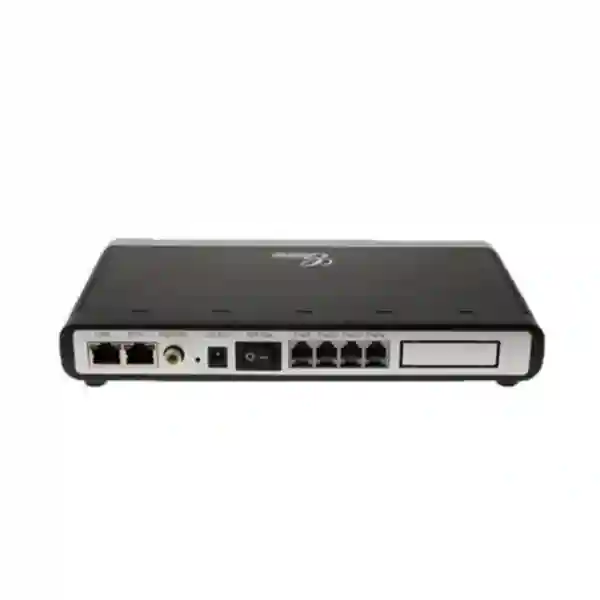
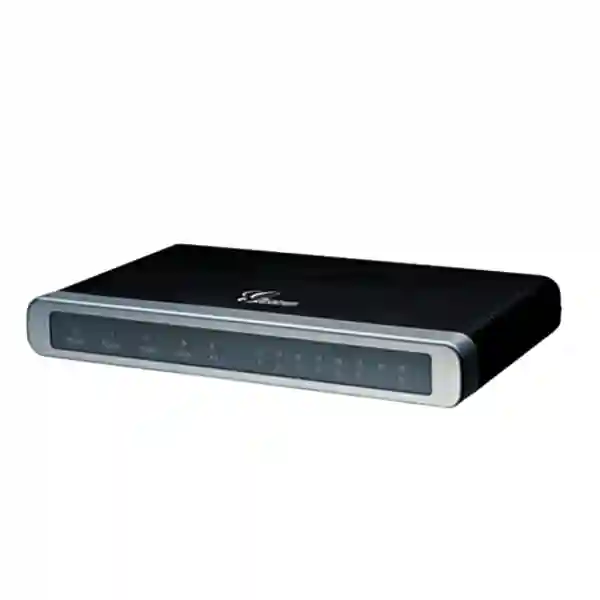
Grandstream GXW4104 FXO Gateway
The Grandstream GXW4104 is a four-port FXO VoIP gateway for businesses that need to connect traditional analogue PSTN trunk lines to a SIP-based IP PBX, softswitch, or compatible hosted communications platform. It provides the conversion point between the public analogue telephone network and the organisation’s SIP environment, so established telephone lines can remain in service while call control moves to an IP platform. This is useful for offices, branches, hotels, schools, clinics, warehouses, retail locations, professional practices, and multi-site organisations that still receive or place calls through analogue trunks but want IP-PBX features such as IVR, extension groups, voicemail, time conditions, centralised routing, and unified administration.
The most important buying fact is that the GXW4104 provides four RJ11 FXO ports. Each FXO port is intended for an analogue trunk line, not an analogue extension telephone. Grandstream’s current information also lists two 10/100 Mbps network ports, broad codec support, caller-ID handling, flexible dial plans, SRTP, T.38 fax support, and PSTN failover on power failure. The correct purchase decision depends on line count, PBX compatibility, local carrier signalling, dial-plan requirements, caller-ID behaviour, network quality, fax requirements, and whether the analogue trunks are a permanent part of the design or only a migration bridge.
For up to four analogue PSTN trunk connections.
Two RJ45 Ethernet interfaces for SIP/IP connectivity.
Fax relay and pass-through options, subject to end-to-end compatibility.
For organisations retaining PSTN trunks while using SIP call control.
Who should consider the GXW4104?
The GXW4104 fits a specific requirement: keeping analogue trunk connectivity while moving business call control to IP. A small office may have several established PSTN numbers that customers already know. A branch may need local analogue lines even though the main PBX is centralised. A hotel, clinic, school, or professional office may want to modernise its PBX while preserving carrier lines during migration. A warehouse or remote site may keep analogue trunks as an alternate route. A company replacing a legacy PBX may need a staged transition while number porting, SIP-trunk activation, or branch standardisation is still underway.
The gateway sits on the trunk side of the architecture. The four analogue carrier lines terminate on the GXW4104 while the IP side communicates with the SIP platform. This is different from an FXS gateway, which provides analogue station interfaces for telephones or other endpoints. Buying an FXS gateway for an FXO requirement is a common procurement error, so the physical role of the existing telephone lines should be confirmed before ordering.
The GXW4104 is particularly appropriate when four ports are enough. If the requirement is likely to exceed four analogue lines, capacity should be reviewed before procurement. Grandstream also has an eight-port GXW4108 in the same family, and newer Grandstream gateway options may be more suitable where current-generation platform capabilities are required. Fourteck can help compare the line count, PBX platform, analogue service, migration plan, and expected growth before a final model is selected.
What problem does a four-port FXO gateway solve?
A SIP PBX uses IP signalling and packetised media. An analogue PSTN line does not. Without an appropriate gateway, the two environments cannot simply be connected with an ordinary network cable or telephone patch lead. The GXW4104 converts between the analogue trunk interface and the SIP/RTP environment. Incoming calls can enter the gateway and then be presented to the IP PBX, where the PBX can route them to reception, an IVR, a hunt group, a queue, voicemail, or another destination. Outbound calls generated by PBX extensions can be directed through one of the analogue lines according to route policy.
This conversion is useful because many organisations do not migrate from analogue telephony to SIP in one step. Existing numbers, carrier contracts, branch conditions, regulatory considerations, or business continuity plans may make a hybrid design sensible. The GXW4104 lets the organisation modernise the PBX side while retaining selected analogue services. This creates a controlled migration path and gives the IT team flexibility around cutover dates, number porting, carrier changes, and branch consolidation.
A planned deployment also centralises call logic. Instead of keeping standalone analogue phones on separate lines, calls can enter the IP PBX and use the same business rules applied to other trunks: business-hours routing, after-hours destinations, extension groups, operator handling, call permissions, and reporting. The gateway itself does not create those PBX functions; it makes the analogue trunks available to a SIP call-control platform that provides them.
Verified GXW4104 technical facts
| Area | GXW4104 detail | Practical meaning |
|---|---|---|
| Telephone interfaces | 4 RJ11 FXO ports | Connects up to four analogue trunk lines. |
| Network interfaces | Dual 10/100 Mbps RJ45 | Connects the gateway to the SIP/IP network. |
| SIP signalling | SIP RFC 3261 | Standards-based integration with compatible SIP systems. |
| Media | RTP/RTCP with SRTP support | Carries voice media and supports protected media where configured compatibly. |
| Voice codecs | G.711, G.723, G.726 variants, G.729A/B/E, G.728, iLBC | Multiple codec choices for interoperability and network design. |
| Fax | T.38 Group 3 fax relay; G.711 pass-through | Supports fax-over-IP workflows subject to the complete call path. |
| DTMF | In-audio, RFC2833 and SIP INFO | Allows alignment with PBX and IVR signalling requirements. |
| QoS / VLAN | DiffServ, TOS, 802.1p/Q VLAN tagging | Supports voice prioritisation and logical traffic separation. |
| Caller ID | Bellcore Type 1/2, ETSI, BT, NTT, DTMF-based CID | Regional signalling should match the carrier service. |
| Provisioning | TFTP and HTTP | Supports repeatable provisioning workflows. |
| Failover | PSTN failover on power failure | Adds a resilience consideration for supported analogue scenarios. |
| Mounting | Desktop or wall mount | Flexible placement near telecom and network equipment. |
| Operating environment | 0–40°C; 10–90% non-condensing humidity | Designed for normal indoor IT/telecom environments within documented limits. |
Specifications should be checked against the relevant Grandstream documentation and firmware used in the project. Analogue telephony behaviour also varies by carrier and country. Caller-ID formats, call-progress tones, polarity behaviour, disconnect supervision, impedance, and line conditions can require local tuning even when the SIP side is configured correctly.
FXO versus FXS: choose the correct side of the analogue connection
FXO and FXS refer to opposite sides of an analogue telephone connection. An FXS interface provides the analogue station service expected by a telephone, while an FXO interface receives service from an analogue line. If a business wants to connect PSTN carrier trunks into an IP PBX, it normally needs FXO ports. If it wants to connect analogue telephones or similar endpoint devices as extensions, it normally needs FXS ports.
The GXW4104 is an FXO gateway. Its four ports are intended for analogue trunks, not for powering ordinary analogue phones. This makes it suitable for PBX migrations and hybrid environments. A company can keep up to four carrier lines, connect them to the gateway, and integrate the gateway with the SIP call-control platform. The PBX then determines how inbound and outbound calls should be routed.
Before ordering, identify what is physically connected today. If the cable from the carrier delivers dial tone to an existing PBX trunk card, that usually points to an FXO requirement. If an analogue handset receives dial tone from an existing PBX extension card, that points to an FXS requirement. Larger environments may need both types of gateway for different purposes.
Typical GXW4104 deployment architecture
Inbound: PSTN line → GXW4104 FXO port → SIP signalling and RTP media over the LAN → IP PBX or softswitch → IVR, operator, queue, ring group, extension, or voicemail. Outbound: user extension → IP PBX route → GXW4104 → selected analogue PSTN line → public telephone network.
This architecture lets the PBX become the policy layer while the analogue network remains one of the available external call paths. The organisation can define permissions, prefixes, route priorities, time conditions, and failover rules on the PBX. Exact call-routing capabilities depend on the PBX platform, not on the gateway alone.
The network between the gateway and PBX should be treated as voice infrastructure. Stable addressing, correct subnet and gateway settings, VLAN design, QoS, firewall policy, and predictable routing all contribute to maintainability. Four simultaneous calls use modest bandwidth compared with modern data applications, but voice is sensitive to packet loss, delay, jitter, and NAT problems. A clean network design usually has more impact on reliability than changing codecs repeatedly.
PBX and SIP-platform compatibility planning
Grandstream positions the GXW410x family for interoperability with IP PBXs, softswitches, and SIP-based environments. A successful installation still requires compatible settings on both sides. The gateway and PBX must agree on registration or peer behaviour, authentication where used, codec order, DTMF method, caller-ID handling, destination routing, source validation, and media transport. If NAT or firewalls sit between the systems, SIP and RTP traversal must also be planned.
An on-premise PBX on the same LAN is usually simpler from a network perspective because the gateway and PBX can communicate directly over private addresses. A hosted PBX introduces WAN, firewall, NAT, and provider compatibility factors. Before purchasing for a hosted deployment, confirm that the service provider accepts the GXW4104 or supports standards-based FXO gateway registration in the intended configuration.
Define the purpose of each trunk before configuration. Is the gateway only receiving calls? Will users also make outbound calls through all four lines? Are specific numbers dedicated to departments? Should all lines be grouped? What happens after business hours? Is caller ID expected to pass through to endpoints? How does the carrier indicate disconnect? Answering these questions before touching configuration screens produces a much cleaner deployment.
Caller ID, tones, and analogue-line behaviour
Analogue trunk integration differs from pure SIP trunking because signalling varies across telephone networks and countries. The GXW4104 supports multiple caller-ID formats, including Bellcore Type 1 and Type 2, ETSI, BT, NTT, and DTMF-based methods. Selecting the correct method matters because the gateway must recognise the signal generated by the PSTN line before it can present the caller information to the SIP system.
Call-progress tones also matter. Ringback, busy, reorder, and disconnect indications can use different cadence or frequency patterns in different regions. A configuration that works in one country may behave differently elsewhere. Common symptoms of mismatched analogue settings include calls that remain seized after the far end hangs up, incorrect busy detection, missing caller ID, or ports that do not clear promptly.
Test every installed line independently. Confirm ringing, caller ID, outbound seizure, DTMF to external IVRs, call release from both directions, recovery after carrier disconnect, and expected behaviour for unanswered or busy calls. One successful call does not validate all four lines or every business scenario.
Voice codecs, QoS, and call quality
Grandstream documents support for G.711, G.723, G.726 variants, G.729A/B/E, G.728, and iLBC. Codec choice should be based on interoperability and network conditions rather than compression alone. G.711 is often used where bandwidth is not constrained and simplicity is preferred. More compressed codecs reduce per-call bandwidth but can add processing or interoperability considerations depending on the full call path.
Because the analogue carrier line forms one end of the voice path, quality also depends on PSTN line condition, impedance, echo behaviour, cabling, and electrical environment. Grandstream’s datasheet lists G.168 echo cancellation and a dynamic jitter buffer, but these mechanisms cannot compensate for damaged copper, severe packet loss, or poor WAN design.
For branches reaching a central PBX over a WAN, calculate simultaneous-call bandwidth and reserve headroom. Voice may be a small traffic load, but it is delay-sensitive. The GXW4104 supports DiffServ/TOS and 802.1p/Q VLAN tagging, so the network team can integrate it into a voice-VLAN and QoS strategy. Keep the design simple enough to troubleshoot and document switch, VLAN, firewall, and IP settings clearly.
Fax over IP with the GXW4104
Grandstream lists T.38 Group 3 fax relay and automatic switching to G.711 for fax pass-through. This makes the GXW4104 relevant when fax traffic still arrives through analogue PSTN lines and must cross an IP segment. Fax reliability, however, depends on the entire route: gateway, PBX, SIP or carrier path, codec policy, packet loss, jitter, and the remote endpoint.
A buyer should not treat T.38 support as a guarantee that every fax will work across every network combination. For business-critical fax, validate the real route. Confirm whether the PBX supports T.38 behaviour, whether upstream systems accept T.38, and whether G.711 fallback is needed. If fax is important for healthcare, legal, logistics, administration, or other operational workflows, pilot testing is advisable before migration.
The same caution applies to alarm diallers, payment devices, modems, or other non-voice analogue equipment. A gateway built primarily for voice is not automatically suitable for every analogue data application. Confirm device requirements and signalling before procurement.
Security and management policy
The GXW4104 supports SRTP media protection. Security must still be considered across the complete design. The PBX, gateway, switches, firewall, remote access policy, administrative credentials, provisioning server, and WAN exposure all contribute to risk. A gateway should not be placed directly on an untrusted network simply because SIP connectivity is required.
For internal deployments, place the device on an appropriate voice or infrastructure VLAN, restrict management access to authorised networks, use strong credentials, limit flows to the systems that need to communicate, and maintain configuration backups. Where remote administration is required, prefer a controlled management path rather than broad internet exposure. Firmware and support documentation should be included in the organisation’s lifecycle process.
Toll fraud must also be considered. The PBX should apply extension permissions, trunk restrictions, international call rules, time policies, authentication, and logging appropriate to the business. The gateway connects the IP environment to billable public telephone services, so weak routing or access controls can create direct financial risk.
Installation and commissioning workflow
- Confirm the requirement. Document the number of PSTN lines, current numbers, inbound and outbound usage, PBX platform, caller-ID needs, fax requirements, and future migration plan.
- Verify each analogue line. Test dial tone, inbound ringing, caller ID, line quality, and any known carrier-specific behaviour before connecting the gateway.
- Prepare the network. Assign addressing according to site policy, confirm VLAN and switch configuration, and define firewall rules between the GXW4104 and the SIP platform.
- Configure SIP connectivity. Define server details, registration or peer settings, credentials, codec order, DTMF method, media policy, and NAT considerations.
- Configure regional PSTN parameters. Select caller-ID and line settings appropriate to the local service, including tone and disconnect behaviour where required.
- Build PBX routes. Create inbound destinations, outbound permissions, line-selection rules, and alternate routing logic.
- Test systematically. Verify inbound and outbound calls on every port, DTMF, caller ID, call release, busy conditions, no-answer behaviour, fax where needed, and restart recovery.
- Document the handover. Record port-to-line mapping, IP address, PBX trunk names, routing logic, firmware level, backup location, and escalation information.
Inbound routing for four analogue lines
The GXW4104 gives the PBX several ways to use four physical lines. All lines can feed a common main-number workflow, or individual lines can map to different departments or destinations. One line might reach reception, another a support desk, another a branch function, and the fourth an alternate or overflow route. The best design depends on how the carrier numbers are used and whether port identity is needed for routing.
For a receptionist model, calls can enter an IVR or ring group and then follow overflow rules. A small office without an operator may ring several extensions simultaneously. A branch can also present a local PSTN number to a central PBX over the WAN, allowing a central team to answer the call while retaining a local carrier line at the branch.
Keep routing understandable. Use consistent names for each physical line and corresponding SIP trunk object. Label every FXO port and record the number connected to it. When troubleshooting, the ability to trace a call from the physical line through the gateway port, SIP object, and PBX route can save substantial time.
Outbound routing and line selection
Outbound policy determines which extensions may place calls through the GXW4104 and which analogue line should be used. A PBX can typically apply permissions based on extension, department, dialled number, prefix, time, or route priority. The gateway then presents the call to the PSTN. Businesses should define this intentionally rather than allowing unrestricted access by default.
If all four analogue lines are equivalent, the deployment can distribute calls across available ports. If each line has a specific purpose, the PBX can select a defined route. Where analogue PSTN is retained only as backup to a SIP trunk, the PBX may place the GXW4104 route at a lower priority so it is used only if the preferred route is unavailable. Actual failover behaviour belongs to the PBX configuration and should be tested under controlled conditions.
Emergency calling requires separate local planning. Organisations should follow applicable carrier and regulatory requirements, ensure location information and route behaviour are appropriate, and avoid designs that obscure the physical source of a call. Hybrid PSTN/SIP connectivity can contribute to resilience, but it must be engineered for the specific site.
When GXW4104 is a strong fit—and when to compare alternatives
Strong fit
- You need to connect up to four analogue PSTN trunks to a SIP PBX.
- You are migrating from a legacy PBX and must retain existing carrier lines.
- A branch needs local analogue lines with centralised call control.
- You need T.38/G.711 fax options as part of a tested hybrid design.
- Your team or integrator can configure SIP, routing, and regional FXO parameters.
Compare alternatives
- You need more than four FXO ports now or soon.
- You need FXS ports for analogue phones rather than FXO trunks.
- You are moving completely to SIP trunks and no longer need analogue lines.
- Your hosted provider requires a different supported gateway.
- Your project requires current-generation capabilities that should be compared with newer Grandstream gateway families.
GXW4104 versus GXW4108
The primary difference is port density. GXW4104 provides four FXO ports while GXW4108 provides eight. If the organisation has five or more analogue trunks, or expects to exceed four, the eight-port model may simplify the deployment. If the requirement is firmly within four lines, GXW4104 can match the required capacity without unused ports.
Line count should be evaluated with the migration roadmap. Consider number-porting plans, carrier contracts, branch expansion, resilience strategy, and whether the gateway will be reused after a PBX change. At the same time, do not retain unnecessary analogue services simply because the gateway has capacity. The communications architecture should follow the real business requirement.
GXW4104 and newer Grandstream FXO options
Grandstream’s current analogue gateway range also includes HT841/HT881, which combine one FXS port with four or eight FXO ports and provide a different current-generation feature set. This does not mean an existing GXW4104 installation should automatically be replaced. It does mean that buyers planning a new deployment should compare port mix, management expectations, routing requirements, PBX compatibility, supportability, and lifecycle strategy.
For an installed GXW4104 that is working reliably, the decision may be about future migration rather than immediate change. For new procurement, confirm whether the GXW4104 remains the best match for the intended architecture and available supply channel. Fourteck can help compare the requirement rather than assuming that the newest or highest-density model is automatically the best choice.
Common deployment mistakes to avoid
Wrong interface type: confirm whether the requirement is FXO trunks or FXS endpoints. Ignoring local PSTN settings: caller ID and disconnect behaviour may depend on the carrier. Skipping line-by-line testing: one good call does not validate all ports. Assuming fax is automatic: T.38 and G.711 behaviour must work across the full path. Exposing SIP or management unnecessarily: restrict network access. Using default call permissions: the PBX should define who can use the external routes and which destinations are permitted.
Missing documentation: label each port and telephone number. Ignoring WAN quality: branch-to-central-PBX deployments depend on latency, jitter, packet loss, and firewall behaviour. Assuming all analogue lines disconnect identically: carrier supervision varies. Choosing capacity without a migration plan: decide whether four lines are a stable requirement, temporary bridge, or resilience path.
Troubleshooting common GXW4104 symptoms
| Symptom | Check | Direction |
|---|---|---|
| No inbound calls | Carrier line, FXO port, SIP reachability, PBX route | Test the analogue line directly, then trace the call through gateway and PBX. |
| No outbound calls | PBX route, permissions, digits, port availability | Confirm the PBX sends the intended number and the line can be seized. |
| Caller ID missing | Carrier service, CID standard, timing, PBX presentation | Verify caller ID on the raw line, then match the gateway to the local method. |
| Calls do not clear | Disconnect supervision, tone detection, polarity | Tune FXO settings to the actual carrier behaviour. |
| DTMF fails | RFC2833/in-audio/SIP INFO | Use a DTMF method supported consistently across the path. |
| One-way audio | RTP path, NAT, firewall, SDP addresses | Check media routing before changing analogue parameters. |
| Poor voice quality | PSTN line, packet loss, jitter, codec, echo, cabling | Separate analogue-line faults from IP-network faults through controlled testing. |
| Fax unreliable | T.38, G.711 fallback, packet loss, PBX/carrier support | Validate the complete fax path rather than the gateway in isolation. |
Business continuity and PSTN failover
Grandstream lists PSTN failover on power failure as a GXW410x capability. A business continuity plan should still map what is expected in the actual deployment. Which line remains reachable? What happens if the PBX fails but power remains available? What happens if the LAN fails? What happens if the carrier line itself is unavailable? These questions determine whether the gateway’s failover characteristic matches the business expectation.
A gateway is only one component in continuity. UPS capacity, switch availability, PBX resilience, internet connectivity, SIP trunk design, mobile fallback, and staff procedures may all matter. Hybrid PSTN connectivity can create a path that is different from an internet SIP trunk, but the design should be tested under realistic failure scenarios rather than treated as automatic redundancy.
Deployment guidance for Dubai and the UAE
UAE businesses often consider an FXO gateway during PBX upgrades, office relocations, branch consolidation, or staged migration to unified communications. A company may have analogue business numbers already in service but want to move internal users to an IP PBX and SIP endpoints. In that situation, GXW4104 can retain up to four analogue trunks while the PBX handles routing and user features.
For UAE projects, configuration should follow the actual carrier behaviour at the site. Caller-ID presentation, disconnect supervision, and call-progress characteristics should be validated instead of copied from an unrelated installation. A cloud PBX increases the importance of WAN resilience and firewall policy, while an on-premise PBX simplifies routing but still benefits from a documented voice VLAN and clear switch-port assignments.
Procurement should separate availability from suitability. A marketplace listing does not guarantee current stock, revision, support expectations, or compatibility with the customer’s PBX. Fourteck can help review the FXO capacity, PBX platform, line type, network topology, and migration strategy before quotation. Customers can also review Fourteck UAE and the Fourteck IP Phone site for related requirements.
Dubai, Sharjah, Abu Dhabi, Ajman, and multi-emirate projects
Dubai: the GXW4104 can fit office moves, legacy-PBX replacement, branch consolidation, or hybrid PSTN/SIP operation. Sharjah: trading, industrial, education, and warehouse sites may use it where established analogue numbers still need to feed a local or central PBX. Abu Dhabi: it can serve a small branch or special-purpose site while the wider organisation standardises call control centrally. Ajman and other emirates: the same architecture applies where four or fewer analogue trunks remain part of the communications design.
Across locations, choose the model by topology and line count rather than city-specific marketing. A branch with two active lines may not need eight-port capacity, while a site expected to grow beyond four trunks should avoid undersizing. In multi-emirate deployments, consistent naming, network policy, configuration backup, and documentation simplify support even when local carrier characteristics differ.
Regional considerations beyond the UAE
The GXW4104 can also be relevant where analogue PSTN trunks remain part of branch communications in Uganda, Kenya, Tanzania, Ghana, Nigeria, Kuwait, and other markets. The central technical question is whether the local analogue service and selected PBX can be configured reliably together. Line quality, caller-ID standards, disconnect supervision, and WAN connectivity can vary significantly by provider and location.
For organisations operating across countries, standardise PBX naming, extension policy, security controls, monitoring, backups, and support procedures while allowing country-specific FXO settings where required. A configuration exported from one country should not be assumed to be correct in another without testing. Relevant Fourteck regional properties include Uganda, Kenya, Tanzania, Ghana, Nigeria, and Kuwait.
Procurement checklist
- How many live analogue PSTN lines need to connect today?
- Will the line count remain at four, grow, or decrease as services move to SIP trunks?
- Which PBX, softswitch, or hosted platform will the gateway connect to?
- Will the PBX be on the same LAN, a private WAN, or across the public internet?
- Is caller ID required and supplied by the carrier on each line?
- Are fax, alarm, payment, modem, or other non-voice devices involved?
- Are analogue lines the main route, a migration bridge, or a backup path?
- Which users or departments may place outbound calls through them?
- Is a voice VLAN and QoS policy already defined?
- Which local caller-ID, tone, and disconnect settings are needed?
- Who will configure and support the gateway, PBX, firewall, and carrier-side issues?
- Should a newer Grandstream gateway also be compared for lifecycle reasons?
Why use Fourteck for GXW4104 planning?
A gateway purchase works best when it starts with the call-flow requirement rather than the product name alone. Fourteck can help businesses review analogue line count, PBX compatibility, branch topology, routing objectives, network readiness, fax requirements, and future migration before selecting a model. This approach is useful for legacy PBX replacement, branch PSTN integration, staged number porting, and resilient hybrid PSTN/SIP designs.
Fourteck can also help determine whether GXW4104 is the right density or whether GXW4108, HT841/HT881, or another design is more appropriate. The aim is to avoid common errors such as choosing FXO when FXS is required, undersizing capacity, overlooking hosted-PBX restrictions, or purchasing hardware before understanding carrier signalling. Availability, commercial terms, and project scope should be confirmed when a quotation is requested rather than assumed from older listings.
Grandstream GXW4104 FAQ
What is the Grandstream GXW4104 used for?
It is a four-port FXO gateway used to connect analogue PSTN trunk lines to a SIP-based IP PBX, softswitch, or compatible SIP environment.
How many analogue lines can GXW4104 connect?
It provides four RJ11 FXO ports for up to four analogue trunk lines.
Is GXW4104 an FXS gateway for analogue phones?
No. It provides FXO ports for analogue trunks. Analogue endpoint telephones normally require FXS interfaces.
Can GXW4104 connect to an IP PBX?
Yes. Grandstream positions GXW410x for interoperability with IP PBXs, softswitches, and SIP-based environments, subject to compatible configuration.
Does GXW4104 support caller ID?
Yes. Grandstream lists several caller-ID formats including Bellcore, ETSI, BT, NTT, and DTMF-based methods.
Does GXW4104 support fax?
Yes. The datasheet lists T.38 Group 3 fax relay and G.711 fax pass-through, subject to end-to-end compatibility.
Does GXW4104 support secure media?
Grandstream lists SRTP support. Overall security also depends on the PBX, network, firewall, credentials, and management policy.
Can GXW4104 work with a hosted PBX?
Potentially, if the provider supports the gateway and SIP/RTP connectivity, NAT, authentication, firewall, and WAN quality are suitable.
What network ports does it have?
Grandstream lists two 10/100 Mbps RJ45 network ports.
What is the difference between GXW4104 and GXW4108?
GXW4104 provides four FXO ports, while GXW4108 provides eight.
Is GXW4104 suitable for Dubai offices?
It can be suitable where the office needs to retain up to four analogue PSTN lines while using a SIP PBX, provided local carrier signalling is validated.
Can it be used as a PSTN backup route?
It can participate in a design where analogue trunks are an alternate path, with routing and failover configured and tested on the PBX.
How do I get current GXW4104 pricing or availability?
Request a current quotation. Price and availability can change, so they should be confirmed at the time of purchase together with technical compatibility.
Request GXW4104 compatibility and quotation support
If your organisation needs to connect up to four analogue PSTN lines to an IP PBX, send Fourteck the PBX model or hosted platform, number of analogue lines, deployment location, expected inbound and outbound call flow, and any fax or failover requirement. Fourteck can review whether Grandstream GXW4104 fits the design, compare suitable alternatives where necessary, and prepare a quotation based on confirmed availability and project scope.
For a faster technical review, provide a simple description of the existing and desired setup: carrier lines → current PBX or equipment → target IP PBX. This helps identify FXO versus FXS requirements, the right gateway density, and a cleaner migration path.

Reviews
There are no reviews yet.