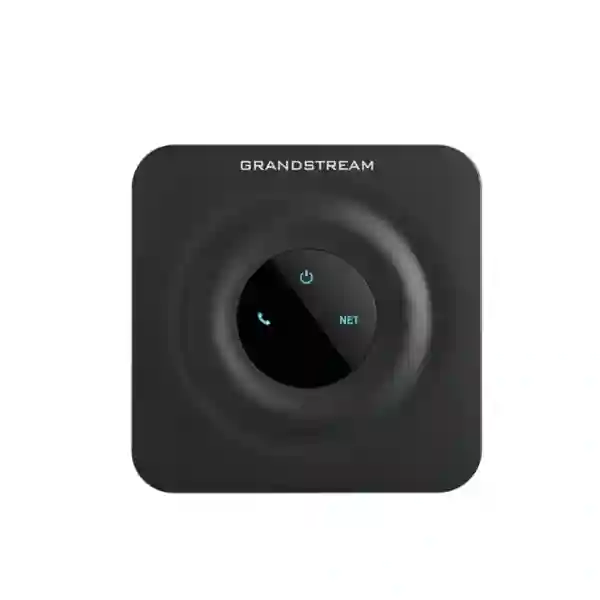
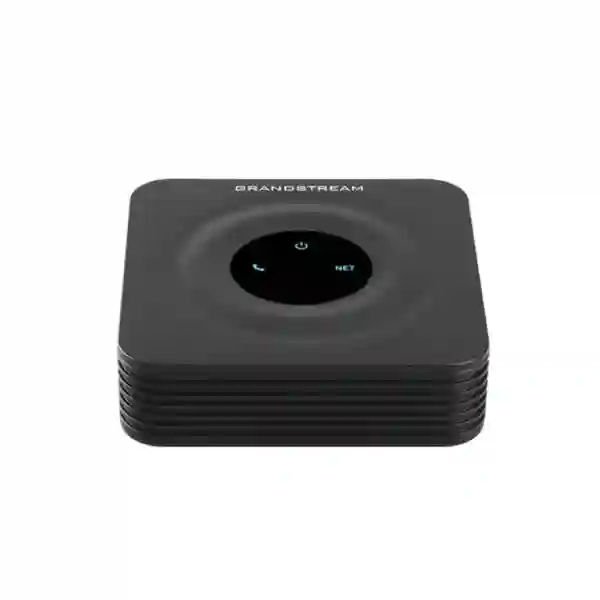
Grandstream HT801 v2 Dubai – 1-Port Analog Telephone Adapter for SIP & VoIP
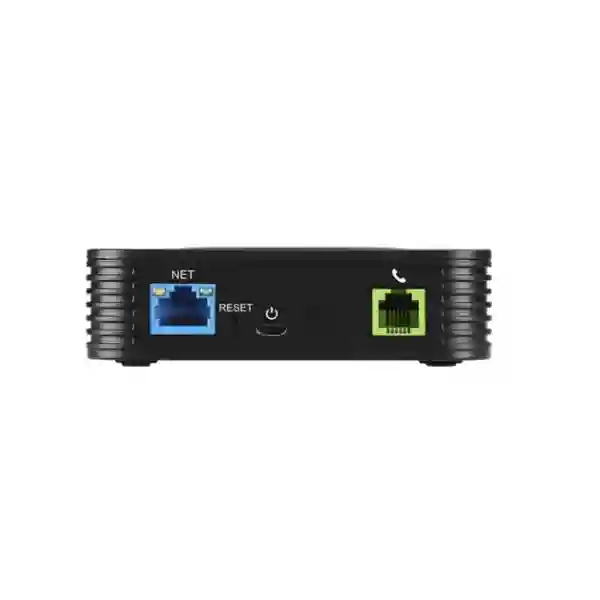
The Grandstream HT801 v2 is a compact one-port analog telephone adapter designed for organizations that need to keep a conventional analog telephone, fax machine, or other compatible analog endpoint while moving the surrounding voice environment to SIP and IP telephony. It provides one RJ11 FXS port for the analog device, one 10/100 Mbps Ethernet interface for the IP network, one SIP profile, T.38 fax support, TLS and SRTP security options, automated provisioning, and Grandstream UCM Zero Configuration support. For businesses in Dubai and across the UAE, the HT801 v2 is especially relevant when only one analog endpoint must be retained at a reception desk, back office, security point, fax station, workshop, branch, or legacy device location without deploying a larger multi-port gateway.
1 × 10/100 Ethernet
T.38 Fax
TLS / SRTP
3-Way Conference

One analog phone or fax machine needs to join a SIP-based voice environment without replacing the endpoint immediately.
The HT801 v2 provides an FXS port for an analog device. It does not provide an FXO port for connecting an incoming analog telephone-company line.
Its single 10/100 Mbps Ethernet port connects the ATA to a router, switch, or modem. The HT801 v2 is not positioned as an integrated NAT router.
Suitable for controlled analog-to-SIP migration, remote branches, single fax retention, legacy handset reuse, and service-provider deployments.
What problem does the HT801 v2 solve?
Many organizations do not move from analog telephony to VoIP in one clean step. A company may deploy a SIP PBX and modern IP phones while still needing one existing analog device at a specific location. That device could be a basic desk handset used by a guard room, a fax machine connected to a business process that has not yet changed, a legacy phone in a warehouse, a reception backup handset, a wall phone in a workshop, or another analog endpoint that remains practical to keep. The HT801 v2 acts as the conversion point between that analog endpoint and the IP voice system. The analog device connects to the FXS interface, while the ATA registers into the SIP environment over Ethernet.
This makes the Grandstream HT801 v2 Dubai use case less about adding a new feature-rich endpoint and more about preserving compatibility during a controlled migration. A business can modernize the PBX, SIP trunking, network, and extension management without forcing every analog endpoint to be replaced at the same time. For a single retained analog device, a one-port ATA can be a cleaner fit than installing a larger gateway with unused interfaces. It also gives IT teams a defined point for SIP registration, security settings, dial-plan control, provisioning, monitoring, and troubleshooting.
The design is particularly useful when the requirement is clear and limited: one analog endpoint, one location, one SIP profile, and a straightforward Ethernet connection. If the project requires multiple analog extensions, PSTN FXO ports, integrated routing, or higher-density analog migration, another model in the Grandstream HT or gateway family may be more suitable. Selecting the correct model at the requirement stage prevents unnecessary cost, cabling complexity, and later replacement.
HT801 v2 quick decision guide
| Requirement | HT801 v2 fit | Buying consideration |
|---|---|---|
| Connect one analog phone to SIP | Strong fit | Confirm SIP server, extension credentials, codecs, VLAN/QoS, and local dial plan. |
| Retain one fax machine | Potential fit | Confirm T.38 support end-to-end and test fax behavior with the SIP provider/PBX. |
| Connect two analog endpoints | Usually not ideal | Consider HT802 v2 with two FXS interfaces. |
| Bring an analog PSTN line into an IP PBX | Not the correct interface type | An FXO gateway is required; the HT801 v2 provides FXS. |
| Need built-in router functions | Not the primary role | Evaluate another HT model with integrated routing if that feature is required. |
| Large analog migration | Better for isolated endpoints | Higher-density FXS gateways may reduce device count and simplify central deployment. |
Verified Grandstream HT801 v2 specifications that matter in real deployments
The most important technical detail is the interface combination. The HT801 v2 has one RJ11 FXS telephone interface and one 10/100 Mbps auto-sensing RJ45 Ethernet interface. It supports one SIP profile. Grandstream lists POWER, NET, and PHONE LED indicators, a factory reset button, and telephony functions including caller ID display or block, call waiting, flash, blind and attended transfer, forwarding, hold, do not disturb, and three-way conferencing. These capabilities are useful because they allow an analog handset to participate in a more modern SIP environment while keeping familiar call-control behavior.
For audio and interoperability, Grandstream documents codecs including G.711, G.722, G.723.1, G.729A/B, G.726-32, iLBC, and OPUS, along with a dynamic jitter buffer and line echo cancellation. Codec selection remains dependent on the PBX, SIP service, network design, and remote endpoint. In practice, administrators should align the ATA codec order with the organization’s voice architecture rather than enabling every option without a reason. Sites with bandwidth constraints, legacy interoperability requirements, or specific service-provider policies may need a different codec priority from an internal LAN-only deployment.
For fax, the HT801 v2 supports T.38 compliant Group 3 fax relay up to 14.4 kbps and can switch to G.711 fax pass-through. This capability is valuable where a business still depends on a fax machine, but successful fax over IP is an end-to-end matter. The ATA alone cannot guarantee fax reliability if the SIP trunk, SBC, PBX, codec handling, network path, or remote side does not properly support the selected method. A proper project should therefore include real fax testing with representative destinations and, where necessary, adjustments to jitter, packetization, echo, codec, or T.38 settings.
For ringing and analog-side reach, Grandstream specifies a 5 REN load and up to 1 km on 24 AWG cabling for the HT801 v2. This can be relevant in villas, warehouses, compounds, workshops, back offices, and facilities where the analog endpoint is not located directly beside the network rack. Cable quality, local wiring topology, connectors, environmental conditions, and the actual analog device still matter, so distance should not be treated as a guarantee for every installation.
Technical specification table
| Analog interface | One RJ11 FXS port |
|---|---|
| Network interface | One 10/100 Mbps auto-sensing Ethernet RJ45 port |
| SIP | One SIP profile |
| Indicators | POWER, NET, PHONE |
| Core telephony | Caller ID, call waiting, transfer, forward, hold, DND, flash, three-way conference and related SIP telephony functions |
| Voice codecs | G.711, G.722, G.723.1, G.729A/B, G.726-32, iLBC, OPUS, plus jitter-buffer and echo-control functions |
| Fax over IP | T.38 Group 3 Fax Relay up to 14.4 kbps; G.711 fax pass-through support |
| Caller ID formats | Bellcore Type 1 & 2, ETSI, BT, NTT and DTMF-based CID |
| DTMF | In-audio, RFC2833 and/or SIP INFO |
| Security | TLS/SIPS/HTTPS control options and SRTP media encryption support |
| Provisioning | TR-069, XML configuration files, HTTP/HTTPS/TFTP and Grandstream management/provisioning capabilities |
| Grandstream PBX integration | UCM series Zero Configuration provisioning support |
| Failover behavior | Can switch to a secondary SIP server if the primary server loses connection |
| Operating temperature | 0°C to 40°C |
| Dimensions | 100 mm × 100 mm × 29.5 mm |

Understanding FXS: the most important buying check
The PHONE interface on the HT801 v2 is FXS. In simple terms, an FXS port is the side that provides an analog extension interface for an analog telephone, fax machine, or compatible analog terminal. This distinction is essential because buyers sometimes assume any “analog adapter” can accept a traditional telecom line from a carrier. That is not the role of the HT801 v2. An incoming analog PSTN line normally requires an FXO interface. If the requirement is to connect an Etisalat/e& analog line, du analog line, hotel PSTN line, elevator line, or another carrier-provided copper line into an IP PBX, the project should be reviewed for a suitable FXO gateway rather than choosing the HT801 v2 by mistake.
For a correct HT801 v2 deployment, think “analog endpoint to SIP.” The analog handset or fax connects to the FXS port, the ATA connects to the IP network through Ethernet, and the device registers to a SIP platform such as a Grandstream UCM PBX, hosted PBX, compatible SIP server, or other supported voice platform. That simple mental model prevents one of the most common procurement errors in analog voice projects.
Where the HT801 v2 fits in a Dubai office voice migration
A typical Dubai migration may involve replacing an aging PBX, moving from proprietary digital extensions to SIP, consolidating branches, introducing a Grandstream UCM platform, changing SIP trunk architecture, or standardizing IP phones. Even when most users receive new IP endpoints, a few analog devices can remain for practical reasons. The HT801 v2 gives the project team a way to isolate one of those exceptions without redesigning the entire solution around legacy wiring.
For example, a reception area might have a modern IP phone for normal operation but retain a basic analog handset in a secondary room. A warehouse may have one wall-mounted analog phone that is difficult to replace immediately. A finance team may still need a fax machine while the rest of the office moves to SIP. A security control room may use a rugged analog handset in a location where a full IP phone is unnecessary. In each case, the decision should be based on the endpoint requirement, SIP compatibility, network availability, power, analog cabling condition, and operational continuity rather than on a blanket rule that all analog equipment must disappear.
Security capabilities and what IT teams should configure
Grandstream supports TLS for SIP signaling and SRTP for media encryption on the HT801 v2. These capabilities can help protect call control and voice traffic when the surrounding SIP infrastructure is configured to use them. Security should still be treated as a system property, not a checkbox on the ATA. The PBX or hosted platform, certificates, credentials, firewall policy, VLAN design, remote access method, provisioning server, DNS, firmware, and administrator password practices all affect the final security posture.
In a business network, Fourteck generally recommends separating voice logically where the architecture supports it, applying appropriate VLAN and QoS policy, restricting device management to trusted networks, using secure provisioning methods, changing default administrative credentials, disabling services that are not required, and keeping firmware aligned with the vendor’s supported release path. SIP credentials should be treated like other production secrets. They should not be reused across unrelated endpoints, published in documentation, or exposed to guest networks.
The HT801 v2 also supports failover SIP server behavior. When configured with a secondary SIP server, it can switch if the main server connection is lost. Whether that creates true business continuity depends on the PBX architecture, DNS, WAN path, authentication, extension database, SIP trunking, firewall policy, and the ability of the secondary server to handle the same account. Buyers should therefore distinguish between “device supports secondary server failover” and “the total voice service is fully redundant.”
Provisioning and fleet management
A single ATA can be configured manually, but the value of automated provisioning becomes more important when an organization operates many branches, many customer sites, or a service-provider environment. Grandstream documents TR-069 and XML configuration-file provisioning for the HT801 v2, along with web-based management and other standard provisioning methods. This allows administrators to standardize configuration parameters instead of relying on repeated manual setup.
When the HT801 v2 is used with a Grandstream UCM series IP PBX, Grandstream also supports Zero Configuration provisioning. This can simplify discovery and deployment in a controlled Grandstream environment. The exact workflow depends on the UCM model, firmware, network topology, and security settings. Zero Config should not be treated as a replacement for planning; the team still needs to define extension numbers, authentication, codecs, caller ID, dial plans, DTMF behavior, VLAN/QoS, firmware policy, and any regional telephony settings.
For service providers and managed voice teams, repeatability is often more important than the one-time setup speed. A documented template can define how the ATA should register, which servers it should trust, which codecs should be preferred, how it should recover after a WAN failure, how it should reach NTP and DNS, where it sends logs, how configuration changes are approved, and what firmware is considered production-ready. That disciplined approach makes a small device easier to support across a larger estate.
Installation flow for an HT801 v2 deployment
Verify that the endpoint is an analog phone or fax device and that one FXS port is sufficient.
Provide Ethernet connectivity to the router or switch and confirm DHCP/static-IP, VLAN, DNS, NTP, and firewall requirements.
Use the RJ11 FXS interface for the analog handset or fax and verify the cabling condition and ring load.
Configure the SIP server, account, authentication, transport, codecs, DTMF and dial-plan parameters.
Test inbound and outbound calling, caller ID, transfer, hold, DTMF, voicemail indication and failure recovery.
Test representative destinations with T.38 or the planned fax method instead of assuming fax compatibility from the ATA alone.
Call quality: the ATA is only one part of the path
The HT801 v2 includes modern voice-processing features, but call quality depends on the complete path between the analog endpoint and the far end. An analog handset introduces its own microphone, speaker, wiring, impedance, and acoustic characteristics. The ATA digitizes the voice and sends it through the LAN. The switch and router apply queuing and forwarding. The firewall may perform NAT. The WAN or Internet connection adds latency, loss, and jitter. The SIP provider or PBX then processes the session before the call reaches another endpoint. A well-designed deployment considers all of these elements rather than attributing every voice symptom to the ATA.
For office use, the network should avoid unnecessary packet loss and congestion. Voice VLANs and QoS can help when they are implemented consistently across switches, routers, firewalls, and WAN services. A QoS marking applied only at the ATA is not useful if every upstream device ignores or rewrites it. Similarly, a high-quality codec cannot compensate for severe packet loss or an overloaded Internet connection. If the customer uses hosted PBX services, the path from the office to the service provider should be included in testing.
Troubleshooting should be systematic: check registration status, IP addressing, DNS resolution, SIP responses, RTP flow, NAT behavior, codec negotiation, DTMF method, packet loss, jitter, analog wiring, and the endpoint itself. Because the HT801 v2 is a focused device with clear interfaces, it can be easier to isolate problems when the surrounding network is documented properly.
Fax over IP with the HT801 v2
Fax is one of the strongest reasons organizations continue to deploy analog telephone adapters. The HT801 v2 supports T.38 fax relay and G.711 fax pass-through, giving the system designer more than one possible method. T.38 is specifically designed to transport fax over packet networks and can be more resilient than treating fax tones as ordinary voice. However, the entire path must support the chosen mode. If the SIP provider does not support T.38, if a session border controller changes the negotiation, or if the far-end route behaves differently, results can vary.
A business that depends on fax for contracts, healthcare workflows, government forms, finance processes, logistics, or supplier documentation should test more than a single page to one number. A practical acceptance test includes inbound and outbound fax, multi-page documents, different destinations, repeated attempts, and busy/error scenarios. If the customer regularly sends long or graphic-heavy documents, those should be part of validation. The goal is to confirm the real operational workflow rather than merely proving that the fax machine can dial.
It is also worth reviewing whether fax remains the right business process. Some organizations use the HT801 v2 as a transition tool while moving toward secure digital document exchange. In that situation, the ATA can preserve continuity during migration without committing the company to permanent analog dependence.
HT801 v2 vs HT802 v2: choose by analog endpoint count
The simplest comparison is port count. The HT801 v2 provides one FXS port and one SIP profile. The HT802 v2 provides two FXS ports and supports two SIP profiles. If the site has one analog phone or one fax device, the HT801 v2 is usually the cleaner fit. If two analog devices at the same location need separate SIP registrations, the HT802 v2 can reduce hardware count and power adapters. The decision should be based on both present and near-term endpoint requirements.
Avoid choosing a two-port model only because it is “bigger” if the second port will never be used, but also avoid installing two separate one-port ATAs in the same cabinet when a two-port model would simplify the design. For branch standardization, some organizations intentionally use the same two-port model everywhere to keep a spare interface available; others optimize each location individually. Fourteck can help map the analog endpoint inventory before the model selection is finalized.
HT801 v2 vs higher-capacity Grandstream analog adapters
Grandstream offers multiple HT models, and the correct choice depends on the analog-port count, Ethernet design, and whether integrated routing is required. The HT801 v2 and HT802 v2 are focused on one and two FXS endpoints with a single 10/100 Mbps Ethernet connection. Other HT81x v2 models increase the number of FXS ports and include dual Gigabit Ethernet interfaces with routing functionality. That makes them more appropriate for locations where the ATA is expected to serve multiple analog devices or play a broader network role.
For large hotels, campuses, residential towers, hospitals, factories, and institutions with many legacy analog extensions, installing a separate HT801 v2 for every endpoint can create unnecessary device sprawl. A high-density FXS gateway may be easier to rack, power, configure, monitor, and maintain. Conversely, a high-density gateway can be excessive when only one remote analog device exists in a small branch. Good design minimizes total operational complexity, not merely purchase price.
If the requirement involves incoming analog PSTN lines rather than analog endpoints, an FXO gateway should be considered. This is a different design problem. The presence of an RJ11 connector does not make FXS and FXO interchangeable. Fourteck recommends documenting whether each analog cable is connected to a device or to a carrier line before selecting gateway hardware.
Use cases by industry
Hotels & hospitality
Useful when a specific back-office, service, or utility location retains one analog handset while the main property voice system moves toward SIP. Guest-room estates usually need a broader analog gateway plan rather than many isolated one-port ATAs.
Retail & restaurants
A small branch may retain one analog device at a service counter, store room, or back office while the manager and customer-facing teams use IP phones.
Warehouses & logistics
Suitable for a single analog handset in a loading bay, workshop, inventory room, or legacy wiring location where a full IP endpoint is not immediately required.
Professional offices
Useful for retaining one fax machine or analog phone during a PBX migration, particularly when the rest of the office has already standardized on SIP endpoints.
Schools & training centers
Can bridge a remaining analog phone in a lab, maintenance room, reception sub-area, or security location into a central IP voice platform.
Healthcare & clinics
May support carefully selected analog endpoints where replacement is impractical, subject to the facility’s reliability, security, compliance, and workflow requirements.
Dubai, Abu Dhabi, Sharjah and wider UAE deployment considerations
Dubai: Branch-heavy organizations, hospitality operators, warehouses, retail chains, clinics, schools, professional offices, and small businesses commonly run mixed voice estates. The HT801 v2 can be used at a location where one analog device remains after a SIP migration. Project planning should verify PBX location, WAN design, SIP provider, VLAN/QoS policy, and whether the analog endpoint needs fax, caller ID, DTMF, or special dialing behavior.
Abu Dhabi: Larger enterprises and institutional environments often apply stricter network segmentation, documentation, change control, and redundancy standards. In those environments, a small ATA should still be treated as a managed production endpoint. Configuration backups, firmware control, secure provisioning, account lifecycle, monitoring, and failover planning should be included in the voice operations process.
Sharjah, Ajman and Northern Emirates: Manufacturing, trading, education, healthcare, warehousing, and SME sites may retain analog endpoints because cabling already exists or a particular device remains functional. The HT801 v2 is practical when Ethernet is available near the ATA and the analog device can connect through a suitable RJ11 path. Long analog runs should be tested rather than assumed to be perfect simply because they fall within a headline distance specification.
Multi-emirate businesses: A standardized ATA template can reduce support effort when branches use the same PBX, SIP provider, dial plan, and security policy. However, standardization should not override site-specific requirements. A branch with two analog endpoints may be better served by a two-port ATA, while a site with many analog rooms may justify a centralized FXS gateway.
GCC and Africa project context
The HT801 v2 can also fit projects outside the UAE where a customer is modernizing telephony while retaining individual analog endpoints. In Kuwait and other GCC markets, a branch may keep one analog phone or fax device while standardizing the core system on SIP. In Uganda, Kenya, Tanzania, Ghana, and Nigeria, mixed estates are also common when businesses expand site by site and reuse existing analog devices during gradual upgrades. The same engineering principle applies: confirm whether the requirement is FXS, confirm network and SIP compatibility, and choose the ATA size according to endpoint count.
Cross-region procurement should also account for power, local telecom rules, carrier/SIP-provider support, installation practices, firmware policy, warranty route, and the customer’s support model. Fourteck can help customers compare a one-port ATA with other Grandstream gateway options as part of a wider unified communications project rather than treating the adapter as an isolated accessory.
Network checklist before commissioning
- Confirm the ATA receives a valid IP address and can reach the SIP server, DNS, NTP, and required provisioning resources.
- Verify whether the site uses DHCP reservation or static addressing and document the chosen method.
- Confirm voice VLAN tagging and QoS requirements. Avoid applying values that conflict with switch or firewall policy.
- Check NAT behavior for hosted SIP deployments, especially when SIP ALG or aggressive firewall rewriting is present.
- Confirm SIP transport requirements such as UDP, TCP, or TLS and align them with the PBX/service-provider configuration.
- Verify the correct DTMF method for IVRs, call queues, banking menus, door systems, and other tone-sensitive applications.
- Apply secure management credentials and limit administrative access to trusted networks wherever practical.
- Record firmware, configuration template, extension details, MAC/device identity, and site location for ongoing support.
- Test behavior after power loss, Internet loss, PBX restart, SIP-server failover, and network changes that are relevant to the customer’s continuity plan.
Firmware lifecycle and maintenance
Grandstream maintains firmware for the HT801 v2 and publishes release information through its support resources. Firmware should be managed deliberately. Organizations should not upgrade production voice endpoints simply because a new version appears, but they should also avoid leaving devices permanently on unreviewed old releases. A sensible approach is to monitor vendor advisories, review release notes, validate important changes in a test unit or pilot site, and deploy according to the organization’s maintenance policy.
Grandstream documentation includes an important downgrade warning for the HT8xx v2 family: after upgrading to firmware 1.0.9.3 or later, downgrading to 1.0.7.5 or earlier is not supported because of CPU frequency adjustments. This is a good example of why firmware changes should be planned rather than treated as reversible by default. Teams should document the starting version, target version, backup configuration, maintenance window, and rollback limitations before a large rollout.
Maintenance also includes more than firmware. SIP credentials can expire or change, PBX addresses can move, certificates can need renewal, VLANs can be redesigned, DNS may change, or a service provider can adjust its requirements. The ATA configuration should therefore be part of the broader voice-system documentation and change-management process.
Common design mistakes to avoid
If the cable comes from a carrier’s analog line, an FXO interface is typically required. HT801 v2 is for an analog endpoint.
T.38 support is important, but real fax reliability must be validated end-to-end with the PBX and SIP provider.
Old cables, splitters, joints, moisture, and poor terminations can create symptoms that look like an IP problem.
Production SIP credentials, management access, provisioning, and firmware policy should be managed intentionally.
One isolated analog endpoint fits the HT801 v2; multiple endpoints may justify another model or centralized gateway.
Secondary SIP server support helps, but true continuity depends on the whole voice and network architecture.
Procurement checklist for Grandstream HT801 v2 Dubai projects
Before requesting a quotation, provide the number of analog endpoints, device type, PBX or hosted platform, branch locations, SIP provider, required quantity, intended use of fax, network topology, installation requirement, and any support expectations. This information helps determine whether the HT801 v2 is the correct model and whether related services or a different gateway should be considered.
For larger orders, it is also useful to define whether the devices need preconfiguration, labeling, standardized firmware, configuration templates, branch-specific extension details, rollout documentation, or remote support. A project with fifty one-port ATAs across fifty remote sites has a very different operational model from a single ATA used in one Dubai office, even though the hardware model is the same.
Fourteck does not recommend choosing based only on a headline price. The right comparison includes port count, management effort, compatibility, support model, installation time, expected service life, and whether the device fits the future telephony roadmap. Request current commercial information directly because pricing, lead time, and availability can change by quantity, region, and distribution conditions.
When should you avoid the HT801 v2?
Avoid choosing the HT801 v2 when the primary requirement is to connect an incoming analog carrier line, because that is an FXO requirement. Avoid it when a site clearly needs several analog endpoints and a higher-density gateway would simplify the deployment. Avoid treating it as a router when the project specifically needs integrated network routing. Avoid using it as the only continuity strategy for a critical voice service without reviewing PBX, WAN, power, SIP trunk, and secondary-server design.
Also reconsider the ATA approach when the analog endpoint itself is near end of life. Sometimes replacing an old analog handset or fax-dependent workflow with a modern IP endpoint or digital process produces a cleaner result than adding conversion hardware. The purpose of an ATA is to preserve a useful analog requirement, not to preserve every legacy device indefinitely.
Why work with Fourteck for an HT801 v2 deployment?
Fourteck approaches the HT801 v2 as part of the customer’s voice architecture rather than as an isolated box. The first question is what the customer is trying to retain or connect. From there, the design can confirm FXS versus FXO, SIP account requirements, PBX compatibility, network readiness, fax requirements, security, provisioning, branch topology, and whether one port is enough. That requirement-led process reduces the risk of ordering the wrong gateway type.
Customers planning a Grandstream environment can also review related IP PBX, IP phone, switching, Wi-Fi, network security, and support requirements so the voice path is designed consistently. For multi-site customers, Fourteck can help define a standard deployment method while still adapting to branch-specific requirements. For customers replacing older systems, the migration plan can identify which analog endpoints should be retained, which should be replaced, and which can be removed entirely.
For a quotation, confirm the required quantity, project location, intended analog device, PBX/SIP platform, installation requirement, and whether you need configuration or rollout support. Current price and availability should be confirmed at the time of inquiry rather than assumed from older online listings.
Related Fourteck resources
For broader UAE technology procurement and integration, visit Fourteck UAE. For IP telephony, PBX, endpoint, gateway, and communication-system planning, explore Fourteck IP Phone solutions. Customers with wider unified communications or PBX requirements can also review IP PBX solutions in Dubai.
Regional organizations can use the Fourteck network for relevant market coverage, including Uganda, Kenya, Kuwait, Tanzania, Ghana, and Nigeria. Regional availability, product variants, compliance, pricing, and support scope should always be confirmed for the specific project.
Frequently asked questions
What is the Grandstream HT801 v2 used for?
It is a one-port analog telephone adapter used to connect one compatible analog phone or fax device to a SIP-based VoIP environment through an Ethernet network.
Does the HT801 v2 have an FXS or FXO port?
It has one FXS port. That means it is intended for an analog endpoint such as a phone or fax machine. It is not the correct device for directly receiving an analog PSTN carrier line, which normally requires FXO.
How many SIP profiles does the HT801 v2 support?
Grandstream specifies one SIP profile for the HT801 v2, matching its single FXS-port design.
Can the HT801 v2 be used with a fax machine?
Yes. It supports T.38 Group 3 fax relay and G.711 fax pass-through. Actual fax reliability depends on the PBX, SIP provider, network, configuration, and remote destination, so end-to-end testing is recommended.
Does the HT801 v2 support secure SIP?
It supports TLS/SIPS options for signaling and SRTP for media encryption. The complete SIP platform and network must also support and be configured for secure operation.
Can it work with a Grandstream UCM IP PBX?
Yes. Grandstream lists UCM series Zero Configuration provisioning support for the HT801 v2, subject to the UCM model, firmware, network, and configuration.
What is the difference between HT801 v2 and HT802 v2?
The HT801 v2 provides one FXS port and one SIP profile. The HT802 v2 provides two FXS ports and is intended for two analog endpoints. Choose according to the number of devices that need SIP connectivity at the same site.
Does the HT801 v2 include a Gigabit Ethernet port?
No. Grandstream specifies one 10/100 Mbps auto-sensing Ethernet port for the HT801 v2.
Does the HT801 v2 act as a router?
The HT801 v2 is a one-port ATA with a single Ethernet connection and is not positioned as an integrated NAT router. Some higher HT81x v2 models include dual Gigabit ports and routing functions.
Can I use the HT801 v2 for a long analog cable run?
Grandstream specifies a 5 REN ring load and up to 1 km on 24 AWG cabling. Real installations should still be tested because cable quality, joints, topology, and endpoint characteristics affect performance.
Can Fourteck supply the HT801 v2 in Dubai and the UAE?
Fourteck can support product selection and quotation requests for UAE projects. Current price, stock, lead time, warranty route, and commercial terms should be confirmed at the time of inquiry because they can change.
Request a Grandstream HT801 v2 Dubai quotation
Send Fourteck your required quantity, project location, analog endpoint type, PBX or SIP platform, and whether you need installation, configuration, or migration assistance. We can help confirm whether the HT801 v2 is the right one-port ATA or whether another Grandstream analog gateway better matches the project.
Technical information on this page is based on Grandstream’s HT801 v2 product documentation and administration/user guides reviewed for this content. Feature behavior can depend on firmware, SIP platform, service provider, regional requirements, and configuration. Confirm compatibility and current commercial details before ordering.

Reviews
There are no reviews yet.