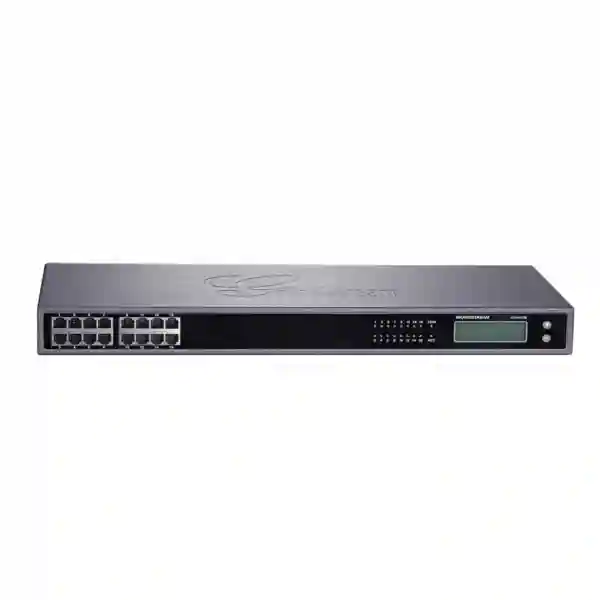
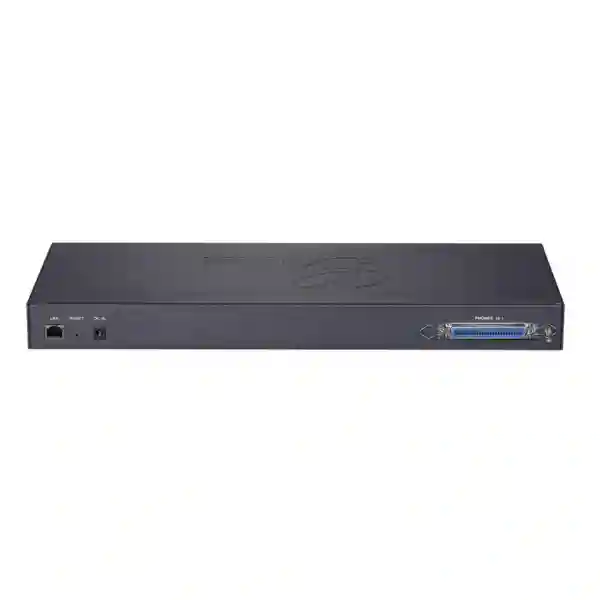
Grandstream GXW4216 V2 Dubai: 16-Port FXS Gateway for Analog-to-SIP Migration
The Grandstream GXW4216 V2 is a high-density FXS VoIP gateway built for organizations that want to preserve useful analog telephones, fax devices, or legacy analog PBX extensions while moving voice services toward a SIP-based environment. It provides 16 FXS interfaces, 16 SIP accounts across four configurable SIP profiles, Gigabit Ethernet connectivity, flexible dial plans, T.38 fax support, and security mechanisms such as TLS and SRTP. For businesses evaluating Grandstream GXW4216 V2 Dubai deployments, the most important question is not simply whether the gateway has enough ports. The practical decision is whether 16 analog endpoints need to remain in service, how those endpoints will register or route through the chosen IP PBX or SIP platform, what fax and caller-ID behavior must be preserved, and how the deployment will be managed after installation.
Fourteck can help organizations plan the gateway around endpoint count, SIP architecture, network readiness, analog cabling, migration stages, and future expansion. Pricing, stock, lead time, and project scope can vary, so these should be confirmed against the exact deployment requirement rather than assumed from a generic product listing.
Connect up to sixteen compatible analog telephone endpoints through the gateway.
Segment registration and routing requirements across configurable SIP server profiles.
A 10/100/1000 Mbps RJ45 interface connects the gateway to the IP network.
Useful where compatible fax-over-IP operation remains part of the migration requirement.
What problem does the GXW4216 V2 solve?
Many organizations still have analog devices that remain operational even after the core phone system, SIP trunk, or communications platform has moved to IP. Replacing every analog endpoint at once can be unnecessary, disruptive, or operationally inconvenient. The GXW4216 V2 creates a controlled bridge between those analog endpoints and a SIP-based network. Each FXS port supplies an analog station interface, while the gateway handles SIP registration, call routing, codec negotiation, signaling, and management on the IP side.
That architecture is especially relevant when a site has a block of analog room phones, warehouse phones, reception extensions, existing fax equipment, simple desk handsets, or a legacy PBX environment that is being migrated in stages. The gateway allows the business to modernize the back-end communications layer without forcing an immediate replacement of every analog endpoint. It can also help centralize analog devices under a SIP platform where routing, numbering, and remote management are handled more consistently.
Choose the GXW4216 V2 when the project genuinely requires a 16-port FXS gateway. If most endpoints can be replaced by native IP phones, a direct IP endpoint design may be simpler. If the requirement is to connect analog PSTN lines into an IP system, the project needs an FXO-oriented gateway rather than an FXS-only device.
Verified GXW4216 V2 technical facts
| Area | GXW4216 V2 capability | Why it matters |
|---|---|---|
| Analog interfaces | 16 FXS ports; 16 RJ11 ports plus one 50-pin RJ21/Telco connector | Supports high-density analog endpoint integration and structured analog cabling options. |
| SIP provisioning | 16 SIP accounts and four configurable profiles | Allows per-port account mapping and multiple SIP profile designs. |
| Network | 10/100/1000 Mbps RJ45 | Connects the analog gateway to a modern switched LAN. |
| Concurrent calls | Up to 16 concurrent calls, with vendor documentation noting an exception when SRTP is used | Capacity planning should account for encryption and real call behavior. |
| Voice codecs | G.711, G.722, G.723.1A, G.726, G.729 and iLBC support documented for the series | Provides codec options for interoperability, bandwidth planning and legacy integration. |
| Fax | T.38 fax support | Useful for compatible fax workflows that need to remain during VoIP migration. |
| Voice processing | G.168 echo cancellation, dynamic jitter handling, VAD, CNG and packet-loss concealment | Helps the gateway handle common real-world VoIP voice conditions. |
| Security | SIPS/TLS and SRTP capabilities, with V2-specific security and firmware behavior | Important for protected signaling, media and lifecycle management. |
| Display | 128 × 32 pixel LCD | Provides local device information for installation and support tasks. |
| Mounting | Desktop and rack mounting supported | Fits communications-room, rack, branch and distributed deployment designs. |
Technical behavior can vary with firmware, SIP platform, codec selection, network policy and endpoint characteristics. Project-specific compatibility should be validated before deployment.
Why the V2 distinction matters
The “V2” label is operationally significant. Grandstream documents that GXW42xx V2 devices use a different firmware file from V1 hardware. A V2 unit can be identified by the model label showing “V2,” and the V2 label also includes a device password. This distinction should be checked before firmware work, replacement planning, configuration restoration, or lifecycle support because using the wrong firmware path can create avoidable deployment risk.
Grandstream also documents downgrade restrictions for V2 firmware generations. For example, once a GXW42xx V2 device has been upgraded to firmware 1.0.7.2, it cannot be downgraded to 1.0.5.4 or earlier because of the addition of second-generation individual certificates. The safest operational approach is to identify the hardware revision, review the current vendor release notes, back up the configuration where appropriate, and follow the exact vendor upgrade path rather than treating the gateway as an older GXW4216 V1 device.
For a managed business rollout, firmware control should be part of change management. A configuration that works on one revision or firmware train should not automatically be assumed to behave identically on another unit without validation.
How to decide whether 16 FXS ports are the right size
Port count should be based on the number of analog endpoints that must remain connected on day one, the expected growth or consolidation plan, and whether spare capacity is operationally useful. Buying a gateway with exactly the current number of connected devices can be efficient, but it may leave no room for temporary extensions, phased migration, additional fax devices, or expansion. Buying a much larger gateway can create unused capacity without improving the architecture. The GXW4216 V2 is therefore most attractive when the real requirement falls naturally around a 16-port block.
| Model family choice | FXS capacity | Typical selection logic |
|---|---|---|
| GXW4216 V2 | 16 ports | Compact high-density analog migration where a 16-port block fits the endpoint count. |
| GXW4224 V2 | 24 ports | Larger floor, branch or property deployments that need more analog stations in one gateway. |
| GXW4232 V2 | 32 ports | Higher-density migrations where consolidating more analog endpoints reduces gateway count. |
| GXW4248 V2 | 48 ports | Very high-density analog requirements, with RJ21-centric connectivity rather than front-panel RJ11 ports. |
The right choice is not always the largest model. Rack space, analog patching, failure-domain design, spare capacity, operational support and future migration plans should all influence the decision. Some organizations prefer two smaller gateways for segmentation or resilience of endpoint groups; others prefer one larger chassis for simplified cabling and administration.
Deployment patterns for Dubai and UAE organizations
Phased PBX migration
A company moves its call control to a SIP-based PBX but keeps a set of existing analog phones during the transition. The GXW4216 V2 becomes the station-side analog bridge while numbering, routing and migration are completed in phases.
Hospitality and property operations
Where compatible analog room or service phones remain operational, a high-density FXS gateway can preserve endpoints while the central communications platform moves toward SIP. Cabling, numbering and PBX feature requirements should be mapped before cutover.
Warehouse and back-office phones
Simple analog endpoints in warehouses, stores, workshops or back-office areas can remain connected while the organization standardizes the IP network and SIP call-control layer.
Fax retention during VoIP transition
Where fax remains a business requirement, T.38 support provides an option for compatible fax-over-IP designs. The end-to-end SIP trunk, PBX and provider path must also support the intended fax method.
For Grandstream GXW4216 V2 Dubai projects, site-level planning is important because analog cabling may terminate in a communications room while the SIP infrastructure is distributed through VLANs, managed switching and centralized IP-PBX resources. The gateway should be treated as part of the voice architecture, not merely as a converter placed between two cables.
Network and SIP planning checklist
A stable FXS gateway deployment depends on more than analog port configuration. The LAN, SIP platform and numbering plan have to be prepared together. Before installation, confirm the following items as part of the project design:
- IP addressing: determine DHCP or static addressing policy, gateway placement and management access rules.
- Voice VLAN: decide whether the gateway belongs in a dedicated voice or communications VLAN and confirm switch-port configuration.
- QoS: align Layer 2/Layer 3 QoS treatment with the broader voice network so signaling and RTP are handled consistently.
- SIP profiles: map the four available SIP profiles to the PBX, provider, branch or routing structure that is actually required.
- Per-port identity: assign SIP user IDs, authentication credentials, port names and routing behavior according to the numbering plan.
- Dial plan: define local extension behavior, external dialing format, prefixes, emergency-number policy and prohibited patterns according to organizational requirements and applicable rules.
- NAT and firewall: ensure SIP/RTP behavior is designed correctly. Avoid arbitrary port forwarding without understanding the PBX, SBC and security architecture.
- Time and logging: configure time synchronization, syslog and monitoring requirements so support teams can diagnose registration or call-quality issues.
Analog-side planning: cabling, REN and endpoint behavior
The IP side may be modern, but the attached station side remains analog. That means deployment quality still depends on analog cabling condition, distance, connectors, ring requirements and endpoint behavior. Grandstream documents a fixed on-hook voltage and support for short-haul analog loops, with the series hardware documentation listing 2 REN and up to 2 km on 24 AWG wire. Real sites should still be assessed individually because cable quality, joints, interference, attached devices and local installation practices affect results.
The GXW4216 provides 16 RJ11 ports and one 50-pin RJ21/Telco connector. RJ11 ports can be convenient for direct patching and testing, while the RJ21 interface can be useful when the site already uses structured multi-pair telephony cabling. Documentation should record which physical pair maps to which FXS port and which SIP identity belongs to that port. That mapping becomes essential during troubleshooting, moves and changes.
Analog endpoints should also be checked for caller-ID expectations, message-waiting behavior, flash timing, ring patterns, polarity behavior, DTMF method and any special device requirements. A basic handset may work with minimal tuning, while fax machines, legacy PBX interfaces or specialty analog endpoints can require more careful validation.
Voice quality: what the gateway can control and what the network must provide
The GXW42xx platform includes voice-processing capabilities such as G.168 echo cancellation, jitter buffering, voice activity detection, comfort-noise generation and packet-loss concealment. These functions are useful, but they cannot compensate for a poorly designed IP network. Latency, packet loss, jitter, congestion, asymmetric routing and misconfigured QoS can still affect calls.
Codec selection also matters. G.711 can provide straightforward interoperability but consumes more bandwidth than compressed codecs. Other supported codecs can reduce bandwidth or meet platform-specific requirements, but every endpoint in the call path must negotiate a compatible codec. In multi-site or WAN deployments, bandwidth calculations should include concurrent call assumptions, RTP overhead, encryption overhead and other network traffic rather than using codec payload alone.
A useful acceptance test should include internal calls, inbound and outbound external calls, DTMF through IVR systems, transfer, hold, caller ID, call waiting, representative long-duration calls, peak concurrency and failover behavior where configured. Voice quality should be tested from the actual analog endpoint, not only from the SIP server side.
Fax over IP: use T.38 as part of an end-to-end design
T.38 support is an important reason some organizations retain an FXS gateway even after most users move to IP phones. However, fax reliability is an end-to-end issue. The analog fax device, the GXW4216 V2, the IP-PBX or SBC, the SIP trunk and the remote side all influence the outcome. A gateway cannot force a provider or remote system to support T.38 correctly.
When fax is business-critical, test the exact path and document the fallback method. Confirm whether the environment will use T.38, G.711 pass-through, or another approved method. Validate several page lengths and representative destinations. If fax traffic is frequent or legally sensitive, consider whether a dedicated electronic fax platform is operationally more suitable than maintaining analog fax hardware.
Security and management considerations
A voice gateway is a networked communications device and should be managed accordingly. Grandstream documents TLS/SIPS and SRTP capabilities for protected SIP signaling and media, together with HTTPS-oriented management and V2 security changes. Security features should be enabled in a way that matches the PBX, certificate environment and operational policy; turning on encryption without validating server support can prevent registration or calling.
Change the default administrative access workflow according to current vendor guidance, restrict management reachability, use strong unique credentials, and avoid exposing the management interface directly to the public internet. Where remote administration is required, use an approved secure management path, VPN, management network or supported cloud-management method rather than casual WAN exposure.
Provisioning also deserves attention because it can change many ports at once. Use trusted HTTP/HTTPS or supported automated provisioning mechanisms with controlled configuration sources. Back up known-good configurations and maintain a change record. If a firmware or configuration update is applied across multiple gateways, test on a representative unit before broad rollout.
The latest Grandstream firmware documentation should be checked before any upgrade. The V2 hardware uses its own firmware image and has documented downgrade restrictions, so firmware maintenance should be deliberate rather than automatic or improvised.
SIP profiles, port routing and multi-tenant or multi-group designs
The GXW4216 V2 supports 16 SIP accounts and four profiles. That distinction is useful because the gateway can group ports by profile while still assigning individual SIP identities. In a straightforward office, all ports may use one PBX profile. In a more segmented environment, different endpoint groups may require separate SIP server profiles, routing rules or authentication policies.
Grandstream documentation for V2 firmware also includes Routing ID behavior for directing incoming SIP calls to specific FXS ports based on matching logic such as the Request URI or To header. This is valuable in integrations where the upstream SIP platform controls called-number routing differently from a simple one-account-per-port registration model. The exact method should be chosen based on the PBX or softswitch design.
Hunting groups can also be relevant where several analog endpoints share a call-distribution requirement. Before enabling a hunting design, confirm how unanswered calls, busy conditions, voicemail, call forwarding and caller ID should behave. The most technically possible configuration is not always the easiest configuration to support.
When the GXW4216 V2 is a strong fit
Keep compatible existing analog endpoints while migrating call control and trunks to SIP.
Match a practical endpoint count without moving immediately to a 24-, 32- or 48-port chassis.
Bring scattered analog station lines into a managed SIP and IP-network architecture.
Move services gradually rather than forcing a single disruptive endpoint-replacement event.
When to choose a different architecture
The GXW4216 V2 is not the correct answer for every voice project. A native IP phone deployment may be cleaner if all users need modern endpoint features such as programmable keys, visual directories, presence, richer call control and direct network provisioning. An FXO gateway is required when the design must terminate analog PSTN lines rather than provide analog station ports. A smaller ATA may be more economical when only one or two analog endpoints remain.
Similarly, if the current site has 20 or more analog endpoints that are likely to remain for years, selecting the 24-, 32- or 48-port member of the GXW42xx family can reduce chassis count and patching complexity. If the migration plan will retire half the analog phones within weeks, a smaller or staged design may make more sense than sizing for a short-lived peak.
Fourteck’s role in a project should therefore start with requirement mapping: number of analog devices, endpoint type, PBX platform, SIP trunk model, site cabling, network readiness, security policy, business continuity expectations and future roadmap.
UAE deployment considerations: Dubai, Abu Dhabi and Sharjah
UAE organizations often operate mixed environments: a modern IP network and centralized communications platform may coexist with analog endpoints in older office areas, warehouses, villas, hotels, retail spaces or legacy equipment rooms. In Dubai, a gateway may be installed in an MDF/IDF or communications rack while analog extensions remain distributed through existing copper pairs. That makes labeling, patching and documentation essential. The deployment should record the FXS port, analog pair, physical destination, SIP extension and responsible department for every connection.
For Abu Dhabi enterprise or multi-site projects, WAN design and centralized PBX reachability can be as important as the local gateway. If branches register back to a central SIP platform, routing, QoS, VPN or SBC design, DNS, time synchronization and failover should be tested across the actual WAN path. In Sharjah industrial and warehouse environments, analog cable condition and distance may need special attention, especially when endpoints are far from the communications rack.
A quotation for Grandstream GXW4216 V2 Dubai should therefore be based on more than the gateway itself. Depending on the project, required items may include patching, rack placement, network configuration, SIP/PBX configuration, endpoint testing, numbering-plan work, firmware checks and documentation. Product availability and commercial terms should be confirmed at the time of enquiry.
Regional projects across GCC and Africa
The same analog-to-SIP migration logic can apply to projects in Kuwait, Uganda, Kenya, Nigeria and Tanzania, but network and site conditions can vary significantly. Some organizations prioritize centralized management across branches, while others need a self-contained site design because WAN links are less predictable. In either case, the gateway should be sized and configured around local endpoint count, IP-PBX reachability, SIP provider behavior, power conditions, analog cabling and the support model available to the site.
For distributed businesses, a repeatable configuration template can simplify operations, but it should not erase site-specific differences. Extension ranges, local dialing rules, SIP trunks, WAN addressing, failover, emergency dialing requirements and endpoint types may differ. A central template should define common security, logging and provisioning standards while allowing controlled per-site settings.
Fourteck’s wider regional resources can support solution planning across Kuwait, Uganda, Kenya, Nigeria and Tanzania when a project extends beyond the UAE.
Migration workflow for an existing analog environment
Record every phone, fax device and analog PBX interface that must remain connected, including location, current number and business owner.
Confirm registration method, codecs, DTMF, fax method, caller-ID behavior, numbering plan, security and failover requirements.
Assign VLAN, IP addressing, QoS, firewall, DNS/NTP, management and monitoring settings before the cutover window.
Map physical FXS port, analog pair, SIP identity and user/location details so later troubleshooting is straightforward.
Test normal handsets plus any fax or special analog device before migrating the complete endpoint group.
Move the remaining ports, run an acceptance checklist, back up the working configuration and provide the support team with the final port map.
Troubleshooting priorities after deployment
When an analog endpoint cannot place or receive calls, troubleshoot in layers. First verify physical port state and cabling. Next confirm the FXS port is enabled and mapped to the intended SIP account or routing ID. Then check registration status, network reachability and SIP server response. If registration is healthy but audio is missing, examine RTP path, firewall/NAT, codec negotiation and VLAN/QoS behavior.
DTMF issues should be tested against the exact IVR or service being called because in-band, RFC2833/RFC4733-style RTP events and SIP INFO behavior can differ between platforms. Caller-ID issues can be regional or PBX-specific. Fax failures need separate testing because voice calls succeeding does not prove that T.38 negotiation or pass-through fax is working correctly.
If all FXS LEDs blink slowly together, Grandstream documentation indicates that the unit may be provisioning or performing a firmware upgrade. Power should not be interrupted during firmware activity. Administrators should use current Grandstream documentation and release notes when diagnosing upgrade behavior.
Procurement questions to answer before requesting a quote
| Question | Why Fourteck needs it |
|---|---|
| How many analog endpoints remain? | Confirms whether 16 FXS ports are appropriate or another GXW42xx capacity is a better fit. |
| What type of endpoints are connected? | Handsets, fax machines and specialty analog devices can have different validation needs. |
| Which IP-PBX, softswitch or SIP service is used? | Determines account, profile, codec, routing, security and provisioning requirements. |
| Is existing RJ21 cabling available? | Influences patching, installation time and analog distribution design. |
| Is fax required? | Allows T.38/pass-through requirements to be tested through the complete call path. |
| Is the gateway local to the PBX or across a WAN? | Changes the network, QoS, security, failover and reachability design. |
| Is configuration or installation assistance required? | Separates hardware supply from deployment, testing and documentation scope. |
Why organizations involve Fourteck
A successful analog-to-SIP migration requires product selection, network planning and voice-system configuration to work together. Fourteck can approach the GXW4216 V2 as part of the complete communications requirement rather than treating it as an isolated piece of hardware. That means identifying the endpoint count, confirming FXS versus FXO requirements, reviewing the IP-PBX or SIP environment, mapping analog ports, planning network and QoS settings, and defining acceptance tests.
This approach is especially useful when an organization has multiple sites or intends to standardize a migration pattern. A consistent template for naming, addressing, SIP profiles, security, logging and documentation can make support easier, while site-specific settings remain controlled. Where the environment includes broader IP telephony requirements, visit IP Phone Fourteck or the main Fourteck UAE site for related infrastructure and communication solutions.
Fourteck does not need to assume a fixed project model. The requirement may be hardware procurement only, a migration consultation, configuration support, or a broader PBX and network project. The appropriate scope should be defined from the customer environment.
Frequently asked questions
What is the Grandstream GXW4216 V2?
It is a high-density FXS VoIP gateway designed to connect up to 16 compatible analog telephone endpoints to SIP-based communications environments. It supports 16 SIP accounts, four SIP profiles, Gigabit Ethernet, multiple voice codecs, T.38 fax and security features including TLS/SRTP support.
How many FXS ports does the GXW4216 V2 have?
The GXW4216 V2 provides 16 FXS ports. Grandstream’s hardware documentation lists 16 RJ11 interfaces plus one 50-pin RJ21/Telco connector for the GXW4216.
Can the GXW4216 V2 connect analog phones to an IP PBX?
Yes. This is a core use case. The FXS ports connect compatible analog endpoints, while the gateway communicates with an IP-PBX, softswitch or SIP platform on the IP side. Exact interoperability and configuration should be confirmed with the target system.
Does the GXW4216 V2 support fax?
Yes, Grandstream documents T.38 fax support for the GXW42xx platform. Reliable fax operation still depends on the complete path, including the PBX, SIP trunk or provider, network conditions and the remote side.
What is the difference between GXW4216 V1 and V2?
V2 is a distinct hardware/firmware platform. Grandstream states that V2 devices show “V2” on the model label, include a device password on the label, and use a different firmware file from V1. Administrators should follow V2-specific firmware guidance.
How many simultaneous calls can the GXW4216 support?
Grandstream documentation lists 16 concurrent calls for the GXW4216, with an exception noted when SRTP is used. Capacity should therefore be validated against the actual encryption, codec and traffic design.
Is the GXW4216 V2 suitable when I need analog PSTN trunk inputs?
No. The GXW4216 V2 is an FXS gateway for analog station endpoints. If the requirement is to bring analog PSTN lines into a SIP system, an FXO gateway should be evaluated instead.
Can Fourteck help with GXW4216 V2 configuration in Dubai?
Fourteck can scope the requirement around SIP/PBX compatibility, port mapping, network settings, dial plans, security, fax needs, testing and migration planning. The exact service scope should be confirmed for the customer’s environment.
Request a GXW4216 V2 requirement review
If your organization needs to preserve up to 16 analog endpoints while moving to a SIP or IP-PBX platform, share the endpoint count, device types, PBX/SIP platform, site location and whether configuration or installation assistance is required. Fourteck can use those details to determine whether the GXW4216 V2 is the right fit or whether another gateway capacity or architecture would be more appropriate.
For Grandstream GXW4216 V2 Dubai enquiries: request a quotation and compatibility review based on the actual project rather than relying on unverified stock or generic online pricing.

Reviews
There are no reviews yet.