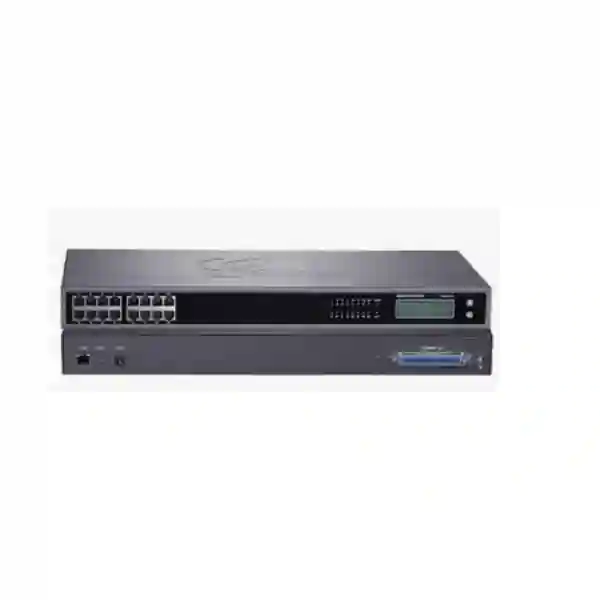
Grandstream GXW4204 Dubai – Model Verification, GXW4200 Series Options & Deployment Guidance
Searching for a Grandstream GXW4204 in Dubai or the UAE? The first step is to verify the exact model reference before a quotation, replacement, migration, or installation is planned. Grandstream’s current GXW4200 family documentation lists the GXW4216, GXW4224, GXW4232, and GXW4248 as the production family members, providing 16, 24, 32, and 48 FXS interfaces respectively. The current manufacturer material does not list GXW4204 as one of those four orderable GXW4200 family models. Some older documentation mirrors contain legacy “GXW4204-8” wording in diagram references, so a buyer may encounter the GXW4204 term while researching historic files. That notation should not be converted into an assumed specification, port count, or stock item without checking the physical label, invoice, existing device, or supplier part number.
Fourteck can help organizations in Dubai, Abu Dhabi, Sharjah, Ajman and across the UAE identify the actual gateway requirement, confirm whether the customer needs FXS or FXO connectivity, determine the required analog port count, and select a suitable Grandstream gateway for SIP-based PBX, hosted VoIP, fax, hotel extensions, legacy analog devices, or phased IP telephony migration. For a GXW4204 inquiry, our recommended process is therefore model verification first, solution matching second, quotation third.
Important GXW4204 model-reference note
Fourteck does not assign specifications to the GXW4204 name unless the exact hardware identity is verified. If your requirement comes from an old asset register, procurement sheet, maintenance contract, customer email, or a label that is difficult to read, share the complete model text and, where possible, a photograph of the device label. This is especially important because Grandstream uses different gateway families for different analog roles. A GXW4104/GXW4108 is an FXO gateway used to connect PSTN/analog trunk lines to VoIP, while the GXW4200 family is a high-density FXS family used to connect analog phones, fax machines, and similar endpoints to SIP. Confusing FXS and FXO can produce a technically incompatible quotation even when the model numbers look similar.
What the verified Grandstream GXW4200 series is designed to do
The GXW4200 series is designed for organizations that want to retain useful analog endpoints while moving the call-control layer to an IP-based environment. Instead of replacing every analog telephone or fax endpoint immediately, the gateway presents multiple FXS interfaces and registers them into compatible SIP infrastructure. This makes the series relevant to hotels, schools, hospitals, offices, apartment or accommodation environments, warehouses, branch networks, service providers, institutions, and sites where a large number of analog devices remain operational.
Grandstream positions the family as a high-density Gigabit FXS gateway range with broad SIP interoperability. The models provide independent SIP accounts per telephone port and four SIP server profiles per system. Depending on the model, the organization can deploy 16, 24, 32, or 48 FXS channels in one gateway platform. This can be more practical than installing many small analog telephone adapters when the requirement involves a concentrated block of analog extensions.
The family is also designed around common analog migration requirements such as caller ID, call waiting, call transfer, call forwarding, do-not-disturb, message waiting indication, flexible dialing plans, fax-over-IP using T.38, and configurable SIP connectivity. For modernized deployments, the V2 generation adds enhanced voice and carrier-grade security capabilities, including wideband codec support, secure boot, unique device certificates, random default passwords, dual firmware images, and expanded provisioning options. Exact functions can depend on hardware version, firmware, PBX configuration, service-provider support, and the analog device connected to the port.
Choose the gateway by customer requirement, not by a similar-looking model number
| Requirement | Gateway direction | What to verify | Likely Grandstream family |
|---|---|---|---|
| Connect many analog phones or fax machines to SIP | FXS ports toward analog endpoints | Number of analog endpoints, REN/loop conditions, fax usage, PBX/SIP platform | GXW4200 series |
| Connect analog PSTN trunk lines to an IP PBX | FXO ports toward PSTN lines | Number of analog lines, caller ID method, disconnect supervision, failover design | GXW4104 / GXW4108 class |
| Small number of analog endpoints | FXS | Port count, router requirement, fax, SIP accounts | ATA / smaller FXS gateway depending on requirement |
| Legacy digital carrier interface | Digital trunk gateway | E1/T1/J1, PRI, signaling and PBX design | GXW4500 series where applicable |
Verified GXW4200 model selection
For a buyer who entered “GXW4204” because the exact part number is uncertain, the safest replacement path is to calculate how many analog endpoint interfaces are actually required and then map that requirement to the verified product range. Grandstream currently identifies four members in the GXW42XX family.
GXW4216
16 FXS ports. Appropriate when a site needs a concentrated but moderate analog endpoint count. It can suit smaller hotel zones, office floors, schools, clinics, branch sites, or migration phases where approximately sixteen analog ports are required.
GXW4224
24 FXS ports. A practical middle option for installations that exceed sixteen analog endpoints but do not require a full thirty-two-port block. Verify whether RJ11 and Telco connector planning fits the rack and cabling design.
GXW4232
32 FXS ports. Suitable for denser analog migration projects, larger accommodation areas, healthcare or education blocks, enterprise floors, and deployments where many analog extensions must be registered to SIP in one gateway.
GXW4248
48 FXS ports. The highest-density member of the verified family. It uses two 50-pin Telco connectors rather than the same RJ11 presentation used by lower-capacity models, so cabling and patching must be designed accordingly.
Key technical capabilities buyers should validate
SIP and IP-PBX interoperability
The GXW4200 family is intended for SIP-based environments and is designed for interoperability with leading IP-PBXs, softswitches, and SIP services. Before deployment, confirm the registration model, authentication method, SIP transport, NAT behavior, dial plan, caller ID mapping, DTMF method, and redundancy expectations of the actual PBX or service.
Gigabit network connectivity
Current GXW4200 product information specifies Gigabit Ethernet connectivity. The LAN design should still account for VLANs, QoS, IP addressing, switch capacity, firewall rules, and management access. A Gigabit interface does not remove the need for correct voice-network engineering.
Voice codecs and wideband support
Supported codecs vary with version and firmware. The family documentation includes common codecs such as G.711, G.729, G.726 and iLBC, while V2 documentation also highlights wideband options such as G.722 and Opus. The end-to-end codec choice must also be supported by the PBX, SIP trunk, remote endpoint and bandwidth plan.
Fax over IP
T.38 support makes the family relevant when analog fax must be retained during an IP migration. Fax success depends on more than gateway support: the PBX, SIP provider, media path, codecs, packet loss, jitter and remote fax network all matter. Fax requirements should therefore be tested in the actual production route.
Security
Manufacturer documentation lists technologies such as TLS/SIPS, SRTP and HTTPS. V2 security enhancements include secure boot, unique certificates, random default passwords and dual firmware images. Security should also include password management, management-plane restrictions, trusted provisioning sources, network segmentation and firmware governance.
Provisioning and remote management
The product family supports centralized provisioning methods, with options depending on generation and firmware. Large deployments should define configuration ownership, template management, firmware policy, backup processes, change control and recovery procedures before many analog ports are migrated.
Why the FXS versus FXO distinction matters for a GXW4204 inquiry
Many incorrect gateway purchases begin with a model number rather than a connectivity diagram. FXS and FXO are complementary analog interfaces, not interchangeable labels. An FXS port supplies the station-side interface expected by an analog telephone or fax machine. An FXO port is used on the side that connects to an analog line or PBX station interface. Therefore, a hotel with 24 analog room phones typically needs a multi-port FXS design, while a company that wants to bring four PSTN analog lines into an IP-PBX typically needs an FXO gateway design.
The similar numbering of Grandstream GXW4104 and the user-entered GXW4204 can easily create confusion. Grandstream currently lists GXW4104/GXW4108 as 4- or 8-port FXO gateway products, while the GXW4200 family is the high-density FXS platform. If the intended requirement is actually “four analog PSTN lines into SIP,” the GXW4104 may be the more relevant reference than a GXW4200 model. If the requirement is “many analog phones into SIP,” the GXW4216/4224/4232/4248 family is the appropriate product class to investigate.
Common deployment scenarios in Dubai and the UAE
Hotel analog extension migration
A hotel may already have working analog room handsets and structured telephone cabling but want to modernize its PBX. A high-density FXS gateway can allow the existing analog room endpoints to register through a SIP-based platform. Planning should cover room count, service phones, reception, emergency dialing, message-waiting behavior, fax or modem devices, failover requirements and cabling presentation.
School or campus buildings
Schools may retain analog phones in classrooms, security rooms, administration areas and utility locations. Rather than replacing every endpoint simultaneously, an FXS gateway can support phased migration. The network team should confirm extension numbering, VLAN design, emergency procedures, UPS strategy, firmware maintenance and how analog endpoints are mapped across buildings.
Healthcare and clinics
Clinics and healthcare environments sometimes retain analog phones, fax machines, courtesy phones or legacy devices that cannot be replaced immediately. A gateway can bridge these into SIP while the broader communications platform is upgraded. Fax and any special analog device should be tested, and critical communications require a resilience plan beyond the gateway alone.
Enterprise branch consolidation
A multi-site business can standardize call control while preserving analog endpoints at selected branches. Four SIP profiles and independent SIP accounts per port can support structured registration designs, but the final architecture should match the PBX topology, WAN quality, security policy, failover strategy and remote management model.
Warehouse and industrial support areas
Some warehouses and support areas keep durable analog phones because they are already cabled or integrated into operational processes. A gateway can bridge those endpoints into centralized SIP communications, provided the environmental placement, cable distances, surge exposure and power continuity are evaluated.
Fax retention during UC migration
Organizations moving to a unified communications platform may still need legacy fax. T.38 capability can help, but Fourteck recommends validating the complete fax route and not assuming that gateway support alone guarantees every carrier-to-carrier fax scenario.
Network and PBX planning checklist
- Confirm the endpoint role: analog phone, fax, modem-like device, paging interface, PBX trunk, or PSTN line.
- Count required ports: include active endpoints, spare capacity, phased migration, and future expansion instead of matching only today’s live extensions.
- Identify FXS or FXO: this is essential before any model is selected.
- Confirm PBX/SIP platform: Grandstream UCM, 3CX, Asterisk-based platform, hosted SIP, softswitch, enterprise call manager, or another compatible SIP environment.
- Review network quality: VLAN, QoS, jitter, packet loss, latency, DHCP/static addressing, DNS, NTP, routing and firewall behavior.
- Define codec policy: ensure codec support aligns across gateway, PBX, SIP trunk and remote endpoint.
- Plan fax separately: confirm T.38 support across the entire route and conduct realistic tests.
- Review caller ID and regional signaling: analog caller ID formats and disconnect methods can vary by deployment.
- Plan power continuity: an IP gateway and the network it depends on require suitable power resilience if analog endpoints are expected to remain available during outages.
- Secure management: use appropriate credentials, HTTPS, trusted provisioning, network restrictions and firmware governance.
- Document port mapping: record analog port, SIP account, extension number, location, cable pair, patching and endpoint owner.
- Test before full cutover: inbound, outbound, transfer, caller ID, voicemail indicator, DTMF, fax, emergency dialing and failover behavior should be validated.
GXW4200 V1 versus V2: why hardware generation matters
When the request originates from a replacement project, an old installation or a secondary-market device, the gateway generation matters. Grandstream’s comparison information for GXW4200 V1 and V2 highlights enhancements in the V2 platform such as 16 kHz voice sampling, wideband codecs including G.722 and Opus, greater capacity for concurrent features, expanded provisioning support, and carrier-grade security features including secure boot, unique certificates, random default passwords and dual firmware images. Therefore, two devices with a similar base family name should not automatically be treated as functionally identical across firmware and hardware generations.
Fourteck recommends capturing the exact product label and current firmware version before planning a like-for-like replacement, bulk firmware update, security hardening exercise or feature migration. If a customer is replacing older hardware, the design should consider whether the goal is merely to restore the same analog capacity or to improve security, codec support, manageability, resiliency and future lifecycle alignment.
Procurement guidance for a “GXW4204” request
A procurement team may send a short request such as “need GXW4204” because the reference was copied from an older list. Rather than quoting a guessed device, Fourteck recommends a short verification workflow. First, determine whether the requested interface is FXS or FXO. Second, check the model label on the existing unit or the original purchase record. Third, count the required analog ports. Fourth, confirm whether the customer is replacing an existing gateway or designing a new SIP migration. Fifth, identify the IP-PBX or service the gateway must register to. Sixth, record fax, caller ID, line-reversal, emergency calling, cabling and rack requirements. With those details, the correct model family can be identified without relying on a possibly mistyped code.
Price and availability should be requested against the verified part number because gateway pricing varies by model, generation, source, region, quantity and commercial terms. Fourteck does not recommend using an unverified “GXW4204” specification as the basis for a purchase order. Ask for a compatibility and model check first if the exact device identity is uncertain.
Regional deployment support
Dubai: Common requests include office PBX upgrades, hotel analog extension migration, warehouse telephony and replacement of aging gateway infrastructure. For Dubai projects, model selection should be coordinated with the actual SIP platform, rack/cabling layout and service continuity requirement.
Abu Dhabi: Enterprise, government, education and multi-building environments often need stronger documentation, change control and integration planning. Port mapping, security policy and staged migration can be as important as the gateway itself.
Sharjah and Ajman: SMB, industrial, education and accommodation sites may benefit from phased analog-to-SIP migration when existing handsets and copper cabling are still serviceable. Correct FXS capacity planning prevents unnecessary replacement of working endpoints.
Wider GCC and Africa: For Kuwait, Uganda, Kenya, Ghana, Nigeria and Tanzania projects, verify local carrier behavior, PBX platform, site power quality, remote-management needs, replacement logistics and any analog signaling requirements before standardizing a gateway design across multiple locations.
When a high-density FXS gateway is the right choice
A high-density FXS gateway is a strong fit when many analog endpoints remain useful, the customer wants to move call control to SIP, and replacing every analog device immediately would add cost or disruption without delivering equivalent value. It is especially suitable where analog phones are concentrated in one building or communications room and where structured cabling can be presented cleanly to the gateway.
It may be less suitable when only one or two analog endpoints remain, when the analog device has unusual electrical or signaling requirements, when the site can economically replace all endpoints with IP phones, or when the true requirement is FXO/PSTN trunk integration rather than FXS station connectivity. In those cases, a smaller ATA, an FXO gateway, a different interface type, or a full endpoint refresh may be more appropriate.
The decision should therefore be based on the customer’s migration strategy rather than a single model search. Fourteck can compare the cost and operational impact of retaining analog endpoints, replacing them with IP phones, using a high-density gateway, or deploying a mixed architecture.
FAQ: Grandstream GXW4204 and GXW4200 series
Is Grandstream GXW4204 a current GXW4200 series model?
Grandstream’s current GXW42XX documentation lists GXW4216, GXW4224, GXW4232 and GXW4248 as the four family models. A current GXW4204 model is not listed in that set. If you have a GXW4204 reference, verify the physical label or source document before ordering.
Why do some older documents show GXW4204-8 wording?
Some legacy draft-manual mirrors contain “GXW4204-8” in figure references. That historic notation should not be interpreted as proof of a current commercial model or used to infer specifications. Current official product documentation should control model selection.
What is the smallest verified GXW4200 family model?
The GXW4216 is the 16-FXS-port member in the currently documented family. If fewer analog endpoints are required, a smaller ATA or another gateway product may be more efficient depending on the requirement.
Is GXW4104 the same as GXW4200?
No. GXW4104/GXW4108 is an FXO gateway family for analog line connectivity, while the GXW4200 family is a high-density FXS platform for connecting analog endpoints to SIP. Confirm the interface direction before selecting a product.
Can GXW4200 gateways work with third-party IP-PBX systems?
The family is designed for SIP interoperability with leading IP-PBXs, softswitches and SIP-based environments. Actual compatibility still depends on the PBX configuration, SIP settings, firmware and features required by the deployment.
Does the GXW4200 series support fax?
Manufacturer documentation includes T.38 fax support. Reliable fax-over-IP also depends on the PBX, SIP provider, media path and network quality, so production testing is recommended.
How many SIP profiles are supported?
The GXW4200 family documentation specifies four SIP server profiles per system and an independent SIP account per telephone port.
Does the GXW4200 series use Gigabit Ethernet?
Yes. Current product documentation describes Gigabit network connectivity. Correct voice VLAN, QoS, switching and firewall configuration remain important for deployment quality.
Can Fourteck quote a replacement if I only have “GXW4204” on an old list?
Yes, but the model should be verified first. Share the label photo, existing gateway purpose, analog port count, PBX platform and whether the connected side is analog phones/fax or PSTN lines. Fourteck can then match the requirement to an appropriate current or compatible option.
Should I order the same number of ports as currently used?
Not necessarily. Include expected growth, spare capacity, migration phases, service phones and any analog devices that may be added later. However, avoid large unused capacity when a smaller design is clearly sufficient.
Why work with Fourteck on gateway selection
The difficult part of an analog gateway project is often not purchasing the hardware; it is identifying the correct interface, validating PBX compatibility, planning port capacity, mapping existing lines or extensions, and avoiding disruption during cutover. Fourteck approaches a GXW4204 inquiry as a technical requirement that needs verification rather than simply attaching specifications to an uncertain model reference.
For related communications requirements, explore Fourteck IP Phone solutions, the wider Fourteck UAE technology portfolio, or regional Grandstream-focused information at Grandstream UAE.
Send these details for a fast model check
- Existing model-label photo
- Required analog port count
- FXS endpoints or FXO/PSTN lines
- PBX or hosted SIP platform
- Fax requirement
- Dubai/UAE site location
- Replacement or new deployment
Request a GXW4204 model verification and quotation
If your requirement says Grandstream GXW4204, Fourteck can help verify whether that reference points to a legacy document, a mistyped model, an FXO GXW4104 requirement, or a high-density GXW4200 FXS requirement. Send the exact model label and your analog port requirement so the correct gateway can be identified before procurement.
Recommended next action: confirm the model and interface type first, then request pricing, compatibility guidance, configuration assistance or a migration plan.
Reviews
There are no reviews yet.