Grandstream GCC6011 in Dubai, UAE – Wired UC, Security, Routing and Switching in One Platform
The Grandstream GCC6011 is a wired UC and networking convergence appliance designed for organizations that want to bring business routing, next-generation firewall functions, IP PBX services, wired switching and centralized Grandstream endpoint management into one coordinated platform. For a Dubai or UAE deployment, the strongest reason to evaluate the GCC6011 is not simply that it combines several functions in one chassis; it is that it can reduce the number of separate management planes used for voice, security, routing and access-layer connectivity in a small or mid-sized environment.
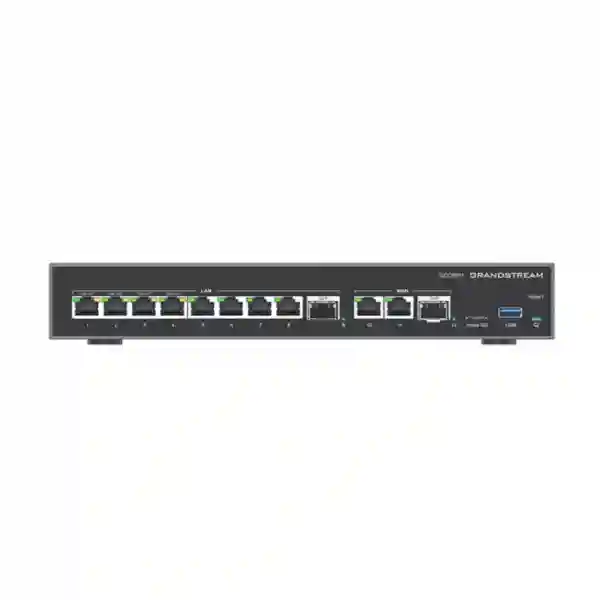
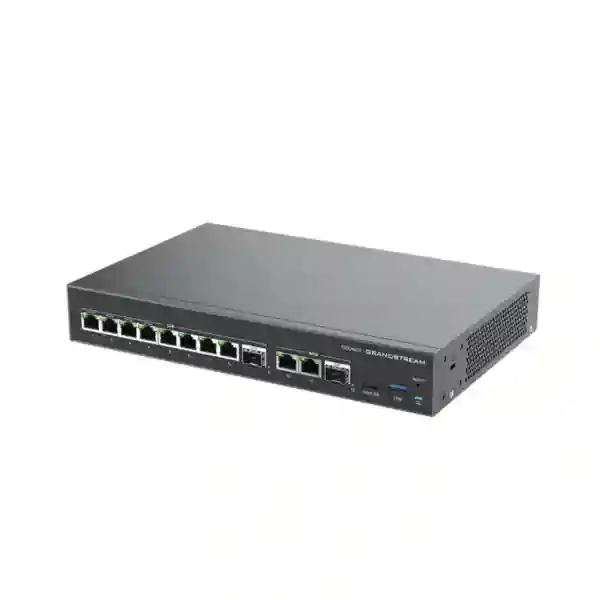
GCC6011 is the larger wired model in the GCC601x family. Current Grandstream documentation lists two 2.5 Gigabit SFP ports, ten Gigabit Ethernet ports with three fixed WAN ports, 2.5Gbps routing performance, 1Gbps IPsec VPN throughput, 900Mbps IDS/IPS performance, 160,000 NAT sessions, support for 128 VLANs, up to 150 managed GWN access points and up to 500 clients. The unit is also rack-mountable and supports an optional M.2 SSD. These characteristics make it especially relevant when a business needs more wired ports and rack integration than the compact GCC6010, but does not need the integrated Wi-Fi 6 radio found in GCC6010W.
2 × 2.5G SFP
3 fixed WAN ports
PBX + NGFW + VPN Router + Switch
Start with the buying question: is convergence useful for your office?
A traditional branch or SME network may use one firewall or router, one managed switch, one IP PBX, separate management software for wireless access points, and a separate provisioning process for IP phones. That approach can be correct for organizations that need best-of-breed platforms, very large scale or specialized security controls. It can also create unnecessary operational overhead for businesses whose real objective is simpler: stable internet access, secure site-to-site or remote-user connectivity, segmented business networks, reliable VoIP, manageable switching and a straightforward way to administer Grandstream devices.
GCC6011 is aimed at that second requirement. It does not remove the need for network design; it changes the design conversation. Instead of asking which independent appliances should be combined, a project team can ask whether the routing, firewall, switching, voice and device-management requirements fit within one GCC platform. If they do, deployment and day-to-day administration can become more coherent. If they do not, the GCC6011 can still be evaluated as one part of a wider architecture, but it should not be selected merely because an all-in-one device sounds simpler.
For Fourteck customers in Dubai, Abu Dhabi, Sharjah and other UAE locations, the practical decision usually depends on WAN design, number of users, simultaneous call requirement, VLAN plan, PoE load, number of wired endpoints, expected security inspection load, VPN requirements, existing Grandstream ecosystem and the level of future expansion. Fourteck can help map those requirements before quotation so the model is evaluated against the actual project rather than a generic product list.
GCC6011 quick facts for technical buyers
| Product role | Wired UC + networking convergence device integrating VPN router, next-generation firewall, IP PBX and managed switch functions. |
|---|---|
| Processor | Quad-core CA53, 2.0GHz according to the current official GCC6010 Series datasheet. |
| Ethernet / uplinks | 10 × Gigabit Ethernet and 2 × 2.5 Gigabit SFP ports; Grandstream specifies three fixed WAN ports for GCC6011. |
| Routing | 2.5Gbps stated routing performance. |
| IPsec VPN | 1Gbps stated IPsec VPN throughput. |
| Security inspection | 900Mbps IDS/IPS performance as listed in current product documentation; real deployments should be sized for enabled services and traffic mix. |
| NAT scale | 160,000 NAT sessions. |
| VLANs | Current Grandstream GCC601X user manual lists support for 128 VLANs on GCC6011. |
| Switching | 15Gbps total non-blocking throughput and 30Gbps switching capacity when hardware acceleration conditions documented by Grandstream apply. |
| PoE output | 4 × IEEE 802.3af/at PoE-out ports with maximum stated PoE budget of 36W. |
| PBX | The Grandstream user manual updated 11 August 2026 lists 24 users and 8 concurrent calls by default, with PBX capacity upgrade options. Older datasheets show lower default values, so confirm the current firmware/package entitlement before ordering. |
| GWN management | Up to 150 GWN APs and up to 500 clients according to current documentation. |
| Memory / storage | 2GB RAM, 32GB eMMC flash and optional M.2 SSD support. |
| Management | GDMS, local web interface, command-line management and SNMP options are documented; exact interface availability can depend on firmware. |
| Mounting | Desktop, wall or rack mounting. Rack-mount kit is specified for GCC6011. |
Why the GCC6011 is different from a normal router
Calling the GCC6011 a router understates the product. Routing is one module within a larger convergence platform. The appliance can terminate WAN connectivity, apply firewall and content-control policy, provide VPN services, switch local Ethernet traffic, supply PoE on selected ports, host a Grandstream PBX environment and participate in centralized endpoint management. That architecture matters because policies that would otherwise be distributed across several appliances can be planned together.
For example, a voice VLAN can be designed alongside QoS and VoIP prioritization rather than treated as an afterthought. Branch VPN requirements can be considered together with SIP traffic and phone provisioning. Grandstream access points and phones can be managed in the same broader vendor ecosystem. A support engineer troubleshooting a user complaint can therefore investigate WAN, LAN, firewall, VLAN, switch, PBX and endpoint context without automatically moving between four unrelated platforms.
This convergence is most valuable when the environment is deliberately standardized. It is less compelling if the organization already operates a large security stack with a dedicated next-generation firewall cluster, an enterprise call-control platform and a different switching ecosystem. GCC6011 should therefore be viewed as an architecture choice rather than an appliance replacement chosen in isolation.
Ten Gigabit Ethernet ports: when the extra wired density matters
The GCC6011 provides ten Gigabit Ethernet ports in addition to two 2.5 Gigabit SFP ports. For many small sites, this can reduce the need for an immediate separate access switch, particularly when the directly connected devices are a modest mix of IP phones, access points, workstations, printers, cameras or uplinks to downstream switches. Four of the Ethernet ports can provide PoE output within the stated 36W total budget, which can be useful for selected endpoints.
Port count should never be evaluated only by counting current devices. A good design leaves room for growth, separates WAN and LAN roles correctly, confirms which ports are assigned as fixed WAN interfaces, calculates PoE power rather than just PoE port quantity, and checks whether downstream devices require features or scale better provided by a dedicated managed switch. A business with fifteen desks, six access points and several cameras will likely still need an access-layer switch even though the GCC6011 has more local ports than GCC6010.
The two 2.5G SFP interfaces also matter when the site needs fiber or higher-speed uplink options. They can support designs in which the convergence gateway connects to another switch or infrastructure segment without making every local link dependent on a one-gigabit copper path. Transceiver choice, fiber type, distance and interoperability should be confirmed for the specific project rather than assumed from the SFP slot alone.
Multi-WAN planning for Dubai and UAE branch connectivity
Grandstream specifies three fixed WAN ports on the GCC6011. Multi-WAN capability can be useful in offices where internet continuity matters to cloud applications, SIP trunks, remote workers, payment systems or customer-facing operations. A business might use a primary fiber connection and a secondary broadband service, with a third path reserved for another provider or a different connectivity strategy. The value is not the number of WAN ports by itself; the value comes from a defined failover and traffic policy.
Before deployment, decide what should happen when the primary WAN fails. Should all traffic move to the backup? Should voice be prioritized? Are public IP addresses, inbound services or SIP trunk registrations tied to one carrier? Does the secondary path provide equivalent latency and capacity? Are VPN tunnels expected to recover automatically? Does an application restrict source IP addresses? These questions determine whether multi-WAN behavior will support continuity in practice.
For UAE deployments, Fourteck can coordinate the GCC6011 configuration with the customer’s available service-provider handoffs and existing network. The carrier service itself, public IP allocation and SIP trunk conditions remain provider-dependent. The product should not be purchased with an assumption that every internet or voice provider behaves identically.
Firewall and threat-control capabilities: size for inspected traffic, not internet speed alone
The GCC6011 includes a next-generation firewall module with functions documented by Grandstream such as traffic rules, NAT, application identification, deep packet inspection, anti-virus, IDS/IPS, SSL inspection and content-control functions. This gives a small or mid-sized organization a broad security toolset without requiring a separate firewall appliance for every project. The correct security design still depends on what services are enabled and how much inspected traffic the device must process.
The official documentation lists 2.5Gbps routing performance but 900Mbps IDS/IPS performance. Those figures illustrate why raw WAN bandwidth is not the same as security throughput. A one-gigabit internet circuit does not automatically mean a 2.5Gbps router rating is sufficient under every security policy. Inspection type, encrypted traffic, application mix, rule complexity, logging and firmware can influence practical performance. For projects close to a platform limit, use the security workload as the sizing reference rather than selecting from the highest headline number.
Grandstream’s GCC FAQ also explains that some firewall security services use signature or engine updates and that behavior can change if a related service term expires. For procurement, ask what security services are included with the device, which services have time-based update entitlements, and what renewal is required for continuing signature updates. Avoid treating a firewall license question as separate from the hardware decision.
VPN capability for branches, administrators and remote access
Current Grandstream documentation for the GCC601x platform lists IPsec, OpenVPN, WireGuard and additional legacy VPN options. The GCC6011 is rated for 1Gbps IPsec VPN throughput. This can make the platform relevant for branch-to-head-office tunnels, secure administrative connectivity and remote-access designs where the requirement fits the supported VPN architecture.
VPN design should start with the topology. For a single office connecting to a data center, site-to-site IPsec may be the natural choice. A distributed team may require client-to-site access. A multi-branch organization may need multiple tunnels, route planning, overlapping subnet remediation, DNS strategy and clear ownership of tunnel endpoints. Security policy should also define who can access which VLAN or service after a tunnel is established.
The presence of a VPN feature does not by itself prove interoperability with every third-party firewall or cloud gateway. Encryption proposals, authentication methods, routing modes and supported firmware should be checked against the peer device. Fourteck can help validate the intended topology and configuration scope before deployment, particularly when GCC6011 must connect to an existing security appliance from another vendor.
The built-in IP PBX: useful, but call capacity must be checked carefully
One of the most important GCC6011 capabilities is the integrated IP PBX. It allows the same platform that handles networking to provide business voice and collaboration features. This can be a strong fit for offices that want Grandstream phones, SIP trunks, extension dialing, call routing and related UC features without maintaining a separate physical PBX appliance.
There is a documentation-version consideration that buyers should know. The current Grandstream GCC601X user manual, updated 11 August 2026, lists 24 users and 8 concurrent calls by default for GCC6011, with upgrades available. An older GCC6010 Series datasheet still visible online lists a lower default capacity. Because the vendor documentation has changed over time, Fourteck recommends confirming the current firmware, PBX package and upgrade entitlement for the actual unit being quoted rather than relying on an older search result or reseller copy.
User count and concurrent calls are different sizing dimensions. A company may have fifty extensions but only a small number of simultaneous external and internal calls, or it may operate a customer-service team where call concurrency is high. The PBX design should therefore include extension count, simultaneous call requirement, SIP trunk channels, IVR and queue requirements, recording needs, remote extensions, conference use, codec expectations and future growth. If the anticipated call load exceeds the appropriate GCC6011 package, consider the available upgrade path or another Grandstream platform with higher capacity.
Fast provisioning and Grandstream endpoint management
A major operational advantage of a Grandstream convergence deployment is the ability to manage compatible Grandstream endpoints from a coordinated environment. Grandstream documents fast-provisioning workflows for supported GCC devices and UC endpoints, including zero-touch or assisted registration approaches depending on the endpoint and firmware. The objective is to reduce repetitive per-phone configuration and make extension assignment easier to control.
For an office rollout, this can change the deployment process substantially. Instead of opening each phone individually, entering SIP credentials and then repeating network settings, administrators can prepare the user and device plan centrally and provision compatible endpoints according to the supported workflow. That reduces configuration drift and can make moves, additions and changes easier after handover.
Compatibility still needs to be verified. Grandstream’s own documentation distinguishes between endpoints that support specific one-click or zero-config methods and third-party SIP devices that may require a different provisioning path. Firmware versions can also matter. A procurement list should therefore pair the GCC6011 with confirmed phone models and a documented provisioning method, not simply assume that any SIP device will have identical management behavior.
VLAN design: 128 supported VLANs creates flexibility, not a reason to over-segment
The current GCC601X manual lists up to 128 VLANs for GCC6011. That is a useful improvement over a very small office router because it allows a business to build logical separation for voice, corporate users, guests, management devices, servers, cameras, building systems or other trust zones. However, a good network rarely needs as many VLANs as the platform can technically support.
Start with security and operational boundaries. Voice endpoints may use a dedicated VLAN so QoS, access rules and troubleshooting are clear. Guest Wi-Fi should be isolated from business resources. Management interfaces can be restricted to an administrative segment. Cameras or IoT devices may be separated because their trust model differs from user laptops. Additional VLANs should have a reason, an addressing plan, a gateway policy and documented inter-VLAN access rules.
When GCC6011 is combined with downstream Grandstream switches and access points, the VLAN plan should be consistent from the gateway through trunks, access ports and SSIDs. A mismatch between switch tagging, AP configuration and gateway interfaces is a common cause of deployment problems. Fourteck can build a VLAN and IP addressing matrix before implementation so the physical and logical design are aligned.
QoS and voice prioritization for converged traffic
When voice and general data share one gateway, quality of service becomes central to the design. Grandstream documents VLAN, TOS, traffic classes, DSCP-related controls, policing, application QoS and VoIP prioritization on the GCC6011 platform. These capabilities can help protect call quality when users are simultaneously moving large files, using cloud applications, streaming media or performing backups.
QoS does not create bandwidth that is not available. If a WAN circuit is undersized, prioritization can protect selected traffic but cannot make every application perform as though congestion does not exist. The design should identify the voice codec, expected concurrent calls, other latency-sensitive applications and the true upstream and downstream circuit capacity. Policies should then prioritize appropriately without starving business data.
The most effective deployment uses end-to-end consistency. Phone markings, switch trust policy, VLAN configuration, GCC6011 rules and service-provider behavior should be understood together. Where the carrier ignores or rewrites DSCP, local QoS can still help at the LAN and WAN edge, but the end-to-end result may differ from a fully managed QoS service.
PoE budgeting: four powered ports, 36 watts total
GCC6011 provides four PoE output ports supporting IEEE 802.3af/at with a maximum total PoE wattage of 36W according to current Grandstream documentation. That can be enough for a few low- or moderate-power endpoints, but buyers should not interpret “four PoE ports” as “four devices of any power class.” The combined consumption must fit inside the available power budget.
Before using the GCC6011 as a PoE source, list the maximum power requirement of each connected device. An IP phone may consume relatively little power, while an access point, video phone or other device can require considerably more. Allow engineering margin rather than designing exactly to the theoretical maximum. If the project includes several access points, cameras or other powered endpoints, a dedicated PoE switch may be the cleaner design.
This is also a resilience decision. When many critical devices depend on one appliance and its power adapter, a single power event can affect networking and endpoints simultaneously. Consider UPS capacity, downstream switch design and whether key voice or wireless devices should be distributed across separate power domains.
Optional M.2 SSD and local storage planning
Unlike GCC6010, the GCC6011 supports optional M.2 SSD storage. That makes the larger chassis more suitable for deployments where supported functions benefit from additional local storage. The exact SSD specification, supported capacity and application use should be checked against the current Grandstream hardware and firmware documentation at deployment time. Do not purchase an arbitrary M.2 device only because the physical form factor appears compatible.
Storage requirements often become important when voice-related functions such as recording, logs or retained data are part of the operational plan. The project should define how much information is expected, how long it needs to be retained, whether backups are required and whether there are internal or regulatory policies governing recordings. Local storage is not the same as a backup strategy; important information should be protected according to the organization’s recovery requirements.
GCC6011 vs GCC6010 vs GCC6010W: which model fits?
| Decision point | GCC6011 | GCC6010 | GCC6010W |
|---|---|---|---|
| Best general fit | Larger wired branch or rack deployment | Compact wired deployment | Compact site needing built-in Wi-Fi 6 |
| Gigabit Ethernet | 10 ports | 5 ports | 5 ports |
| 2.5G SFP | 2 ports | 2 ports | Not the same wired/SFP design; verify current datasheet |
| Built-in Wi-Fi | No | No | Dual-band Wi-Fi 6 |
| Rack mounting | Yes | Desktop / wall | Desktop-style form factor |
| Optional M.2 SSD | Yes | No M.2 option listed | Check current model documentation |
The most common mistake is choosing GCC6011 expecting built-in Wi-Fi. GCC6011 is the wired high-port-count member of the GCC601x family. If the site needs Wi-Fi, connect suitable wireless access points or evaluate GCC6010W where its capacity and integrated wireless design match the requirement. If the office is already using multiple APs, a wired gateway such as GCC6011 can actually be preferable because wireless coverage can be designed independently using ceiling- or wall-mounted access points.
When GCC6011 is a strong fit
GCC6011 is particularly compelling for a small or mid-sized company standardizing on Grandstream networking and communications. A new office can deploy the gateway in the communications rack, use the built-in switching for selected devices, add GWN access points for wireless coverage, register Grandstream phones to the integrated PBX, connect one or more WAN services, create VLANs and security policies, and use GDMS or supported local management for ongoing administration.
It can also fit a branch office where corporate headquarters already provides centralized applications but the branch needs local internet, secure VPN, local voice functions and managed endpoints. Hotels, education environments, retail branches, professional offices, clinics, warehouses and remote offices can all have suitable use cases when their scale remains inside the platform’s documented capacity.
The common factor is operational simplicity. The project benefits when the same team wants visibility across network and UC functions and when the Grandstream ecosystem is a strategic choice rather than an incidental collection of devices.
When to consider another design instead
A convergence appliance is not automatically the best answer. If the site requires multi-gigabit threat inspection above the GCC6011 security rating, very high call concurrency, large-scale PBX capacity, extensive high-power PoE switching, high availability features outside the model’s supported design, or integration with a security ecosystem already standardized across many sites, another architecture may be more appropriate.
Likewise, a large campus with hundreds of switch ports should not attempt to make the GCC6011 replace the entire access layer simply because it includes a switch. In that case the GCC6011 may still serve as a gateway or UC component, while dedicated switches provide distribution, redundancy and higher PoE budgets. A contact center with demanding recording and call-flow requirements may need a more specialized PBX platform. A regulated organization may require security inspection, logging, HA or certification requirements that must be validated separately.
Fourteck’s role in product selection is to determine whether the device fits the customer requirement, not to force every network into one model. If the requirement is beyond GCC6011, a better design should be proposed before procurement.
Deployment scenario 1: new SME office in Dubai
Consider a professional-services office opening in Dubai with around thirty staff, a primary business internet circuit, a backup internet connection, Grandstream desk phones, several wireless access points, printers and a small number of wired servers or appliances. The business wants guest Wi-Fi separated from corporate traffic and wants secure remote administrative access. It also prefers one support team for both networking and telephony.
A GCC6011-based design can place the convergence appliance at the edge, use separate VLANs for corporate users, voice, guest access and management, connect the WAN services, integrate GWN access points, host the PBX if the user and concurrent-call plan fits, and apply QoS so voice remains prioritized during normal traffic peaks. A downstream PoE switch may be added if the AP and phone count exceeds the GCC6011’s direct port or PoE capacity.
The critical engineering work is not plugging in the device. It is deciding the VLAN and IP plan, firewall rules, backup-WAN behavior, SIP trunk configuration, extension numbering, call routing, AP placement, PoE budget, UPS sizing and handover documentation. When those pieces are designed together, the GCC6011 becomes the control point for a clean small-business architecture.
Deployment scenario 2: branch office connected to headquarters
A UAE branch may require a secure tunnel to headquarters while still breaking out general internet traffic locally. The branch may use a local SIP provider, or voice may be routed over the corporate VPN. The site also needs guest wireless, corporate wireless, IP phones and several networked devices. In this situation the GCC6011 can be evaluated as a branch convergence gateway.
The design should define routes to headquarters, local and remote DNS, failover behavior for the site-to-site VPN, which applications use local internet, and whether phone services depend on the tunnel. If corporate security policy requires all traffic to pass through headquarters, the WAN design will differ from a local-breakout model. If voice depends on headquarters, call survivability during a WAN failure should be considered.
For multi-branch rollouts, configuration standardization becomes especially valuable. VLAN numbers, SSIDs, firewall templates, extension ranges and device naming can be designed consistently while preserving site-specific addresses. This is where coordinated Grandstream device management can reduce operational effort compared with configuring each branch as an unrelated environment.
Deployment scenario 3: hotel, education or distributed-service environment
Hotels, training centers, schools and similar environments often combine voice, guest internet, staff networks and many wireless clients. GCC6011’s ability to manage up to 150 GWN APs and 500 clients can be relevant for smaller deployments in these sectors, but the application should be sized carefully. Wireless capacity depends on AP model, radio design, client density, channel planning and traffic behavior; the gateway’s client-management limit is only one part of the solution.
In a hospitality project, separate guest, staff, administration, voice and building-system networks may be appropriate. In education, student, staff, voice and administrative traffic may need different policies. In a clinic, medical or business systems should be isolated from guest services. The VLAN capacity of GCC6011 gives flexibility to create these boundaries without forcing every endpoint into one flat LAN.
Because these environments can be more security-sensitive and may require many PoE devices, dedicated managed switches are typically part of the design. GCC6011 can then focus on gateway, security, UC and centralized control rather than serving as the only switching device.
Pre-order engineering checklist
- Confirm current user count, expected growth and true simultaneous-call requirement.
- List internet services, WAN handoff types, public IP requirements and required failover behavior.
- Document SIP trunk provider, channel capacity, number ranges and any carrier IP restrictions.
- Count wired endpoints and decide which require direct GCC6011 ports versus a downstream managed switch.
- Calculate PoE load in watts, not only the number of powered devices.
- Define VLANs, IP subnets, DHCP scopes and permitted inter-VLAN traffic.
- Estimate security-inspected traffic and compare it with the documented IDS/IPS figure.
- Define site-to-site and remote-access VPN requirements, including peer-vendor interoperability.
- Confirm required Grandstream phone, AP and switch models and their supported firmware.
- Decide whether optional M.2 storage is needed and verify supported SSD specifications.
- Plan UPS runtime and power distribution for the gateway and dependent network devices.
- Determine whether centralized GDMS management, local management or both will be used.
- Confirm the current PBX base entitlement and any capacity upgrade needed for the quote.
- Review firewall service/update entitlements and any recurring security-service requirement.
- Create a handover plan covering admin credentials, backup, configuration export, diagrams and support ownership.
Installation approach recommended for a production GCC6011 deployment
A professional deployment should begin with a configuration plan before the production network is moved. First document the current WAN, LAN, IP PBX and device environment. Then define the target VLANs, subnets, routes, firewall rules, VPNs, SIP trunks, extensions and endpoint groups. This reduces the risk of building the design interactively while users are waiting for service.
The device should be installed in an appropriate location with ventilation, stable power and UPS protection. The provided power adapter should be used; Grandstream warns against unsupported adapters. For rack deployments, use the correct rack-mount hardware. WAN and LAN connections should be labeled, and SFP modules should be verified for the intended fiber or uplink specification.
Configuration can then be staged: update to an approved firmware version, secure administrator access, configure time and DNS, build VLANs and DHCP, establish WAN connectivity, apply firewall policy, test VPNs, configure switching and PoE, deploy the PBX, register test endpoints and validate call flows. Only after these services are individually tested should the production cutover occur. A rollback plan should be retained if GCC6011 is replacing an existing gateway or PBX.
After cutover, verify internet access, DNS, inter-VLAN policy, guest isolation, remote access, WAN failover, SIP registration, inbound and outbound calls, emergency or priority call routes where applicable, voicemail, IVR, queues, endpoint provisioning and monitoring. Capture a clean configuration backup after acceptance.
Security hardening after basic connectivity
Getting traffic to pass is only the first stage. The GCC6011 should be hardened for the business environment. Administrative access should be restricted to trusted management paths, default credentials must not be retained, remote administration should be exposed only when required and protected by secure methods, and firmware should be kept within a tested maintenance process.
Firewall policy should follow least privilege. Guest networks should not have access to corporate subnets. Voice devices generally need only the services required for provisioning, DNS, NTP, PBX and approved network access. Management interfaces for switches and access points should not be reachable from untrusted segments. Unused services should be disabled where practical.
Security monitoring also matters. Review logs for unusual authentication attempts, repeated blocks, unexpected outbound traffic and VPN activity. When signature-based security functions are used, confirm that update entitlements remain current. Back up the configuration after meaningful changes and protect exported files as sensitive operational data.
Operational management with GDMS, local web UI and SNMP
Different IT teams prefer different management models. Grandstream documents GDMS cloud management, a local web interface and SNMP support for the GCC6011 platform, together with command-line options in current documentation. A small organization may prefer cloud-assisted management so its provider can support multiple sites efficiently. A security-sensitive environment may prefer more local control. A larger IT department may integrate monitoring into an SNMP-based network management platform.
The important point is to decide the operating model during the project. Who owns the administrator account? Who receives alerts? Who approves firmware changes? Where are backups stored? What access remains after an implementation partner completes the deployment? The answers should be part of the handover document rather than informal knowledge held by one technician.
For managed support, Fourteck can align the platform with broader UAE IT support services. Organizations that want ongoing infrastructure assistance can review Fourteck IT services, while customers planning IP telephony can also explore IP PBX solutions in Dubai. These are complementary project resources rather than claims that every service is bundled with GCC6011 hardware.
Procurement: what should a GCC6011 quotation clarify?
A useful quotation should identify more than the model number. It should clarify the quantity, power adapter, included rack-mount accessories, required transceivers, optional M.2 storage, PBX capacity upgrade if applicable, security-service requirements, compatible phones, access points, switches and any implementation or support scope. If the project includes a SIP trunk, licensing or service from a telecom provider, that should be described separately so hardware and recurring service costs are not confused.
Price can vary with project scope, accessory selection, quantity, services and current distribution conditions. Fourteck therefore treats GCC6011 price as a quotation item rather than publishing an invented or stale number. Buyers requesting a quote should provide the number of users, simultaneous calls, WAN services, phone models, AP count, switch requirements and installation location. That information allows the quotation to reflect the architecture rather than only a box price.
Stock and delivery should also be confirmed at the time of order. This page does not claim real-time inventory. Where deployment timing is important, request current availability and lead-time confirmation from the sales team before committing to a project schedule.
GCC6011 and dedicated Fortinet or enterprise firewall environments
Some buyers compare a convergence appliance with a dedicated firewall platform. The comparison should be based on architecture rather than brand labels. GCC6011 is attractive when networking, UC and endpoint convergence are the priority and its security capacity is appropriate. A dedicated enterprise firewall may be preferred when the organization already standardizes on advanced security policies, centralized threat management, larger-scale VPN, high availability or inspection performance beyond the GCC6011 target.
The two approaches can also coexist. A corporate branch could retain an enterprise firewall at the security edge while using Grandstream infrastructure for switching, Wi-Fi or UC, although the benefits of full GCC convergence should then be reconsidered. If security is the dominant project requirement, buyers can compare specialist options through Fourteck’s Fortinet UAE resource. The correct choice depends on policy, scale and operational ownership.
Regional considerations for UAE deployments
A network appliance is globally specified, but deployment context is local. In Dubai, many businesses operate from leased offices where internet handoff location, rack space and structured cabling are determined by the building. A site survey may be needed to confirm where the GCC6011 can be mounted, whether existing copper runs support the design and whether fiber or SFP uplinks are required.
In Abu Dhabi, multi-site corporate or government-related projects may place greater emphasis on documented security policy, change control and support responsibilities. In Sharjah, Ajman or industrial areas, warehouses and workshops may have longer cable runs, higher AP coverage requirements or separate office and production networks. Remote sites can make dual-WAN resilience and centralized management more important because on-site technical access is limited.
The GCC6011 should therefore be configured around the actual site rather than cloned blindly between locations. Standardization is useful, but WAN providers, IP addressing, VLANs, RF environments, rack space and user requirements differ. Fourteck supports UAE customers from the broader Fourteck UAE portfolio and can align voice, networking and support requirements where requested.
A note about changing specifications and firmware
Grandstream documentation for the GCC601x family has evolved. One visible example is PBX capacity: the user manual updated in August 2026 lists a higher default user and call capacity than some older datasheets and third-party comparison sheets. This page therefore prioritizes the most recent official Grandstream documentation and flags differences where they can influence buying decisions.
Firmware can also add, modify or deprecate functions. Before a production deployment, confirm the supported firmware train, review release notes and validate critical features in the intended configuration. Avoid upgrading a production communications gateway solely because a newer firmware version exists; follow a tested change process and keep a backup and rollback plan.
Why buy and deploy GCC6011 through Fourteck?
The value of a convergence platform depends heavily on design and implementation. Fourteck can assist with requirement gathering, model selection, network planning, IP PBX design, VLAN and QoS strategy, Grandstream endpoint selection, installation, configuration and handover. The goal is to make the GCC6011 part of a working business communications environment rather than an isolated hardware purchase.
For projects using Grandstream phones and related UC equipment, visit Fourteck IP Phone. For broader regional solution coverage, customers can also review Fourteck. Project scope, installation availability, stock and commercial terms are confirmed during quotation and are not assumed on this page.
A good GCC6011 engagement begins with the customer requirement. Fourteck can compare the device with smaller GCC601x models, higher-capacity convergence platforms or a separate firewall, switch and PBX architecture where appropriate. That protects the customer from buying a model that looks attractive on a feature list but does not fit the actual traffic, call or power requirement.
Frequently asked questions
What is the Grandstream GCC6011?
GCC6011 is a wired Grandstream UC and networking convergence device combining VPN routing, next-generation firewall capabilities, an IP PBX, managed switching and centralized endpoint-management functions in one platform. It is part of the GCC601x family and is positioned for small and mid-sized business environments that need a higher wired port count and rack-mount form factor.
Does GCC6011 include Wi-Fi?
No. GCC6011 is the wired model. If wireless coverage is required, connect compatible access points or evaluate GCC6010W, which is the GCC601x model with integrated dual-band Wi-Fi 6. For offices with multiple rooms or larger coverage areas, separate access points are often preferable because they can be placed where RF coverage is needed rather than where the internet gateway is installed.
How many Ethernet ports does GCC6011 have?
Current Grandstream documentation lists ten Gigabit Ethernet ports and two 2.5 Gigabit SFP ports. The model has three fixed WAN ports. The exact port-role and cabling plan should be checked before installation, especially when replacing an existing multi-WAN router.
How many VLANs does GCC6011 support?
The Grandstream GCC601X user manual updated in August 2026 lists support for up to 128 VLANs on GCC6011. Real deployments should use only the VLANs needed for a clear security and operations design.
What is the routing speed?
Grandstream lists 2.5Gbps router performance for GCC6011. Security-inspected throughput is a separate figure; IDS/IPS is listed at 900Mbps. The project should be sized for the enabled features and traffic pattern rather than assuming every service will operate at the routing headline speed.
What VPN performance does GCC6011 provide?
The current documentation lists 1Gbps IPsec VPN throughput. Actual deployment performance can depend on encryption, tunnel configuration, firmware, routing and other active services.
Does GCC6011 have PoE?
Yes. Four ports provide IEEE 802.3af/at PoE output with a maximum total stated PoE budget of 36W. Always total the maximum wattage of all connected powered devices before deciding that the built-in PoE capacity is sufficient.
How many PBX users and concurrent calls are included?
Grandstream’s GCC601X user manual updated 11 August 2026 lists 24 users and 8 concurrent calls by default, with upgrade options. Older datasheets visible online show lower default values. Because this entitlement has changed in documentation, confirm the current package and firmware for the actual unit during quotation.
Can GCC6011 manage Grandstream access points?
Grandstream lists management support for up to 150 GWN access points and up to 500 clients on GCC6011. Wireless capacity and RF design still depend on the access-point models, coverage, user density and traffic requirements.
Can GCC6011 be installed in a rack?
Yes. GCC6011 supports desktop, wall and rack mounting. Grandstream lists a rack-mount kit for GCC6011 in the package information. Confirm package contents with the current supply channel when ordering.
Does GCC6011 support additional storage?
Yes. Current Grandstream documentation lists optional M.2 SSD support. Confirm the supported drive specification and intended application before purchasing storage.
Is GCC6011 suitable for a 1Gbps internet connection?
It can be, but the answer depends on enabled security functions. Routing is rated at 2.5Gbps while IDS/IPS is listed at 900Mbps. If the objective is to inspect a full one-gigabit internet stream with multiple advanced security services enabled, validate the expected workload and performance before deployment.
Can GCC6011 replace a separate PBX, router, firewall and switch?
In a suitably sized small or mid-sized deployment, that is the intended convergence use case. However, organizations with larger call requirements, higher security throughput, large PoE loads, extensive switching needs or specialized firewall requirements may still use separate platforms. The correct answer comes from capacity planning, not from the number of functions listed on the product page.
Where can I request GCC6011 pricing in Dubai or UAE?
Contact Fourteck with the required quantity and project details. For an accurate solution quotation, include user count, concurrent calls, SIP trunk details, WAN services, number of phones, APs, switches, PoE needs and whether installation or configuration support is required. Stock, delivery and commercial terms should be confirmed at quote time.
Request a GCC6011 solution review
If you are planning a new office, replacing an aging router or PBX, consolidating Grandstream networking, or designing a branch deployment in the UAE, Fourteck can review the requirement before quotation. Send the number of users, concurrent calls, WAN links, existing firewall or router, switch and AP count, phone models, VLAN needs, VPN topology and installation location. This allows the proposed GCC6011 design to be checked against network, security and UC capacity instead of treating the purchase as a generic gateway order.
For projects outside the UAE, Fourteck’s regional network also includes Uganda, Kenya, Tanzania, Ghana and Nigeria. Regional product availability and support scope should be confirmed for each project.
Technical verification note: Product facts on this page were checked against Grandstream’s GCC6000/GCC601X documentation, including the GCC601X user manual updated 11 August 2026, the GCC6010 Series product page and official installation documentation. Specifications, firmware behavior, service entitlements and package contents can change. Confirm current details before procurement.
Official references: Grandstream GCC6000 Series · GCC601X User Manual · GCC6010/GCC6011 Quick Installation Guide

Reviews
There are no reviews yet.