GRANDSTREAM • ANALOG TO SIP MIGRATION
GXW Analog VoIP Gateway Series
Keep useful analog phones while planning a controlled move to SIP telephony. Choose a Grandstream GXW gateway by the interface you need, the number of connected devices and the way your PBX handles calls.
Start with what you need to connect
The Grandstream GXW4200 V2 is a high-density FXS analog VoIP gateway family that connects existing analog telephones and fax machines to SIP-based systems. It suits projects where keeping working handsets and telephone cabling is valuable, while call control moves to a compatible IP PBX or SIP platform.
FXS and FXO solve opposite sides of the connection. FXS ports serve analog phones; FXO ports accept analog telephone lines. Buying a gateway by its port count alone can therefore produce the wrong system. GXW4500 equipment uses digital E1/T1/J1 interfaces and falls outside this analog selection.
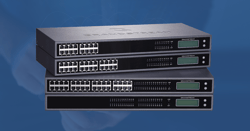
GXW4200 V2 model selection
Count every analog endpoint you intend to retain, including fax devices and planned additions. Then check how those circuits terminate in the equipment room. A high-density gateway should fit the existing distribution frame as well as the extension count.
| Model | FXS capacity | Connection planning |
|---|---|---|
| GXW4216 V2 | 16 ports | RJ11 connections; verify Telco termination against the supplied revision. |
| GXW4224 V2 | 24 ports | Suitable to evaluate for a central group of up to 24 analog devices. |
| GXW4232 V2 | 32 ports | Plan circuit labels and distribution for a larger analog extension group. |
| GXW4248 V2 | 48 ports | Two 50-pin Telco connectors; allow for patch-panel or distribution-frame termination. |
The V2 family has a Gigabit Ethernet interface, four SIP server profiles and an independent SIP account per telephone port. These specifications do not determine your provider’s external call allowance: PBX capacity, service channels and network conditions also matter. Confirm the V2 hardware identity when comparing offers for similarly named older units.
Legacy GXW4104/4108: an FXO requirement
The GXW4104 and GXW4108 provide four and eight FXO ports respectively. Grandstream lists them in its product archive. Treat them as legacy equipment when assessing a new purchase or an existing installation; an archive listing does not establish local stock or an individual unit’s support entitlement.
For a new analog-line project, compare the current HT841 and HT881 family, with four or eight FXO ports respectively and one FXS port. Assess the replacement against line signalling, caller ID, disconnect detection, dial rules and PBX configuration. A newer gateway still needs commissioning for the actual carrier handoff.
Where retaining analog equipment makes sense
Hotel room phones with serviceable copper cabling
A property can evaluate gateways for existing analog room phones while using SIP phones at reception and other work areas. Survey room circuits, test representative handsets and define reception transfer behaviour. Room billing, wake-up services and property-management integration require a separate PBX and application assessment. Compare this route with Grandstream hotel guest room phone systems when handset replacement is also under consideration.
Office and institutional migrations
An office, school or administrative site may retain selected analog extensions during a PBX replacement. Start with a pilot group covering ordinary calls, voicemail access, transfers and any fax traffic. Keep a port-to-extension schedule so the migration team can identify faults without tracing every cable again.
Distributed branches
Choose centralized or local gateway placement around existing cabling and the consequences of a WAN interruption. A branch that relies on a remote PBX needs a documented continuity plan. Avoid interpreting spare gateway ports as independent branch call control.
Design the whole call path
For analog handsets, the typical arrangement is: analog phone → existing telephone pair → GXW4200 V2 FXS gateway → managed IP network → compatible SIP PBX or service. An FXO deployment starts instead with the carrier’s analog line and an FXO gateway. Draw the planned path before purchasing equipment.
Check the PBX’s rules for third-party devices, account count, provisioning, DTMF, codec negotiation and call routing. Grandstream describes broad SIP interoperability, but that does not certify every PBX release or hosted-service policy. Our existing VoIP PBX compatibility guide provides related platform checks; gateway-specific acceptance tests remain necessary.
Assess latency, packet loss, jitter and voice prioritization on the actual network. Use a deliberate management-access policy and restrict administration to approved personnel. TLS and SRTP are supported by the V2 family, but protection depends on compatible configuration across the SIP path. The analog telephone pair remains an analog segment.
Plan configuration ownership, backups, access recovery and firmware maintenance before rollout. Read the relevant release notes for the exact hardware revision rather than applying an update intended for another unit. See Grandstream device management and provisioning planning for the wider operational process.
Cabling and installation checks that affect the result
Inspect the telephone distribution frame and record pair condition, circuit length, connected equipment and the number of ringers. Verify connector pinouts and the supplied cable arrangement before cutting over a live extension. For the GXW4248 V2, plan the Telco connection explicitly rather than assuming individual telephone sockets.
Follow the manufacturer’s GXW42XX V2 installation guide for power, environmental limits, grounding and surge precautions. Include the correct power supply and backup power in the installation scope. Do not infer PoE operation from the presence of a network port.
Specialized devices such as alarms, lift emergency phones, payment terminals and modem-based equipment require their own compatibility and operational assessment. A working voice call does not prove that the device’s signalling or recovery behaviour is acceptable.
Plan regional deployment around the site
Dubai, Deira and Bur Dubai: for an occupied hotel or office refurbishment, request a floor-by-floor circuit survey and a cutover window agreed with operations. Check whether the existing operator handoff is analog, digital or SIP before specifying the gateway. Keep a rollback plan for reception and other essential extensions.
Sharjah, Ajman and Abu Dhabi: for warehouses, schools and branch offices, review cabinet conditions, cable routes and inter-building telephone pairs. Request installation and test scope by site so a central equipment quotation does not conceal additional termination work.
Uganda, Kenya and Tanzania: a multi-branch procurement brief should identify the PBX location, WAN dependencies and backup-power arrangement at each site. Specify who will perform local cable termination and acceptance testing, especially when equipment and technical attendance are ordered separately.
For projects in Kuwait, Ghana or Nigeria, include destination, required documentation, power accessories and support expectations in the enquiry. Confirm delivery arrangements, local service scope, availability and commercial terms for the individual order. These planning examples do not establish a local office or guaranteed coverage.
Compare total project cost
A useful quotation separates the gateway from Telco cables, patch panels, distribution work, PBX or service charges, configuration, testing, training and ongoing support. Request the exact model and hardware revision on the bill of materials. Avoid comparing a bare unit price with an installed and commissioned system.
Consider a smaller ATA when only a few analog endpoints remain. Consider direct SIP phones when users need richer displays or functions that an existing analog handset cannot expose. Retaining copper can reduce replacement work, but it also retains responsibility for the condition and documentation of that copper.
Agree acceptance before cutover
- Map each physical port to its extension, device and location.
- Test incoming and outgoing calls, caller ID, transfers, hold, voicemail and DTMF.
- Test fax in both directions over the intended service route where required.
- Test representative busy periods against the PBX and service capacity.
- Verify restart behaviour, registration recovery and the agreed outage scenarios.
- Hand over configuration backups, credentials through an approved channel, circuit labels and support contacts.
Use results from the pilot to approve wider migration. Record any device-specific limitations so the operating team understands what has been accepted.
GXW gateway questions
What is the GXW Analog VoIP Gateway Series?
Grandstream GXW gateways bridge traditional telephone interfaces and SIP networks. For new high-density analog extension projects, the GXW4200 V2 family provides FXS connections for analog phones and fax machines. Older GXW4104/4108 gateways serve the different role of connecting analog lines through FXO ports.
Which GXW model supports 48 analog extensions?
The GXW4248 V2 provides 48 FXS channels through two 50-pin Telco connectors. Plan suitable cable termination and a labelled patching arrangement; this model does not provide 48 individual front-panel RJ11 sockets.
Can I connect a telephone company analog line to GXW4200?
The GXW4200 is an FXS gateway for analog endpoints. An incoming analog telephone line requires an FXO interface. Identify the actual handoff before ordering; an Ethernet socket on an operator router does not establish whether voice is supplied as analog or SIP.
Will a GXW gateway work with my existing IP PBX?
Compatibility depends on the PBX platform, its endpoint policy, gateway revision, firmware and required features. Agree registration or trunk configuration with the PBX administrator and test representative calls, transfers, DTMF and fax before a full migration.
Does SIP server failover keep phones working during a power cut?
SIP server failover and power backup address different failures. An alternative SIP server does not power the gateway or network. Include the gateway, switch, router and PBX in a suitable backup-power design and test recovery.
Can a fax machine continue working over VoIP?
The GXW4200 V2 supports T.38 and fax pass-through, but successful faxing also depends on the fax machine, SIP service, PBX and network. Test inbound and outbound documents over the intended production route before accepting the migration.
How do I obtain a GXW quotation?
Send Fourteck your endpoint or analog-line count, exact PBX or SIP service, preferred gateway revision, cabling arrangement, project location and required services. Request confirmation of model availability, accessories, price and service scope in the quotation.
Prepare a configuration-specific GXW enquiry
Share the number of analog phones or incoming analog lines, exact PBX and SIP provider, fax requirements, cable termination, growth allowance and site location. Fourteck can review the requirement and prepare quotation guidance, with equipment availability and any installation or support services confirmed in the agreed scope.
Manufacturer references
GXW4200 series product information · GXW4200 V2 datasheet · GXW42xx V1/V2 technical FAQ · Grandstream analog gateway portfolio. Specifications and lifecycle references checked on 16 October 2026. Confirm the supplied revision and current documentation before ordering.